The Warning Against Mysticism: Colossians 2:18-19 (Podcast #23).

Growing in the Grace & Knowledge of Jesus Christ

11 While they were going, behold, some of the guard went into the city and told the chief priests all that had taken place. 12 And when they had assembled with the elders and taken counsel, they gave a sufficient sum of money to the soldiers 13 and said, “Tell people, ‘His disciples came by night and stole him away while we were asleep.’ 14 And if this comes to the governor’s ears, we will satisfy him and keep you out of trouble.” 15 So they took the money and did as they were directed. And this story has been spread among the Jews to this day.” (Matthew 28:11–15 (ESV)
The following comments are taken from John Calvin’s commentary from the Gospel of Matthew concerning today’s text. John Calvin (1509-1564) was a 16th century Protestant reformer, pastor, teacher and theologian.
“It is not only credible, but the fact is manifest, that the soldiers, to whom had been entrusted the charge of the sepulcher, were corrupted by a bribe, so that they were prepared to tell a lie at the bidding of the priests. They knew well that there was nothing which the priests dreaded more than that a report should gain credit that Christ rose on the third day after his death; and they knew that they had been sent there, that, by guarding the body, they might suppress that report.”
“Those men, therefore, being addicted to making gain, and seizing on opportunities of making it from every quarter, after having found that their diligence was of no service to them, contrive a new method of cheating their employers out of their money. The words of Matthew — some of them came — leave it uncertain if a few cunning men adopted this resolution without communicating with the rest, or if they were sent, by a general agreement, in the name of all. The latter supposition appears to be more probable; for Matthew afterwards says that money was given, not to one or two, but generally to the soldiers, to induce them to commit perjury. It is at all events certain that, whether they all plotted together, or only a part of them, they sought to make profit of the cruel and implacable hatred which the priests bore towards Christ; and that, looking upon them as convicted of a crime. They abused their evil conscience to extort money from them.”
“For, as usually happens with all wicked men, the priests, conscious of having done wrong, in order to cover their disgrace, were compelled to bribe the soldiers by a large reward. Thus it is evident that the reprobate, after having once given themselves up to a course of sinning, are continually entangled in new crimes; and this arises out of their desire to conceal their shame before men, while they give themselves no concern about the offense committed against God. Those wretched men not only bribe the soldiers by a large sum of money, but expose their own reputation and life to serious danger, should cognizance be taken of the crime. And what constrains them, in addition to the expense which they have laid out, to incur so serious a risk, but because inveterate rage does not permit them to withdraw until they have added sin to sin?”
“It was the finishing stroke of the vengeance of God to blind the Jews, that the resurrection of Christ was buried by the perjury of the soldiers, and that so gross a falsehood was believed. And hence it is evident that those who did not believe that Christ was risen were deceived by a voluntary error, as the world voluntarily gives itself up to be deceived by the snares of Satan. For if a man had but opened his eyes, it was unnecessary that he should make a long inquiry.”
“Armed soldiers say that the body of Christ was stolen from them by a feeble, timid, small, and unarmed body of men. What plausible grounds have they for saying so? They add that this was done while they were asleep. How then do they come to know that it was stolen? And if they had any suspicion of the disciples, why did they not track their footsteps? Why did they not, at least, make a noise? It was therefore a childish subterfuge, which would not have screened them from punishment, if they had had to deal with an honest and upright governor; but through the connivance of Pilate, that enormous wickedness was allowed to pass unnoticed, In like manner, we see it happen every day, that irreligious judges give themselves little trouble, when truth is oppressed by fraud and malice; but, on the contrary, if they are not afraid of suffering damage, they appear to enter into collusion with base and infamous men.”
“Though it may appear strange that God should permit this false report to gain currency to extinguish the glory of his Son, we ought to render the honor which is due to his just vengeance. For we perceive that this nation deserved to have its light taken away by clouds, because it so eagerly seizes hold on an idle and childish falsehood; next, because almost all have struck on the stone of stumbling, it was proper that their eyes should be darkened, that they might not see that the cup of giddiness was presented to them; and, in short, that they were abandoned to every kind of madness, as Isaiah had foretold, (Isaiah 6:9.).
“For God would never have permitted them to be deceived by such a foolish credulity, but in order that those who had despised the Redeemer might be shut out from the hope of salvation; as he now inflicts a similar punishment on the ingratitude of the world, by giving loose reins to the reprobate, that they may go from bad to worse (Rom. 1:18-32). But though this falsehood obtained currency among the Jews, this did not prevent the truth of the Gospel from flying at liberty to the very ends of the earth, as it always rises victorious over all the obstacles in the world.”
Soli deo Gloria!

11 While they were going, behold, some of the guard went into the city and told the chief priests all that had taken place. 12 And when they had assembled with the elders and taken counsel, they gave a sufficient sum of money to the soldiers 13 and said, “Tell people, ‘His disciples came by night and stole him away while we were asleep.’ 14 And if this comes to the governor’s ears, we will satisfy him and keep you out of trouble.” 15 So they took the money and did as they were directed. And this story has been spread among the Jews to this day.” (Matthew 28:11–15 (ESV)
All four Gospels parallel each other concerning the events on Resurrection Sunday. The Holy Spirit specifically inspired one of two of the writers to provide particular information not found in the other Gospels. While each writer provides selective, insightful information, they do not contradict each other in telling the wonderful news that Jesus Christ is alive. Such is the case with today’s text from Matthew.
The phrase “while they were going” refers to the women who came to the empty tomb. Upon seeing the angel, hearing the announcement of Jesus’ resurrection, and then encountering the risen Lord, they obeyed the angel’s command to “go and tell my brothers to go to Galilee, and there they will see me” (Matt. 28:1-10).
At the same time, some of the guards the religious leaders stationed at the same tomb (Matt. 27:62-66), went to the chief priests: Annas and Caiaphas. They told them what occurred. The guards had no reason to lie and faced the real possibility of incurring the fury of, and execution by, the religious leaders for failing to protect the tomb.
However, instead of punishing the soldiers for the tomb’s breach on their watch, the chief priests and the Sanhedrin counseled together and decided to bribe the guards by having them say Jesus’ disciples stole the body. This supposedly occurred because the guards were asleep.
The religious leaders further reasoned this explanation would satisfy Pontius Pilate and keep the soldiers from facing the governor’s wrath. The guardsmen accepted the bribe and spread the perpetrated lie.
“Although the Jewish religious leaders did not believe Jesus’ predictions that He would rise on the third day, they now treat them more seriously to cover up what has happened,” explains Dr. R. C. Sproul.
“Soldiers posted to guard the tomb against Jesus’ disciples become ‘like dead men’ in their terror when the angel of the Lord descends to remove the stone from the empty tomb of the risen, living Lord Jesus (Matt. 28:3). The glorious, stunning appearance of the angel of the Lord (28:3-4) appears to have had no effect on those committed to unbelief. For a price, and the promise of immunity from punishment for sleeping on their watch, the soldiers readily perjure themselves. That the story of the disciples’ stealing Jesus’ body was still circulated in the days of Justin Martyr (160 A.D.) suggests the Jewish leaders’ desperation to explain the indisputable fact of Jesus’ empty tomb.”
“We do not read that the Sanhedrin rejected the soldiers’ report in utter disbelief. Neither is it correct, however, to say that the Sanhedrin believed it. One fact is certain: this body did not want to have the people believe what the soldiers had just now reported. It was afraid that any such news would readily be linked with the idea of a resurrection from the grave, and that this belief, in turn, would cause the people to lose confidence in their leaders, who had been chiefly responsible for the murder of Jesus,” states Dr. William Hendriksen.
“So the Sanhedrin pass a resolution containing three items, namely, to give the soldiers: a. a large sum of money; b. a story to spread; and c. assurance of freedom from punishment. As to a. the sum had to be large, for the admission that they, the men on guard duty, had been sleeping instead of watching, would not reflect honor on themselves. As to b. the story “his disciples … stole him” would explain why the tomb was empty, and would hopefully counteract belief in a resurrection. And as to c. what had happened at Calvary—see Matt. 27:23–26; cf. John 19:12, 13—had strengthened the Sanhedrin’s conviction that Pilate could be bent according to its will. “We will persuade—or satisfy—him,” says the council.”
“As to the Sanhedrin, it may seem strange that a body of such dignitaries and clothed with such high authority would actually resort to this crookedness. But is it so strange that men who had committed murder now also resort to lying in order to cover up what they had done,” concludes Dr. Hendriksen.
1 Corinthians 2:14 (ESV) says, “The natural person does not accept the things of the Spirit of God, for they are folly to him, and he is not able to understand them because they are spiritually discerned.” As it was with the unconverted in today’s text, so it remains today.
May the Lord’s truth and grace be found here.

11 But Mary stood weeping outside the tomb, and as she wept she stooped to look into the tomb. 12 And she saw two angels in white, sitting where the body of Jesus had lain, one at the head and one at the feet. 13 They said to her, “Woman, why are you weeping?” She said to them, “They have taken away my Lord, and I do not know where they have laid him.” 14 Having said this, she turned around and saw Jesus standing, but she did not know that it was Jesus. 15 Jesus said to her, “Woman, why are you weeping? Whom are you seeking?” Supposing him to be the gardener, she said to him, “Sir, if you have carried him away, tell me where you have laid him, and I will take him away.” 16 Jesus said to her, “Mary.” She turned and said to him in Aramaic, “Rabboni!” (which means Teacher). 17 Jesus said to her, “Do not cling to me, for I have not yet ascended to the Father; but go to my brothers and say to them, ‘I am ascending to my Father and your Father, to my God and your God.’ ” 18 Mary Magdalene went and announced to the disciples, “I have seen the Lord”—and that he had said these things to her.” (John 20:11–18 (ESV)
All four Gospels parallel each other concerning the events on Resurrection Sunday. The Holy Spirit specifically inspired one of two of the writers to provide particular information not found in the other Gospels. While each writer provides selective, insightful information, they do not contradict each other in telling the wonderful news that Jesus Christ is alive. Such is the case with today’s text from John.
John 20 records Jesus’ appearances to the following individuals: Mary Magdalene (vs. 1-18), the ten disciples (vs. 19-23), and to Thomas (vs. 24-29). “Once again John’s purpose in recording these resurrection appearances was to demonstrate that Jesus’ physical and bodily resurrection was the crowning proof that he truly is the Messiah and Son of God who laid down his life for his own (John 10:17–18; 15:13; cf. Rom. 1:4),” explains Dr. John MacArthur.
Upon Mary’s recognition of Jesus, she clung to Him desperately. To cling (ἅπτω; hapto) means to hold on to tightly seize. Once Mary saw Jesus alive, she held on to Him and would not let go. Jesus gently command her to not do so. This was not because of He was some ghostly apparition but because He would be with her for another 40 days until He ascended to heaven (Acts 1:1-11).
“What Jesus probably means is this: “Do not think, Mary, that by grasping hold of me so firmly (cf. Matt. 28:9), you can keep me always with you. That uninterruptible fellowship for which you yearn must wait until I have ascended to be forever with the Father.” Jesus did not object to being touched. Otherwise, how can we explain his word to Thomas? See John 20:27. What he condemned was Mary’s mistaken notion that the former mode of fellowship was going to be resumed, in other words, that Jesus would once again live in daily visible association with his disciples, both men and women. The fellowship, to be sure, would be resumed; but it would be far richer and more blessed. It would be the communion of the ascended Lord in the Spirit with his Church,” explains Dr. William Hendriksen.
“Jesus was telling Mary that He was not yet leaving to return to heaven. She was holding on to Him as if she would never see Him again, but she would see Him again before His departure. It was not yet time to say goodbye,” states Dr. R. C. Sproul.
Jesus then commanded Mary to go and tell His disciples, the eleven, He was alive. Mary obediently did so.
“Jesus’ disciples were slow to recognize that He rose from the dead because there was some kind of change in His physical appearance after the resurrection. We do not know exactly what this change was, but both Mary Magdalene and the disciples on the road to Emmaus did not realize they had seen Jesus face-to-face after His resurrection until He revealed Himself to them more clearly (Luke 24:13–35; John 20:14). Although the same body of Jesus that died was raised, something about His glorified body was different from His body before His death. His resurrected body is a spiritual body, not in that it is nonphysical but in that it is suffused by and transformed into incorruptible flesh by the Holy Spirit. We will be changed in like manner when our bodies are resurrected (1 Cor. 15:35–49),” concludes Dr. Sproul.
Soli deo Gloria!

11 But Mary stood weeping outside the tomb, and as she wept she stooped to look into the tomb. 12 And she saw two angels in white, sitting where the body of Jesus had lain, one at the head and one at the feet. 13 They said to her, “Woman, why are you weeping?” She said to them, “They have taken away my Lord, and I do not know where they have laid him.” 14 Having said this, she turned around and saw Jesus standing, but she did not know that it was Jesus. 15 Jesus said to her, “Woman, why are you weeping? Whom are you seeking?” Supposing him to be the gardener, she said to him, “Sir, if you have carried him away, tell me where you have laid him, and I will take him away.” 16 Jesus said to her, “Mary.” She turned and said to him in Aramaic, “Rabboni!” (which means Teacher). 17 Jesus said to her, “Do not cling to me, for I have not yet ascended to the Father; but go to my brothers and say to them, ‘I am ascending to my Father and your Father, to my God and your God.’ ” 18 Mary Magdalene went and announced to the disciples, “I have seen the Lord”—and that he had said these things to her.” (John 20:11–18 (ESV)
All four Gospels parallel each other concerning the events on Resurrection Sunday. The Holy Spirit specifically inspired one of two of the writers to provide particular information not found in the other Gospels. While each writer provides selective, insightful information, they do not contradict each other in telling the wonderful news that Jesus Christ is alive. Such is the case with today’s text from John.
John 20 records Jesus’ appearances to the following individuals: Mary Magdalene (vs. 1-18), the ten disciples (vs. 19-23), and to Thomas (vs. 24-29). “Once again John’s purpose in recording these resurrection appearances was to demonstrate that Jesus’ physical and bodily resurrection was the crowning proof that he truly is the Messiah and Son of God who laid down his life for his own (John 10:17–18; 15:13; cf. Rom. 1:4),” explains Dr. John MacArthur.
Following her, and the other women’s, initial encounter with the angels at Jesus’ empty tomb, Mary returned to the tomb after Peter and John returned to their homes (John 20:10). She was weeping and inconsolable.
The angels were still at the tomb. They said to her, “Woman, why are you weeping?” She said to them, “They have taken away my Lord, and I do not know where they have laid him.” (John 20:13). Mary was unwilling to believe the Lord was alive.
“From John’s narrative, we know that after Mary saw the empty tomb, she left the grave site to inform the disciples (vv. 1–2). This means that John 20:11–18 records her second visit to the tomb, though John does not tell us specifically why she returned. Perhaps the most likely explanation is that she was investigating the mystery of where the body of Jesus had been placed, for that would explain the question she asks in verse 15,” explains Dr. R. C. Sproul.
Life is filled with pivotal moments. These are occasions and encounters we never forget or always remember. They forever change our lives. This was such a pivotal moment for Mary Magdalene. Mary turned away from the empty tomb and saw Jesus standing before her. However, she did not recognize it was the Lord. This may be because of her tears and grief. In other words, she was in total despair.
Jesus said to her, “Woman, why are you weeping? Whom are you seeking?” Supposing him to be the gardener, she said to him, “Sir, if you have carried him away, tell me where you have laid him, and I will take him away. 16 Jesus said to her, “Mary.” She turned and said to him in Aramaic, “Rabboni!” (John 20:15-16).
“The presence of the angels should have told Mary right away that something supernatural had occurred; however, she did not draw that conclusion. She continued to weep, prompting the angels to ask her why she was crying (John 20:13). In fact, the angels’ question was a gentle rebuke to her. She should not have been crying but rejoicing, for the reason the body of Jesus was gone and the angels were present was that God had raised His Son from the dead. But Mary was not yet able to grasp that fact,” continues Dr. Sproul.
“At that point, Mary turned and saw Jesus standing there, though she did not recognize Him at first (v. 14). He repeated the angels’ inquiry regarding the reason for her crying, but He also asked her whom she was seeking. Mary thought He was the gardener and was still thinking that someone had stolen the body of Jesus (v. 15). She would only realize that it was Jesus once He called her name (v. 16).”
Try to remember a pivotal moment in your walk with the Lord. When was it? Where was it? Who was with you at the time? Were you alone? Was it at church or at your home? Wherever, whenever and with whoever, such moments are life changing for the better. It was for Mary.
Soli deo Gloria!
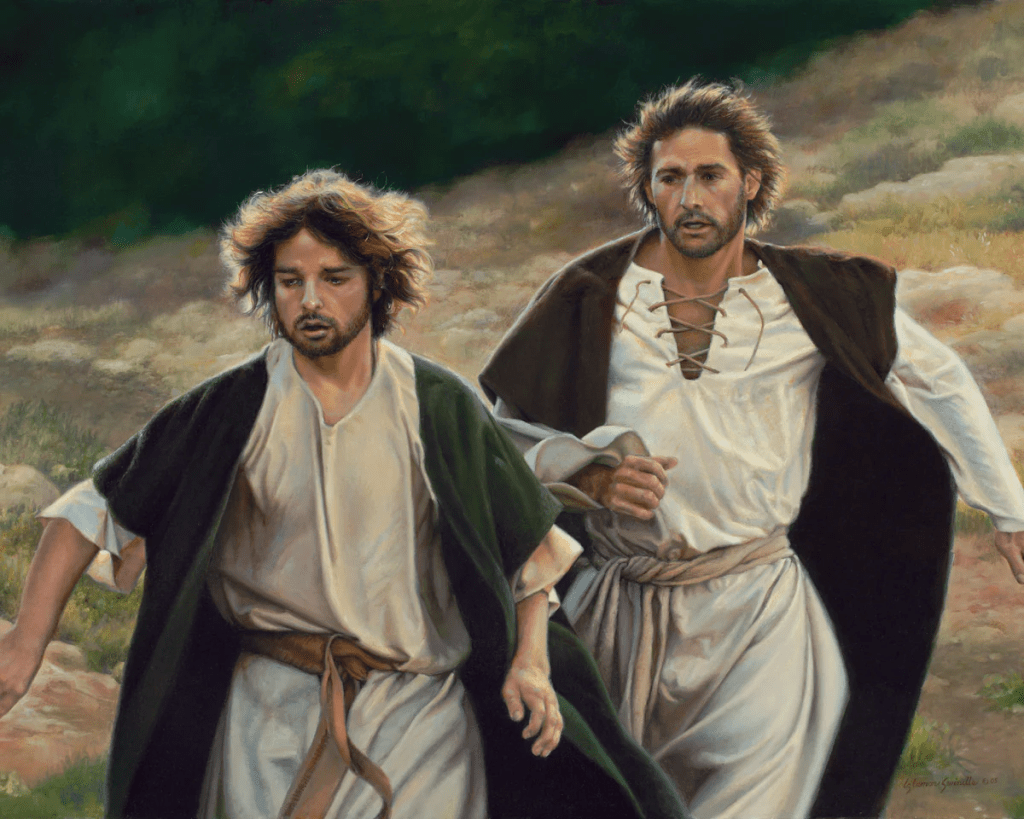
“Now on the first day of the week Mary Magdalene came to the tomb early, while it was still dark, and saw that the stone had been taken away from the tomb. 2 So she ran and went to Simon Peter and the other disciple, the one whom Jesus loved, and said to them, “They have taken the Lord out of the tomb, and we do not know where they have laid him.” 3 So Peter went out with the other disciple, and they were going toward the tomb. 4 Both of them were running together, but the other disciple outran Peter and reached the tomb first. 5 And stooping to look in, he saw the linen cloths lying there, but he did not go in. 6 Then Simon Peter came, following him, and went into the tomb. He saw the linen cloths lying there, 7 and the face cloth, which had been on Jesus’ head, not lying with the linen cloths but folded up in a place by itself. 8 Then the other disciple, who had reached the tomb first, also went in, and he saw and believed; 9 for as yet they did not understand the Scripture, that he must rise from the dead. 10 Then the disciples went back to their homes.” (John 20:1–10 ESV)
All four Gospels parallel each other concerning the events on Resurrection Sunday. The Holy Spirit specifically inspired one of two of the writers to provide particular information not found in the other Gospels. While each writer provides selective, insightful information, they do not contradict each other in telling the wonderful news that Jesus Christ is alive. Such is the case with today’s text from John.
John 20 records Jesus’ appearances to the following individuals: Mary Magdalene (vs. 1-18), the ten disciples (vs. 19-23), and to Thomas (vs. 24-29). “Once again John’s purpose in recording these resurrection appearances was to demonstrate that Jesus’ physical and bodily resurrection was the crowning proof that he truly is the Messiah and Son of God who laid down his life for his own (John 10:17–18; 15:13; cf. Rom. 1:4),” explains Dr. John MacArthur.
Upon hearing the news from Mary Magdalene about the empty tomb, and the angels’ declaration to her and the other women concerning Jesus’ resurrection (Matthew 28:1-6; Mark 16:1-6; Luke 24:1-7), Peter and John went to personally investigate. This was in spite of the skepticism by the other disciples (Luke 24:11). Luke solely focused on Peter’s reaction. “But Peter rose and ran to the tomb; stooping and looking in, he saw the linen cloths by themselves; and he went home marveling at what had happened.” (Luke 24:12 (ESV)
John’s Gospel records both Peter and John ran to the tomb. However, John was the faster of the two men and he arrived at the tomb before Peter. However, Peter eventually reached the same destination. Both men arrived at the same tomb, and the correct tomb; Jesus’ tomb.
5 “And stooping to look in, he (John) saw the linen cloths lying there, but he did not go in. 6 Then Simon Peter came, following him, and went into the tomb. He saw the linen cloths lying there, 7 and the face cloth, which had been on Jesus’ head, not lying with the linen cloths but folded up in a place by itself.” (John 20:5-7 ESV)
John came to the tomb and saw it was empty, but he did not go in. In writing this first-hand account, he gave no reason as to why. However, Peter did go in and surveyed the scene. He saw the burial cloths and the facial shroud in an orderly condition.
One of the evidences for the resurrection of Jesus Christ is the orderly condition of the grave clothes. The linen cloths Jesus’ followers used to wrap Him for burial and the face cloth were found separately, with the face cloth folded. The evidence shows a methodical moment had occurred and not an abrupt theft of Jesus’ body by the disciples.
Finally, John did go into the tomb. When he did so, he believed Jesus rose from the dead. John inserted a comment indicating that prior to this moment, he and Peter still had not understood Jesus’ words regarding Him rising from the dead. After this moment, both of them went back to their respective homes.
“Earlier when they saw Jesus’ signs, His disciples responded by believing in Him (John 2:11), and His resurrection would cause them to believe both the Scripture and His word (2:22). But the comment in vs.9, that they did not understand Scripture’s prediction of Christ’s resurrection may suggest that at this point John simply believed Mary’s report that Jesus’ body had been removed from the tomb. According to Luke 24:11-12, the women’s report, of seeing angels seemed to the male apostles ‘an idle tale’ and Peter’s trip to the empty tomb left him marveling,” explains Dr. R. C. Sproul.
“At this point some commentators seem to think that the purpose of the text is to emphasize the weakness of the apostles’ faith, as if the meaning were on this order: the faith of these men was but a step removed from unbelief, for they needed to see before they were willing to believe.—However, that is probably not the sense of the words,” states Dr. William Hendriksen.
“What is meant is this: they now saw and believed. They saw the things which the Lord had arranged in such a manner as to arouse and strengthen faith. Scripture also began to take on a new meaning now. Previously such beautiful passages as Ps. 16:10, 11; Ps. 110:1, 4; Ps. 118:22–24; and Is. 53:11, 12—passages which referred to Christ’s resurrection—had meant very little to them. Now these same passages were beginning to assume significance! They now understood that Christ’s glorious resurrection was a divine must. Cf. Luke 24:26. On and after Pentecost all this would become even clearer.”
Soli deo Gloria!

“Now on the first day of the week Mary Magdalene came to the tomb early, while it was still dark, and saw that the stone had been taken away from the tomb. 2 So she ran and went to Simon Peter and the other disciple, the one whom Jesus loved, and said to them, “They have taken the Lord out of the tomb, and we do not know where they have laid him.” 3 So Peter went out with the other disciple, and they were going toward the tomb. 4 Both of them were running together, but the other disciple outran Peter and reached the tomb first. 5 And stooping to look in, he saw the linen cloths lying there, but he did not go in. 6 Then Simon Peter came, following him, and went into the tomb. He saw the linen cloths lying there, 7 and the face cloth, which had been on Jesus’ head, not lying with the linen cloths but folded up in a place by itself. 8 Then the other disciple, who had reached the tomb first, also went in, and he saw and believed; 9 for as yet they did not understand the Scripture, that he must rise from the dead. 10 Then the disciples went back to their homes.” (John 20:1–10 ESV)
All four Gospels parallel each other concerning the events on Resurrection Sunday. The Holy Spirit specifically inspired one of two of the writers to provide particular information not found in the other Gospels. While each writer provides selective, insightful information, they do not contradict each other in telling the wonderful news that Jesus Christ is alive. Such is the case with today’s text from John.
John 20 records Jesus’ appearances to the following individuals: Mary Magdalene (vs. 1-18), the ten disciples (vs. 19-23), and to Thomas (vs. 24-29). “Once again John’s purpose in recording these resurrection appearances was to demonstrate that Jesus’ physical and bodily resurrection was the crowning proof that he truly is the Messiah and Son of God who laid down his life for his own (John 10:17–18; 15:13; cf. Rom. 1:4),” explains Dr. John MacArthur.
John begins today’s text with the statement ““Now on the first day of the week.” In other words, this was the Sunday following the Lord’s crucifixion on the preceding Friday and the Sabbath, or Saturday, that immediately followed. It is because Jesus rose from the dead on a Sunday that the early church began to gather for worship and to celebration (Acts 20:7; I Cor. 16:1-2). Sunday became known as the Lord’s Day (Rev. 1:10).
Prior to the women coming to Jesus’ tomb at dawn, Mary Magdalene came to the sepulcher early in the morning; while it was still dark. Upon her arrival, she saw the stone had been rolled away from the tomb.
“Perhaps the reason why Jesus first appeared to Mary Magdalene was to demonstrate grace by his personal, loving faithfulness to someone who formerly had a sordid past; but clearly also because she loved him so dearly and deeply, that she appeared before anyone else at the tomb. Her purpose in coming was to finish the preparation of Jesus’ body for burial by bringing more spices to anoint the corpse (Luke 24:1),” states Dr. MacArthur.
Upon seeing the stone moved from the tomb’s opening, Mary immediately ran to find Simon Peter and John. She said to them, ““They have taken the Lord out of the tomb, and we do not know where they have laid him.” The personal pronoun “we” may refer to the other women who joined Mary at the tomb as dawn was breaking. This announcement prompted Peter and John to not dismiss Mary, as the other disciples did (Luke 24:11), but rather to go to the tomb and investigate (Luke 24:12). Could it be Jesus was alive?
Soli deo Gloria!


8 “So they departed quickly from the tomb with fear and great joy, and ran to tell his disciples. 9 And behold, Jesus met them and said, “Greetings!” And they came up and took hold of his feet and worshiped him. 10 Then Jesus said to them, “Do not be afraid; go and tell my brothers to go to Galilee, and there they will see me.11 While they were going, behold, some of the guard went into the city and told the chief priests all that had taken place.” (Matthew 28:8–11 (ESV)
22 “Men of Israel, hear these words: Jesus of Nazareth, a man attested to you by God with mighty works and wonders and signs that God did through him in your midst, as you yourselves know— 23 this Jesus, delivered up according to the definite plan and foreknowledge of God, you crucified and killed by the hands of lawless men. 24 God raised him up, loosing the pangs of death, because it was not possible for him to be held by it.” Acts 2:22–24 (ESV)
The Bible says if Christ has not been raised, then our preaching is in vain and our faith is in vain (1 Cor. 15:14). No event is more critical to Christianity than the Lord Jesus Christ’s resurrection. One commentator writes of the resurrection, “Its historicity is the fact upon which our faith stands or falls.”
“Like the other gospels but unlike the epistles, Matthew offers little theological commentary in his resurrection account. Also, he does not report everything that happened from the time the women came to the tomb to Jesus’ ascension. The other three evangelists likewise recount only some of what transpired during that momentous period, selecting the details important for their audiences. Comparing the four accounts gives us a fuller picture of all that occurred. In any case, the resurrection is historically well-attested. Besides the evidence in the Gospels, Paul records Jesus’ appearances to five hundred people at once, James, and himself (1 Cor. 15:6–8). There are also veiled references to our Lord’s resurrection in rabbinic sources that go back to the first century,” explains Dr. R. C. Sproul.
“Matthew tells us the angel used an earthquake to remove the stone covering Jesus’ tomb (Matt. 28:2). Since Christ left the tomb before the stone was rolled away, this was not to let Him out of the grave but to let the women see the empty tomb. Jesus is not risen as a ghost or spirit; the women grasp His feet, revealing that His physical flesh has been raised (Matt. 28:9). That Christ’s physical body is resurrected indicates matter is not inherently evil and that our eternal state will not be that of a disembodied spirit. Like Jesus, our bodies too will be raised on the last day in our glorification, and the physical world will once again be “very good” and untainted by evil (1 Cor. 15:35–58).”
The Bible says Jesus, having been “delivered up for our trespasses,” was “raised for our justification” (Rom. 4:23–25). By raising His Son from the dead, God the Father signified His acceptance of Jesus’ atonement for the sins of His people, proving that all who trust in Christ alone have their sins covered by the righteousness of Jesus and are reconciled to God (Rom. 3:21-26).
John Calvin comments, “The lively assurance of our reconciliation with God arises from Christ having come from hell as the conqueror of death” with “the power of a new life at his disposal.”
Soli deo Gloria!
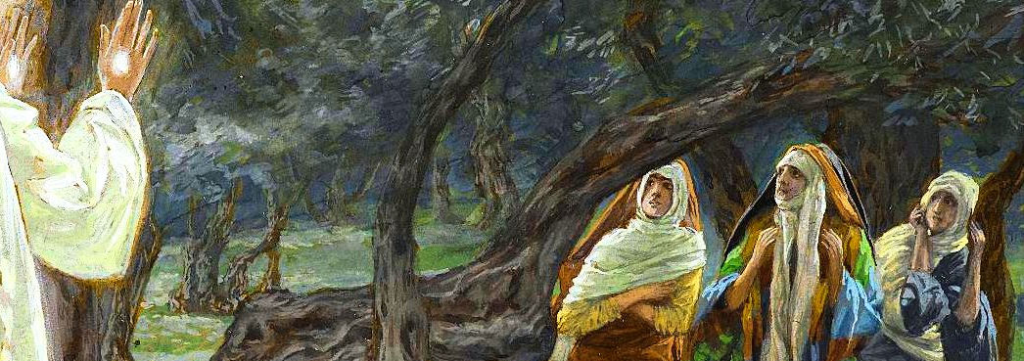
8 “So they departed quickly from the tomb with fear and great joy, and ran to tell his disciples. 9 And behold, Jesus met them and said, “Greetings!” And they came up and took hold of his feet and worshiped him. 10 Then Jesus said to them, “Do not be afraid; go and tell my brothers to go to Galilee, and there they will see me.” (Matthew 28:8–10 (ESV)
All four Gospels parallel each other concerning the events on Resurrection Sunday. The Holy Spirit specifically inspired one of two of the writers to provide particular information not found in the other Gospels. While each writer provides selective, insightful information, they do not contradict each other in telling the wonderful news that Jesus Christ is alive. Such is the case with today’s text from Matthew.
“Given the importance of the resurrection, it is no surprise that critics of the Christian faith often attack the resurrection accounts and defenders of the faith argue for their historical credibility. The four Gospels describe the empty tomb and the post-resurrection appearances of Jesus differently, but the differences are not irreconcilable. Much good work has been done in showing how the accounts fit together, and it is good for believers to equip themselves with a basic knowledge of such things as we face a culture increasingly hostile to the Christian faith. We must be prepared to give an answer for the hope that is within us (1 Peter 3:15–16),” explains Dr. R. C. Sproul.
“That we might be so equipped, we will note one important factor that argues for the historicity of Jesus’ resurrection. In each gospel account, women were the very first witnesses of the empty tomb. This is noteworthy because first-century Jewish culture did not view the testimony of women as reliable. So, if someone invented the resurrection, having women be the first witnesses of it would not be the smart way to go about telling the story. There would be no reason to have the women be the first witnesses of the resurrection unless, in fact, they were the first to see the empty tomb and the risen Lord. The Evangelists include this fact because they had to. It is what actually happened, and they note the women’s presence because they were relaying history.”
The women encountered the angels at Jesus’ empty tomb. These witnesses included Mary Magdalene and Joanna and Mary the mother of James and the other women with them (Matt. 28:7-8; Mark 16:7-8; Luke 24:8-11). Upon hearing the great news of Jesus’ resurrection, and the angel’s command to go and tell the disciples, the women ran with fear and great joy to spread the glorious news to Jesus’ followers. It was at that moment Jesus met them.
He said, “Greetings.” The text continues to say, “And they came up and took hold of his feet and worshiped him.” Being the Incarnate Lord of heaven and earth, Jesus received their worship.
“To put them at ease Jesus used an ordinary greeting when he met them, one that can perhaps be best rendered “Hello,” or “How do you do?” or “Good morning.” See also Matt. 26:49; 27:29. Immediately they recognized him, fell down before him, taking hold of his feet and worshipping him. He was real, even physical (“his feet”). He was Jesus, no one else, the very Jesus whom they had known for a considerable time, and to whom they had rendered valuable service,” states Dr. William Hendriksen.
He then told them, “Do not be afraid; go and tell my brothers to go to Galilee, and there they will see me.” The brothers of whom Jesus referred were the eleven apostles.
“My brothers,” not: “those habitual quarrelers, those men who promised to remain loyal to me no matter what would happen, but who when the crisis arrived left me and fled; those men who, with one exception, were not even present at Calvary when I was laying down my life for them.” None of that. Instead, “my brothers,” those whom I acknowledge as members of my family, those who share the inheritance with me, those whom I love,” explains Dr. Hendriksen.
“Our actions tend to reveal what we really believe, so if we believe Christ has been raised from the dead, we must tell the world. And we tell the world by telling those with whom we have personal contact about Jesus and supporting the work of the church to make disciples of all nations. Are you sharing the good news of Jesus’ resurrection? Are you giving to and praying for the task of world missions,” concludes Dr. Sproul.
Soli deo Gloria!

