
20 O Timothy, guard the deposit entrusted to you. Avoid the irreverent babble and contradictions of what is falsely called “knowledge,” 21 for by professing it some have swerved from the faith. Grace be with you.” (1 Timothy 6:20–21 (ESV)
Martin Luther possessed a singular and even obsessive passion for God’s Word. For in the Scriptures, he discovered God’s truth (John 17:17; 2 Tim. 3:16-17; 2 Peter 1:20-21). Following his conversion, and while teaching from the Apostle Paul’s Epistle to the Romans, Martin posted 95 Theses on the University Church Door of Wittenberg, Germany. It was the bulletin board of the day. His intention was to discuss with his fellow professors the abuses occurring within the church and how such behavior and doctrine deviated from the Scriptures.
He also wrote extensively and debated with leaders of the church who opposed his writings. The formal cause of the brewing controversy was Martin’s contention the Scriptures were the sole authority binding the believer’s conscience. He also affirmed the Bible’s teaching of justification by grace alone, through faith alone, in the person and work of Jesus Christ alone.
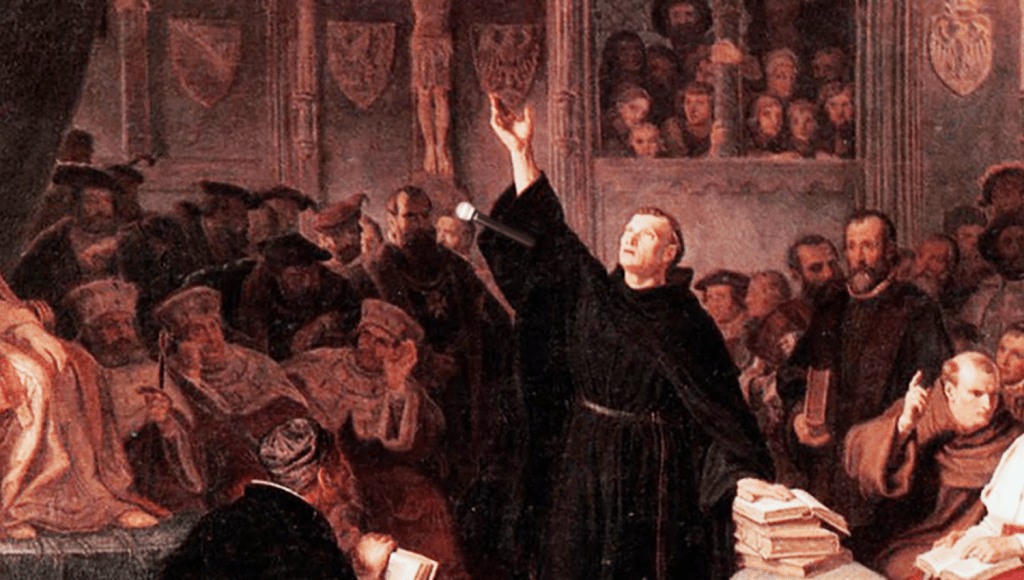
The die was cast and eventually Martin was called to appear before religious and magisterial leaders to answer their charges against him of committing heresy. The meeting, or diet, was held in the German town of Worms, April 16-18, 1521. Martin thought his appearance would allow him to explain his teachings.
However, when he arrived he was asked two questions. The council asked him if he acknowledged the books he had written were his. He replied yes. They then asked him whether he would recant what he had written. They ordered him to renounce his books which criticized church abuses, the pope and doctrine.
At first, Martin answered so softly no one heard him. The interrogators demanded he speak louder. He replied by asking if he could have 24 hours to consider their question. In other words, to think it over. The interrogators agreed to his request.
The next morning, following an evening of heartfelt prayer for courage and God’s strength, Martin once again faced his interrogators. They asked him if he would recant of his writings criticizing the church, the pope and the church’s doctrine. The following is Martin’s reply.
My lord, emperor most serene, princes most illustrious, lords most gracious,
I am here obedient to the order made yesterday evening that I should appear at this time. By the mercy of God I beseech your most Serene Majesty and your most illustrious lordships to deign to hear with forbearance my cause – which (I hope) is both just and true. If through my inexperience I do not give any one his proper title, or offend in any way against courtly etiquette, I beg you of your kindness to pardon me as a man whose life has not been spent in the courts of princes but in the cells of monks, and who can testify of himself nothing more than that he has hitherto taught and written with a simplicity of mind which looked solely to the glory of God and the sincere upbuilding of Christian believers.
Most serene emperor, most illustrious princes: two questions were put to me yesterday by your Highness, whether I acknowledged as mine a list of books published under my name, and whether I wished to hold to my defence of them or to revoke them. I gave a deliberate and plain answer to the first, and I stand by it and always shall – namely, that the books were mine, being published by me under my own name, unless perchance it has happened that by the guile or meddlesome cleverness of my rivals things in them have been altered or omitted. For I only acknowledge what is solely my own and what I alone have written, and not the interpretations which the industry of others has added.
In answer to the second question, may I ask your Highness and your lordships to deign to take note that my books are not all of the same kind.
In some I have dealt with religious faith and morals so simply and evangelically that my very antagonists are compelled to confess that these books are useful, harmless and fit to be read by Christians. Even the Bull, savage and cruel as it is, grants that some of my books are harmless, even though it condemns them by a judgment that is simply monstrous. If, then, I were to start revoking them, what (I beg you) should I be doing? Should I not alone of mankind be condemning that very truth which friends and enemies alike confess? Should I not alone be wrestling against the agreed confession of all?
Another class of my writings consists of polemic against the Papacy and the doctrine of the Papists, as men who by their most evil teachings and examples have laid waste all Christendom, body and soul. Nobody can deny or dissemble this: the experience and the complaint of all men bear witness that by the laws of the Pope and man-made doctrines, the consciences of the faithful have been most wretchedly ensnared, tormented, tortured, that above all, in this renowned German nation, goods and wealth have been devoured by tyranny unbelievable, and to this day the devouring goes on, endlessly and by most grievous means. Yet the canon law of the Papists itself provides that Papal laws and doctrines contrary to the Gospel or the opinions of the Fathers should be counted erroneous and rejected.
If, then, I revoke these books, all I shall achieve is to add strength to tyranny, and open not the windows but the doors to this monstrous godlessness, for a wider and freer range than it has ever dared before. The memorial of my revocation would be the kingdom of their wickedness, with license complete and unbridled, exercising over its wretched subjects a sway by far the most intolerable of all, and even strengthened and stabilized if word got abroad that I had revoked my books with the authority of your serene Majesty and all the Roman Empire. Good God, what wickedness and tyranny should I then let loose!
A third class of my writings has been aimed at certain private persons and (as they say) people of consequence, who have laboured to defend the Roman tyranny and undermine my religious teaching. Here I confess I have been more acrimonious than befits my religion or my calling. For I do not pose as a saint, and I am not disputing about my own life but about the teaching of Christ. Yet the way is not clear for me to revoke even these writings, for by such revocation I should lend my countenance to the reign of tyranny and wickedness, which would hold more savage and violent sway than ever among the people of God
However, because I am a man and not God, I can bring no other protection to my writings than my Lord Jesus Christ brought to his own teaching, when at the interrogation before Annas he was struck by a servant and said: “If I have spoken evil, testify to the evil.” If the Lord himself, who knew he could not err, did not disdain to listen to testimony against his teaching, even from the meanest of slaves, how much more should I, the dregs of a man, who cannot but err, seek and await for someone to bear witness against my teaching? I therefore beg by the mercy of God that your serene Majesty, your illustrious lordships, or anyone at all, from the highest to the lowest, who is able, should bear witness, convict me of error, vanquish me by the prophets or the evangelists of scripture. I shall be only too ready, if I am convinced, to revoke any error, and in that case I shall be the first to cast my books into the fire.
From these remarks I think it is clear that I have sufficiently considered and weighed the hazards and dangers, as well as the excitement and dissensions aroused in the world as a result of my teachings, things about which I was gravely and forcefully warned yesterday. To see excitement and dissension arise because of the Word of God is to me clearly the most joyful aspect of all in these matters. For this is the way, the opportunity, and the result of the Word of God, just as He [Christ] said, ‘I have not come to bring peace, but a sword. For I have come to set a man against his father, etc.’ [Matt. 10:34– 35].
Therefore, we ought to think how marvelous and terrible is our God in his counsels, lest by chance what is attempted for settling strife grows rather into an intolerable deluge of evils, if we begin by condemning the Word of God. And concern must be shown lest the reign of this most noble youth, Prince Charles (in whom alter God is our great hope), become unhappy and inauspicious. I could illustrate this with abundant examples from Scripture—like Pharaoh, the king of Babylon, and the kings of Israel who, when they endeavored to pacify and strengthen their kingdoms by the wisest counsels, most surely destroyed themselves. For it is He who takes the wise in their own craftiness [Job 5:13] and overturns mountains before they know it [Job 9:5].
Therefore, we must fear God. I do not say these things because there is a need of either my teachings or my warnings for such leaders as you, but because I must not withhold the allegiance which I owe my Germany. With these words I commend myself to your most serene majesty and to your lordships, humbly asking that I not be allowed through the agitation of my enemies, without cause, to be made hateful to you. I have finished
Since your serene Majesty and your lordships request a simple answer, I shall give it, with no strings and no catches. Unless I am convicted by the testimony of scripture or plain reason (for I believe neither in Pope nor councils alone, since it is agreed that they have often erred and contradicted themselves), I am bound by the scriptures I have quoted, and my conscience is captive to the Word of God. I neither can nor will revoke anything, for it is neither safe nor honest to act against one’s conscience. Amen.
It is debated whether Martin concluded his reply with the words “Here I stand, I can do no other, so help me God. Amen!” What is not debated is the Reformation began and the Lord used Martin Luther to bring such reformation to the church.
May the Lord’s truth and grace be found here.
Soli deo Gloria!

