I Timothy: Women in the Ancient World.   

likewise also that women should adorn themselves in respectable apparel, with modesty and self-control, not with braided hair and gold or pearls or costly attire, 10 but with what is proper for women who profess godliness—with good works. (1 Timothy 2:9–10 (ESV)

Today’s text must not be separated from its immediate context. I Timothy 1:8 provides insight to what the Apostle Paul wrote concerning women in the church. He stated, I desire then that in every place the men should pray, lifting holy hands without anger or quarreling;” (1 Timothy 2:8 (ESV).

Having instructed the men in the church, Paul then gave instructions regarding the behavior of the women. This is evidenced by his segue using the word likewise (ὡσαύτως; hosautos) meaning similarly or in like manner. Paul used this transition several times in this epistle (I Tim. 3:8, 11). See also Mark 12:21 and I Cor. 11 1:25.  

“The word similarly shows that Paul is continuing his remarks about conduct in connection with public worship. Just as the men must make the necessary preparations, so that with prepared hearts and without previous disposition to evil they “come to church,” able to lift up holy hands, so also the women must give evidence of the same spirit of holiness, and must show this while they are still at home, getting ready to attend the service,” states Dr. William Hendriksen. [1]

Again, what the apostle wrote to believing women is in the same manner the truth and spirit in which he wrote to believing men. This is evidenced by the phrase likewise also that women (γυναῖκας; gynaikas). This is the plural form of the noun γυνή (gyna). The English word gynecology is from this Greek word.

In the biblical context, the woman, or women, refers to a female person of marriageable age. Therefore, the Scriptures view women as persons, individuals, and human beings of inherent value in the sight of God (Gen. 1:26-27). Biblically, they hold equal value with men. How did the ancient world consisting of Jews, Greeks and Romans view a woman’s value?

In the ancient Jewish culture, women were not given opportunities to learn or become educated. While they were not forbidden to come to the synagogue, they were not encouraged to do so either. Many rabbis refused to greet women in public and believed teaching them was a waste of time. Perhaps the perspective of ancient Jewish males towards women, and other people groups, is summarized by this daily prayer; “Blessed are you, LORD our God, Ruler of the Universe, who has not made me a woman, or a Gentile and a slave.”

The ancient Greek culture’s view of women was not much different from the Jews. Women were on the same social level as slaves. They were under the authority and control of their husbands; both by custom and written law.

While the Greek philosopher Plato viewed men and women as equals, his perspective was the exception rather than the norm. In contrast, Aristotle viewed women as inferior to men and this was inherent in the female sex.

Ancient Greece viewed physical intimacy in marriage as solely for the procreation of children. In ancient Sparta, women were used to procreate children in order to produce sons who would become soldiers and warriors. Marriage could be dissolved by the husband without any legality or reason.

In ancient Athens, the State was all important. Women lived secluded lives. Their position in society was only of a mother, Otherwise, she was nothing more than a domestic servant. However, women were in full charge of domestic issues. She was the absolute ruler in the home, which served as a place of honor.

The Hetairai were a separate class of women. They could not marry a Greek citizen. They were the companions, intellectually and sexually, of Athenian men. They were to bear children and be managers of a man’s home.

In Macedonia at the time of Alexander the Great, women had a greater level of freedom. Even, so freedom was not automatic but rather to be grasped and manipulated.

Ancient Rome did have some distinctives regarding the role of women. Freeborn women were citizens (cives), but could not vote or hold a government position. However, while Roman women did not have political power and position, women from wealthy or powerful families could and did exert influence by private meetings and negotiations.

In the Roman Republic, a high emphasis was placed on a woman’s virginity. The focus on a woman’s purity and on her role as a faithful wife and dutiful mother in the family increased during the reign of Augustus (27 BC – AD 14). Later during the Roman Empire, Roman women could own land, write their own wills, and appear in court. Roman marriage was one of mutual loyalty, where husbands and wives shared interests, activities, and property. Roman women were involved in business as much as men. Money was their first care.

Within this melting pot of cultures, the Apostle Paul gave instructions to Timothy of how women should conduct themselves in the church. This would include their appearance and behavior. Rather than begin derogatory to women, the church community was to be a blessing to women, unlike the secular culture.

More to come. May the Lord’s truth and grace be found here. Have a blessed day in the Lord.

Soli deo Gloria!  


[1] William Hendriksen and Simon J. Kistemaker, Exposition of the Pastoral Epistles, vol. 4, New Testament Commentary (Grand Rapids: Baker Book House, 1953–2001), 105.

I Timothy: Men and Women are Equal in Value.

26 Then God said, “Let us make man in our image, after our likeness. And let them have dominion over the fish of the sea and over the birds of the heavens and over the livestock and over all the earth and over every creeping thing that creeps on the earth.” 27 So God created man in his own image, in the image of God he created him; male and female he created them. 28 And God blessed them. And God said to them, “Be fruitful and multiply and fill the earth and subdue it, and have dominion over the fish of the sea and over the birds of the heavens and over every living thing that moves on the earth.” (Genesis 1:26–28 (ESV)

The following article appeared in the June 2025 issue of Tabletalk Magazine. It is entitled Made Male and Female.

God’s work of creation receives much attention in Scripture. The first two chapters of the Bible detail the order of creation and the Lord’s formation of a garden in Eden, and thereafter references to His work of creation recur throughout Scripture. Although all of God’s work of creation is important, the Bible puts special emphasis on God’s crowning work of creation: His making humanity male and female after His own image.

We see that God’s creation of mankind is the apex of His original creative work in that our Creator pronounced creation “very good” only after He had made human beings on the sixth day (Gen. 1:31). God’s evaluation of creation on each of the preceding five days is simply that it was “good.” This, plus the fact that we are made in God’s image and that Scripture is the story of our Creator’s relationship to humanity, tells us that God regards people as incredibly important. Such importance, of course, comes from how He has made us and chosen to interact with us and not from anything apart from Him.

Genesis 1:26–27 tells us that God made man male and female after His own image. The Lord made both men and women in His image. Clearly, then, God created human beings in what we call the gender binary—male and female and only male and female—and our biological sex and gender are identical, given to us by the Lord Himself. God intends that men live as men and women live as women, and any feelings or desires to the contrary must come from the fall into sin.

Furthermore, the fact that some rare intersex conditions affect the appearance of genitalia and the manifestation of secondary sex characteristics does not invalidate the gender binary. Such abnormalities are also a consequence of the fall and one reason that the whole world longs for its complete renewal (Rom. 8:19–23). We should have compassion for people with intersex conditions or who believe that their gender does not match their biological sex, but we cannot compromise on the truth of the gender binary.

Our creation as male and female also implies that the Lord has duties and callings specific to each gender. The rest of Scripture explains this in more detail (e.g., Gen. 3:16–19Eph. 5:22–33). Some of these duties and callings may overlap, but this does not mean that the roles of men and women are completely interchangeable.

 Some roles of men and women may vary from culture to culture, but some roles are fixed by God Himself, including the husband’s headship in the home and male-only eldership in the church (Eph. 5:22–331 Tim. 3:1–13). We are not allowed to violate what God has ordained in these areas.

There is more to come as we explore the role of women in the church. May the Lord’s truth and grace be found here. Have a blessed day in the Lord.

Soli deo Gloria

I Timothy: Instructions to Women in the Church.

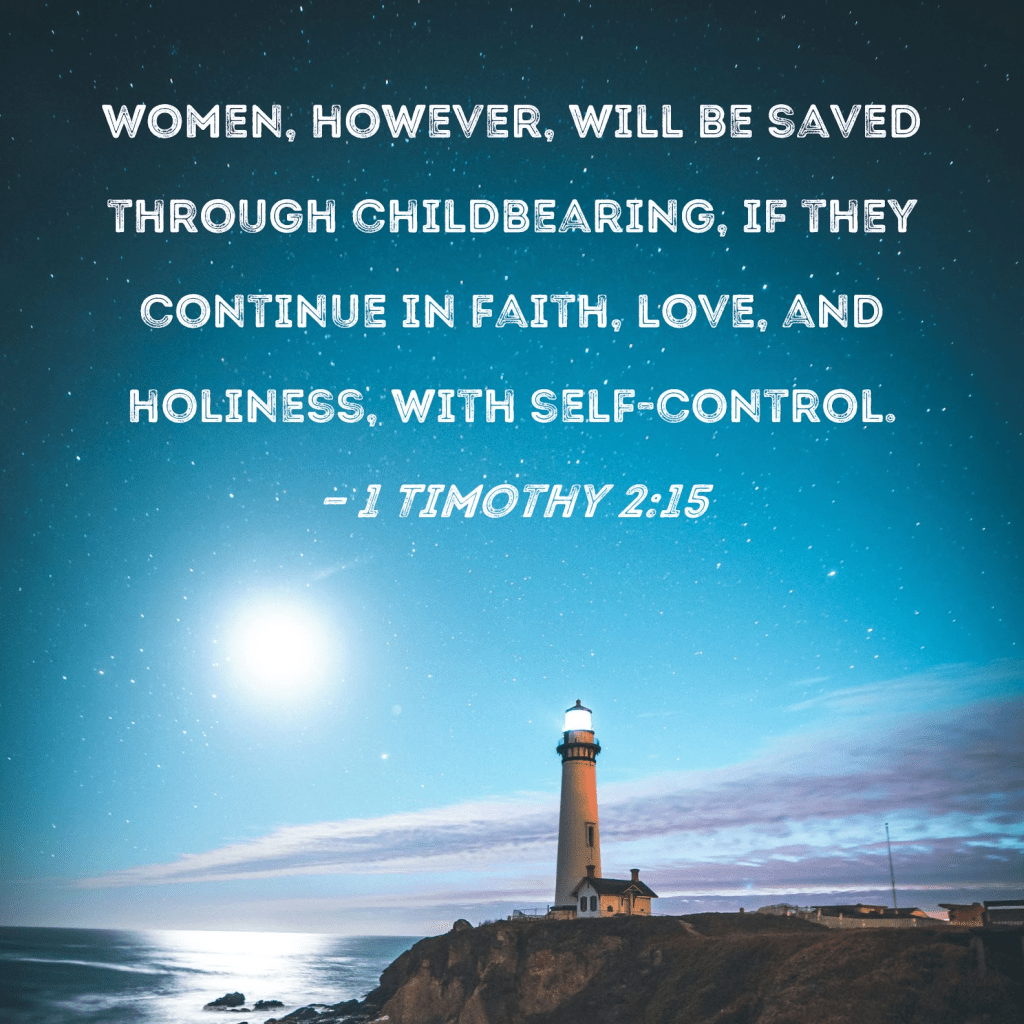
likewise also that women should adorn themselves in respectable apparel, with modesty and self-control, not with braided hair and gold or pearls or costly attire, 10 but with what is proper for women who profess godliness—with good works. 11 Let a woman learn quietly with all submissiveness. 12 I do not permit a woman to teach or to exercise authority over a man; rather, she is to remain quiet. 13 For Adam was formed first, then Eve; 14 and Adam was not deceived, but the woman was deceived and became a transgressor. 15 Yet she will be saved through childbearing—if they continue in faith and love and holiness, with self-control.” (1 Timothy 2:9–15 (ESV)

“Some people view the controversy over women’s leadership in the church as simply a collision between two viewpoints—one that espouses women’s liberation of one form or another, and the other, die-hard male chauvinism. But that’s a simplistic approach to the very controversial issue of women’s ordination.” – Dr. R. C. Sproul

A discussion concerning the role of women in the church is sure to provoke strong reactions and opinions. All manner of passionate perspectives is given. Many authors have written many books and articles on the subject. However, the debate rages on, and for many “rage” is the optimal word. There is a lot more “heat” generated in this discussion rather than the light of understanding.  

For example, there are those who say women cannot do anything in the church, except cook, clean, and take care of the kids in the nursery and Sunday school. An individual once remarked to me women should not be driving the church bus because in his words “women are to remain quiet.” The ridiculousness of the statement was not lost on anyone who heard it except for the individual who said it.   

Then there are those churches and denominations who advocate for women pastors. They too are equally passionate in their perspective the Apostle Paul was a chauvinist and what he wrote in today’s text is culturally bound to the first century and has no application to the 21st century church. The frame of mind is women can do anything in the church, and do it better than men.

What are the seeds which have germinated into this on-going and fervent debate? We cannot know how to address this issue of a woman’s role in the church unless we understand how the now controversial subject began.

The modern feminist movement, beginning in 1966, is often cited as provoking the initial spark of controversy of a woman’s service in the local church. The feminist movement continues to infiltrate the evangelical church while dominating the liberal church. Various arguments are set forth to advocate women pastors and elders in the church.

First, biblical passages regarding the “roles” of men and women in the church are reinterpreted and the immediate biblical context ignored. Second, certain biblical passages are completely ignored due to their perceived misogynistic or an anti-female bias. In other words, ignoring biblical passages strongly prejudiced against women should be advocated. Third, there is the perspective certain biblical passages were added later by editors and do not reflect the intent of the original authors.

What are the responses to such arguments? The following examples are but a few evidenced in the church at this time.

First, there is Unbiblical Capitulation. This is a surrender or retreat to the feminist movement within the church. This is evidenced by the ordination and appointment of women pastors and elders. This is illustrated by the slogan “Women pastors have to break free to follow God’s call.”

Second, there is Unbiblical Chauvinism. This is where women are derogatorily treated by men; not only in the home but also in the church. Women are to be seen and not heard. They are not allowed to give an opinion or serve. If women venture an opinion, they are told they are being un-submissive.

Third is Biblical Comprehensiveness. There needs to be a biblical and comprehensive perspective on the value, responsibilities and roles God has assigned to men and women. This presumes such a perspective can be achieved and adhered to by men and women. This is the goal of this study that such a perspective can be achieved.

In Scripture, God has assigned specific value, responsibilities and roles for men and women in the church. We need to understand them, teach them and reaffirm them. Value refers to an individual’s inherent worth, importance and significance. Responsibilities refers to duties, obligations and tasks. Roles involves positions of character-based leadership.   

The ongoing debate concerns a woman’s “role” in the church; their position for leadership. Two primary views when discussing the leadership role of women in the church are as follows.

The first is Egalitarianism. Men and women in the church have equal value, responsibilities and leadership roles. 

The second is Complementarianism. Men and women in the church have equal value and responsibilities, but different leadership roles with some leadership positions exclusively God-given to men.

It will be the goal of this study to biblically examine which of these two perspectives is indeed the biblically accurate one. The primary text is I Timothy 2:9-15. Due to the seriousness of this subject, only one verse will be examined daily. The object of this study is not to see how quickly we can complete it but rather to understand it in all its complexity. Other pertinent biblical passages will also be examined. These include Genesis 1 & 2, Acts 20, I Timothy 3, Titus 1 and I Peter 5.

There may not be total agreement when conclusions are made. There is no naïveté here. However, this should not prevent an attempt to achieve an understanding of this timely subject. Prayers are appreciated.

May the Lord’s truth and grace be found here. Have a blessed day in the Lord.

Soli deo Gloria!   

A Word Fitly Spoken. Systematic Theology.

16 All Scripture is breathed out by God and profitable for teaching, for reproof, for correction, and for training in righteousness, 17 that the man of God may be complete, equipped for every good work.” (2 Timothy 3:16–17 (ESV)

As the New Year of 2026 soon dawns upon us, the subject of Systematic Theology will be the focus each Sunday in the Word Fitly Spoken section of His Word Today. Two obvious questions are (1) What is systematic theology and (2) Why is it necessary for study?  

Systematic theology is any examination answering the question, “What does the Bible teach us on any particular subject or doctrine?” Systematic theology involves collecting, categorizing and understanding all relevant biblical passages concerning a particular topic. What follows is a clear summary of biblical doctrines in order to know what Christians are to believe and why they are to believe it.

“Wherefore all theology, when separated from Christ, is not only vain and confused, but is also mad, deceitful, and spurious; for, though the philosophers sometimes utter excellent sayings, yet they have nothing but what is short-lived, and even mixed up with wicked and erroneous sentiments.”~ John Calvin (1509 – 1564)

“We need theology for the sake of people. Theology is the application of the Word by persons to the world and all areas of human life”Dr. John Frame, Reformed Theological Seminary, Orlando, FL

The word systematic means methodical, orderly, organized and logical. Theology refers to religion, doctrine, spirituality and holiness.

“The word theology shares a suffix, -ology, with the names of many disciplines and sciences, such as biology, physiology, and anthropology. The suffix comes from the Greek word logos, which we find in the opening of John’s gospel: “In the beginning was the Word, and the Word was with God, and the Word was God” (John 1:1). The Greek word logos means ‘word’ or ‘idea or ‘logic’ The primary part of the word theology comes from the Greek Theos, which means ‘god,’ So, theology is the word or logic of God Himself,” explains Dr. R. C. Sproul.

When discussing and studying systematic theology, what are the core doctrines involved in such a study from Scripture? The following areas compromise the central teachings of systematic theology. They include;

Why should believers in Christ undertake a study of systematic theology? Dr. Wayne Grudem, professor of theology and biblical studies at Phoenix Seminar, Scottsdale, AZ, offers some helpful observations.

First, he indicates the basic reason is “that it enables us to obey the command of Jesus to teach believers to observe all that He commanded (Matt. 28:19-20).”  

Second, Dr. Grudem says such a study benefits believers’ lives. It helps them recognize and overcome wrong ideas, enables them to make better decisions regarding doctrinal questions, and helps Christian grow in their faith.

How should believers in Christ approach the study of systematic theology? The following attitudes are crucial and recommended. A perspective of prayer, humility, logical reason, assistance from scholars and mentors, and a spirit of rejoicing and praise.

What are the best works on systematic theology. Each Sunday, I will include a recommendation of a worthwhile systematic theological work you may consider reading. Today’s entry is John Calvin’s Institutes of the Christian Religion.

Strengths:

  • Theological and Ecclesiastical Precision: Calvin’s work is renowned for its clarity and depth in articulating core doctrines of Reformed theology. It offers a comprehensive foundation for understanding Christian doctrine from a Reformed perspective.
  • Orthodoxy: It serves as a touchstone for theological orthodoxy within Reformed and Presbyterian circles, ensuring that doctrinal teachings remain aligned with historical creeds and confessions.
  • Influence: The “Institutes” have profoundly influenced not only Presbyterianism but also other Reformed traditions and Baptist theologians.

Benefits:

  • Doctrinal Stability: Provides a robust framework that helps maintain doctrinal purity and orthodoxy within the church.
  • Educational Tool: Acts as a valuable resource for theological education, helping both clergy and laity to grasp the essentials of Reformed theology.

Next Lord’s Day, we will begin to examine the Doctrine of Holy Scripture, or Bibliology. Until then, may the Lord’s truth and grace continue to be found here. Have a blessed day in the Lord.

Soli deo Gloria!

His Word Today; Your Word is Now Fulfilled.

16 For I am not ashamed of the gospel, for it is the power of God for salvation to everyone who believes, to the Jew first and also to the Greek. 17 For in it the righteousness of God is revealed from faith for faith, as it is written, “The righteous shall live by faith.” (Romans 1:16–17 (ESV). See Galatians 3:11; Hebrews 10:38.

The prophet Habakkuk was burdened deeply. He lived in a land filled with violence and devoid of justice, a land under oppression by a foreign enemy. It perplexed him that the God of Israel could allow His own people to be destroyed by pagans. So he protested that while God was too holy to look at wickedness, He was tolerating it in abundance.

Having voiced his vexing questions, the prophet ascended a rampart, his “watch tower,” to await God’s reply. When God answered, He instructed Habakkuk to write His words down: “ ‘Write the vision and make it plain on tablets, that he may run who reads it. For the vision is yet for an appointed time; but at the end it will speak, and it will not lie. Though it tarries, wait for it; because it will surely come, it will not tarry. Behold the proud, his soul is not upright in him; but the just shall live by his faith’ ” (Hab. 2:2–4).

These words, “the just shall live by faith,” are quoted three times in the New Testament. God was telling Habakkuk that the righteous person will live by trusting Him. This call to faith was a summons to trust God’s promise of redemption. The promise had been set for an appointed time by the determinate counsel of God. He called it an appointment that would not lie, for it was an appointment grounded in the truth of God Himself. It would not be broken because it could not be broken.

The divine instructions were simple: “ ‘Though it tarries, wait for it.’ ” This command could be attached to all of the promises of God. Throughout the Old Testament, God promised the coming of the Messiah. He had set an appointment for the Incarnation to occur in the fullness of time—the exact moment in world history that He had decreed from the foundation of the world. This decree made that of Caesar Augustus (Luke 2:1) pale into insignificance, except that it provided the context for the fulfillment of the ultimate plan of God.

When the moment came for Christ’s entrance into the world, Israel once again was under foreign denomination. It is clear from the New Testament that at the time of His Advent, the Old Testament church was not ready for Him. Four hundred years had passed since Israel had received its last prophetic word from God. The people had grown tired of waiting. In their eyes, the promised Messiah had tarried too long. The quaint promises of their ancient religion now appeared to be simply myths and legends, or even worse, lies.

For the most part Israel had been secularized. The people still maintained the trappings of religion—they still observed their annual festivals, and they still had a professional priesthood and the ministries of the scribes and Pharisees. But this external religion was empty. It was a hypocritical sham that Jesus quickly exposed.

Perhaps the saddest commentary on that day is found in the prologue to John’s gospel: “He was in the world, and the world was made through Him, and the world did not know Him. He came to His own, and His own did not receive Him” (John 1:10–11).

God invited Israel to a reception in honor of His Son. But they did not come. Instead, they fled from the receiving line. It was not the pagans who refused to receive Him. It was Israel, God’s own people, the people of the covenant, the people who possessed the promise of God, who would not receive Him.

Yet John indicates that despite this national apostasy, God preserved for Himself a remnant. This remnant was a small group of Jews who lived by faith. They were not secularized. They waited for the promise, even though it had tarried for centuries. Of these people John writes: “But as many as received Him, to them He gave the right to become children of God, to those who believe in His name: who were born, not of blood, nor of the will of the flesh, nor of the will of man, but of God” (John 1:12–13).

John speaks of those who were the adopted children of God. These were the people who received Christ. The term translated “right” is better rendered “authority” or “power” to become God’s children. These people were born of God and not of human effort.

Luke gives us cameo portraits of some of these members of the remnant that received Jesus. In his infancy narratives, he speaks of Zacharias and Elizabeth, Mary and Joseph, and Anna and Simeon.

Simeon is one of my favorite characters in the Bible. He was a man of persevering faith. He is described by Luke as being just and devout. To be devout is to be a person of devotion. His allegiance to God was not a casual matter. Rather, his commitment revealed a singular passion, a constant and steadfast love, despite the unbelief of those around him.

Luke tells us that Simeon was “waiting for the Consolation of Israel.” The phrase Consolation of Israel was a Messianic title, an appellation that described one of the functions of the coming Redeemer, who would bring comfort to His people. Where others had forgotten the promises of God or abandoned hope in their fulfillment, Simeon was doing exactly what Habakkuk was instructed to do: He was waiting. He was anointed by the Holy Spirit, and God had revealed to him that he would not die before seeing the coming Messiah.

We don’t know when God revealed to him that he would see the Messiah. It probably had been many years earlier, as he is described as a man who had been “waiting.”

We are told that Simeon was led to the temple by the Spirit. We don’t know whether he came daily to inquire about the Messiah. But one day, when he came to the temple, he saw the parents of Jesus with their child. To their astonishment, Simeon took the babe in his arms and said (or sang) the nunc dimittis: “ ‘Lord, now You are letting Your servant depart in peace, according to Your word; for my eyes have seen Your salvation …’ ” (Luke 2:29–30).

When he finished these words, he made a grim prophecy to Mary: “ ‘Behold, this Child is destined for the fall and rising of many in Israel, and for a sign which will be spoken against (yes, a sword will pierce through your own soul also), that the thoughts of many hearts may be revealed’ ” (vv. 34–35).

Simeon was ready to die. He didn’t need to see the public ministry of Jesus, His miracles, death, and resurrection. He had seen enough. He had witnessed the arrival of the Consolation of Israel. It was worth the wait—as are all of God’s promises.

May the Lord’s truth and Grace be found here. Have a blessed day in the Lord. Merry Christmas.

Soli deo Gloria!

His Word Today: Come, Let Us Adore Him.

Now after Jesus was born in Bethlehem of Judea in the days of Herod the king, behold, wise men from the east came to Jerusalem, saying, “Where is he who has been born king of the Jews? For we saw his star when it rose and have come to worship him.” (Matthew 2:1–2 (ESV)

The following article is by Rev. Joseph Novenson. The articled originally appeared in the December 2002 issue of Tabletalk Magazine. It is entitled Come,. Let Us Adore Him.

“Literary whiplash,” the sudden shock of plot twist, seems an appropriate description for the gospel record of the wise men visiting the Christ child after His birth.

Perhaps our familiarity with the story, recorded in Matthew 2:1–12, blunts the remarkable nature of this visit from these eastern wise men. It appears in the gospel account designed by a Jew primarily to convince Jewish readers to believe in the Jew named Jesus as Messiah, an account that is filled with Jewish linguistic and logistic structure. Therefore, it is startling when a cadre of Gentiles steps into the narrative as sincere and extravagant worshipers. Why did this Hebrew author include this Gentile parenthesis in the written record? The most obvious answer is simple: Matthew recorded it because it happened. The narrative is history, not an author’s fabrication. But God’s “providential conspiracy” to usher these Gentile journeymen onto the Biblical stage has some weighty lessons for both Jewish and Gentile readers of Matthew’s account.

Matthew teaches that this Child is the King of all the cosmos. The fabric of creation reacted to Jesus, as witnessed by the star at His birth (Matt. 2:2), and by the darkness and the earthquake at His death (Matt. 27:45, 51). God’s creation could not stand idly by as its Creator advanced His redemptive plan. Whether it was His birth or His crucifixion, time and space sent up flares and threw down markers.

The star is called “His star” by the Gentile seekers in Matt. 2:2. In other words, they believed the star had an owner! They were more accurate than perhaps they even realized, for Jeremiah 31:35 says, “Thus says the LORD, who gives the sun for a light by day, the ordinances of the moon and the stars for a light by night.” And Psalm 147:4 records, “He counts the number of the stars; He calls them all by name.”

Here we are at least reminded that Christ’s work is not only redemptively reformational, but cosmically transformational. Various prophets painted pictures of massive cosmic upheaval that would accompany the intrusion of God’s kingdom upon this misshapen planet: Deserts would flow with rivers and plush gardens would explode where drought once seared all before it. Due to the devastation of the Fall, the coming of Christ’s kingdom impacts nature itself with dramatic import. Ultimately, Christ’s work will remove every cosmic mark of the Fall. Paul said that as creation waits to be “delivered from the bondage of corruption,” it “groans and labors with birth pangs together until now” (Rom. 8:21–22). We should even expect stars, sunlight, and the earth’s stability to act outside normal laws of nature because He has come! He is redeeming His people, and creation is showing signs of kingdom alteration and transfer. When the Lawgiver, the star namer, the cosmos Creator acts in history to be the wretch Redeemer, the wrath receiver, and the Savior of His people, creation pulses with the “office memo.”

Your worship this Advent season is of a Savior who won the ultimate victory, in the ultimate battle, for the ultimate kingdom’s coming. Even a star heralded the King’s arrival, like a troubadour of a greater parade of providence to come. When you were regenerated by God, you joined the ultimate renewal. Mediocre response to this is trespass in itself. Listen to Matthew 2:10: “When they saw the star, they rejoiced with exceedingly great joy.” Bland, insipid, and pedestrian worship had no place in the Magi’s practice. It should have no place in our hearts either.

Matthew teaches that Jesus is the King of all cultures. The arrival of wise men, Magi or astronomers from the East, is a small taste of Christ’s cross-cultural drawing of people from “every tribe and tongue” to Himself in sovereign, electing power. Christ’s kingdom will take down every man-made and sin-made barrier between cultures until a new humanity assembles in Christ-glorifying wonder before Him, including all cultures and transcending them. Even at His birth, this promise of the Abrahamic covenant (Gen. 12:3) begins to find fulfillment as the nations are drawn to the Son.

Matthew ends his narrative with Christ’s commission to take the Gospel to all the nations (Matt. 28:18–20), but it begins with the drawing of the nations to the King’s birth. God wants Christmas to remind us that He comes for the outsider, the ones we might not expect Him to call to Himself. It must not be missed that Christ draws the apparent outsiders with natural or general revelation (the star) and with special revelation (the Word of God quoted to the wise men in Jerusalem, Matt. 2:6). He uses both instruments to turn outsiders into Christ adorers. God conspires behind the details of His world and His Word to pursue the people no one would have thought He would or could transform.

Is it not thrilling to see God’s divine design behind star and statements, world and Word, natural laws and supernatural revelation, to capture the hearts and minds of these unexpected guests? Is He conspiring behind the details of your life and language of His Word to call you, even now? Perhaps the same transforming grace that invaded the cosmic laws of stars and the cultural laws of “the East” is invading the “laws” of your life. May it be so!

In his gospel record, Matthew discloses two kinds of hearts. First, there are those who seem logistically near to Him, but who are spiritually numb to His grace (Herod). Second, there are those who seem logistically far from Him, but are spiritually filled with faith in Him (the Magi). The contrast is another cause for “literary whiplash.”

The near-but-numb heart of Herod had access to the high priests, scholars, and prophets of God. But his was a heart aimed at murdering Christ. Proximity to truth is no guarantee of yieldedness to truth. By contrast, the far but “faith-filled” hearts of the Magi had no Biblical priests, scholars, or prophets of God. They probably had a culture of idolatrous adversaries to this truth. But their hearts were aimed at magnificently worshiping Christ. Spiritual distance and folly can be utterly shattered by the invasive grace of the King of hearts.

Here’s an Advent test. Do you want to remove His presence or revere His presence? Attack Him or adore Him?

Matthew teaches that Jesus is the King, worthy of extravagant worship. From their composure, or lack of it (v. 10, “exceedingly great joy”); to their posture, or the lack of it (v. 11, “They fell to the ground,” NASB); to their practice (v. 11, “and [they] worshiped Him”); to their presentation (v. 11, “They presented gifts to Him: gold, frankincense, and myrrh”), the Magi were extravagant in their worship. Their behavior was far beyond perfunctory or routine. It was emotionally joyful, humble in posture, honoring in practice, and beautiful in presentation.

How few supportive worship appendices with which we are so familiar were present. There was no organ, choir, worship leader, or hymns—just the blessed incarnate Son of God and some “awestruck” Gentiles who obviously thought He was “worth it” because of the quality of their extravagant worship. Here’s a key to spiritually vital worship: When the inner person is astonished at the worth of the Savior, extravagance of emotion, posture, practice, and presentation is the result. Perhaps the real “worship war,” as the ecclesiastical pundits call it, is a fight for the worth of the Savior to be known among His people so they are astonished by Him. Not style, not music, but Him.

The word worship is the conflation of the old English greeting “worth-ship,” given to the highly respected like “lordship.” I am told that it indicates the worth of the one greeted. Apparently the Magi truly worshiped due to their grasp of His “worth-ship.” They knew Him as the cosmic King, the culture King, the heart King, and thus they immediately “downloaded” all that had worth to them, for He alone is worthy to be worshiped.

George MacDonald, the Scottish novelist and poet of the late 1800s and early 1900s, wrote of how this worth of Christ should move our response:

When I no more can stir my soul to move,
And life is but the ashes of a fire;
When I can but remember that my heart
Once used to live and love, long and aspire—
Oh, be Thou then the first,
The One Thou art;
Be Thou the calling, before all answering love,
And in me wake hope, fear, boundless desire.

This advent, remember that He is “the One . . . the calling, before all answering love.” If you do, you will find Him waking “hope, fear, boundless desire” within you. Then join the Magi and “rejoice exceedingly with great joy.” For the King of the cosmos has become King of your culture and your heart.

May the Lord’s truth and grace be found here. Have a blesse day in the Lord. Merry Christmas.

Soli deo Gloria!

His Word Today: Tidings of Great Joy.

And in the same region there were shepherds out in the field, keeping watch over their flock by night. And an angel of the Lord appeared to them, and the glory of the Lord shone around them, and they were filled with great fear. 10 And the angel said to them, “Fear not, for behold, I bring you good news of great joy that will be for all the people. 11 For unto you is born this day in the city of David a Savior, who is Christ the Lord. 12 And this will be a sign for you: you will find a baby wrapped in swaddling cloths and lying in a manger.” 13 And suddenly there was with the angel a multitude of the heavenly host praising God and saying, 14     “Glory to God in the highest, and on earth peace among those with whom he is pleased!”(Luke 2:8-14 ESV)

The following article is by Dr. Richard L. Ganz. Prior to his retirement, he served as minister at the Ottawa Reformed Presbyterian Church in Ottawa, Canada. He is author of Free Indeed: Escaping Bondage and Brokenness for Freedom in Christ. His article was originally published tin the December 2002 issue of Tabletalk magazine. It is entitled Tidings of Great Joy.

All four gospels record the portion of Jesus’ trial when Pilate examined Him, asking, “ ‘Are You the King of the Jews?’ ” Jesus testified that He was: “ ‘It is as you say’ ” (Matt. 27:11Mark 15:2Luke 23:3). In John’s gospel, we have a fuller account of this discussion: When Pilate questioned, “ ‘Are You the King of the Jews?’ ” Jesus answered: “ ‘My kingdom is not of this world.… My kingdom is not from here.’ ” Pilate exclaimed, “ ‘Are You a king then?’ ” Jesus declared: “ ‘You say rightly that I am a king. For this cause I was born, and for this cause I have come into the world, that I should bear witness to the truth’ ” (John 18:33–37).

Jesus was born not only to be the King, but to testify to the truth that He was the King! He was born to rule this world—and God would establish His Son’s reign on earth through the Cross. But Jesus also came here to proclaim the truth about Himself, that He was the Son of God, so that all the people might believe in Him and be saved by Him.

When Jesus was born, two sets of heralds were sent forth to proclaim the joyous news of the birth of this great King, whose kingdom was not of this world. How fitting that the first messengers themselves—the angels and the shepherds—were in no way representatives of any worldly kingdom. The mighty angels came from heaven’s magnificent realms; the lowly shepherds were the humble of the earth, men who were living outside, guarding their only material wealth. No, there was no earthly splendor displayed by the heralds of this newborn King.

On the night when Jesus was born, when the shepherds were out in the fields near Bethlehem keeping watch over their flocks, they beheld the glory of the Lord. “An angel of the Lord stood before them, and the glory of the Lord shone around them, and they were greatly afraid” (Luke 2:9). The shepherds beheld a being and a glory so awesome that they were filled with fear and dread. Later, an entire heavenly host appeared with the angel, and the shepherds beheld angelic splendor seldom seen upon this earth. They were given a glimpse of the glory of heaven; they were overwhelmed by the glory of the Lord; they heard heaven’s host singing and praising God.

But as amazing as these sights and sounds were to their eyes and ears, these were not the greatest glories of that night. The angels were simply messengers. It was the message that they brought from heaven—the Word of the Lord—that was more glorious! The shepherds heard from the lips of an angel the glory of the Gospel of Jesus Christ, a Gospel filled with grace and truth, “ ‘good tidings of great joy which will be to all people’ ” (Luke 2:10). God’s greatest promise had been fulfilled that night! The long-promised Savior had arrived! The angel proclaimed: “ ‘There is born to you this day in the city of David a Savior, who is Christ [the Messiah] the Lord’ ” (Luke 2:11).

But as gracious and as glorious as God’s Word to them was, this also was not the greatest glory of the Lord that night. The Word of the Lord spoken by the angel sent the shepherds to an ordinary human baby: “He has no form or comeliness; and when we see Him, there is no beauty that we should desire Him” (Isa. 53:2). The newborn King announced by the angels had neither heavenly glory nor earthly majesty. He was just a funny-looking, wrinkled, swaddled baby—born sadly in a stable, wrapped meanly in rags, and placed humbly in the food trough for the animals. The shepherds had been given a sign by the angel, that they would find a baby lying in a manger. Without that sign, the shepherds would not have recognized Him as the Messiah, so common was His birth, so lowly His looks. But in this Child was the greatest display of the glory of the Lord, for the Son “is the brightness of God’s glory and the express image of His person” (Heb. 1:3). What the shepherds beheld in this Child was a veiled glory, but nothing less than the glory of God incarnate!

Christ’s lowly birth was just the beginning of His humiliation in this world. Although He was “in the form of God, He did not consider it robbery to be equal with God, but made Himself of no reputation, taking the form of a bondservant, and coming in the likeness of men. And being found in appearance as a man, He humbled Himself and became obedient to the point of death, even the death of the cross” (Phil. 2:6–8). For this reason Christ was born. What the shepherds saw when they looked at the baby lying in the manger was the beginning of the humiliation of the Son of God. What they beheld was the first glimpse of that most terrible glory—the crucifixion of the Christ.

The shepherds, who first beheld the glory of the Lord by sight in the appearance of the angel, ultimately beheld the glory of God by faith as they looked upon the newborn Babe, believing that He was the Savior, the Messiah, the Lord! They believed the words the angel had spoken to them. They believed the Word of God! Their faith was expressed in their actions. First they hurried to Bethlehem to see what the Lord had told them. Then they “made widely known the saying which was told them concerning this Child” (Luke 2:17). The Gospel was now being proclaimed, not by the voice of an angel, but through the voices of men. Finally, “the shepherds returned, glorifying and praising God for all the things that they had heard and seen” (Luke 2:20). Worship was the shepherds’ response to the angels they had seen, the Word of the Lord they had heard, and their encounter with Christ!

We, too, must believe the message of the angels. We also must follow the example of the shepherds: We must believe the Word of the Lord and the Gospel of Christ spoken to us. We must seek the Savior and look upon Him, but not by the side of the manger. We must seek Him at the foot of the cross, and we must look to Him dying there to save us from our sins. Jesus Himself said: “ ‘As Moses lifted up the serpent in the wilderness, even so must the Son of Man be lifted up, that whoever believes in Him should not perish but have eternal life. For God so loved the world that He gave His only begotten Son, that whoever believes in Him should not perish but have everlasting life. For God did not send His Son into the world to condemn the world, but that the world through Him might be saved’ ” (John 3:14–17). Having looked to Christ on the cross by faith, having placed our trust in the Word of the Lord, we, too, like the shepherds, must go our way through life, spreading the word concerning the Savior, and glorifying and praising God for all the things they heard and saw that night, and for all the things we have seen and heard about Christ.

May the Lord’s truth and grace be found here. Have a blessed day in the Lord. Merry Christmas.

soli deo Gloria!

His Word Today: The Fullness of Time.

I mean that the heir, as long as he is a child, is no different from a slave, though he is the owner of everything, but he is under guardians and managers until the date set by his father. In the same way we also, when we were children, were enslaved to the elementary principles of the world. But when the fullness of time had come, God sent forth his Son, born of woman, born under the law, to redeem those who were under the law, so that we might receive adoption as sons.” (Galatians 4:1–5 (ESV)

The following article is by Dr. R. C. Sproul (1939-2017). He was founder of Ligonier Ministries, first minister of preaching and teaching at Saint Andrew’s Chapel in Sanford, Fla., first president of Reformation Bible College, and executive editor of Tabletalk magazine. His radio program, Renewing Your Mind, is still broadcast daily on hundreds of radio stations around the world and can also be heard online. He was author of more than one hundred books, including The Holiness of GodChosen by God, and Everyone’s a Theologian. He was recognized throughout the world for his articulate defense of the inerrancy of Scripture and the need for God’s people to stand with conviction upon His Word.

Today’s article is entitled The Fullness of Time. It was originally published in the December 2001 issue of Tabletalk.

In the beginning God created.…” These five words, the first ones in the Bible, are like a blaring trumpet blasting the ears of secular naturalists, for they assert three foundational truths on which the children of postmodernism always choke. This triad of truths sets the stage for the entire Biblical history of redemption. These truths are: There is a God, the universe was created by God, and history had a beginning in time.

The issues of God’s existence and His creation of the universe are paramount points of conflict with all forms of naturalism. These issues, though worthy of close attention, are beyond the scope of this article. I want to focus on the third point, the truth that the universe had a beginning in time. This reduces my concern from the first five words of the Bible to the first three: “In the beginning.…”

In the conflict between Christianity and naturalism, the popularity of “big bang” cosmology would seem to force agreement on the point of the universe’s having a beginning in time. It is usually argued that the big bang, by which all the energy and matter of the universe exploded from a compressed, infinitesimal “point of singularity,” occurred sometime 12 billion to 17 billion years ago (give or take a billion). However, lurking beneath the surface of the theory is the idea that something antedated the beginning, that matter and energy pre-existed the explosion, as far back as eternity. Thus, for some naturalists the big bang does not really describe the beginning as such, merely a radical change in the form and structure of reality for which there is no beginning.

In the ancient world, the Hebrew assertion of a beginning was somewhat radical. The favorite theory of history, embraced particularly (but not exclusively) by Greek philosophers, was the cyclical view. In this view, history is neither linear nor progressive. Rather, it goes around and around in a never-ending circle. It has no point of origin or any specific point of destination. This often is seen as a schema wherein there is no purpose to history. This pessimistic view is explored and countered in the book of Ecclesiastes. The refrain, “Vanity of vanities, all is vanity,” describes a view of history wherein the sun sets and rises, but nothing new appears “under the sun.”

Against cyclical theories of history stands the Judeo-Christian view of a linear-progressive history that has a specific starting point and a future consummation. This assertion is crucial not only to the conflict between Christianity and naturalism, but to critical theories of Biblical interpretation.

Rudolf Bultmann’s neo-gnostic approach to theology was the most influential view of the second half of the twentieth century. He distinguished between the presence of history and myth in the Bible. Working from a naturalistic framework, he denied all things miraculous in the Biblical narrative. In his view, miracles were the mythical husk that needed to be peeled away to reach the kernel of historical truth. It did not bother Bultmann’s understanding of faith to say that the Bible was filled with mythology in its quasi-historical narratives. He sought to construct a theology of timelessness. For him, salvation is not wrought within the boundaries of history. Rather, it is “supra-temporal” or “trans-temporal.” The supra or trans realm is that which is above the realm of history and is not contained within it. Bultmann argued for a salvation that takes place in the “here and now,” on a vertical existential plane, not the horizontal plane of history. In this scheme, the historical content of the Bible doesn’t need to be true in the factual sense. In the final analysis, it doesn’t even matter if there was a historical Jesus.

Swiss Biblical scholar and historian Oscar Cullmann wrote against this radical violation of Biblical Christianity. By examining the time-frame references of the Bible, Cullmann concluded that Biblical Christianity is unintelligible apart from its historical context. The Hebrew-Christian view of history is tied to Judeo-Christian faith. Christianity is about a God who creates history, governs it, and works out His plan of salvation in it. To rip the content of me Bible from its historical context is not to rescue it from naturalistic philosophical criticism but to surrender it to philosophical naturalism. A Christian naturalism is an oxymoron.

Cullmann noted the difference between two Greek words for “time,” chronos and kairos. Chronos refers to the normal moment-by-moment passage of time, to normal history that is “chronicled.” Kairos refers to a specific moment in time that is especially significant. A kairotic moment defines the significance of the past and the future. We approximate this distinction by the English words historical and historic. Everything that happens is historical but not everything is historic. However, everything that is historic is also historical in that it takes place within history. Thus, the kairotic moments of which the Bible speaks are not moments out of time; they take place within the context of chronos.

In God’s eternal purpose, Jesus’ birth took place in the “fullness of time.” God had governed history in preparation for that kairotic moment, which happened in real history. Christianity stands or falls with that real history.

May the Lord’s truth and grace be found here. Have a blessed Christmas Eve.

Soli deo Gloria!

His Word Today: Far as the Curse is Found.

Joy to the world! the Lord is come;
Let earth receive her King;
Let every heart prepare him room,
And heaven and nature sing,
And heaven, and heaven, and nature sing.

Joy to the world! the Saviour reigns;
Let men their songs employ;
While fields and floods, rocks, hills, and plains
Repeat the sounding joy,
Repeat, repeat the sounding joy.

No more let sins and sorrows grow,
Nor thorns infest the ground;
He comes to make His blessings flow
Far as the curse is found,
Far as, far as, the curse is found.

He rules the world with truth and grace,
And makes the nations prove
The glories of His righteousness,
And wonders of His love,
And wonders, wonders, of His love.—Issac Watts

The following article is by R. Albert Mohler, Jr. He currently serves as the  president of The Southern Baptist Theological Seminary in Louisville, Kentucky. He is also host of the podcast The Briefing, where he gives a daily analysis of news and events from a Christian worldview. He preached this message on December 8, 2017. It is entitled Far as the Curse is Found.

Many Christians would be surprised, and perhaps even disappointed, to learn that the song often cited as our favorite Christmas carol is not actually a Christmas carol at all. The famed hymn writer Isaac Watts published “Joy to the World” in 1719. Millions of Christians sing this great hymn at Christmas, celebrating the great news of the incarnation and declaring “let earth receive her king.”

“Let every heart, prepare him room, and heaven and angels sing.” At Christmas we celebrate the incarnation of Christ, the coming of Jesus in Bethlehem. But “Joy to the World,” though sung rightly and triumphantly at Christmas, is really about the Second Coming of Christ.

Watts led in the development of hymns in the English tradition, drawing many of his hymn texts directly from the Psalms. “Joy to the World” is based upon Psalm 98, which declares creation’s joy when the Lord comes to rule and to judge. When we sing “Joy to the World, the Lord is Come,” it applies when we talk about Bethlehem and when we rejoice in the gift of the infant Christ. But the song also reminds us that Christmas isn’t over; the promises of Christmas are not yet fulfilled. Earth will fully receive her King when Christ comes again, to reign and to rule.

Think with me about verse three of the hymn, in which we read,

“No more let sins and sorrows grow, nor thorns infest the ground. He comes to make his blessings flow, far as the curse is found, far as the curse is found.”

The reversal of the curse is promised in the coming of the Messiah and the fulfillment of his atoning work. Implicit in this third verse is the promise of the new creation. We live in light of that promise, even as we look back to Bethlehem and as we celebrate Christmas.

But look carefully at the reference to the curse. Christ’s victory over sin is declared to extend “far as the curse is found.” What curse? How far does it extend? Where is it found?

We find the curse in Genesis, Chapter 3. After Eve has eaten of the forbidden tree, and then Adam also ate, and after they found themselves facing God in the reality of their sin, God first cursed the serpent:

The Lord God said to the serpent, “Because you have done this, cursed are you above all livestock and above all beasts of the field; on your belly you shall go, and dust you shall eat all the days of your life. I will put enmity between you and the woman, and between your offspring and her offspring; he shall bruise your head, and you shall bruise his heel.”

Then, God cursed the woman:

To the woman he said, “I will surely multiply your pain in childbearing; in pain you shall bring forth children. Your desire shall be contrary to your husband, but he shall rule over you.”

Then came to curse to Adam, and through Adam to all humanity:

And to Adam he said, “Because you have listened to the voice of your wife and have eaten of the tree of which I commanded you, ‘You shall not eat of it,’ cursed is the ground because of you; in pain you shall eat of it all the days of your life; thorns and thistles it shall bring forth for you; and you shall eat the plants of the field. By the sweat of your face you shall eat bread, till you return to the ground, for out of it you were taken; for you are dust, and to dust you shall return.”

By Adam, our federal head, the curse of sin came upon all humanity. We are dust, who must return to the dust, for the wages of sin is death. All creation is under the effects of the curse. “Cursed is the ground because of you,” Adam is told.

The curse is God’s righteous judgment of sin, and the effect of the curse is death. The curse has fallen upon all human beings, first because of Adam’s sin and then because of our own. In Adam, we all sinned. In Adam, we all died.

Where is the curse found? Everywhere we look, we see the curse and its malignant effects. How far does it extend? To every atom and molecule of creation — from coast to coast, shore to shore, sky to sky, and to every square inch of the planet. That’s how far the curse is found.

Most importantly, every single human being is found under this curse. “For there is no distinction, for all have sinned and fall short of the glory of God” (Romans 3:23).

So, how can we sing about joy to the world? Look with me to Galatians 3:10-14:

For all who rely on works of the law are under a curse; for it is written, “Cursed be everyone who does not abide by all things written in the Book of the Law, and do them.” Now it is evident that no one is justified before God by the law, for “The righteous shall live by faith.” But the law is not of faith, rather “The one who does them shall live by them.” Christ redeemed us from the curse of the law by becoming a curse for us—for it is written, “Cursed is everyone who is hanged on a tree”— so that in Christ Jesus the blessing of Abraham might come to the Gentiles, so that we might receive the promised Spirit through faith.

Here is the gospel of Christ, the good news. But first, the bad news. All who rely on works of the law are under a curse. All humanity is born under this curse, and under the law. The congregation that originally received Paul’s letter would have understood immediately where Paul grounded his argument, in Deuteronomy 27 and 28. At the end of the series of curses God delivered from Mount Nebo, we find the most comprehensive of all: “Cursed be everyone who does not abide by all things written in the Book of the Law, and do them.” [Paul in Galatians 3:10, citing Deuteronomy 27:26]

We are born under the curse, we are cursed by the curse, and the law offers no escape. We cannot work our way from under the curse.

So where is the good news? Where is joy to the world? Look at verses 13 and 14.

Christ redeemed us from the curse of the law by becoming a curse for us. What we sinners could not and cannot do for ourselves, Christ has done for us. He removes the curse and the power of the law to condemn us.

How? He redeemed us from the curse by becoming a curse for us. The sinless Son of God became incarnate as the Word became flesh and dwelled among us. That sinless Son of God became sin for us, in order that we might become the righteousness of God (2 Corinthians 5:21). He became a curse for us, by hanging on a tree, in fulfillment of Scripture.

Christ died on the cross, in our place, bearing our shame and guilt, paying the full penalty for our sin, dying as our Substitute, in our place, by his shed blood. He redeemed us from the curse by becoming a curse for us. He died our death, in our place, bearing our sins, redeeming us from the curse. And on the third day the Father raised him from the dead. The cursed and crucified Savior rose victorious from the grave.

Paul concludes that all this took place so that in Christ the blessing of Abraham might come to the Gentiles, and so that we, as Christians, might receive the promised Holy Spirit through faith.

Today we celebrate commencement, the graduation of ministers of Jesus Christ who now enter into a new season of service to the church and to the gospel. The main contours of the ceremony would be recognizable to almost anyone. Here you see graduates, diplomas, faculty, academic regalia, dignity, proud loved ones. But this is a distinctively Christian service. This is an academic ceremony, but it is a Christian service of worship.

These graduates are one of the most remarkable sights you will ever see. Who gets to observe such a moment as this, looking at newly minted ministers of Christ and knowing that they are soon to be deployed to the church and to the ends of the earth? No school is worthy of them, and not one of them is worthy of their calling. Everything you observe is by grace, and to the glory of God.

Graduates, you are wearing the gowns of academic and ministry preparation. You will soon hold diplomas as evidence of your seriousness of preparation and devotion to the ministry. You are surrounded by a host of friends and family and faculty. Their own hopes and dreams of ministry go with you and in you. This faculty has taught you with conviction and affection, and now you go to bear the gospel of Christ and to preach the Word.

Why? Because the world is full of sinners who live every day under the curse, and the penalty of the curse is death. You go to preach the gospel and to declare salvation to all who believe in Christ and repent of their sin. You go to feed Christ’s flock and to shepherd the church for whom Christ died.

How far does the gospel reach, and to what lengths must it be taken? Far as the curse is found. Go and preach. Go and tell. Teach the good news that Christ has redeemed us from the curse by becoming a curse for us.

Joy to the world! The Lord is come.

No more let sins and sorrows grow, nor thorns infest the ground. He comes to make his blessings flow, far as the curse is found.

And so, prayerfully and proudly,  we send you out — ministers of Christ, heralds of the gospel, far as the curse is found.

May the Lord’s truth and grace be found here. Have a blessed day in the Lord.

Soli deo Gloria!

His Word Today: Christmas is the Most Unsentimental Way of Looking at Life.

“But there will be no gloom for her who was in anguish. In the former time he brought into contempt the land of Zebulun and the land of Naphtali, but in the latter time he has made glorious the way of the sea, the land beyond the Jordan, Galilee of the nations. The people who walked in darkness have seen a great light; those who dwelt in a land of deep darkness, on them has light shone. You have multiplied the nation; you have increased its joy; they rejoice before you as with joy at the harvest, as they are glad when they divide the spoil.        For the yoke of his burden, and the staff for his shoulder, the rod of his oppressor, you have broken as on the day of Midian. For every boot of the tramping warrior in battle tumult and every garment rolled in blood will be burned as fuel for the fire. For to us a child is born, to us a son is given; and the government shall be upon his shoulder, and his name shall be called Wonderful Counselor, Mighty God, Everlasting Father, Prince of Peace.” (Isaiah 9:1–6 (ESV)

The following article was written by pastor, author, teacher and Christian apologist Timothy Keller (1950-2023). It is entitled Christmas is the Most Unsentimental Way of Looking at Life. It is adapted from his book Hidden Christmas: The Surprising Truth Behind the Birth of Christ. Keller was the founding pastor of Redeemer Presbyterian Church in Manhattan.

Christmas is the only Christian holy day that is also a major secular holiday. This brings some discomfort on both sides. Many Christians can’t help but notice that more and more of the public festivities surrounding Christmas studiously avoid any references to its Christian origins. The background music in stores is moving from “Joy to the World” to “Have a Holly, Jolly Christmas.”

On the other hand, nonreligious people can’t help but find that the older meaning of Christmas keeps intruding uninvited, for instance, through the music of traditional Christmas carols. It can be irritating to have to answer their child’s question, “What does that music mean — ‘born to give them second birth’?”

Christmas does not say, ‘Cheer up! If we all pull together, we can make the world a better place.’

As a Christian believer, I am glad to share the virtues of that day with the entirety of society. My fear is, however, that its true roots will become more and more hidden to most of the population.

The secular Christmas is a festival of lights, a time for family gatherings, and a season to generously give to those closest to us and to those in greatest need. These practices are genuinely congruent with the Christian origins of the celebration. The emphasis on light in darkness comes from the Christian belief that the world’s hope comes from outside of it. The giving of gifts is a natural response to Jesus’ act of self-­giving, when he laid aside his glory and was born into the human race. The concern for the needy recalls that the Son of God was born not into an aristocratic family but into a poor one. The Lord of the universe identified with the least and the most excluded of the human race. But the truth is that Christmas, like God himself, is both more wondrous and more threatening than most understand.

Christmas is about receiving presents, but consider how challenging it is to receive certain kinds of gifts. Some gifts by their very nature make you swallow your pride. Imagine opening a present on Christmas morning from a friend — and it’s a dieting book. Then you take off another ribbon and wrapper and you find it is another book from another friend, “Overcoming Selfishness.” If you say to them, “Thank you so much,” you are in a sense admitting, “For indeed, I am fat and obnoxious.”

In other words, some gifts are hard to receive, because to do so is to admit you have flaws and weaknesses and you need help. Perhaps on some occasion you had a friend who figured out you were in financial trouble and came to you and offered a large sum of money to get you out of your predicament. If that has ever happened to you, you probably found that to receive the gift meant swallowing your pride.

There has never been a gift offered that makes you swallow your pride to the depths that the gift of Jesus Christ requires us to do. Christmas means that we are so lost, so unable to save ourselves, that nothing less than the death of the Son of God himself could save us. That means you are not somebody who can pull yourself together and live a moral and good life.

Christmas, therefore, is the most unsentimental, realistic way of looking at life. It does not say, “Cheer up! If we all pull together, we can make the world a better place.” The Bible never counsels indifference to the forces of darkness, only resistance, but it supports no illusions that we can defeat them ourselves. Christianity does not agree with the optimistic thinkers who say, “We can fix things if we try hard enough.” Nor does it agree with the pessimists who see only a dystopian future.

The message of Christianity is, instead, “Things really are this bad, and we can’t heal or save ourselves. Things really are this dark — nevertheless, there is hope.” The Christmas message is that “on those living in the land of deep darkness a light has dawned.”

Notice that it doesn’t say from the world a light has sprung, but upon the world a light has dawned. It has come from outside. There is light outside of this world, and Jesus has brought that light to save us; indeed, he is the Light.

May the Lord’s truth and grace be found here. Have a blessed day in the Lord.

Soli deo Gloria!