
12 “…which is why I suffer as I do. But I am not ashamed, for I know whom I have believed, and I am convinced that he is able to guard until that day what has been entrusted to me. 13 Follow the pattern of the sound words that you have heard from me, in the faith and love that are in Christ Jesus.” (2 Timothy 1:12–13 (ESV)
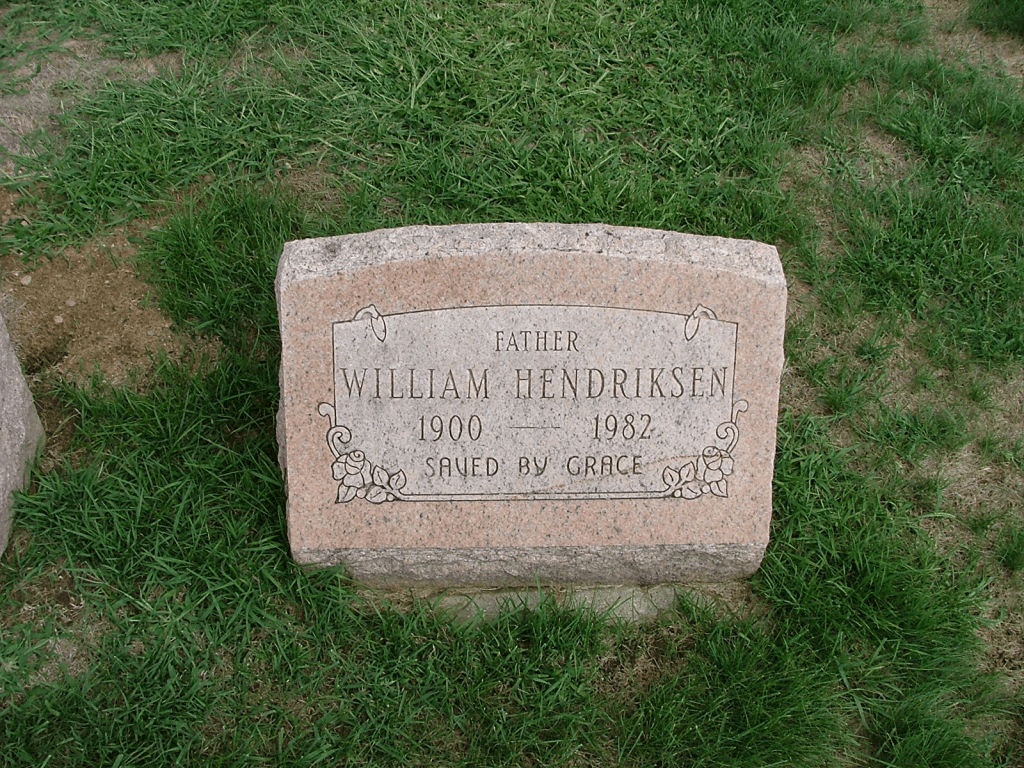
The following commentary on today’s text from 2 Timothy 1:12 is by Dr. William Hendriksen (1900-1982). Hendriksen was an ordained minister in the Christian Reformed Church and served as Professor of New Testament at Calvin Theological Seminary from 1942 to 1952. He was pastor of First Christian Reformed Church of Byron Center, MI from 1952 to 1961.[4] He started the New Testament Commentary, completing commentaries on more than half of the New Testament books. This series was published by Baker and completed by Simon Kistemaker after Hendriksen’s death. Hendriksen has been described as “one of the leading and most respected of New Testament commentators.”
Paul has once for all placed his trust in the sovereign God (see verses 8, 9). One might also translate with the A.V., “for I know whom I have believed,” i.e., I know God who revealed himself in his precious Son, “our Savior Christ Jesus” (verse 10). The apostle has become abidingly convinced of God’s infinite power, tender love, and absolute faithfulness.
Literally translated, the apostle says, “… and I am convinced that he is able to guard my deposit (τὴν παραθήκην μου) with a view to (or unto: εἰς) that day.” This leads to the question on which commentators are hopelessly divided: Just what is meant by my deposit? Is it “that deposit which he has entrusted to me,” or is it “that deposit which I have entrusted to him”? Or, putting it differently, is it the gospel or is it myself and my complete salvation?
As I see it, the latter view deserves the preference, for the following reasons:
(1) Clearly, not Paul but God (in Christ) guards this deposit (“he is able to guard”). Hence, the view that it is the deposit which Paul has entrusted to God has probability on its side. In verse 14 (see on that verse) and also in 1 Tim. 6:20 it is not God but Timothy who must do the guarding. Hence, in that case it is the deposit which God has entrusted to (Paul and to) Timothy.
Now if verse 12 has to do with the deposit which Paul has entrusted to God, then the view that the reference is to my soul or my spirit or myself and my complete salvation has logic on its side. Here some commentators favor my soul; others, my salvation. But the difference is not very important: “myself and my complete salvation” includes both.
(2) The immediate context favors this interpretation. Paul has just written, “I know whom I have believed,” meaning, in the light of the clause which follows: “I know that this God in whom I have placed my confidence is dependable, and will certainly keep in perfect safety that which I have entrusted to him for safe-keeping and protection.”
(3) The words of verse 10 also support this view. The apostle has just referred to “life and incorruptibility.” But, as was noted in the explanation of verse 10, the believer does not fully receive this blessing until the day of Christ’s glorious Return. Hence, the idea of verse 12 is that this truly immortal life possessed even now in principle, and deposited with God for safe-keeping, will be returned to Paul more gloriously than ever on “that day,” the day of the great consummation (cf. verse 18 below; also 2 Tim. 4:8; then 2 Thess. 1:10).
(4) The idea of a treasure that is guarded by God is also found elsewhere; sometimes in a slightly different sense (1 Peter 1:4).
(5) Cf. the words of our Lord as he died on the cross (Luke 23:46; cf. Ps. 31:5; 1 Peter 4:19). Christ’s spirit, having been committed to the Father, is on the third day re-united with the body, now gloriously resurrected.[1]
May the Lord’s truth and grace be found here. Have a blessed day in the Lord.
Soli deo Gloria!
[1] William Hendriksen and Simon J. Kistemaker, Exposition of the Pastoral Epistles, vol. 4, New Testament Commentary (Grand Rapids: Baker Book House, 1953–2001), 234–236.

