The following essay is Dr. J.I. Packer. It is from his book Concise Theology.
“This is what the LORD says—Israel’s King and Redeemer, the LORD Almighty: I am the first and I am the last; apart from me there is no God” (Isaiah 44:6).
The Old Testament constantly insists that there is only one God, the self-revealed Creator, who must be worshiped and loved exclusively (Deut. 6:4-5; Isa. 44:6– 45:25). The New Testament agrees (Mark 12:29-30; 1 Cor. 8:4; Eph. 4:6; 1 Tim. 2:5) but speaks of three personal agents, Father, Son, and Holy Spirit, working together in the manner of a team to bring about salvation (Rom. 8; Eph. 1:3-14; 2 Thess. 2:13-14; 1 Pet. 1:2). The historic formulation of the Trinity (derived from the Latin word trinitas, meaning “threeness”) seeks to circumscribe and safeguard this mystery (not explain it; that is beyond us), and it confronts us with perhaps the most difficult thought that the human mind has ever been asked to handle. It is not easy; but it is true.
The doctrine springs from the facts that the New Testament historians report, and from the revelatory teaching that, humanly speaking, grew out of these facts. Jesus, who prayed to his Father and taught his disciples to do the same, convinced them that he was personally divine, and belief in his divinity and in the rightness of offering him worship and prayer is basic to New Testament faith (John 20:28-31; cf. 1:18; Acts 7:59; Rom. 9:5; 10:9-13; 2 Cor. 12:7-9; Phil. 2:5-6; Col. 1:15-17; 2:9; Heb. 1:1-12; 1 Pet. 3:15). Jesus promised to send another Paraclete (he himself having been the first one), and Paraclete signifies a many-sided personal ministry as counselor, advocate, helper, comforter, ally, supporter (John 14:16-17, 26; 15:26-27; 16:7-15). This other Paraclete, who came at Pentecost to fulfill this promised ministry, was the Holy Spirit, recognized from the start as a third divine person: to lie to him, said Peter not long after Pentecost, is to lie to God (Acts 5:3-4).
So, Christ prescribed baptism “in the name (singular: one God, one name) of the Father and of the Son and of the Holy Spirit”—the three persons who are the one God to whom Christians commit themselves (Matt. 28:19). So, we meet the three persons in the account of Jesus’ own baptism: the Father acknowledged the Son, and the Spirit showed his presence in the Son’s life and ministry (Mark 1:9-11). So, we read the trinitarian blessing of 2 Corinthians 13:14, and the prayer for grace and peace from the Father, the Spirit, and Jesus Christ in Revelation 1:4-5 (would John have put the Spirit between the Father and the Son if he had not regarded the Spirit as divine in the same sense as they are?). These are some of the more striking examples of the trinitarian outlook and emphasis of the New Testament. Though the technical language of historic trinitarianism is not found there, trinitarian faith and thinking are present throughout its pages, and in that sense the Trinity must be acknowledged as a biblical doctrine: an eternal truth about God which, though never explicit in the Old Testament, is plain and clear in the New.
The basic assertion of this doctrine is that the unity of the one God is complex. The three personal “subsistences” (as they are called) are coequal and coeternal centers of self-awareness, each being “I” in relation to two who are “you” and each partaking of the full divine essence (the “stuff” of deity, if we may dare to call it that) along with the other two. They are not three roles played by one person (that is modalism), nor are they three gods in a cluster (that is tritheism); the one God (“he”) is also, and equally, “they,” and “they” are always together and always cooperating, with the Father initiating, the Son complying, and the Spirit executing the will of both, which is his will also. This is the truth about God that was revealed through the words and works of Jesus, and that undergirds the reality of salvation as the New Testament sets it forth.
The practical importance of the doctrine of the Trinity is that it requires us to pay equal attention, and give equal honor, to all three persons in the unity of their gracious ministry to us. That ministry is the subject matter of the gospel, which, as Jesus’ conversation with Nicodemus shows, cannot be stated without bringing in their distinct roles in God’s plan of grace (John 3:1-15; note especially vv. 3, 5-8, 13-15, and John’s expository comments, which NIV renders as part of the conversation itself, vv. 16-21). All non-Trinitarian formulations of the Christian message are by biblical standards inadequate and indeed fundamentally false, and will naturally tend to pull Christian lives out of shape.
15 “We ourselves are Jews by birth and not Gentile sinners; 16 yet we know that a person is not justified by works of the law but through faith in Jesus Christ, so we also have believed in Christ Jesus, in order to be justified by faith in Christ and not by works of the law, because by works of the law no one will be justified.” (Galatians 2:15–16 (ESV)
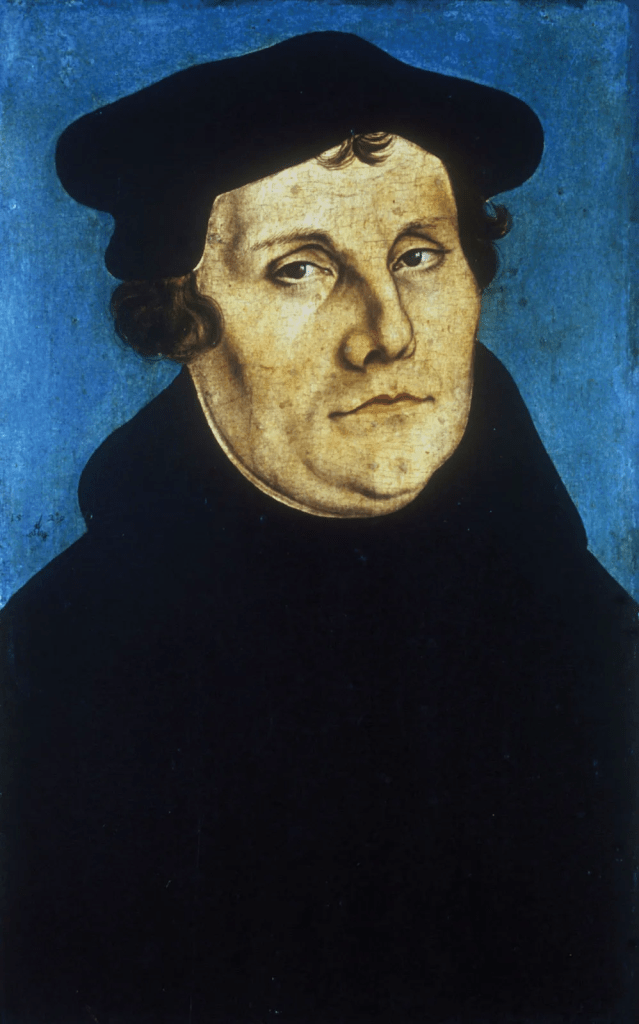
Martin Luther possessed a singular and even obsessive passion for God’s Word. For in the Scriptures, he discovered God’s truth (John 17:17). Following his conversion, and while teaching from the Apostle Paul’s Epistle to the Romans, Martin posted 95 Theses on the University Church Door of Wittenberg, Germany. It was the bulletin board of the day. His intention was to discuss with his fellow professors the abuses occurring within the church and how such behavior and doctrine deviated from the Scriptures.
He also wrote extensively and debated with leaders of the church who opposed his writings. The formal cause of the brewing controversy was Martin’s contention the Scriptures were the sole authority binding the believer’s conscience. He also affirmed the Bible’s teaching of justification by grace alone, through faith alone, in the person and work of Jesus Christ alone. Attributed to Martin is the statement, “Justification by faith alone is the article on which the church stands of falls.”
Martin Luther taught if the doctrine of justification by faith alone (sola fide) stands, the church stands; if it collapses, the church collapses. While Luther did not use the exact wording “justification is the foundation by which the church stands or falls,” his writings and sermons consistently emphasized its centrality. The Augsburg Confession (1530), a key Protestant statement, explicitly calls justification “the article on which the Church stands or falls.”
The following is an excerpt from Luther’s book Justification by Faith. It is his brief commentary concerning Galatians 2:16.
For this cause, we do so often repeat and so earnestly set forth the righteousness of faith that the adversaries may be confounded and this article established and confirmed in our hearts. And this is a most necessary thing; for if we once lose this sun, we fall again into our former darkness. And most horrible it is that the Pope should ever be able to bring this to pass in the church: that Christ should be denied, trodden under foot, spit upon, blasphemed, yea, and that even by the gospel and sacraments—which he has so darkened and turned into such horrible abuse, that he has made them to serve him against Christ, for the establishing and confirming of his detestable abominations. O deep darkness! O horrible wrath of God!
“Even we have believed in Jesus Christ, that we might be justified by the faith of Christ, and not by the works of the law.”—Galatians 2:16
This is the true means of becoming a Christian, even to be justified by faith in Jesus Christ and not by the works of the Law. Here we must stand, not upon the wicked gloss of the schoolmen, which say that faith justifies when charity and good works are joined with it. With this pestilent gloss the sophisters have darkened and corrupted this and other like sentences in Paul, wherein he manifestly attributes justification to faith only in Christ. But when a man hears that he ought to believe in Christ, and yet, notwithstanding, faith does not justify except it be formed and furnished with charity, by and by he falls from faith—and thus he thinks, “If faith without charity does not justify, then faith is in vain and unprofitable. And charity alone justifies; for except faith be formed with charity, it is nothing.”
The role of charity. And to confirm this pernicious and pestilent gloss, the adversaries do allege this place: “Though I speak with the tongues of men and of angels…and have not charity, I am nothing” (1Co 13:1-2). This place is their brazen wall! But they are men without understanding, and therefore they can see or understand nothing in Paul. By this false interpretation, they have not only perverted the words of Paul, but have also denied Christ and buried all His benefits. Wherefore, we must avoid this gloss as a most deadly and devilish poison, and conclude with Paul that we are justified, not by faith furnished with charity, but by faith only and alone.
We grant that we must teach also good works and charity, but it must be done in time and place; that is to say, when the question is concerning works, and does not touch this article of justification. But here the question is: By what means are we justified and attain eternal life? To this we answer with Paul that by faith only in Christ we are pronounced righteous, and not by the works of the Law or charity (Gal 2:16). [This is] not because we reject good works, but because we will not suffer ourselves to be removed from this anchor-hold of our salvation, which Satan most desires. Wherefore, since we are now in the matter of justification, we reject and condemn all good works; for this place will admit no disputation of good works.
In this matter, therefore, we do generally cut off all laws and all the works of the Law. But the Law is “holy, and just, and good” (Rom 7:12). True, it is. But when we are in the matter of justification, there is no time or place to speak of the Law. [Instead,] the question is what Christ is, and what benefit He has brought unto us. Christ is not the Law; He is not my work, or the work of the Law. He is not my charity, my obedience, or my poverty; but He is the Lord of life and death, a mediator, a savior, and a redeemer of those that were under the Law and sin. We are in Him by faith, and He in us. The bridegroom must be alone with the bride in his secret chamber, all the servants and family being put apart. But afterwards, when the door is open and he comes forth, then let the servants and handmaidens return to minister unto them. Then let charity do her office, and let good works be done.
The role of the Law. We must learn therefore to discern all laws (yea, even the Law of God), and all works, from the promise of the gospel and from faith, [so] that we may define Christ rightly. For Christ is no law, and therefore He is no exactor of the Law and works; but He is “the Lamb of God, which taketh away the sin of the world” (Joh 1:29). This faith alone lays hold of—and not charity, which notwithstanding must follow faith as a certain thank[1]fulness. Wherefore, victory over sin and death, salvation, and everlasting life come not by the Law, nor by the works of the Law, nor yet by the power of free-will, but by the Lord Jesus Christ only and alone. “That we might be justified by the faith of Christ, and not by the works of the law.”—Galatians 2:16b
Paul speaks here not of the ceremonial law only, as before we have said, but of the whole Law—for the ceremonial law was the law of God as well as the moral law. For ex[1]ample, circumcision, the institution of the priesthood, and the service and ceremonies of the Temple were as well commanded of God as the Ten Commandments. Moreover, when Abraham was commanded to offer up his son Isaac in sacrifice, it was a law. This work of Abraham pleased God no less than other works of the ceremonial law did, and yet was he not justified by this work, but by faith, for the Scripture says, “Abraham believed God, and it was counted unto him for righteousness” (Rom 4:3; Gen 15:6). But since the revealing of Christ, say they, the ceremonial law kills and brings death. Yea, so does the Law of the Ten Commandments also, [if] without faith in Christ.
Moreover, there may no law be suffered to reign in the conscience, but only the law of the spirit and life, whereby we are made free in Christ from the Law of the letter and of death, from the works thereof, and from all sins. [This is] not because the Law is evil, but because it is not able to justify us, for it has a plain contrary effect and working. It is a high and an excellent matter to be at peace with God; and therefore, in this case, we have need of a far other mediator than Moses or the Law. Here we must be nothing at all, but only receive the treasure which is Christ, and apprehend Him in our hearts by faith— although we feel ourselves to be never so full of sin. These words, therefore, of the apostle, “That we might be justified by the faith of Christ, and not by the works of the law,” are very effectual—and not in vain or unprofitable as the schoolmen think, and therefore they pass them over so lightly.
This is then a general conclusion: “By the deeds of the law there shall no flesh be justified” (Rom 3:20). The Law of God is greater than the whole world, for it comprehends all men; and the works of the Law far excel even the most glorious will-works of the merit-mongers. And yet Paul says that neither the Law, nor the works of the Law, do justify. Therefore, we conclude with Paul, that only faith justifies.
20 O Timothy, guard the deposit entrusted to you. Avoid the irreverent babble and contradictions of what is falsely called “knowledge,” 21 for by professing it some have swerved from the faith. Grace be with you.” (1 Timothy 6:20–21 (ESV)
Martin Luther possessed a singular and even obsessive passion for God’s Word. For in the Scriptures, he discovered God’s truth (John 17:17; 2 Tim. 3:16-17; 2 Peter 1:20-21). Following his conversion, and while teaching from the Apostle Paul’s Epistle to the Romans, Martin posted 95 Theses on the University Church Door of Wittenberg, Germany. It was the bulletin board of the day. His intention was to discuss with his fellow professors the abuses occurring within the church and how such behavior and doctrine deviated from the Scriptures.
He also wrote extensively and debated with leaders of the church who opposed his writings. The formal cause of the brewing controversy was Martin’s contention the Scriptures were the sole authority binding the believer’s conscience. He also affirmed the Bible’s teaching of justification by grace alone, through faith alone, in the person and work of Jesus Christ alone.
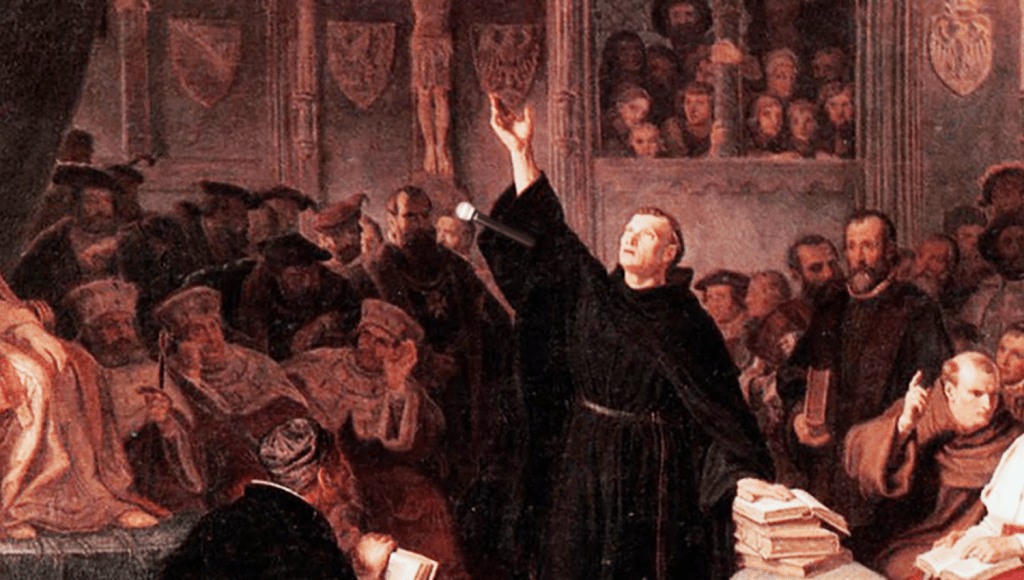
The die was cast and eventually Martin was called to appear before religious and magisterial leaders to answer their charges against him of committing heresy. The meeting, or diet, was held in the German town of Worms, April 16-18, 1521. Martin thought his appearance would allow him to explain his teachings.
However, when he arrived he was asked two questions. The council asked him if he acknowledged the books he had written were his. He replied yes. They then asked him whether he would recant what he had written. They ordered him to renounce his books which criticized church abuses, the pope and doctrine.
At first, Martin answered so softly no one heard him. The interrogators demanded he speak louder. He replied by asking if he could have 24 hours to consider their question. In other words, to think it over. The interrogators agreed to his request.
The next morning, following an evening of heartfelt prayer for courage and God’s strength, Martin once again faced his interrogators. They asked him if he would recant of his writings criticizing the church, the pope and the church’s doctrine. The following is Martin’s reply.
My lord, emperor most serene, princes most illustrious, lords most gracious,
I am here obedient to the order made yesterday evening that I should appear at this time. By the mercy of God I beseech your most Serene Majesty and your most illustrious lordships to deign to hear with forbearance my cause – which (I hope) is both just and true. If through my inexperience I do not give any one his proper title, or offend in any way against courtly etiquette, I beg you of your kindness to pardon me as a man whose life has not been spent in the courts of princes but in the cells of monks, and who can testify of himself nothing more than that he has hitherto taught and written with a simplicity of mind which looked solely to the glory of God and the sincere upbuilding of Christian believers.
Most serene emperor, most illustrious princes: two questions were put to me yesterday by your Highness, whether I acknowledged as mine a list of books published under my name, and whether I wished to hold to my defence of them or to revoke them. I gave a deliberate and plain answer to the first, and I stand by it and always shall – namely, that the books were mine, being published by me under my own name, unless perchance it has happened that by the guile or meddlesome cleverness of my rivals things in them have been altered or omitted. For I only acknowledge what is solely my own and what I alone have written, and not the interpretations which the industry of others has added.
In answer to the second question, may I ask your Highness and your lordships to deign to take note that my books are not all of the same kind.
In some I have dealt with religious faith and morals so simply and evangelically that my very antagonists are compelled to confess that these books are useful, harmless and fit to be read by Christians. Even the Bull, savage and cruel as it is, grants that some of my books are harmless, even though it condemns them by a judgment that is simply monstrous. If, then, I were to start revoking them, what (I beg you) should I be doing? Should I not alone of mankind be condemning that very truth which friends and enemies alike confess? Should I not alone be wrestling against the agreed confession of all?
Another class of my writings consists of polemic against the Papacy and the doctrine of the Papists, as men who by their most evil teachings and examples have laid waste all Christendom, body and soul. Nobody can deny or dissemble this: the experience and the complaint of all men bear witness that by the laws of the Pope and man-made doctrines, the consciences of the faithful have been most wretchedly ensnared, tormented, tortured, that above all, in this renowned German nation, goods and wealth have been devoured by tyranny unbelievable, and to this day the devouring goes on, endlessly and by most grievous means. Yet the canon law of the Papists itself provides that Papal laws and doctrines contrary to the Gospel or the opinions of the Fathers should be counted erroneous and rejected.
If, then, I revoke these books, all I shall achieve is to add strength to tyranny, and open not the windows but the doors to this monstrous godlessness, for a wider and freer range than it has ever dared before. The memorial of my revocation would be the kingdom of their wickedness, with license complete and unbridled, exercising over its wretched subjects a sway by far the most intolerable of all, and even strengthened and stabilized if word got abroad that I had revoked my books with the authority of your serene Majesty and all the Roman Empire. Good God, what wickedness and tyranny should I then let loose!
A third class of my writings has been aimed at certain private persons and (as they say) people of consequence, who have laboured to defend the Roman tyranny and undermine my religious teaching. Here I confess I have been more acrimonious than befits my religion or my calling. For I do not pose as a saint, and I am not disputing about my own life but about the teaching of Christ. Yet the way is not clear for me to revoke even these writings, for by such revocation I should lend my countenance to the reign of tyranny and wickedness, which would hold more savage and violent sway than ever among the people of God
However, because I am a man and not God, I can bring no other protection to my writings than my Lord Jesus Christ brought to his own teaching, when at the interrogation before Annas he was struck by a servant and said: “If I have spoken evil, testify to the evil.” If the Lord himself, who knew he could not err, did not disdain to listen to testimony against his teaching, even from the meanest of slaves, how much more should I, the dregs of a man, who cannot but err, seek and await for someone to bear witness against my teaching? I therefore beg by the mercy of God that your serene Majesty, your illustrious lordships, or anyone at all, from the highest to the lowest, who is able, should bear witness, convict me of error, vanquish me by the prophets or the evangelists of scripture. I shall be only too ready, if I am convinced, to revoke any error, and in that case I shall be the first to cast my books into the fire.
From these remarks I think it is clear that I have sufficiently considered and weighed the hazards and dangers, as well as the excitement and dissensions aroused in the world as a result of my teachings, things about which I was gravely and forcefully warned yesterday. To see excitement and dissension arise because of the Word of God is to me clearly the most joyful aspect of all in these matters. For this is the way, the opportunity, and the result of the Word of God, just as He [Christ] said, ‘I have not come to bring peace, but a sword. For I have come to set a man against his father, etc.’ [Matt. 10:34– 35].
Therefore, we ought to think how marvelous and terrible is our God in his counsels, lest by chance what is attempted for settling strife grows rather into an intolerable deluge of evils, if we begin by condemning the Word of God. And concern must be shown lest the reign of this most noble youth, Prince Charles (in whom alter God is our great hope), become unhappy and inauspicious. I could illustrate this with abundant examples from Scripture—like Pharaoh, the king of Babylon, and the kings of Israel who, when they endeavored to pacify and strengthen their kingdoms by the wisest counsels, most surely destroyed themselves. For it is He who takes the wise in their own craftiness [Job 5:13] and overturns mountains before they know it [Job 9:5].
Therefore, we must fear God. I do not say these things because there is a need of either my teachings or my warnings for such leaders as you, but because I must not withhold the allegiance which I owe my Germany. With these words I commend myself to your most serene majesty and to your lordships, humbly asking that I not be allowed through the agitation of my enemies, without cause, to be made hateful to you. I have finished
Since your serene Majesty and your lordships request a simple answer, I shall give it, with no strings and no catches. Unless I am convicted by the testimony of scripture or plain reason (for I believe neither in Pope nor councils alone, since it is agreed that they have often erred and contradicted themselves), I am bound by the scriptures I have quoted, and my conscience is captive to the Word of God. I neither can nor will revoke anything, for it is neither safe nor honest to act against one’s conscience. Amen.
It is debated whether Martin concluded his reply with the words “Here I stand, I can do no other, so help me God. Amen!” What is not debated is the Reformation began and the Lord used Martin Luther to bring such reformation to the church.
20 O Timothy, guard the deposit entrusted to you. Avoid the irreverent babble and contradictions of what is falsely called “knowledge,” 21 for by professing it some have swerved from the faith. Grace be with you.” (1 Timothy 6:20–21 (ESV)
Having studied I Timothy, I cannot forget the Apostle Paul’s final charge to his young protégé. The phrase “guard the deposit entrusted to you” resonates with me. It is a solemn command to passionately and obediently protect and keep the true doctrine of God’s Word.
Each and every pastor who seeks to rightly divide the Word of truth (2 Tim. 2:15) can identify with this directive from Paul. Each evangelist who shares the Gospel and seminary professor who teaches theology does so in light of this divine directive. Each Sunday school teacher who instructs the youngest or the eldest, and all those in-between, are to obey this command from God.
One such minister who understood this command was Martin Luther. He possessed a singular and even obsessive passion for God’s Word. For in the Scriptures, he discovered God’s truth (John 17:17). Following his conversion, and while teaching from the Apostle Paul’s Epistle to the Romans, Martin posted 95 Theses on the University Church Door of Wittenberg, Germany. It was the bulletin board of the day. His intention was to discuss with his fellow professors the abuses occurring within the church and how such behavior and doctrine deviated from the Scriptures.
He also wrote extensively and debated with leaders of the church who opposed his writings. The formal cause of the brewing controversy was Martin’s contention the Scriptures were the sole authority binding the believer’s conscience. He also affirmed the Bible’s teaching of justification by grace alone, through faith alone, in the person and work of Jesus Christ alone.
The die was cast and eventually Martin was called to appear before religious and magisterial leaders to answer their charges against him of committing heresy. The meeting, or diet, was held in the German town of Worms, April 16-18, 1521. Martin thought his appearance would allow him to explain his teachings.
However, when he arrived he was asked two questions. The council asked him if he acknowledged the books he had written were his. He replied yes. They then asked him whether he would recant what he had written. They ordered him to renounce his books which criticized church abuses, the pope and doctrine.
At first, Martin answered so softly no one heard him. The interrogators demanded he speak louder. He replied by asking if he could have 24 hours to consider their question. In other words, to think it over. The interrogators agreed to his request.
That evening, Martin prayed a prayer. Perhaps, you have either heard or read the prayer. For those who have, and especially for those who have not, here is the prayer Martin Luther prayed the night before he would respond to his accusers.
O God, Almighty God everlasting! how dreadful is the world! behold how its mouth opens to swallow me up, and how small is my faith in Thee! … Oh! the weakness of the flesh, and the power of Satan! If I am to depend upon any strength of this world – all is over… The knell is struck… Sentence is gone forth… O God! O God! O thou, my God! help me against the wisdom of this world. Do this, I beseech thee; thou shouldst do this… by thy own mighty power… The work is not mine, but Thine. I have no business here… I have nothing to contend for with these great men of the world! I would gladly pass my days in happiness and peace. But the cause is Thine… And it is righteous and everlasting!
O Lord! help me! O faithful and unchangeable God! I lean not upon man. It were vain! Whatever is of man is tottering, whatever proceeds from him must fail. My God! my God! dost thou not hear? My God! art thou no longer living? Nay, thou canst not die. Thou dost but hide Thyself. Thou hast chosen me for this work. I know it! … Therefore, O God, accomplish thine own will! Forsake me not, for the sake of thy well-beloved Son, Jesus Christ, my defense, my buckler, and my stronghold.
Lord – where art thou? … My God, where art thou? … Come! I pray thee, I am ready… Behold me prepared to lay down my life for thy truth… suffering like a lamb. For the cause is holy. It is thine own! … I will not let thee go! no, nor yet for all eternity! And though the world should be thronged with devils – and this body, which is the work of thine hands, should be cast forth, trodden under foot, cut in pieces, consumed to ashes, my soul is thine. Yes, I have thine own word to assure me of it. My soul belongs to thee, and will abide with thee forever! Amen! O God send help! … Amen!
When reading this prayer, I recall the words by the Sons of Korah in Psalm 46:1–3 (ESV) which says, “1 God is our refuge and strength, a very present help in trouble. 2 Therefore we will not fear though the earth give way, though the mountains be moved into the heart of the sea, 3 though its waters roar and foam, though the mountains tremble at its swelling.” Selah
Are there individuals, or councils, in your life who challenge your trust in the Scriptures? Perhaps it is a student, a colleague or co-worker, or even a family member or friend. Resolve to obey the command of I Timothy 6:20-21 and find comfort in the counsel of Psalm 46:1-3. Timothy did. So, did Martin. May we also.
20”O Timothy, guard the deposit entrusted to you. Avoid the irreverent babble and contradictions of what is falsely called “knowledge,” 21 for by professing it some have swerved from the faith. Grace be with you.” (1 Timothy 6:20–21 (ESV)
The following transcript is by Dr. J. Ligon Duncan. He preached this November 14, 2004. The message is entitled Guard What God has Given You.
III. Refrain from False Knowledge.
It’s false knowledge. Paul isn’t mad at it because it’s knowledge. No, he’s mad at it because it’s false knowledge. He’s not saying, “Well, we shouldn’t get hung up about what you believe, it’s just how you live.” That’s not what he’s saying. He’s saying that what it being claimed is wrong
And then he says, realize something. Look at verse 21. Paul says that some have claimed to have this false knowledge, and even though they’ve professed faith in Jesus Christ, they’ve gone astray. Look at what he says in verse 21: “…which some have professed and thus gone astray from the faith.” You see what Paul is saying. Paul is saying that there are some people in this congregation who have professed faith in the Lord Jesus Christ. They’ve professed to believe the Christian truths which had been taught by Paul and the apostles. And yet, because they became entangled in these false teachings, because they began to stray, in curiosity embracing these false teachings, they had gone astray from the faith.
You see, Paul is saying that bad theology leads to spiritual destruction. And he’s saying, “Timothy, the reason that I warn you against false teaching is because I’m concerned for the lives and the souls of men and women, and boys and girls.” This is not the first time that Paul has given this warning, but isn’t it urgent? It’s in his own hand, it’s the last thing that he’s going to say in this letter to Timothy and to his church, and he’s saying false teaching will lead to spiritual disaster. And that’s why we need to retain the truth and refrain from becoming entangled in the study and the curious discussion of these false teachings, and we need to realize that this false teaching leads to spiritual disaster.
IV. Rely on God’s Grace.
But Paul’s not done. If you look at verse 21, Paul concludes with a benediction: “Grace be with you”, in which he calls on Timothy to rely upon the grace of God. Indeed, he calls upon the whole congregation to rely upon the grace of God, to depend upon God’s unmerited and strengthening favor. “Grace be with you.” This little phrase indicates the greatest blessing of them all: God’s favor to us through Jesus Christ; his blessing on those who are undeserving of that blessing, purchased at the cost of the death of His own Son.
This grace Paul pronounces on Timothy. Why? Because for the ongoing life of the believer, the grace of the Lord Jesus Christ is essential. There is nothing that we are able to do apart from the grace of God, and there is nothing that God cannot do through us by His own grace. And so, Paul, even in pronouncing this blessing, is reminding Timothy and that congregation (and you and me) that we are always dependent upon the grace of God. That’s very important for us to remember in this season of this life of this congregation. We have tremendous opportunities and challenges for ministry and service before us, but we must be dependent upon the grace of God, because we can do absolutely nothing without it.
But notice what Paul says: “Grace be with you.” Now, you can’t pick it up in your English translation, but he’s not saying “Grace be with you (singular), Timothy.” He’s saying here, “Grace be with …y’all!” It’s a plural! Paul’s speaking this benediction on the whole congregation. It is yet another indication that this book has two audiences in mind. It has Timothy in mind, the elders in mind; but it has the congregation of the people of God in mind. And this blessing is not simply on Timothy, it’s on the whole congregation of the people of God, because in the realities of life in this fallen world, and of life and ministry in an imperfect church, the only hope we have is the grace of God.
Paul calls on Timothy and his congregation, and us, to retain the truth, to hold fast to it; to refrain from dabbling in worldly speculation and false teaching; to realize that false teaching will lead sheep over the edge into destruction; and to be utterly dependent, as we hold fast to that truth, on the only thing that can hold us up, which is the grace of God.
And what a rich blessing it is! The Aaronic priests, you remember, in the Old Testament had a blessing for the people of God: “The Lord bless you and keep you; the Lord make His face to shine upon you and be gracious to you. The Lord lift up his countenance upon you, and give you peace.” The Lord lifting up His face and making it to shine upon you, and being gracious to you, is giving you His favor. And receiving the Lord’s favor creates the reality of the enjoyment of peace; not cessation of physical warfare in this world, but peace with God, reconciliation with Him wherein we receive all the benefits which He has intended for us in His mercy.
And when Paul says “Grace be with you” he’s reminding you of that gift which God has given to all those who trust in Jesus Christ, and he’s reminding us that that message of grace is not just for those who are as yet unbelievers. It’s a message for us, too. Just as those who are apart from Christ need the grace of God if they would be saved, so we need the grace of God if we will live the Christian life. It’s the same message: rely on God’s grace. May the Lord bless His word. Let’s pray.
Our Lord and our God, we thank You for the mercy that You have given us in Jesus Christ, and for the truth which You have committed to us in Your word. Grant that we would hold on to that truth, and that we would rely on Your mercy and grace. We ask it in Jesus’ name. Amen. Grace be with you. Amen.
“The doctrine of the Trinity has always bristled with difficulties, and therefore it is no wonder that the Church in its attempt to formulate it was repeatedly tempted to rationalize it and to give a construction of it which failed to do justice to the Scriptural data.” — Louis Berkhof
The following essay is from Ligonier Ministries. Author unknown.
The early church father Tertullian is believed to have been the first to use the word, Trinity. In his treatise Adversus Praxean, Tertullian refers to the “Trinitas unius Divinitatis, Pater et Filii et Spiritus Sancti” (the Trinity of the One Divinity, Father, Son, and Holy Spirit).
Tertullian provided the building blocks regarding the multiplicity of persons (Latin personae), but later fathers provided the essential vocabulary to understand and defend Trinitarian doctrine. Athanasius was the great defender of the consubstantiality of the Father and the Son—i.e., that the Father and Son are the same in essence—after the Council of Nicaea, and the Cappadocian Fathers (Basil of Caesarea, Gregory of Nazianzus, and Gregory of Nyssa) drew the clear distinction between the meaning of essence and person.
The Cappadocian Fathers were the determinative voices in the outcome of the Council of Constantinople, which built on the Council of Nicaea by clarifying the distinct personhood of the Holy Spirit in light of His unity of essence with the Father and the Son. Nicholas Needham explains, “The Cappadocians fashioned the language of Trinitarian orthodoxy that we still use today. In addition to the term ousia for the divine nature, they defined the term hypostasis to express the reality of the divine persons.”
In the early church, the deity of the Son was the central point of doctrinal contention. The Christian church’s definitive presentation of the core truths of the doctrine of the Trinity was established at the Council of Nicaea (AD 325) and at the Council of Constantinople (AD 381). In both councils, Christological error was refuted and doctrinal precision established. The essential elements of the deity of Christ and the doctrine of the Trinity were codified in the Nicene Creed (also known as the Niceno-Constantinopolitan Creed, because it was refined and expanded at the Council of Constantinople).
After the Cappadocians, Augustine further refined established trinitarian distinctions. His De Trinitatis (On the Trinity) is one of the most significant theological works in church history. Herman Bavinck explained the importance of Augustine’s articulation of the Trinity:
[Augustine] does not derive the Trinity from the Father but from the unity of the divine essence, nor does he conceive of it as accidental but rather as an essential characteristic of the divine being. It belongs to God’s very essence to be triune. In that regard personhood is identical with God’s being itself. . .. Each person . . . is identical with the entire being and equal to the other two or all three together. With created beings that is different. One person does not equal three but, says Augustine, “in God that is not so, for the Father, the Son, and the Holy Spirit together are not a greater being than the Father alone or the Son alone; but these three substances or persons, if they must be so called, are at one and the same time equal to each individually” (De trin., VII, 6).
One particular phrase became controversial over the course of church history. In the eleventh century, the Western church added the word filioque (and the Son) to the Nicene Creed, in keeping with centuries of liturgical practice and the biblical testimony that the Holy Spirit proceeds from both the Father and the Son, not the Father alone. Eastern Orthodox churches rejected (and continue to reject) the filioque clause, which contributed to the break between the Eastern and Western churches in 1054.
The Reformed confessions and catechisms of the seventeenth century concur with the early and medieval church regarding the doctrine of the Trinity. The Westminster Standards summarize the Nicene doctrine of the Trinity. The Westminster Shorter Catechism states, “There are three persons in the Godhead; the Father, the Son, and the Holy Ghost; and these three are one God, the same in substance, equal in power and glory” (Q&A 5). The Westminster Larger Catechism notes that the members of the Godhead are “distinguished by their personal properties” (Q&A 9), which are defined in this way: “It is proper to the Father to beget the Son, and to the Son to be begotten of the Father, and to the Holy Ghost to proceed from the Father and the Son from all eternity” (Q&A). This distinction serves to delineate the order of existence among the members of the Godhead. The Father is commonly said to be the first person of the Godhead, the Son is the second person, and the Spirit is the third person. This does not suggest any subordination in the Godhead. Rather, it reflects the persons of the Godhead in their personal capacity and their order of operation. Salvation comes to us from the Father through the Son and by the Holy Spirit, and we return praise to God by the Holy Spirit through the Son unto the Father.
“In the formula of the Trinity, the church bows to sacred Scripture, honoring both the unity of God and the distinctions among the persons of the Godhead. The formula made use of terms such as person, subsistence, hypostasis, in an attempt to get at the unity and the distinction within God Himself. In addition to affirming the deity of Jesus, without which deity it would be blasphemous for Him to be an object of worship in the church, the Holy Spirit is also described in the Scriptures in terms of divine attributes. He is omnipotent. He is omniscient. He is infinite. He is eternal. He is actively involved in the divine work of creation, and in conjunction with His being the author of life and human intelligence, He is active in empowering the work of Christ in redemption. We see in the Bible that the work of creation involves the Father, the Son, and the Holy Spirit, just as the work of redemption includes the Father, the Son, and the Holy Spirit. All three are testified to uniformly by the Scriptures as being divine. They are not three gods, because the unity of God remains axiomatic in the Monarchianism of sacred Scripture. The church still declares that the Lord our God is one. He is one being, though we must distinguish within that one being the subsistence of Father, Son, and Holy Spirit.” — R.C Sproul, “Triune Monarchy” Tabletalk magazine
20”O Timothy, guard the deposit entrusted to you. Avoid the irreverent babble and contradictions of what is falsely called “knowledge,” 21 for by professing it some have swerved from the faith. Grace be with you.” (1 Timothy 6:20–21 (ESV)
The following transcript is by Dr. J. Ligon Duncan. He preached this November 14, 2004. The message is entitled Guard What God has Given You.
I. Retain the truth.
In verse 20, Paul says, “O Timothy, guard what has been entrusted to you….” There Paul says, ‘Timothy, retain the truth which I have entrusted to you.’ He’s telling Timothy that he has the responsibility to value, and protect, and defend, and retain the truth of the Christian faith. Paul is serious about orthodoxy. He’s serious about us holding on to those great truths of the Christian faith which have been expounded through Jesus and His apostles, and have been enscripturated in the word of God.
What is this…the fifth or sixth time in this letter that Paul has stopped to exhort Timothy to hold fast to sound teaching, and to oppose false teaching in the church? But you know, there’s another way you see how serious Paul is about retaining hold of the Christian faith, and it’s in the very way he addresses Timothy. You notice how he speaks to Timothy? He speaks the little word “O” in front of “Timothy”. “O Timothy…” he has picked up the pen himself now.
This isn’t the secretary transcribing Paul’s words; this is Paul himself: “O Timothy.” It’s filled with emotion and exhortation, and command. He’s exclaiming, and repeating his concern that Timothy would hold fast to the truth, and he says to him, “Guard what has been entrusted to you.”
Immediately what comes to your mind is the question, “Well, what has been entrusted to Timothy? What is this deposit that Timothy is supposed to guard?” Well, of course, in this book already Paul has talked about the gifts of the Spirit that had been entrusted to Timothy. He’s been given certain abilities; those things have been entrusted to him, but that doesn’t seem to be what Paul has in view here. Instead, Paul has clearly in view here Timothy holding fast to the truth of the Christian faith, not merely to his spiritual endowments, but to the very truth of the Christian faith.
Let me demonstrate that for you. Turn forward just 14 verses in your Bibles to 2 Timothy 1:13, and look at what Paul says there: “Retain the standard of sound words which you have heard from me, in the faith and love which are in Christ Jesus. Guard through the Holy Spirit who dwells in us, the treasure which has been entrusted to you.”
You see the same language that is being repeated there in II Timothy. Paul is calling on Timothy to hold fast to the sum of religion and sound doctrine, to the standard of sound words that he had received from Paul; to hold fast to the total truth content of the Christian faith summarized in the preaching of the apostles. And Paul is saying, “Timothy, value that truth. Protect that truth. Defend that truth. Retain that truth.”
You see, Timothy didn’t invent this faith. He received it. It was first passed on to him from his grandmother and from his mother, and Paul taught this truth to him. Timothy didn’t invent this as he was going along. He had received a message. He had received truth from God, and Paul is saying, “Timothy, hold onto it.”
One of the early church fathers, in commenting on this passage and teaching the church from it, asks the question, “What is meant here by ‘the deposit’; what has been entrusted to you?” And he answers this way:
“…That which is committed to you, not that which is invented by you. The deposit is that which you have received, not that which you have devised. It is not a thing of your wit, but of your learning. It is not a thing of private assumption, but a public teaching. It is not a thing brought forth from you, but a thing brought to you. You are not its author, but its keeper; you are not its leader, but a follower.”
You see, the Christian message is not something which the church’s minister works out for himself, or is entitled to add to. It is a divine revelation which has been committed to his care, and which is his bounden duty to pass on unimpaired to others. And Paul is saying, ‘Timothy, you didn’t invent this message, but your job is to guard it. Hold onto it; retain it,” Paul says.
And notice how he tells him to treat it. “O Timothy, guard what has been entrusted to you.” The word deposit, or that which has been entrusted to you, meant in Paul and Timothy’s Day something that was a treasured possession entrusted to someone else.
Can you imagine a scene on a battlefield, where two buddies who have been fighting side by side are speaking to one another. One of them is dying; he has been mortally wounded. From his pocket he pulls a watch, a family heirloom which has been in his family for five generations, and he says to his friend, “If you get back home, take this to my mother. This watch has been in my family for five generations, and I cannot take it home to her. This is an entrusted heirloom, a possession–take care of it.”
Paul is saying to Timothy, “You have been entrusted with something far more precious than a family heirloom. You have been entrusted with the word of salvation, with the word of truth, with the very revelation of God; so, Timothy, value it; protect it; defend it; retain it; hold on to it.” I want to say, my friends, it is easy for us to shortchange the significance of our having been entrusted with the truth of God from a series of faithful ministers and elders in this congregation for 170 years, and we should not undervalue it, because until the truth is deeply valued by each one of us, we will not protect it.
If we do not protect it, it will not be in danger, we will be in danger. God’s truth will endure. It is truth unchanged and unchanging. It is unconquerable truth. It will endure when the worlds are not more. But if we do not value it and protect it, we are in danger of losing it. And so, Paul says not just to Timothy, but to you and to me, we have to value, and protect, and defend and retain the truth of the Christian faith, which has been entrusted to us.
II. Refrain from World Talk.
But Paul doesn’t stop there. He goes on to say in verse 20 that we are to refrain from something. He says, “Timothy, you’re to guard what has been entrusted to you, avoiding worldly and empty chatter and opposing arguments of what is falsely called ‘knowledge’.” He tells Timothy, in other words, that he is to refrain from being entangled in empty and speculative theological chatter. He’s to avoid this kind of empty and speculative teaching. He’s to avoid this kind of vain speaking, theological or otherwise.
Now, it’s very interesting: the people who were propounding this ‘new and deep and spiritual teaching’ in the Christian church do doubt thought of themselves as exceedingly wise: wiser than Timothy; wiser than Paul; and, certainly, wiser than mere Christians in the congregation. They were intelligent! They had insights that none other could grasp! They knew truth that nobody could understand, and yet….
Do you notice the four qualities that Paul uses to describe what they no doubt thought as profound teaching? He calls it worldly, empty, contradictory, and false. He says, ‘Let me tell you about this ‘wisdom’, this ‘knowledge’ that is being taught by false teachers. It’s worldly. It doesn’t come from God, it’s worldly. It comes from this world. And it’s not only worldly, it’s empty. It claims to be profound and weighty, but it’s a vapor–it’s vain, it’s empty. There’s nothing to it, and it’s contradictory. It contradicts the clear teaching of God’s word.
More to come. May the Lord’s truth and grace be found here.
20”O Timothy, guard the deposit entrusted to you. Avoid the irreverent babble and contradictions of what is falsely called “knowledge,” 21 for by professing it some have swerved from the faith. Grace be with you.” (1 Timothy 6:20–21 (ESV)
The following transcript is by Dr. J. Ligon Duncan. He preached this November 14, 2004. The message is entitled Guard What God has Given You.
I Timothy that this is a book that is clearly not simply descriptive of how things were in the early church–it doesn’t give us a mere historical picture of what life would have been like in the early church–it’s designed to show us how we are to live and minister together in the local church today. And that theme runs throughout the Pastoral Epistles: not only I Timothy, but II Timothy and Titus.
Today we’ve come to the very final verses. It was Paul’s habit to sign his letters so that the people of the church who were receiving these letters would know that it was Paul who was writing to them. Typically, a secretary would have been employed, and Paul would have dictated the words of the letter, and then at the end of the writing of the letter, Paul would have taken the pen in his own hand to sign it himself.
But what Paul often did, when he did this, was give some final phrase or sentence of exhortation to the people to whom he was writing, and that’s what we have before us today. Paul has taken up the pen in his own hand. The secretary has written exactly what Paul, under the inspiration of the Holy Spirit had told the secretary to write down, but now Paul in his own hand is going to give one final exhortation to Timothy and to us, and then he’s going to pronounce a benediction.
Before we do, look at verses 17-19, because the last time we were together we were looking at Paul’s exhortation to wealthy Christians, and we acknowledged that all of us qualify for that particular title. We have been exceedingly blessed by God. What does Paul say?
Well, he first of all tells us not to be prideful because of what He has given us in terms of our worldly wealth, and he tells us not to fix our hope on that worldly wealth. It can go away, and if our hope and security is in that wealth being permanent, then we’ll never have hope and security in this world. Positively, Paul goes on to say that in contrast to fixing our hope on present wealth, we should instead fix our hope on God, and remember that everything that we have comes from God, and use all the resources that He has given us to do good, and not simply for selfish purposes; and strive to be rich in good works; and cultivate our generosity, so that we not only have an attitude of generosity, but we have a practice of generosity; and lay up for ourselves treasures in heaven, and not on this earth; and take hold of real life, not that which merely appears to be the life; or [what] those who pander materialism to us would say is the life, but the real life, which is in Jesus Christ.
In those three verses, he’s given very helpful exhortations to those of us who have been entrusted with more resources than most Christians have had in the history of the world. Then he comes to this final word. So, before we come to this final word, let’s look to Him in prayer and ask for His help.
Our Lord and our God, we thank You for Your word. We confess that we sometimes take it for granted. We are coming to the end of the study of a book of the Bible. We do this frequently here, and so perhaps we think that it is not anything of any great occasion, but there are very few people around this world who have ever had the privilege of meeting together Lord’s Day after Lord’s Day and studying through a book of the Bible. Heavenly Father, what a glorious privilege it is that we have, to hear Your word Sunday after Sunday; to hear Your word proclaimed Lord’s Day after Lord’s Day. We pray that we would not take for granted one moment, one iota of the privilege we have. We know this is Your word; You have revealed Yourself in it; You have revealed Your will in it; You have revealed our sin to us in it; and You have revealed to us our Savior. We pray, O God, that You would reveal these things to us today, for we ask it in Jesus’ name. Amen.
This is the word of God; hear it. “O Timothy, guard what has been entrusted to you, avoiding worldly and empty chatter and the opposing arguments of what is falsely called ‘knowledge’–which some have professed and thus gone astray from the faith. Grace be with you.”
In this brief sentence and benediction, the Apostle Paul sums up in two phrases all his concern for the integrity of the gospel, and all of his horror of the danger of deviating from the truth of God’s word. He gives an exhortation not simply to Timothy, we will see, but to us in this passage: an exhortation that involves four things: Paul calls on Timothy to retain the truth; To refrain from dabbling and arguing and speculating with false teaching; To realize the danger of false teaching, and, to rely on the grace of God. Those four things in these two little phrases…I’d like to spend some time with you this morning looking at those exhortations.
20 O Timothy, guard the deposit entrusted to you. Avoid the irreverent babble and contradictions of what is falsely called “knowledge,” 21 for by professing it some have swerved from the faith. Grace be with you.” (1 Timothy 6:20–21 (ESV)
The Apostle Paul gave his young protégé Timothy one final charge or command to obey as a man of God. It was to guard. The Scriptures contain many Old and New Testament words translated “guard.” In the context of today’s text, the word guard (φύλαξον; phylaxon) is an aorist, active, imperative verb. It means to decisively, actively and obediently watch, keep in close custody, to observe and to preserve.
What Timothy was to guard was the deposit entrusted to you (παραθήκην; paratheken). Timothy had the responsibility to protect and to be responsible for something precious. Paul was referring to the biblical and sound doctrine of the gospel (I Timothy 1:8-11).
“Timothy is a trustee of God’s invaluable treasure, charged to maintain it undamaged and to entrust it unmodified into the custody of future generations of faithful stewards (2 Tim. 1:14; 2:1-2),” states Dr. R. C. Sproul.
Paul also commanded Timothy to “avoid the irreverent babble and contradictions of what is falsely called “knowledge.” The word avoid (ἐκτρεπόμενος; ektrepomenos) is a present, middle participle. It means to presently and personally not become involved and stray after an object. The item or object Paul had in mind to avoid was two-fold.
First, Timothy was to avoid irreverent babble (βεβήλους κενοφωνίας; bebelous kenophonias). This is godless and foolish talk.
Second, Timothy was also to avoid contradictions (ἀντιθέσεις; antithesis) which are logically, inconsistent statements. Such statements are falsely called knowledge or understanding.
Paul’s concern for Timothy was due in large measure to individuals who had swerved from the faith. Swerved (ἠστόχησαν; estochesan) means to decisively, actively and realistically abandon the truth and to lose one’s way. Some professing disciples of Jesus Christ had done so. Paul did not want this to happen to his beloved son in the faith. This warning Paul gave to Timothy in this letter’s conclusion parallels the apostle’s introduction.
3 “As I urged you when I was going to Macedonia, remain at Ephesus so that you may charge certain persons not to teach any different doctrine, 4 nor to devote themselves to myths and endless genealogies, which promote speculations rather than the stewardship from God that is by faith. 5 The aim of our charge is love that issues from a pure heart and a good conscience and a sincere faith. 6 Certain persons, by swerving from these, have wandered away into vain discussion, 7 desiring to be teachers of the law, without understanding either what they are saying or the things about which they make confident assertions.” (1 Timothy 1:3–7 (ESV)
“One final time Paul exhorted Timothy to guard (cf. phylaxon, “keep,” in 5:21) the “deposit” or “trust” Paul had passed on to him (parathēkēn, used elsewhere only in 2 Tim. 1:12, 14), a reference to the body of Christian truth which in some way was under attack in Ephesus. Paul was concerned that Timothy give himself wholly to the truth and reject even the subtle inroads of error. Thus Timothy must turn away from godless chatter (lit., “profane empty utterances”; cf. 2 Tim. 2:16), and from opposing ideas (antitheseis, “counter-assertions”) of what is falsely called knowledge. Such knowledge was the supposed key to the mystery religions which were already aborning and which would mature into a full-fledged Gnosticism during the next century. Their influence was already being felt in Ephesus, so much so that Paul could say that some had gotten so caught up in professing their esoteric gnōsis that they wandered from the faith (lit., “concerning the faith missed the aim”; cf. 1 Tim. 1:6; 2 Tim. 2:18). This does not suggest that true believers lose their salvation but that some believers turn to false doctrines, from the content of their faith. With these exhortations Paul seemed to have come full circle, back to his concerns in 1 Timothy 1:3–6.”[1]
Paul concluded his letter as he began it with a simple, but sincere, statement; “Grace be with you.” However, the personal pronoun “you” is in the plural form. Paul desired God’s grace to not only be with Timothy but to all believers in Christ.
“Nowhere in Paul’s letters is there a shorter benediction: Grace (be) with you. But though brief, it is rich in meaning, for grace is the greatest blessing of all. It is God’s favor in Christ toward the undeserving, transforming their hearts and lives and leading them to glory. The apostle, who in his opening salutation had spoken of grace, as the first element in the series “grace, mercy, peace,” now closes the letter by pronouncing this grace (note the article; hence really “the grace”) upon … well, upon whom? The reader who is unacquainted with the original is almost sure to reason that the words “Grace be with you,” of the A.R.V., mean, “Grace be with you, Timothy.” The R.S.V. has not improved matters any. And the A.V. is based upon an inferior reading; hence has “with thee.” This shows how necessary it is in our translation to distinguish carefully between “you” (singular) and “you” (spaced letters, plural), for surprisingly, it is the plural that is used here! Though the epistle is addressed to just one person, Timothy, the latter would certainly see to it that its contents reached others. God’s grace, accordingly, is pronounced upon the entire Christian community.”[2]
A letter written to one man was to be read the entire church. As it was then, so may it be done today. May the Lord’s truth and grace be found here.
Soli deo Gloria!
.
[1] A. Duane Litfin, “1 Timothy,” in The Bible Knowledge Commentary: An Exposition of the Scriptures, ed. J. F. Walvoord and R. B. Zuck, vol. 2 (Wheaton, IL: Victor Books, 1985), 748.
[2] William Hendriksen and Simon J. Kistemaker, Exposition of the Pastoral Epistles, vol. 4, New Testament Commentary (Grand Rapids: Baker Book House, 1953–2001), 213.
18 “They are to do good, to be rich in good works, to be generous and ready to share, 19 thus storing up treasure for themselves as a good foundation for the future, so that they may take hold of that which is truly life.” (1 Timothy 6:18–19 (ESV)
“The financial wealth of prosperous Christians is not merely for their personal consumption, but provides resources for them to amass eternal “riches” through generous sharing with others. God blesses His people so that they may be a blessing to others,” explains Dr. R. C. Sproul.
What are wealthy people to do with their wealth? Are they to hoard it and when they die leave it to their family and friends? The Apostle Paul submitted to Timothy God instructs the rich to use their riches for the betterment of others.
The rich are to do good (ἀγαθοεργεῖν; agathoergein). This means to presently, actively and infinitely show kindness and benevolence.
Second, they are also to be rich in good works. To be rich (πλουτεῖν; ploutein) is also a present, active and infinitive verb. It means to lavishly be involved in good works (καλοῖς ἔργοις; kalois ergois). This refers to deeds God views as pleasant and desirable.
Third, the wealthy are to be generous and ready to share. To be generous (εἶναι εὐμεταδότους; einai eumetadotous) means to presently, actively and infinitely impart tangible and literal assistance to those in need. The phrase ready to share (κοινωνικούς; koinonikous) means to freely share and to be sympathetic.
“The Greek word means “liberal,” or “bountiful.” Those believers who have money must use it in meeting the needs of others, unselfishly and generously,” states Dr. John MacArthur.
Doing so will result in the wealthy storing up treasure for themselves as a good foundation for the future.” By giving materially in the present an individual is storing up for themselves treasure in heaven. The treasure in heaven consists of a good conscience (I Tim. 1:5), a glad reception by the one’s benefiting from a person’s generosity (Luke 16:1-9), and an entrance into all the joys of heaven.
“Paul’s teaching here in I Tim. 6:19 is in exact accord with Christ’s in Matt. 25:34-40, 46b. Salvation, to be sure, is entirely by grace through faith (Eph. 2:8-9; Titus 3:1-5), but the reward is according to works (Dan. 12:1-3; 2 Cor. 5:10; Rev. 20:12),” explains Dr. William Hendriksen.
“Storing up” can be translated “amassing a treasure,” while “foundation” can refer to a fund. The idea is that the rich in this world should not be concerned with receiving a return on their earthly investment. Those who make eternal investments will be content to receive their dividends in heaven,” says Dr. MacArthur.
“The inference drawn by Papists from this passage, that we therefore obtain eternal life by the merit of good works, is excessively frivolous. It is true that God accepts as given to himself everything that is bestowed on the poor. (Matthew 25:40.) But even the most perfect hardly perform the hundredth part of their duty; and therefore, our liberality, does not deserve to be brought into account before God,” states John Calvin.
“So far are we from rendering full payment, that, if God should call us to a strict account, there is not one of us who would not be a bankrupt. But, after having reconciled us to himself by free grace, he accepts our services, such as they are, and bestows on them a reward which is not due. This recompense, therefore, does not depend on considerations of merit, but on God’s gracious acceptance, and is so far from being inconsistent with the righteousness of faith, that it may be viewed as an appendage to it.”