
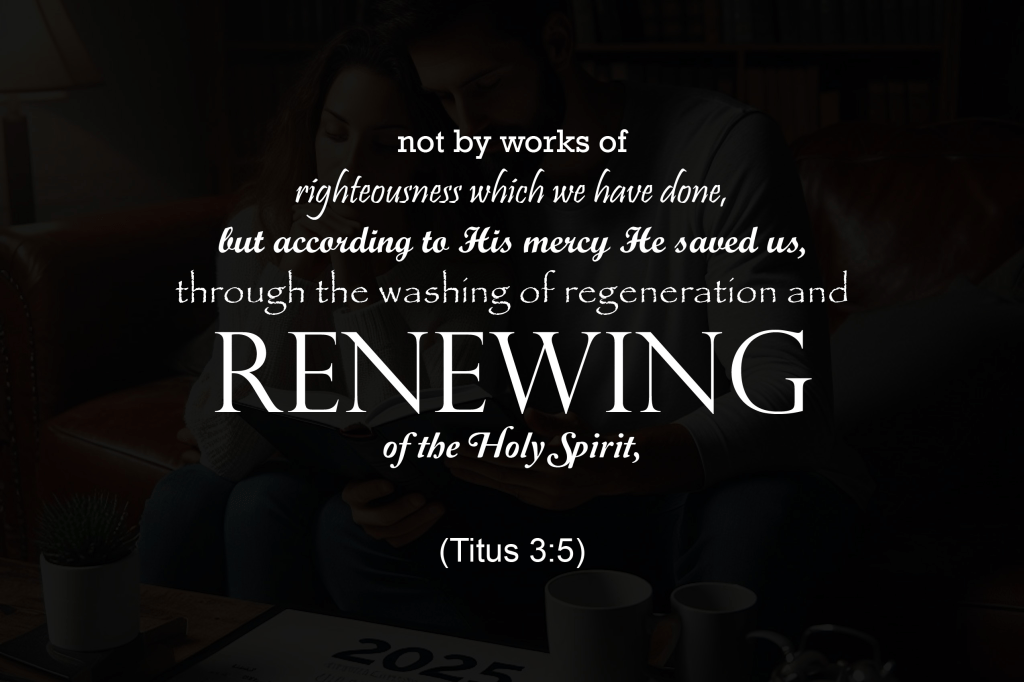
3 For we ourselves were once foolish, disobedient, led astray, slaves to various passions and pleasures, passing our days in malice and envy, hated by others and hating one another. 4 But when the goodness and loving kindness of God our Savior appeared, 5 he saved us, not because of works done by us in righteousness, but according to his own mercy, by the washing of regeneration and renewal of the Holy Spirit,” (Titus 3:3–5 (ESV)
The following message was preached by Pastor John Piper February 3, 2008. He entitled it Through Washing of Regeneration. The biblical text is Titus 3:5.
The Meaning of Grace: But God . . .
Then comes one of the most precious phrases in the Bible (verse 4): “But . . . God.” We were foolish, disobedient, led astray, slaves to sinful pleasures, malicious, envious, hated and hating. But . . . God . . . “But when the goodness and loving kindness of God appeared, he [God!] saved us.”
This is the same amazing sequence that we saw in Ephesians 2:3-5: “[We were] carrying out the desires of the body and the mind, and were by nature children of wrath, like the rest of mankind. But God, being rich in mercy, because of the great love with which he loved us, even when we were dead in our trespasses, made us alive together with Christ—by grace you have been saved.” We were dead, but God made us alive. This is the meaning of grace. The dead can do nothing to make themselves live. But God . . .
That’s what we have here in Titus 3:3-5. We were slaves to desires and pleasures that were so powerful we could not taste and see that the Lord was good. So far as our ability to know and trust and love God was concerned, we were dead. But . . . God. Verse 4-5: “But when the goodness and loving kindness of God our Savior appeared, he saved us, not because of works done by us in righteousness, but according to his own mercy, by the washing of regeneration and renewal of the Holy Spirit.”
How Does the New Birth Happen?
So we turn now to today’s question: How does God do it? How does the new birth happen? Just like we saw in the words of Jesus in John 3, Paul describes regeneration as a cleansing and a renewing. At the end of Titus 3:5, Paul says that God saved us “by the washing of regeneration and renewal of the Holy Spirit.” Regeneration is a kind of washing. And regeneration is a kind of renewal.
Recall that Jesus said in John 3:5, “Unless one is born of water and the Spirit, he cannot enter the kingdom of God.” So in John 3, you have born of water and the Spirit. And in Titus 3, you have washing of regeneration and renewal in the Holy Spirit.
My argument in John 3 was that this language of water and Spirit came from Ezekiel 36:25-27 where God promises his people,
I will sprinkle clean water on you, and you shall be clean from all your uncleannesses, and from all your idols I will cleanse you. And I will give you a new heart, and a new spirit I will put within you. . . . And I will put my Spirit within you, and cause you to walk in my statutes.
Jesus was saying that the time of the new covenant promises has arrived. Ezekiel’s promise is coming to pass by the Spirit in connection with me. The Spirit gives life (John 6:63). And I am the way the truth and the life (John 14:6). And when the Spirit connects you to me by faith you experience a new birth. And there are at least two ways to look at it: cleansing from all that is past and renewal for all that is future.
Both Clean and New
So when Paul says here in verse 5 that God “saved us . . . by the washing of regeneration and renewal of the Holy Spirit,” he means roughly the same thing: The promises of the new covenant have arrived. The beginning of the kingdom of God is here. The final universal “regeneration” has begun. And your new birth is a cleansing from all the sin that you have ever committed; and it is the creation of a new nature by the Holy Spirit. You are still you after the new birth. But there are two changes: You are clean, and you are new. That is what it means to be born again, regenerated.
How did God bring that about?
What Paul wants to emphasize here is that it is owing to the way God is, not owing to what we have done—even done in righteousness. Verses 4 and 5 give three descriptions of the way God is and puts this in contrast to anything we might try to do to be born again. “But when the goodness and loving kindness of God our Savior appeared, he saved us, not because of works done by us in righteousness, but according to his own mercy, by the washing of regeneration and renewal of the Holy Spirit.”
Salvation is the big overarching idea in this text (verse 5: “he saved us”). But the specific way he does it is regeneration. And Paul traces both of them back to God’s “goodness,” his “loving kindness” (verse 4), and his “mercy” (verse 5). This is Paul’s ultimate answer to how God regenerates sinners. God is good. God is loving. God is merciful.
More to come. May the Lord’s truth and grace be found here. Have a blessed day in the Lord.
Soli deo Gloria!

