2 in hope of eternal life, which God, who never lies, promised before the ages began.” (Titus 1:2 (ESV)
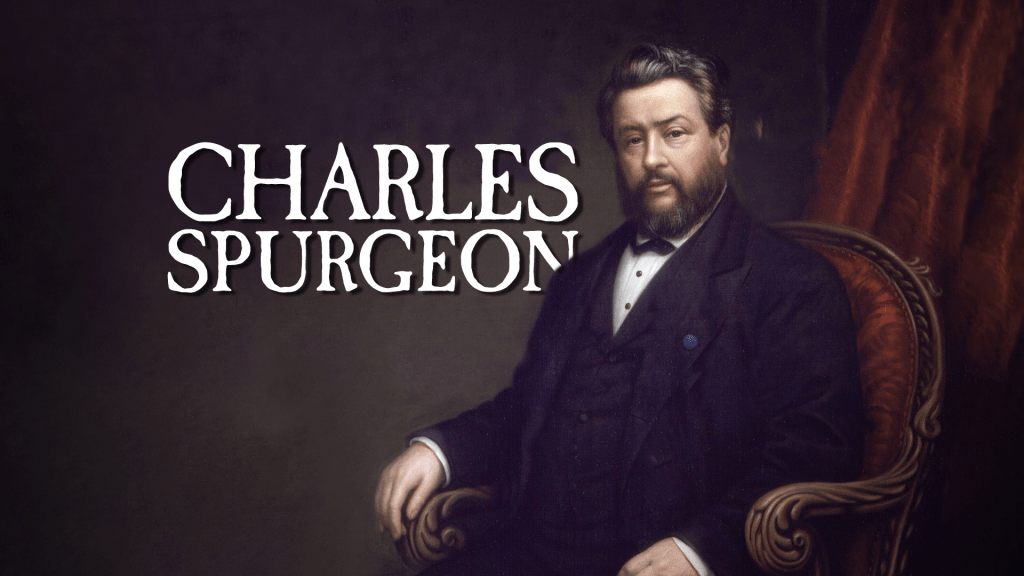
The following sermon was delivered on Sunday morning May 8, 1864 by the Rev. C. H. Spurgeon at the Metropolitan Tabernacle, Newington. The sermon text is Titus 1:2. The sermon title is What God Cannot Do.
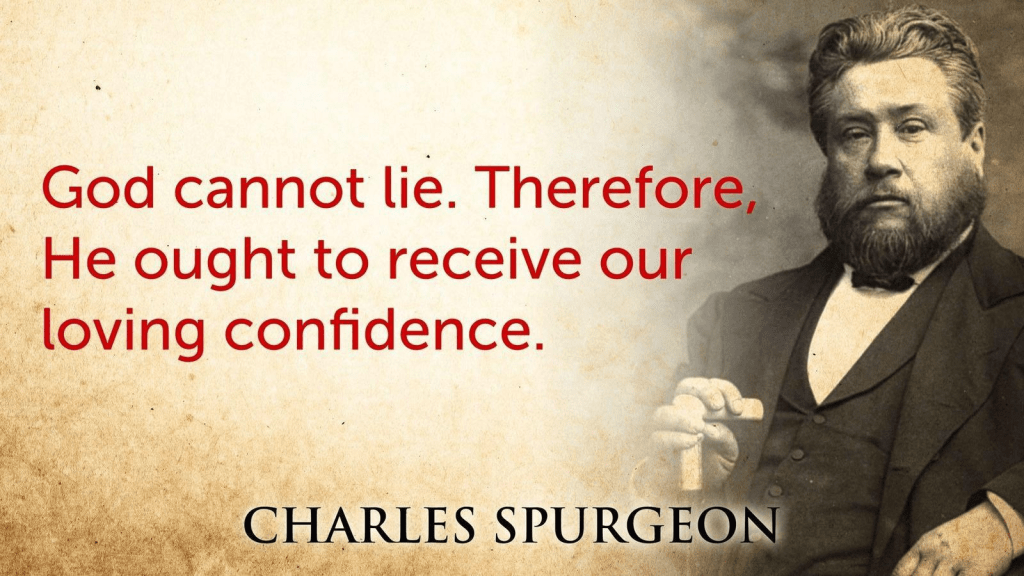
III. But I shall now come to make a practical use of the text, in the third place, by observing HOW WE OUGHT TO ACT TOWARDS GOD IF IT BE TRUE THAT HE IS A “GOD THAT CANNOT LIE.”
Brethren, if it be so that God cannot lie, then it must be the natural duty of all His creatures to believe Him. I cannot resist that conclusion. It seems to me to be as clear as noonday that it is every man’s duty to believe the truth, and that if God must speak and act truth, and truth only, it is the duty of all intelligent creatures to believe Him. Here is “Duty-faith” again, which some are railing at, but how they can get away from it, and yet believe that God cannot lie, I cannot understand.
If God has set forth the Lord Jesus Christ as the propitiation for sin, and has told me to trust Christ, it is my duty to trust Christ, because God cannot lie. And though my sinful heart will never believe in Christ as a matter of duty but only through the work of the Holy Spirit, yet faith does not cease to be a duty. And whenever I am unbelieving and have doubts concerning God, however moral my outward life may be, I am living in daily sin. I am perpetrating a sin against the first principles of morality.
If I doubt God, as far as I am able, I rob Him of His honor, and stab Him in the vital point of His glory. I am, in fact, living an open traitor and a sworn rebel against God, upon whom I heap the daily insult of daring to doubt Him.
Many believers cannot be comfortable without signs and evidences. When they feel in a good frame of mind—ah! then God’s promise is true, when they can pray heartily, when they can feel the love of God shed abroad in their hearts, then they say, “How God has kept His promise.”
Ah! but my brother, that is a seeing-faith. “Blessed are they that have not seen, and yet have believed.” Faith is to believe in God when my heart is as hard as the nether millstone, when my frames are bad, when I cannot pray, when I cannot sing, when I can do nothing good. To say, “He has promised.
Come now, will you kick against the promise because of its greatness? Do not so, but let your doubts and fears be hushed to sleep, and now with the promise of God as your pillow, and God’s faithfulness as your support, lie down in peace, and behold in faith’s open vision the ladder the top whereof leads to heaven. Trust the promise of God in Christ, and depend upon it that He will be as good to you, even to you, as His own Word, and in heaven you shall have to sing of the “God, that cannot lie.”
I would that these weak words of mine, for I am very conscious of their feebleness this morning, may nevertheless have comfort in them for any who have been doubting and fearing, that they may trust my Lord. And sure, I am that if they begin a life of faith, they will begin a life of happiness and of security. “The just shall live by faith,” and well may they do so, when they have to trust in a “God, that cannot lie.”
2 in hope of eternal life, which God, who never lies, promised before the ages began.” (Titus 1:2 (ESV)
The following sermon was delivered on Sunday morning May 8, 1864 by the Rev. C. H. Spurgeon at the Metropolitan Tabernacle, Newington. The sermon text is Titus 1:2. The sermon title is What God Cannot Do.
II. Let us pass on to look at THE BREADTH OF MEANING IN THE TEXT.
When we are told in Scripture that God cannot lie, there is usually associated with the idea the thought of immutability. As for instance— “He is not a man that he should lie, nor the son of man that he should repent.” The word “lie,” here includes beyond its ordinary meaning the thought of change, so that when we read that God cannot lie, we understand by it not only that He cannot say what is untrue, but that having said something which is true He never changes from it, and does not by any possibility alter His purpose or retract His word.
This is very consolatory to the Christian, that whatever God has said in the divine purpose is never changed. The decrees of God were not written upon sand, but upon the eternal brass of His unchangeable nature. We may truly say of the sealed book of the decrees, “Hath he said and shall he not do it? hath he purposed and shall it not come to pass?”
We read in Scripture of several instances where God apparently changed, but I think the observation of the old Puritan explains all these. He says, “God may will a change, but He cannot change His will.” Those changes of operation which we sometimes read of in Scripture did not involve any change in the divine purpose.
God wills a change, but He never changes His will. And when the last great day shall come, you and I shall see how everything happened according to that hidden roll wherein God had written with His own wise finger every thought which man should think, every word which he should utter, and every deed which he should do. Just as it was in the book of decree, so shall it transpire in the roll of human history.
But we must not, while talking in this manner, forget the primary meaning, that He cannot be false in His thoughts, words, or actions. There is no shadow of a lie upon anything which God thinks, or speaks, or does. He cannot lie in His prophecies. How solemnly true have they been! Ask the wastes of Nineveh. Turn to the mounds of Babylon. Let the traveler speak concerning Idumean and Petra. Turn even to the rock of Sidon, and to Your land, O Immanuel.
As God is true in His prophecies, so is He faithful to His promises. Have you and I, dear friends, a confidence in these? If so, let us try them this morning. Sinner, weeping and bemoaning yourself, God will forgive you your sin if you believe in Jesus. If you will confess that He is faithful and just to forgive you, He has promised to do so, and He cannot lie.
Christian, if you have a promise today laid upon your heart, if you have been pleading it, perhaps for months, and it has not been fulfilled, I pray you gather fresh courage this morning, and again renew your wrestling. Go and say, “Lord, I know You cannot lie, therefore fulfill Your word unto Your servant.”
His threatening’s are true also. Ah! sinner, you may go on in your ways for many a day, but your sin shall find you out at last. Seventy years God’s long-suffering may wait over you, but when you shall come into another world you shall find every terrible word of Scripture fulfilled. You shall then know that there is a place, “where their worm dieth not, and the fire is not quenched.” You shall then experience the “wailing and gnashing of teeth” unless you repent. If you will believe in Jesus, you shall find the promise true, but if you will not, equally sure shall be the threatening.
We might thus go through everything which concerns God, from prophesy to promises, and threatening’s, and onwards, and multiply observations, but we choose to close this point by observing that every word of instruction from God is most certainly true.
It is astounding how much sensation is caused in the Christian church by the outbreak every now and then of fresh phases of infidelity. I do not think that these alarms are at all warranted. It is what we must expect to the very end of this dispensation. If all carnal minds believed the Bible, I think the spiritual might almost begin to doubt it. But as there are always some who will attack it, I shall feel none the less confidence in it.
Beloved, we may rest assured that we have not a word in the book of God which is untrue. There may be an interpolation or two of man’s which ought to be revised and taken away, but the Book as it comes from God is truth, and nothing but truth. Not only containing God’s Word, but being God’s Word; being not like a lump of gold inside a mass of quartz, but all gold, and nothing but gold, and being inspired to the highest degree. I will not say verbally inspired, but more than that, having a fullness more than that which the letter can convey, having in it a profundity of meaning such as words never had when used by any other being, God having the power to speak a multitude of truths at once.
Nothing can set forth in words to us the hatred and detestation which God has in His heart of anything which is untrue. O that we knew and felt this, and would glow with the same anger, seeking to exterminate the false, slaying it in our own hearts, and giving it nothing to feed upon in our temper, our conversation, or our deeds.
2 in hope of eternal life, which God, who never lies, promised before the ages began.” (Titus 1:2 (ESV)
The following sermon was delivered on Sunday morning May 8, 1864 by the Rev. C. H. Spurgeon at the Metropolitan Tabernacle, Newington. The sermon text is Titus 1:2. The sermon title is What God Cannot Do.
Again, we all know that God is too wise to lie. Falsehood is the expedient of a fool. It is only a shortsighted man who lies. For some present advantage the poor creature who cannot see the end as well as the beginning states that which is not, but no wise man who can look far into the future ever thinks a lie to be profitable. He knows that truth may suffer loss at first, but that in the long run she is always successful. He endorses that worldly-wise proverb that “Honesty is the best policy” after all, and the man, I say, who has anything like foresight, or judgment, or wisdom, prefers always the straight line to the curve, and goes directly to the mark, believing that this is in the end the best.
Do you suppose that God, who must know this, with an intensity of knowledge infinitely greater than ours, will choose the policy of the witless knave. Shall God, only wise, who sees the end from the beginning, act as only brainless fools will choose to behave themselves? Oh! it cannot be, my brethren. God, the all-wise, must also be all-true.
And the lie, again, is the method of the little and the mean. You know that a great man does not lie. A good man can never be false. Put goodness and greatness together, and a lie is altogether incongruous to the character. Now God is too great to need the lie, and too good to wish to do such a thing, both His greatness and His goodness repel the thought.
My dear friends, what motive could God have for lying? When a man lies it is that he may gain something, but “the cattle on a thousand hills” are God’s, and all the beasts of the forest, and all the flocks of the meadows. He says, “If I were hungry, I would not tell thee.” Mines of inexhaustible riches are His, and treasures of infinite power and wisdom. He cannot gain aught by untruth, for “the earth is the LORD’s, and the fullness thereof,” wherefore, then, should He lie?
Men are false oftentimes to win applause. See how the sycophant cringes to the tyrant’s foot, and spawns his villainy. But God needs no honor and no fame, especially from the wicked. To Him it was the greatest disgust of His righteous soul to be loved by unholy creatures. His glory is great enough even if there were no creatures. His own self-contained glory is such that if there were no eyes to see it, and no ears to hear it, He would be infinitely glorious. He asks nothing, no respect and no honor of man, and therefore has He no need to stoop to the lie to gain it.
And of whom, again, could He be afraid? Men will sometimes, under the impulse of fear, keep back or even contradict the truth, but can fear ever enter into the heart of the eternal God? He looks down upon all nations who are in rebellion against Him, and He does not even care to rise to put them down. “He that sitteth in the heavens shall laugh: the LORD shall have them in derision!”
Moreover, dear friends, we may add to all this the experience of men, with regard to God. It has been evident enough in all ages that God cannot lie. He did not lie when Adam fell. It seemed a strange thing, that after all the skill and labor which had been spent in making such a world as this, so fair and beautiful, God should resign it to the dominion of Satan, and drive the man whom He had made in His own image, out of his home, his Eden, to labor in sweat, and toil, and suffering, until he came to his grave. But God did it, and the fiery sword at the gate of Eden was proof that God could not and would not lie.
He might come to Adam, and bemoan Himself, crying, “Adam, where art thou?” as if He pitied him, and would, if it had been possible, have spared the stroke. But still it must be done, and Eden is blasted, and Adam becomes a wanderer upon the fruitless earth.
Then afterwards, to quote a notable instance of God’s faithfulness, when the flood swept away the race of men, and Noah came forth the heritor of a new covenant, we have clear proof that God cannot lie. No flood has ever destroyed the earth since then. Partial floods there have been, and parts of provinces have been inundated, but no flood has ever come upon the earth of such a character as that which Noah saw. Hence the rainbow, every time it is painted upon the cloud, is an assurance to us that God cannot lie.
Then He made an oath with Abraham that he should have a son, and that his seed should become possessors of all the land in which the patriarch had sojourned. Did not that come true? They waited in Egypt two hundred years. They smarted under the tyrant’s lash. They lay among the pots, and yet, after all, with a high hand and with an outstretched arm He brought forth His people, led them through the wilderness and divided Canaan by lot to them, having driven out the inhabitants of the land before them.
Since that time, He made His covenant with David, and how fast has that stood! All the threatening’s which He has uttered against the enemies of Israel, how surely have they been fulfilled! Last of all, and best of all, when the fullness of time was come, did not God send forth His own Son, born of a woman, made under the law? Did He not, according to His ancient promise, lay upon Him the iniquity of us all?
Was not the incarnation and death of our Lord Jesus the grandest proof of the truthfulness of God which could be afforded. His own Son must leave heaven emptied of its glory, must be given up to be despised and rejected of men, must be nailed to the accursed wood, and be forsaken in the hour of His bitterest grief, herein is truth indeed.
May I not add as another argument that you have found Him true! You have been to Him, dear friends, in many times of trial. You have taken His promise and laid it before His mercy seat, what say you, has He ever broken His promise? You have been through the floods—did He leave you? You have passed through the fires—were you burned? You have cried to Him in trouble—did He fail to deliver you?
O ye poor and needy ones, you have been brought very low, but has He not been your helper? You have passed hard by the gates of the grave, and hell has opened its horrid jaws to swallow you up, but are you not today the living monuments of the fidelity of God to His promise, and the veracity of every word of the Most High God? Let these things, then, refresh your memories that you may the more confidently know that He is “God, that cannot lie.”
2 in hope of eternal life, which God, who never lies, promised before the ages began.” (Titus 1:2 (ESV)
The following sermon was delivered on Sunday morning May 8, 1864 by the Rev. C. H. Spurgeon at the Metropolitan Tabernacle, Newington. The sermon text is Titus 1:2. The sermon title is What God Cannot Do.
After wandering over the sandy desert of deceit, how pleasant it is to reach our text, and feel that one spot at least is verdant with eternal truth. Blessed be Thou, O God, for Thou canst not lie.
We will use our text in the following manner this morning. First, while we do not attempt to prove it, we will remind you of a few things which may confirm your confidence that God cannot lie, so that our opening remarks shall be upon the truth of the text. Then secondly, we will speak upon the breadth of the text, endeavoring to show that we must give no narrow interpretation to the words before us, but must receive them with an extent of meaning not usual to the expression. And then, thirdly, we will try to use the text for our own improvement, arguing from it that if God cannot lie, He ought to receive our loving confidence.
First then, let us commune together awhile concerning THE TRUTH OF THE TEXT, not, as we have said, to prove it, because we all believe it, but to confirm our confidence thereon.
I think we shall feel assured that God cannot lie, when we remember that He is not subject to those infirmities which lead us into falsehood. Lord Bacon has said, “There are three parts in truth: first, the inquiry, which is the wooing of it; secondly, the knowledge of it, which is the presence of it; and thirdly, the belief, which is the enjoyment of it.” In each of these three points, by reason of infirmity, men fail to be perfectly true.
In the search after truth, our moral eye is not altogether clear, and therefore we fail to see what we love not. We do not follow truth in a straight line, but are very liable to turn aside to the right hand or to the left, either to obey our prejudices or advance our profit. “Truth lies in a well,” said the old philosopher. Many go down into that well to find truth, but looking into the water they see their own faces, and become so desperately enamored of their own beauty that they forget poor truth, or dream that she is the counterpart of themselves.
Now the great God cannot be liable to this error, because there is no discovery of truth with Him. He needs not to search anything out, for “all things are naked and opened unto the eyes of him with whom we have to do.” When in Scripture that term is sometimes used— “Shall not God search this out?” when we hear Him spoken of as “searching the heart and trying the reins of the children of men,” it is not because He is not perfectly acquainted with all things, but only to set forth the certainty and accuracy of divine knowledge. God having no need to search, or if He had, having nothing in Him which should lead Him to make a dishonest search, therefore He does not lie.
When we have searched out the truth there is the knowing of it. And here the falsehood gets a footing in the form of a sin of omission, for we often refuse to know all that we might know. It would be inconvenient perhaps, for us to be too well acquainted with certain arguments, for then our prejudices must be given up, and therefore we close our eyes to them for fear of knowing the truth. Do not many men leave passages of Scripture altogether unread because they have no wish to receive the doctrines which are taught in them? Every time you refuse to give a hearing to God’s truth, you do in effect lie, because you prefer not to know the truth, which is really to prefer to hold error.
Now nothing of this kind can ever happen with our only wise God. He knows all truth, seeing it all at a glance, and retaining it ever in His mind. In nothing is He ignorant, either willfully or otherwise. He receives truth as His own beloved, and when the world casts her out, truth finds a happy shelter beneath His shield. We are quite clear that we frequently fall into the lie through a defect in our believing, for we sometimes know more than we care to believe.
Truth is grasped by the understanding, but thrust out by the affections. We know her as Peter knew his Lord, and yet deny it after the same fashion as that disciple did his Master. Moreover, through weakness, we are led to doubt what we know to be God’s truth, and even to speak unadvisedly with our lips.
Now this can never occur with God, since God is one, and is not to be divided into parts and passions, and His tongue can never be diverse from His heart. God’s tongue is His heart, and God’s heart is His hand. God is one. You and I are such that we can know in the heart, and yet with the tongue deny. But God is one and indivisible, God is light, and in Him is no darkness at all, with Him is no variableness, neither shadow of turning.
Then, again, the Scriptural idea of God forbids that He should lie. Just review your thoughts about God, if you can. What idea have you formed of Him? If you have read Holy Scripture, and have gotten the slightest shadow of an idea of God, I think you will see that it is utterly inconsistent with the thrice Holy One, whose kingdom is over all, that He could lie. Admit the very possibility of His speaking an untruth, and to the Christian there would be no God at all.
The depraved mind of the heathen may imagine a monster to be a god who can live in adultery, and in theft, and in lying, for such the gods of the Hindus are described as being, but the enlightened mind of the Christian can conceive no such thing. The very word “God” comprehends everything which is good and great. Admit the lie, and to us at once there would be nothing but the black darkness of Atheism forever. I could neither love, worship, nor obey a lying God.
2 in hope of eternal life, which God, who never lies, promised before the ages began.” (Titus 1:2 (ESV)
The following sermon was delivered on Sunday morning May 8, 1864 by the Rev. C. H. Spurgeon at the Metropolitan Tabernacle, Newington. The sermon text is Titus 1:2. The sermon title is What God Cannot Do.
TRUTH once reigned supreme upon our globe, and then earth was paradise. Man knew no sorrow while he was ignorant of falsehood. The Father of Lies invaded the garden of bliss, and with one foul lie he blighted Eden into a wilderness, and made man a traitor to his God. Cunningly he handled the glittering falsehood and made it dazzle in the woman’s eyes—“God doth know that in the day ye eat thereof, then your eyes shall be opened, and you shall be as gods, knowing good and evil.” Proud ambition rode upon that lie as a conqueror in his chariot, and the city of Mansoul opened its gates to welcome the fascinating enemy.
As it was a lie which first subjugated the world to Satan’s influences, so it is by lies that he secures his throne. Among the heathen his kingdom is quiet and secure, because the minds of the people are deluded with a false mythology. The domains of Mohammed and the Pope are equally the kingdom of Satan, and his reign is undisturbed, for human merit, priestly efficacy, and a thousand other deceptions buttress his throne. The darkness of ignorance, the dungeons of falsehood, and the chains of superstition are the main reliance of that monster who oppresses all the nations with his infernal tyranny.
Since by the lie Satan now holds the world and maintains his power, he everywhere encourages lies and aids their propagation. Look about you and see what a prolific family falsehood has! The children of the untrue are as many as the frogs of Egypt, and like those plagues they intrude into every chamber. The slime of falsehood may be seen upon most things, both in secular and religious life. You have lying news and garbled reports in print, and as for the flying gossip of the tongue, if it touches the characters of good men, beware of believing a word it utters.
If you would not have complicity with those who make the lie, be not hasty to entertain it. From the high places of the earth falsehood is not excluded. The untruth glides right royally from the kingly tongue, but is as much a lie as if the ragged mendicant had blurted it forth with low-lived oaths and curses.
What is diplomacy for the most part? Is it not “the art of lying”? Was not he thought to be the best politician who used language to conceal his thoughts? In how many a conference have the plenipotentiaries labored which could overreach, dissimulate, and intrigue to the greatest degree? In the commerce of courts, who knows not that flatteries and lies are the most abundant commodities? The art of king-craft, as practiced by the Most High and Mighty Prince James, whose name dishonors our English Bible, was only and simply the science of lying in the neatest possible manner.
In these modern times, the difference between the promises of the hustings and the performances in the House of Commons proves that the lie is still commonly patronized. Falsehood is everywhere. It is entertained both by the lowest and the highest. It permeates all society. It has ruined the whole of our race, and so defiled the entire world that upright men exclaim, “Woe is me, that I sojourn in Mesech, that I dwell in the tents of Kedar!”
In the so-called religious world, which should be as the holy of holies, here too, the lie has insinuated itself. Of old there were prophets who prophesied lies, and dreamers of false dreams. And there were others who spoke the word of God with such bated breath, and after such a fashion, that it was no longer the truth as it came from God, but truth alloyed with human falsehood. It is so today.
There are those wearing the vestments of God’s priests who do not hesitate to profess what they do not believe. Such men are the priests of hell. To wear a bishop’s miter and teach infidelity—how shall I stigmatize it?—it is nothing less than detestable hypocrisy and robbery. And what shall I say of men of all creeds, all subscribing to the same articles and catechism, when all the world knows they cannot all honestly believe the same thing, and yet differ as much from one another as light from darkness?
What shall I say but that shame covers my face that there should be so many ministers of God who are untrue to their convictions, and continue to do and say what they feel to be unscriptural? In other quarters philosophy is believed and Christianity professed. The traditions of men are put in the place of God’s truth. The prophets prophesy lies, and the people love to have it so.
Brethren, we have everywhere to battle with falsehood, and if we are to bless the world, we must confront it with sturdy face and zealous spirit. God’s purpose is to drive the lie out of the world, and let this be your purpose and mine. His Holy Spirit has undertaken to drive falsehood out of our hearts, be this our determination, in His strength, that it shall be cut up root and branch, and utterly consumed. Then let us walk in the truth, “Buy the truth, and sell it not,” hold fast the truth, speak the truth in love, and act the truth in all our deeds, for so shall we be known to be the children of that God of whom our text asserts that He is “God, that cannot lie.”
“Paul, a servant of God and an apostle of Jesus Christ, for the sake of the faith of God’s elect and their knowledge of the truth, which accords with godliness, 2 in hope of eternal life, which God, who never lies, promised before the ages began.” (Titus 1:1–2 (ESV)
The ultimate purpose of the Apostle Paul’s service solely of God and apostleship solely of Jesus Christ he clearly declared. It was initially for the faith of God’s elect and their knowledge of the truth resulting in their godliness. However, ultimately it was for the hope of eternal.
In the Scriptures, hope (ἐλπίδι; elpidi) is never a wish. Rather, it is a confident expectation of what will happen, and not what might or could happen. How can the believer in Christ be so confident their hope of eternal life in Christ is more than just a wish?
The believer can be confident of eternal life because the promise for such a life is from God. The reason Paul gives for such confidence in God is because God never lies (Num. 23:19; 2 Tim. 2:13; Heb. 6:18). Additionally, God’s promise for eternal life originated before the ages began. Paul also stated this truth as did the Apostles.” Peter and John.
Ephesians 1:3–4a (ESV) – “3 Blessed be the God and Father of our Lord Jesus Christ, who has blessed us in Christ with every spiritual blessing in the heavenly places, 4 even as he chose us in him before the foundation of the world, that we should be holy and blameless before him.”
2 Timothy 1:8–9 (ESV) – “8 Therefore do not be ashamed of the testimony about our Lord, nor of me his prisoner, but share in suffering for the gospel by the power of God, 9 who saved us and called us to a holy calling, not because of our works but because of his own purpose and grace, which he gave us in Christ Jesus before the ages began.”
1 Peter 1:17–21 (ESV) – “17 And if you call on him as Father who judges impartially according to each one’s deeds, conduct yourselves with fear throughout the time of your exile, 18 knowing that you were ransomed from the futile ways inherited from your forefathers, not with perishable things such as silver or gold, 19 but with the precious blood of Christ, like that of a lamb without blemish or spot. 20 He was foreknown before the foundation of the world but was made manifest in the last times for the sake of you 21 who through him are believers in God, who raised him from the dead and gave him glory, so that your faith and hope are in God.”
Revelation 13:7–8 (ESV) – “7Also it was allowed to make war on the saints and to conquer them. And authority was given it over every tribe and people and language and nation, 8 and all who dwell on earth will worship it, everyone whose name has not been written from the foundation of the world in the book of life of the Lamb who was slain.”
“Now all that has been said so far—Paul’s service and apostleship in the interest of the faith of God’s elect and of their acknowledgment of the truth which accords with godliness—rests on the hope of life everlasting, which the never-lying God promised before times everlasting. This hope is an earnest yearning, confident expectation, and patient waiting for “life everlasting,” salvation in its fullest development (cf. John 17:24; Rom. 8:25). It was this salvation which the God who cannot lie (1 Sam. 15:29; Heb. 6:18; cf. 2 Tim. 2:13; contrast Titus 1:12) “promised before times everlasting.”[1]
“This “before the foundation of the world” doctrine, the exact phraseology, is not only Johannine but also definitely Pauline. Note Eph. 1:4, “He elected us for himself in him (i.e., in Christ) before the foundation of the world. Thus interpreted, Titus 1:2 is entirely in harmony with Pauline thinking, which regularly traces the salvation of believers to its origin in God’s redemptive plan from eternity (besides 2 Tim. 1:9 and Eph. 1:4 see also Rom. 8:29, 30; 1 Cor. 2:7; 2 Thess. 2:13; and see N.T.C. on 1 Thess. 1:4).[2]
“Why does Paul insert here the statement, who does not lie, in reference to God? Titus would surely have been in no doubt about this. His intention must be to underline the reliability of God’s promises. The further words before the beginning of time draw attention to the fact that those promises are grounded in God’s eternal purposes. Linked with this eternal view of God’s purposes is the appointed time of the bringing of his word to light, that is at the incarnation. The words here are reminiscent of the opening of John’s gospel.” [3]
May the Lord’s truth and grace be found here.
Soli deo Gloria!
[1] William Hendriksen and Simon J. Kistemaker, Exposition of the Pastoral Epistles, vol. 4, New Testament Commentary (Grand Rapids: Baker Book House, 1953–2001), 340–341.
[3] Donald Guthrie, “Titus,” in New Bible Commentary: 21st Century Edition, ed. D. A. Carson et al., 4th ed. (Leicester, England; Downers Grove, IL: Inter-Varsity Press, 1994), 1312.
“Paul, a servant of God and an apostle of Jesus Christ, for the sake of the faith of God’s elect and their knowledge of the truth, which accords with godliness,” (Titus 1:1 (ESV)
“Paul’s fellow-servant Titus first appears in Galatians 2:1–10, wherein the gospel of grace apart from the works of the Law was vindicated when the Jerusalem apostles did not require him to be circumcised. Thus, unlike Timothy, Titus was a Gentile convert to Christ Jesus. As one of Paul’s closest associates, Titus seems to have been gifted for navigating contentious situations. From 2 Corinthians 7–8 and 12 we learn that Titus both delivered Paul’s difficult letter to the Corinthian church and collected money in Corinth for the church in Jerusalem,” explains one biblical commentator.
“At the time he received his letter from Paul, Titus was leading the church on Crete, which was apparently in its infancy. We infer this from the fact that while Timothy had to reform a church already in place at Ephesus (1 Tim. 1:3), Titus was going to be the first one to appoint elders on Crete (Titus 1:5). Like Timothy, Titus also had to deal with false teaching, as we will see in the days ahead.”
As previously noted, biblically, there are three aspects to justification by faith alone. In the Latin, they are Notitia, Assensus, and Fiducia.
Notitia. Notitia refers to the content of faith, or those things that we believe. We place our faith in something, or more appropriately, someone. In order to believe, we must know something about that someone, who is the Lord Jesus Christ.
Assensus. Assensus is our conviction that the content of our faith is true. You can know about the Christian faith and yet believe that it is not true. Genuine faith says that the content — the notitia taught by Holy Scripture — is true.
Fiducia. Fiducia refers to personal trust and reliance. Knowing and believing the content of the Christian faith is not enough, for even demons can do that (James 2:19). Faith is only effectual if, knowing about and assenting to the claims of Jesus, one personally trusts in Him alone for salvation.
When God enables the sinner to exercise faith, it involves all three aspects (Eph. 2:1-10). This justifying trust, commitment, dependence worship of the person and work of Jesus Christ delivers the sinner from the penalty of sin, the power of sin and eventually the presence of sin. The result of God’s deliverance, or salvation, of the sinner results in a changed life in the here and now which foreshadows the eternal change of life in heaven. It was this three-fold aspect of justifying faith the Apostle Paul had in mind when he began his letter to his young protégé Titus.
After he identified himself as a servant of God and an apostle of Jesus Christ, the Apostle Paul expressed the vision and mission of his God-ordained ministry. Paul wrote this epistle and served the Lord “for the sake of the faith of God’s elect and their knowledge of the truth, which accords with godliness,”
The phrase for the sake of (κατὰ; kata) is one word in the Greek. It means in accordance with or in relationship to an object. In this particular instance, the object was the faith of God’s elect. Faith (πίστιν; pistis) refers to an intellectual, emotional, and volitional trust. commitment, dependance and worship of Jesus Christ. It is only possessed by the elect (ἐκλεκτῶν; eklekton) or only the ones who God alone has chosen.
When Paul wrote of faith, it was in reference to a blind faith. Rather, he spoke of a trust, commitment, dependence and worship centered in a knowledge of the truth. Knowledge (ἐπίγνωσιν; epignosin) refers to a recognition or understanding of reality. Truth (ἀληθείας; aletheias) is reality or the way things are. Paul referred to the truth and reality of the Gospel, which sets forth the doctrines of God’s existence, sin’s existence, the Savior Jesus Christ’s existence and salvation’s existence (John 1:1-18).
This understanding of the Gospel results in a changed life for reach individual believer in Christ. The apostle identified it as godliness (εὐσέβειαν; eusebeian). Godliness is “the devout practice and appropriate beliefs of God; (Acts 3:12; 1Tim. 2:2; 3:16; 4:7, 8; 6:3, 5, 6, 11; 2 Tim. 3:5; Titus 1:1; 2 Peter 1:3, 6, 7; 3:11).[1]
“The service and apostleship are exercised “in the interest of” (that seems to be the meaning of κατά here; cf. John 2:6; 2 Cor. 11:21) the faith of God’s elect and (their) acknowledgment of the truth which accords with godliness; that is, they are carried out in order to further or promote the reliance of God’s chosen ones upon him, and their glad recognition or confession of the redemptive truth which centers in him; a truth which, in sharp contrast with the vagaries of false teachers, accords with (or here also “is in the interest of,” “promotes”) godliness, the life of Christian virtue, the spirit of true consecration,” explains Dr. William Hendriksen.[2]
“Paul began by identifying himself as a servant of God. Usually, no doubt as a result of his Damascus Road experience (Acts 9:1–9), Paul called himself a “servant of Christ Jesus.” Only here did he use the term “servant of God.” On the other hand, apostle of Jesus Christ is standard. Both of these titles (“servant” and “apostle”) focus on Paul’s two main concerns: the faith of God’s elect (cf. Rom. 8:33; Col. 3:12) and the knowledge of the truth that leads to godliness (cf. 1 Tim. 2:4; 2 Tim. 2:25; 3:7). God was using Paul to call out a people for Himself (e.g., 1 Thes. 1:2–10) and to teach them the truth which is conducive to godly living (cf. 1 Tim. 6:3). In other words, Paul’s ministry was aimed at both the salvation and sanctification of God’s people.”[3]
[2] William Hendriksen and Simon J. Kistemaker, Exposition of the Pastoral Epistles, vol. 4, New Testament Commentary (Grand Rapids: Baker Book House, 1953–2001), 340.
[3] A. Duane Litfin, “Titus,” in The Bible Knowledge Commentary: An Exposition of the Scriptures, ed. J. F. Walvoord and R. B. Zuck, vol. 2 (Wheaton, IL: Victor Books, 1985), 761.
“Paul, a servant of God and an apostle of Jesus Christ, for the sake of the faith of God’s elect and their knowledge of the truth, which accords with godliness,” (Titus 1:1 (ESV)
“When we think back to the first few decades after Pentecost, we are often tempted to think that the early church functioned as an ideal community in which everything was done properly and in order. By this point, however, our study of Paul’s career should have disabused us of this notion. From the first of his epistles, Galatians, to the final letters he wrote, the Pastorals (1 and 2 Timothy, Titus), we see that the church had problems from the start, problems the apostle addresses in nearly all of his writings,” explains Dr. R. C. Sproul.
Biblically, there are three aspects to justification by faith alone. In the Latin, they are Notitia, Assensus, and Fiducia.
Notitia. Notitia refers to the content of faith, or those things that we believe. We place our faith in something, or more appropriately, someone. In order to believe, we must know something about that someone, who is the Lord Jesus Christ.
Assensus. Assensus is our conviction that the content of our faith is true. You can know about the Christian faith and yet believe that it is not true. Genuine faith says that the content — the notitia taught by Holy Scripture — is true.
Fiducia. Fiducia refers to personal trust and reliance. Knowing and believing the content of the Christian faith is not enough, for even demons can do that (James 2:19). Faith is only effectual if, knowing about and assenting to the claims of Jesus, one personally trusts in Him alone for salvation.
When God enables the sinner to exercise faith, it involves all three aspects (Eph. 2:1-10). This justifying trust, commitment, dependence worship of the person and work of Jesus Christ delivers the sinner from the penalty of sin, the power of sin and eventually the presence of sin. The result of God’s deliverance, or salvation, of the sinner results in a changed life in the here and now which foreshadows the eternal change of life in heaven. It was this three-fold aspect of justifying faith the Apostle Paul had in mind when he began his letter to his young protégé Titus.
Paul began this letter as he began his other epistles. He identified himself; not only by his given name but also by his God-give position and resp0onjsbilites.” “Paul, a servant of God and an apostle of Jesus Christ.”
A servant (δοῦλος; doulos) means a slave who is the property of an owner. Paul was the sole property of God (θεοῦ; theou). The Greek noun for God is in the genitive case. It is a genitive of possession. Paul was the sole possession of God.
“Letters customarily opened with the name of the sender. It could be prestigious to be the slave in a high-status household, and the Old Testament prophets were often called “servants of God.” Judaism believed that Jewish people were chosen for salvation by virtue of their corporate participation in Israel; perhaps especially to counter false teachers in Crete (1:10), Paul applies the term to all believers in Jesus (though he usually does so anyway).”[1]
Paul was also an apostle (ἀπόστολος; apostolos). This refers to one who was a special messenger. In the first century of the church, it was a title reserved for the immediate twelve disciples of Jesus Christ and also those who communicated the Gospel. As with being God the Father’s servant, Paul was an apostle solely belonging to and the possession of Jesus Christ.
“This is a considerably longer greeting than in either 1 or 2 Timothy. It is in fact more theological. Only here does Paul specifically describe himself as servant of God, although he does elsewhere call himself ‘servant of Jesus Christ’. The more usual apostle of Jesus Christ is nevertheless added and then developed.”[2]
“Paul is God’s servant (“servant” also in Rom. 1:1; Phil. 1:1; cf. James 1:1; 2 Peter 1:1, but note variation in modifiers), and has received his authoritative commission directly from Jesus Christ, being therefore his apostle.”[3]
Are you God’s sole possession? This occurs only by grace alone, through faith alone in the person and work of Jesus Christ alone. When you repent of sin and place faith in Christ, you not only began possessing justification, redemption and reconciliation with God, you also became the possession of God. Hallelujah!
[2] Donald Guthrie, “Titus,” in New Bible Commentary: 21st Century Edition, ed. D. A. Carson et al., 4th ed. (Leicester, England; Downers Grove, IL: Inter-Varsity Press, 1994), 1311.
[3] William Hendriksen and Simon J. Kistemaker, Exposition of the Pastoral Epistles, vol. 4, New Testament Commentary (Grand Rapids: Baker Book House, 1953–2001), 340.
“Paul, a servant of God and an apostle of Jesus Christ, for the sake of the faith of God’s elect and their knowledge of the truth, which accords with godliness,” (Titus 1:1 (ESV)
The following article is by Lee Gatiss. He is an author in the Reformed and Evangelical tradition of the Church of England, and an author of books and articles on the Bible, theology, Anglicanism, and church history. This essay, entitled Three Things to Know about Titus, appeared December 6, 2023 in Tabletalk Magazine published by Ligonier Ministries.
Titus is one of the Pastoral Epistles, which is an eighteenth-century term for the books of 1 and 2 Timothy and Titus because they are letters from the Apostle Paul to his fellow pastors. Here are three important things to keep in mind as you read this letter.
1. Titus is about the truth that leads to godliness.
At the beginning of his letter to Titus, Paul says that he is “an apostle of Jesus Christ, for the sake of the faith of God’s elect and their knowledge of the truth, which accords with godliness” (Titus 1:1). The stress on truth and godliness continues throughout the letter: these things must always go together.
When it comes to describing the sort of people Titus is to appoint as elders in the churches on Crete, Paul is very clear that they must be “above reproach” and that they must “hold firm to the trustworthy word as taught” (Titus 1:6–9). Conversely, the false teachers that Titus has to wrestle with “profess to know God, but they deny him by their works”—which shows they are wrong in both lip and life, in their teaching as well as their behavior (Titus 1:16).
To counter this, Titus is to “teach what accords with sound doctrine,” since the same grace of God, which offers salvation to all, also teaches us to “renounce ungodliness and worldly passions” (Titus 2:1, 11–12). If we miss that connection between truth and godliness, we have missed the main point of this letter.
2. Paul calls Jesus “God.”
In chapter 2, Paul says that Christians are “to live self-controlled, upright, and godly lives in the present age, waiting for our blessed hope, the appearing of the glory of our great God and Savior Jesus Christ” (Titus 2:12–13). What we might easily miss is the reference here to Jesus as “our great God.”
We know that Jesus is God, of course, from elsewhere in the Bible. His words and actions, His fulfillment of prophecy, and the way the New Testament speaks about Him prove that this is so. It is a central tenet of the Nicene Creed that Jesus is “God of God, Light of Light, very God of very God.” But there aren’t many places in the New Testament where it is stated as baldly as it is in Titus 2. Can you think of the others? John 1:1 is an obvious example: “the Word was God.” And Paul also speaks in Romans 9:5 of “the Christ, who is God over all, blessed forever.”
The context for this tremendous identification is that we are waiting for the glory of our God and Savior Jesus Christ to appear when He returns. This is our great hope. Note that Paul brings this up at the same time as he reminds us that the God and Savior who will appear is the same One who “gave himself for us to redeem us from all lawlessness and to purify for himself a people” (Titus 2:14). That is, his identification of Jesus as God is in service of the melodic line of this letter—his call to remember the truth that leads to godliness.
3. Paul tells us how to handle heretics.
Titus is told to “avoid foolish controversies” with the false teachers in Crete because “they are unprofitable and worthless” (Titus 3:9–10). He does need to be able to refute their arguments and silence them when he can, even rebuking them sharply if need be (Titus 1:9, 11, 13). But there comes a time when those who have been upsetting whole families and disrupting households with their teaching need to be recognized as divisive and dealt with decisively.
The word Paul uses for a “divisive person” in Titus 3:10 is hairetikos, from which we eventually get our word heretic. Heretic has a somewhat different meaning in modern English than that original word in ancient Greek. In Titus, it does not necessarily mean someone who preaches a specific heresy or false doctrine, but someone who starts or encourages factions, though possibly they do this by means of heterodox teaching as well as pointless speculations.
It is important to note that in Titus 3, the divisive person is given a warning and not just dismissed at once. Just as in Jude 22–23, an attempt should be made to have mercy and snatch people from the fire, warning them as brothers before treating them otherwise (see also 2 Thess. 3:15). Classic definitions of heresy include the idea that a person should only be classified as a divisive heretic, and therefore avoided, if they persist in their false teaching after prayerful instruction and time for repentance (a repentance also hoped for in 2 Tim. 2:25–26).
The underlying assumption here is that the unity of the church is threatened by divisive people teaching unsound (meaning unhealthy) doctrine. That is why, out of a right concern for church unity, we should “have nothing to do” with such people. It is they who cause the problems and should be avoided (see Jude 19; Rom. 16:17).
In his commentary on Titus 3, Thomas Aquinas (1225–1274) says that “if a person were to maintain that God is not triune and one, or that fornication is not a sin, he would be a heretic.” These two examples of heresy nicely sum up the emphasis of Paul’s letter, showing how theology and ethics, truth and godliness, both go together.
I encourage to you begin reading the Apostle Paul’s Epistle to Titus. May the Lord’s truth and grace be found here.
“As for Titus, he is my partner and fellow worker for your benefit. And as for our brothers, they are messengers of the churches, the glory of Christ.” (2 Corinthians 8:23 (ESV)
Continuing our study in the Apostle Paul’s Pastoral Epistles, the next in line historically is the Epistle of Titus. Paul’s letter to this other young protégé follows his first epistle to Timothy and precedes his second. In beginning this exegetical study, what do we know of Titus?
Titus was a Greek believer in Christ (Gal. 2:3). Paul’s ministry was how the Holy Spirit brought Titus to saving faith (John 3:1-8; Romans 10:14-17; Titus 1:4). There is little we know about Titus’ his background. Luke never mentioned him in Acts. It is possible he was a convert from heathenism who Paul enlisted for service.
Titus assisted Paul in collecting the offering for the saints (2 Cor. 2:1–9; 7:8–12; 12:18); and he met Paul at Troas with the report of the Corinthian situation (see 2 Cor. 2:12–13; 7:5–16). Titus carried the Epistle of 2 Corinthians back for Paul (2 Cor. 8:16–24). Titus remained on Crete to organize the church (Titus 1:5) until Paul could send Tychicus or Artemas to take over (Titus 3:12). Titus was also at Rome during Paul’s second imprisonment, until traveled to Dalmatia on a mission for the apostle (2 Tim. 4:10). Paul’s estimate of Titus is given in 2 Cor. 8:23.
Paul identified Titus as a partner and fellow worker. Partner (κοινωνὸς; koinonos) refers to one who joins in with another for shared purposes and activities. Fellow worker (συνεργός; synergos) means a co-laborer. Both terms are references to Titus’ work of ministering the Gospel of Jesus Christ.
Why did Paul write this letter to Titus? Paul’s haste in leaving Titus at Crete prompted Paul to write to Titus in order encourage and instruct his dedicated co-laborer. The Cretians were not the easiest people to work with, as Titus 1:12–13 indicates. We do not know who began the church at Crete. However, we know the organization of the church, and the lives of the believes, needed repair.
“It is likely that the church suffered from two sources: (1) visiting Judaizers who mixed law and grace, and (2) ignorant Christians who abused the grace of God and turned it into license,” explains Dr. Warren Wiersbe. .
The Apostle Paul had several purposes in mind when he wrote this letter: (1) to remind Titus of his work of organizing the church and appointing elders; (2) to warn him about false teachers; (3) to encourage him in pastoring the various people groups in the church; (4) to emphasize the true meaning of grace; and (5) to explain how to deal with troublemakers in the church.
There are several repeated words in this brief letter. They help us to understand Paul’s burdened heart. First, there is a major emphasis on good works (1:16; 2:7, 14; 3:1, 5, 8, 14). Salvation by grace alone also means saved unto good works. Second, Christian doctrine and Christian living are to be sound (1:9, 13; 2:1–2, 8). Third, believers in Christ are to live a life of godliness (1:1; 2:12), not worldliness. Fourth, God’s grace leads a person to live a godly life (1:4; 2:11ff; 3:7, 15).
The key verse is Titus 3:8. “The saying is trustworthy, and I want you to insist on these things, so that those who have believed in God may be careful to devote themselves to good works. These things are excellent and profitable for people.” (Titus 3:8 (ESV)
A suggested outline for the Epistle of Titus is as follows.
I. Chapter 1: In Congregational Life.
A. The Address and Salutation.
B. Well-qualified elders must be appointed in every town.
C. Reason: Crete is not lacking in disreputable people who must be sternly rebuked.
II. Chapter 2: In Family and Individual Life
A. All classes of individuals that compose the home-circle should conduct themselves in such a manner that by their life they may adorn the doctrine of God, their Savior.
B. Reason: to all, the grace of God has appeared unto sanctification and joyful expectation of the appearing in glory of our great God and Savior, Jesus Christ.
III. Chapter 3: In Social (i.e. Public) Life
A. Believers should be obedient to the authorities. They should be kind to all men, since it was the kindness of God our Savior—not our own works!—which brought salvation.
B. On the other hand, foolish questions should be shunned, and factious men who refuse to heed admonition should be rejected.
C. Concluding directions with respect to kingdom-travelers (Artemas or Tychicus, Titus, Zenas, Apollos) and Cretan believers in general. Greetings.[1]
I encourage you to begin reading the Apostle Paul’s Epistle to Titus. May the Lord’s truth and grace be found here.
Soli deo Gloria!
[1] William Hendriksen and Simon J. Kistemaker, Exposition of the Pastoral Epistles, vol. 4, New Testament Commentary (Grand Rapids: Baker Book House, 1953–2001), 336.