
10 “For there are many who are insubordinate, empty talkers and deceivers, especially those of the circumcision party. 11 They must be silenced, since they are upsetting whole families by teaching for shameful gain what they ought not to teach.” (Titus 1:10–11 (ESV)
We know what false teachers do. We should know who they are. They are insubordinate, empty talkers and deceivers, The only way believers in Christ are able to discern who are false teachers is by knowing sound doctrine. It is by knowing the Gospel.
The United States Bureau of Engraving and Printing designs and produces Federal Reserve Notes to include a number of security features. Counterfeiters can sometimes duplicate one or two of these unique characteristics but rarely all of them. United States Treasury agents are trained to know the characteristics of each numerical note. Therefore, by knowing the original they can identify the counterfeit.
Such it is with perceiving false teachers and false doctrine. If believers in Christ are so familiar with God’s Word, they will know when someone is teaching error.
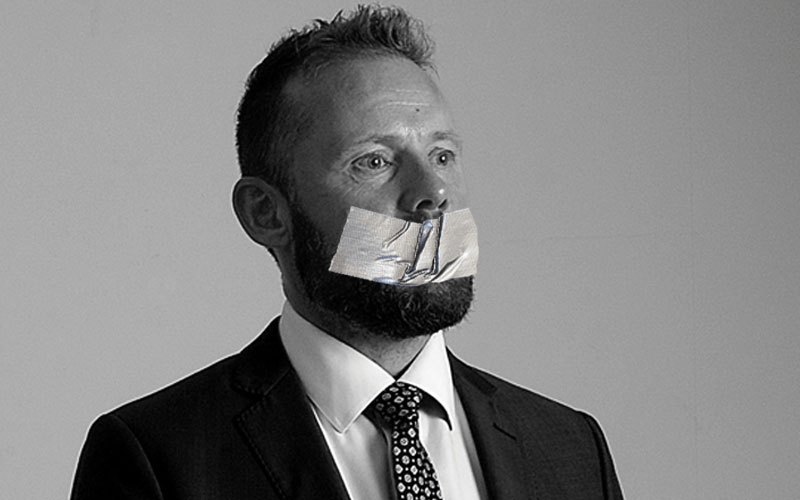
When such error is perceived and understood, what is to be done? What should a pastor, elder and overseer do? The Apostle Paul’s directive to Titus is clear and concise. False teachers must be silenced.
The phrase must be silenced (δεῖ ἐπιστομίζειν; dei epistomizein) contains two present active verbs. The word “must” is what is necessary. In other words, the subsequent action must be and ought to be done. The subsequent action “be silenced” is to keep someone from speaking. Literally, it means to stop the mouth.
“In telling Titus what should be done with such people, Paul uses a rare verb which has as its primary meaning “to stop the mouth by means of a bridle, muzzle, or gag.” The deceivers, then, must not be tolerated but be silenced, and this should be done by Titus and by the elders, as the context would seem to indicate (verses 5–9).[1]
“Just how this silencing should be done is not indicated in the present passage. See, however, on 1 Tim. 1:3, 4; 1:20; 4:7; 2 Tim. 2:16, 21, 23; 4:2; Titus 1:13b; 3:10. At first the errorist should be tenderly admonished so that he may be won for the truth. If he refuses, he must be sharply reprimanded and told to desist. The person who persists in his evil ways must be shunned by the church and disciplined. The supreme measure, excommunication, may have to be employed in order to safeguard the church and in order to bring the sinner to repentance. In the church of God there is no such thing as “freedom of misleading speech.” Reason: it would be too dangerous.”[2]
Paul provided the answer as to why such drastic action of silencing a false teacher must be done. The apostle wrote, “since they are upsetting whole families by teaching for shameful gain what they ought not to teach.”
First, false teachers were upsetting whole families. The word upsetting (ἀνατρέπουσιν; anatrepousin) means to presently and actively upset others in what they truly believe from God’s Word. False teachers seek to overturn and destroy a believer’s true faith in Christ.
Second, they teach for shameful gain. This means disgraceful profit. Many a televangelist falls into this category. They prey upon the naiveté and seek to steal hard earned dollars from hard working families.
Third, they teach what they ought not to teach. This means to teach what is not necessary or true. Their teaching is not in accordance with sound doctrine (Titus 1:9).
“The teachers of false doctrine “upset (cf. John 1:15) entire families,” causing them to wander away from the truth (see 2 Tim. 3:6). They do this by teaching “what is not proper,” that is, “Jewish myths and injunctions of men” (see on verse 14). And their purpose is to acquire shameful profit, profit that is shameful because the men who are after it are anxious to enrich themselves even at the expense of the downfall of others. They are utterly selfish, aiming at nothing but money and prestige. (Cf. 1 Tim. 3:3, 8; 6:5; Titus 1:7; 1 Thess. 2:9.).” [3]
“As is often the case with false teachers, the ones on Crete were motivated by a lust for money, not the glory of God, “teaching for shameful gain what they ought not to teach” (v. 11). Citizens of Crete were well-known in the ancient world for their greed, and so the preachers of error were guilty of absorbing Cretan morals instead of having their lives transformed by renewing their minds according to apostolic doctrine (Rom. 12:1–2),” explains Dr. R. C. Sproul.
“The presence of “teachers” who rebel against the Word of God is the reason why our Lord has ordained elders to provide correction and guidance to the church. Elders therefore, John Calvin says, must “be on the watch, so as not to give silent permission to wicked and dangerous doctrines to make gradual progress, or to allow wicked men an opportunity of spreading them.”
All believers in Christ are to be on guard against false teachers, May the Lord’s truth and grace be found here.
Soli deo Gloria!
[1] William Hendriksen and Simon J. Kistemaker, Exposition of the Pastoral Epistles, vol. 4, New Testament Commentary (Grand Rapids: Baker Book House, 1953–2001), 351.
[2] Ibid., 351.
[3] Ibid., 351.

