
“For there are many who are insubordinate, empty talkers and deceivers, especially those of the circumcision party.” (Titus 1:10 (ESV)
The Apostle Paul instructed Titus to appoint elders/overseers in all the churches on the Island of Crete (Titus 1:5). They were to be men of godly character (1:6-8). They were also to be men of Scripture. This was so they would give instruction in sound doctrine and also rebuke those who contradicted it (1:9).
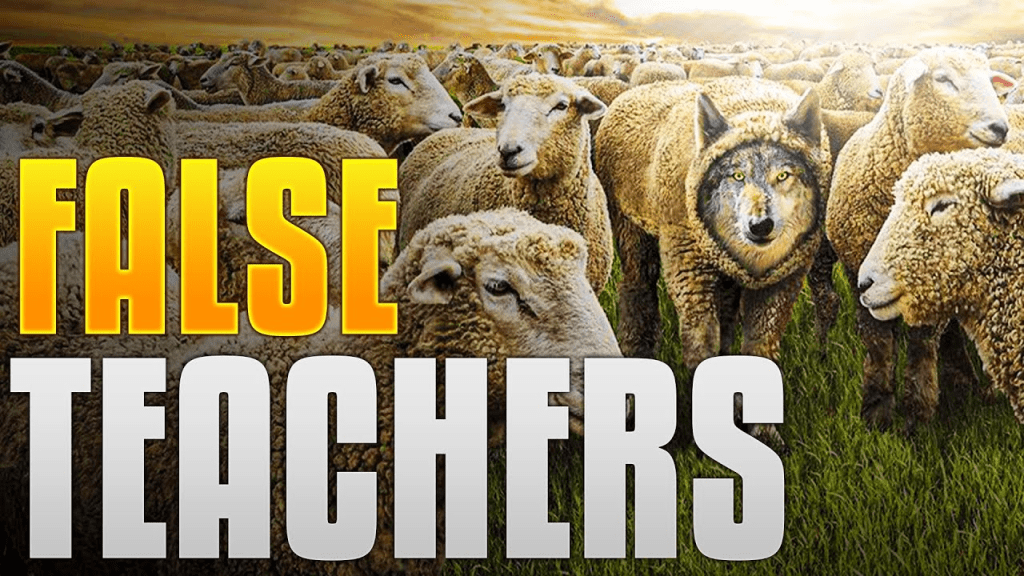
Who would dare to contradict the Word of God? Of the many terms found in Scripture, the phrase false teacher summarizes these who oppose God’s Word. What was the character of these individuals? Paul provided a brief list which sharply is in contrast to the character of godly elders.
First, false teachers are insubordinate (ἀνυπότακτοι; anypotaktai). They are rebellious and disobedient. They lack self-control and are not Spirit controlled. They have no fear of God or man.
Second, they are empty talkers (ματαιολόγοι; mataiologoi). They idly speak of what they do not know. It is conversation which is both foolish and stupid.
Thirdly, they are deceivers (φρεναπάται; phrenapatai). They are individuals who mislead others from the truth. They deceive but are also self-deceiving. They believe the lies they tell never realizing they speak lies. Paul pointed out many of these deceivers were Jews.
“These men are present here in Crete in alarming numbers (“many insubordinate men”; contrast the “certain individuals” in 1 Tim. 1:3). This may have been due to the fact that their peculiar faults were in line with the Cretan national character and that they were under the strong influence of Jewish rabbis (outsiders, verses 14b–16). They are insubordinate; that is disobedient to the Word of God. Also, they are futile talkers, achieving no useful purpose, with their fictitious tales about Adam, Moses, Elijah, etc., and with their legalistic hair-splitting (cf. 1 Tim. 1:6); yet deceiving the minds (see M.M., p. 675) of the weak. Especially “those of the circumcision-party,” that is, Jewish church-members (cf. Acts 10:45; Gal. 2:12), belong to the class of futile talkers and mind-deceivers. They probably regarded their circumcision as a mark of superior excellence, entitling them to be heard and looked up to by others.” [1]
“Having mentioned those who oppose the truth, Paul then described them for Titus and offered advice on how to handle them. He noted their three most prominent characteristics: they are rebellious (cf. Jude 8), mere talkers, and deceivers. All three characteristics were also present in Timothy’s opponents in Ephesus (cf. 1 Tim. 1:3–11; 6:3–10; 2 Tim. 2:14–18); but in Crete, Titus faced a Jewish element (the circumcision group, cf. Acts 11:2; Gal. 2:12) in whom these characteristics stood out prominently.” [2]
False teachers are not only outside he church, but also within the church (Acts 20:18-35; I John 4:1-6; Jude 3-4). This latter reality makes these individuals especially dangerous.
“Certainly, the need for elders to hold firm to apostolic doctrine is a permanent requirement for the office, and this need is particularly strong when false teachers arise to threaten the peace and purity of the church. This was the case in first-century Crete where its young churches were in desperate need of godly, biblically literate men to stem the tide of error that was beginning to rise,” states Dr. R. C. Sproul.
“We know this to be the case from Titus 1:10–11 wherein Paul gives the presence of “insubordinate, empty talkers, and deceivers” as one of the reasons for appointing theologically grounded pastors and teachers (v. 9). It is difficult to identify precisely the erroneous creeds circulating in Crete, but as is the case with the letters to Timothy, there are certain clues as to the falsehoods being taught there. Apparently, they had a particularly Jewish cast to them because the apostle names the “circumcision party” as being especially responsible for the upheaval there (v. 10).”
“Unlike the situation Paul addressed in his letter to the Galatians (Gal. 6:12–13), this does not necessarily mean they wanted to impose circumcision upon the Cretan believers; in fact, most commentators believe the practice of circumcision itself was not an issue. But it is clear that the teachers causing difficulties in Crete were either Jewish Christians or Gentiles enthralled with certain “Jewish myths” (Titus 1:14),” concludes Dr. Sproul.
Pray for the elders of your church to hold firm to the Word of God and oppose false teaching and teachers wherever they may be found.
May the Lord’s truth and grace be found here.
Soli deo Gloria!
[1] William Hendriksen and Simon J. Kistemaker, Exposition of the Pastoral Epistles, vol. 4, New Testament Commentary (Grand Rapids: Baker Book House, 1953–2001), 350–351.
[2] A. Duane Litfin, “Titus,” in The Bible Knowledge Commentary: An Exposition of the Scriptures, ed. J. F. Walvoord and R. B. Zuck, vol. 2 (Wheaton, IL: Victor Books, 1985), 763.

