
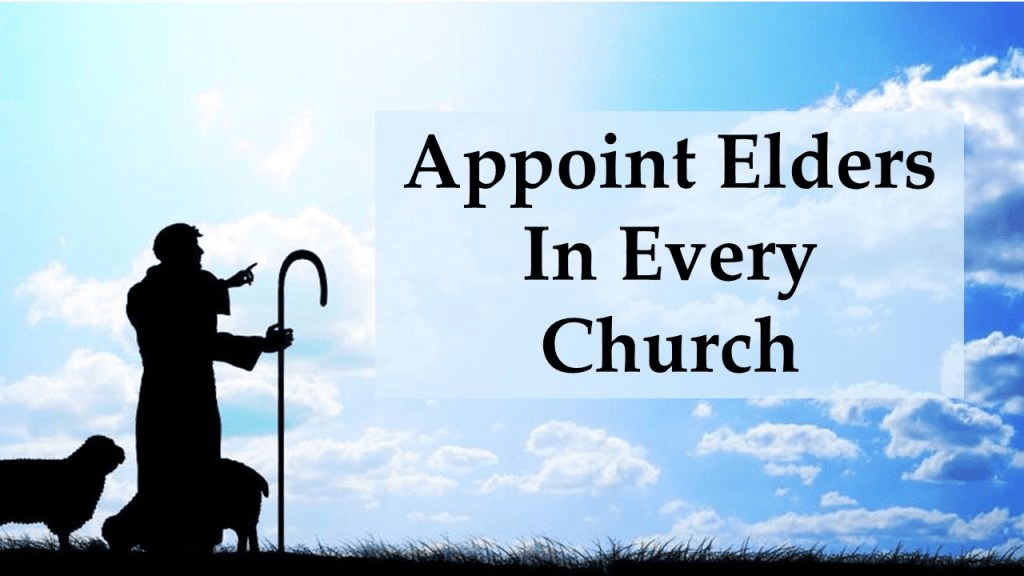
5 This is why I left you in Crete, so that you might put what remained into order, and appoint elders in every town as I directed you— 6 if anyone is above reproach, the husband of one wife, and his children are believers and not open to the charge of debauchery or insubordination.” (Titus 1:5–6 (ESV)
We know the Apostle Paul directed Titus to appoint elders in churches throughout the cities on the Island of Crete. What were the qualifications for those elders? What kind of individuals were they? What was their character? The qualifications Paul set forth in Titus 1 coincided with what he shared to Timothy in I Timothy 3:1-7.
“Paul’s mission to Crete is never described in detail; his visit to the island recorded in Acts 27 occurs in a period that was too short to allow for extensive evangelization. So, he probably visited Crete again after being released from the Roman imprisonment described in Acts 28. Clearly, Titus was with him on this second visit, otherwise Paul could not have left him behind there to perform the necessary task of appointing elders (Titus 1:5),” explains Dr. R. C. Sproul.
As John Calvin says, “Churches cannot safely remain without the ministry of pastors, and that consequently, wherever there is a considerable body of people, a pastor should be appointed over it.”
What are the biblical qualifications of church elders? The Scriptures are consistent in the objective and required standards. It is not left up to humankind’s emotional and cultural persuasions and perspectives. The standards come from God alone.
First, an elder is to be above reproach. The phrase above reproach (ἀνέγκλητος; anenkletos) means to be blameless and without accusation. While no individual elder is perfect and sinless, there is a consistent pattern of godliness in speech, attitude and behavior.
John Calvin explains, “When Paul says, that a bishop must be anenkleos, blameless, he does not mean one who is exempt from every vice, (for no such person could at any time be found,) but one who is marked by no disgrace that would lessen his authority. He means, therefore, that he shall be a man of unblemished reputation.”
Second, an elder is to be the husband of one wife. As in I Timothy 3, the phrase means the elder is to be a one, woman man. There is to be no hint of impropriety with a person of the opposite sex or for that matter the same sex. Additionally, this phrase strengthens the biblical perspective for an elder to be a man. While men and women have equal value before God, He has assigned them different roles in the church.
Thirdly, his children are to be believers in Christ. In other words, elders must have their own household under control. This involves not only discipline (1 Tim. 3:4–5), but also a godly influence. “His children are to be believers who are not open to the charge of being wild and disobedient. The apostle had explained why this requirement is important (1 Tim. 3:5).”[1]
Furthermore, an elder’s children are not be guilty of debauchery or insubordination. Debauchery (ἀσωτίας; asotias) refers to senselessness and recklessness in life and living. Insubordination (ἀνυπότακτα; anypotakta) means to be rebellious, disobedient, and a spirit refusing to listen to any authority.
“Being a center for the sea trade in the Roman Empire, it was particularly important for the Cretan church to be well-organized, with structures in place to keep it from doctrinal and ethical contamination. People throughout the empire would first hear of Christianity from their own travels to Crete or from the many who sailed through its ports, and this initial impression would have a lasting effect upon world missions. This is one practical reason why Paul wants elders to be “above reproach” (Titus 1:6), although the need for personal holiness is ultimately based on God’s call for us to be holy as He is holy (Lev. 11:45),” continues Dr. Sproul.
.
“Being above reproach is not perfection but honesty regarding personal sin and corresponding evidence of repentance. No one is perfect until they are glorified, but all of us must constantly strive to turn from sin (1 John 1:8–10.”
Augustine observes the Apostle Paul does not say “‘If anyone is without sin.’ For if he were to say this, every person would be rejected, no one would be ordained” (Ancient Christian Commentary on Scripture, NT vol. 9, p. 286; hereafter ACCNT).
The qualification for being a church elder, and for being a faithful believer in Christ, is repentance — a continual confession of one’s sin, a returning to Jesus Christ for forgiveness, and an effort to make right what one has made wrong.
May the Lord’s truth and grace be found here.
Soli deo Gloria!
[1] A. Duane Litfin, “Titus,” in The Bible Knowledge Commentary: An Exposition of the Scriptures, ed. J. F. Walvoord and R. B. Zuck, vol. 2 (Wheaton, IL: Victor Books, 1985), 762.

