
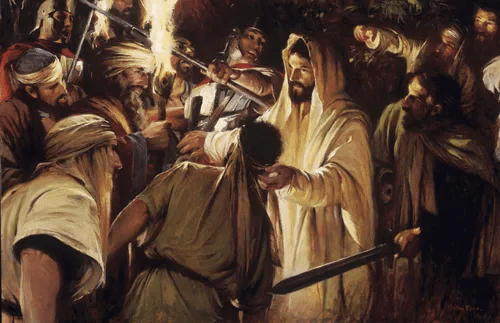
51 “And behold, one of those who were with Jesus stretched out his hand and drew his sword and struck the servant of the high priest and cut off his ear. 52 Then Jesus said to him, “Put your sword back into its place. For all who take the sword will perish by the sword. 53 Do you think that I cannot appeal to my Father, and he will at once send me more than twelve legions of angels? 54 But how then should the Scriptures be fulfilled, that it must be so?” (Matthew 26:51–54 ESV)
“But one of those who stood by drew his sword and struck the servant of the high priest and cut off his ear.” (Mark 14:47 (ESV)
49 “And when those who were around him saw what would follow, they said, “Lord, shall we strike with the sword?” 50 And one of them struck the servant of the high priest and cut off his right ear. 51 But Jesus said, “No more of this!” And he touched his ear and healed him.” (Luke 22:49–51 ESV)
10 Then Simon Peter, having a sword, drew it and struck the high priest’s servant and cut off his right ear. (The servant’s name was Malchus.) 11 So Jesus said to Peter, “Put your sword into its sheath; shall I not drink the cup that the Father has given me?” (John 18:10–11 ESV)
All four Gospels refer to an act of violence by one of Jesus’ disciples against the servant of the high priest. What are the various and observable facts contained in these four accounts?
First, Matthew describes the individual as “one of those who were with Jesus” (Matt. 26:51). Mark says it was “one who stood by” (Mark 14:47). Luke reports “when those who were around him saw what would follow…one of them struck the servant” (Luke 22:49-50a). John specifically identifies Simon Peter as the disciple who performed the violent act (John 18:10).
Second, all four Gospels use the same word for sword (μάχαιρα; machaira). This refers to a small dagger. Perhaps this would have been an instrument Peter used as a fisherman.
Third, all four Gospels record Simon Peter cut off the servant’s ear. John says it was the servant’s right ear (John 18:10). John is also the only one who identified the servant as Malchus (John 18:10).
Fourth, with the exception of Mark, the Gospel writers state Jesus immediately condemned Peter’s act. However, Luke is the only one who said Jesus also healed the servant by touching his ear (Luke 22:51).
Fifth, both Matthew and John said Jesus acknowledge God the Father’s sovereign control in this situation so the Scriptures would be fulfilled (Matt. 26:53-54; John 18:11). Jesus also referred to more than twelve legions of angels God the Father could send to defend God the Son (Matt. 26:53)
Finally, although each of the four Gospels share particular information not found in the other accounts, none of them contradict each other. They are all in harmony.
“Though a scuffle broke out in which one of the soldiers had his ear cut off, Jesus did not put up a fight when the evil men arrested Him (Mark 14:46–50). He went willingly and even showed love for His enemies in the process. Luke 22:50–51 reports that Jesus healed the soldier’s ear,” explains Dr. R. C. Sproul.
“Although the incident is related in all four Gospels, only John mentions the names of the two persons who (in addition to Jesus himself) figured most prominently in it. When John published his Gospel it was no longer possible to punish the assailant. Hence, in John’s Gospel the assailant’s name and that of the person attacked could be mentioned,” states Dr. William Hendriksen.
John Calvin states in his commentary, “The fact that Jesus healed the man and that the arrest nevertheless continued shows the depths of human depravity. Wicked men were so intent on capturing Jesus that they would not pause when He showed His divine identity by healing the soldier.”
The texts also reveal that spiritual warfare is not fought by human methods. 2 Corinthians 10:3–5 (ESV) says, “3 For though we walk in the flesh, we are not waging war according to the flesh. 4 For the weapons of our warfare are not of the flesh but have divine power to destroy strongholds. 5 We destroy arguments and every lofty opinion raised against the knowledge of God, and take every thought captive to obey Christ.”
Soli deo Gloria!

