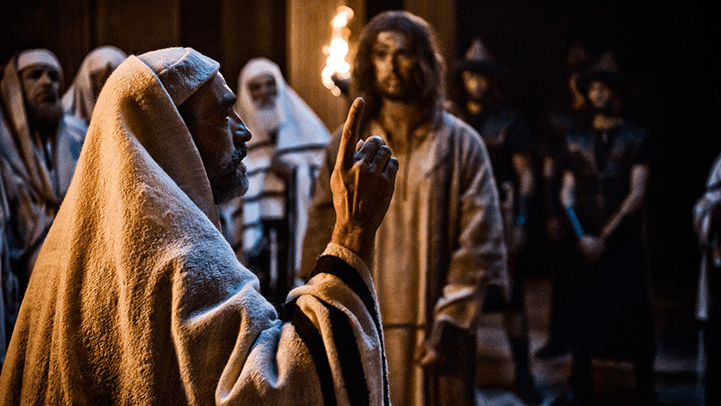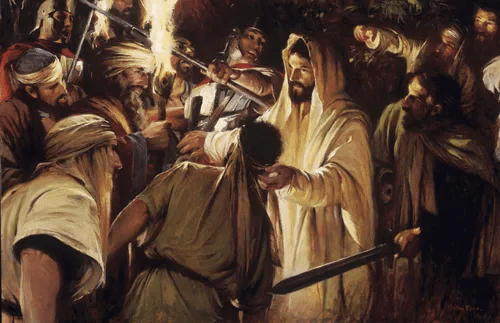
The Gospel of Matthew: Blaspheming Christ.

66 What is your judgment?” They answered, “He deserves death.” 67 Then they spit in his face and struck him. And some slapped him, 68 saying, “Prophesy to us, you Christ! Who is it that struck you?” (Matthew 26:66–68 (ESV)

64 You have heard his blasphemy. What is your decision?” And they all condemned him as deserving death. 65 And some began to spit on him and to cover his face and to strike him, saying to him, “Prophesy!” And the guards received him with blows.” (Mark 14:64–65 (ESV)

63 “Now the men who were holding Jesus in custody were mocking him as they beat him. 64 They also blindfolded him and kept asking him, “Prophesy! Who is it that struck you?” 65 And they said many other things against him, blaspheming him.” (Luke 22:63–65 (ESV)

“There’s none so blind as those who will not see.” — John Heywood, English Poet

Caiaphas demanded Jesus tell him if He was the Son of God. Jesus replied “I am” (Mark 14:62). He used the phrase (ἐγώ εἰμί; ego eimi) to reference the divine name of Yahweh. This is the name the LORD revealed to Moses (Ex. 3:14; Deut. 32:39; Isaiah  41:4; 43:10, 13, 25; 45:18; 52:6; Hosea 13:4; Joel 2:27). It is the name Jesus invoked with the Pharisees (John 8:58). It is the name prefacing Jesus’ seven “I Am” statements of deity in John’s Gospel (John 6; 8:12; 9: 10; 11; 14; 15).

When Caiaphas heard Jesus say this, the high priest tore his garments. This was a symbolic gesture of shock, horror and fury (Gen. 37:29; 2 Kings 18:37; 19:1; Ezra 9:3; Jer. 36:24; Joel 2:13). Caiaphas then said, ““He has uttered blasphemy. What further witnesses do we need? You have now heard his blasphemy” (Matt. 26:65).

Blasphemy (βλασφημία; blasphemia) means to slander and utter an insult towards God. Caiaphas accused Jesus of blaspheming God. The hypocritical irony was that Caiaphas was the one blaspheming God. The very God who stood before him.

To add injury to insult, the emboldened Jewish religious leaders, consisting of the high priests, scribes and the elders (Matthew 26:57), verbally declared Jesus to be guilty of death. This would be their judgment because Leviticus 24:16 says, “Whoever blasphemes the name of the Lord shall surely be put to death. All the congregation shall stone him. The sojourner as well as the native, when he blasphemes the Name, shall be put to death.”  Their judgment of Jesus would become Jesus’ judgment upon them.

Additionally, the religious leaders and guards began to verbally and physical mock and abuse the Lord. They struck Him, slapped Him, and spit on Him. They blindfolded Him and proceeded to demand Jesus tell them who hit Him. Luke concludes the scene by saying, “And they said many other things against him, blaspheming him.”(Luke 22:65).

 “Today’s passage reveals that the Sanhedrin want Christ executed because they believe Him to be a blasphemer. Our Savior, as prophesied, has remained silent through most of His trial (Matt. 26:62–63; see Isa. 53:7), but Jesus finally declares Himself to be the Christ under oath (Matt. 26:64). The claim to be the promised son of David is not blasphemous in itself; rather, it is the kind of Messiah that Jesus claims to be that is the problem for the Jewish leaders. In asserting that He will be seated at the right hand of “Power,” Jesus puts Himself on God’s level, appropriating to Himself Yahweh’s power and authority,” explains Dr. R. C. Sproul.

“This would be blasphemy indeed were He incorrect, but Jesus, the incarnate Son of God, has all divine power and authority (9:1–8). Caiaphas and the others could see this if they would look, but their own power and position, which holds first place in their hearts, blinds them to the truth (26:65–66; see Matt.12:22–32).”

John Calvin writes, “this insolence was turned by the providence of God to a very different purpose; for the face of Christ, dishonored by spitting and blows, has restored to us that image which had been disfigured, and almost effaced, by sin.”

“In spitting upon Jesus and striking Him, the leaders are the ones who commit blasphemy. However, as Let us never forget the high price Jesus paid to purchase us and always live after the example He gives as the true image of God,” concludes Dr. Sproul.

Soli deo Gloria!

The Gospel of Matthew: Blasphemy.

62 And the high priest stood up and said, “Have you no answer to make? What is it that these men testify against you?” 63 But Jesus remained silent. And the high priest said to him, “I adjure you by the living God, tell us if you are the Christ, the Son of God.” 64 Jesus said to him, “You have said so. But I tell you, from now on you will see the Son of Man seated at the right hand of Power and coming on the clouds of heaven.” 65 Then the high priest tore his robes and said, “He has uttered blasphemy. What further witnesses do we need? You have now heard his blasphemy.” (Matthew 26:62–65 ESV)

 60 And the high priest stood up in the midst and asked Jesus, “Have you no answer to make? What is it that these men testify against you?” 61 But he remained silent and made no answer. Again the high priest asked him, “Are you the Christ, the Son of the Blessed?” 62 And Jesus said, “I am, and you will see the Son of Man seated at the right hand of Power, and coming with the clouds of heaven.” 63 And the high priest tore his garments and said, “What further witnesses do we need? 64 You have heard his blasphemy. What is your decision?” And they all condemned him as deserving death.” (Mark 14:60–64 (ESV)

It is Matthew and Mark who provide an extensive report of Jesus’ appearance before Caiaphas. Following the chief priests’ efforts to convict Jesus by false testimony and lying witnesses, Caiaphas began interrogating the Lord. Unlike Isaiah, the disciples, and even Peter, who had a sense of un-doneness in the presence of the Son of God (Isaiah 6:1-7; Luke 5:1-11; 8:22-25; John 12:36-43), the high priest possessed no such understanding. Caiaphas approached the Lord with an arrogance befitting his ignorance.

14 The natural person does not accept the things of the Spirit of God, for they are folly to him, and he is not able to understand them because they are spiritually discerned.” (1 Corinthians 2:14 (ESV)

For those who live according to the flesh set their minds on the things of the flesh, but those who live according to the Spirit set their minds on the things of the Spirit. For to set the mind on the flesh is death, but to set the mind on the Spirit is life and peace. For the mind that is set on the flesh is hostile to God, for it does not submit to God’s law; indeed, it cannot.” (Romans 8:5–7 (ESV)

Caiaphas treated the Lord Jesus with disrespect because he was a natural person, according to I Corinthians 2:14. To be natural (ψυχικός; psychikos) refers to the fallen, sinful nature which does not accept or receive anything from the Holy Spirit. Caiaphas did not receive Jesus as Lord because the high priest, in spite of his religious position and authority, was at heart an unforgiven and rebellious sinner.  

Caiaphas demanded Jesus tell him if He was the Son of God. Jesus replied “I am” (Mark 14:62). He used the phrase (ἐγώ εἰμί; ego eimi) to reference the divine name of Yahweh. This is the name the LORD revealed to Moses (Ex. 3:14; Deut. 32:39; Isaiah  41:4; 43:10, 13, 25; 45:18; 52:6; Hosea 13:4; Joel 2:27). It is the name Jesus invoked with the Pharisees (John 8:58). It is the name prefacing Jesus’ seven “I Am” statements of deity in John’s Gospel (John 6; 8:12; 9: 10; 11; 14; 15).

Jesus also said that He was the Son of Man. This was a reference to this title of deity from Daniel 7:13-14.

13 “I saw in the night visions, and behold, with the clouds of heaven there came one like a son of man, and he came to the Ancient of Days and was presented before him. 14 And to him was given dominion and glory and a kingdom, that all peoples, nations, and languages should serve him; his dominion is an everlasting dominion, which shall not pass away, and his kingdom one that shall not be destroyed.” (Daniel 7:13–14 (ESV)

When Caiaphas heard Jesus say this, the high priest tore his garments. This was a symbolic gesture of shock, horror and fury (Gen. 37:29; 2 Kings 18:37; 19:1; Ezra 9:3; Jer. 36:24; Joel 2:13). Caiaphas then said, ““He has uttered blasphemy. What further witnesses do we need? You have now heard his blasphemy” (Matt. 26:65).

Blasphemy (βλασφημία; blasphemia) means to slander and utter an insult towards God. Caiaphas accused Jesus of blaspheming God. The hypocritical irony was that Caiaphas was the one blaspheming.

“Here the hypocrisy of the high priest becomes very clear. He acts as if he is overwhelmed with grief, though he could have shouted for joy. The man puts on a real show. He tears his high priestly robe, and says, “He has blasphemed,” using the word “blasphemed” in its gravest sense: unjustly he has claimed for himself the prerogatives that belong to God alone,” explains Dr. William Hendriksen.  

“Not that claiming to be the Messiah would in and by itself constitute blasphemy. But representing oneself as the fulfilment of Daniel’s prophecy, that is, as the One who, coming with the clouds of heaven, would receive a. authority to judge all the nations, and b. everlasting dominion (see Dan. 7:13, 14); such a claim—and it was indeed this claim that Jesus was making—could be made only by God! Hence, either a. Jesus was indeed divine, “the Son of God,” in the fullest sense of that term, or else b. he was guilty of blasphemy, punishable by death (Lev. 24:16).”

People often say “seeing is believing.” Caiaphas was seeing Jesus, but he was not believing in Jesus. Jesus said it this way to Thomas: “Have you believed because you have seen me? Blessed are those who have not seen and yet have believed.” (John 20:29 (ESV)

Soli deo Gloria!

The Gospel of Matthew: False Testimony.

59 Now the chief priests and the whole council were seeking false testimony against Jesus that they might put him to death, 60 but they found none, though many false witnesses came forward. At last two came forward 61 and said, “This man said, ‘I am able to destroy the temple of God, and to rebuild it in three days.’ ” (Matthew 26:59–61 (ESV)

55 Now the chief priests and the whole council were seeking testimony against Jesus to put him to death, but they found none. 56 For many bore false witness against him, but their testimony did not agree. 57 And some stood up and bore false witness against him, saying, 58 “We heard him say, ‘I will destroy this temple that is made with hands, and in three days I will build another, not made with hands.’ ” 59 Yet even about this their testimony did not agree.” (Mark 14:55–59 (ESV)

Justice should be about discovering truth. It is being morally righteous by following, and upholding, the letter and the spirit of law. The chief priests and the whole council were not seeing justice in their trial against Jesus. They sought to condemn Him any way they could.

Matthew and Mark alone record the account of the false witnesses against Jesus. The chief priests and the whole council sought this false testimony. The Jewish religious leaders displayed a complete lack of integrityleaders. The irony was they could not find anything to condemn Jesus although many false witnesses came forward.

The only accusation they could find was Jesus’ statement “‘I am able to destroy the temple of God, and to rebuild it in three days.’ ” (John 2:18-20). However, Jesus was referring to His resurrection from the dead (John 2:21-22).

The title chief priests is plural. This refers to both Annas and Caiaphas. The whole council refers to the Sanhedrin. The Sanhedrin was the Supreme Court or “high council” of Judaism. It contained 71 members and they met in Jerusalem. The Sanhedrin is prominent in the Passion narratives of the Gospels as the religious court that tried Jesus. They also appear Acts as the judicial body who investigated and persecuted the growing church (Acts 3-5).

“The name Sanhedrin (Greek, sunedrion, from sun, “together,” and hedra, “seat”) occurs for the first time in the reign of Herod the Great (Antiquities 14.9.3–5). This is the term used throughout the NT (22 times), along with “the elders” (Lk 22:66; Acts 22:5) and “gerousia” (Acts 5:21),” states the Tyndale Bible Dictionary.

“Probably this trial took place in a large upper room of that wing of the palace where Caiaphas lived. The question might be asked, “But why have a trial at all, since the Sanhedrin had decided a long time ago that Jesus must be put to death (John 11:49, 50), an agreement which very recently had been reconfirmed (Matt. 26:4)?” Answer: the verdict must be made official and reasons must be formulated, so that the sentence that subsequently will be based upon it can be justified before the Jews, and so that the indispensable co-operation of the Gentiles—especially of Pilate—can be obtained,” explains Dr. William Hendriksen.

“Our Savior’s trial is the greatest miscarriage of justice ever committed. Matthew makes this plain, stating that the council seeks “false testimony” (v. 59). Whatever they feel about their actions — and they likely believe themselves to be doing God’s will — Caiaphas and his cohorts only want evidence against Jesus. They could care less about the truth and are probably frustrated in their inability to build a case against Him (vv. 59–60a). Even as this chaos surrounds Him, our Lord remains in control, refusing to answer the false charges (vv. 62–63a,” states Dr. R. C. Sproul.

John Calvin writes, “Christ is silent not only because the objection [is] frivolous, but because, having been appointed to be a sacrifice, he [has] thrown aside all anxiety about defending himself,”

God remains in control.

Dr. Clothier

The Gospel of Matthew: The Second Trial.

57 Then those who had seized Jesus led him to Caiaphas the high priest, where the scribes and the elders had gathered. 58 And Peter was following him at a distance, as far as the courtyard of the high priest, and going inside he sat with the guards to see the end.” (Matthew 26:57–58 (ESV)

53 And they led Jesus to the high priest. And all the chief priests and the elders and the scribes came together. 54 And Peter had followed him at a distance, right into the courtyard of the high priest. And he was sitting with the guards and warming himself at the fire.” (Mark 14:53–54 (ESV)

54 Then they seized him and led him away, bringing him into the high priest’s house, and Peter was following at a distance. 55 And when they had kindled a fire in the middle of the courtyard and sat down together, Peter sat down among them.” (Luke 22:54–55 (ESV)

12 So the band of soldiers and their captain and the officers of the Jews arrested Jesus and bound him. 13 First they led him to Annas, for he was the father-in-law of Caiaphas, who was high priest that year. 14 It was Caiaphas who had advised the Jews that it would be expedient that one man should die for the people.” (John 18:12–14 (ESV)

To understand the context of Matt. 26:57–68, and the other gospel accounts, it is necessary to know Jesus had to undergo two trials. The first was an ecclesiastical, or religious, trial, which would be in three stages. The second was a civil trial. This also would be in three stages. 

The second religious trial took place before Caiaphas. John indicated Caiaphas was the current high priest (John 18:13). John also mentioned Caiaphas had stated it would be advantageous for Jesus to die for the people (John 11:45=53). 

Concurrent with Jesus’ trials was Peter’s attendance. He followed at a distance and got as far as the high priest’s courtyard. He sat with guards, warming himself at a fire kindled by the soldiers. Matthew recorded Peter wanted to see what would happen to Jesus (Matt. 26:58). John provides additional information regarding Peter’s presence.                                                                                     

15 Simon Peter followed Jesus, and so did another disciple. Since that disciple was known to the high priest, he entered with Jesus into the courtyard of the high priest, 16 but Peter stood outside at the door. So the other disciple, who was known to the high priest, went out and spoke to the servant girl who kept watch at the door, and brought Peter in.” (John 18:15–16 (ESV)

“Though all the disciples had fled, two soon rallied, and began to follow the band which was leading Jesus to the high priest’s palace. Still fearful, Peter was following (imperfect tense) from a considerable distance (Matthew, Mark, Luke). With him was someone who is simply called another disciple. That this unnamed person was no one else than the author of the Fourth Gospel we have tried to prove,” explains Dr. William Hendriksen.

“The “other disciple” (John) was known—though not of necessity intimately—to the high priest. How it was that Annas (see on verse 13)—hence, probably also his son-in-law—knew John remains a mystery. Theories—such as, that John was a distant relative, or that his father’s firm delivered fish to the high priest’s palace (the view of Nonnus, an Egyptian scholar, about 400 a.d.)—are nothing but guesses. It is important, nevertheless, to bear in mind the fact as such (that John was known to the high priest). See also on 18:10. This explains why, without difficulty, John—who, having by this time regained courage, had shortened the distance between himself and the band—entered with Jesus into the court of the high priest.”

This scene set the stage for Peter’s three denials of knowing Jesus.

Soli deo Gloria!

The Gospel of Matthew: The First Trial.

57 Then those who had seized Jesus led him to Caiaphas the high priest, where the scribes and the elders had gathered.” (Matthew 26:57 ESV)

53 And they led Jesus to the high priest. And all the chief priests and the elders and the scribes came together.” (Mark 14:53 ESV)

54 Then they seized him and led him away, bringing him into the high priest’s house, and Peter was following at a distance.” (Luke 22:54 (ESV)

12 So the band of soldiers and their captain and the officers of the Jews arrested Jesus and bound him. 13 First they led him to Annas, for he was the father-in-law of Caiaphas, who was high priest that year. (John 18:12–13 ESV)

To understand the context of Matt. 26:57–68, along with the events of Matthew 27, it is necessary to know Jesus had to undergo two trials. The first was an ecclesiastical, or religious, trial, which would be in three stages. The second was a civil trial. This also would be in three stages.  

To seize (κρατέω; krateo) means to make an official arrest. The enemies of Jesus then bound and led Him (John 18:12) to the chief priest, Caiaphas. The commanding officer in charge is a captain (χιλίαρχος; chiliarchos), general or military tribune (John 18:12).

“The first contained three stages, and so did the second. The three stages of the so-called ecclesiastical trial were: a. the preliminary hearing before Annas (John 18:12–14, 19–23); b. the trial before the Sanhedrin, that is, before Caiaphas and the scribes and the elders (Matt. 26:57); and c. the trial before the same body just after daybreak (Matt. 27:1). The hearing before Annas, described only by John, must not be confused with the trial before Caiaphas,” explains Dr. William Hendricksen.

John records that before they brought Jesus to Caiaphas, they initially brought him to Annas, Caiaphas’ father-in-law (Luke 3:2; John 18:13; Acts 4:6). This initiated the first stage of Jesus’ ecclesiastical trial. Who exactly was Annas?

“Annas (or Ananus, as Josephus calls him; the name is from the Hebrew Hananiah, meaning Jehovah is gracious) had been appointed high priest by Quirinius in the year 6 a.d., and was deposed by Valerius Gratus, about 15 a.d. Though deposed, he remained for a long time the ruling spirit of the Sanhedrin. He was the dominant member of the Jewish hierarchical machine,” states Dr. Hendriksen.

“He was very proud, exceedingly ambitious, and fabulously wealthy. His family was notorious for its greed. The main source of his wealth seems to have been a goodly share of the proceeds from the price of sacrificial animals, which were sold in the Court of the Gentiles. See on 2:14. By him the house of prayer had been turned into a den of robbers. Even the Talmud declares: “Woe to the family of Annas! Woe to the serpent-like hisses” (probably the whisperings of Annas and the members of his family, seeking to bribe and influence the judges).” concludes Dr. Hendriksen.

Caiaphas may have possessed the title, but Annas possessed the power. More to come.

Soli deo Gloria!

The Gospel of Matthew: The Arrest.

55 At that hour Jesus said to the crowds, “Have you come out as against a robber, with swords and clubs to capture me? Day after day I sat in the temple teaching, and you did not seize me. 56 But all this has taken place that the Scriptures of the prophets might be fulfilled.” Then all the disciples left him and fled.” (Matthew 26:55–56 (ESV)

48 And Jesus said to them, “Have you come out as against a robber, with swords and clubs to capture me? 49 Day after day I was with you in the temple teaching, and you did not seize me. But let the Scriptures be fulfilled.” 50 And they all left him and fled.” (Mark 14:48–50 (ESV)

52 Then Jesus said to the chief priests and officers of the temple and elders, who had come out against him, “Have you come out as against a robber, with swords and clubs? 53 When I was with you day after day in the temple, you did not lay hands on me. But this is your hour, and the power of darkness.” (Luke 22:52–53 (ESV)

Then Jesus, knowing all that would happen to him, came forward and said to them, “Whom do you seek?” They answered him, “Jesus of Nazareth.” Jesus said to them, “I am he.” Judas, who betrayed him, was standing with them. When Jesus said to them, “I am he,” they drew back and fell to the ground. So he asked them again, “Whom do you seek?” And they said, “Jesus of Nazareth.” Jesus answered, “I told you that I am he. So, if you seek me, let these men go.” This was to fulfill the word that he had spoken: “Of those whom you gave me I have lost not one.” (John 18:4–9 (ESV)

In observing the four Gospels concerning Jesus’ arrest in Gethsemane, Matthew, Mark and Luke record Jesus asking the crowd “Have you come out as against a robber?” Luke alone specifically identifies the crowd, consisting of “the chief priests and officers of the temple and elders” (Luke 22:52).

The three authors mention Jesus saying, “Day after day I sat in the temple teaching, and you did not seize me.” Again, Luke alone records Jesus also saying, “But this is your hour, and the power of darkness” (Luke 22:53). The setting of physical darkness is appropriate for the dynamic of spiritual darkness. Additionally, Matthew and Mark alone mention the disciples leaving Jesus and fleeing the scene of darkness (Matt. 26:56; Mark 14:50). Jesus also refers this scene as a fulfillment of Old Testament prophecy.

Psalm 88:8 (ESV) – “You have caused my companions to shun me; you have made me a horror to them. I am shut in so that I cannot escape.”

Psalm 88:18 (ESV) – “You have caused my beloved and my friend to shun me; my companions have become darkness.” 

What an ironic contrast to Jesus’ statement in His Sermon on the Mount that His disciples were salt and light (Matt. 5:13-16) and also when Jesus said, “I am the light of the world. Whoever follows me will not walk in darkness, but will have the light of life,” (John 8:12).

Not surprisingly, John emphasized the deity of Jesus Christ in his narrative. He refers to Jesus’ omniscience (John 18:4), His holiness (vs. 6), His authority (vs. 8) and His perfect fulfillment of Scripture (vs. 9). 

Our Lord expressed amazement during His arrest, noting that He was being treated as a robber and being taken at night even though there had been opportunities to arrest Him during the day (Mark 14:52–53). The soldiers acted as if He were a criminal even though they had plainly seen in the daylight that He was not one, and their arrest of Him at night shows their awareness that He was guilty of no sin. They had to come at night, when no one was looking, lest they meet protests from the crowds that Jesus was an innocent man. They had to hide their unjust actions under cover of darkness,” explains Dr. R. C. Sproul.

“If anyone wishes to know what kind of person this Jesus had proved himself to be during the slightly more than three years of his public ministry, let him read such passages as Matt. 4:23–25; 11:25–30; 12:18–21; Luke 24:19; Acts 2:22. To say, as some, in commenting on Matt. 26:55, have done, that he was “harmless” is putting it too mildly. He was and is, “the Savior of the world” (John 4:42; 1 John 4:14), the world’s greatest Benefactor. How absurd and hypocritical it was for the foe in the hour of darkness to pounce upon this Good Shepherd, from whom no one who heeded his message had anything to fear, and who even taught people to love their enemies,” states Dr. William Hendriksen.

Soli deo Gloria!

The Gospel of Matthew: A Sword and a Servant.  

51 And behold, one of those who were with Jesus stretched out his hand and drew his sword and struck the servant of the high priest and cut off his ear. 52 Then Jesus said to him, “Put your sword back into its place. For all who take the sword will perish by the sword. 53 Do you think that I cannot appeal to my Father, and he will at once send me more than twelve legions of angels? 54 But how then should the Scriptures be fulfilled, that it must be so?” (Matthew 26:51–54 ESV)

But one of those who stood by drew his sword and struck the servant of the high priest and cut off his ear.” (Mark 14:47 (ESV)

49 And when those who were around him saw what would follow, they said, “Lord, shall we strike with the sword?” 50 And one of them struck the servant of the high priest and cut off his right ear. 51 But Jesus said, “No more of this!” And he touched his ear and healed him.” (Luke 22:49–51 ESV)

10 Then Simon Peter, having a sword, drew it and struck the high priest’s servant and cut off his right ear. (The servant’s name was Malchus.) 11 So Jesus said to Peter, “Put your sword into its sheath; shall I not drink the cup that the Father has given me?” (John 18:10–11 ESV)

All four Gospels refer to an act of violence by one of Jesus’ disciples against the servant of the high priest. What are the various and observable facts contained in these four accounts?

First, Matthew describes the individual as “one of those who were with Jesus” (Matt. 26:51). Mark says it was “one who stood by” (Mark 14:47). Luke reports “when those who were around him saw what would follow…one of them struck the servant” (Luke 22:49-50a). John specifically identifies Simon Peter as the disciple who performed the violent act (John 18:10).

Second, all four Gospels use the same word for sword (μάχαιρα; machaira). This refers to a small dagger. Perhaps this would have been an instrument Peter used as a fisherman.

Third, all four Gospels record Simon Peter cut off the servant’s ear. John says it was the servant’s right ear (John 18:10). John is also the only one who identified the servant as Malchus (John 18:10).

Fourth, with the exception of Mark, the Gospel writers state Jesus immediately condemned Peter’s act. However, Luke is the only one who said Jesus also healed the servant by touching his ear (Luke 22:51).

Fifth, both Matthew and John said Jesus acknowledge God the Father’s sovereign control in this situation so the Scriptures would be fulfilled (Matt. 26:53-54; John 18:11). Jesus also referred to more than twelve legions of angels God the Father could send to defend God the Son (Matt. 26:53)

Finally, although each of the four Gospels share particular information not found in the other accounts, none of them contradict each other. They are all in harmony.

“Though a scuffle broke out in which one of the soldiers had his ear cut off, Jesus did not put up a fight when the evil men arrested Him (Mark 14:46–50). He went willingly and even showed love for His enemies in the process. Luke 22:50–51 reports that Jesus healed the soldier’s ear,” explains Dr. R. C. Sproul.  

“Although the incident is related in all four Gospels, only John mentions the names of the two persons who (in addition to Jesus himself) figured most prominently in it. When John published his Gospel it was no longer possible to punish the assailant. Hence, in John’s Gospel the assailant’s name and that of the person attacked could be mentioned,” states Dr. William Hendriksen.

John Calvin states in his commentary, “The fact that Jesus healed the man and that the arrest nevertheless continued shows the depths of human depravity. Wicked men were so intent on capturing Jesus that they would not pause when He showed His divine identity by healing the soldier.

The texts also reveal that spiritual warfare is not fought by human methods. 2 Corinthians 10:3–5 (ESV) says, For though we walk in the flesh, we are not waging war according to the flesh. For the weapons of our warfare are not of the flesh but have divine power to destroy strongholds. We destroy arguments and every lofty opinion raised against the knowledge of God, and take every thought captive to obey Christ.”

Soli deo Gloria!

The Gospel of Matthew: Judas’ Kiss.

47 While he was still speaking, Judas came, one of the twelve, and with him a great crowd with swords and clubs, from the chief priests and the elders of the people. 48 Now the betrayer had given them a sign, saying, “The one I will kiss is the man; seize him.” 49 And he came up to Jesus at once and said, “Greetings, Rabbi!” And he kissed him. 50 Jesus said to him, “Friend, do what you came to do.” Then they came up and laid hands on Jesus and seized him.” (Matthew 26:48–50 (ESV)

43 And immediately, while he was still speaking, Judas came, one of the twelve, and with him a crowd with swords and clubs, from the chief priests and the scribes and the elders. 44 Now the betrayer had given them a sign, saying, “The one I will kiss is the man. Seize him and lead him away under guard.” 45 And when he came, he went up to him at once and said, “Rabbi!” And he kissed him. 46 And they laid hands on him and seized him.” (Mark 14:43–46 (ESV)

47 While he was still speaking, there came a crowd, and the man called Judas, one of the twelve, was leading them. He drew near to Jesus to kiss him, 48 but Jesus said to him, “Judas, would you betray the Son of Man with a kiss?” (Luke 22:47–48 (ESV)

Then Jesus, knowing all that would happen to him, came forward and said to them, “Whom do you seek?” They answered him, “Jesus of Nazareth.” Jesus said to them, “I am he.” Judas, who betrayed him, was standing with them.” (John 18:4–5 (ESV)

It was horrible enough for Judas Iscariot to betray the Lord Jesus for thirty pieces of silver. It was even worse for him to betray the Lord with a kiss. However, this act was a fulfillment of Old Testament prophecy (Psalm 41:9; John 13:18).

All four Gospels describe Judas as one of the twelve (Matt. 26:47; Mark 14:43; Luke 22:47; John 6:71). “Only once (John 20:24) is another disciple so described. The Gospel writers seem to use the expression to underscore the insidiousness of Judas’ crime—especially here in the midst of betrayal,” explains Dr. John MacArthur.

A kiss is one of most tactile and affectionate expressions of friendship and love. Spouses kiss, parents kiss their children, and close friends occasionally kiss each other in times of grief or joy. We kiss to say hello, and we kiss when we say goodbye. Even at a wedding, the climactic moment of the ceremony, prior to introducing the bride and groom, is when the minister instructs the groom to kiss the bride.  

“Now a soft kiss- Aye, by that kiss, I vow and endless bliss.” – John Keats

“Close your eyes and I’ll kiss you, Tomorrow I’ll miss you.” ― Paul McCartney

“You should be kissed and by someone who knows how.” ― Margaret Mitchell

Judas’ kiss of Christ was not one of love or friendship but rather of hatred and even greed. It was because of his kiss of betrayal that Judas sealed the deal to secure his fortune and Jesus’ arrest, trial and crucifixion.

“What made Judas’ betrayal of the Savior even worse than it would have been otherwise was that Judas was allegedly a friend of our Lord. It is bad enough to be betrayed by an acquaintance, but to be abandoned by a loved one is truly horrific. And Judas compounded his treason even further by betraying Jesus with a kiss, a sign of affection, and referring to Him as “Rabbi,” a title of honor (vv. 44–45). One commentator notes that these actions were the first acts of mockery that would take place during the trial and passion of our Savior. Judas’ actions show that he neither truly loved Jesus nor honored Him as He deserved,” explains Dr. R. C. Sproul.

I wonder how it makes you feel when the prodigal won’t come home
I wonder how it makes you feel when he’d rather be on his own
I wonder what it’s like for you when a lamb has gone astray
I wonder what it’s like for you when your children disobey.

I wonder how it makes you feel when no one seeks your face
I wonder how it makes you feel when they give up in the race
I wonder what it’s like for you when they willingly disobey
I wonder what it’s like for you when they willingly walk away.

It must be like another thorn struck in your brow
It must be like another close friend’s broken vow
It must be like another nail right through your wrist
It must be just like
Just like Judas’ kiss.
– Bob Hartman

The Gospel of Matthew: Betrayed!

46 Rise, let us be going; see, my betrayer is at hand.” 47 While he was still speaking, Judas came, one of the twelve, and with him a great crowd with swords and clubs, from the chief priests and the elders of the people.” (Matthew 26:46–47 ESV)

43 And immediately, while he was still speaking, Judas came, one of the twelve, and with him a crowd with swords and clubs, from the chief priests and the scribes and the elders.” (Mark 14:43 (ESV)

47 While he was still speaking, there came a crowd, and the man called Judas, one of the twelve, was leading them.” Luke 22:47a (ESV)

When Jesus had spoken these words, he went out with his disciples across the brook Kidron, where there was a garden, which he and his disciples entered. Now Judas, who betrayed him, also knew the place, for Jesus often met there with his disciples. So Judas, having procured a band of soldiers and some officers from the chief priests and the Pharisees, went there with lanterns and torches and weapons.” (John 18:1–3 ESV)

All four Gospels record the account of Judas’ betrayal of Jesus. There are several observations which can be made concerning this treacherous event.

First, it was a personal betrayal because Judas was one of the twelve disciples. Second, it was public betrayal with Judas leading a great crowd containing officers from the chief priests and the Pharisees, scribes, elders, and a band of soldiers. Third, it was a potentially violent betrayal for the crowd had swords, clubs and weapons. Fourth, it was a covert betrayal because it happened at night evidenced by the crowd’s use of torches and lanterns. Jesus’ enemies did not want the public to know what they were doing; at least not yet.

“Because they are sent by prominent men of Jerusalem, the band that comes to arrest Jesus is probably the temple guard. They come prepared for armed resistance from one they suppose is a messianic revolutionary,” explains commentator Craig Keener.

“When Jesus had exposed Judas at the Passover supper, that traitor must have hurried off to the chief priests, etc., the men who had hired him. Was he afraid that once his treachery became known the alarm would spread and from everywhere friends of Jesus—think especially of the many from Galilee, now in the city—would gather in his defense? “Act quickly,” he must have told the Jewish authorities, preferably by night, when no crowds are around. Act tonight,” states Dr. William Hendriksen.

Judas’ hurried act of betrayal resulted in a lasting legacy of ignominy. However, it was all within the providence and sovereignty of God (Acts 2:22-23).

Take care to watch and pray so as to not enter into temptation by sins of commission or omission (Matt. 26:41; James 4:17).

Soli deo Gloria!