
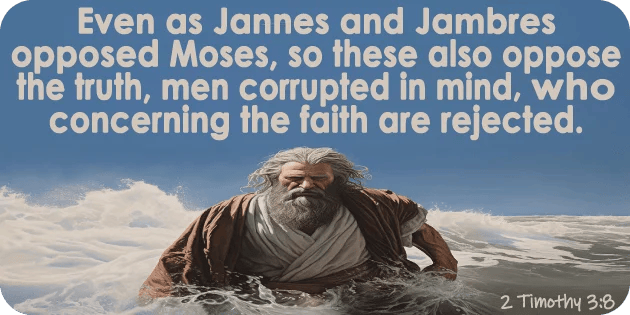
8 Just as Jannes and Jambres opposed Moses, so these men also oppose the truth, men corrupted in mind and disqualified regarding the faith. 9 But they will not get very far, for their folly will be plain to all, as was that of those two men.” (2 Timothy 3:8–9 (ESV)
The opposition to God’s truth began in the Garden of Eden when the serpent (Satan) spoke to Eve, “Did God actually say” (Gen. 3:1). Throughout history, there have been those who not only challenged what God said, but whether He existed (Psalm 14:1). Consequently, false teachers who oppose the existence and revelation of God, also oppose those who affirm God’s existence and His revealed truth.
The Apostle Paul provided his young protégé Timothy, and believers in Christ today, an example form biblical history; Jannes and Jambres. Who exactly were these two individuals?
“Jannes and Jambres were two of Pharaoh’s magicians, who opposed Moses and tried to show that they were as effective as he at working miracles (Ex 7–9). Jewish legend regarded Jannes and Jambres (somewhat improbably) as sons of Balaam, the Midianite prophet of Numbers 22–24. Curiously, the Exodus chapters do not identify them by name. The only biblical reference to them appears in the NT. The Apostle Paul saw similarity between Jannes and Jambres and the false teachers of debased intellect who were enemies of the truth in his day (2 Tm 3:6–8).”[1]
“Much speculation has arisen about the two names. They are apparently Semitic, but their precise derivation is unclear. They are referred to in the Qumran documents and in late Jewish, pagan, and early Christian literature. Variations include “Yohanneh and his brother” (Qumran), “Yohane and Mamre” (Babylonian Talmud), and “Mambres” (the translation in most Latin and some Greek manuscripts of 2 Tm 3:8). The names appear also in the writings of Pliny (first century ad) and of Apuleius and Numenius (both second century), though both names are not always cited.”[2]
“When Moses told Pharaoh, “Let my people go” (Ex. 5:1), and when he proved his divine commission by performing genuine miracles through the power of God (Ex. 7:10, 20, etc.), Pharaoh’s magicians performed their counter-miracles (Ex. 7:11, 22; 8:7; but see also 8:18, 19). From Jewish tradition, with which Paul was very familiar (having been a student of Gamaliel, Acts 22:3), he cites the example of those two ring-leaders among the magicians who, whatever their real names may have been, were known to the Jews as “Jannes and Jambres” (Aram. probably: “he who seduces and he who makes rebellious”). The apostle had in mind the following comparison:”[3]
“This point of comparison is definitely stated. (For another undoubted third of comparison see below, on verse 9.) Whether here in verse 8 any further resemblances are implied cannot be proved. The following are mere possibilities:
(1) Jannes and Jambres were deceivers; so are the purveyors of strange doctrine against whom Paul warns Timothy.
(2) If Jewish tradition can be credited in this respect, Jannes and Jambres became proselytes, faking “conversion” to the Jewish religion. When they saw that they could not prevent Israel’s exodus from Egypt, they are said to have joined the departing multitude. Later (according to Jewish tradition!) they were the ones who induced the people to make a golden calf and to worship it. They were pretenders, therefore; hypocrites, and as such very dangerous. —Similarly, the false leaders whom Paul describes are all the more dangerous because they pretend to be genuine converts to the Christian religion.”[4]
As these two men opposed Moses, the false teachers of Paul’s day, and ours, oppose the truth. To oppose (ἀνθίστανται; anthistantai) is a present middle indicative plural verb. It means to continuously, personally, sincerely and collectively resist, withstand, and be hostile to truth (ἀληθείᾳ; aletheia). Truth is what is actual and real.
TRUTH is what is real and verifiable by experience. In Scripture, truth is a very important concept because God is the God of all truth (Ps. 31:5; 108:4; 146:6), who speaks and judges truly (57:3; 96:13). He is the real source and cause of the whole universe. Scripture also focuses on the revealed truth in the gospel of God’s redeeming grace through Christ. This is the truth Christ and the apostles proclaimed (Jn 8:44–46; 18:37; Rom 9:1; 2 Cor 4:2), which was foreshadowed in the OT (1 Pt. 1:10–12), and witnessed to by the Holy Spirit (Jn 16:13). The OT teaching was never false, but it was shadowy and incomplete in comparison with the revealed truth of the NT. So, Christ brought spiritual reality (Jn 1:17), and the Holy Spirit leads believers into the experience of all that is real in Christ (16:13).”[5]
“Christ is the truth because, being God, his words carry divine authority. They are truth and life (Jn 6:63). In addition, the life of Christ epitomized truthfulness and utter reliability. When people live in obedience to the truth, they themselves are true and reliable. Scripture calls upon people to “do the truth” (Jn 3:21, kjv). Those who have experienced God’s reality in Christ know, by experience, that Christ is the way, the truth, and the life (Jn 14:6).”[6]
Paul continued to write false teachers were “men corrupted in mind and disqualified regarding the faith.” To be corrupted in mind (κατεφθαρμένοι νοῦν; katephtharmenoi noun). This refers to a past completed action with continuing results of depravity in thinking and manner of thought. This results in being disqualified regarding the faith (ἀδόκιμοι pistin; adokimoi pistin). This refers to a worthlessness.
“God in His providence has often used false teaching to move His church to state more clearly the truths taught in Scripture. This does not mean heresy is good, only that even in others’ deceptions God is working all things together for the church’s good (Rom. 8:28). A good book on church history will encourage you as you see the truth of God’s Word triumph again and again. Try to find time to read one that you might be encouraged in your faith,” concludes Dr. R. C. Sproul.
May the Lord’s truth and grace be found here.
Soli deo Gloria!
[1] Walter A. Elwell and Philip Wesley Comfort, Tyndale Bible Dictionary, Tyndale Reference Library (Wheaton, IL: Tyndale House Publishers, 2001), 669.
[2] Ibid., 669.
[3] William Hendriksen and Simon J. Kistemaker, Exposition of the Pastoral Epistles, vol. 4, New Testament Commentary (Grand Rapids: Baker Book House, 1953–2001), 287–288.
[4] Ibid., 287-288.
[5] Walter A. Elwell and Philip Wesley Comfort, Tyndale Bible Dictionary, Tyndale Reference Library (Wheaton, IL: Tyndale House Publishers, 2001), 1276.
[6] Ibid., 1276.

