
5 “This is why I left you in Crete, so that you might put what remained into order, and appoint elders in every town as I directed you—” (Titus 1:5 (ESV)
In Titus 1:1, the Apostle Paul wrote he was “an apostle of Jesus Christ, for the sake of the faith of God’s elect and their knowledge of the truth, which accords with godliness.” Paul’s primary task was to preach the gospel so the elect would trust, commit, depend and worship the Lord Jesus Christ as Savior and Lord. Additionally, the apostle desired believers grow up in the knowledge of God. This knowledge would produce holy living. Having planted a church, Paul appointed overseers/elders to continue teaching the apostolic and prophetic word (Acts 14:19–23) before he moved to a new mission field.
19 “But Jews came from Antioch and Iconium, and having persuaded the crowds, they stoned Paul and dragged him out of the city, supposing that he was dead. 20 But when the disciples gathered about him, he rose up and entered the city, and on the next day he went on with Barnabas to Derbe. 21 When they had preached the gospel to that city and had made many disciples, they returned to Lystra and to Iconium and to Antioch, 22 strengthening the souls of the disciples, encouraging them to continue in the faith, and saying that through many tribulations we must enter the kingdom of God. 23 And when they had appointed elders for them in every church, with prayer and fasting they committed them to the Lord in whom they had believed.” (Acts 14:19–23 (ESV)
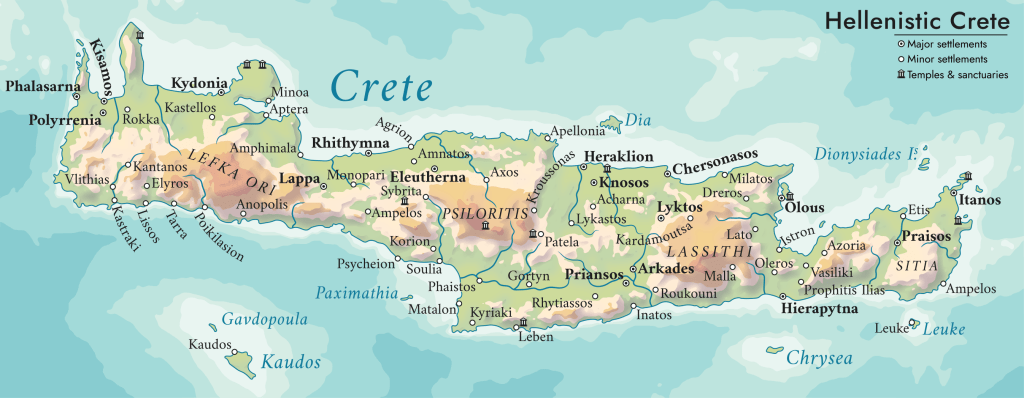
Paul left Titus on the Island of Crete. Paul visited Crete on his way to Rome (Acts 27:1-8). What is known about this Mediterranean island?
“Crete is the fourth largest island in the Mediterranean, lying approximately 60 miles (97 kilometers) southeast of Greece and 110 miles (177 kilometers) southwest of Turkey. It is 160 miles (257.4 kilometers) long from east to west, with a width of approximately 36 miles (58 kilometers), an area of 3,200 square miles (5,149 square kilometers). Through the island stretches a mountain range dominated in the center by the sacred Mt Ida (altitude 9,000 feet or 2,742 meters). These mountains slope down sharply to the southern coast, with the result that most of the inhabitants live on the more gradual northern slopes.[1]
“Civilization in ancient Crete reached its climax with the Minoan era (3000–1100 bc). The spectacular remnants of this high civilization may be seen best at Knossos, thanks to the labors of British archaeologist Arthur Evans. About 1950–1900 bc, beautiful pottery was produced and exported. Metallurgy was highly developed, and hieroglyphic writing was introduced. This civilization was suddenly and dramatically destroyed in a mysterious manner about 1700 bc, perhaps by volcanic eruption or earthquake. Following this, the towns and palaces were rebuilt, and the island enjoyed its greatest prosperity. The partially restored palace of Knossos amazes today’s visitor with superb frescoes, stairways, and pillars. All this ended in destruction about 1450 bc. Some think it was caused by the volcanic explosion at the nearby island of Santorini.”[2]
“Because of its location and its relative fertility, Crete has been a prize of war and of commerce. The island was conquered by Rome in 67 bc and became a separate province. The inhabitants prospered under the Romans and later under the Greek Christians (Byzantines). The Saracens (Muslims) occupied the island for over a century (ad 823–960). After centuries of Christian leadership, it was conquered by the Turkish sultan, and civilization languished (1669–1898). In the 20th century Crete has been a part of Greece, except for a period of German occupancy during World War II.”[3]
“Crete is important in the history of the Christian church. When Paul went to Rome as a prisoner, the ship sought refuge from a storm at Fair Havens (Acts 27:8). The ship tried in vain to reach the more commodious harbor at Phoenix (v 12) but was blown off course and sought refuge at an island off the southwest coast of Crete, called Cauda (v 16). Paul may have visited Crete after imprisonment in Rome, for in his Letter to Titus, he said, “I left you on the island of Crete” (Ti 1:5, nlt). On the basis of this and other evidence, many scholars conclude that Paul was released and had an extended ministry before his second imprisonment and execution (2 Tm 4:6). Paul had little good to say about the people of Crete, quoting one of their own poets as saying they were “liars, cruel animals, and lazy gluttons” (Ti 1:12). But the gospel must have made quite a difference there, for today the name of Titus is honored in many villages, churches, and monasteries.”[4]
In the next installment, we’ll discover why Paul left Titus on this island. May the Lord’s truth and grace be found here.
Soli deo Gloria!
[1] Walter A. Elwell and Philip Wesley Comfort, Tyndale Bible Dictionary, Tyndale Reference Library (Wheaton, IL: Tyndale House Publishers, 2001), 332.
[2] Ibid., 332–333.
[3] Ibid., 333.
[4] Ibid., 333.

