
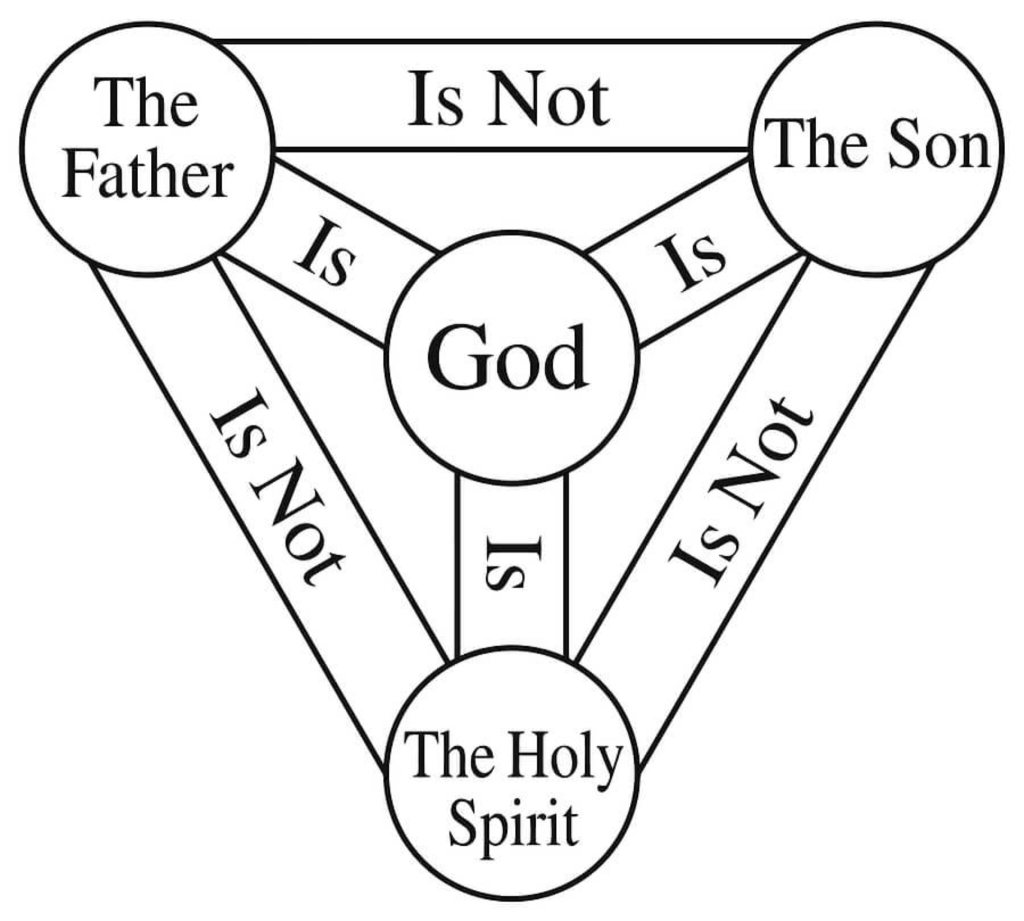
The following essay is from Ligonier Ministries. Author unknown.
“This is what the LORD says—Israel’s King and Redeemer, the LORD Almighty: I am the first and I am the last; apart from me there is no God” (Isaiah 44:6).
Although the word Trinity does not appear in Scripture, the essence of the doctrine is revealed in both the Old and New Testaments. In the Old Testament, God’s triunity is alluded to rather than explicitly revealed. This is due, in part, to the preparatory nature of Old Testament revelation. In the Old Testament, God did not fully reveal all that He intended to reveal throughout redemptive history. We need the New Testament revelation to give us the full unfolding of the Old Testament revelation that prepared God’s people for the new covenant.
Additionally, the monotheistic character of God is emphasized in the Old Testament in such a way as to contrast the truth of Israel’s God with the polytheism of the surrounding pagan nations. This emphasis on the singular nature of God was meant to protect the people from the idolatry of the nations. There are, however, significant Old Testament allusions to the multiplicity of persons in the Godhead.
Consider the following:
- Certain theologians—most notably Peter Lombard and Martin Luther—found an allusion to a multiplicity of persons in the Godhead in the use of the divine name Elohim.
- Throughout church history, many theologians have accepted the Trinitarian character of the communication of the divine council in Genesis 1:26, 11:7, and Isaiah 6:8. The alternative proposal that God was speaking to the angels is unlikely, since Genesis 1:26 reveals that God makes man in His “own” image rather than in the image of angels.
- There are many passages in the Old Testament in which the persons of the Godhead communicate to one another or refer to one another (e.g., Ps. 45:6–7; 110:1; Zech. 2:8–11; Heb. 1:8–9). This is a strong proof of the Trinitarian character of God in the Old Testament.
- Many early church, Lutheran, and Reformed theologians held to the view that the “Angel of the Lord” (Hebrew malakh YHWH) was a preincarnate manifestation of the second person of the Godhead—namely, the Logos.
- The revelation of the Spirit of God in the Old Testament—in distinction to the Father (Isa. 63:16) and the Son (Ps. 2:7; Prov. 30:4)—bears strong witness to the multiplicity of persons in the Godhead (e.g., Gen. 1:2; Ex. 35:31; 2 Sam. 23:2; Isa. 63:10; Ezek. 2:2). The Spirit is the agent of creation, sustenance, power, revelation, and the application of redemption in the Old Testament.
When we come to the New Testament, we see the mystery of the Trinity more clearly unfolded at the baptism of Jesus. All three persons of the Godhead are present when Jesus is baptized. The Father speaks about the Son while the Spirit descends upon the Son (Matt. 3:13–27).
Additionally, the persons of the Godhead are specifically mentioned alongside one another in in the New Testament (Luke 1:35; 3:21–22; Matt. 28:19; 1 Cor. 12:3–4; 2 Cor. 13:14; 1 Peter 1:2). In the Gospels, the Son prays to the Father on numerous occasions, thereby proving that He is in some way distinct from the Father and that the Father and Son are not merely different modes or manifestations of the same divine person, as suggested in the view known as modalism (Luke 22:42; 23:34, 46; John 12:28; 17:1). Rather, Jesus is God incarnate—the eternal Son of God—in perfect unity with and yet distinct from His Father and the Spirit. Jesus speaks explicitly of all three persons of the Godhead in His discourse in John 14–16.
The divine personhood of the Spirit is taught throughout the pages of the New Testament—and most strikingly in the references to His speaking (Acts 13:2; Rev. 2:7, 11, 17, 29; 3:6, 13, 22; 14:13; 22:17). “The Holy Spirit says,” “The Spirit said through . . .,” and “As the Spirit says,” are common ways in which Old Testament citations are introduced in the New Testament. The New Testament speaks both of the eternal divine equality between the Father, Son, and Spirit and of the functional subordination of the Son to the Father in the work of redemption that He performed as the incarnate God-man.
Theologians have commonly distinguished between the ontological Trinity and the economic Trinity. The ontological Trinity describes God as He is in Himself. In the ontological Trinity there is absolute divine equality without any subordination of being. As to the being and attributes of God, the Son is absolutely equal to the Father (John 1:1; 8:58; Col. 1:15, 19; Heb. 1:3). The economic Trinity describes the persons of the Godhead in God’s external working. As to the work of God in redemption, there is functional subordination of the incarnate Christ to the Father (John 5:19–23; 1 Cor. 11:3). This subordination in time as Christ carried out the work of salvation fulfilled the Father’s commitment to send the Son and the Son’s commitment to purchase our redemption that was made in the covenant of redemption (John 10:17–18, 12:49; Titus 1:2).
The term ‘Trinity’ is not a biblical term, and we are not using biblical language when we define what is expressed by it as the doctrine that there is one only and true God, but in the unity of the Godhead there are three coeternal and coequal Persons, the same in substance but distinct in subsistence. A doctrine so defined can be spoken of as a Biblical doctrine only on the principle that the sense of Scripture is Scripture. And the definition of a biblical doctrine in such unbiblical language can be justified only on the principle that it is better to preserve the truth of Scripture than the words of Scripture. The doctrine of the Trinity lies in Scripture in solution; when it is crystallized from its solvent it does not cease to be Scriptural, but only comes into clearer view. — B.B. Warfield, “The Biblical Doctrine of the Trinity”
Have a blessed Lord’s Day.
Soli deo Gloria!

