
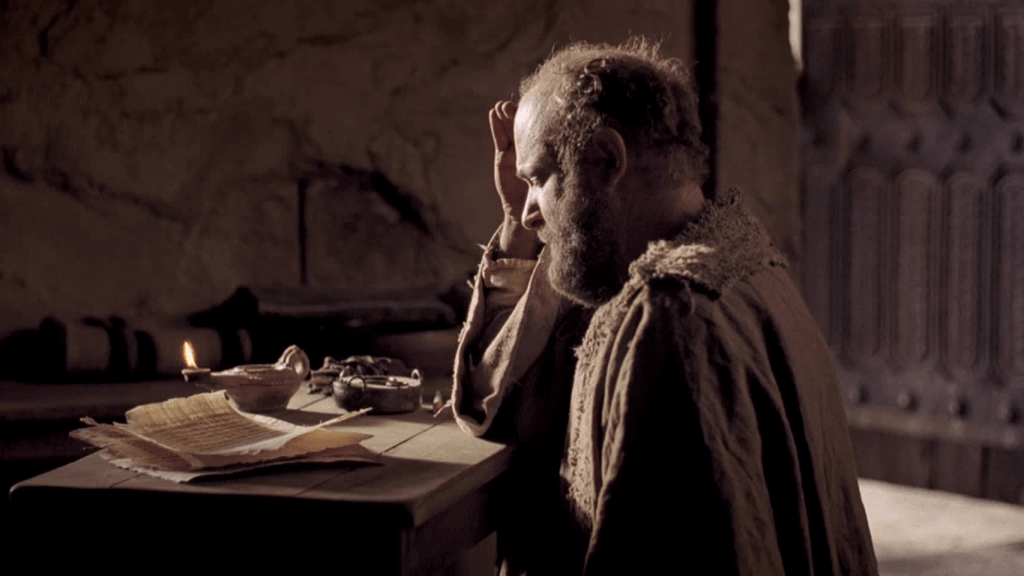
13 I charge you in the presence of God, who gives life to all things, and of Christ Jesus, who in his testimony before Pontius Pilate made the good confession, 14 to keep the commandment unstained and free from reproach until the appearing of our Lord Jesus Christ,” (1 Timothy 6:13–14 (ESV)
What do other biblical scholars and commentators say regarding today’s featured text? The following quotes are but a brief sampling.
Repeatedly in this letter Paul directly addressed Timothy with personal charges, the second strongest of which is found in 5:21. But here is Paul’s strongest, most solemn charge of all (I charge you, parangellō; cf. 1:3; 4:11; 5:7; 6:14) conjuring up images of perhaps a familiar baptismal formula triggered by the reference in verse 12. While testifying before Pontius Pilate is translated by some, “who testified in the time of Pontius Pilate.” If translated this way, the qualifying clause is designed to fix the Crucifixion in time, as in the Apostles’ Creed. Both translations are possible.
6:14. The content of Paul’s charge is that Timothy keeps this commandment without spot or blame. The “commandment” is probably broader than any single law. It refers to the entire body of sound teaching Paul had been describing throughout the letter. Timothy, by his own godly life and by his faithful ministry, was to preserve this body of truth from stain or reproach until the appearing (cf. 2 Tim. 1:10; 4:1, 8; Titus 2:13) of our Lord Jesus Christ. Then and only then will the struggle (1 Tim. 6:12) be over.[1]
It is perhaps surprising to find a reference to Pontius Pilate in v 13, but the historic event of the trial of Jesus provides the best example of the kind of good confession which Paul wants to see in Timothy. The fact that he gives a charge shows how seriously he regards the matter of Timothy’s behavior. This command has given rise to various suggestions. Some see it as referring to some kind of baptismal or ordination charge, but this does not fit the context. It may refer to the advice of vs 11–12 or to the whole of Paul’s advice to Timothy in this letter. The reference here to the appearing of our Lord Jesus Christ (14) gives a future aspect to the preceding statement. The idea of being without spot or blame at that appearing can be paralleled elsewhere in Paul’s letters (cf. 1 Cor. 1:8; Phil. 2:15–16; 1 Thes. 3:13; 5:23).[2]
Another encouragement in our battle is the witness of Jesus Christ our Savior. He “witnessed a good confession” (1 Tim. 6:13) before Pontius Pilate and did not relent before the enemy. He knew that God the Father was with Him and watching over Him, and that He would be raised from the dead. It is “God who makes all things alive” (literal translation), who is caring for us, so we need not fear. Timothy’s natural timidity might want to make him shrink from the battle. But all he had to do was remember Jesus Christ and His bold confession, and this would encourage him.
Paul gave Timothy military orders: “I give thee charge” (1 Tim. 6:13, also 1:3). He was to guard the commandment and obey it. Why? Because one day the Commander would appear and he would have to report on his assignment! The only way he could be ready would be to obey orders “without spot or blame” (1 Tim. 6:14, Niv).
The Greek word translated “appearing” (1 Tim. 6:14) gives us our English word epiphany which means “a glorious manifestation.” In Paul’s day, the word was used in the myths to describe the appearing of a god, especially to deliver someone from trouble. Paul used it of the first coming of Jesus Christ (2 Tim. 1:10) and of His return (2 Tim. 4:1, 8). We do not know when Christ will come again, but it will be “in His own time” (1 Tim. 6:15, Niv) and He knows the schedule. Our task is to be faithful every day and abide in Him (1 John 2:28).[3]
He gives him a solemn charge: I give thee charge in the sight of God that thou do this. He charges him as he will answer it at the great day to that God whose eyes are upon us all, who sees what we are and what we do: —God, who quickens all things, who has life in himself and is the fountain of life. This should quicken us to the service of God that we serve a God who quickens all things. He charges him before Christ Jesus, to whom in a peculiar manner he stood related as a minister of his gospel: Who before Pontius Pilate witnessed a good confession. Observe, Christ died not only as a sacrifice, but as a martyr; and he witnessed a good confession when he was arraigned before Pilate, saying (Jn. 18:36, 37), My kingdom is not of this world: I am come to bear witness unto the truth. That good confession of his before Pilate, My kingdom is not of this world, should be effectual to draw off all his followers, both ministers and people, from the love of this world.
He reminds him of the confession that he himself had made: Thou hast professed a good profession before many witnesses (v. 12), namely, when he was ordained by the laying on of the hands of the presbytery. The obligation of that was still upon him, and he must live up to that, and be quickened by that, to do the work of his ministry.
He reminds him of Christ’s second coming: “Keep this commandment-until the appearing of our Lord Jesus Christ; keep it as long as thou live, till Christ come at death to give thee a discharge. Keep it with an eye to his second coming, when we must all give an account of the talents we have been entrusted with,” Lu. 16:2. Observe, The Lord Jesus Christ will appear, and it will be a glorious appearing, not like his first appearing in the days of his humiliation. Ministers should have an eye to this appearing of the Lord Jesus Christ in all their ministrations, and, till his appearing, they are to keep this commandment without spot, unrebukable. Mentioning the appearing of Christ, as one that loved it, Paul loves to speak of it, and loves to speak of him who shall then appear. The appearing of Christ is certain (he shall show it), but it is not for us to know the time and season of it, which the Father has kept in his own power: let this suffice us, that in time he will show it, in the time that he thinks fit for it.[4]
May the Lord’s truth and grace be found here.
Soli deo Gloria!
[1] A. Duane Litfin, “1 Timothy,” in The Bible Knowledge Commentary: An Exposition of the Scriptures, ed. J. F. Walvoord and R. B. Zuck, vol. 2 (Wheaton, IL: Victor Books, 1985), 747.
[2] Donald Guthrie, “1 Timothy,” in New Bible Commentary: 21st Century Edition, ed. D. A. Carson et al., 4th ed. (Leicester, England; Downers Grove, IL: Inter-Varsity Press, 1994), 1304.
[3] Warren W. Wiersbe, The Bible Exposition Commentary, vol. 2 (Wheaton, IL: Victor Books, 1996), 236.
[4] Matthew Henry, Matthew Henry’s Commentary on the Whole Bible: Complete and Unabridged in One Volume (Peabody: Hendrickson, 1994), 2358–2359.
 His Word Today