
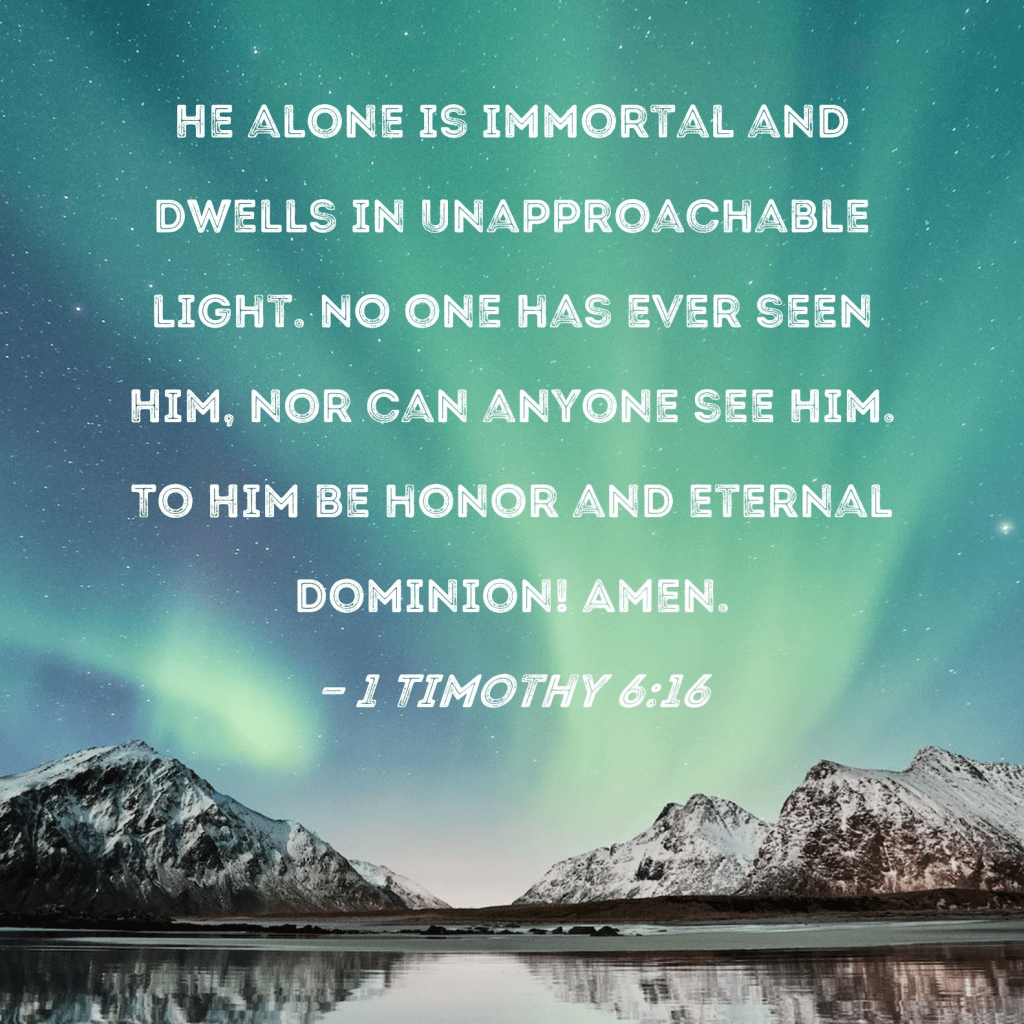
15 which he will display at the proper time—he who is the blessed and only Sovereign, the King of kings and Lord of lords, 16 who alone has immortality, who dwells in unapproachable light, whom no one has ever seen or can see. To him be honor and eternal dominion. Amen.” (1 Timothy 6:15–16 (ESV)
The names the Apostle Paul communicated to his young protégé Timothy concerning God the Father were, and are, not mere arbitrary labels. They are names and titles of attributes which reflect the very nature of the One True, God.
What names and titles did Paul use? It is not an exhaustive list. However, it is a glorious list pointing to the presence of God and the soon appearing of Jesus Christ (I Timothy 6:13). His appearing will occur at the proper time (καιροῖς ἰδίοις; kairois idiois). This refers to a unique occasion. This is the Lord’s second coming (2 Tim. 4:1-8; Titus 2:13). The attributes of God the Father coincide with the attributes of the Lord Jesus.
The One and Only God presently exists as the (1) bless and only Sovereign; (2) the King of kings; (3) the Lord of lords; (4) immortal; (5) unapproachable light; (6) unseen; (7) honorable; (8) and who possesses eternal dominion. Today we examine attributes five and six.
Who dwells in unapproachable light. The phrase who dwells in (οἰκῶν; oikon) is a present, active, masculine participle. It means a continual and active occupying, inhabiting, and residing by God the Father. In the context, this refers to God dwelling in unapproachable light. The word unapproachable (ἀπρόσιτον; aprositon) means not being capable to approach. This adjective modifies the noun light (φῶς; phos). In the context, light does refer to natural, physical light but rather to God’s personal and inherent greatness and holiness.
“The idea of life, implied in immortality, naturally leads to that of light. “In him was life, and that life was the light of men” (John 1:4). Now, this light is like the sun. We need it to see by, yet we cannot look into it, for it is too intensely brilliant. In that sense, God, too, dwells in light unapproachable. The metaphor is even stronger than that employed in Ps. 104:2 (“He covers himself with light as with a garment”). Like a dwelling conceals its occupants, and hides them even more when it is unapproachable, so God’s very essence, by virtue of what it is, conceals him. Hence, the term light as here used re-emphasizes his incomparable greatness. “Verily, thou art a God that hidest thyself, O God of Israel, the Savior” (Is. 45:15). “Behold, God is great.”[1]
Timothy lived in the godless city of Ephesus, but God dwells in glorious light. “And the sight of the glory of the Lord was like devouring fire” (Ex. 24:17). “Who coverest Thyself with light as with a garment” (Ps. 104:2). John’s description of heaven emphasized the glory of God that gives light to the city (Rev. 21:11, 23–24; 22:5). Of course, light is a symbol of holiness (1 John 1:5–7). God dwells apart from sin, and God is glorious in His holiness.[2]
“It is impossible for a sinful human to approach the holy God. It is only through Jesus Christ that we can be accepted into His presence. Jacob saw God in one of His Old Testament appearances on earth (Gen. 32:30); and God allowed Moses to see some of His glory (Ex. 33:18–23). “No man hath seen God at any time” (John 1:18) refers to seeing God in His essence, His spiritual nature. We can only see manifestations of this essence, as in the person of Jesus Christ.”
“Why did Paul write so much about the person and glory of God? Probably as a warning against the “emperor cult” that existed in the Roman Empire. It was customary to acknowledge regularly, “Caesar is Lord!” Of course, Christians would say “Jesus Christ is Lord!” Only God has “honor and power everlasting” (1 Tim. 6:16b). If Timothy was going to fight the good fight of faith, he had to decide that Jesus Christ alone was worthy of worship and complete devotion.[3] [4]
Whom no one has ever seen or can see. Paul referred to this attribute earlier in I Timothy 1:17 when he identified God as invisible (John 1:18; Col. 1:15; Heb. 11:27; I John 4:12).
“He is invisible: Whom no man hath seen, nor can see. It is impossible that mortal eyes should bear the brightness of the divine glory. No man can see God and live.[5]
“God is invisible to our physical eyes (I Tim. 1:17). Yet God condescends to make His glory visible to sinful, human beings while at the same time shielding them from the full manifestation of His divine being, lest they be destroyed by His consuming holiness (Gen. 32:30; Ex. 24:10-11; 33:18-23; Num. 12:6-8; Isaiah 6:1-5). Paul refers here to the overpowering radiance of God’s divine being in Himself, which we His sinful creatures cannot perceive apart from mediation of Christ the divine Son (John 1:18; Rev. 22:1-5). In glory, however, we will see the Lord as He is and view Him face to face (I Cor. 13:12; I John 3:1-2),” explains Dr. R. C. Sproul.
May the Lord’ truth and grace be found here.
Soli deo Gloria!
[1] William Hendriksen and Simon J. Kistemaker, Exposition of the Pastoral Epistles, vol. 4, New Testament Commentary (Grand Rapids: Baker Book House, 1953–2001), 208.
[2] Warren W. Wiersbe, The Bible Exposition Commentary, vol. 2 (Wheaton, IL: Victor Books, 1996), 237.
[3] Ibid.,237.
[4] Ibid., 237.
[5] Matthew Henry, Matthew Henry’s Commentary on the Whole Bible: Complete and Unabridged in One Volume (Peabody: Hendrickson, 1994), 2359.

