
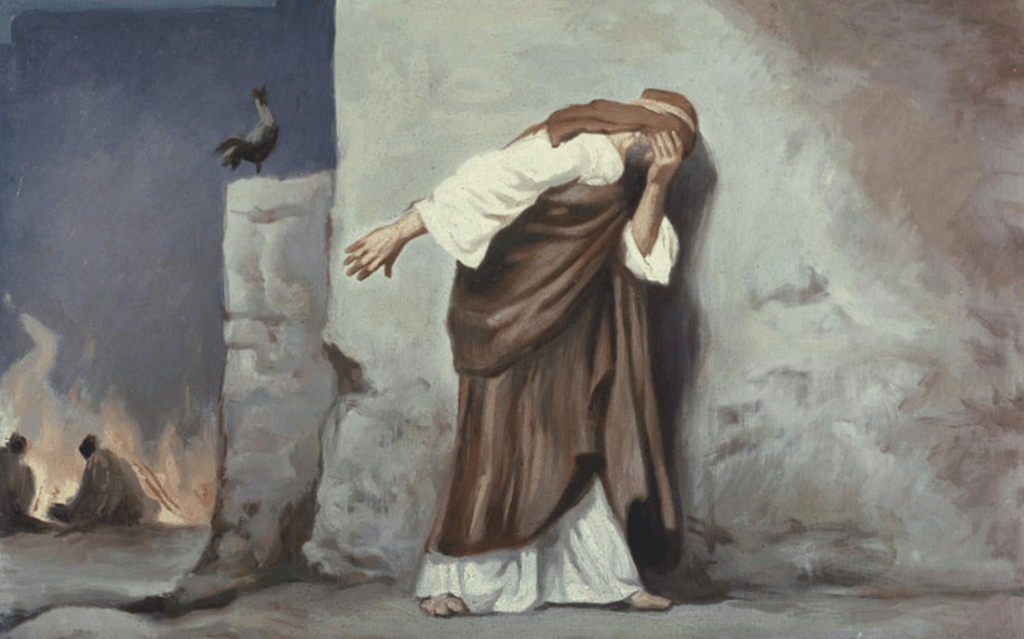
69”Now Peter was sitting outside in the courtyard. And a servant girl came up to him and said, “You also were with Jesus the Galilean.” 70 But he denied it before them all, saying, “I do not know what you mean.” Matthew 26:69–70 (ESV)
66 “And as Peter was below in the courtyard, one of the servant girls of the high priest came, 67 and seeing Peter warming himself, she looked at him and said, “You also were with the Nazarene, Jesus.” 68 But he denied it, saying, “I neither know nor understand what you mean.” And he went out into the gateway and the rooster crowed.” (Mark 14:66–68 (ESV)
54 “Then they seized him and led him away, bringing him into the high priest’s house, and Peter was following at a distance. 55 And when they had kindled a fire in the middle of the courtyard and sat down together, Peter sat down among them. 56 Then a servant girl, seeing him as he sat in the light and looking closely at him, said, “This man also was with him.” 57 But he denied it, saying, “Woman, I do not know him.” (Luke 22:54–57 (ESV)
15 “Simon Peter followed Jesus, and so did another disciple. Since that disciple was known to the high priest, he entered with Jesus into the courtyard of the high priest, 16 but Peter stood outside at the door. So the other disciple, who was known to the high priest, went out and spoke to the servant girl who kept watch at the door, and brought Peter in. 17 The servant girl at the door said to Peter, “You also are not one of this man’s disciples, are you?” He said, “I am not.” 18 Now the servants and officers had made a charcoal fire, because it was cold, and they were standing and warming themselves. Peter also was with them, standing and warming himself.” (John 18:15–18 (ESV)
Simon Peter’s denial of Jesus transpired in three instances, as Jesus predicted (Matt. 26:30-35). Therefore, it is wise to examine each denial in order of their occurrence. The purpose of this is not to just voyeuristically observe a historical event. Rather, it is also to identify the circumstances of this historical event and how it may apply in our own lives as believers in Christ.
Make no mistake. Simon Peter was a true believer and disciple of Jesus. He was not an apostate, which is a biblical renouncer or defector. Judas was an apostate. However, it is clear Peter committed apostasy. What is the difference? Judas was an apostate. It was who he was. Peter committed apostasy, which is what he did, but of which he later repented.
Each and every believer in Christ has committed acts of subtle, if not overt, denials of Jesus. It may be due to fear, embarrassment, intimidation or comfortability. We do not know what to say or what to do when someone confronts us and asks if we’re a believer in Christ and why. We mumble, and stumble, over our words and fail to give a clear answer for the confidence we have in Christ. Ironically, Peter addressed this challenge in his first epistle.
13 Now who is there to harm you if you are zealous for what is good? 14 But even if you should suffer for righteousness’ sake, you will be blessed. Have no fear of them, nor be troubled, 15 but in your hearts honor Christ the Lord as holy, always being prepared to make a defense to anyone who asks you for a reason for the hope that is in you; yet do it with gentleness and respect, 16 having a good conscience, so that, when you are slandered, those who revile your good behavior in Christ may be put to shame. 17 For it is better to suffer for doing good, if that should be God’s will, than for doing evil.” (1 Peter 3:13–17 (ESV)
Observe what Peter directed the elect exiles (I Peter 1:1) to always be prepared to do. (1) Be zealous for what is good; (2) Do not fear suffering and those who inflict it; (3) Honor Christ as holy; (4) Always be prepared to defend the hope you have in Christ; (5) Always speak to unbelievers with gentleness and respect; (6) Realize you may be slandered for your good behavior; and (7) Understand it is better to suffer for obeying the Lord than doing evil.
A.W. Pink writes, “In view of this solemn and awful fact, the writer earnestly calls upon himself and each reader to get down before God and sincerely cry, “Search me, O God: reveal me to myself. If I am deceived, undeceive me ere it be eternally too late. Enable me to measure myself faithfully by Thy Word, so that I may discover whether or not my heart has been renewed, whether I have abandoned every course of self-will and truly surrendered to Thee; whether I have so repented that I hate all sin, and fervently long to be free from its power, loathe myself and seek diligently to deny myself; whether my faith is that which overcomes the world (1 John 5:4), or whether it be only a mere notional thing which produces no godly living; whether I am a fruitful branch of the vine, or only a cumberer of the ground; in short, whether I be a new creature in Christ, or only a painted hypocrite.” If I have an honest heart, then I am willing, yea anxious to face and know the real truth about myself.”
Soli deo Gloria!
 His Word Today
Amen
LikeLike