
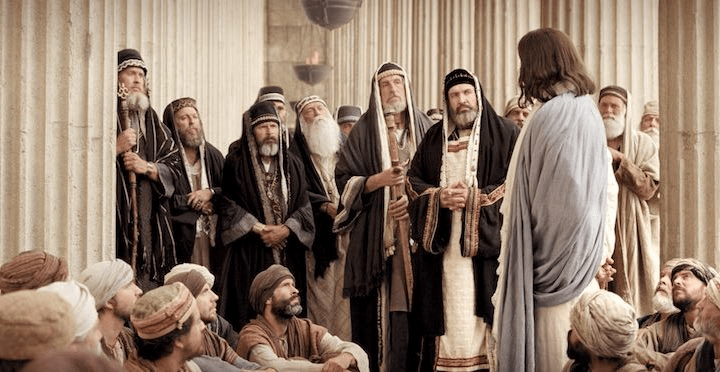
23 “The same day Sadducees came to him, who say that there is no resurrection, and they asked him a question, 24 saying, “Teacher, Moses said, ‘If a man dies having no children, his brother must marry the widow and raise up offspring for his brother.’ 25 Now there were seven brothers among us. The first married and died, and having no offspring left his wife to his brother. 26 So too the second and third, down to the seventh. 27 After them all, the woman died. 28 In the resurrection, therefore, of the seven, whose wife will she be? For they all had her.” (Matthew 22:23–28 (ESV)
The controversial conversations Jesus encountered with His enemies were relentless during His Passion Week. Following the dialogue with the Pharisees concerning taxes (Matt. 22:15-22), Jesus then faced the Sadducees.
John Calvin writes, “Satan brings together all the ungodly, who in other respects differ widely from each other, to attack the truth of God.”
This is not the first occasion Matthew recorded Jesus encountering the Sadducees. A brief review of this first century people group is appropriate.
“In the Gospel narrative the Sadducees first appeared, together with Pharisees, at John’s baptism. He addressed them as “sons of snakes” and challenged them to show repentance in their lives (Matt.3:7–10). Later, the Sadducees came along with some Pharisees to “test” Jesus, asking him to show them a sign from heaven (16:1). Jesus told his disciples to beware of the Sadducees (vv 6, 11–12),” states the Tyndale Bible Dictionary.
“A great difference begins to emerge between Pharisees and Sadducees in Matthew 22:23–33 (cf. Mk 12:18–27; Lk 20:27–38). The Sadducees, who, like others, wanted to embarrass Jesus with their questions, came with a trick question that showed their doubts concerning the resurrection of the dead.”
“Josephus, the Jewish historian who wrote in the closing years of the first century ad, adds to the information in the NT about this party. He said that the Sadducees, in contrast to the Pharisees and Essenes, gave no place to the overruling providence of God but emphasized that all that happens to us is the result of the good or evil that we do (Antiquities 13.5.9; War 2.8.14). Josephus, in a way comparable to the NT, spoke of the Sadducees’ rejection of “the immortal duration of the soul, and the punishments and rewards in Hades” (War 2.8.14). “Souls die with the bodies” was what they said (Antiquities 18.1.4).”
The Sadducees proposed scenario and question is contained in today’s text. In light of a woman married to seven brothers, following each preceding brother’s death, they wanted to know, according to the Mosaic Law, who would she be married to in the resurrection? Remember, the Sadducees did not believe in a resurrection of the body.
“Most Jews disliked the priestly Sadducees, because they embraced Roman customs, accommodating themselves to Rome to maintain their priestly authority. Quarreling with the popular Pharisees did not win friends for the Sadducees, whose contempt for the Pharisaic belief in resurrection is seen in their use of levirate marriage (Deut. 25:5–10) to ask Jesus about the life to come (Matt. 22:24–28),” explains Dr. R. C. Sproul.
“The need to determine the husband to whom the childless woman belongs in eternity remains even if only two brothers are involved. But the Sadducees spoke of seven men to emphasize the countless hurdles they found to belief in the resurrection. They were inferring that resurrection would force incest (being married simultaneously to many living brothers, Lev. 18:16) and break God’s law. How, then, could they affirm the doctrine?”
We will examine Jesus’ response to the Sadducees next time. Until then, have a blessed day in the Lord.
Soli deo Gloria!
 His Word Today
I find so much value to your blogs and it gives me more information to develop my own personal blogs. Thanks.
LikeLike