
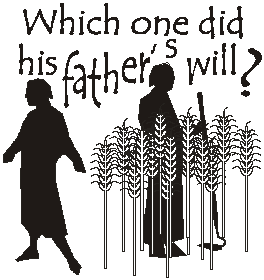
28 “What do you think? A man had two sons. And he went to the first and said, ‘Son, go and work in the vineyard today.’ 29 And he answered, ‘I will not,’ but afterward he changed his mind and went. 30 And he went to the other son and said the same. And he answered, ‘I go, sir,’ but did not go. 31 Which of the two did the will of his father?” They said, “The first.” Jesus said to them, “Truly, I say to you, the tax collectors and the prostitutes go into the kingdom of God before you. 32 For John came to you in the way of righteousness, and you did not believe him, but the tax collectors and the prostitutes believed him. And even when you saw it, you did not afterward change your minds and believe him.” (Matthew 21:28–32 (ESV)
Today’s text continues within the context of Jesus teaching the Jewish religious leaders (Matt. 21:23-27). The phrase “What do you think?” validates this interpretation. Jesus is speaking to the chief priests and the scribes. This same setting will continue through Matthew 23:39. The Parable of Two Sons is the first of three Jesus gave to His opponents at this time. It is followed by The Parable of the Tenants (Matt. 21:33-46) and The Parable of the Wedding Feast (Matthew 22:1-14).
The parable concerns a man with two sons. It is similar to the well-known Parable of the Prodigal Son (Luke 15:11-32). The father, presumably Jewish, went to his first son, presumably the eldest and most significant. He said to him, “Son, go and work in the vineyard today.” Jesus gives no particular age for the son. The parable’s presumption is the son was of a suitable age to do the hard labor required to work in the family’s vineyard.
This was not a father’s request for his son to work, but rather a command. This is what the father directed his son to do, and what the son was expected to do. However, in defiance to his father, the eldest son initially refused to obey his father’s command. He said, “I will not.” The son gave no reason for his refusal. However, he later changed his mind and went to work the vineyard.
“The lad’s answer, “I will not,” or “I won’t,” “I don’t want to,” also has a modern ring. Children have not changed much over the centuries. Happily, however, that even applies to the boy’s further reaction: subsequently “he repented and went.” For one reason or another he regretted his earlier flat refusal. He rues his blunt, negative reply and goes to work,” explains Dr. William Hendriksen.
Jesus then said, “And he went to the other son and said the same. And he answered, ‘I go, sir,’ but did not go.” The second son, probably the younger of the two, initially agreed but ultimately disobeyed his father by both lying to him and not working for him in the vineyard. It is also interesting to note this son addressed his father as sir, or lord. While this is a title of respect, it is lacking in familial love and affection.
Having set the stage, Jesus then asked the religious leaders a question. “Which of the two did the will of his father?” They said, “The first.” This was the correct and obvious answer. Ultimately obedience, even when initially rejected, determines whether an individual does the will of a father. Jesus then brought forth the parable’s application.
“Truly, I say to you, the tax collectors and the prostitutes go into the kingdom of God before you. 32 For John came to you in the way of righteousness, and you did not believe him, but the tax collectors and the prostitutes believed him. And even when you saw it, you did not afterward change your minds and believe him.”
Even though the tax collectors and prostitutes initially rejected John the Baptist’s message and God’s law, they ultimately repented of their sin. They returned to the Lord as a direct result of John’s preaching and teaching. The religious leaders, in contrast, did the exact opposite. Professing devotion to God’s law, they ultimately rejected it by rejecting both John and Jesus. The former group would enter the kingdom of God, while the latter group would not.
“Though this parable of the Two Sons, found only in Matthew, is perhaps not as well-known as many of the others, it is by no means less important. In fact, a more important lesson than the one taught here is scarcely imaginable. That lesson is, of course, this: the doing of the will of God is the one thing needful. Is not that the teaching of both the Old and the New (Testaments)? See 1 Sam. 15:22; Ps. 25:4; 27:11; 86:11; 119; 143:10; Isa. 2:3; Matt. 7:21–27; 28:20; John 15:14; Acts 5:29. And the will of God is that men should everywhere be converted and acknowledge Jesus Christ as Lord and Savior, to the glory of God Triune (Matt. 3:2; 4:17; 11:28–30; John 3:16, 36; 1 Cor. 10:31; 2 Cor. 10:5). As for the Mediator’s own relation to the will of his Sender, did he not say, “My food is to do the will of the One who sent me, and to accomplish his work” (John 4:34),” concludes Dr. Hendriksen.
Remember, obedience is the very best way to show that you believe. Have a blessed day in the Lord.
Soli deo Gloria!
 His Word Today
Iron sharpens iron.
LikeLiked by 1 person