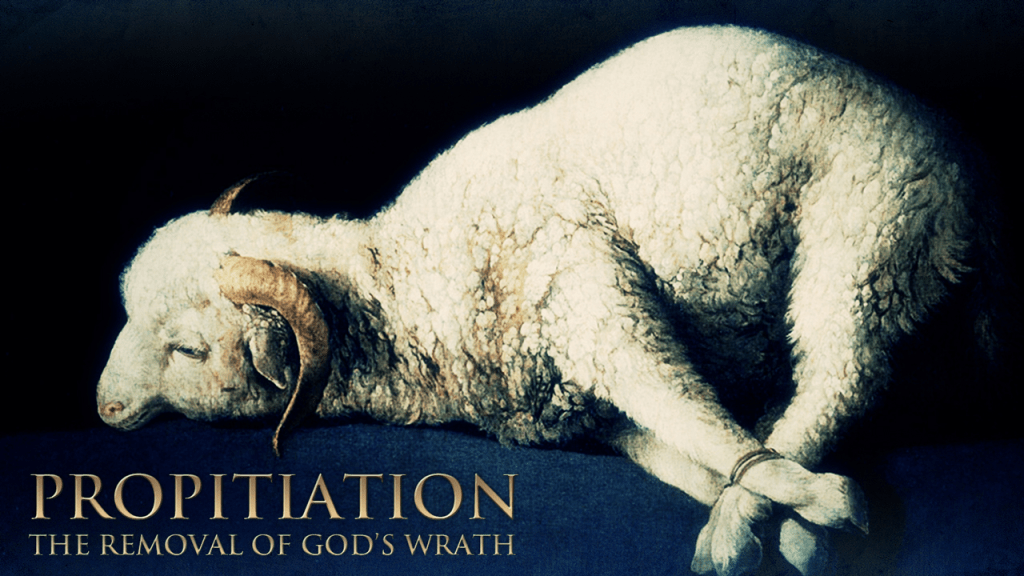
The Vocabulary of Salvation: Propitiation. Part 2.

“To love and to be propitious are not convertible terms. It is false to suppose that the doctrine of propitiation regards propitiation as that which causes or constrains the divine love. It is loose thinking of a deplorable sort to claim that propitiation of the divine wrath does prejudice to or is incompatible with the fullest recognition that the atonement is the provision of the divine love.” – Dr. John Murray, Westminster Theological Seminary

In what New Testament texts do we find occurrences of the word Propitiation? Here is a list.

Romans 3:21–26 (ESV) – “21 But now the righteousness of God has been manifested apart from the law, although the Law and the Prophets bear witness to it— 22 the righteousness of God through faith in Jesus Christ for all who believe. For there is no distinction: 23 for all have sinned and fall short of the glory of God, 24 and are justified by his grace as a gift, through the redemption that is in Christ Jesus, 25 whom God put forward as a propitiation by his blood, to be received by faith. This was to show God’s righteousness, because in his divine forbearance he had passed over former sins. 26 It was to show his righteousness at the present time, so that he might be just and the justifier of the one who has faith in Jesus.

Hebrews 2:14–17 (ESV) – “14 Since therefore the children share in flesh and blood, he himself likewise partook of the same things, that through death he might destroy the one who has the power of death, that is, the devil, 15 and deliver all those who through fear of death were subject to lifelong slavery. 16 For surely it is not angels that he helps, but he helps the offspring of Abraham. 17 Therefore he had to be made like his brothers in every respect, so that he might become a merciful and faithful high priest in the service of God, to make propitiation for the sins of the people.

1 John 2:1–2 (ESV) – “My little children, I am writing these things to you so that you may not sin. But if anyone does sin, we have an advocate with the Father, Jesus Christ the righteous. He is the propitiation for our sins, and not for ours only but also for the sins of the whole world.

John 4:7–10 (ESV) – “Beloved, let us love one another, for love is from God, and whoever loves has been born of God and knows God. Anyone who does not love does not know God, because God is love. In this the love of God was made manifest among us, that God sent his only Son into the world, so that we might live through him. 10 In this is love, not that we have loved God but that he loved us and sent his Son to be the propitiation for our sins.

What was the place on which propitiation was accomplished? It took place on the cross of Christ. This is the doctrine of penal, substitutionary atonement. See Luke 22:39-46; Romans 5:6-11; I Corinthians 1:18-31; I Corinthians 2:1-2; 2 Corinthians 5:17-21; Ephesians 2:13; Galatians 3:13-14; Colossians 2:13-15; Hebrews 9:11-14; Hebrews 10:1-14; I Peter 2:21-25.

“Propitiation is not a turning of the wrath of God into love. The propitiation of the divine wrath, effected in the expiatory work of Christ, is the provision of God’s eternal and unchangeable love, so that through the propitiation of his own wrath that love may realize its purpose in a way that is consonant with and to the glory of the dictates of his holiness. It is one thing to say that the wrathful God is made loving. That would be entirely false. It is another thing to say the wrathful God is loving. That is profoundly true. But it is also true that the wrath by which he is wrathful is propitiated through the cross. This propitiation is the fruit of the divine love that provided it. “Herein is love, not that we loved God, but that he loved us and sent his Son to be the propitiation for our sins” (I John 4:10). The propitiation is the ground upon which the divine love operates and the channel through which it flows in achieving its end,” explains Dr. Murray.

How is Jesus Christ’s propitiatory sacrifice applied to the sinner? It is by grace alone, through faith alone in the person and work of Jesus Christ alone. See Romans 1:16-17; Romans 3:21-26; Galatians 2:15-16; Galatians 3:10-14; Ephesians 2:1-9 Philippians 3:1-9; and Titus 3:1-5.

Soli deo Gloria!

The Vocabulary of Salvation: Propitiation.

“Propitiation presupposes the wrath and displeasure of God, and the purpose of propitiation is the removal of this displeasure. Very simply stated the doctrine of propitiation means that Christ propitiated the wrath of God and rendered God propitious to his people.” – Dr. John Murray, Westminster Theological Seminary

“Perhaps no tenet respecting the atonement has been more violently criticized than this one. It has been assailed as involving a mythological conception of God, as supposing internal conflict in the mind of God and between the persons of the Godhead. It has been charged that this doctrine represents the Son as winning over the incensed Father to clemency and love, a supposition wholly inconsistent with the fact that the love of God is the very fount from which the atonement springs.”

What is the meaning of Propitiation? Propitiation means to appease and placate the righteous wrath and justice of God the Father. It means,“To remove us from the wrath of God that we deserved. Christ died as a propitiation for our sins (I John 4:10,” explains Dr. Wayne Grudem.

Understandably, some modern theologians have reacted against using the term in reference to the God of the Bible. However, the word propitiation occurs in several  biblical passages (Rom. 3:25; Heb.2:17; 1 John 2:2; 4:10). Additionally, the idea of the wrath of God is found throughout the Bible; it must be taken into account in the way sin is forgiven.  

Propitiation comes from three Greek words. The first is ἱλαστήριον (hilasterion). It literally means mercy seat. It is a sin offering, by which the wrath of the deity shall be appeased, a means of propitiation (Rom. 3:25); (b) the covering of the ark, which was sprinkled with the atoning blood on the Day of Atonement (Heb. Kappôreth; Leviticus 16; Heb. 9:5).

Romans 3:23–25 (ESV) – 23 for all have sinned and fall short of the glory of God, 24 and are justified by his grace as a gift, through the redemption that is in Christ Jesus, 25 whom God put forward as a propitiation by his blood, to be received by faith. This was to show God’s righteousness, because in his divine forbearance he had passed over former sins.”

The second Greek word is ἱλάσκομαι (hilaskomai). It means to render favorable, to satisfy and to appease or pardon the wrath of God. In other words, to make atonement.

Hebrews 2:17 (ESV) – “Therefore he had to be made like his brothers in every respect, so that he might become a merciful and faithful high priest in the service of God, to make propitiation for the sins of the people.”

Third, there is the Greek word ἱλασμός (hilasmos) meaning to make atonement before an angry God. This word is found in two texts.

1 John 2:1–2 (ESV) – “My little children, I am writing these things to you so that you may not sin. But if anyone does sin, we have an advocate with the Father, Jesus Christ the righteous. He is the propitiation for our sins, and not for ours only but also for the sins of the whole world.”

1 John 4:10 (ESV) – “In this is love, not that we have loved God but that he loved us and sent his Son to be the propitiation for our sins.”

The New Testament clearly teaches Jesus Christ died on the cross as a propitiatory sacrifice. His death on the cross satisfied the divine judgment against sinners and assuages the Father’s wrath against them, bringing about forgiveness and justification.

The idea that God cannot be angry towards sinners is not based on the OT or the NT. God does have anger for the sins of the human race (Psalm 5:5; 11:4-7). Whenever humans sin, they provoke the wrath of God (Romans 1:18). However, God’s anger is not an irrational lack of self-control. His wrath is the settled opposition of His holy nature to everything that is evil. Such opposition to sin cannot be dismissed with a casual wave of the hand. It requires something much more substantial.

The Bible states that it was only the cross that did this. Jesus is “the propitiation for our sins: and not for ours only, but also for the sins of the whole world” (1 John 2:2, kjv). This is the only way of interpreting the cross. Since God’s anger is real, then it must be taken into account in the way that sin, which caused that wrath, is addressed. Propitiation means that Jesus’ death on the cross for sinners put away God’s wrath against his people once and for all.

Soli deo Gloria!

The Vocabulary of Salvation: Key Words for Substitution.

There are three key words, or phrases, in the New Testament that explain the doctrine of the penal substitutionary atonement of Jesus Christ on the cross. They are the phrases in the place of, for the benefit of and the word ransom.

In the place of (ἀντί; anti) refers to a substitution for sin. There are many facets to the meaning of Christ’s death, but the central one—without which the others have no eternal meaning—is substitution. This simply means that Christ died in the place of sinners. The use of the Greek preposition anti clearly teaches this because it means in the place of. This meaning is found in a passage that has nothing to do with the death of Christ (Luke 11:11).

Most significantly, it is used in two passages that gives our Lord’s own interpretation of the meaning of His death. These are Matthew 20:28 and Mark 10:45). His death, He said, was to be a payment in the place of, or for, many.

Matthew 20:28 (ESV) – “28 even as the Son of Man came not to be served but to serve, and to give his life as a ransom for many.

Mark 10:45 (ESV) – “45 For even the Son of Man came not to be served but to serve, and to give his life as a ransom for many.”

The second word is also a Greek preposition. It is the word (ὑπέρ; hyper). The preposition, huper, is used in the New Testament, and it has two meanings. Sometimes it means for the benefit of and sometimes in the place of. It is also translated in the English with the word for

“The death of Christ was both in our place and for our benefit, and there is no reason why huper, when it is used in relation to His death, does not include both ideas,” explains Dr. Charles Ryrie.

The word vicarious, meaning substitute, is extremely important to our understanding of the atonement of Christ. He was the sinners’ substitute (Luke 22:14-20; John 11:50; Romans 5:6-10; 2 Corinthians 5:14-15; Galatians 1:3-4; I Thessalonians 5:9-10; Philemon 13).

“The late Swiss theologian Karl Barth once said that, in his judgment, the single most important word in all of the Greek New Testament is the miniscule word huper. This little word is translated by the English phrase “on behalf of. He was seeking to call attention to the importance of what is known in theology as the vicarious aspect of the ministry of Jesus,” states Dr. R. C. Sproul.

“We sometimes speak of Jesus’ work on the cross as the substitutionary atonement of Christ. This means that when He offered an atonement, it was not to satisfy God’s justice for His own sins, but for the sins of others. He stepped into the role of the Substitute, representing His people. He didn’t lay down His life for Himself; He laid it down for His sheep. He is our ultimate substitute.” See Genesis 3:21; 22:10-13; Exodus 12:12-13; Isaiah 53:1-6; John 10:11-18; 2 Corinthians 5:17-21; I Peter 2:20-24; 3:13-18.

The third word is the noun ransom (λύτρον; lytron). A ransom is the means or instrument by which release or deliverance is made possible. It is the means of release.

“Ransom” refers to the price paid to free a slave or a prisoner; “for” means “in place of.” Christ’s substitutionary death on behalf of those who would put their faith in him is the most glorious, blessed truth in all of Scripture (cf. Rom. 8:1–31 Cor. 6:20Gal. 3:13; 4:5Eph. 1:7Titus 2:141 Pet. 1:18–19). The ransom was not paid to Satan, as some erroneous theories of the atonement teach. Satan is presented in Scripture as a foe to be defeated, not a ruler to be placated. The ransom price was paid to God to satisfy his justice and holy wrath against sin. In paying it, Christ “bore our sins in his body on the tree” (1 Pet. 2:24),” explains Dr. John MacArthur.

May we consider the substitutionary work Jesus Christ accomplished on the cross on our behalf.

Soli deo Gloria!

The Vocabulary of Salvation: Substitution.

For God has not destined us for wrath, but to obtain salvation through our Lord Jesus Christ, 10 who died for us so that whether we are awake or asleep we might live with him.” (1 Thessalonians 5:9–10 ESV)

Theologians have long plumbed the depths of Scripture to understand the nature of the atonement. They have discovered that the Bible reveals many significant things about the death of the Lord Jesus Christ.  

The Scriptures teach that Jesus died as a ransom to free us from slavery to sin, Satan, and death (Mark 10:45). Other biblical passages tell us that Jesus’ death and subsequent victory defeated the devil and his demons (Col. 2:15). These truths are too precious to ignore, but we will miss the full significance of the atonement if we neglect another truth about the cross—namely, that Jesus died to bear the wrath and curse of God as our substitute.

When our Creator entered into a relationship with sinners, He did so by means of a covenant (Gen. 12:1-3; 15; 17; Exodus 20; 2 Samuel 7:14-20; Jer. 31:31-34). The LORD promised to be God to His people while demanding their faith and obedience. God gave promises of blessings and curses in His covenant with Israel. The blessings can be summarized as long life in the blessed presence of the Lord. The curses can be summarized as death outside of God’s presence.

Keeping the covenant brought blessings; breaking it brought curses. Those who sought the Lord to obey Him, while repenting when they fell short and offering the prescribed sacrifices, were blessed. Those who flagrantly violated the terms of the covenant and remained impenitent were cursed. Such individuals could be cast out of the nation, and as a nation they could be sent out of Canaan into exile (Lev. 24:10–23; 26Deut. 27 & 28). The blessings and curses, as the book of Hebrews indicates, pointed beyond themselves to an even better country for those of faith and an even worse punishment for the impenitent—eternal life for believers, eternal death for those who reject God’s grace (Hebrews 10).

Once a year, on the Day of Atonement, the sins of Israel were to be placed on a goat. The high priest then had the goat driven outside the camp to its freedom in the wilderness (Lev. 16:20-22). The goat bore the curse of God, but the blood of bulls and goats cannot truly atone for sin (Heb. 10:4).

Jesus came to bear the curse of God in our place. All of us, except Jesus, are covenant breakers who God cast out of His blessed presence. God ejected Adam and Eve from Eden, and Israel repeated Adam’s failure and God cast the nation out of the Promised Land (Gen. 32 Kings 25:1–21; 2 Chronicles 36:17-21). This curse could only be removed by the Messiah who received God’s curse on His people so that they would return to His blessed presence. Jesus died as a penal substitute, taking our place under God’s wrath so that sinners can receive God’s eternal blessings.

The penal substitutionary view of the atonement that we have looked at in today’s study stands at the center of our salvation. If we reject this view, then we reject the biblical teaching that God’s justice must be satisfied. We end up with an unjust Judge. However, if God is an unjust Judge, He cannot be trusted to always do what is right. By affirming penal substitution, we affirm that the Judge of all the earth is righteous. By affirming penal substitution, we affirm the Gospel.

“The view of Christ’s death presented here has frequently been called the theory of penal substitution. Christ’s death was ‘penal’ in that he bore the penalty when He died. His death was also a ‘substitution’ in that He was a substitute for us when He died. This has become the orthodox understanding of the atonement held by evangelical theologians, in contrast to other views that attempt to explain the atonement apart from the idea of the wrath of God or payment of the penalty for sin.” – Dr. Wayne Grudem

Soli deo Gloria!

The Vocabulary of Salvation: Faith. Part Two.      

There are two biblical components to a true conversion to the Gospel of Jesus Christ; repentance and faith. Today, we examine the biblical doctrine of faith.

What is faith? It is a commitment to, a dependence upon, a trust in and an honoring of an object. In effect, every individual who has lived, is living, and will live has been, is and will be an individual of faith. The all-important question is “faith in what or who?”

What Faith is Not. Faith is not…

  • Faith is not a blind leap into the dark.
    • Faith is not supposition.
      • Faith is not speculation.
        • Faith is not opinion or hypothesis.
        • Faith is not believing in something when common sense tells you not to.

What is the relationship between repentance and faith? Repentance is a turning from sin. Faith is a turning to Christ (Acts 20:21).

How is faith produced? Faith is produced by the Holy Spirit (John 3:1-8; Titus 3:1-5) and consequently understanding the Word of God (Romans 10:13-17; Galatians 3:1-5).

Why is Faith Necessary? Without faith, it is impossible to please God (Heb. 11:6). Sinners are saved by grace, through faith alone, in the person and work of Jesus Christ alone (Rom. 3:21-26; Acts 16:31; Gal. 3:10-15; Eph. 2:1-9). The converted are sanctified by faith. We live by faith (Rom. 1:19). We stand by faith (2 Cor. 1:24). We walk by faith (2 Cor. 5:7). We battle by faith (I Tim. 6:12). We overcome by faith (I John 5:4).

“Consistently the Scriptures teach that faith is not conjured up by the human will but is a sovereignly granted gift of God (John 6:44-65; Acts 3:16; Philippians 1:29; 2 Peter 1:1). “As a divine gift, faith is neither transient or impotent. It has an abiding quality that guarantees it will endure to the end,” states Dr. John MacArthur.

“Although we have been considering initial faith and repentance as the two aspects of conversion at the beginning of the Christian life, it is important to realize that faith and repentance are not confined to the beginning of the Christian life,” explains Dr. Wayne Grudem.

“Although it is true that initial saving faith and initial repentance occur only once in our lives, and when they occur the constitute true conversion, nonetheless the heart attitudes of repentance and faith only begin at conversion. These same attributes should continue throughout the course of our Christian lives. Each day we should have heartfelt repentance for sins we have committed and faith in Christ to provide for our needs and to empower us to live the Christian life.”

Soli deo Gloria!

The Vocabulary of Salvation: Faith.  

There are two biblical components to a true conversion to the Gospel of Jesus Christ; repentance and faith. Today, we examine the biblical doctrine of faith.

What is faith? It is a commitment to, a dependence upon, a trust in and an honoring of an object. In effect, every individual who has lived, is living, and will live has been, is and will be an individual of faith. The all-important question is “faith in what or who?”

In the Old Testament, there are three words for faith.

(a) אמן (‘mn), “trust” or “reliability.”

  •  אֱמוּנָה (Emunah), “trust” or “reliability.” In contexts related to human relationships, this term “often refers to those who have the capacity to remain stable (i.e., faithful) amid the unsettling circumstances of life, realizing God’s truth has established them” (Wilson, 183). For example, the term is used of Moses’ hands as Aaron and Hur supported him on the hill at Rephidim (Exod. 17:12). Thus, his hands were firm, steady, and reliable.
  •  אֱמֶת (emeth), “faithfulness” or “truth.” Some scholars gloss over this term as “loyalty” when it regards covenantal relationship and defines it as demonstrated loyalty, or “faithfulness in action.” The term frequently appears alongside the Hebrew term for “loving-kindness” (חֶ֫סֶד, chesed) in describing Israel’s God (e.g., Gen. 32:10; Neh. 9:17; Ps.  25:10; 86:15; 98:3).

In the New Testament, there is only one word for faith, or to believe.

  • Πίστις (pistis). Faith.
    • Πιστεύω (pisteuo). Believe.

In the Synoptic Gospels, the language of faith relates to trust in God and in Jesus (Mark 4:40; 11:22–24; Luke 8:25; Matt 21:21–22), with some verses expressing concern for faith’s relationship to divine judgment (Luke 18:8). Jesus’ miracles are of greatest interest in regard to the subject of faith.

The Gospel of John emphasizes the act of believing, as evidenced by the pervasiveness of the term “believing” (πιστεύω, pisteuō) and the absence of the noun “faith” (πίστις, pistis). John has a Christ-centered motif, in which trust in God demonstrates itself in belief in Jesus. This is evident in John 6:29: “This is the work of God, that you may believe in him whom he has sent” (John 12:44; 14:1).

The Apostle Paul’s letters contain the vast majority of the occurrences of the term “faith” (πίστις, pistis) in the New Testament. The term appears over 60 times in Romans and Galatians alone. He uses various senses of the term in his writings and shows both continuity and contrast to the Jewish sense of the term in his time.

“The phrase “justification by faith,” which figures prominently in Romans and Galatians, is particularly distinctive of Protestant Christianity (e.g., Rom 3:26, 28; 4:5; 5:1; Gal 2:16; 3:11, 24). In popular understanding, this phrase has been understood to mean salvation by acceptance of Jesus’ self-sacrifice for human sin, without personal merit. While there are a few places where Paul makes clear that God’s gifts of grace and salvation are freely given (Rom 4:4–5; Eph 2:8–9), it is necessary to understand the meaning of justification by faith in the first-century Jewish context of Paul’s ministry,” explains the Lexham Bible Dictionary.

The word “faith” (πίστις, pistis) also holds a strong cognitive connotation for Paul, where faith is something you hold with your mind, along with your emotions and will. True saving faith involves knowledge of the Gospel, agreement with the Gospel, and personal trust in the person and work of the Gospel; Jesus Christ (Romans 10:14-17).

The Epistle to the Hebrews emphasizes the theme of faith. The Greek terms for faith (πίστις, pistis) and to believe (πιστεύω, pisteuō) occur more than 30 times in the text, with the majority of occurrences in Heb 11. Beginning with the statement “Now faith (πίστις, pistis) is the assurance of things hoped for, the conviction of things not seen” (Heb 11:1).

Hebrews commends biblical people who trusted God to passionately pursue Him despite obstacles (Heb 11:6). The letter predominantly focuses on faith that trusts in God’s promises of restoration and reward (Heb 6:1; 13:7).

The Epistle of James speaks on the subject of faith in a way that is distinct from the author of Hebrews and Paul’s teachings. Suggesting the sense of covenant faithfulness, James calls believers to practice faith that can hold up under pressure (James 1:3) and that it does not hesitate or doubt (James 1:6). In James 2:14–26, James shifts his discussion to focus on faith and its relationship with good works.

“James’ use of the word “works” in relationship to faith suggests a meaning of “deed,” where deeds are the natural expressions of true faith. With this understanding, James’ teachings are not in opposition to Paul’s teachings regarding Torah-regulations. Rather, their teachings seem to be in alignment,” states the Lexham Bible Dictionary.

Finally, Jesus taught something similar in Matt. 7:21 when He says, “Not everyone who says to me, ‘Lord, Lord’ will enter the kingdom of heaven, but only the one who does the will of my Father in heaven.” Jesus said that some might even prophesy, cast out demons, and perform powerful deeds, but obedience to Him and His Father is the true test, or measure, of faith (Matt 7:22–27).

More to come. Have a blessed day in the Lord.

Soli deo Gloria!

The Vocabulary of Salvation: Repentance. Part Two.

There are two biblical components to a true conversion to the Gospel of Jesus Christ; repentance and faith. Today, we continue our study with the biblical doctrine of repentance.

What is repentance? It is a change of attitude and action from sin toward obedience to God. The doctrine of repentance differs slightly in the Hebrew and Greek minds, but an emphasis upon right behavior is comprehensively consistent.

In the New Testament, the ministry and message of repentance began with John the Baptist. His message was clear from the outset.

  • Matthew 3:2 (ESV) – “Repent, for the kingdom of heaven is at hand.”
  • Matthew 3:8 (ESV) – “Bear fruit in keeping with repentance.”
  • Mark 1:4 (ESV) “John appeared, baptizing in the wilderness and proclaiming a baptism of repentance for the forgiveness of sins.” 

The message of repentance continued in the ministry of the Lord Jesus Christ.

  • Matthew 9:13 (ESV) – “Go and learn what this means: ‘I desire mercy, and not sacrifice.’ For I came not to call the righteous, but sinners.”
  • Luke 13:5 (ESV) – “No, I tell you; but unless you repent, you will all likewise perish.”
  • Luke 15:7 (ESV) – “Just so, I tell you, there will be more joy in heaven over one sinner who repents than over ninety-nine righteous persons who need no repentance.”
  • Luke 24:47 (ESV) – “…and that repentance for the forgiveness of sins should be proclaimed in his name to all nations, beginning from Jerusalem.” 

With the beginning of the church, the Apostle Peter continued the message of repentance.

  • Acts 2:38 (ESV) – “And Peter said to them, “Repent and be baptized every one of you in the name of Jesus Christ for the forgiveness of your sins, and you will receive the gift of the Holy Spirit.”
  • Acts 3:19 (ESV) – “Repent therefore, and turn back, that your sins may be blotted out,”

Like the Apostle Peter and his ministry to the Jews, the Apostle Paul maintained the message of repentance to the Gentiles.

(a) Acts 17:30 (ESV) – “The times of ignorance God overlooked, but now he commands all people everywhere to repent,”

(b) Acts 26:20 (ESV) – “…but declared first to those in Damascus, then in Jerusalem and throughout all the region of Judea, and also to the Gentiles, that they should repent and turn to God, performing deeds in keeping with their repentance.”

“Repentance is a critical element of conversion. It always speaks of a change of purpose and specifically a turning from sin. Repentance is not merely shame or sorrow, although genuine repentance always involves an element of remorse,” explains Dr. John MacArthur.

“It is a redirection of the human will, a purposeful decision to forsake all unrighteousness and pursue righteousness instead. Nor is repentance merely a human work. It is, like element of redemption, a sovereignly bestowed gift of God (Acts 5:31; 11:18; 2 Tim. 2:25). If God is the One who grants repentance, it cannot be viewed as a human work,” concludes Dr. MacArthur.

“What we need is to go back to our Reformation roots and remember what Martin Luther wrote as the first of the Ninety-Five Theses posted on the door of the Castle Church at Wittenberg. “When our Lord and Master, Jesus Christ, said ‘repent,’ he meant that the entire life of believers should be one of repentance.” This means that we never cease being sinners, that we must honestly and constantly confess that we are sinners, and that we must rely unceasingly on the sustaining grace of God to obey God, live for God, and serve others. Even then we must confess that at the best “we are unworthy servants” (Luke 17:10),” explains Dr. James Montgomery Boice.

May each of us seek to be repentant sinners as we serve the Lord Jesus Christ. Have a blessed day in the Lord.

Soli deo Gloria!

The Vocabulary of Salvation: Repentance.

There are two biblical components to a true conversion to the Gospel of Jesus Christ; repentance and faith. Today, we concern ourselves with the biblical doctrine of repentance.

What is repentance? It is a change of attitude and action from sin toward obedience to God. The doctrine of repentance differs slightly in the Hebrew and Greek minds, but an emphasis upon right behavior is comprehensively consistent.

In the Old Testament, there is no Hebrew word that is an exact equivalent for the English term “repentance.” Repentance was expressed by a number of different actions that show a change in thinking and attitude toward sin and God.

Therefore, repentance may be demonstrated by (1) a public display of mourning over sin, such as weeping (Ezra 10:1), tearing garments and/or hair (Ezra 9:3), and wearing sackcloth (Joel 1:13); (2) making restitution for wrongs committed (1 Chr. 21:22–26); and (3) abasing oneself before the wronged party (Gen. 33:3).

In the New Testament, the sole word for repentance in the Greek is (μετανοέω; metanoeo). It derives from a verb meaning “to radically change one’s thinking.” “Repentance” is an event when an individual reaches a divinely provided new understanding of their behavior and is compelled to change that behavior and begin a new relationship with God (Heb 6:1; Acts 20:21). Examples of changed behaviors following repentance include:

  • Zacchaeus making restitution for the fraud he committed as part of his occupation (Luke 19:1–10).
    • Paul preaching the faith he once tried to destroy (Acts 9:1–28)
      • Onesimus, the runaway slave, returning to his master, Philemon, to face the consequences of his actions (Phm. 8–16).

James 2:14–26 offers the most explicit comments in the New Testament regarding the relationship between repentance and appropriate actions. Without repentance, an individual’s professed faith in Christ is dead. It never existed.

What repentance is not. Repentance is not a reformation or the turning over a new leaf. It is not simply remorse or regret. These may be the fruit of repentance but it is not the root. E.g. Esau (Heb. 12:17; Judas (Matt. 27:1-10). It is not penance or penitence. Repentance is not the act or attempt to make up for one’s sins through good works. E.g. Roman Catholicism.

What repentance is. Repentance is a turning from specific sin(s). It is turning from a previous rejection of Jesus Christ. Genuine repentance results in a changed life.

“Repentance is a heartfelt sorrow for sin, a renouncing of it, and a sincere commitment to forsake it and walk in obedience to Christ,” explains Dr. Wayne Grudem.

“This definition indicates that repentance is something that can occur at a specific point in time and is not equivalent to a demonstration of change in a person’s pattern of life. It is an intellectual understanding that sin is wrong, an emotional approval of the teachings of Scripture regarding sin (a sorrow for sin and a hatred of it), and a personal decision to turn from it (a renouncing of sin and decision of the will to forsake it and lead a life of obedience to Christ instead).”

‘Repentance…involves a recognition of one’s utter sinfulness and a turning from self and sin to God (I Thess. 1:9). Far from being a human work, it is the inevitable result of God’s work in a human heart,” explains Dr. John MacArthur.

“Repentance is much more than a change of mind—it involves a complete change of heart, attitude, interest, and direction, It is a conversion in every sense of the word.” 

Soli deo Gloria!