
Colossians 1:24-26. Rejoicing in Sufferings (Podcast #11).

Growing in the Grace & Knowledge of Jesus Christ

24 “He also who had received the one talent came forward, saying, ‘Master, I knew you to be a hard man, reaping where you did not sow, and gathering where you scattered no seed, 25 so I was afraid, and I went and hid your talent in the ground. Here, you have what is yours.’ 26 But his master answered him, ‘You wicked and slothful servant! You knew that I reap where I have not sown and gather where I scattered no seed? 27 Then you ought to have invested my money with the bankers, and at my coming I should have received what was my own with interest. 28 So take the talent from him and give it to him who has the ten talents.” (Matthew 25:24–28 ESV)
God has called believers in Christ to serve Him (Eph. 2:10). It is one the great privileges He has entrusted to the church. All we do is to be for His glory alone (I Cor. 10:31). This is the case whether God calls us into vocational and pastoral ministry, or we serve as a layman in the local church.
10 “As each has received a gift, use it to serve one another, as good stewards of God’s varied grace: 11 whoever speaks, as one who speaks oracles of God; whoever serves, as one who serves by the strength that God supplies—in order that in everything God may be glorified through Jesus Christ. To him belong glory and dominion forever and ever. Amen.” (1 Peter 4:10–11 ESV)
“So I exhort the elders among you, as a fellow elder and a witness of the sufferings of Christ, as well as a partaker in the glory that is going to be revealed: 2 shepherd the flock of God that is among you, exercising oversight, not under compulsion, but willingly, as God would have you; not for shameful gain, but eagerly; 3 not domineering over those in your charge, but being examples to the flock.” (1 Peter 5:1–3 ESV)
“On the popular religious level, many people believe that God somehow stands in need of His creation or is otherwise dependent on it for His satisfaction. The Bible presents no such deity, and it would be bad news indeed if the Lord actually needed us. A God who needs us cannot ultimately help us because He requires assistance from us,” explains one commentator.
Although God does not need us to serve Him, He has called believers in Christ to do so. Therefore, we are to be obedient and faithful wherever He has called us. This must be understood in light of today’s text and the master’s encounter with his third servant.
Whereas the master’s first two servants were good and faithful in their service to him (Matt. 25:19-23), the third one was not. He did not wisely use the master’s finances as the previous two, but rather dug a hole in the ground and buried the one talent he received (Matt. 25:18).
As the master began settling accounts with his servants, the third one approach him saying, “Master, I knew you to be a hard man, reaping where you did not sow, and gathering where you scattered no seed, 25 so I was afraid, and I went and hid your talent in the ground. Here, you have what is yours.”
The third servant did not take responsibility for his faithless stewardship, but rather blamed the master. He called the master a hard man. The word hard (σκληρός; skleros) means sever, demanding and harsh. He also accused the master of being an unethical thief.
“What the wicked servant is saying, then, amounts to this, “If in doing business with the talent which you entrusted to me I had lost it, you would have demanded it of me nevertheless. That’s the kind of man you are. I was afraid, therefore. That fear was not really my fault but yours. You made it so that the only thing I could do was to dig a hole in the ground and hide the talent.” Then, calling his master’s attention to the bag holding the money, he adds, Look, (here) you have what is yours; as if to say, “I did not keep anything back. You should be thankful that I kept it intact, and that I now return to you whatever is yours,” explains Dr. William Hendriksen.
It is evident the third servant did not love his master. He is representative of professing believers who do not truly possess a covenant relationship with Jesus Christ as Savior and Lord.
“His characterization of the master maligns the man as a cruel and ruthless opportunist, “reaping . . . and gathering” what he had no right to claim as his own. This slothful servant does not represent a genuine believer, for it is obvious that this man had no true knowledge of the master,” states Dr. John MacArthur.
In the parable, the master’s words to the wicked servant mirror are direct. “You wicked and slothful servant! You knew that I reap where I have not sown and gather where I scattered no seed? 27 Then you ought to have invested my money with the bankers, and at my coming I should have received what was my own with interest.”
“In repeating the slave’s charge against him, the master was not acknowledging that it was true. He was allowing the man’s own words to condemn him. If the slave really believed the master to be the kind of man he portrayed, that was all the more reason for him not to be slothful. His accusation against the master—even if it had been true—did not justify his own laziness,” comments Dr. MacArthur.
The master’s word parallel the warning Jesus gave in his Sermon on the Mount.
21 “Not everyone who says to me, ‘Lord, Lord,’ will enter the kingdom of heaven, but the one who does the will of my Father who is in heaven. 22 On that day many will say to me, ‘Lord, Lord, did we not prophesy in your name, and cast out demons in your name, and do many mighty works in your name?’ 23 And then will I declare to them, ‘I never knew you; depart from me, you workers of lawlessness.” (Matthew 7:21–23 ESV)
John Calvin says, “There will be no excuse of the indolence of those who both conceal the gifts of God, and waste their time in idleness.”
May we make every effort to confirm our calling and election by God (2 Peter 1:3-11). While we are saved solely by the person and work of Jesus Christ, our relationship in Christ is evidenced by our work for Christ.
Soli deo Gloria!

19 “Now after a long time the master of those servants came and settled accounts with them. 20 And he who had received the five talents came forward, bringing five talents more, saying, ‘Master, you delivered to me five talents; here, I have made five talents more.’ 21 His master said to him, ‘Well done, good and faithful servant. You have been faithful over a little; I will set you over much. Enter into the joy of your master.’ 22 And he also who had the two talents came forward, saying, ‘Master, you delivered to me two talents; here, I have made two talents more.’ 23 His master said to him, ‘Well done, good and faithful servant. You have been faithful over a little; I will set you over much. Enter into the joy of your master.’ (Matthew 25:19–23 (ESV)
Following an indefinite but lengthy period of time, the master of the three servants returned from his journey. Upon his return, he settled accounts with all three. Jesus did not provide a reason for the long absence of the master. The focus was rather on the stewardship of the master’s servants with his finances in his absence.
“A faithful servant in the ancient Near East often became a steward over his master’s household (for example, Joseph; Gen. 39:1–6a) and could be entrusted with enormous resources This is the background for the parable of the talents (Matt. 25:14-18); even the servant who is given one talent is entrusted with much as one talent is equivalent to twenty years of pay for a first-century day laborer (Matt. 25:15),” states Dr. R. C. Sproul.
The master proceeded to meet with each servant. The first slave entrusted with five talents came forward with the increase of five more saying, “Master, you delivered to me five talents; here, I have made five talents more.” The master was pleased and said, “Well done, good and faithful servant. You have been faithful over a little; I will set you over much. Enter into the joy of your master.”
Note the following. First, the master was pleased with his servant. Second, the master commended him by saying “well done” or “excellent job.” What servant would not want to hear such a statement from their master? Third, the master, after commending the servant for his good work, praised him for being superior in his trustworthiness, dependability, commitment and honor to the master. Fourth, the master entrusted the servant with even more responsibilities. Finally, the master commanded the servant to experience the happiness from his master. The extended principle of sowing and reaping is found throughout this scene (Gal. 6:6-10).
The same scene is repeated with the servant entrusted with two talents from the master. The master amply rewarded the second faithful and wise servant for his stewardship of the master’s finances.
“We can picture a party at which the three—the master and these two good and faithful servants—tell each other what has happened, rejoice because of the business enterprises that have been carried forward so successfully, but especially share each other’s joy. Each man is happy because so are the others,” comments Dr. William Hendricksen.
“Our Creator has blessed everyone in Christ with spiritual blessings above and beyond our undeserved salvation. Even those who have comparatively fewer gifts are rich in Him and must put their time and talents to work. God sovereignly determines our gifts and graces (v. 15), and, whether we have many or few, He mandates their profitable use,” states Dr. Sproul.
Each believer in Christ is God’s workmanship. God justified us by grace alone, through faith alone in the person and work of Jesus Christ alone to faithfully serve Him (Eph. 2:10). We do so with the spiritual gifts the Holy Spirit has sovereignly entrusted to us (I Cor. 12:11-12). Let us be faithful in the Master’s service.
Soli deo Gloria!

14 “For it will be like a man going on a journey, who called his servants and entrusted to them his property. 15 To one he gave five talents, to another two, to another one, to each according to his ability. Then he went away. 16 He who had received the five talents went at once and traded with them, and he made five talents more. 17 So also he who had the two talents made two talents more. 18 But he who had received the one talent went and dug in the ground and hid his master’s money.” (Matthew 25:14–18 ESV)
Jesus continued using parables describing His return and the complete establishment of His rule and reign on earth. The phrase, “For it will be like” refers to the main subject in this context; the kingdom of heaven. Jesus used a simile indirectly comparing the kingdom of heaven to a man “going on a journey who called his servants and entrusted to them his property.”
The phrase “going on a journey” (ἀποδημέω; apodomeo) refers to leaving one’s home and country for a considerable period of time and for a long distance. The strong implication is this journey the man was actively taking was going to be a lengthy one.
“Well-to-do masters often went on long journeys. Given the uncertainties of transportation in those days, the time of return for even a well-planned trip would be uncertain,” explains commentator Craig Keener.
With this in mind, the man wanted to keep his financial affairs in order. He owned property (ὑπάρχω; hyparcho) or possessions. He was a man of means for he had servants (δοῦλος; doulos) or slaves he also owned and controlled. He entrusted (παραδίδωμι; paradidomi) or handed over the authority to his servants for them to manage his household and property; specifically his money.
“The beginning of the parable pictures a propertied individual who is about to leave on a journey. Cf. 21:33. Before he does so he entrusts his belongings to his servants. In the present parable it is not a vineyard that he entrusts to them but money (verse 27), specifically “talents,” comments Dr. William Hendriksen.
The money the master entrusted to his servants were talents (τάλαντον; talanton). A talent was a Greek monetary unit (also a unit of weight) with a fluctuating value depending upon the particular monetary system which prevailed at a particular period of time. For example, a silver talent was worth approximately six thousand denarii with gold talents worth at least thirty times more. However, the primary point of interest is not the value of money as much as the amount given to each servant, according to their ability to manage the entrusted amount.
The man entrusted one servant with five talents. He entrusted a second servant with two talents. Finally, he entrusted a third servant with one talent. The master did not give the three servants money they could use as they pleased. Rather, he entrusted each with his money for which he expected them to manage on his behalf.
What did each servant do with the entrusted funds? The first multiplied the five talents by five. The second servant multiplied two talents by two. Both increased their master’s resources by twice the original amount.
“Prompted undoubtedly by the orders they had received from their master, by the confidence he had placed in them, and by the knowledge that one day they would have to give an account to him, the first and the second servants used the entrusted sums so effectively that in each case the amount doubled,” states Dr. Hendriksen.
However, the third servant did not do as his fellow servants had done. He took the one talent he received from his master, dug a hole in the ground and buried his master’s money. Therefore, the money was not invested and did not yield any accumulated interest. Why did he do this?
“The third servant did not care to be bothered by the task that had been assigned to him. So he dug a hole in the ground and buried the talent there. It was not unusual for treasures to be buried in the ground. See 13:44. What motivated this man in deciding to do this? Was it love for his master, lest some burglar might come along and steal what belonged to the absent one? Was it timidity perhaps, a feeling of inferiority strengthened by the consideration that less had been entrusted to him than to the others,” asks Dr. Hendriksen.
“Today’s passage shows what it means to expect the second coming of Christ and ready ourselves for it. Jesus exhorts us to stay awake and be prepared for His return in 24:36–25:13, but those verses give few specific, practical directives for how to wait and equip ourselves properly. The parable of the talents makes it plain that the waiting and preparation Jesus expects is ethical and active. We must work, putting our gifts to use for His glory, which means nothing less than the love of God and neighbor (Micah 6:8; Matt. 22:34–40),” concludes Dr. R. C. Sproul.
Soli deo Gloria!

“Do your best to present yourself to God as one approved, a worker who has no need to be ashamed, rightly handling the word of truth.” (2 Timothy 2:15 (ESV)
I find the content of the Olivet Discourse (Matthew 24 -25) intriguing, interesting and challenging to properly interpret. The Apostle Paul’s instruction to Timothy is quite personal for me; as a pastor and seminary professor. I desire to accurately preach and teach God’s Word. I do not want to lead anyone astray. I do not want to make a mistake.
Therefore, I began to seek out godly men of whom I respect and highly value as sound teachers. I wanted to know their thoughts on the various genre’s contained in Jesus’ discourse regarding His return. What follows are some selected comments which proved helpful for me, and I trust for you pertaining to the Parable of the Ten Virgins. May you be encouraged.
“Parables are meant to communicate one main point. The main point here is: A people of God are being instructed about how to get ready to meet the bridegroom. The bride doesn’t even show up in this parable. But we may, then, collapse it into other teachings and say: Okay, we treat this as the bride, even though they are ten virgins leading the bridegroom into the bridal chamber. So, don’t stumble over these details. Go for the main, central thing,” explains Dr. John Piper.
Matthew 25:2–4, “Five of them were foolish, and five were wise. For when the foolish took their lamps, they took no oil with them, but the wise took flasks of oil with their lamps.” All ten of them had a job to do. They had lamps. The lamps were supposed to be ready, ignited when he comes. Light. “Prepare the way of the Lord” (Matthew 3:3, quoting Isaiah 40:3). He is coming. Light your lamps. Lead him in. This is their job. This is a job. These ten women have a job to do, and they are supposed to be ready to do it. That is the situation.”
“Five of them are foolish. They are not taking seriously their calling to give light. They are neglecting the only means by which their lamps can do any good. What good is a lamp in that culture which has no oil to burn so it can make light? Their job was to provide light when he comes. If they go off, they are candles without wicks, as it were, light bulbs with no electricity, lamps with no sufficient oil, torches with no fire.“
“They liked their position. They could have left if they didn’t like it. They liked being lamp carriers. “I have a lamp. I have a lamp. I have a shiny lamp” — with no attention to its emptiness. Their foolishness was to think that mere religious form was sufficient. Their foolishness was to think that power for light can be borrowed in the last minute. Have you ever heard anybody talk about getting saved like that? “I will just wait. I will just wait.” That is really dangerous,” states Dr. Piper.
A college friend of mine said those words to me when I shared the Gospel to him. I was a new believer in Christ. He listened to what I said but then remarked he would wait until he was about to die, and then he would receive Christ as his Savior and Lord. He wanted to go to heaven and did not want to go to hell. However, he also did not want to live for Christ while on earth. He enjoyed the pleasures of sin too much.
That conversation occurred some 50 years ago. I often think about Frank and wonder if he is still alive. I also wonder if the Lord’s grace broke through his heart of stone and turned it into a heart of flesh. What about you?
Soli deo Gloria!

6 “But at midnight there was a cry, ‘Here is the bridegroom! Come out to meet him.’ 7 Then all those virgins rose and trimmed their lamps. 8 And the foolish said to the wise, ‘Give us some of your oil, for our lamps are going out.’ 9 But the wise answered, saying, ‘Since there will not be enough for us and for you, go rather to the dealers and buy for yourselves.’ 10 And while they were going to buy, the bridegroom came, and those who were ready went in with him to the marriage feast, and the door was shut. 11 Afterward the other virgins came also, saying, ‘Lord, lord, open to us.’ 12 But he answered, ‘Truly, I say to you, I do not know you.’ 13 Watch therefore, for you know neither the day nor the hour.” (Matthew 25:6–13 (ESV)
The bridegroom finally arrives. It is midnight. Jesus provides no explanation as to why the delay in the bridegroom’s arrival. The announcement of his coming awakens the ten sleeping maidens (Matt. 25:5). They are now to accompany the bridegroom to meet his bride.
The ten trimmed their lamps, or lit their torches. Five of the ten had a sufficient supply of oil to replenish their torches and keep them ablaze. The remaining five did not. They came unprepared, not expecting it would take such a long time for the bridegroom to arrive.
The unwise virgins asked the other five to give them some of their supply of oil. However, the wise virgins refused to do so because there would be not enough oil for them all. They told the unwise virgins to the dealers and buy some more oil. How this was to be done a midnight is not explained.
“Instead of finding fault with these girls because of their heartlessness, we must try to understand their situation. Wedding processions generally move slowly. Besides, this is midnight. Not only must the girls go out to meet the bridegroom; they must also escort him back to the house with their lamps still brightly burning all the time. Their reply is therefore not unreasonable. It is rather “in character,” showing forethought, a further manifestation of the same careful planning they had done when they had filled their lamps with oil,” comments Dr. William Hendriksen.
However, while the five unwise virgins went to buy some more oil, the bridegroom came. Those who were ready to accompany him to the wedding feast did so. Upon the entourage’s arrival to the place of the feast, the door to the building was shut.
“Certain passages of Scripture are filled with pathos, with a deep feeling of tragedy. Think, for example, of 2 Sam. 18:33, “O my son Absolom, my son, my son, Absolom.…” So also the “never again” at the close of the six lines of Rev. 18:21–23a. And so here also: when the bridegroom comes, those who are ready enter. The others never get in, for when they arrive they discover that the door is shut. (Luke 13:25),” states Dr. Hendriksen.
When the five unwise virgins arrived to the wedding feast, having presumably purchased more oil for their lamps, the master of the house refused them entry. He announced he did not know them.
“In Jesus’ parable, the bridegroom for whom the ten virgins are waiting is the Savior Himself (v. 1). Jesus is here implicitly claiming to be God incarnate; the Old Testament often pictures the Creator as a groom and His people as His bride (Isa. 54:4–8; Hos. 2:14–20). The bridegroom’s arrival is clearly taking longer than expected, for all ten ladies fall asleep (Matt. 25:2–5). This reveals that although we cannot know the exact time of His return, the fact that Jesus has tarried 2,000 years and counting is not unexpected,” states Dr. John MacArthur.
“The foolish virgins are unprepared for the bridegroom (vv. 8–13). They did not count the cost of being in the processional and did not ready themselves for its delay. Like many others, the foolish girls have not understood the price of discipleship; sacrifice and forethought are required to stand in the day of trial and to be assured that one’s faith is real (Eph. 6:10–20; 2 Tim. 3:16–17; 1 John 5:13). Only the spiritually prepared — the wise virgins — will enter the kingdom.”
Jesus’ concluding statement was a word or warning and preparation. “Watch therefore, for you know neither the day nor the hour.” True then, true now.
Soli deo Gloria!
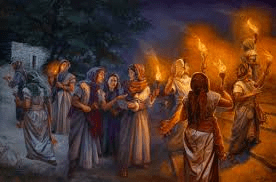
“Then the kingdom of heaven will be like ten virgins who took their lamps and went to meet the bridegroom. 2 Five of them were foolish, and five were wise. 3 For when the foolish took their lamps, they took no oil with them, 4 but the wise took flasks of oil with their lamps. 5 As the bridegroom was delayed, they all became drowsy and slept.” (Matthew 25:1–5 (ESV)
God the Father alone knows exactly when He has decreed God the Son, Jesus Christ, to return to earth in power, might and glory (Matt. 24:29-31, 36), With this in mind, believers in Christ are live in anticipation of the Son’s return. The Lord Jesus could return any day. Therefore, using illustrations and parables, the Lord explained how to prepare for His coming (24:37–25:30). Today, we begin to examine the Parable of the Ten Virgins.
Jesus introduced the parable with the phrase, “the kingdom of heaven will be like.” The kingdom of heaven is the Lord Jesus Christ’s rule and reign over His servants; believers in Christ. Matthew 8 contains several kingdom parables. Today’s text indirectly compares the kingdom of heaven to ten virgins and a wedding. Jesus used this analogy to prepare His disciples for a long delay for His return to earth in power, might and glory. He cautioned all followers to be ready.
The parable begins with ten virgins taking their lamps and meeting a bridegroom. Obviously, a wedding is about to take place. Presumably, it is a Jewish wedding. It is also taking place at night, which explains the need for lamps. The word lamps (λαμπάς; lampas) literally means torch. It most often refers an oil saturated wick contained is a bowl like vessel. However, lamps may also refers to Roman torches.
“Weddings were held toward evening and torches were used as part of the celebration, which focused on a procession leading the bride to the groom’s house,” explains commentator Craig Keener.
“It is unlikely that “lamps” refers to the small Herodian oil lamps, which could be carried in the hand; all the evidence points instead to torches, which were also used in Greek and Roman wedding ceremonies. These torches may have been sticks wrapped with oil-soaked rags. In many traditional Palestinian villages in more recent times, the wedding feast occurs at night after a day of dancing; the bridesmaids leave the bride, with whom they have been staying, and go out to meet the bridegroom with torches. They then escort him back to his bride, whom they all in turn escort to the groom’s home.”
Jesus made a distinction between the ten unmarried bridesmaids. He said five of these women were foolish and five of them were wise. In other words, there was a lack of understanding among half of the women which the other half possessed.
This wisdom, or lack thereof, directly related to the supply of oil required to keep the respective lamps lit and burning. The foolish women did not take extra oil with them. The wise women did. This was all the more necessary because the bridegroom was delayed in his arrival. Whereupon, all ten virgins became drowsy and slept.
“As is clear from a comparison of 25:13 with 24:42, 44, there is a close connection between this parable and the immediately preceding one. Both emphasize the need of being prepared at all times for the coming of the Bridegroom, Jesus Christ,” comments Dr. William Hendriksen.
“The ten are alike in ever so many respects. All intend to meet the bridegroom and to escort him to the place where the festivities are to be held. All have lamps. All are expecting the bridegroom to come before another day has arrived, but none of them knows at what hour he is coming. All are looking forward to taking part in the marriage feast. When the bridegroom lingers, all these ten girls fall asleep, a sleep from which all are suddenly aroused (verses 5 and 6).”
The significance of this sudden awakening, and the lack of knowledge of the bridegroom’s arrival, will concern us as we continue our study tomorrow. Are you prepared to meet the Lord?
Soli deo Gloria!


45 “Who then is the faithful and wise servant, whom his master has set over his household, to give them their food at the proper time? 46 Blessed is that servant whom his master will find so doing when he comes. 47 Truly, I say to you, he will set him over all his possessions. 48 But if that wicked servant says to himself, ‘My master is delayed,’ 49 and begins to beat his fellow servants and eats and drinks with drunkards, 50 the master of that servant will come on a day when he does not expect him and at an hour he does not know 51 and will cut him in pieces and put him with the hypocrites. In that place there will be weeping and gnashing of teeth.” (Matthew 24:45–51 (ESV)
God the Father alone knows exactly when He has decreed God the Son, Jesus Christ, to return to earth in power, might and glory (Matt. 24:29-31, 36), With this in mind, believers in Christ are to still live in rapt anticipation of the Son’s return. The Lord Jesus could return any day. Therefore, using illustrations and parables, the Lord began explaining how to be prepared for His coming (24:37–25:30).
Recently, we examined two distinct phrases Jesus used commanding His disciples to a have particular perspective regarding His return. They were to stay awake and to be ready. In today’s text, Jesus also illustrated His soon return with a parable of two servants. One is wise and the other is wicked. Yesterday, we examined the wise servant. Today’s focus is on the wicked servant.
48 But if that wicked servant says to himself, ‘My master is delayed,’ 49 and begins to beat his fellow servants and eats and drinks with drunkards, 50 the master of that servant will come on a day when he does not expect him and at an hour he does not know 51 and will cut him in pieces and put him with the hypocrites. In that place there will be weeping and gnashing of teeth.”
The word wicked (κακός; kakos) refers to what God deems as evil, wrong, incorrect and harmful. It is behavior that is in opposition to God and His Word. To be wicked is to live a life of hateful rebellion against the Lord and His disciples. The wicked do not believe in the soon return of Christ. They may not even believe in the return of Christ at all; soon or otherwise.
Consequently, their behavior reflects this unbelief. They treat other individuals harshly, indulge in drunkenness with little of no concern of God. They live a life, according to one commentator, of “carelessness, cruelty and carousing.” They fail to understand they are ultimately facing the Lord’s righteous judgment.
“The lesson of the parable, therefore, is this “Be and remain actively loyal to the Master, sensibly and joyfully carrying out the task assigned by him, in the interest of those who are precious to him,” states Dr. William Hendriksen.
Bishop Hilary of Poiters, an early church father, says, “Our ignorance of the day of Christ’s return should provoke us to be careful as we eagerly await his coming.”
“Knowing that Jesus could come at any minute should motivate us to pursue holiness, loving God and neighbor. We certainly do not want the Lord to catch us off-guard. Instead, we want to be found working diligently so that He will have no cause to be ashamed of His people,” concludes Dr. R. C. Sproul.
Soli deo Gloria!

45 “Who then is the faithful and wise servant, whom his master has set over his household, to give them their food at the proper time? 46 Blessed is that servant whom his master will find so doing when he comes. 47 Truly, I say to you, he will set him over all his possessions. 48 But if that wicked servant says to himself, ‘My master is delayed,’ 49 and begins to beat his fellow servants and eats and drinks with drunkards, 50 the master of that servant will come on a day when he does not expect him and at an hour he does not know 51 and will cut him in pieces and put him with the hypocrites. In that place there will be weeping and gnashing of teeth.” (Matthew 24:45–51 (ESV)
God the Father alone knows exactly when He has decreed God the Son, Jesus Christ, to return to earth in power, might and glory (Matt. 24:29-31, 36), With this in mind, believers in Christ are to still live in anticipation of the Son’s return. The Lord Jesus could return any day. Therefore, using illustrations and parables, the Lord began explaining how to be prepared for His coming (24:37–25:30).
Yesterday, we examined two distinct phrases Jesus used commanding His disciples to have a particular perspective regarding His return. They were to stay awake and to be ready. In today’s text, Jesus also illustrated His soon return with a parable of two servants. One is wise and the other is wicked. Today, we examine the wise servant.
45 “Who then is the faithful and wise servant, whom his master has set over his household, to give them their food at the proper time? 46 Blessed is that servant whom his master will find so doing when he comes. 47 Truly, I say to you, he will set him over all his possessions.”
Jesus called this first servant faithful and wise. To be faithful (πιστός; pistis) means to be trustworthy, dependable and reliable. To be wise (φρόνιμος; phronimos) means to be understanding and prudent. In light of the Lord’s soon return, the faithful and wise servant is the disciple, or church leader, who remains dutiful to their tasks in spite of the Lord’s delay in returning (2 Peter 3:1-10). The Lord pronounced an oracle of blessing on such servants.
“The duty of faithfulness applies not only to leaders but also to followers. Doing the will of the Master and caring for those in need, whether this need be material, spiritual, or both, is certainly the task assigned to all,” explains Dr. William Hendriksen.
“Now upon the faithful and sensible (cf. 25:2, 4, 8, 9) servant a special beatitude is pronounced: Such “blessedness” means that the servant upon whom the words of approval, congratulation, and cheer are pronounced is the object of his master’s special favor, is a delight to him. Moreover, the clause “whom his master shall find so doing” shows that the proper attitude on the part of the one who awaits the master’s return is active service in the interest of those whom the master has entrusted to him. When the figure is interpreted, this means that the proper spirit in which believers should eagerly await as Savior the Lord Jesus Christ (Phil. 3:20) is not the feverish nervousness of certain Thessalonians (2 Thess. 2:1, 2; 3:6–12), nor the nauseating lukewarmness of the Laodiceans (Rev. 3:14–22), but the active faithfulness of the Smyrniots (Rev. 2:8–11).”
“Therefore, we must be ready for Jesus’ return. Readiness, however, is not passive; rather, we are to serve our king actively, knowing that He could come at any minute. May we be wise, faithful servants who work for the kingdom, not those who lie down on the job and are fit only for destruction (vv. 45–51),” concludes Dr. R. C. Sproul.
Soli deo Gloria!
 His Word Today