
Colossians 2:11-12. True Circumcision and Baptism, (Podcast #19).

Growing in the Grace & Knowledge of Jesus Christ
5 “Put to death therefore what is earthly in you: sexual immorality, impurity, passion, evil desire, and covetousness, which is idolatry. 6 On account of these the wrath of God is coming.” (Colossians 3:5–6 (ESV)
The Word of God is not silent concerning the holiness of the believer in Christ. No matter who we are, of what we do for the kingdom of God and the church, the Lord calls each Christian to put to death what is earthly in their lives. God calls believers to be holy (I Peter 3:13-16).
The phrase put to death (νεκρόω; nekroo) is an aorist active imperative verb. It is in the plural form. This means to actively and obediently stop and completely cease a behavior and perspective of life and living. What each believer in Christ must resolve to completely cease is what is earthly (γῆ; ge) in them. The earthly is what is in harmony with the philosophy of the fallen world system of thought and action in believers’ minds, emotions and wills. This is the lust of the flesh, the lust of the eyes, and the pride of life (I John 2:15-17).
The Apostle Paul briefly outlined what earthly living and desire looks like for the believer in Christ. It is gratifying sexual immorality, impurity, passion, evil desire and covetousness, which the apostle calls idolatry. These desires are not just outside of us, but rather still remain within us. These are contrary to holiness and must be killed.
“We are not yet perfectly holy in practice, and passages like Colossians 3:5–8 that call us to put sin to death exist because disobedience is a reality for us. Still, the Bible defines Christians as already holy, “sanctified . . . in the name of the Lord Jesus Christ and by the Spirit of our God” (1 Cor. 6:11). In Christ we have made a decisive break with unholiness. Our Creator declares us holy in His Son — we are saints of God Most High, and He sees us as pure through Jesus’ blood (Col. 1:2; Heb. 9:13–14),” states Dr. R. C. Sproul.
What happens if we do not put sin to death, as God commands? The Scriptures give us ample warning and examples of the tragic wake of disobedience and compromise.
“Adam compromised God’s law and lost paradise (Genesis 3:6, 22–24). Abraham compromised the truth, lied about Sarah’s relationship to him, and nearly lost his wife (Genesis 12:10–20). Moses compromised God’s command and lost the privilege of entering the Promised Land (Numbers 20:7–12). Samson compromised his devotion as a Nazarite and lost his strength, his eyesight, and his life (Judges 16:4–6, 16–31). Israel compromised the commands of the Lord and lost the Ark of God (1 Samuel 4:11). Israel also compromised the law of God with idolatry and lost her land (2 Chronicles 36:14–17). Saul compromised God’s divine word by not slaying all of the animals of his enemy and lost his kingdom (1 Samuel 15:3, 20–28). David compromised God’s standard, committed adultery with Bathsheba, murdered Uriah, and lost an infant son (2 Samuel 11:1–12:23). Solomon compromised his convictions, married foreign wives, and ultimately caused the division of the kingdom (1 Kings 11:1–8),” warns Dr. John MacArthur.
How do we go about putting sin to death? Dr. Sinclair Ferguson has some suggestions.
This is every Christian’s battle. The question is whether or not God finds us faithful to His call to holiness. Are you ready, willing and serious about putting your sin to death and being holy in practice before humankind what you are in position before God?
Soli deo Gloria!

“The integrity of the upright guides them, but the crookedness of the treacherous destroys them.” (Proverbs 11:3 (ESV)
The West Point Military Academy conducts a Protestant/Inter-denominational chapel every Sunday. During the service, cadets pray these words regarding personal integrity. “Make us to choose the harder right instead of the easier wrong, and never to be content with a half-truth when the whole can be won. Endow us with courage that is born of loyalty to all that is noble and worthy, that scorns to compromise with vice and injustice and knows no fear when truth and right are in jeopardy.”
What is integrity? Proverbs 11:3 was authored by King Solomon (Prov. 10:1). In today’s text, integrity (תֻּמָּה tum’mat) means wholeness and completeness. The English word “integrity” comes from the mathematical word integer, referring to a whole number and not a fraction. An individual of integrity is undivided in their commitment to truth and moral uprightness.
“Integrity is a steadfast adherence to a moral code. Regardless of circumstances, the man of integrity is the same person with the same convictions. He is not duplicitous or two-faced, adapting his moral character to the supposed needs of the moment. Instead, there is a simplicity to him. He is the same man at home, work, and church—before watching eyes and when he is alone,” explains Dr. John MacArthur.
“Integrity means that you live by your convictions: You know what you believe, and you act according to what you believe. And consistently so. Psalm 15:4 says that even when a man of integrity promises something “to his own hurt,” he does not change. Although it is costly, he will not be moved from his moral principles.”
Solomon wrote the integrity of the upright (יָשָׁר; ya’sar), or the straight and level individual, continually guides (נחה; tan’hem) or leads them. Within the antithetical parallelism of the proverb, the opposite is also true. The crookedness (סֶ֫לֶף se’lep) falsehood and duplicity of the treacherous (בגד; bo’ge’dim) and their untrustworthiness destroys (שׁדד; ye’sod’de), devastates and ruins lives.
“This kind of uncompromising integrity is severely lacking in men today. We repeatedly watch spiritual leaders collapse. Men abandon conviction when compromise is more beneficial. Men say they believe the Bible—but don’t faithfully preach it. Men say that sin should be punished—but not if it’s committed by their children. Men oppose corruption—until they have to confront someone and risk losing their job. Men maintain high moral standards—until their lusts are kindled by some illicit impulse. Men are honest—until a little dishonesty will save them money. Men hold convictions—until they’re challenged by someone they fear or admire,” states Dr. MacArthur.
There have been individuals in my life who I considered spiritual mentors and heroes. I respected them and appreciated their preaching, their teaching and their godly example. I’ve listened to their sermons, bought their books and supported their ministries; financially and prayerfully.
Several of them failed in their walk of integrity. While I was never disillusioned, I became deeply disappointed. I also was reminded of I Corinthians 10:12: “Therefore let anyone who thinks that he stands take heed lest he fall.”
These instances, and the teaching from God’s Word, give me a holy resolved to finish well (2 Timothy 4:6-8). I do not want to become another pastoral casualty. I do not want to bring shame upon the Lord, the Gospel, my family, my colleagues, my students or my friends. I desire to be one of a few, good men. I pray there are others who possess this holy resolve as well (I Peter 1:13-16).
Soli deo Gloria!
The following essay is by Dr. R. C. Sproul. Dr. Sproul was founder of Ligonier Ministries, first minister of preaching and teaching at Saint Andrew’s Chapel in Sanford, Fla., and first president of Reformation Bible College.
The intercession of our Great High Priest is the foundation for our confidence when it comes to our perseverance. It also helps us make sense of the accounts of Peter and Judas, two of Jesus’ disciples who experienced a serious fall. One disciple’s fall away from Christ is seen as a final and full work of apostasy, whereas the other disciple’s fall is not final and full because he is restored. And we see that their crime against Christ was very similar. Judas betrayed Jesus. And that same night, Peter denied Christ.
These two men who had been disciples with Jesus during His earthly ministry committed treason against Him in His darkest hour. And there are further similarities in these two examples in that Jesus predicted both Peter’s and Judas’ diabolical acts. But we recall that when Jesus said, “One of you will betray me,” the disciples said among themselves, “Who is it, Lord? Is it I?” When Judas asked, “Is it I, Rabbi?” Jesus said to him, “You have said so” (Matt. 26:25). Jesus’ final words to Judas were “What you are going to do, do quickly” (John 13:27). And He dismissed him from their presence.
When Jesus prophesied that Peter would deny Him, Peter protested profusely. “Though they all fall away because of you, I will never fall away,” he said (Matt. 26:33). This brings to mind Paul’s admonition, “Let anyone who thinks that he stands take heed lest he fall” (1 Cor. 10:12), because Jesus then turned to Simon and said to him in loving terms, “Simon, Simon, behold, Satan demanded to have you, that he might sift you like wheat” (Luke 22:31).
Sifting wheat is not a laborious task that only the strong can perform. It may take time and it may be tedious, but it’s not labor intensive. In using this metaphor, Jesus is cautioning Simon not to rely on his own strength, because it would be an easy thing for Satan to entice him to fall. Satan is stronger than Peter, and would have no trouble overcoming whatever strength Peter thought he had.
Notice, however, that Jesus does not say to Peter, “What you are going to do, do quickly.” Our Lord’s words to Simon Peter were significantly different from what He said to Judas. He said, “I have prayed for you that your faith may not fail. And when you have turned again, strengthen your brothers” (Luke 22:32).
Notice what Jesus doesn’t say. He doesn’t simply hope that Peter will be able to resist Satan, or that he will return, or that he will be able to strengthen the brothers. He expresses certainty that Peter will do these things. There was no doubt in Jesus’ mind not only that Peter would fall, and fall abysmally, but also that Peter would be restored. Indeed, history testifies that Peter, in spite of this radical and serious fall, nevertheless endured to the end. He repented, he was forgiven, he was restored, and he endured to the end.
Soli deo Gloria!

The following essay is by Dr. John Piper entitled Why Did Jesus Choose Judas? Dr. Piper is founder and teacher of desiringGod.org and chancellor of Bethlehem College and Seminary. For 33 years, he served as pastor of Bethlehem Baptist Church, Minneapolis, Minnesota. He is author of more than 50 books, including Desiring God: Meditations of a Christian Hedonist and most recently Providence.
There are few more perplexing questions of the Bible than this: If he knew that he would betray him in the end, why did Jesus choose Judas as a disciple to begin with?
The perplexing question comes specifically from a podcast listener named Austin. “Hello, Pastor John. I have been studying through the book of John lately, and I began to wonder why Jesus chose Judas to be one of his disciples in the first place. And what does Jesus have to teach us by choosing someone to be his disciple, knowing full well he would betray him? Are there any takeaways for us in this?”
John 6:64 says, “Jesus knew from the beginning who those were who did not believe, and who it was who would betray him.” Jesus chose his own betrayer to be part of his apostles. Why? I’m going to give five answers that I see in the Scriptures for why God ordained, and Jesus chose, Judas the betrayer to be part of his team.
The Old Testament Scriptures prophesied that this would take place. So Jesus chose Judas to fulfill the Scriptures. In John 13:18, Jesus says to his apostles, “I am not speaking of all of you; I know whom I have chosen. But the Scripture will be fulfilled.” And then he quotes Psalm 41:9: “He who ate my bread has lifted his heel against me.” And Peter, on the day of Pentecost, in Acts 1:16, says, “Brothers, the Scripture had to be fulfilled . . . concerning Judas, who became a guide to those who arrested Jesus.”
Step by step, Jesus moved toward the cross, taking pains to fulfill every Scripture concerning his death, right down to the details of how he would be handed over. The point was to show that the Scriptures cannot be broken, and that God is in control.
By choosing to be betrayed by a close friend, and even by a kiss, Jesus shows us that the most despicable act in the history of the world — the betrayal and consequent murder of the Son of God — was part of God’s saving plan. That’s explicitly said in Acts 4:27–28, that by his hand and his predestination these things took place.
In other words, the lesson of Judas is that the most horrible sins in the world are used by God for his saving purposes. Just when people think they’re getting the upper hand, they find that their hand is serving the very one they are opposing. That’s a great lesson for us to learn.
By choosing from the beginning an apostle who was destined for apostasy and destruction, and by including him in his closest relations, and by giving him power over unclean spirits and over diseases, Jesus shows us that religious associations and religious practices and miracle-working are no sure evidences of being born again. Matthew 10:1–4 describes the choosing of the twelve. It names Judas and says Jesus “gave them authority over unclean spirits, to cast them out, and to heal every disease and every affliction” (Matthew 10:1). Judas walked with Jesus, ministered with Jesus for three years, and he worked those miracles.
Judas becomes a vivid illustration of the people in Matthew 7:22–23: “On that day many will say to me, ‘Lord, Lord, did we not prophesy in your name, and cast out demons in your name, and do many mighty works in your name?’” That’s Judas — and many, many other people in history. And then Jesus will declare to them, “I never knew you; depart from me, you workers of lawlessness.” What a vivid lesson to learn that right doctrine (“Lord, Lord, we know who you are; we’ve got our doctrine right, Lord, Lord”) and religious activity and miracle-working (“We’ve cast out demons; we’ve healed people”) prove nothing about saving faith and being born again. That’s the lesson of Judas.
Judas serves as an illustration that predestination and human responsibility go hand in hand. Judas’s destiny was set before his betrayal. Jesus said that he kept all his disciples from apostasy except Judas, “the son of destruction” (John 17:12). In John 6:64, it says, “Jesus knew from the beginning . . . who it was who would betray him.” And then Jesus explained in the next verse, “This is why I told you that no one can come to me unless it is granted him by the Father” (John 6:65). In other words, Judas didn’t repent because it was not granted to him by the Father; his destiny was sealed. And yet he was guilty — really guilty, really accountable, really blameworthy. He was really responsible for what he did. He himself said in Matthew 27:4, “I have sinned by betraying innocent blood.”
So, we learn from Judas not to stumble over the fact that a person may be destined for destruction and yet be totally responsible for what he does.
Judas serves as a vivid example of the terrible, terrible power of the love of money, and how it blinds us to what is true and beautiful and valuable in this world. In John 12:4–6, when Mary anointed Jesus, Judas said, oozing with hypocrisy, “Why was this ointment not sold for three hundred denarii and given to the poor?” And John comments, “He said this, not because he cared about the poor, but because he was a thief, and having charge of the moneybag he used to help himself to what was put into it.” He did that under the nose of the very Son of God, who would give his life as a ransom for many, whose teachings he had heard for three years, in whose power he did miracles.
Judas loved money more than he loved Jesus. That’s horrific, unbelievable, and unspeakably evil. It should make every one of us tremble at the thought of the power that money has in our lives to blind us to what is true and beautiful and precious. So, when Judas got his chance, thirty pieces of silver is all it took to sell the very Son of God.
I’m sure there are more answers to Austin’s question, but these are at least five answers that I see in the Bible as to why God would ordain, and Jesus would choose, that a betrayer be included among the apostles from the beginning.
Soli deo Gloria!
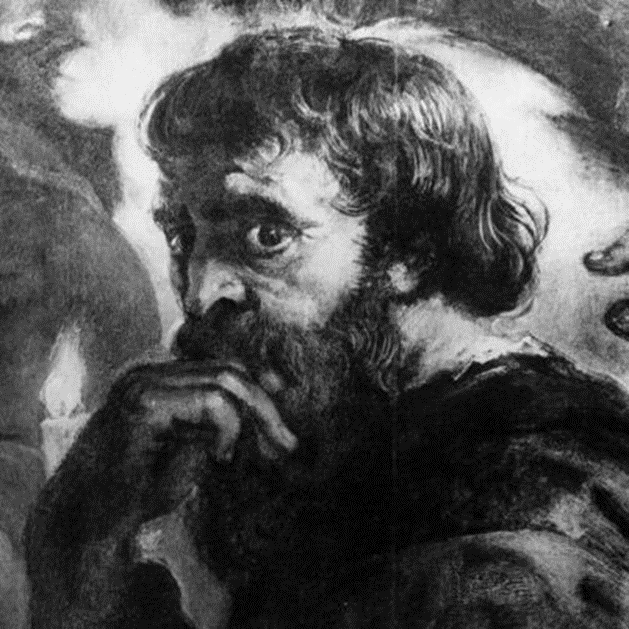
3 “Then when Judas, his betrayer, saw that Jesus was condemned, he changed his mind and brought back the thirty pieces of silver to the chief priests and the elders, 4 saying, “I have sinned by betraying innocent blood.” They said, “What is that to us? See to it yourself.” 5 And throwing down the pieces of silver into the temple, he departed, and he went and hanged himself. 6 But the chief priests, taking the pieces of silver, said, “It is not lawful to put them into the treasury, since it is blood money.” 7 So they took counsel and bought with them the potter’s field as a burial place for strangers. 8 Therefore that field has been called the Field of Blood to this day. 9 Then was fulfilled what had been spoken by the prophet Jeremiah, saying, “And they took the thirty pieces of silver, the price of him on whom a price had been set by some of the sons of Israel, 10 and they gave them for the potter’s field, as the Lord directed me.” (Matthew 27:3–10 (ESV)
Matthew is the lone Gospel writer to speak of the ignoble end of Judas Iscariot. Judas was a tragic figure in the earthly ministry of Jesus Christ. He embodied the wicked individual the psalmist described in Psalm 1.
“Blessed is the man who walks not in the counsel of the wicked, nor stands in the way of sinners, nor sits in the seat of scoffers; 2 but his delight is in the law of the Lord, and on his law he meditates day and night. 3 He is like a tree planted by streams of water that yields its fruit in its season, and its leaf does not wither. In all that he does, he prospers. 4 The wicked are not so, but are like chaff that the wind drives away. 5 Therefore the wicked will not stand in the judgment, nor sinners in the congregation of the righteous; 6 for the Lord knows the way of the righteous, but the way of the wicked will perish.” (Psalm 1:1–6 ESV)
Judas was not a God-blessed man. This was because Judas walked, or lived, in the counsel of the ungodly. He stood, or agreed, with the way and lifestyle of sinners. Finally, he fostered the mocking ridicule of the Lord. Unlike the righteous man who is like a tree, Judas was rather like chaff that the wind drives away. He had no solid, spiritual foundation in his life; even though he was in the Lord’s presence for three years. Judas’ end will be him not standing in the judgment as righteous and he will not participate with the congregation of the righteous.
What can we observe from today’s text from Matthew?
“Matthew’s juxtaposition of Peter’s denial and Judas’ death invites us to compare the state of their souls. Like Peter, Judas is remorseful after the fact, changing his mind about the wisdom of his deed after seeing Jesus condemned (Matt. 27:3–4). Unlike Peter, Judas does not feel the “godly grief” of repentance (2 Cor. 7:10),” explains Dr. R. C. Sproul.
“The Greek verb for Judas’ change of mind (Matt. 27:3) is not the one normally used for repentance. Moreover, Judas does not really try to stop what he has started and will not testify of Christ’s innocence before Pilate. Were Judas repentant, justice and righteousness would move him to intervene on Jesus’ behalf. Godly sorrow leads people to run to God, but Judas’ despair makes him run into the arms of death (v. 5).”
John Calvin writes, “True repentance is displeasure at sin, arising out of fear and reverence for God, and producing, at the same time, a love and desire of righteousness.”
“Once more, the Jewish leaders care more about the minutiae of ceremonial regulation than the greater sin of killing an innocent man (Amos 5:21–24). They use the blood money paid to Judas to buy a place to bury Gentiles (Matt. 27:6–8), thereby fulfilling prophecy (vv. 9–10). “The text Matthew cites seems to be a paraphrase of Jeremiah 19:1–14 and Zechariah 11,” states Dr. Sproul.
“Both prophets allude to Israel’s rejecting the shepherds God sent to them and the destruction that results. For centuries the Almighty sent His prophets to shepherd His people, but His people rejected them and the destruction of exile occurred. Now with the condemnation of Jesus to death, the leaders have rejected the “Shepherd and Overseer” of their souls (1 Peter 2:25), and they make themselves even more worthy of God’s wrath than their ancestors.”
Neither Judas’ betrayal of Christ nor his suicide is the unpardonable sin. The unforgivable sin was his rejection of the grace of God in the person and work of Jesus Christ. Simon Peter and Judas both committed sins, but Peter repented and received restoration. Let each of us repent of our sins and turn to Jesus Christ for renewal and restored intimate fellowship (I John 1:8-10).
Soli deo Gloria!
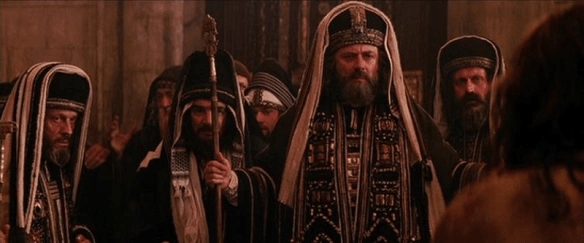
“When morning came, all the chief priests and the elders of the people took counsel against Jesus to put him to death. 2 And they bound him and led him away and delivered him over to Pilate the governor.” (Matthew 27:1–2 (ESV)
“And as soon as it was morning, the chief priests held a consultation with the elders and scribes and the whole council. And they bound Jesus and led him away and delivered him over to Pilate.” (Mark 15:1 (ESV)
“Then the whole company of them arose and brought him before Pilate.” (Luke 23:1 (ESV)
Jesus’ trial before Annas and Caiaphas eventually resulted in His trial before the Sanhedrin. As previously noted, the Sanhedrin was the supreme judicial council, or “high council”, of Judaism. It contained 71 members and was located in Jerusalem.
“The name Sanhedrin (Greek, sunedrion, from sun, “together,” and hedra, “seat”) occurs for the first time in the reign of Herod the Great (Antiquities 14.9.3–5). This is the term used throughout the NT (22 times), along with “the elders” (Luke 22:66; Acts 22:5) and “gerousia” (Acts 5:21),” states the Tyndale Bible Dictionary.
The previous two religious trials occurred in the pre-daylight hours. With the arrival of morning, the entire Sanhedrin council pronounced Jesus guilty of blasphemy and sent Him to Pontius Pilate, the Roman governor, for final sentencing. They wanted Jesus executed.
“From about three o’clock until daybreak Jesus must have been held in imprisonment somewhere in the palace of Caiaphas. Then “early in the morning”—the Sanhedrin is convened once more. A few minutes may have sufficed, since the verdict, “Guilty of blasphemy and therefore worthy of death” had already been agreed upon. Besides, Jesus must be rushed off to Pilate before the crowds know what is going on. So, very quickly Jesus is sentenced to death,” explains Dr. William Hendriksen.
“The Jewish authorities have to bring Jesus to Pilate, because they were not authorized by the Romans to execute the death penalty themselves. Pilate would be available as early as sunrise; like other Roman officials, he would finish his regular public day before noon,” states commentator Craig Keener.
“Jesus’ first Jewish trials occurred under the cover of darkness. Since Jewish law required trials to be conducted during the day, the chief priests and the elders of the people realized an official trial was necessary. The brief trial recorded in Matthew 27:1 was simply for the court to reaffirm what had taken place earlier. The court decided that Jesus must die, but they did not have the power to put that decision into action (John 18:31). To get a death sentence, they needed to take the case to Pilate, the governor, the procurator of Judea and Samaria, a.d. 26–36 (cf. Luke 3:1). Jesus was therefore bound and brought by the Jews to Pilate. Pilate’s home was in Caesarea, but at this festival time, he was in his Jerusalem palace,” concludes the Bible Knowledge Commentary.
All of this was according to the sovereign and providential plan of God the Father (Acts 2:22-24).
Soli deo Gloria!


16 For I am not ashamed of the gospel, for it is the power of God for salvation to everyone who believes, to the Jew first and also to the Greek. 17 For in it the righteousness of God is revealed from faith for faith, as it is written, “The righteous shall live by faith.” (Romans 1:16–17 (ESV)
The Protestant Reformation’s enduring legacy, and that of Reformer Martin Luther, centers upon the doctrines of the “solas.” The Reformers believed and taught these five truths and they remain indispensable to the health of the Gospel of Jesus Christ and the authentic growth of the church.
Why? It is because these five tenants did not originate with the Reformers of the Reformation. On the contrary, the Reformers rediscovered truth God had given in Scripture and which had long been buried by the church. Therefore, the “solas” are to be continually studied, embraced, taught, and defended as God’s eternal truth in a fallen, temporal, and worldly culture.
A brief description of each “sola” is appropriate. In April 1996, the Alliance of Confessing Evangelicals held its first major meeting of evangelical scholars. The Cambridge Declaration, first presented at this meeting, is a call to the evangelical church to turn away from the worldly methods it has come to embrace and to recover the Biblical doctrines of the Reformation. The Cambridge Declaration explains the importance of regaining adherence to the five “solas” of the Reformation. The fine “solas” are as follows:
As any Christian should realize, the 16th century Protestant Reformation was anything but a tempest in a teapot. It was a cataclysmic event which shook the then known world, and continues to do so today. May we continue to hold fast to the truths of Scripture, especially the Five Solas.
Be strong and courageous!
Soli deo Gloria!
16 For I am not ashamed of the gospel, for it is the power of God for salvation to everyone who believes, to the Jew first and also to the Greek. 17 For in it the righteousness of God is revealed from faith for faith, as it is written, “The righteous shall live by faith.” (Romans 1:16–17 (ESV)
“Therefore, since we have been justified by faith, we have peace with God through our Lord Jesus Christ. 2 Through him we have also obtained access by faith into this grace in which we stand, and we rejoice in hope of the glory of God.” (Romans 5:1–2 (ESV)
The church as a whole, and in Wittenberg in particular, anticipated the observance of All Saints Day on November 1, 1517. Therefore, indulgence vendors were in full force. The most notorious of these peddlers was Johann Tetzel.
When entering a town, Tetzel proceeded with a great deal of pomp and circumstance. A cross bearing the pope’s official declaration was held high on a gold-embroidered cushion. The cross, or crucifix, was then planted in the town square, and then Tetzel would begin his sermon. An excerpt follows:
“Consider the salvation of your souls and those of your departed loved ones. Visit the holy cross erected before you. Listen to the voices of your dear dead relatives and friends beseeching you and saying, ‘Pity us, pity us. We are in dire torment from which you can redeem us for a pittance.’ Do you not wish to? Open you ears. Hear the father saying to his son, the mother to her daughter, ‘We bore you, nourished you, brought you up, left you our fortunes, and you are so cruel and hard that now you are not willing for so little to set us free. Will you let us lie here in flames? Will you delay our promised glory’?”
There was a little song composed in light of Tetzel’s motivational speaking. It went like this: “As soon as the coin in the coffer rings, another soul from purgatory springs.”
Talk about a guilt trip! What was a person to do in such an atmosphere but to comply and by so doing alleviate the suffering of their departed dead, as well as the guilt of the living? The tragedy is that this did not, and does not, happen. There is no such thing as purgatory, but only the promise of heaven for the believer, and the promise of hell for the unbeliever.
How many candles have been lit, and prayers said and monies given for the deliverance of the dead? Tetzel even had people believing the cross he brought to a town square was of equal value to the cross Jesus Christ bore to Calvary. As far as Martin Luther was concerned, he had had enough.
As the church as a whole, and in Wittenberg in particular, anticipated the observance of All Saints Day on November 1, 1517, indulgence vendors were in full force.
So, on All-Hallows Eve, October 31, 1517, Martin Luther posed his Ninety-Five Thesis to the door of the Castle Church in Wittenberg. Martin had no intention of breaking from the church by his actions. Rather, he was hoping to inspire debate within the church and in the community. Posting such a notice on the church door was a common practice. He did not realize that he would unwittingly tap into a growing resentment among the people that the church cared more about money than it did them.
The preamble to the Ninety-Five Thesis says, “Out of love and zeal for truth and the desire to bring it to light, the following theses will be publicly discussed at Wittenberg under the chairmanship of the reverend Martin Luther.”
Thesis 1 stressed the importance of repentance and that it was God’s will the believer’s life be one of repentance. Thesis 32 declared that those who believed that they were saved because of the payment of an indulgence would be eternally damned to hell along with those who taught such heresy. Thesis 79 declared that it was blasphemous to compare the papal coat of arms or a human cross as equal in worth to the cross of Christ. Thesis 82 questioned why the pope did not open all of purgatory and allow the people to enter heaven? The answer was that the pope wanted people to continue to contribute money to the St. Peter’s Basilica’s building program, and selling indulgences was a way to do it.
Luther originally wrote the Ninety-Five Thesis in Latin. However, university students copied the theses and had them translated into German. Copies were then made, thanks to Gutenberg’s printing press, and distributed throughout Germany. Within months, Luther’s objections were not only the talk of the town, but of many towns.
The church’s leadership were not happy. Pope Leo X said, “Luther is a drunken German. He will feel different when he is sober.” Rather than address Luther’s concerns, the pope dismissed them and this German monk. The fires of the Reformation began to blaze even higher.
Luther found himself in the middle of an ecclesiastical firestorm. It soon blazed beyond anything Martin could have imagined. The controversy Luther created eventually addressed not only the particular subject of indulgences, but ultimately how sinners were justified before God and what by authoritative, objective standard of truth ruled the individual believer along with the church?
While justification by faith may have been the instrumental cause of the Reformation, the foundational issue was the Bible being the sole and ultimate authority binding both Christian and church. The battle continues to this day.
I encourage you to rest in the knowledge that in Christ alone, we have peace with God (Romans 5:1) by grace alone, through faith alone. Reject any notion that forgiveness can be purchased by anything other than the precious blood of Christ (I Peter 1:17-18).
Soli deo Gloria!
 His Word Today