2 “Continue steadfastly in prayer, being watchful in it with thanksgiving. 3 At the same time, pray also for us, that God may open to us a door for the word, to declare the mystery of Christ, on account of which I am in prison— 4 that I may make it clear, which is how I ought to speak.” Colossians 4:2–4 (ESV)
The reading, studying and application of God’s Word, corporate along with individual worship, communion or fellowship with fellow believers and the sharing of the gospel to the lost are indispensable disciplines and responsibilities for each believer in Christ. Along with these is the discipline and practice of prayer. Since God speaks to the believer through His inerrant Word, then the believer speaks to God through the privilege of prayer.
“Our prayers may be awkward. Our attempts may be feeble. But since the power of prayer is in the One who hears it and not in the one who says it, our prayers do make a difference.” – Max Lucado
John Calvin proposed four indispensable rules for prayer.
1. The first rule is a heartfelt sense of reverence.
In prayer, we must be “disposed in mind and heart as befits those who enterconversation with God.” Our prayers should arise from “the bottom of our heart.” Calvin calls for a disciplined mind and heart, asserting that “the only persons who duly and properly gird themselves to pray are those who are so moved by God’s majesty that, freed from earthly cares and affections, they come to it.”
2. The second rule is a heartfelt sense of need and repentance.
We must “pray from a sincere sense of want and with penitence,” maintaining “the disposition of a beggar.” Calvin does not mean that believers should pray for every whim that arises in their hearts, but that they must pray penitently in accord with God’s will, keeping His glory in focus, yearning for every request “with sincere affection of heart, and at the same time desiring to obtain it from him.”
3. The third rule is a heartfelt sense of humility and trust in God.
True prayer requires that “we yield all confidence in ourselves and humbly plead for pardon,” trusting in God’s mercy alone for blessings both spiritual and temporal, always remembering that the smallest drop of faith is more powerful than unbelief. Any other approach to God will only promote pride, which will be lethal: “If we claim for ourselves anything, even the least bit,” we will be in grave danger of destroying ourselves in God’s presence.
4. The final rule is to have a heartfelt sense of confident hope.
The confidence that our prayers will be answered does not arise from ourselves, but through the Holy Spirit working in us. In believers’ lives, faith and hope conquer fear so that we are able to “ask in faith, nothing wavering” (James 1:6, KJV). This means that true prayer is confident of success, owing to Christ and the covenant, “for the blood of our Lord Jesus Christ seals the pact which God has concluded with us.” Believers thus approach God boldly and cheerfully because such “confidence is necessary in true invocation… which becomes the key that opens to us the gate of the kingdom of heaven.”
May the Lord’s truth and grace be found here. Have a blessed Lord’s Day.
5 For we never came with words of flattery, as you know, nor with a pretext for greed—God is witness. 6 Nor did we seek glory from people, whether from you or from others, though we could have made demands as apostles of Christ.” (1 Thessalonians 2:5–6 (ESV)
The Fox News Channel recently reported one of the wealthiest religious broadcasters in the world is looking to offload his luxury condo in Florida. The report stated “the beachfront residence of Brazilian billionaire televangelist Edir Macedo in the ultra-exclusive Porsche Design Tower Miami is now listed for just under $14.6 million after a price cut, according to public real estate records.”
The article continued to say “Macedo, founder and bishop of the Igreja Universal do Reino de Deus (Universal Church of the Kingdom of God), is no stranger to lavish living or controversy. His net worth is estimated at $1.8 billion, ranking him 1,901st on Forbes’ real-time billionaire index. By comparison, Kim Kardashian’s net worth is $1.7 billion.”
The report stated “the Trinity Foundation, a nonprofit that investigates religious fraud, has long tracked Macedo’s financial activities. Macedo’s empire includes media companies, banking interests, and international real estate, the group noted, citing his control of Brazil’s Record TV network and Banco Renner. The Universal Church isn’t just active in Brazil. It operates worldwide, including in Portugal, Mexico and the United States. The church even built a modern version of Solomon’s Temple in São Paulo, Brazil.”
Finally, the article said, “Despite its clear wealth and power, the church’s “Contact Us” page on its U.S. website claims “the Universal Church does not provide financial aid programs. Their 24/7 livestream available on the Universal Church’s website currently offers ‘Blessed Water’ for sale, which purports to heal everything from depression to cancer. According to the Trinity Foundation, the organization also owns four private jets and a helicopter, assets rarely seen in the nonprofit religious world.”
“People love to be told what they want to hear. Who among us has not turned an ear to those who reinforce our high estimation of ourselves, while ignoring those who are critical? We tend to look for confirmation of what we want to be true about ourselves, not for our flaws to be revealed to us,” explains Dr. R. C. Sproul.
“This desire has characterized men and women alike for millennia, and flatterers have taken advantage of this longing to enrich themselves in many different ways. Ancient writers recognized this, with even the great philosopher Aristotle authoring works that give signs for how to recognize disingenuous words. Then, as now, purveyors of false religion frequently used flattery to gain a hearing so that they could then convince audiences to give them money.”
Apparently, there were individuals who accused the Apostle Paul of greed and avarice. They slandered the apostle before the Thessalonian believers. In writing to them, Paul wanted the church to know that he, Silas and Timothy were pure in their motives in ministry; by their speech, sincerity and in not seeking glory.
First, regarding their preaching Paul wrote, “For we never came with words of flattery, as you know.” The phrase words of flattery (λόγῳ κολακείας; logo kolakeias) means having a message appealing to an individual’s vanity. The word “blarney” refers to skillful flattery. Paul would have nothing to do with this type of speech. He never preached what people wanted to hear but rather what they needed to hear (2 Tim. 4:1-5).
Second, Paul also stated, “…nor with a pretext for greed—God is witness.” Pretext (προφάσει; prophasei) means to pretend or to have a pretense. This means Paul, Silas and Timothy were not con artists, hoaxers, grifters or deceivers pursuing greed (πλεονεξίας; pleonexias) referring to covetousness and exploitation. They did not desire to acquire more and more material possessions irrespective of need. Their hearts were not trained in greed (2 Peter 2:12-16; vs. 14). In invoking the phrase “God is witness,” Paul was affirming God Himself would testify to their sincerity of heart.
Third, Paul wrote, “Nor did we seek glory from people, whether from you or from others, though we could have made demands as apostles of Christ.” They did not presently, actively and collectively seek (ζητοῦντες; zetountes) or demand glory (δόξαν; doxan) or praise and honor from the Thessalonians. This was in spite of their status as apostles and missionaries of God.
John Calvin comments, “All that would be . . . true pastors must exercise this disposition of Paul—to have more regard to the welfare of the Church than to their own life, and not be impelled to duty by a regard to their own advantage, but by a sincere love to those to whom they know that they are conjoined, and laid under obligation.”
“Not any impure but the purest possible motive had been the subjective source of the entreaty. To prove this, Paul permits the facts to speak for themselves,” explains Dr. William Hendriksen.
“By saying, “as you (well) know,” he appeals to the readers’ memory of these facts. Had the motive been impure and selfish (see verse 3), the missionaries would have copied the charlatans who roamed the country. Like these quacks they too would have made use of flattery. And their message would have amounted to nothing more than a pretext to cover up their greed.”
“But with an appeal to God the writer of this epistle solemnly affirms that they have never made use of either flattery or disguise. Their aim, moreover, had never been to seek human fame (see John 5:41), whether from the Thessalonians or from anybody else; and this in spite of the fact that they were in a position to make weighty claims with respect to themselves, being Christ’s apostles (used in the broader sense) commissioned to represent him, and therefore invested with authority over life and doctrine,” concludes Dr. Hendriksen.
From Scripture, let us evaluate who is a true servant of the Lord: Edir Macedo or the Apostle Paul, Silas, Timothy. As we serve the Lord, may we be like that latter three. May the Lord’s truth and grace be found here. Have a blessed day in the Lord.
3 For our appeal does not spring from error or impurity or any attempt to deceive, 4 but just as we have been approved by God to be entrusted with the gospel, so we speak, not to please man, but to please God who tests our hearts.” (I Thessalonians 2:3–4 (ESV)
“Throughout church history, preachers who have left a lasting impact upon the church and their generation have always been known for their strong, biblical preaching. God’s work is to be done God’s way if it is to know God’s blessing. This necessitates the centrality and primacy of biblical preaching in the church. If we are to see another Reformation, Puritan era, or Great Awakening, then we must see a return to expository preaching in the power of the Holy Spirit. Paul commanded Timothy to “Preach the Word; be ready in season and out of season” (2 Timothy 4:2). In this present hour, we must see again preaching that is biblical, preaching that is authoritative, and preaching, quite frankly, that is dominant,” wrote one preacher about his craft and God’s calling to preach.
In writing to the Thessalonian church, the Apostle Paul explained it was the Lord working through him, Silas and Timothy to boldly declare the gospel of God to them (I Thess. 2:1-2). Therefore, their preaching was biblical, authoritative and effectual because it was obedience to God driven and not pleasing to the audience driven. Paul previously stated the gospel came to the Thessalonians not only in word, referring to what the missionaries said, but also in power and in the Holy Spirit and with full conviction (I Thess. 1:5).
“The Apostle defends his ministry because some people were criticizing his work in the hearing of the Thessalonians. To understand why some Thessalonian Christians might listen to these criticisms, we need to consider the first-century religious context of the Thessalonians,” explains Dr. R. C. Sproul.
“In that era, many would-be philosophers and leaders of new religions traveled from city to city, seeking to gain an audience. Some of these individuals believed what they were teaching, but others were charlatans who sought to take advantage of men and women for their own financial gain. Although Paul preached the gospel of the one true God, it was easy for his opponents to accuse him of exploiting his students just as other teachers did.”
Paul used two words in today’s text when referring to his preaching the gospel of God. The first was the word appeal (παράκλησις; paraklesis), which means to encourage, comfort and to earnestly plead.
“The noun and the verb appeal (παράκλησις, παρακαλέω related to παράκλητος; see N.T.C. on John 14:16), basically a calling to one’s side, can have various meanings: appeal or entreat(y), exhort(ation), encourage(ment), comfort. The exact meaning depends on the context in each instance,” explains Dr. William Hendriksen.
“Here appeal or entreaty (cf. the use of the verb in 2 Cor. 5:20), fits as well as any. It was the message by means of which the missionaries, clothed with authority from God and with yearning sympathy, had pleaded with the hearers to forsake their wicked ways and to turn to God in Christ.”
Paul stated this appeal to repent of sin and to turn to God in Christ did not come from error (πλάνης; planes) by self-deluded imposters, from impurity or immorality (ἀκαθαρσίας; akatharsias), or any attempt to deceive (δόλῳ; dolo) or to trick, to be cunning or treacherous.
Rather, the motivation to preach the Word of God (2 Tim. 4:1-5) was because all three men, note the personal pronouns “our” and “we,” were God approved (δεδοκιμάσμεθα; dedokimasmetha). God examined them and judged them to be good.
Good for what? God judged them worthy to be entrusted (πιστευθῆναι; pisteuthenai), or faithful, committed, and dependable with the gospel. This a holy trust. This is a sacred trust. This is an important trust.
Paul then used a second word; speak (λαλοῦμεν; laloumen). This refers to presently and actively communicating to individuals. What Paul and his companions spoke was the gospel. The goal was not to please men but to please God. To please (ἀρέσκοντες; areskontes) in this context means to make God happy and not people. This is the overall goal of preaching.
It is God who tests (δοκιμάζοντι; dokimazonti) and examines the preacher’s heart to see if it is genuinely committed to preach the Word. The Lord does this presently and actively.
The good news that comes from God, had been the objective source of Paul’s appeal to the Thessalonians. These three official ambassadors had been approved by God and therefore stand approved (the perfect of abiding result of a verb which in the present tense means to test; perfect tense, to have been tested, here: with favorable results; hence, approved,” continues Dr. Henriksen. “For the divine approbation entrusting Paul, Silas, and Timothy with the gospel of salvation, the following passages come into consideration: Acts 9:15; 13:1–4; 15:40; 16:1, 2; 1 Tim. 1:2, 12, 18; 6:12, 20; 2 Tim. 1:5, 13, 14.”
“Now it was in strict accordance with God’s directive, that these missionaries were always telling (note present continuative) the good news. Hence, their message was not an error, but truth springing from the highest source. And the motive in bringing it was not selfish—for instance, pleasing men in order to gain favor; cf. Gal. 1:10—but most commendable: pleasing God (cf. 4:1; 2 Thess. 2:4), the One before whom nothing is hid, and who tests our hearts (see Jer. 17:10; then 11:20; Ps. 7:9; Ps. 139). The human eye cannot discern the inner motive of his fellowman, whether good or bad; hence, Paul, as it were, appeals to God’s omniscience,” concludes Dr. Hendriksen.
Do we seek to share the gospel of God to people with the goal of making them happy or God? Who ultimately are believers in Christ to please? May the Lord’s truth and grace be found here. Have a God pleasing day.
“For you yourselves know, brothers, that our coming to you was not in vain. 2 But though we had already suffered and been shamefully treated at Philippi, as you know, we had boldness in our God to declare to you the gospel of God in the midst of much conflict. “(1 Thessalonians 2:1–2 (ESV)
The preaching of the Gospel of Jesus Christ results in either acceptance, ambivalence, or resistance (Acts17:32-34). Some individuals mock the Gospel, while others casually dismiss discussing it for another day. Still others repent of their sin and receive Jesus Christ as Lord and Savior. The believers’ responsibility is not to convince or convert the sinner of their need for Christ. Rather, God calls and commissions each believer to solely communicate the truth of the person and work of Jesus Christ (Matt. 28:19-20; Luke 24:44-49;). God alone is the One who convinces and converts (John 3:1-8; I Cor. 3:5-9; Titus 3:1-5).
The Apostle Paul acknowledged the Lord’s work was not in vain with the Thessalonians. The word vain (κενὴ; kene) means to be without result or without effect. It means to be lacking. The Lord’s ministry through Paul, Silas and Timothy was not lacking any effect. Many Thessalonians believed the Gospel (Acts 17:1-9). This was ultimately because of God’s sovereign election and the regenerating work by the Holy Spirit (I Thess. 1:4-5).
However, this did not mean Paul and his companions were devoid of any responsibility in spite of the difficulties they encountered in Philippi (Acts 16:16-40), the three missionaries preached the Gospel in Thessalonica. They did so with boldness (ἐπαρρησιασάμεθα; eparresiasmetha) and courage in the face of danger and opposition. Their boldness was in the LORD.
While in the midst of dejection, depression and desperation, the Prophet Jeremiah poured out his soul to God (Jer. 20:7-10, 14-18). He had come to hate his life and the day of his birth. He perceived his life to be one of toil, sorrow and shame (20:18). The LORD called Jeremiah to serve Him as a prophet (Jer. 1:4-10) and to speak the oracles of God.
“Jeremiah has been known as “the weeping prophet” (cf. 9:1; 13:17; 14:17), living a life of conflict because of his predictions of judgment by the invading Babylonians against the Nation of Judah in the 7th century B.C. He was threatened, tried for his life, put in stocks, forced to flee from the Jewish King Jehoiakim, publicly humiliated by a false prophet, and thrown into a pit.” – Dr. John MacArthur
Jeremiah’s initial refusal to speak God’s Word to a wicked nation resulted in a so-called burning fire within the prophet’s heart and soul. He became weary from holding it in and indeed could not (20:9). He had to proclaim God’s truth.
Jeremiah’s ultimate strength to serve the true and living LORD was not his own. Rather, it was the strength originating from the LORD God Himself as a “dread warrior’ (20:11). The LORD is an awe-inspiring fighter, a skilled warrior who is mighty in battle against His foes and the foes of His people.
The boldness Jeremiah the Prophet ultimately possessed, was the same strength Paul, Silas and Timothy had when they declared the gospel in much conflict (ἀγῶνι; agoni) or intense struggle. To declare (λαλῆσαι; lalesai) means to speak and to tell. In this context, Paul and his companions declared the gospel of God. This was the good news of salvation by grace alone, through faith alone in the person and work of Jesus Christ alone.
“Nevertheless (i.e., in spite of this suffering and shameful treatment), by virtue of their union with God (ἐν τῷ θεῷ), hence, by his help, they had summoned courage to continue the work. They had done what Jesus had enjoined, “When they persecute you in this city, flee into the next” (Matt. 10:23),” explains Dr. William Henriksen.
“Thus, a journey of a hundred miles had brought them to Thessalonica. Their interest in this city did not spring from any selfish motive. They desired most eagerly to tell, in plain language and in a forthright manner, the good news of God, uttering (note the verb λαλῆσαι) the message which God himself had given them, and doing this with profound solicitude (deep anxiety) for the people involved. The phrase ἐν πολλῷ ἀγῶνι has been interpreted variously, as follows:
a. “in spite of heavy opposition” (cf. A.V. “with much contention”; A.R.V. “in much conflict,” which may also be linked with b.)
b. “in great anguish”
c. “with strenuous exertion”
d. “with profound solicitude (deep concern or anxiety)”
“The term (ἀγών) refers first to a gathering, especially for games or contests; then the contest itself, and finally the agony (cf. the Greek word), anguish, or anxiety that is connected with it, or also any kind of agony, anguish, or anxiety, concern or solicitude. Hence, viewed by itself (apart from the context) it could have any of the four meanings listed above. The context, however, seems to favor c. and d. (there is not much difference between these two). The affectionate desire or yearning of the missionaries for the people of Thessalonica is mentioned also in verse 8 (and see verse 11). Paul and his companions had exerted themselves to the utmost, as an athlete who is aiming for the prize, in order that they might do the will of God (2:4) and might win these people for whom they yearned so earnestly,” concludes Dr. Hendriksen.
The LORD is our “dread warrior” who leads us into battle. The believer’s battle is ultimately against the world, the flesh and the devil (Eph. 2:1-3; 6:10-20; James 4:7; I Peter 5:8; I John 2:15-17). Let us take strength, comfort and courage for Jesus is our heavenly warrior.
1 Jesus our heavenly Warrior is, He fights our battles well; His wisdom, love, and power displays, And conquers death and hell.
2 When this almighty Warrior stood The church’s woes to bear, Sin, Satan, and the curse of God, In blazing wrath drew near.
3 He bore their every poisonous dart, Nor from God’s vengeance fled; Hell seized his agonized heart, And, lo! he bowed his head.
4 He stained his garments in their blood, And, O victorious King! In triumph rose the conquering God, Sweet victory to sing.
5 He satisfied the claims of law, In that tremendous day; Let saints from hence their comfort draw, And sing their cares away.
6 O for a living faith to view The victories of the Lamb; And sweetly lean upon him too, Nor fear to trust his name. — William Gadsby (1773-1844)
May the Lord’s truth and grace be found here. Have a blessed day in the Lord.
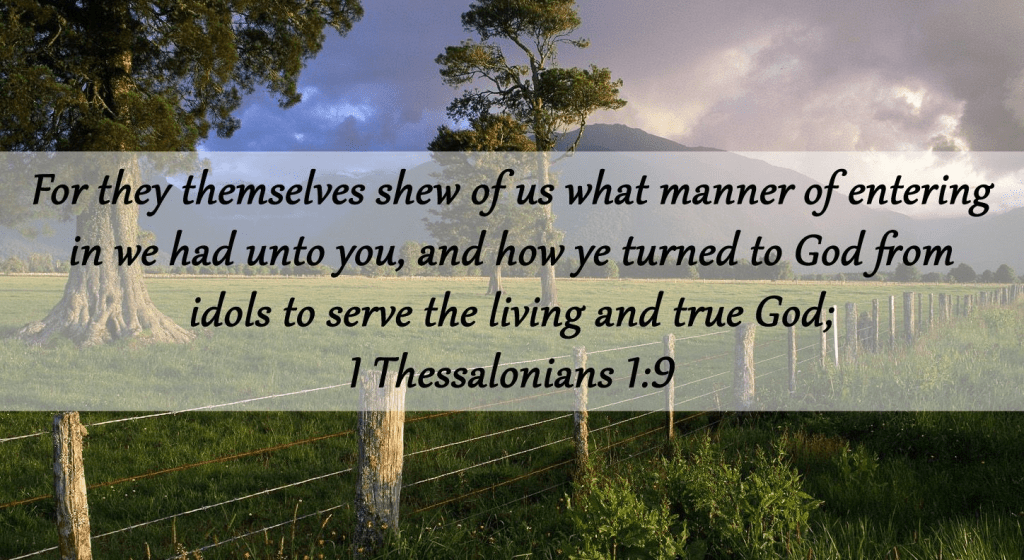
9 For they themselves report concerning us the kind of reception we had among you, and how you turned to God from idols to serve the living and true God, 10 and to wait for his Son from heaven, whom he raised from the dead, Jesus who delivers us from the wrath to come.” (1 Thessalonians 1:9–10 (ESV)
The Scriptures are abundantly clear the God of the Bible is the One, True God. There are no other gods but He alone. All other so-called gods are idols and are not the living and true God. The Apostle Paul’s statement in today’s text was in harmony with the Old Testament.
4 “Hear, O Israel: The Lord our God, the Lord is one. 5 You shall love the Lord your God with all your heart and with all your soul and with all your might. 6 And these words that I command you today shall be on your heart. 7 You shall teach them diligently to your children, and shall talk of them when you sit in your house, and when you walk by the way, and when you lie down, and when you rise. 8 You shall bind them as a sign on your hand, and they shall be as frontlets between your eyes. 9 You shall write them on the doorposts of your house and on your gates.” (Deuteronomy 6:4–9 (ESV)
6 Thus says the Lord, the King of Israel and his Redeemer, the Lord of hosts: “I am the first and I am the last; besides me there is no god. 7 Who is like me? Let him proclaim it. Let him declare and set it before me, since I appointed an ancient people. Let them declare what is to come, and what will happen. 8 Fear not, nor be afraid; have I not told you from of old and declared it? And you are my witnesses! Is there a God besides me? there is no Rock; I know not any.” (Isaiah 44:6–8 (ESV)
5 “I am the Lord, and there is no other, besides me there is no God; I equip you, though you do not know me, 6 that people may know, from the rising of the sun and from the west, that there is none besides me; I am the Lord, and there is no other. 7 I form light and create darkness; I make well-being and create calamity; I am the Lord, who does all these things.” (Isaiah 45:5–7 (ESV)
“The intent of these words was to give a clear statement of the truth of monotheism, that there is only one God. Thus, it has also been translated “the Lord is our God, the Lord alone.” The word used for “one” in this passage does not mean “singleness,” but “unity.” The same word is used in Gen. 2:24, where the husband and wife were said to be “one flesh.” Thus, while this verse was intended as a clear and concise statement of monotheism, it does not exclude the concept of the Trinity,” explains Dr. John MacArthur.
The Thessalonians turned (ἐπεστρέψατε; epespsate) intensely, actively, and collectively. To turn means to turn about, or to turn from something and to turn towards something. The Thessalonians turned from idols to the living and true God of heaven and earth for worship, service and salvation.
The Bible also calls this turning repentance (Matt. 3:1-2; 4:17; Acts 2:38; 3:19; 5:31; 20:21). Saving faith involves a turning from sin and a turning to faith in the person and work of Jesus Christ. This is called conversion. All those who, by the Holy Spirit, turn from sin to Christ abandon the worship of false gods to honor and serve the living God.
Additionally, while serving the living and true God in the present, believers in Christ also wait for Jesus’ return from heaven. To wait (ἀναμένειν; anamemein) means to presently, actively and infinitely await with patient confidence the Lord’s return in power, might and glory. To wait the Lord’s return is a consistent theme of the Thessalonians letters (I Thess. 3:13; 4:15-17; 5:8, 23; 2 Thess. 3:6-13). See also Acts 1:11; 2 Tim. 4:1-8; Titus 2:11-13.
“As a result of the operation of God’s grace whereby the message was applied to the hearts, the eyes of the Thessalonians had been opened, so that they saw that their idols were vanities. They had turned from them to a God living and real. Here the true God is not so much pointed out as described. All the emphasis is on his character, which is the very opposite of the idols. They are dead, he is living. They are unreal, he is real, genuine. They are unable to help, he is almighty and eager to help. To this God the Thessalonians have turned to serve him continually, submitting themselves to him as completely as does a slave to his master, nay far more completely and far more willingly.
Now, turning to a God living and real implies turning to his only begotten Son and salvation through him,” explains Dr. William Hendriksen.
Have you turned by the enabling power of the Holy Spirit from idols to serve the living and true God? May the Lord’s truth and grace be found here.
8 For not only has the word of the Lord sounded forth from you in Macedonia and Achaia, but your faith in God has gone forth everywhere, so that we need not say anything.” (1 Thessalonians 1:8 (ESV)
What is meant by reverberation? To reverberate means (1) a repeated loud noise almost like an echo; (2) to vibrate or be disturbed because of a loud noise; (3) to return or re-echo a sound: and (4) to have a continuing and serious effect upon people and/or places. This fourth definition defines the impact the Thessalonian believers had upon their immediate surroundings and beyond. Through them, the Word of the Lord sounded forth (ἐξήχηται; exechetai) and created what amounted to a turmoil.
Through them, the gospel impacted the regions of Macedonia and Achaia. However, not only did the Thessalonian believers influence these areas, but their faith in God was everywhere. Their commitment, trust, dependence and worship of God, through the Lord Jesus Christ, made a lasting impact. Consequently, Paul, Silas and Timothy did not need to share the gospel to certain people groups because the Thessalonians had already done so.
“Though it may appear that this church developed such a testimony in only three Sabbaths of preaching (cf. Acts 17:2) spanning as little as 15 days, it is better to understand that Paul preached three Sabbaths in the synagogue before he had to relocate elsewhere in the city. In all likelihood, Paul spent months not weeks, which accounts for: 1) the two collections he received from Philippi (Phil. 4:16); 2) the time he worked night and day (1 Thess. 2:9; 2 Thess. 3:8); and 3) the depth of pastoral care evidenced in the letter (1 Thess. 2:7–8, 11),” explains Dr. John MacArthur.
“Paul notes that “the word of the Lord” had “sounded forth” from the church at Thessalonica, a clear reference to the proclamation of divine revelation. He also notes that their “faith in God” had “gone forth everywhere” (1 Thess. 1:8). “Faith in God” might refer to the Thessalonians’ own subjective trust in the gospel—the Thessalonians’ belief in the gospel had become known,” explains Dr. R. C. Sproul.
“However, it more likely refers to the content of what they believed—the Christian faith was proclaimed from Thessalonica. Thus, the Thessalonians were known for enthusiastically preaching the gospel to as many people as possible. Their faith went forth “everywhere”; that is, Thessalonian believers had gone out from the city with the gospel in every direction, and they had evangelized their provinces so thoroughly that Paul did not need to preach the gospel in those regions any longer (v. 8). Indeed, the Thessalonians were vital players in the early spread of the gospel. Aristarchus, for example, traveled with Paul on some of his missionary journeys (Acts 19:29; 27:2).”
Are you prepared for God to use you in such a way as to make a reverberation in your family, neighborhood, school and/or place of employment? Such an effect is because of a prior cause. The biblical cause to make a sounded forth impact is having a work of faith, a labor of love and a steadfastness of hope in the Lord Jesus Christ (I Thess. 1:3).
“All the believers at Thessalonica had to do was avail themselves of the opportunities which their strategic location afforded,” states Dr. William Hendriksen. The same can be said of believers in Christ today.
May the Lord’s truth and grace be found here. Have a blessed day in the Lord.
6 And you became imitators of us and of the Lord, for you received the word in much affliction, with the joy of the Holy Spirit, 7 so that you became an example to all the believers in Macedonia and in Achaia.” (1 Thessalonians 1:6–7 (ESV)
“If Jesus was not God in human flesh, Christianity is exploded,” writes John Stott. “We are left with just another religion with some beautiful ideas and noble ethics; its unique distinction has gone.” Stott wrote this in his classic book Basic Christianity. I’ve given today’s blog the same title because I Thessalonians 1:6-7 contains the biblical basics for life and living for the glory of God.
“The first-century church in Thessalonica stands out as one of the healthiest churches in the New Testament. As evidence, we need only look to today’s passage, wherein Paul says the Thessalonian Christians were “an example to all the believers in Macedonia and in Achaia” (1 Thess. 1:6–7). (The Roman provinces of Macedonia and Achaia covered territory that makes up most of modern Greece.) Paul does not describe any of the other churches he addresses in his epistles as examples or models for others, so the Thessalonians evidenced Christian virtues in a special way,” explains Dr. R.C. Sproul.
The Apostle Paul wrote, “You became imitators of us and of the Lord.” To be imitators (μιμηταὶ; mimetai) means to mimic, simulate or copy the original. In the entertainment industry, there are comedians who impersonate, or do impressions, of famous people and celebrities. They do so to entertain.
The Thessalonians mimicked Paul, Silas, Timothy and the Lord in order to become godly. Their godly, Christlike behavior was a natural result of what previously occurred in their lives. First, they received the Word of God. To receive (δεξάμενοι; dexamenoi) means to personally and completely grasp, welcome and accept. In the context, the Thessalonians welcomed the Word of God into their souls.
Within the historical context of Acts 17:1-9, the Thessalonians received God’s Word, the Gospel, in much affliction (θλίψει; thlipsei) meaning stress and oppression. The unbelieving Jews did not respond well when the Holy Spirit regenerated their fellow citizens unto repentance and new life in Christ. The anger of the unbelievers was in stark contrast to the joy of these new believers.
“The evidence of Divine election shewed itself not only in Paul’s ministry, in so far as it was furnished with the power of the Holy Spirit, but also in the faith of the Thessalonians, so that this conformity is a powerful attestation of it. He says, however, “Ye were imitators of God and of us,” in the same sense in which it is said, that the people believed God and his servant Moses, (Exodus 14:13 not as though Paul and Moses had anything different from God, but because he wrought powerfully by them, as his ministers and instruments. Their readiness in receiving the gospel is called an imitation of God, for this reason, that as God had presented himself to the Thessalonians in a liberal spirit, so they had, on their part, voluntarily come forward to meet him.,” states John Calvin.
Additionally, the Thessalonian coverts were well known examples following their conversion. Their impact spread throughout all Macedonia and Achaia. Their influence was profound because the church was located in one of the most important cities of the Roman Empire; the provincial capital of Macedonia. Thessalonica was located near the conjunction of several imperial crossroads and was an important seaport. News of their salvation would naturally spread to churches in other parts of the empire. Other believers could not miss the example the Thessalonians set.
The Thessalonians believed the Gospel message even though they knew it would bring suffering, and they continued to suffer for the kingdom of God well after their conversions (2 Thess. 1:5). The Thessalonians, knowing that living as Christians would mean their suffering just as it meant suffering for Jesus and His Apostles, did not turn away from the faith preached to them (see Matt. 16:21; 2 Cor. 1:5–7). They were truly a godly congregation.
“The Thessalonians were examples not merely because they suffered but because they suffered “with the joy of the Holy Spirit” (1 Thess. 1:6). They did not reject the vocation of suffering for the sake of the kingdom of God, to which all believers are called; rather, they rejoiced that they could suffer for the sake of the Lord (see Matt. 16:24; Acts 5:41). They were not sadists who enjoyed suffering for suffering’s sake. Instead, they had the Spirit-wrought joy in suffering that makes believers willing to endure the harshest opposition if that is what it means to be faithful to the Savior,” states Dr. Sproul.
“Disciples are not above their master, so we cannot think that we are above suffering for the sake of God’s kingdom (Matt. 10:24). Jesus and His Apostles suffered, and we must be willing to do the same. As we trust the Lord, we will even find ourselves rejoicing in our sufferings for the gospel, as the Holy Spirit works joy and endurance in the hearts of His people to make them persevere through the pain, looking to the coming glory (Rom. 8:18),” concludes Dr. Sproul.
The gospel cannot be properly, or sincerely received, unless it be with a joyful heart. Nothing, however, is more at variance with our natural disposition, than to rejoice in afflictions,” comments Calvin.
May the Lord’s truth and grace be found here. Have a blessed day in the Lord.
2 “Continue steadfastly in prayer, being watchful in it with thanksgiving. 3 At the same time, pray also for us, that God may open to us a door for the word, to declare the mystery of Christ, on account of which I am in prison— 4 that I may make it clear, which is how I ought to speak.” Colossians 4:2–4 (ESV)
The reading, studying and application of God’s Word, corporate along with individual worship, communion or fellowship with fellow believers and the sharing of the gospel to the lost are indispensable disciplines and responsibilities for each believer in Christ. Along with these is the discipline and practice of prayer. If God is speaking to the believer through His inerrant Word, then the believer speaks to God through the privilege of prayer.
Prayer lays hold of God’s plan and becomes the link between his will and its accomplishment on earth. Amazing things happen, and we are given the privilege of being the channels of the Holy Spirit’s prayer. — Elisabeth Elliot
Prayer must carry on our work as much as preaching; he preaches not heartily to his people that will not pray for them. — Richard Baxter
Groanings which cannot be uttered are often prayers which cannot be refused. — Charles H. Spurgeon
Work, work, from morning until late at night. In fact, I have so much to do that I shall have to spend the first three hours in prayer. — Martin Luther
Study your prayers, a great part of my time is spent getting in tune for prayer. — Robert M. McCheyne
“Prayer is the easiest and hardest of all things; the simplest and the mostsublime; the weakest and the most powerful; its results lie outside the range of human possibilities-they are limited only by the omnipotence of God.” ~ Edward McKendree Bounds
The phrase continue steadfastly (προσκαρτερεῖτε; proskartereite) is a present active imperative verb. It means to be devoted, to persist obstinately, and to persevere. The Bible commands believers in Christ to continue steadfastly, to persist obstinately, and to persevere faithfully in prayer.
Not only are believers in Christ to continue steadfastly in prayer, but we are also to be watchful in prayer. The word watchful (γρηγοροῦντες; gregorountes) is a present active participle. To be watchful means to be awake and on the alert in prayer.
Along with being steadfast and watchful, the believer in Christ must also be grateful in prayer. Thanksgiving (εὐχαριστίᾳ; eucharistia) refers to gratitude to God.
John Calvin writes, “Paulreturns to general exhortations, in which we must not expect an exact order, for in that case he would have begun with prayer, but Paul had not an eye to that. Farther, as to prayer, he commends here two things; first, assiduity; secondly, alacrity, or earnest intentness. For, when he says, continue, he exhorts to perseverance, while he makes mention of watching in opposition to coldness, and listlessness.”
“He adds,thanksgiving, because God must be solicited for present necessity in such a way that, in the meantime, we do not forget favors already received. Farther, we ought not to be so importunate as to murmur, and feel offended if God does not immediately gratify our wishes, but must receive contentedly whatever he gives. Thus, a twofold giving of thanks is necessary. As to this point something has also been said in the Epistle to the Philippians.” (Philippians 4:6.)
As believers in Christ worship the Lord on this day, referred to in Scripture as the “Lord’s Day (Rev. 1:9-10), let us resolve once again, or for the first time, to be people of God who are know for being continually steadfast, watchful and grateful in prayer.
May the Lord’s truth and grace be found here. Have a blessed day in the Lord.
“…because our gospel came to you not only in word, but also in power and in the Holy Spirit and with full conviction. You know what kind of men we proved to be among you for your sake.” (1 Thessalonians 1:5 (ESV)
The following article is by Robert Murray McCheyne (21 May 1813 – 25 March 1843) was a minister in the Church of Scotland from 1835 to 1843. His comments are taken from I Thessalonians 1:5 and are from a series of meditations reprinted in 1988 by Free Presbyterian Publications, 133 Woodlands Road, Glasgow, G3 6LE.
Thrice happy minister who can address his people in these delightful words. Oh! that all our ministers could with truth say this. Why is it not so? Surely if we are determined, like Paul, “to know nothing among them but Christ Jesus and him crucified”; if we are filled with the same Holy Spirit, if we live the same devoted life, and carry the same message night and day with tears, we ought to be able to use these precious words. “He that goeth forth and weepeth, bearing precious seed, shall doubtless come again with rejoicing, bringing his sheaves with him.” The day of Pentecost was the time of the first-fruits. The day of ingathering is yet to come. The apostles had the former rain. We wait for the time of the latter rain.
1. Let us meditate on an unsuccessful ministry. The gospel comes to the people in word only. How often a faithful minister preaches the gospel, and the people seem to drink it in with joy! A beam of natural eloquence lights up all he says, or he has a gentle pathetic strain which rivets their attention. But no saving effects are seen to follow. No hearts are broken, no souls added to the church of such as shall be saved. So it was with Ezekiel: “Lo! thou art unto them as a very lovely song of one that hath a pleasant voice, and can play well on an instrument: for they hear thy words, but they do them not” (Ezekiel 33:32). These are they that receive the word into stony places; they hear the word, and anon, with joy receive it, yet have they not root in themselves, but endure only for a while.
Oh! my soul, art thou contented to receive the gospel in word only? Can a hungry man be fed by the smell of the viands? Or can a beggar turn rich by hearing the sound of money? And can my hungry soul find rest by hearing the tinkling of the gospel cymbals? Alas! it is a fearful thing to drop into hell under the sound of gospel mercy.
But there are some who not only hear the gospel, but know the gospel; and yet it comes to them in word only. How many a child is brought up under godly parents, well catechized in divine truth, well-disciplined in the Bible? They understand the gospel scheme. They have all knowledge; no point is new to them. And yet they have no spiritual sight; no tasting and seeing that Christ is good; no rock below their feet; no sitting with great delight under the shadow of the apple-tree. Ah! these are the most miserable of all unconverted hearers. They will sink lower than Capernaum. Ah! how many children of ministers, how many sabbath-school teachers, how many preachers of the gospel may know, that the gospel has come to them in word only, and never in power. Alas! how sad is it to perish pointing to the city of refuge, to preach to others, and then to be a castaway. But there is a more excellent way. Turn we now to meditate on –
2. A successful ministry. “Our gospel came unto you in power.” What a powerless thing the gospel sometimes appears. The minister is half ashamed of it. The people slumber under its most affecting statements. Again, at another time, the gospel is evidently “the power of God unto salvation”. An unseen power accompanies the preached word, and the sanctuary is felt to be the house of God, and the very gate of heaven. Then the word of Jeremiah is fulfilled: “Is not my word like as a fire? saith the Lord; and like a hammer that breaketh the rock in pieces?” (Jeremiah 23.29). Then stout-hearted sinners are awakened. Old, and middle-aged, and little children, are made to cry. What must I do to be saved? An awful stillness pervades the assembly. The arrows of the King of Zion are sharp in the heart of the King’s enemies, and the people are brought down under Him. Oh! sinner, has the gospel come thus in power to you? Has the hammer of the word broken your rocky heart? Has the fire of the word melted your icy heart?
Has the voice that is “like the noise of many waters” spoken peace to your soul?
“Our gospel came unto you …. in the Holy Ghost.” It is He, the third person of the blessed Godhead, that makes the gospel come with power. It was He who “moved upon the face of the waters”, when this world was without form and void, and brought life and beauty out of a dead world, Genesis 1:2. It is He that moves over the face of nature still, when the winter is past, and brings the fresh life of spring out of the cold bosom of the ground, Psalm 104:30. But most of all, it is the Holy Spirit’s work to take away the vail from the hearts of sinners, so that they turn to the Lord, 2 Corinthians 3:16. The carnal mind has got such enmity to God, the unconverted sinner is so dead in trespasses and sins, the natural man is so stupid in divine things, that there must be the work of the Almighty Spirit – quickening, enlightening, and making willing – before the sinner will cleave to Jesus.
Oh! sinner, has the Holy Spirit come to you? Sweet is the peace, which they enjoy who are taught by Him. When it is a dry time, ministers labor in vain; they spend their strength for nought and in vain. They feel like one standing on the sea-shore, speaking to the hard rocks, or the raging waves, or the tameless winds. But when the Holy Spirit comes, the weakest instruments are mighty, “mighty, through God, to the pulling down of strongholds”. Oh pray for such a blessed time.
“Our gospel came unto you in much assurance.” This is the effect on the soul, when the word comes with power, carried home by the Holy Ghost. The soul thus taught has a sweet certainty of the truth of the great things revealed in the gospel. When a man contemplates the sun, he feels a certainty that it is not the work of man but of God. So when a sinner gets anointed eyes, he sees a glorious beauty and fulness in Christ, so that his heart is filled with a sweet certainty of the truth of the gospel. He does not ask for evidences. He sees enough of evidence in Christ Himself. He says, I am all guilt: thou art Jehovah my righteousness. I am all weakness: thou art Jehovah my banner. I am all emptiness: in thee dwelleth all the fulness of the Godhead bodily. “I am my Beloved’s and my Beloved is mine. He feedeth among the lilies.”
It is this that fills the bosom with all joy and peace. It is this that gives a sweet sense of forgiveness and nearness to God. It is this that enables us to pray. Now we can say, “My soul shall make her boast in the Lord”. “I know that my Redeemer liveth.” “Who shall separate me from the love of Christ?” This is the gospel coming in much assurance. Oh! happy minister that can take up these words of Paul, and say, “Our gospel came not unto you”, etc. That people is thy joy here, and shall be thy crown throughout eternity.
May the Lord’s truth and grace be found here. Have a blessed day in the Lord.
“…remembering before our God and Father your work of faith and labor of love and steadfastness of hope in our Lord Jesus Christ.” (1 Thessalonians 1:3 (ESV)
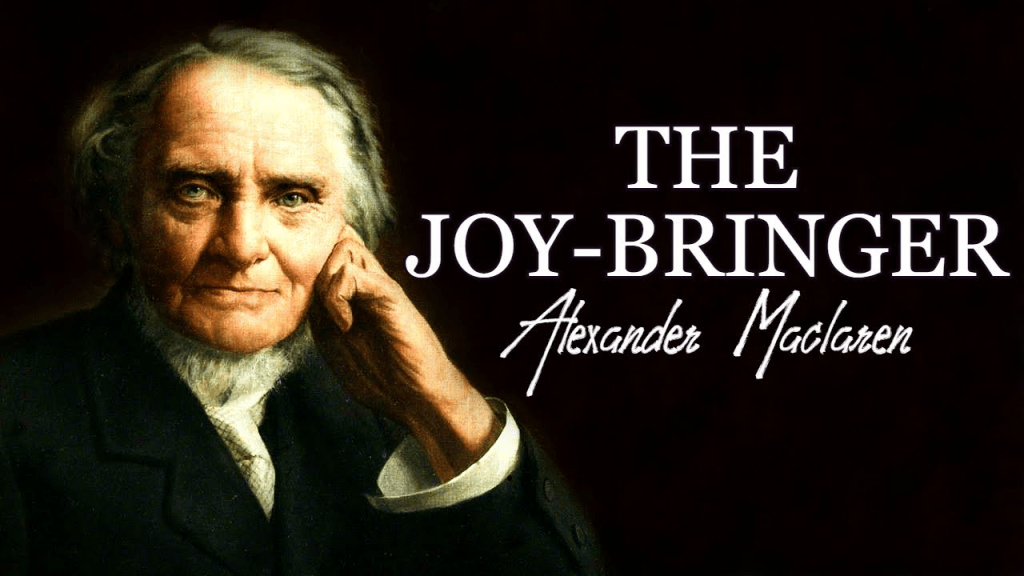
The following article is by Alexander Maclaren (11 February 1826 – 5 May 1910) who was a Scottish Baptist minister and writer. His comments are taken from I Thessalonians 1:3. This first excerpt was entitled The Three Foundation Stones. Today we excerpt McClaren’s Three Views of the Fair Building that is built upon them.
I have already half apologized for using the metaphor of a foundation and a building. I must repeat the confession that the symbol is an inadequate one. For the Apostle does not conceive of the work and labor and patience which are respectively allocated to these three graces as being superimposed upon them, as it were, by effort, so much as he thinks of them as growing out of them by their inherent nature. The work is’ the work of faith,’ that which characterizes faith, that which issues from it, that which is its garment, visible to the world, and the token of its reality and its presence.
Faith works.
It is the foundation of all true work; even in the lowest sense of the word we might almost say that. But in the Christian scheme it is eminently the underlying requisite for all work which God does not consider as busy idleness. I might here make a general remark, which, however, I need not dwell upon, that we have here the broad thought which Christian people in all generations need-to have drummed into their heads over and over again, and that is that inward experiences and emotions, and rotates of mind and heart, however good and precious, are so mainly as being the necessary foundations of conduct. What is the good of praying and feeling comfortable within, and having ‘a blessed assurance,’ a ‘happy experience,’ ‘sweet communion,’ and so on? What is the good of it all, if these things do not make us ‘live soberly, righteously, and godly in this present world’? What is the good of the sails of a windmill going whirling round, if the machinery has been thrown out of gear, and the great stones which it ought to actuate are not revolving? What is the good of the screw of a steamer revolving, when she pitches, clean above the waves? It does nothing then to drive the vessel onwards, but will only damage the machinery. And Christian emotions and experiences which do not drive conduct are of as little use, often as perilous, and as injurious. If you want to keep your ‘faith, love, hope,’ sound and beneficial, set them to work. And do not be too sure that you have them, if they do not crave for work, whether you set them to it or not.
‘Your work of faith.’
There is the whole of the thorny subject of the relation of faith and works packed into a nutshell. It is exactly what James said and it is exactly what a better than James said. When the Jews came to Him with their externalism, and thought that God was to be pleased by a whole rabble of separate good actions, and so said, ‘What shall we do that we might work the works of God?’ Jesus said, ‘Never mind about Works. This is the work of God, that ye believe on Him whom He hath sent,’ and out of that will come all the rest. That is the mother tincture; everything will flow from that. So, Paul says, ‘Your work of faith.’
Does your faith work? Perhaps I should ask other people rather than you. Do men see that your faith works; that its output is different from the output of men who are not possessors of a ‘like precious faith’? Ask yourselves the question, and God help you to answer it.
Love labors.
Labor is more than work, for it includes the notion of toil, fatigue, difficulty, persistence, antagonism. Ah! the work of faith will never be done unless it is the toil of love. You remember how Milton talks about the immortal garland that is to be run for, ‘not without dust and sweat.’ The Christian life is not a leisurely promenade. The limit of our duty is not ease of work. There must be toil. And love is the only principle that will carry us through the fatigues, and the difficulties, and the oppositions which rise against us from ourselves and from without. Love delights to have a hard task set it by the beloved, and the harder the task the more poignant the satisfaction. Loss is gain when it brings us nearer the beloved.
And whether our love be love to God, or its consequence, love to man, it is the only foundation on which toil for either God or man will over permanently be rested. Do not believe in philanthropy which has not a bottom of faith, and do not believe in work for Christ which does not involve in toil and be sure that you will do neither, unless you have both these things: the faith and the love.
Hope is patient.
And then comes the last. Faith works, love toils, hope is patient. Is that all that ‘hope’ is? Not if you take the word in the narrow meaning which it has in modern English; but that was not what Paul meant.
He meant something a great deal more than passive endurance, great as that is. It is something to be able to say, in the pelting of a pitiless storm, ‘Pour on! I will endure.’ But it is a great deal more to be able, in spite of all, not to bate one jot of heart or hope, but ‘still bear up and steer right onward’; and that is involved in the true meaning of the word inadequately rendered ‘patience’ in the New Testament. For it is no passive virtue only, but it is a virtue which, in the face of the storm, holds its course; brave persistence, active perseverance, as well as meek endurance and submission.
‘Hope’ helps us Both to bear and to do. They tell us nowadays that it is selfish for a Christian man to animate himself, either for endurance or for activity, By the contemplation of those great glories that lie yonder. If that is selfishness, God grant we may all Become a great deal more selfish than we are! No man labors in the Christian life, or submits to Christian difficulty, for the sake of going to heaven. At least, if he does, he has got on the wrong tack altogether. But if the motive for Both endurance and activity be faith and love, then hope has a perfect right to come in as a subsidiary motive, and to give strength to the faith and rapture to the love.
We cannot afford to throw away that hope, as so many of us do — not perhaps, intellectually, though I am afraid there is a very considerable dimming of the clearness, and a narrowing of the place in our thoughts, of the hope of a future Blessedness, in the average Christian of this day — but practically we are all apt to lose sight of the recompense of the reward. And if we do, the faith and love, and the work and toil, and the patience will suffer. Faith will relax its grasp, love will cool down its fervor; and there will come a film over Hope’s blue eye, and she will not see the land that is very far opt. So, dear brethren, remember the sequence, ‘faith, love, hope,’ and remember the issues, ‘work, toil, patience.’
May the Lord’s truth and grace be found here. Have a blessed day in the Lord.








 His Word Today