2 “Continue steadfastly in prayer, being watchful in it with thanksgiving. 3 At the same time, pray also for us, that God may open to us a door for the word, to declare the mystery of Christ, on account of which I am in prison— 4 that I may make it clear, which is how I ought to speak.” Colossians 4:2–4 (ESV)
The reading, studying and application of God’s Word, corporate along with individual worship, communion or fellowship with fellow believers and the sharing of the gospel to the lost are indispensable disciplines and responsibilities for each believer in Christ. Along with these is the discipline and practice of prayer. If God is speaking to the believer through His inerrant Word, then the believer speaks to God through the privilege of prayer.
Prayer lays hold of God’s plan and becomes the link between his will and its accomplishment on earth. Amazing things happen, and we are given the privilege of being the channels of the Holy Spirit’s prayer. — Elisabeth Elliot
Prayer must carry on our work as much as preaching; he preaches not heartily to his people that will not pray for them. — Richard Baxter
Groanings which cannot be uttered are often prayers which cannot be refused. — Charles H. Spurgeon
Work, work, from morning until late at night. In fact, I have so much to do that I shall have to spend the first three hours in prayer. — Martin Luther
Study your prayers, a great part of my time is spent getting in tune for prayer. — Robert M. McCheyne
“Prayer is the easiest and hardest of all things; the simplest and the mostsublime; the weakest and the most powerful; its results lie outside the range of human possibilities-they are limited only by the omnipotence of God.” ~ Edward McKendree Bounds
The phrase continue steadfastly (προσκαρτερεῖτε; proskartereite) is a present active imperative verb. It means to be devoted, to persist obstinately, and to persevere. The Bible commands believers in Christ to continue steadfastly, to persist obstinately, and to persevere faithfully in prayer.
Not only are believers in Christ to continue steadfastly in prayer, but we are also to be watchful in prayer. The word watchful (γρηγοροῦντες; gregorountes) is a present active participle. To be watchful means to be awake and on the alert in prayer.
Along with being steadfast and watchful, the believer in Christ must also be grateful in prayer. Thanksgiving (εὐχαριστίᾳ; eucharistia) refers to gratitude to God.
John Calvin writes, “Paulreturns to general exhortations, in which we must not expect an exact order, for in that case he would have begun with prayer, but Paul had not an eye to that. Farther, as to prayer, he commends here two things; first, assiduity; secondly, alacrity, or earnest intentness. For, when he says, continue, he exhorts to perseverance, while he makes mention of watching in opposition to coldness, and listlessness.”
“He adds,thanksgiving, because God must be solicited for present necessity in such a way that, in the meantime, we do not forget favors already received. Farther, we ought not to be so importunate as to murmur, and feel offended if God does not immediately gratify our wishes, but must receive contentedly whatever he gives. Thus, a twofold giving of thanks is necessary. As to this point something has also been said in the Epistle to the Philippians.” (Philippians 4:6.)
As believers in Christ worship the Lord on this day, referred to in Scripture as the “Lord’s Day (Rev. 1:9-10), let us resolve once again, or for the first time, to be people of God who are know for being continually steadfast, watchful and grateful in prayer.
May the Lord’s truth and grace be found here. Have a blessed day in the Lord.
“…because our gospel came to you not only in word, but also in power and in the Holy Spirit and with full conviction. You know what kind of men we proved to be among you for your sake.” (1 Thessalonians 1:5 (ESV)
The following article is by Robert Murray McCheyne (21 May 1813 – 25 March 1843) was a minister in the Church of Scotland from 1835 to 1843. His comments are taken from I Thessalonians 1:5 and are from a series of meditations reprinted in 1988 by Free Presbyterian Publications, 133 Woodlands Road, Glasgow, G3 6LE.
Thrice happy minister who can address his people in these delightful words. Oh! that all our ministers could with truth say this. Why is it not so? Surely if we are determined, like Paul, “to know nothing among them but Christ Jesus and him crucified”; if we are filled with the same Holy Spirit, if we live the same devoted life, and carry the same message night and day with tears, we ought to be able to use these precious words. “He that goeth forth and weepeth, bearing precious seed, shall doubtless come again with rejoicing, bringing his sheaves with him.” The day of Pentecost was the time of the first-fruits. The day of ingathering is yet to come. The apostles had the former rain. We wait for the time of the latter rain.
1. Let us meditate on an unsuccessful ministry. The gospel comes to the people in word only. How often a faithful minister preaches the gospel, and the people seem to drink it in with joy! A beam of natural eloquence lights up all he says, or he has a gentle pathetic strain which rivets their attention. But no saving effects are seen to follow. No hearts are broken, no souls added to the church of such as shall be saved. So it was with Ezekiel: “Lo! thou art unto them as a very lovely song of one that hath a pleasant voice, and can play well on an instrument: for they hear thy words, but they do them not” (Ezekiel 33:32). These are they that receive the word into stony places; they hear the word, and anon, with joy receive it, yet have they not root in themselves, but endure only for a while.
Oh! my soul, art thou contented to receive the gospel in word only? Can a hungry man be fed by the smell of the viands? Or can a beggar turn rich by hearing the sound of money? And can my hungry soul find rest by hearing the tinkling of the gospel cymbals? Alas! it is a fearful thing to drop into hell under the sound of gospel mercy.
But there are some who not only hear the gospel, but know the gospel; and yet it comes to them in word only. How many a child is brought up under godly parents, well catechized in divine truth, well-disciplined in the Bible? They understand the gospel scheme. They have all knowledge; no point is new to them. And yet they have no spiritual sight; no tasting and seeing that Christ is good; no rock below their feet; no sitting with great delight under the shadow of the apple-tree. Ah! these are the most miserable of all unconverted hearers. They will sink lower than Capernaum. Ah! how many children of ministers, how many sabbath-school teachers, how many preachers of the gospel may know, that the gospel has come to them in word only, and never in power. Alas! how sad is it to perish pointing to the city of refuge, to preach to others, and then to be a castaway. But there is a more excellent way. Turn we now to meditate on –
2. A successful ministry. “Our gospel came unto you in power.” What a powerless thing the gospel sometimes appears. The minister is half ashamed of it. The people slumber under its most affecting statements. Again, at another time, the gospel is evidently “the power of God unto salvation”. An unseen power accompanies the preached word, and the sanctuary is felt to be the house of God, and the very gate of heaven. Then the word of Jeremiah is fulfilled: “Is not my word like as a fire? saith the Lord; and like a hammer that breaketh the rock in pieces?” (Jeremiah 23.29). Then stout-hearted sinners are awakened. Old, and middle-aged, and little children, are made to cry. What must I do to be saved? An awful stillness pervades the assembly. The arrows of the King of Zion are sharp in the heart of the King’s enemies, and the people are brought down under Him. Oh! sinner, has the gospel come thus in power to you? Has the hammer of the word broken your rocky heart? Has the fire of the word melted your icy heart?
Has the voice that is “like the noise of many waters” spoken peace to your soul?
“Our gospel came unto you …. in the Holy Ghost.” It is He, the third person of the blessed Godhead, that makes the gospel come with power. It was He who “moved upon the face of the waters”, when this world was without form and void, and brought life and beauty out of a dead world, Genesis 1:2. It is He that moves over the face of nature still, when the winter is past, and brings the fresh life of spring out of the cold bosom of the ground, Psalm 104:30. But most of all, it is the Holy Spirit’s work to take away the vail from the hearts of sinners, so that they turn to the Lord, 2 Corinthians 3:16. The carnal mind has got such enmity to God, the unconverted sinner is so dead in trespasses and sins, the natural man is so stupid in divine things, that there must be the work of the Almighty Spirit – quickening, enlightening, and making willing – before the sinner will cleave to Jesus.
Oh! sinner, has the Holy Spirit come to you? Sweet is the peace, which they enjoy who are taught by Him. When it is a dry time, ministers labor in vain; they spend their strength for nought and in vain. They feel like one standing on the sea-shore, speaking to the hard rocks, or the raging waves, or the tameless winds. But when the Holy Spirit comes, the weakest instruments are mighty, “mighty, through God, to the pulling down of strongholds”. Oh pray for such a blessed time.
“Our gospel came unto you in much assurance.” This is the effect on the soul, when the word comes with power, carried home by the Holy Ghost. The soul thus taught has a sweet certainty of the truth of the great things revealed in the gospel. When a man contemplates the sun, he feels a certainty that it is not the work of man but of God. So when a sinner gets anointed eyes, he sees a glorious beauty and fulness in Christ, so that his heart is filled with a sweet certainty of the truth of the gospel. He does not ask for evidences. He sees enough of evidence in Christ Himself. He says, I am all guilt: thou art Jehovah my righteousness. I am all weakness: thou art Jehovah my banner. I am all emptiness: in thee dwelleth all the fulness of the Godhead bodily. “I am my Beloved’s and my Beloved is mine. He feedeth among the lilies.”
It is this that fills the bosom with all joy and peace. It is this that gives a sweet sense of forgiveness and nearness to God. It is this that enables us to pray. Now we can say, “My soul shall make her boast in the Lord”. “I know that my Redeemer liveth.” “Who shall separate me from the love of Christ?” This is the gospel coming in much assurance. Oh! happy minister that can take up these words of Paul, and say, “Our gospel came not unto you”, etc. That people is thy joy here, and shall be thy crown throughout eternity.
May the Lord’s truth and grace be found here. Have a blessed day in the Lord.
“…remembering before our God and Father your work of faith and labor of love and steadfastness of hope in our Lord Jesus Christ.” (1 Thessalonians 1:3 (ESV)
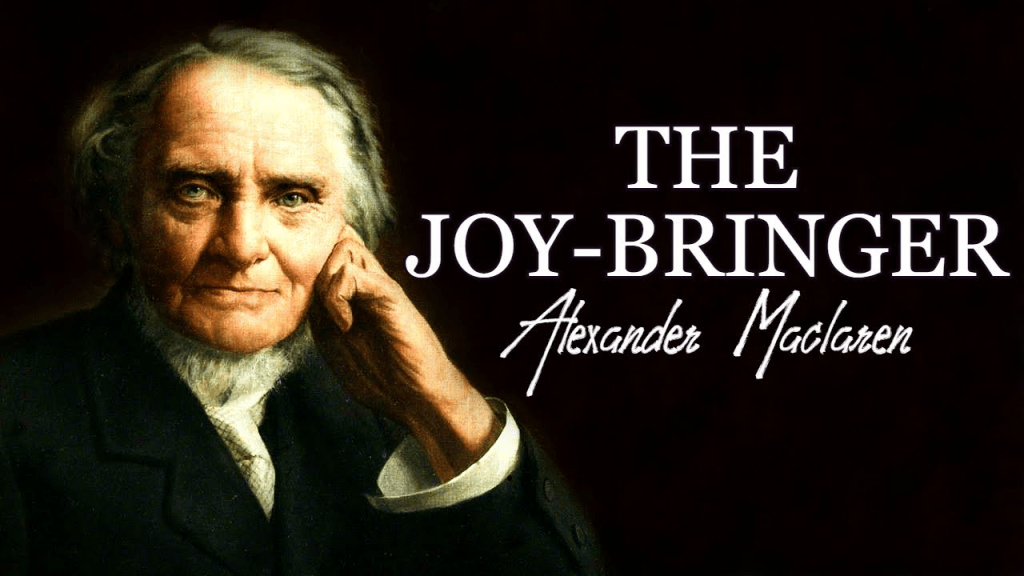
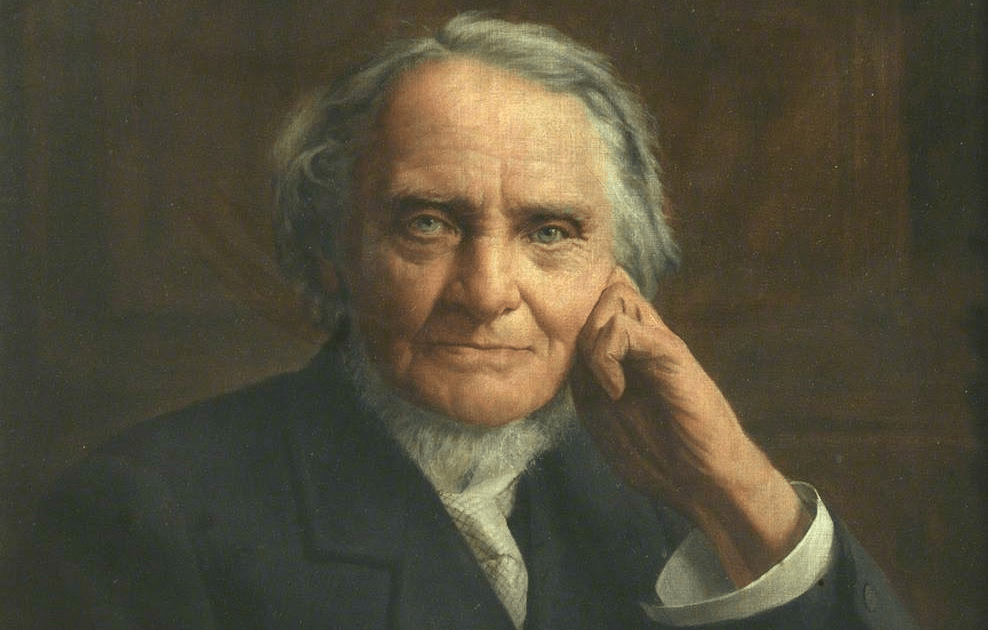
The following article is by Alexander Maclaren (11 February 1826 – 5 May 1910) who was a Scottish Baptist minister and writer. His comments are taken from I Thessalonians 1:3. This first excerpt was entitled The Three Foundation Stones. Today we excerpt McClaren’s Three Views of the Fair Building that is built upon them.
I have already half apologized for using the metaphor of a foundation and a building. I must repeat the confession that the symbol is an inadequate one. For the Apostle does not conceive of the work and labor and patience which are respectively allocated to these three graces as being superimposed upon them, as it were, by effort, so much as he thinks of them as growing out of them by their inherent nature. The work is’ the work of faith,’ that which characterizes faith, that which issues from it, that which is its garment, visible to the world, and the token of its reality and its presence.
Faith works.
It is the foundation of all true work; even in the lowest sense of the word we might almost say that. But in the Christian scheme it is eminently the underlying requisite for all work which God does not consider as busy idleness. I might here make a general remark, which, however, I need not dwell upon, that we have here the broad thought which Christian people in all generations need-to have drummed into their heads over and over again, and that is that inward experiences and emotions, and rotates of mind and heart, however good and precious, are so mainly as being the necessary foundations of conduct. What is the good of praying and feeling comfortable within, and having ‘a blessed assurance,’ a ‘happy experience,’ ‘sweet communion,’ and so on? What is the good of it all, if these things do not make us ‘live soberly, righteously, and godly in this present world’? What is the good of the sails of a windmill going whirling round, if the machinery has been thrown out of gear, and the great stones which it ought to actuate are not revolving? What is the good of the screw of a steamer revolving, when she pitches, clean above the waves? It does nothing then to drive the vessel onwards, but will only damage the machinery. And Christian emotions and experiences which do not drive conduct are of as little use, often as perilous, and as injurious. If you want to keep your ‘faith, love, hope,’ sound and beneficial, set them to work. And do not be too sure that you have them, if they do not crave for work, whether you set them to it or not.
‘Your work of faith.’
There is the whole of the thorny subject of the relation of faith and works packed into a nutshell. It is exactly what James said and it is exactly what a better than James said. When the Jews came to Him with their externalism, and thought that God was to be pleased by a whole rabble of separate good actions, and so said, ‘What shall we do that we might work the works of God?’ Jesus said, ‘Never mind about Works. This is the work of God, that ye believe on Him whom He hath sent,’ and out of that will come all the rest. That is the mother tincture; everything will flow from that. So, Paul says, ‘Your work of faith.’
Does your faith work? Perhaps I should ask other people rather than you. Do men see that your faith works; that its output is different from the output of men who are not possessors of a ‘like precious faith’? Ask yourselves the question, and God help you to answer it.
Love labors.
Labor is more than work, for it includes the notion of toil, fatigue, difficulty, persistence, antagonism. Ah! the work of faith will never be done unless it is the toil of love. You remember how Milton talks about the immortal garland that is to be run for, ‘not without dust and sweat.’ The Christian life is not a leisurely promenade. The limit of our duty is not ease of work. There must be toil. And love is the only principle that will carry us through the fatigues, and the difficulties, and the oppositions which rise against us from ourselves and from without. Love delights to have a hard task set it by the beloved, and the harder the task the more poignant the satisfaction. Loss is gain when it brings us nearer the beloved.
And whether our love be love to God, or its consequence, love to man, it is the only foundation on which toil for either God or man will over permanently be rested. Do not believe in philanthropy which has not a bottom of faith, and do not believe in work for Christ which does not involve in toil and be sure that you will do neither, unless you have both these things: the faith and the love.
Hope is patient.
And then comes the last. Faith works, love toils, hope is patient. Is that all that ‘hope’ is? Not if you take the word in the narrow meaning which it has in modern English; but that was not what Paul meant.
He meant something a great deal more than passive endurance, great as that is. It is something to be able to say, in the pelting of a pitiless storm, ‘Pour on! I will endure.’ But it is a great deal more to be able, in spite of all, not to bate one jot of heart or hope, but ‘still bear up and steer right onward’; and that is involved in the true meaning of the word inadequately rendered ‘patience’ in the New Testament. For it is no passive virtue only, but it is a virtue which, in the face of the storm, holds its course; brave persistence, active perseverance, as well as meek endurance and submission.
‘Hope’ helps us Both to bear and to do. They tell us nowadays that it is selfish for a Christian man to animate himself, either for endurance or for activity, By the contemplation of those great glories that lie yonder. If that is selfishness, God grant we may all Become a great deal more selfish than we are! No man labors in the Christian life, or submits to Christian difficulty, for the sake of going to heaven. At least, if he does, he has got on the wrong tack altogether. But if the motive for Both endurance and activity be faith and love, then hope has a perfect right to come in as a subsidiary motive, and to give strength to the faith and rapture to the love.
We cannot afford to throw away that hope, as so many of us do — not perhaps, intellectually, though I am afraid there is a very considerable dimming of the clearness, and a narrowing of the place in our thoughts, of the hope of a future Blessedness, in the average Christian of this day — but practically we are all apt to lose sight of the recompense of the reward. And if we do, the faith and love, and the work and toil, and the patience will suffer. Faith will relax its grasp, love will cool down its fervor; and there will come a film over Hope’s blue eye, and she will not see the land that is very far opt. So, dear brethren, remember the sequence, ‘faith, love, hope,’ and remember the issues, ‘work, toil, patience.’
May the Lord’s truth and grace be found here. Have a blessed day in the Lord.
“…remembering before our God and Father your work of faith and labor of love and steadfastness of hope in our Lord Jesus Christ.” (1 Thessalonians 1:3 (ESV)
The following article is by Alexander Maclaren (11 February 1826 – 5 May 1910) who was a Scottish Baptist minister and writer. His comments are taken from I Thessalonians 1:3.
THIS Epistle, as I suppose we all know, is Paul’s first letter. He had been hunted out of Thessalonica by the mob, made the best of his way to Athens, stayed there for a very short time, then betook himself to Corinth, and at some point of his somewhat protracted residence there, this letter was written. So that we have in it his first attempt, so far as we know, to preach the Gospel By the pen. It is interesting to notice how, whatever changes and developments there may have Been in him thereafter, all the substantial elements of his latest faith beam out in this earliest letter, and how even in regard to trifles we see the germs of much that came afterwards. This same triad, you remember, ‘faith, hope, charity,’ recurs in the First Epistle to the Corinthians, though with a very significant difference in the order, which I shall have to dwell upon presently.
The letter is interesting on another account. Remembering that it was only very short time since these Thessalonians had turned from idols to serve the living God, there is something very beautiful in the overflowing generosity of commendation, which never goes beyond veracity, with which he salutes them. Their Christian character, like seeds sown in some favored tropical land, had sprung up swiftly; yet not with the dangerous kind of swiftness which presages decay of the growth. It was only a few days since they had been groveling before idols, but now he can speak of ‘your work of faith, and labor of love, and patience of hope’… and declare that the Gospel ‘sounded out’ from them — the word which he employs is that which is technically used for the blast of a trumpet — ‘so that we need not to speak anything.’
Rapid growth is possible for us all, and is not always superficial.
I desire now to consider that pair of triads — the three foundation-stones, and the three views of the fair building that is reared upon them.
I. THE THREE FOUNDATION STONES
That is a natural metaphor to use, but it is not quite correct, for these three — faith, love, hope — are not to be conceived of as lying side by side. Rather than three foundations we have three courses of the building here; the lowest one, faith; the next one, love; and the top one, hope. The order in 1 Corinthians is different, ‘faith, hope, charity,’ and the alteration in the sequence is suggested by the difference of purpose. The Apostle intended in 1 Corinthians to dwell at some length thereafter on ‘charity,’ or ‘love.’ So, he puts it last to make the link of connection with what he is going to say. But here he is dealing with the order of production, the natural order in which these three evolve themselves. And his thought is that they are like the shoots that successive springs bring upon the bough of a tree, where each year hem its own growth, and the summit of last year’s becomes the basis of next. Thus, we have, first, faith; then, shooting from that, love; and then, sustained by both, hope. Now let us look at that order.
It is a well-worn commonplace, which you may think it not needful for me to dwell upon here, that in the Christian theory, both of salvation and of morals, the basis of everything is trust. And that is no arbitrary theological arrangement, but it is the only means by which the life that is the basis both of salvation and of righteousness can be implanted in men. There is no other way by which Jesus Christ can come into our hearts than by what the New Testament calls ‘trust,’ which we have turned into the hard, theological concept which too often glides over people’s minds without leaving any dint at all — ‘faith.’
Distrust is united with trust. There is no trust without, complementary to it, self-distrust. Just as the sprouting seed sends one little radicle downwards, and that becomes the root, and at the same time sends up another one, white till it reaches the light, and it becomes the stem, so the underside of faith is self-distrust, and you must empty yourselves before you can open your hearts to be filled by Jesus. That being so, this self-distrustful trust is the beginning of everything. That is the alpha of the whole alphabet, however glorious and manifold may be the words into which its letters are afterwards combined.
Faith is the hand that grasps. It is the means of communication, it is the channel through which the grace which is the life, or, rather, I should say, the life which is the grace, comes to us. It is the open door by which the angel of God comes in with his gifts. It is like the petals of the flowers, opening when the sunshine kisses them, and, by opening, laying bare the depths of their calyxes to be illuminated and colored, and made to grow by the sunshine which itself has opened them, and without the presence of which, within the cup, there would have been neither life nor beauty. So, faith is the basis of everything; the first shoot from which all the others ascend.
Brethren, have you that initial grace? I leave the question with you. If you have not that, you have nothing else.
Then again, out of faith rises love. No man can love God unless he behooves that God loves him. I, for my part, am old-fashioned and narrow enough not to believe that there is any deep, soul-cleansing or soul-satisfying love of God which is not the answer to the love that died on the Cross. But you must believe that, and more than believe it; you must have trusted and cast yourselves on it, in the utter abandonment of self-distrust and Christ-confidence, before there will well up in your heart the answering love to God. First faith, then love. My love is the reverberation of the primeval voice, the echo of God’s. The angle at which the light falls on the mirror is the same as the angle at which it is reflected from it. And though my love at its highest is low, at its strongest is weak: yet, like the echo that is faint and far, feeble though it be, it is pitched on the same key, and is the prolongation of the same note as the mother-sound. So, my love answers God’s love, and it will never answer it unless faith has brought me within the auditorium, the circle wherein the voice that proclaims ‘I love thee, my child,’ can be heard.
Now, we do not need to ask ourselves whether Paul is here speaking of love to God or love to man. He is speaking of both, because the New Testament deals with the latter as being a part of the former, and sure to accompany it. But there is one lesson that I wish to draw.
If it be true that love in us is thus the result of faith in the love of God, let us learn how we grow in love. You cannot say, ‘Now I will make an effort to love.’ The circulation of the blood, the pulsations of the heart, are not within the power of the will. But you can say, ‘Now I will make an effort to trust.’ For faith is in the power of the will, and when the Master said, ‘Ye will not come unto me,’ He taught us that unbelief is not a mere intellectual deficiency or perversity, but that it is the result, in the majority of cases — I might almost say in all — of an alienated will
Therefore, if you wish to love, do not try to work yourself into a hysteria of affection, but take into your hearts and minds the Christian facts, and mainly the fact of the Cross, which will set free the frozen and imprisoned fountains of your affections, and cause them to flow out abundantly in sweet water. First faith, then love; and get at love through faith. That is a piece of practical wisdom that it will do us all good to keep in mind.
Then the third of the three, the topmost shoot, is hope. Hope is faith directed to the future. So, it is clear enough that, unless I have that trust of which I have been speaking, I have none of the hope which the Apostle regards as flowing from it.
But love has to do with hope quite as much, though in a different way, as faith has to do with it. For in the direct proportion in which we are taking into our hearts Christ and His truth, and letting our hearts go out in love towards Him and communion with Him, will the glories beyond brighten and consolidate and magnify themselves in our eyes.
The hope of the Christian man is but the inference from his present faith, and the joy and sweetness of his present love. For surely when we rise to the heights which are possible to us all, and on which I suppose most Christian people have been sometimes, though for far too brief seasons; when we rise to the heights of communion with God, anything seems more possible to us than that death, or anything that lies in the future, should have power over a tie so sweet, so strong, so independent of externals, and so all-sufficing in its sweetness. Thus, we shall be sure that God is our portion forever, in the precise degree in which, by faith and love, we feel that ‘He is the strength of our hearts,’ to-day and now.
May the Lord’s grace and truth be found here. Have a blessed day in the Lord.
4 “For we know, brothers loved by God, that he has chosen you, 5 because our gospel came to you not only in word, but also in power and in the Holy Spirit and with full conviction. You know what kind of men we proved to be among you for your sake.” (1 Thessalonians 1:4–5 (ESV)
How did the Apostle Paul know God had chosen the Thessalonian believers unto salvation? How could he be so certain? How can believers in Christ today know God has chosen them? How can we be certain God has truly saved our souls?
The Apostle Paul knew God had chosen the Thessalonians because of four indisputable factors. (1) The word of the gospel had been preached; (2) The preaching came with power; (3) The power was from the Holy Spirit; and (4) The Holy Spirit brought full conviction. Let’s examine each of these factors individually.
First, the Apostle Paul, Silas and Timothy preached the word of the gospel to the Thessalonians. Second, Paul wrote the gospel came to them not just in word (λόγῳ; logos) or speech, but also in supernatural power (δυνάμει; dynamei). The supernatural power was from God through these three missionaries. The Thessalonians became changed people. The gospel changed them. Third, the power of the gospel originated from or by the Holy Spirit. The Holy Spirit empowered Paul, Silas and Timothy to preach the gospel. However, it was the Holy Spirit who converted the Thessalonians.
Fourth, the Thessalonians conversion by the supernatural power of the gospel through the personal work of the Holy Spirit came with full conviction. The word full (πολλῇ; polle) is an adjective meaning to be great, numerous, or large. The noun conviction (πληροφορίᾳ; plerophoria) means confidence, assurance and certainty.
The Apostle Paul knew the Thessalonian’s conversion was true because it was accompanied by their full conviction the gospel was true. This was a work by the Holy Spirit through Paul, Silas and Timothy.
“Paul identifies the Thessalonians as elect because they showed conviction by believing the gospel. They placed their faith in Christ when the good news was preached to them. Paul’s observation regarding belief and election confirms Jesus’ own words, when He said that all whom the Father has given to Him will certainly come to Him and will never be cast out (John 6:37). Our faith is the instrument or means by which we cling to Christ for salvation, but it also reveals our eternal election,” explains Dr. R.C. Sproul.
We must remember the biblical truth of faith. Faith, is the trust in, commitment to, dependence upon and the honor and worship of Jesus Christ. Faith, or belief, involves the entire person: intellect, emotions and the will.
“Faith is an intellectual element (notitia), which is “a positive recognition of the truth”; an emotional element (assensus), which includes “a deep conviction of the truth”; and a volitional element (fiducia), which involves “a personal trust in Christ as Savior and Lord, including a surrender … to Christ,” states Dr. Louis Berkhof, in his Systematic Theology.
Faith is also a sovereign gift from God. Biblical, saving faith does not originate within the fallen sinner. Rather, saving faith is a result of the regenerating power and ministry of the Holy Spirit and is rightly viewed as God’s gift (John 1:12-13; 3:1-8; John 6:35-60; Acts 13:48; 16:14; Eph. 2:1-9; Phil. 1:19; 2 Peter 1:1). Paul added neither he, Silas or Timothy did anything unethical in sharing the gospel Therefore, the LORD receives all the glory and praise.
“All kinds of traveling philosophers were roving about in the world of that day. They plied their trade for their own sake, in their own interest. Paul, Silas, and Timothy were different. They carried on their difficult tasks for the sake of the people, that they might be saved. In that spirit and frame of mind they had entered Thessalonica, and the experiences which they had endured there had added to their spiritual vigor (hence, it is not at all necessary to weaken the sense of the verb “became”),” states Dr. William Hendriksen.
William Hendriksen and Simon J. Kistemaker, Exposition of I-II Thessalonians, vol. 3, New Testament Commentary (Grand Rapids: Baker Book House, 1953–2001), 51.
As Herman Bavinck explained, “Christ has accomplished everything, and though he did not accomplish rebirth, faith, and repentance in our place, he did acquire them for us, and the Holy Spirit therefore applies them.”
“Though Christ does not repent for His people, the faith and repentance a believer exercises are gifts of His grace (Acts 5:31; Phil. 1:29).Like faith, repentance holds a continual place in the Christian’s life. Believers do not merely repent of their sins at the beginning of their Christian experience. Rather, as Martin Luther famously stated in the first of his Ninety-Five Theses, “Our Lord and Master Jesus Christ willed the entire life of believers to be one of repentance,” concludes Dr. Sproul.
The evidence of true, biblical faith is a changed life of obedience before the Lord.
4 For we know, brothers loved by God, that he has chosen you, 5 because our gospel came to you not only in word, but also in power and in the Holy Spirit and with full conviction.” (1 Thessalonians 1:4–5a (ESV)
How did the Apostle Paul know God had chosen the Thessalonian believers unto salvation? How could he be so certain? How can believers in Christ today know God has chosen them? How can we be certain God has truly saved our souls?
The Apostle Paul knew God had chosen the Thessalonians because of four indisputable factors. (1) The word of the gospel had been preached; (2) The preaching came with power; (3) The power was from the Holy Spirit; and (4) The Holy Spirit brought full conviction. Let’s examine each of these factors individually.
First, the Apostle Paul, Silas and Timothy preached the word of the gospel to the Thessalonians. The word gospel (εὐαγγέλιον; euangelion) means good news or good tidings. In the New Testament (NT), the gospel specifically refers to four truths: (1) God exists; (2) Sin exists; (3) Salvation from sin’s penalty, power and eventual presence exists; and (4) One Savior exists and this is Jesus Christ (John 1:1-18).
Second, Paul wrote that the gospel came to the Thessalonians not just in word (λόγῳ; logos) or speech, but also in supernatural power (δυνάμει; dynamei). The supernatural power was from God through these three missionaries. The Thessalonians became changed people. The gospel them. Here is what the Apostle Paul says elsewhere about the power of the gospel.
16 For I am not ashamed of the gospel, for it is the power of God for salvation to everyone who believes, to the Jew first and also to the Greek. 17 For in it the righteousness of God is revealed from faith for faith, as it is written, “The righteous shall live by faith.” (Romans 1:16–17 (ESV)
18 For the word of the cross is folly to those who are perishing, but to us who are being saved it is the power of God. 19 For it is written, “I will destroy the wisdom of the wise, and the discernment of the discerning I will thwart.” 20 Where is the one who is wise? Where is the scribe? Where is the debater of this age? Has not God made foolish the wisdom of the world? 21 For since, in the wisdom of God, the world did not know God through wisdom, it pleased God through the folly of what we preach to save those who believe.” (1 Corinthians 1:18–21 (ESV)
“And I, when I came to you, brothers, did not come proclaiming to you the testimony of God with lofty speech or wisdom. 2 For I decided to know nothing among you except Jesus Christ and him crucified. 3 And I was with you in weakness and in fear and much trembling, 4 and my speech and my message were not in plausible words of wisdom, but in demonstration of the Spirit and of power, 5 so that your faith might not rest in the wisdom of men but in the power of God.” (1 Corinthians 2:1–5 (ESV)
Third, the power of the gospel originated from or by the Holy Spirit. The Holy Spirit empowered Paul, Silas and Timothy to preach the gospel. However, it was the Holy Spirit who converted the Thessalonians. Jesus spoke of the Holy Spirit’s necessary enablement in His conversation with Nicodemus (John 3:1-8). The Apostle Paul also contributed to this work by the Holy Spirit in Titus 3:1-5.
“Scripture reveals that all people are born “dead in sins and trespasses” (Eph. 2:1-3). By nature, we are unable to do anything pleasing to God. No one naturally seeks after God (Rom. 3:10–11). The natural man or woman is unable to see the kingdom of God or understand the things of God (John 3:3; 1 Cor. 2:14). This means that no one can trust in Christ apart from the initiative of God’s saving grace—namely, regeneration,” states Dr. R. C. Sproul.
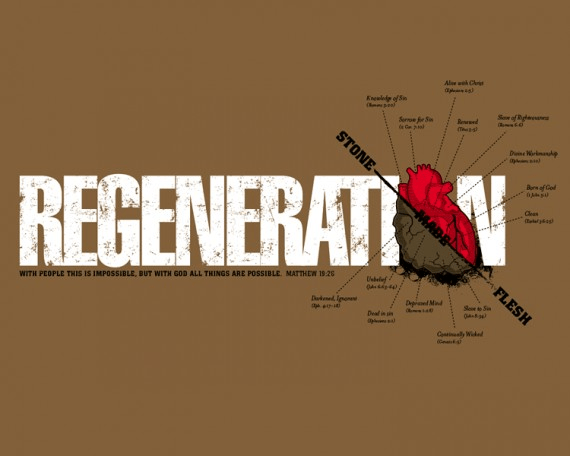
In regeneration, God places a new heart—together with a renewed will, affections, and desires—in the elect. This enables believers in Christ to repent of sin, trust in Christ as Savior and Lord, and live in a manner pleasing to Him. Regeneration is, therefore, one of the saving benefits of redemption purchased by Christ and applied to the elect by the Holy Spirit. In the Old Testament (OT), the Prophet Ezekiel illustrated regeneration God replacing the sinner’s heart of stone into a heart of flesh (Ezekiel 36:25-27). The prophet also described regeneration by the vision of the dry bones (Ezekiel 37:1-14).
“The sense of the entire passage (verses 5–10) can be summarized as follows: “Do not be deceived by the enemies of the faith who are trying, by means of an attack on our integrity, to undermine your faith and your assurance of salvation. Our behavior among you was proof of our integrity and of the reliability of our message. Your own joyful acceptance of the gospel which we preached, so that you began to spread the news everywhere, and turned away from those idols of yours to serve the living God and to await his Son from heaven, clearly indicate that what happened (and is happening) in Thessalonica was (is) wrought by the Holy Spirit and was (is) the fruit of election. Any doubt about the genuine character of your faith was removed by Timothy (See I Thess. 3:5.) So, continue steadfastly,” comments Dr. William Hendriksen.
The Spirit regenerates. How often have the clear words of Jesus been misunderstood! People universally re-write ‘You must be born again’ so that the phrase reads instead, ‘You must born yourself again!’ Not only does this mis-interpretation make no sense grammatically (an intransitive verb has no object); it makes nonsense of a profound spiritual truth. Just as you did nothing to cause yourself to be born into this fallen world, so you can do absolutely nothing to bring yourself into the divinely renewed world of redemption. You must be born ‘of the Spirit’ (John 3:5, 8). You cannot even coerce the Spirit of God to effect your regeneration. The wind blows where it will — and it is the Spirit’s will, not yours, that causes a person to be born from above (John 3:3). Indeed, if your will is renewed by the regeneration of the Spirit, you will choose to cry out to God for salvation, just as the newborn baby cries out once born. But give the divine Spirit the glory He deserves! Your cry for salvation comes as a consequence of your new birth, and never could be the cause of regeneration. The Spirit Himself sovereignly does this great work of total renewal.
May the Lord’s truth and grace be found here. Have a blessed day in the Lord.
4 For we know, brothers loved by God, that he has chosen you, 5 because our gospel came to you not only in word, but also in power and in the Holy Spirit and with full conviction.” (1 Thessalonians 1:4–5a (ESV)
How did the Apostle Paul know God had chosen the Thessalonian believers unto salvation? How could he be so certain? How can believers in Christ today know God has chosen them? How can we be certain God has truly saved our souls?
The Apostle Paul knew God had chosen the Thessalonians because of four indisputable factors. (1) The word of the gospel had been preached; (2) The preaching came with power; (3) The power was from the Holy Spirit; and (4) The Holy Spirit brought full conviction. Let’s examine each of these factors individually.
First, the Apostle Paul, Silas and Timothy preached the word of the gospel to the Thessalonians. The word gospel (εὐαγγέλιον; euangelion) means good news or good tidings. In the New Testament (NT), the gospel specifically refers to four truths: (1) God exists; (2) Sin exists; (3) Salvation from sin’s penalty, power and eventual presence exists; and (4) One Savior exists and this is Jesus Christ (John 1:1-18).
The gospel is individually applied to the sinner by God’s sovereign grace alone, through God given faith alone, through the person and work of Jesus Christ alone (Rom. 3:21-26; Eph. 2:1-10). This is the good news that came to the Thessalonians.
“Paul identifies the Thessalonians as elect because they showed conviction by believing the gospel. They placed their faith in Christ when the good news was preached to them. Paul’s observation regarding belief and election confirms Jesus’ own words, when He said that all whom the Father has given to Him will certainly come to Him and will never be cast out (John 6:37). Our faith is the instrument or means by which we cling to Christ for salvation, but it also reveals our eternal election,” explains Dr. R. C. Sproul.
Second, Paul wrote that the gospel came to the Thessalonians not just in word (λόγῳ; logos) or speech, but also in supernatural power (δυνάμει; dynamei). The supernatural power was from God; specifically, the Holy Spirit. The Thessalonians became changed people. The Holy Spirit changed them (John 3:1-8; Titus 3:1-5). Here is what the Apostle Paul says elsewhere about the power of the gospel and the Holy Spirit.
16 For I am not ashamed of the gospel, for it is the power of God for salvation to everyone who believes, to the Jew first and also to the Greek. 17 For in it the righteousness of God is revealed from faith for faith, as it is written, “The righteous shall live by faith.” (Romans 1:16–17 (ESV)
18 For the word of the cross is folly to those who are perishing, but to us who are being saved it is the power of God. 19 For it is written, “I will destroy the wisdom of the wise, and the discernment of the discerning I will thwart.” 20 Where is the one who is wise? Where is the scribe? Where is the debater of this age? Has not God made foolish the wisdom of the world? 21 For since, in the wisdom of God, the world did not know God through wisdom, it pleased God through the folly of what we preach to save those who believe.” (1 Corinthians 1:18–21 (ESV)
“And I, when I came to you, brothers, did not come proclaiming to you the testimony of God with lofty speech or wisdom. 2 For I decided to know nothing among you except Jesus Christ and him crucified. 3 And I was with you in weakness and in fear and much trembling, 4 and my speech and my message were not in plausible words of wisdom, but in demonstration of the Spirit and of power, 5 so that your faith might not rest in the wisdom of men but in the power of God.” (1 Corinthians 2:1–5 (ESV)
“Paul says he knows the Thessalonians have been chosen by God also because the gospel came to them “in power and in the Holy Spirit” (1 Thess. 1:5). It is possible that Paul is speaking of miracles that accompanied his preaching, but the account of the Thessalonians’ conversion in Acts 17:1–9 does not talk about any supernatural signs or wonders when Paul preached in Thessalonica. More likely, then, the work of power and the Holy Spirit of which Paul speaks is the power of the Spirit to release men and women from bondage to sin and generate in them a new pattern of living in obedience to Jesus,” continues Dr. Sproul.
I am an individual the Holy spirit released from bondage to sin. He alone regenerated me through the preaching of the gospel enabling me to repent of sin and trust, commit, depend and worship Jesus Christ as Savior and Lord. Since that moment of conversion, the Holy Spirit continues to conform me to the image of the Savior (Romans 8:1-17; 29-30). What about you?
“Certainly, this is how Paul expects the Spirit to work in the lives of believers—not primarily in extraordinary signs but in the putting to death of sin and the creation and cultivation of spiritual fruit such as love, joy, peace, patience, kindness, goodness, faithfulness, gentleness, and self-control (Gal. 5:22–24). If we believe in the biblical Christ and have a measure of fruit, no matter how meager it may seem, then we can be sure we are among God’s elect,” concludes Dr. Sproul.
May the Lord’s truth and grace be found here. Have a blessed day in the Lord.
“Masters, treat your bondservants justly and fairly, knowing that you also have a Master in heaven.” (Colossians 4:1 (ESV)
Continuing our study in Paul’s Epistle to the Colossians, a new paragraph begins in Colossians 3:18-4:1. The truth of what believers “are” in Christ is to be balanced by how believers are to live for Christ. The practical truth of Jesus Christ as the only and all-sufficient Savior, and as Lord of the believers’ life, is now applied to specific groups and situations. What people groups does the Apostle Paul, and the Holy Spirit, have in mind?
To begin with, Paul addressed wives and husbands (Col. 3:18-19). He then wrote of parents and their children (Col. 3:20-22). Thirdly, Paul considered the Christian responsibility of work (Col. 3:23-4:1).
The protestant work ethic arising from the 16th century Reformation stressed the equality of work. No one was to assume their labor was any more important than someone else’s. All work contributed to the value and improvement of society. Today’s text from the Apostle Paul’s letter to the Colossian church supports this concept.
“Martin Luther stressed that vocation is not first about what we do. Rather, it is about what God does through us. God gives us this day our daily bread through the vocation of farmers, millers, bakers, and—we would add—the factory workers, truck drivers, grocery store employees, and the hands that prepared our meal,” explains Gene Edward Veith.
“God creates and cares for new life by means of the vocations of mother and father, husband and wife. He protects us by means of police officers, judges, the military, and other Romans 13 vocations of those who “bear the sword.” God brings healing not primarily through miracles but through the vocation of doctors, nurses, pharmacists, and the other medical vocations. God teaches through teachers, conveys His Word through preachers, gives the blessings of technology through engineers, and creates beauty through artists. God works through all the people who do things for us, day by day. And He also works through us, in whatever tasks, offices, and relationships He has called us to do.”
Following his instruction to Christian workers, or slaves in the historical context, Paul drew his attention to masters. Matters, or employers, are to treat their bondservants (δούλοις; doulois) or slaves justly (δίκαιον; dikaion) and fairly (ἰσότητα; isoteta). Justly means to be righteous. Fairly refers to equality. In other words, employers are to be fair and equal towards their employees.
The master’s motivation for such ethical behavior is the Lord. He is the master’s Master.
“The masters must remember that they, too, have a Master. The commended centurion understood this (Matt. 8:5–13, see especially verse 9). The unmerciful servant of the parable related in Matt. 18:23–35 did not. Let the masters then realize that just as their slaves are accountable to them, so they, in turn, will have to answer to the Master in heaven,” states Dr. William Hendriksen.
“If they understand this, they will not treat their slaves harshly. They will “forbear threatening” (Eph. 6:9), and will, instead, show the same consideration to their servants as they themselves expect to receive from the One who exercises authority over them. What we have here, therefore, is an application of the Golden Rule (Matt. 7:12) to the master-slave relationship.”
“The summary of admonitions addressed to separate groups ends, accordingly, with the mention of the all-sufficient, pre-eminent Master, even “the Lord Christ” (cf. 4:1 and 3:24), for it is he who is the source of the believers’ life, the One who is ever ready to enable every believer, to whatever group he belongs, to live to the glory of God.”
May the Lord’s truth and grace be found here. Have a blessed day in the Lord.
“For we know, brothers loved by God, that he has chosen you.” (1 Thessalonians 1:4 (ESV)
How does anyone know for sure if God has chosen them for salvation? In other words, how can we know if God elected us unto eternal life?
“Am I one of God’s elect, one of those chosen by the Lord to inherit eternal life? Many of us have asked that question at one time or another. Some of us have even agonized for months or years to answer the question,” asks one commentator.
“Without denying the real struggle that many people experience with this question, discovering the answer is not as hard as one might think. We know that we are among God’s elect if we believe the gospel and see that the Holy Spirit is at work in our lives.”
Those whom God choses are loved by Him. To be loved (ἠγαπημένοι; egapemenoi) means to be self-sacrificially loved with an unearned affection. This verb is a perfect, passive plural. This respectively means God’s love for sinners is a past completed action with continuing results, and it is a saving work God alone does on the sinners’ behalf.
The doctrine of election is not only found in I Thessalonians 1:4, but also throughout the Scriptures. Particular focus on this important doctrine is taken today from the Apostle Pauli’s epistles. The following summary is by New Testament scholar Dr. William Hendriksen (1900-1982).
The noun election also occurs in the following passages of Paul’s epistles: Rom. 9:11; 11:5, 7, 28 (cf. 2 Peter 1:10).
The apostle, who was himself an “elect vessel” (Acts 9:15), dwells on the theme of sovereign election in such passages as the following (in addition to those already mentioned): Rom. 8:33; 11:29; 16:13; 1 Cor. 1:27, 28; Eph. 1:4–6; Col. 3:12–17; 2 Tim. 2:10, 19; Titus 1:1. There are several additional passages which, though not containing the word elect, are of value for the study of this subject; e.g., Rom. 8:28–30; 1 Cor. 4:7; Eph. 2:8; Phil. 4:3.
On the basis of all these passages, Paul’s teaching on election can be summarized as follows:
(1) It (election) is from eternity (Eph. 1:4, 5).
(2) It becomes evident in life (1 Thess. 1:4). This does not mean that anyone has the right to assign his neighbor to hell or to call him a reprobate: God sees the heart; we do not. Also, we are not infallibly inspired, as Paul’s teaching was. There may be a death-bed conversion.
(3) It is sovereign and unconditional; that is, it is not conditioned on foreseen works or foreseen faith (1 Cor. 1:27, 28; 4:7; Eph. 1:4; 2:8). See also Canons of Dort, I, ix, x.
(4) It is just (Rom. 9:14, 15).
(5) It is not limited to Gentiles; in every age a remnant of the Jews is also included (Rom. 11:5).
(6) It is immutable and effectual; the elect actually reach heaven at last. They obtain salvation (Rom. 11:7). God’s “chain” cannot be broken (Rom. 8:28–30; cf. 11:29; 2 Tim. 2:19).
(7) It affects life in all its phases, is not abstract. Although election belongs to God’s decree from eternity, it becomes a dynamic force in the hearts and lives of God’s children. That is clearly also the meaning here in 1 Thess. 1:4; see verses 5–10. It produces such fruits as adoption as sons, calling, faith, justification, etc. (Rom. 8:28–30, 33; Eph. 1:4, 5; Titus 1:1). The proposition: “If a man has been elected, he will be saved regardless of how he lives (e.g., whether or not he believes in Christ, whether or not he gives evidence of possessing the fruits of the Holy Spirit),” is wicked and absurd. No true and sane believer of any denomination, whether he be Methodist, Baptist, Calvinist, Lutheran, or whether he belongs to any other denomination or religious group, will ever subscribe to it. Everyone should read and reread the beautiful description of the truly elect person which is found in Col. 3:12–17.
(9) It comprehends these individuals “in Christ,” so that they are definitely viewed as one body (Eph. 1:4; 2 Tim. 2:10).
(10) It is an election not only unto salvation but definitely also (as a link in the chain) unto service (Col. 3:12–17; cf. Acts 9:15, 16).
(11) It is taught not only by Paul, but also by Jesus himself. See N.T.C. on John 6:39; 10:11, 14, 28; 17:2, 9, 11, 24.
(12) It has as its final aim God’s glory, and it is the work of his delight (Eph. 1:4–6).
The elect are called “brothers beloved by God.” Paul loves the designation brothers, using it again and again (1 Thess. 1:4; 2:1, 9, 14, 17; 3:7; 4:1, 10, 13; 5:1, 4, 12, 14, 25, 26, 27; 2 Thess. 1:3; 2:1, 13, 15; 3:1, 6, 13; and many times in the other epistles). In the present instance he adds the beautiful description “beloved of God” (cf. 2 Thess. 2:13; further also Rom. 1:7; 11:28; 12:19; 16:8, 9, 12; 1 Cor. 4:14, 17, etc.).
Because of its combination with the word “of God” it would seem probable that the deepest and fullest sense must be ascribed to the participle (pl. mascul., perfect passive) beloved. See N.T.C. on John 21:15–17. This love of God extends backward to eternity, as the preceding context clearly implies. It also extends forward and is still continuing (as is implied in the tense of the participle). No one can ever separate believers from the love of God in Christ. Moreover, as the parallel passages indicate, God’s beloved ones are also Paul’s (and Silas’ and Timothy’s) beloved ones.
May we praise the LORD for His sovereign love by which He chose us in Christ unto eternal life. May the Lord’s truth and grace be found here. Have a blessed day in the Lord.
“For we know, brothers loved by God, that he has chosen you.” (1 Thessalonians 1:4 (ESV)
I received Jesus Christ as my Savior and Lord in October, 1974. That Sunday evening event occurred after two years of hearing the Gospel from co-workers and friends throughout high school and college. My decision to receive Christ that evening was precipitated by a statement the pastor, who eventually became a dear friend and mentor, made from the pulpit. He said, “If you were to die tonight, where would you spend eternity: heaven or hell?”
That comment rocked my mind, emotions and will. In other words, my soul. When I arrived back at my parent’s home, I tried to go to sleep in my room, but sleep wouldn’t come. I finally got up, knelt beside my bed and asked Jesus to forgive me of my sins, and save my soul. I prayed that prayer several times, in order to be certain, the Lord heard me.
He certainly answered my prayer. God filled me with an incredible peace and I went sound to sleep with the joy of the Lord. I came to know someone who loved me enough to die on the cross for me.
In my testimony of conversion, look at the personal pronouns I used. They are predominately “I.” I received Christ. I arrived at my parent’s home. I tried to go to sleep. I finally got up from my bed. I knelt beside my bed. I prayed. I came to know.
Little did I know and understand what occurred that evening in my upstairs bedroom, God had determined before He created the world (Eph. 1:4). This is because He chose me by grace alone, through faith alone, in the person and work of Jesus Christ alone to become His child before the foundations of the world.
The late Dr. R. C. Sproul became an impactful Bible teacher in my life. Through his radio ministry Renewing Your Mind, his many books, and the Ligonier National Conferences, God used him to help me grow in the grace and knowledge of the Lord Jesus Christ (2 Peter 3:18).
One statement, of many Dr. Sproul made, resonates with me to this day. It impacts every blog I write, every sermon I preach and every Bible lesson I teach. I remind myself of it every day. He wrote the following:
YOU ARE REQUIRED TO BELIEVE, TO PREACH, AND TO TEACH WHAT THE BIBLE SAYS IS TRUE, NOT WHAT YOU WANT THE BIBLE TO SAY IS TRUE.
Of all the doctrines contained in the Scriptures, the one arguably generating the most debate within the church is the doctrine of election, and its complimentary terms “chosen” and “predestination.” One of the reasons I not only accept, but also love this biblical doctrine, is because humans would never have originated such a dogma. It is counterintuitive to our thinking. It also infuriates many believers in Christ with the notion of it not being fair and God perceived as capricious or impulsive.
“Am I one of God’s elect, one of those chosen by the Lord to inherit eternal life? Many of us have asked that question at one time or another. Some of us have even agonized for months or years to answer the question. Some of us may even be asking this question as we read this daily study,” explains one commentator.
“Without denying the real struggle that many people experience with this question, discovering the answer is not as hard as one might think. We know that we are among God’s elect if we believe the gospel and see that the Holy Spirit is at work in our lives.”
The reason Paul knew God had chosen the Thessalonians unto salvation was because of their work of faith, labor of love and steadfastness of hope in the Lord Jesus Christ (I Thess. 1:3). Their faith, love and hope in Jesus was evidence of their election (Eph. 2:8-10; James 2:14-26) and not the means unto election. Salvation is always by God’s sovereign grace alone, through God-given faith alone, in the person and work of Jesus Christ alone.
“Divine election is a theme of both Thessalonian epistles (I Thess. 5:9; 2 Thess. 2:13). Paul is not afraid to assure this young, predominately Gentile congregation that they were elected by God. Paul sees in them the fruit of God’s electing grace, manifested in their response to the preaching of the gospel and their early progress in sanctification,” explains Dr. Sproul.
The word “chosen” (ἐκλογὴν; eklogen) is actually a noun phrase in the Greek. It can be translated “chosen ones.” Believers are the chosen ones solely of God. God’s choice of saving the elect originated within Himself and was not prompted by any foreseen act by anyone other than God Himself.
“In the final analysis, the reason for the joy and gratitude which fill the hearts of the missionaries is the fact that they know that (speaking by and large) the members of the Thessalonian church are God’s chosen ones. Paul, Silas, and Timothy actually know this. They know (knowing εἰδοτες, is the participle used) it because the facts speak so clearly that the conclusion is inevitable, direct, immediate,” states Dr. William Hendriksen.
“This passage is a most forceful repudiation of the position of those who say that one can never really know whether he or whether anybody else is included in God’s eternal decree of election. The missionaries had become acquainted with the readers in the recent past. After a very brief stay among them, they had been forced to move on. Nevertheless, they do not hesitate to state, “The ultimate reason why thanksgiving fills our hearts is that we know that you were chosen (from eternity).”
John Calvin comments, “The election of God, which is in itself hid, is manifested by its marks—when he gathers to himself the lost sheep and joins them to his flock, and holds out his hand to those that were wandering and estranged from him.”
All who believe the gospel of Jesus Christ and show evidence of spiritual life can be assured God has chosen for unto salvation and they will inherit eternal life.
May the Lord’s truth and grace be found here. Have a blessed day in the Lord.





 His Word Today