Titus: Avoid Foolish Controversies.

“But avoid foolish controversies, genealogies, dissensions, and quarrels about the law, for they are unprofitable and worthless.” (Titus 3:9 (ESV)

A pastor’s responsibilities in a local church are multi-faceted and never ending. They extend beyond the normal work hours of 9-5. They include also stressful problems and controversies. The pastor needs wisdom from the Lord to navigate these stormy ecclesiastical seas (James 1:5).

The Apostle Paul’s warning to Titus involved the false teachers of which the apostle spoke of in Titus 1:1-16. Paul did not want Titus to become bogged down in nonsensical issues that could prevent him from performing his duties as a pastor.

Foolish controversies (μωρός ζήτησις; moros zetesis) refers to moronic disputes. In others words, nonsense. These are subjects that make no sense for the pastor to become involved and to devote any significant time or energy.

Genealogies (γενεαλογία; genealogia) addressed one’s ancestry. Perhaps this would include an individual assuming church leadership because his family helped plant the church. Or, it might be an individual who placed great status upon themselves because they were a charter member of the church.

Dissensions (ἔρις; eris) are contentions. It is conflict resulting from rivalry and discord.

Quarrels (μάχη; mache) are disputes and fights. These are serious conflicts, which may become physically violent. They are intense and bitter.

“This is in strong contrast with the preceding: Titus must do the one, but avoid the other. The order of the words in the sentence (the compound object placed before the verb) and the absence of the article before any of the four nouns, these facts clearly prove that all possible emphasis is placed on the quality and contents of the object. It is exactly foolish inquiries, namely, investigations into genealogical lore, that must be avoided. It is precisely wrangling, namely, skirmishes about the law, that must be given a wide berth. See also on Titus 1:9, 10, 14.[1]

“The matters referred to have been described in detail in connection with 1 Tim. 1:3–7, 19, 20 and 1 Tim. 6:3–5 (see on these passages). Let Titus then shun (cf. 2 Tim. 2:16) the Jewish legends and the stipulations, the inquiries and the wrangling. When he sees them coming, let him turn around and flee! Let him see these things for what they truly are: unprofitable, futile. What a sharp contrast between all this useless nonsense and the very useful matters about which Paul has just spoken in verses 4–7 (see also verse 8). A minister who does justice to the latter will have no time for the former.”[2]

I recall attending a Christian men’s conference several years ago in a major American city. There were protestors who gathered outside the venue in order to stir up controversy. They also sought to confront several of the attendees during a lunch break. The best tactic of engagement in such situations is to not engage. That is what the protestors want. Deny them that desire.

“Genealogies and details about the law (including arguments of Jewish legal scholars over spellings or vocalizations of Hebrew words) were minutiae that missed the genuinely critical issues in the spirit of the Old Testament (Titus 1:10; 1 Tim 1:6; 2 Tim 2:14),” explains biblical scholar Craig S. Keener.

“Paul returns to the false teachers in Titus 3:9. His admonition to avoid “foolish controversies, genealogies, dissensions, and quarrels about the law” is not only sound advice from the Word of God but also a parting shot at the falsehood of Titus’ opponents. These teachers were trying to stay connected to a perverted form of Judaism, speculating about minor figures in biblical genealogies, like Timothy’s Ephesian enemies (1 Tim. 1:3–4), to promote esoteric and erroneous doctrines. Our generation is not the first to encounter those who major on the minors or who embrace rank heresy, and it will not be the last. Dealing with such problems now, as in Paul’s day, means that we reject as church leaders those who prefer their own ideas to the faith once for all delivered to the saints (Jude 3),” explains Dr. R. C. Sproul.

Paul concluded all of these controversies are unprofitable and worthless. Unprofitable (ἀνωφελεῖς; anopheles) means to be without advantage and of no special benefit. The word worthless (μάταιοι; mataioi) refers to what is empty or fruitless.

It can be easy to become embroiled in foolish arguments with people who desire to major on the minors. It is wise to walk away from such people. I recently had to cease conversing with a friend on social media because of his argumentativeness.

To an angry individual on social media, one pastor wrote, “You are cordially invited to take your angry rants elsewhere. A response is self-evidently pointless. Bye . . .” See Matthew 7:6.

May the Lord’s struth and grace be found here. Have a blessed day in the Lord.

Soli deo Gloria!


[1] William Hendriksen and Simon J. Kistemaker, Exposition of the Pastoral Epistles, vol. 4, New Testament Commentary (Grand Rapids: Baker Book House, 1953–2001), 394.

[2] Ibid., 394–395.

Titus: Devoted to Good Works.

“The saying is trustworthy, and I want you to insist on these things, so that those who have believed in God may be careful to devote themselves to good works. These things are excellent and profitable for people.” (Titus 3:8 (ESV)

Today’s text refers us back to Titus 3:3-7. God has provided salvation to sinners by grace alone, through faith alone, and in the person and work of Jesus Christ alone. The Apostle Paul insists this gospel of deliverance from sin’s penalty, power and eventual presence is a trustworthy message.

Trustworthy (πιστός; pistos) is a saying which is reliable, faithful and believable. It is the truth; worthy of a commitment to, a dependence upon and a worship of God. Paul wanted (βούλομαι; boulomai) and desired Titus to insist (διαβεβαιόομαι; diabebaioomai) and state with confidence this truth of the Gospel of God’s grace and mercy.

The apostle’s purpose in writing this was so believers in Christ would be presently and actively careful (φροντίζω; phrontizo) to think about devoting themselves to good works. Paul spoke of this in 3:1. This insistence on godliness is evidence an individual is truly converted and has a knowledge of the truth (Titus 1:1). Believers in Christ are not saved by their good works, but display saving faith by their good works (James 2:14-26).

Doing things which are not only praiseworthy to God, but also for people, is excellent and profitable. Excellent (καλός; kalos) means good while profitable (ὠφέλιμος; ophelimos) refers to being advantageous, beneficial and useful.

“Chapter 3 of Titus began with a call for believers to “be ready for every good work” and “to show perfect courtesy for all people,” (vv. 1–2), and Paul returns to this admonition in today’s passage after providing the theological basis for his charge. Lest any of us think that it is proper to serve only those who are “worthy,” God’s willingness to redeem us when we were foolish and hateful means that we must likewise seek the best even for our enemies if we are to be imitators of Him (vv. 3–7). Sound theology, then, is not merely a collection of abstract truths about our Creator but also a ground and motivation for fulfilling the call of Jesus that we serve one another (John 13:1–17),” explains Dr. R. C. Sproul.

“This, then (that is, verses 4–7), was the last of the five great “sayings.” See on 1 Tim. 1:15 for the meaning of the introductory formula, “Reliable is the saying.” It is about these matters—namely, a. the kindness of the Father and his love toward man; b. the work of the Holy Spirit in regenerating and renewing man; c. the grace of Jesus Christ considered as the effective cause of our justification; and d. the purpose of all this: that we might become what we are today, heirs-in-hope of life everlasting—that Paul wants Titus to speak with confidence. Others, to be sure, speak with confidence about frivolous matters; matters, moreover, about which they know nothing.” [1]

“Let Titus then stress those matters of which he has become firmly and rightfully convinced, the purpose being that those who have their faith fixed on God (note perfect participle, indicating both the past action and the present abiding result) may be careful to apply themselves to noble deeds. They should concentrate their thought on such deeds of gratitude, applying themselves with diligence to their performance, and making this their chief business. These matters—that is, the things just mentioned: the kindness of the Father, the work of the Holy Spirit, etc.—are excellent and beneficial for (all) people. Not only are these things excellent in themselves, but they are also beneficial (useful, profitable; see on 1 Tim. 4:8; 2 Tim. 3:16; also, in classical Greek and in the papyri). Moreover, when appropriated by faith, they benefit men in general, not this or that particular class. They bring life, light, joy, and peace where before there was death, darkness, sadness, and fear.[2]

On the basis of the Gospel, what excellent and profitable work is before you today? Whatever it may be, do is with your whole heart (Col. 3:23-24). Have a blessed day in the Lord.

Soli deo Gloria!


[1] William Hendriksen and Simon J. Kistemaker, Exposition of the Pastoral Epistles, vol. 4, New Testament Commentary (Grand Rapids: Baker Book House, 1953–2001), 393–394.

[2] Ibid., 394.

Titus: Richly Poured Out Upon Us.

3 “For we ourselves were once foolish, disobedient, led astray, slaves to various passions and pleasures, passing our days in malice and envy, hated by others and hating one another. 4 But when the goodness and loving kindness of God our Savior appeared, 5 he saved us, not because of works done by us in righteousness, but according to his own mercy, by the washing of regeneration and renewal of the Holy Spirit, 6 whom he poured out on us richly through Jesus Christ our Savior, 7 so that being justified by his grace we might become heirs according to the hope of eternal life.” (Titus 3:3-7 ESV)

Titus 3:6-7 continues the instructions the Apostle Paul began in 3:3-5. In stating the Holy Spirit is the source of regeneration, or the new birth (John 3:1-8), Paul further explains what God the Father did through the Holy Spirit on the basis of the completed work of Jesus Christ. This section is an excellent treatise regarding the Trinity.

To begin with, Paul describes God the Father pouring out the Holy Spirit. The word poured (ἐκχέω; ekcheō) means to shed or to pour out like a liquid. This was a rich pouring. Richly (πλουσίως; plousiōs) means lavishly and abundantly. God has blessed believers beyond measure (Acts 2:38–39; 1 Cor. 12:7, 11, 13; Eph. 3:20; 5:18).

The ministry of the Holy Spirit is contingent upon the person and work of Jesus Christ. The earthly ministry of Christ was the prerequisite for the New Testament ministry of the Holy Spirit. It is because of the justifying grace of God that believers in Christ are heirs (Romans 8:16-17; Galatians 3:29; I Peter 1:3-5). This status in Christ provides believers with confidence before God in their anticipation of eternal life in Christ.

Being justified (δικαιωθέντες; dikaiothentes) is an aorist passive plural verb. It refers to God the Father declaring the repentance sinner righteous on the basis of the perfect righteousness of Christ. It refers to the guilt of our sin being satisfied by the substitutionary atonement of the Lord Jesus on the cross.

Romans 5:1 (ESV) says, “Therefore, since we have been justified by faith, we have peace with God through our Lord Jesus Christ.”  

“The central truth of salvation is justification by faith alone. When a sinner repents and places his faith in Jesus Christ, God declares him just, imputes the righteousness of Christ to him, and gives him eternal life by virtue of the substitutionary death of Christ as the penalty for that sinner’s iniquity (Rom. 3:21–5:21; Gal. 3:6–22; Phil. 3:8–9). As adopted children of God through faith in Jesus Christ, believers become “heirs of God and fellow heirs with Christ” (Rom. 8:17; cf. 1 Pet. 1:3–4),” explains Dr. John MacArthur.

God’s justifying work is on the basis on His sovereign grace alone, through God-given faith alone in the person and work of Jesus Christ alone. It is because of God’s unmerited favor towards sinners they become heirs according to the hope of eternal life.” 

“The purpose, then, of the work of God in saving us is “that … we might become heirs … of life everlasting”; that is, that even now in this present life we might have the right as children to look forward to the full possession of that which we now possess only in principle. When that future day arrives, we shall rejoice in the richest possible (because sinless!) fellowship with God in Christ (John 3:16; 17:3), basking in the sunshine of his love (John 5:42) and partaking, to the fullest extent possible for man, of his joy and glory (John 17:13). That life differs, accordingly, in essence from the “life”(?) of the unbeliever, and in degree even from the life of the believer here below. It is, moreover, actually ever-lasting, that is, never-ending. Of that life as it is in principle we are now the possessors; and of that life as it will be in perfection we are even now the heirs, but heirs-in-hope, hoping heirs. But this hope will certainly be realized (Rom. 5:5).”[1]

Take the opportunity today to thank God for the indwelling presence of the Holy Spirit in your life (Rom. 8:9). Have a blessed day in the LORD.

Soli deo Gloria!


[1] William Hendriksen and Simon J. Kistemaker, Exposition of the Pastoral Epistles, vol. 4, New Testament Commentary (Grand Rapids: Baker Book House, 1953–2001), 393.

Titus: The Washing of Regeneration.  

4 “But when the goodness and loving kindness of God our Savior appeared, 5 he saved us, not because of works done by us in righteousness, but according to his own mercy, by the washing of regeneration and renewal of the Holy Spirit,” (Titus 3:4-5 ESV).

The Apostle Paul explained to Titus that while our sins are sufficient to condemn us, our works of righteousness are not sufficient to save us from God’s judgment. Salvation from sin’s penalty, power and eventual presence is based upon God’s sovereign grace alone, through God given faith alone in the person and work of Jesus Christ alone. It is not based on human effort.

The appearance of God our Savior’s goodness and loving kindness was to save sinners. God has personally saved us. This salvation is not based upon “any” works of righteousness sinners could ever hope to accomplish (Isaiah 64:6). The instrumental means by which God converts sinners unto salvation is the person and work of the Holy Spirit.

What does the phrase the washing of regeneration mean? Washing (λουτρόν; loutron) means bathing or spiritual purification. Coupled with the word regeneration (παλιγγενεσία; palingenesia) it refers to the new birth. It means to be born again (John 3:1-8).

“The term regeneration as applied to individuals occurs only in this one New Testament passage. (Matt. 19:28 has reference to the cosmic regeneration.) Literally it means new birth, the being born again (palin = again, plus genesia = birth; hence, palin-genesia). But though the word occurs only this once, the idea is found in many other passages (John 1:13; 3:3, 5–8; 1 Peter 1:23; 1 John 2:29; 3:9; 4:7; 5:1, 4, 18; cf. also 2 Cor. 5:17; Gal. 6:15; Eph. 2:5; 4:24; and Col. 2:13). I know of no better definition than that which is given by L. Berkhof, namely, “Regeneration is that act of God by which the principle of the new life is implanted in man, the governing disposition of the soul is made holy, and the first holy exercise of this new disposition is secured.”[1]

“Salvation brings divine cleansing from sin and the gift of a new, Spirit-generated, Spirit-empowered, and Spirit-protected life as God’s own children and heirs (Titus 3:7). This is the new birth (cf. John 3:5; 1 John 2:29; 3:9; 4:7; 5:1).  Cf. Rom. 8:2. The Holy Spirit is the agent of the “washing of regeneration,” explains Dr. John MacArthur. See Ezek. 36:25–31; Eph. 5:26–27; James 1:18; 1 Pet. 1:23.

“By His Spirit God removes our hearts of stone and replaces them with hearts of flesh enabled to trust in His Son and be justified through faith alone, setting us right in the eyes of our Creator (Gal. 2:15–16). But the Holy Spirit in bringing us to faith does not only effect a change in our status before God from that of a condemned sinner to that of a person clothed in Jesus’ righteousness, He also brings inward renewal, empowering us to do good in gratitude for the great salvation bestowed on us (Rom. 7:4–6; Heb. 12:28),” states Dr. R. C. Sproul.

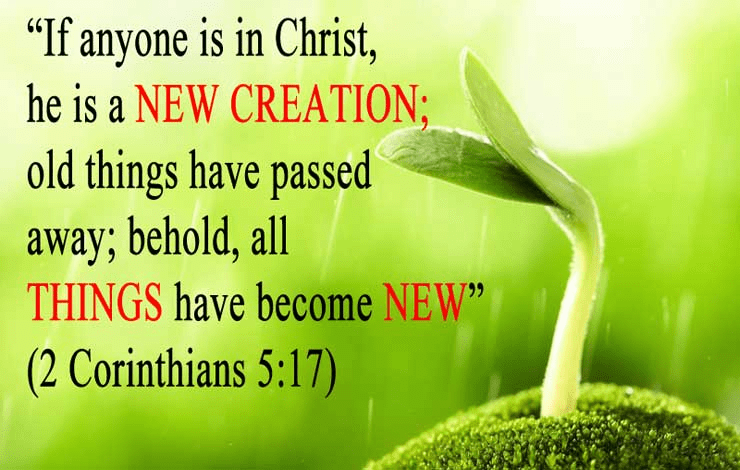
The word renewal (ἀνακαίνωσις; anakainosis) means to cause something to become new, different, or superior. The sinner becomes a new creation in Christ (2 Cor. 5:17). The renewal continues through the process of spiritual sanctification (Romans 12:1-2). The work of regeneration and renewal is done solely by the Holy Spirit.

“God in His grace saves those who believe, not because of any righteousness in them (cf. Rom. 3:21–24; Eph. 2:8–9; 2 Tim. 1:9), but because of His mercy. The three words, “kindness,” “love,” and “mercy” (Titus 3:4–5) all represent aspects of God’s grace. The dual means of grace through which He accomplished this salvation are (1) the rebirth spoken of as a washing from the filth of sin, and (2) the renewal by the Holy Spirit (cf. 2 Cor. 5:17). No mention is made here of the role of faith in the process because Paul’s entire focus was on what God has done, not on human response,” explains Dr. A. Duane Liftin.

“The present passage, in connection with its context, places emphasis on the following particulars in connection with this wonderful work of God:

(1) It is the work of the Holy Spirit. This stands to reason, for in Scripture it is especially the third person of the Trinity who is represented as the bestower of life; hence, also of spiritual life. Also, it is he, the Holy Spirit, who takes the lead, as it were, in the work of making men holy.

(2) It precedes and gives rise to the process of renewing. While the latter is a life-long activity, the former is a single act, an instantaneous change.

(3) It affects the entire man. Note: “he saved us.”

(4) It is a radical change, so that those who beforehand were loaded down with the seven vices mentioned in verse 3 are now in principle adorned with the seven virtues mentioned in the verses 1 and 2.”[2]

Thank the LORD today for your new birth by the Holy Spirit. May your regeneration, and subsequent renewal, by the Spirit be evident to all you meet today. Have a blessed day in the Lord.

Soli deo Gloria!


[1] William Hendriksen and Simon J. Kistemaker, Exposition of the Pastoral Epistles, vol. 4, New Testament Commentary (Grand Rapids: Baker Book House, 1953–2001), 391.

[2] Ibid.,391.

Titus: Saved by God’s Mercy.  

4 “But when the goodness and loving kindness of God our Savior appeared, 5 he saved us, not because of works done by us in righteousness, but according to his own mercy, by the washing of regeneration and renewal of the Holy Spirit,” (Titus 3:4-5 ESV).

Today’s text is a stark contrast to the condition of fallen sinners described in Titus 3:3: “For we ourselves were once foolish, disobedient, led astray, slaves to various passions and pleasures, passing our days in malice and envy, hated by others and hating one another.”

The Apostle Paul explained to Titus while our sins are sufficient to condemn us, our works of righteousness are not sufficient to save us from God’s judgment. Salvation from sin’s penalty, power and eventual presence is based upon God’s sovereign grace alone, through God given faith alone in the person and work of Jesus Christ alone. It is not based on human effort.

The appearance of God our Savior’s goodness and loving kindness was to save sinners. God has personally saved us. To save (σῴζω; sozo) means to deliver, rescue and heal. At a particular point in time, As is the case with every believer in Christ, God saved me from the penalty of sin, is saving me from the power of sin, and will eventually save me from the very presence of sin.

This salvation is not based upon “any” works of righteousness sinners could ever hope to accomplish. The Prophet Isaiah said, “We have all become like one who is unclean, and all our righteous deeds are like a polluted garment. We all fade like a leaf, and our iniquities, like the wind, take us away,” (Isaiah 64:6 ESV). 

“Salvation has never been by deeds, or works (Eph. 2:8–9; cf. Rom. 3:19–28) but according to his own mercy. Cf. Eph. 2:4; 1 Tim. 1:13; 1 Pet. 1:3; 2:10” explains Dr. John MacArthur.

Salvation from and of God is solely based upon His mercy. Mercy (ἔλεος; eleos) refers to God’s compassion and kindness in not giving sinners what they deserve; judgment and damnation. Salvation, in all aspects, is by grace alone, through faith alone in the person and work of Jesus Christ alone (Eph. 2:8-9; 2 Tim. 1:9).

“Paul’s exposition of the key elements of the gospel in Titus 3:3–8 is the theological foundation for why we should do good to all people, even those who are not particularly likeable (vv. 1–2). Just as our Creator manifested His grace in Christ while we were raising our fists in protest against His righteous rule (vv. 3–4), so too must we not wait for others to favor us before we serve them,” states Dr. R. C. Sproul.

“Not by (i.e., in consequence of, on the basis of; cf. Gal. 2:16) works which we ourselves had performed in a state of righteousness.” The implication is: there were no such works. Neither Paul nor anyone else had ever performed such a work, for before God and his holy law all—both Jews and pagans—are by nature “under sin” (Rom. 3:9). Hence, if men are ever to be saved at all, it can only be done “according to his (God’s) own mercy.” Note, not only are men saved of or by or on the basis of his mercy (all this, to be sure, is implied), but according to his mercy, the “wideness of God’s mercy” being the yardstick which determines the wideness of their salvation (cf. Eph. 1:7). God’s mercy (for which see on 1 Tim. 1:2) is his kindness and pity to those in need or in distress.”[1]

Not in Me.

[Verse 1]
No list of sins I have not done
No list of virtues I pursue
No list of those I am not like
Can earn myself a place with You
O God, be merciful to me
I am a sinner through and through
My only hope of righteousness
Is not in me, but only You.

[Verse 2]
No humble dress, no fervent prayer
No lifted hands, no tearful song
No recitation of the truth
Can justify a single wrong
My righteousness is Jesus’ life
My debt was paid by Jesus’ death
My weary load was borne by Him
And he alone can give me rest.

[Verse 3]
No separation from the world
No work I do, no gift I give
Can cleanse my conscience, cleanse my hands
I cannot cause my soul to live
But Jesus died and rose again
The power of death is overthrown
My God is merciful to me
And merciful in Christ alone.

My righteousness is Jesus’ life
My debt was paid by Jesus’ death
My weary load was borne by Him
And he alone can give me rest. –
Eric Schumacher; David L. Ward

May each of us God has saved take time today to praise Him for this wonderful gift of mercy. May each of us evidence this mercy to others. Have a blessed day in the Lord.

Soli deo Gloria!


[1] William Hendriksen and Simon J. Kistemaker, Exposition of the Pastoral Epistles, vol. 4, New Testament Commentary (Grand Rapids: Baker Book House, 1953–2001), 390–391.

Titus: The Goodness and Kindness of God.

4 “But when the goodness and loving kindness of God our Savior appeared, 5 he saved us, not because of works done by us in righteousness, but according to his own mercy, by the washing of regeneration and renewal of the Holy Spirit,” (Titus 3:4-5 ESV).

Today’s text is a stark contrast to the condition of fallen sinners the Apostle Paul described in Titus 3:3: “For we ourselves were once foolish, disobedient, led astray, slaves to various passions and pleasures, passing our days in malice and envy, hated by others and hating one another.”

The Apostle Paul explained to Titus that while our sins are sufficient to condemn us, our works of righteousness are not sufficient to save us from God’s judgment. Salvation from sin’s penalty, power and eventual presence is based upon God’s sovereign grace alone, through God given faith alone in the person and work of Jesus Christ alone. It is not based on human effort.

“But when the goodness and loving kindness of God our Savior appeared.” Titus 3:4 begins with a conjunction of contrast; But. What fallen sinners were is contrasted with what they have become. The basis for this change in status is the goodness and loving kindness of God our Savior.

Goodness (χρηστότης; chrēstotēs) is kindness, which is a manifestation of grace. Loving kindness (φιλανθρωπία; philanthrōpia) is a benevolent love for one’s fellow man. Both of these qualities are solely sourced in and from God the Father, our Savior.

Paul refers to God the Father as Savior in this text. In the Pastoral Epistles, Paul describes both God the Father and God the Son as Saviors for the elect (I Timothy 1:1; 2:3; 4:10; 2 Tim. 1:8-10; Titus 1:3-4; 2:10; 2:13; 3:4-6).

To appear (ἐπιφαίνω; epiphainō) is a past tense passive verb. It means to give light and understanding. It means to manifest and reveal something. In this context, what God manifested to fallen sinners was His goodness and loving kindness.

The appearance of God our Savior’s goodness and loving kindness was to save us sinners. God has personally saved us. To save (σῴζω; sozo) means to deliver, rescue and heal. At a particular point in time, God actively chose to deliver me from my sin; its penalty, power and eventual presence. As is the case with every believer in Christ, God saved me from the penalty of sin, is saving me from the power of sin, and will eventually save me from the very presence of sin.

Romans 3:21–26 (ESV) says, “21 But now the righteousness of God has been manifested apart from the law, although the Law and the Prophets bear witness to it— 22 the righteousness of God through faith in Jesus Christ for all who believe. For there is no distinction: 23 for all have sinned and fall short of the glory of God, 24 and are justified by his grace as a gift, through the redemption that is in Christ Jesus, 25 whom God put forward as a propitiation by his blood, to be received by faith. This was to show God’s righteousness, because in his divine forbearance he had passed over former sins. 26 It was to show his righteousness at the present time, so that he might be just and the justifier of the one who has faith in Jesus.”

Ephesians 2:4–7 (ESV)  – “4 But God, being rich in mercy, because of the great love with which he loved us, 5 even when we were dead in our trespasses, made us alive together with Christ—by grace you have been saved— 6 and raised us up with him and seated us with him in the heavenly places in Christ Jesus, 7 so that in the coming ages he might show the immeasurable riches of his grace in kindness toward us in Christ Jesus.”

“Titus 3:1–7 also reflects this principle of imitation, making the Creator’s benevolence toward us while we were hateful and undeserving the basis for the courtesy we are to show to the non-Christians around us. Against those who would try to argue that Titus and the other Pastoral Epistles (1 and 2 Timothy) are not Pauline, the concept of imitation in Titus 3 indicates that these letters come from the apostle. Moreover, it is a powerful reminder of the grace that our triune God has shown to us lest we forget what we were before Christ called us to Himself, rescuing us from our wandering,” Dr. R. C. Sproul explains.

“What a striking contrast, a double contrast, in fact! (1) Over against “man’s inhumanity to man” pictured in verse 3, is portrayed God’s benignity (a word used only by Paul: Rom. 2:4; 3:12; 11:22, etc.) and love for man (cf. Acts 28:2). And (2) upon the Stygian darkness of our past (verse 3) dawns dramatically the light of the Father’s kindliness and pity which brought us into the present state of grace. (Here again is that glorious epiphany mentioned earlier; see on Titus 2:11.)”[1]

May each of us God has saved take time today to praise Him for this wonderful gift of grace. Have a blessed day in the Lord.

Soli deo Gloria!


[1] William Hendriksen and Simon J. Kistemaker, Exposition of the Pastoral Epistles, vol. 4, New Testament Commentary (Grand Rapids: Baker Book House, 1953–2001), 389.

Titus: What Believers in Christ Were without Christ.

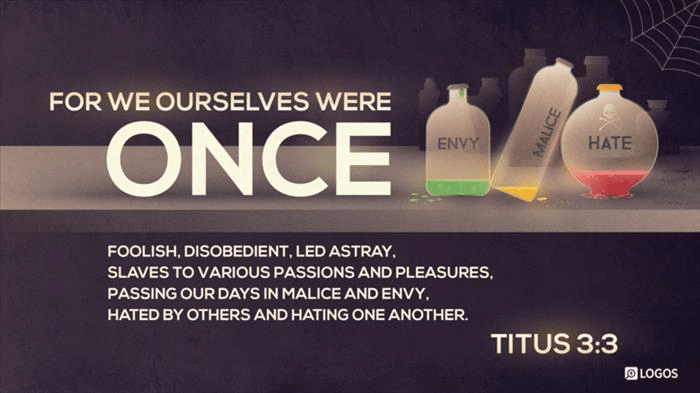
“For we ourselves were once foolish, disobedient, led astray, slaves to various passions and pleasures, passing our days in malice and envy, hated by others and hating one another.” (Titus 3:3 ESV)

“Some years ago, I heard someone say that we should preach the gospel to ourselves every day. Though I had already been doing that to some degree, the statement brought clarity and focus to my own practice, so I began using it in my ministry to others.” – Jerry Bridges, The Gospel for Real Life.

Believers in Christ should be thankful each day for God’s salvation to us from the penalty, power and eventual presence of our sin. Realizing this deliverance from sin is by grace alone, through faith alone in the person and work of Jesus Christ alone should make our gratitude even greater.

Often, we focus our attention on what the LORD has saved us for (Eph. 2:10). However, we must always remember what God has delivered us from. Today’s text from Titus has this as its focus.

I Corinthians 2:14 says, “The natural person does not accept the things of the Spirit of God, for they are folly to him, and he is not able to understand them because they are spiritually discerned.”

Ephesians 2:1–3 (ESV) says, “And you were dead in the trespasses and sins 2 in which you once walked, following the course of this world, following the prince of the power of the air, the spirit that is now at work in the sons of disobedience— 3 among whom we all once lived in the passions of our flesh, carrying out the desires of the flesh and the mind, and were by nature children of wrath, like the rest of mankind.”

The Apostle Paul explains that we ourselves were once foolish. He includes himself in this spiritual diagnosis. To be foolish (ἀνόητος; anoētos) refers to a lack of good sense or senselessness regarding the things of God (Gal. 1:3; 3:3; I Timothy 6:9).

This condition of foolishness results in disobedience to God. To be disobedient (ἀπειθής; apeithēs) means to not trust in, commit to, depend upon and worship Jesus Christ as Savior and Lord. This results in a lifestyle that is rebellious against God.

To be led astray (πλανάω; planaō) is a present passive participle meaning to be deceived and to wander from the ways of God.

To be a slave to various passions (δουλεύω; douleuō/ ἐπιθυμία; epithymia) means to presently and actively serve one’s lusts or desires. These are passions that bring willing enslavement (I John 2:15-17; Gal. 6:16-21). Pleasures (ἡδονή; hēdonē) refers to sensuous habits. The English word hedonism comes from this Greek word.

Malice (κακία; kakia) refers to a vicious disposition of wickedness. Envy (φθόνος; phthonos) means being jealous and holding a grudge.

Finally hatred (στυγητός; stygētos) is to be despicable, wicked, vile and loathsome. Hating (μισέω; miseō) is a present, active participle. It means to evidence one’s nature by one’s behavior.  

“It is not that every believer has committed every sin listed here, but rather that before salvation every life is characterized by such sins. That sobering truth should make believers humble in dealing with the unsaved, even those who are grossly immoral and ungodly. If it weren’t for God’s grace to his own, they would all be wicked (1 Pet. 3:15; cf. 2 Tim. 2:25; See Rom. 1:18–32; 1 Cor. 6:9–10; Gal. 5:19–21; Eph. 4:17–19),” states Dr. John MacArthur.

“Reflection upon our own former condition makes it easier for us to be mild and kind toward others. Note, “For at one time we also were …” We means: I, Paul, who write the letter; you, Titus, who receive it; and further, all believers in Crete, and in fact, all believers everywhere. Paul, too, had been a slave of sin. To be sure, he had been “zealous for the traditions,” but at the same time he had been “persecuting the church” (see on 1 Tim. 1:13; then Gal. 1:11–17). As to what Titus had been, read Gal. 2:2, 3.”[1]

“This merciful inclusion of oneself is very effective and appealing. It causes the reader (Titus) and the hearers (the Cretan believers when the letter is read to them) to feel that the writer is standing on common ground with them and understands them (cf. Titus 1:4; then 1 Thess. 5:9; Rev. 1:9). Moreover, the sharp contrast between what men were in their state of sin and what they have become since they entered the state of grace encourages gratitude to God; hence also goodwill toward the neighbor who was made in God’s image. (The vivid portrayal of this contrast is characteristic of Paul; see 1 Tim. 1:12–17; then Rom. 6:17–23; 1 Cor. 6:11; Eph. 2:2–13; 5:8; Col. 3:7; and cf. 1 Peter 4:3.).”[2]

Consider the particular sins of which the Lord has delivered, and is delivering, you. Pray that your behavior will display His delivering power. Have a blessed day in the Lord.

Soli deo Gloria!


[1] William Hendriksen and Simon J. Kistemaker, Exposition of the Pastoral Epistles, vol. 4, New Testament Commentary (Grand Rapids: Baker Book House, 1953–2001), 387.

[2] Ibid., 387.

Titus: What does Godliness Look Like?

“…to speak evil of no one, to avoid quarreling, to be gentle, and to show perfect courtesy toward all people.” (Titus 3:2 (ESV)

At the beginning of his letter to Titus, the Apostle Paul wrote, “Paul, a servant of God and an apostle of Jesus Christ, for the sake of the faith of God’s elect and their knowledge of the truth, which accords with godliness,” (1:1). Godliness is a consistent devotion to the Lord and His Word. Godliness is also a demonstration of devotion in one’s relationships with other individuals; believers and unbelievers.

What does godliness look like in everyday life? How is godliness evident in the believer’s life at home, school, work, and relationships? As previously noted, godliness involves being respectful and obedient, when possible, to government (Titus 3:1; Acts 5:27-32).

Godliness also involves the believer in Christ’s speech. Godly Christians are to speak evil of no one. To speak evil of no one (μηδείς βλασφημέω; medeis blasphemeo) means to “not” speak against someone in such a way as to harm or injure their reputation. It means to not revile and defame another person’s character. This involves not only our speech about other people but also our speech about God.

“Paul tells us that believers must “speak evil of no one” (3:2), which does not mean that we never publish the wickedness of others when it is appropriate to do so but rather that we not engage in slander. The Greek word the apostle uses is blasphēme_ō, which is the same verb used to describe the blasphemy of God. Basically, the apostle is telling us not to misuse the names of other people, whether by spreading falsehoods about them or by maligning their character,” explains Dr. R. C. Sproul.

Godliness also means to avoid quarreling (ἄμαχος; amachos), which refers to being peaceable and uncontentious. It refers to not seeking conflict. In other words, to not look for a fight.

Godly individuals are to be gentle (ἐπιεικής; epieikes). This is being gracious and yielding when appropriate. When possible, it means to be tolerant of other people.

Finally, godliness means to show perfect courtesy toward all people. This refers to being personally and consistently meek and mild. It means to not be harsh with other people.

“It stands to reason that believers should never revile any one (see on 1 Tim. 6:4). Not many believers will even need such a reminder. Insulting and abusive language is surely out of place for anyone, certainly for believers. A more stringent requirement is the one which demands that believers be not even contentious or quarrelsome (cf. 1 Tim. 3:3). But more than the absence of a vice is expected of them. A positive virtue must display itself in all their contacts with those outside the church: Christians must be genial (also 1 Tim. 3:3), that is, ready to yield personal advantage, eager to help the needy, kind to the weak, considerate toward the fallen, always filled with the spirit of sweet reasonableness. The climax is surely reached with the words: “showing all mildness (cf. 2 Tim. 2:25) toward all people.” Note the play on words, reflected also in the A.V. and A.R.V. renderings. Showing some mildness toward some people might not be so difficult. Nor showing all (that is, complete, thorough-going) mildness to some people, or some mildness to all people. But to show all mildness to all people, even to all those Cretan “liars, evil brutes, and lazy bellies,” was an assignment impossible of fulfilment apart from God’s special grace!”[1]

“Christians are to exemplify these godly virtues in their dealings with everyone. The admonition applies especially to dealings with unbelievers,” states Dr. John MacArthur.

Matthew Henry helpfully exhorts us: “If no good can be spoken, rather than speak evil unnecessarily, say nothing. We must never take pleasure in speaking ill of others, nor make the worst of anything, but the best that we can.”

How may you display these godly virtues today? Pray that the LORD will give you discernment in each relationship you have and with each person you meet. Have a godly day.  

Soli deo Gloria!


[1] William Hendriksen and Simon J. Kistemaker, Exposition of the Pastoral Epistles, vol. 4, New Testament Commentary (Grand Rapids: Baker Book House, 1953–2001), 386–387.

Titus: The Believer and the State.  

“Remind them to be submissive to rulers and authorities, to be obedient, to be ready for every good work,” (Titus 3:1 ESV).

“Jesus is Lord is an affirmation that is difficult for human beings to hear and truly believe. In confessing the lordship of Christ we are denying human autonomy, the idea that we are a law unto ourselves and are not subject to any higher authority. To bow the knee to Jesus is also to admit that no human government is absolute, that we will always follow our Savior’s demands when they are contrary to the demands of the state (Acts 5:27–29),” explains Dr. R. C. Sproul.

Believers in Christ do have a biblical responsibility to the state. God has created several social institutions. These include the family, labor, the church, community, the state, and the relationship between man and God. If believers in Christ are to be godly (Titus 1:1; 2:11-12), we need to have a biblical perspective toward the state; or government.

What is the state or government? In the broadest sense of the word, a government is the system to govern a state or community. The Cambridge Dictionary defines government as, “the system used for controlling a country, city, or group of people”, or “an organization that officially manages and controls a country or region, creating laws, collecting taxes, providing public services”.[ While all types of organizations have governance, the word government is often used more specifically to refer to the approximately 200 independent national governments on Earth, as well as their subsidiary organizations, such as state and provincial governments as well as local governments.

The word government derives from the Greek verb κυβερνάω [kubernáo] meaning to steer with a gubernaculum (rudder), the metaphorical sense being found in classical literature including Plato‘s Ship of State. In British English, “government” sometimes refers to what is also known as a “ministry” or an “administration“, i.e., the policies and government officials of a particular executive or governing coalition. Finally, government is also sometimes used in English as a synonym for rule or governance.

The Apostle Paul commanded Titus to do something. The command was to remind believers (ὑπομιμνῄσκω; hypomimnesko) to recall, to remember or to call to attention (John 14:26; 2 Tim. 2:14; Titus 3:1; 2 Peter 1:12; 3 John 10; Jude 5) their responsibilities toward the state.

To begin with, believers are to be submissive (ὑποτάσσω; hypotasso). This refers to being responsible to and responsible for government. It is to be obedient to the government’s delegated authority as long as government does not violate God’s Word. When the state disobeys God and mandates its citizens to do the same, the believer in Christ cannot comply (Acts 4:19-20; 5:27-29). 

Rulers (ἀρχή; arche) and authorities (ἐξουσία; exousia) are those who have the authority to govern. Yet, all authority comes from God and He alone sovereignly appoints people into government service (Daniel 2:20-23; Rom. 13:1-7).

Believers are to be obedient (πειθαρχέω; peitharcheo). This is a present, active and infinitive verb. This command includes the attitude of respect for those in government authority (I Tim. 2:1-2; I Peter 2:13-17).

Finally, believers are to be ready for every good work. This means to be prepared for all kinds of honorable tasks in the country we live. Christians are to be excellent citizens.

“During the present age, God establishes His kingdom as a society that must live within the kingdoms of this world. Many who are now citizens of these earthly dominions have been chosen before the foundation of the world to be citizens of the heavenly kingdom as well. As we submit to secular laws we show that faith in Jesus does not produce lawlessness, and the Spirit can use our witness to make His kingdom attractive to those who are elect but have not yet come to faith in Christ. This is apparently one of the means the Lord used to convert the Philippian jailer (Acts 16:25–34), and He can do the same today as we obey laws that do not force us to compromise our faith, even if some of these laws are burdensome. Disobedience is not permitted merely because we find regulations foolish or do not like the people in power,” states Dr. Sproul.   

Examine your thinking, emotions and decisions today regarding the subject of the state. Examine your speech and behavior. Are you primarily critical of your government, its leaders and policies?  Do you cheerfully obey laws which you may not particularly like, but which do not compromise your faith in Christ? As a church leader, do you set an example for other believers to follow regarding a biblical perspective toward earthly government and biblical citizenship?  

May the LORD convict and challenge all of us to be godlier in this area of our lives. Have a blessed day in the LORD.

Soli deo Gloria!

Titus: Four Commands.

“Declare these things; exhort and rebuke with all authority. Let no one disregard you.” (Titus 2:15 ESV).

The Apostle Paul summarized his pastoral mentoring, in the immediate context, to Titus with four imperatives. Paul’s directives were to be obeyed for they ultimately came from the Holy Spirit (2 Timothy 3:16-17; 2 Peter 1:20-21). What were these four command from Paul to Titus?

Declare these things. This present active imperative pertains to all the Apostle Paul previously stated to Titus. It concerned the qualifications of church elders (1:5-9), how to treat false teachers (1:10-16), pursuing a multigenerational ministry (2:1-10), and personal godliness (2:11-14). This command concerns proclamation.

Exhort!  To exhort (παρακαλέω; parakaleō) means to urge and implore. This second present, active imperative transitions from declaring truth to the application of God’s declared truth. This command is about application.

Rebuke! Pastors not only have the responsibility to declare God’s truth, and urge believers in Christ to apply God’s truth, but also to rebuke those who do not comply with God’s truth. To rebuke (ἐλέγχω; elenchō) means to expose, reprove and convict someone of wrong. Pastors are to rebuke those within the church who do not obey God’s Word. This refers to confrontation.

The pastor’s responsibility to exhort and rebuke God’s people is due to his God-given authority. This does not mean that pastors are unaccountable to anyone. However, God calls pastors to exhibit great care in ministering in the church.

“Titus must never grow slack in his duty. He must continue to do what he has been doing all along. He must constantly talk (see on verse 1) about this glorious life of sanctification as a thank-offering presented to God for his wonderful grace in Christ. He must urge it upon the people, doing this whenever the occasion presents itself, admonishing (see on verse 6) those who are in need of special admonition, and even reproving (see on Titus 1:9, 13) those who have merited reproof. All this he must do “with all authority,” the authority of Christ whom he represents.”[1]

Let no one disregard you. To disregard (περιφρονέω; periphroneō) is also a present, active imperative. It means to look down on or to be condescending. Pastors are to presently, actively and obediently not allow anyone to despise their position as pastor (Hebrew 13:7, 17).  This refers to respect and appreciation.

“Declare . . . exhort . . . rebuke. These three verbs identify the need for proclamation, application, and correction by the word. “Authority” to command people in the spiritual realm comes only from God’s word. Cf. Matt. 7:28–29. Rebellion against the truth has to be dealt with. Cf. Matt. 18:15–20; 1 Cor. 5:9–13; 2 Thess. 3:14–15,” explains Dr. John MacArthur.

“First Timothy 4:11–16 is an important parallel passage, demonstrating along with Titus 2:15 the significance of the teaching office in the church. In fulfillment of the Great Commission to make disciples of all nations (Matt. 28:18–20), all believers have a role in instructing others; however, the church’s appointed teachers have special authority to teach biblical doctrine, exhort and encourage others to believe it, and rebuke professing Christians who reject it. This authority is not inherent in the teacher but is based on the Word of God (15:1–9; 18:15–20), and his teaching is not binding if it violates Scripture,” states Dr. R. C. Sproul.   

Pray for your pastor(s) and church elders to be faithful in obeying these biblical commands set forth in today’s text. Pray for your congregation that they will be respectful of their pastor(s) and church elders. Have a blessed day in the Lord.

Soli deo Gloria!


[1] William Hendriksen and Simon J. Kistemaker, Exposition of the Pastoral Epistles, vol. 4, New Testament Commentary (Grand Rapids: Baker Book House, 1953–2001), 377.