The Gospel of Matthew: Mercy Received; Mercy Given.

31 When his fellow servants saw what had taken place, they were greatly distressed, and they went and reported to their master all that had taken place. 32 Then his master summoned him and said to him, ‘You wicked servant! I forgave you all that debt because you pleaded with me. 33 And should not you have had mercy on your fellow servant, as I had mercy on you?’ 34 And in anger his master delivered him to the jailers, until he should pay all his debt. 35 So also my heavenly Father will do to every one of you, if you do not forgive your brother from your heart.” (Matthew 18:31–35 (ESV)

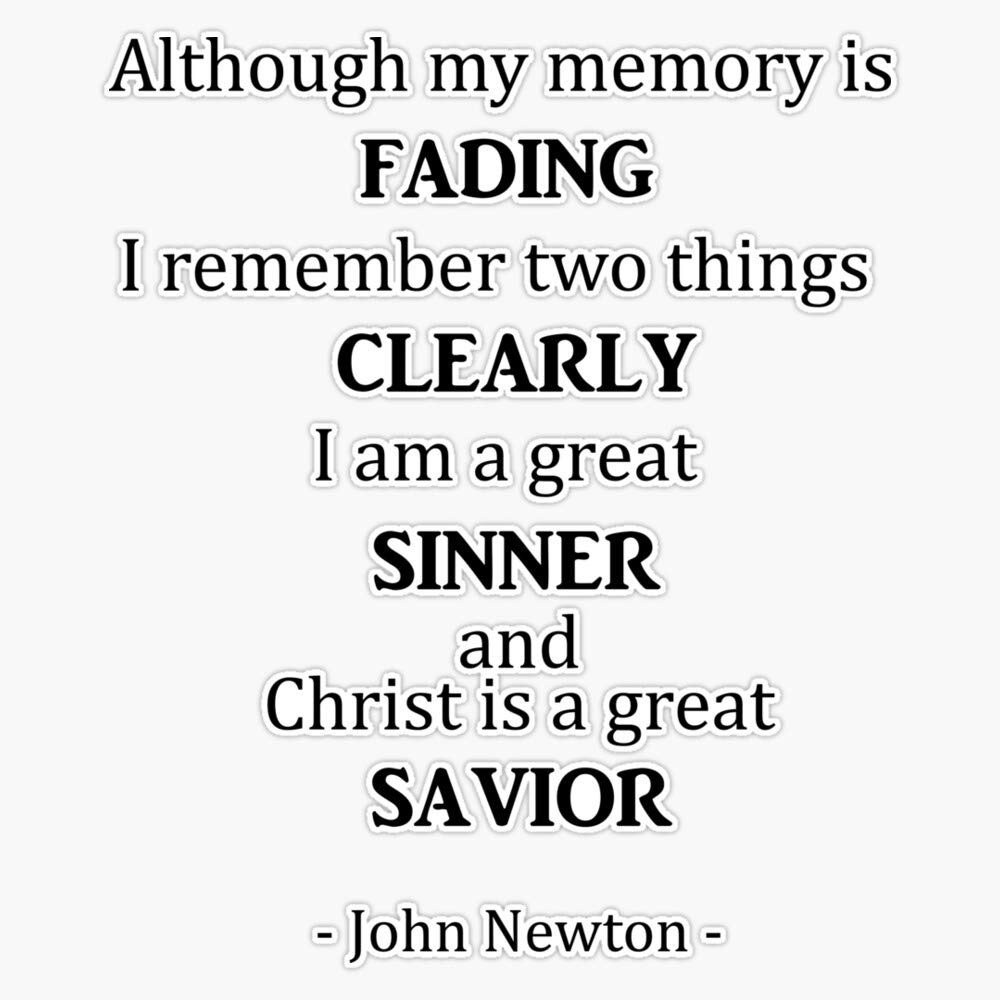
“Although my memory’s fading, I remember two things very clearly: I am a great sinner and Christ is a great Savior.” ― John Newton, Amazing Grace.

For the most part, believers in Christ acknowledge that Jesus Christ is a great Savior. Individuals have written songs and books, and preached great sermons testifying to the great love of God in sending His Son, Jesus Christ, as both Savior and Lord. The familiarity of John 3:16, even in a superficial understanding, underscores this biblical truth.

A disconnection arises when believers in Christ fail to acknowledge that prior to their conversion, and after God’s great salvation, they were/are great sinners. There is a tendency to minimize our own sin, while at the same time maximize the sins of others; especially when they sin against us. We must never forget the greatness of God’s salvation, as compared to the greatness of our sin. John Newton never did.

Unfortunately the first servant, in the context of Matthew 18:23-30, forgot God’s mercy and forgiveness for his unpayable debt. He displayed this callousness by his cruel treatment of a fellow servant, who owed the former a comparatively smaller, payable debt.

When other servants heard about this situation, they were greatly distressed or saddened. They reported what had happened to the master of them all; including the unforgiving servant.

What did the master say? 32 “Then his master summoned him and said to him, ‘You wicked servant! I forgave you all that debt because you pleaded with me. 33 And should not you have had mercy on your fellow servant, as I had mercy on you?’ Mercy received should result in mercy given. How soon we forget the greatness of our sin with respect to the greatness of God’s forgiveness. I’m ashamed to say that I often have.

What did the master do? 34 “And in anger his master delivered him to the jailers, until he should pay all his debt. 35 So also my heavenly Father will do to every one of you, if you do not forgive your brother from your heart.”

“The point of the parable is not that God’s forgiveness, once granted, will be revoked if a follower of Jesus refuses to forgive his brother or sister. Rather, refusal to forgive is symptomatic of a person who fails to grasp the impossible depth of his debt and the infinite magnitude of God’s mercy and therefore has no reason to presume that he has received God’s forgiveness in the first place,” explains Dr. R. C. Sproul.

Do you identify with John Newton’s sentiment? Do you acknowledge that you are a great sinner and that Jesus Christ is a great Savior? Ask God to forgive you of your unforgiving spirit. Ask God to constantly remind you that mercy received should result in mercy given.

Soli deo Gloria!

The Gospel of Matthew: The Unforgiving Servant. 

28 “But when that same servant went out, he found one of his fellow servants who owed him a hundred denarii, and seizing him, he began to choke him, saying, ‘Pay what you owe.’ 29 So his fellow servant fell down and pleaded with him, ‘Have patience with me, and I will pay you.’ 30 He refused and went and put him in prison until he should pay the debt.” (Matthew 18:28–35 (ESV)

“With great power there must also come great responsibility.” – Stan Lee

“With great power there must also come great responsibility” is a proverb popularized by Spider-Man in Marvel comicsfilms, and related media. Introduced by Stan Lee, it originally appeared as a closing narration in the 1962 Amazing Fantasy #15, and was later attributed to Uncle Ben as advice to his young nephew, Peter Parker (aka. Spider-Man).

A similar proverb is, “With great grace received comes great graciousness given.” When an individual receives God’s amazing and gracious forgiveness for sin, the same individual should be willing, ready and able to forgive others of their sin.

Matthew 6:14–15 (ESV) says, 14 For if you forgive others their trespasses, your heavenly Father will also forgive you, 15 but if you do not forgive others their trespasses, neither will your Father forgive your trespasses.”

Ephesians 4:31–32 (ESV) says, 31 Let all bitterness and wrath and anger and clamor and slander be put away from you, along with all malice. 32 Be kind to one another, tenderhearted, forgiving one another, as God in Christ forgave you.

The servant who received forgiveness of his unpayable debt to his master (Matt. 18:23-27), was unwilling to forgive a comparatively smaller debt a fellow servant owed him.  One hundred denarii was not an insubstantial sum. However, the debt owed by the second servant was nothing compared to the debt owed by the first servant.

“One hundred denarii represented one hundred days of a common worker’s wages, which would be a small sum for his fellow tax farmer, after he had finished his accounting with the king (18:23). It was also a ridiculously minuscule sum compared to what the first servant had owed the king. But apparently the forgiven slave, instead of internalizing the principle of grace, had decided to become ruthlessly efficient in his exacting of debts henceforth. Such extreme actions as choking are reported of angry creditors elsewhere in antiquity as well,” explains commentator Craig Keener.

The first servant displayed his calloused heart by his physical and verbal abuse of his fellow servant. When the second servant pleaded for patience to pay the debt, the first servant would not hear of it. The text says, “He refused and went and put him in prison until he should pay the debt.”  

This action was not only hard-hearted, but also ridiculous because how could the imprisoned servant pay off his debt while in jail? “Someone in prison could not pay back what he owed (v. 34), unless friends came to his aid with the requisite funds,” says Keener.

“Because of the smallness of the debt he was not legally permitted to sell his fellow servant into slavery, but was legally permitted to have him sentenced to prison and forced labor, to work off his debt,” explains R. William Hendriksen.

“The foundation for a forgiving spirit is the experience of divine grace. It is by grace that we are saved. It is by grace that we live. It is by grace that we have been forgiven. Therefore, the why of forgiving is to manifest our own gratitude for the grace that we have received,” explains Dr. R. C. Sproul.    

Are you grateful for how much God has forgiven you? Are you willing to forgive others because of God’s forgiveness? Remember, with great grace received comes great graciousness given.

Soli deo Gloria!

The Gospel of Matthew: The Forgiving Master.

23 “Therefore the kingdom of heaven may be compared to a king who wished to settle accounts with his servants. 24 When he began to settle, one was brought to him who owed him ten thousand talents. 25 And since he could not pay, his master ordered him to be sold, with his wife and children and all that he had, and payment to be made. 26 So the servant fell on his knees, imploring him, ‘Have patience with me, and I will pay you everything.’ 27 And out of pity for him, the master of that servant released him and forgave him the debt.” (Matthew 18:23–27 (ESV)

Regarding the subject of forgiveness (Matt. 18:21-22), Jesus taught a parable about the extent of God’s unimaginable forgiveness of sinners and how this should provoke believers in Christ to an eager readiness to forgive others.

The kingdom of heaven, which is God’s rule and reign in the believer’s soul, may be compared to a king seeking to settle accounts with his servants. “Servants probably refers to free provincial satraps, who functioned as the ruler’s tax farmers in various regions; they too were vassals of the king. The ruler would allow them to collect taxes for him at a profit, but he demanded efficiency; this was the time of year when he was going to settle their accounts with him,” explains commentator Craig Keener.

As the king was settling his accounts, there was one servant who owed the master ten thousand talents. Jesus gave no reason as to why the master allowed the servant to accrue so much debt. A talent was the highest monetary unit of currency in first century Judea. It was equal to six thousand denarii. A denarii was a day’s wages. Ten thousand talents was equivalent to sixty million days wages. In other words, the servant owed an unpayable amount.

“Such a debt was practically unpayable, and a debt of this amount would not be repayable over many lifetimes,” explains Dr. R. C. Sproul.

In response, the master ordered the servant to be sold, along with his wife and children and all his possessions. This was so repayment could be made. Selling insolvent debtors into slavery was nothing unusual in the first century, as mentioned in Scripture (Exod. 22:3; Lev. 25:39, 47; 2 Kings 4:1; Neh. 5:5; Isa. 50:1; Amos 2:6; 8:6).

“Outside of the country of the Israelites the practice of selling those who were unable to pay their debts was common, and it is to this that the parable refers. So by royal decree this official, his family, and all his possessions are ordered to be sold. The proceeds must go toward paying the debt. The words used in the original (pay, payment) indicates that the debtor must “give back” what he owes: he must “pay off” his obligation in full. Of course, this was actually impossible. The amount that was to be placed in the king’s treasury, the full proceeds of the sale, would be but a drop in the bucket. So huge was the debt,” explains Dr. William Hendriksen.

What was the servant to do? His sinful irresponsibility resulted not only in his own punishment, but also the punishment of his family. They too bore the consequences of his sin. He faced an unpayable amount of debt and an unfortunate future of regret.

What could the servant do? He begged the master to have patience with him. He promised to repay what he owed. He must have known, as would the master that such a promise was virtually impossible to fulfill.

“The servant is completely crushed by the realization of the severity of his impending punishment. He does not deny that he owes the huge amount, neither does he try to explain how he got into this terrible predicament. He was probably well aware of the fact that excuses would have been useless. It is important to note also that he does not offer to make at least a down-payment on his debt. The implication is clearly this: he makes no such offer for the simple reason that he has nothing! Having prostrated himself, he begged,” states Dr. Hendriksen.

The master was under no obligation to forgive the servant’s debt. There was no one greater than the master who could pressure him to forgive the debt. Yet, that is what master chooses to do. He forgives the debt. Such behavior was not because the servant deserved to be forgiven. It was because the master had pity upon the servant. The master felt love and compassion for an unworthy servant. He forgave him the debt he owed.

“It was out of sheer compassion that the master granted this servant far more than he had asked, completely canceling his huge debt and releasing him from punishment,” concludes Dr. Hendriksen.

Matthew 5:3 (ESV) says, “Blessed are the poor in spirit, for theirs is the kingdom of heaven.”  Like the servant in today’s parable, we faced the Lord God with an unpayable debt. We were beggar poor facing a debt we could not pay. We deserved to be punished The Lord would have been just in doing so. However, the Lord Jesus Christ paid our debt of sin on the cross (Rom. 3:21-26). Our debt is paid in full (John 19:30).

  1. I will sing of my Redeemer,
    And His wondrous love to me;
    On the cruel cross He suffered,
    From the curse to set me free.
  2. Refrain:
    Sing, oh, sing of my Redeemer,
    With His blood He purchased me;
    On the cross He sealed my pardon,
    Paid the debt, and made me free.
  3. I will tell the wondrous story,
    How my lost estate to save,
    In His boundless love and mercy,
    He the ransom freely gave.
  4. I will praise my dear Redeemer,
    His triumphant pow’r I’ll tell,
    How the victory He giveth
    Over sin, and death, and hell.
  5. I will sing of my Redeemer,
    And His heav’nly love to me;
    He from death to life hath brought me,
    Son of God with Him to be.

Soli deo Gloria!


The Gospel of Matthew: Seventy Times Seven.

21 Then Peter came up and said to him, “Lord, how often will my brother sin against me, and I forgive him? As many as seven times?” 22 Jesus said to him, “I do not say to you seven times, but seventy-seven times.” (Matthew 18:21–22 (ESV)

I was never, and am not, strong in mathematics. I am thankful to have married a woman who is. What does math have to do with today’s lesson from the Gospel of Matthew?  Plenty? In today text, Jesus provides believers in Christ with a lesson on multiplication, and forgiveness.

In the immediate aftermath of Jesus instructions regarding church discipline, Peter approached Him and asked, ““Lord, how often will my brother sin against me, and I forgive him? As many as seven times?”

Sin (ἁμαρτάνω; hamartano) refers to a wrongdoing. It means to act or behave contrary to the will and law of God. To forgive (ἀφίημι; aphiemi) means to dismiss, send away or cancel a debit. In this case, the canceled debt that is sent away is a sin committed by someone against you. Peter wanted to know how many times such a cancellation should be done by a believer in Christ. Perhaps he reasoned the doing so up to seven times was really spiritual.

“Peter may have been of the opinion that Jesus would praise him for his bigheartedness. If so, his expectation was not fulfilled. There was something wrong with Peter’s approach. It smacked of rabbinism. It sounded as if the forgiving spirit were a commodity that could be weighed, measured, and counted; as if it could be parceled out little by little up to a certain well defined limit, when further distribution would have to stop,” explains Dr. William Hendriksen.

Jesus dismissed such legalism in His disciples. “Jesus said to him, “I do not say to you seven times, but seventy-seven times.”

“Seventy times seven (some interpreters read seventy-seven) does not really mean exactly 490 here; it is a typically graphic Jewish way of saying “Never hold grudges.” Because true repentance should involve turning from sin, some later rabbis’ limited opportunities for forgiveness for a given sin to three times; Peter might have thought his offer of seven times was generous,” states commentator Craig Keener.

“Forgiveness and the restoration of relationship is the goal of discipline — from the first step to the last step of excommunication. Peter understands this partly; he will forgive a person up to seven times, more than the three times the rabbis prescribe in his day (v. 21). That Peter’s comprehension is incomplete is revealed in the Savior’s command to forgive “seventy times seven” (v. 22). According to some Reformed New Testament scholars Jesus really says, “seventy-seven times,” but the precise number is unimportant. Either way, as seen in the parable that follows, Christ is actually teaching that forgiveness must be unlimited,” explains Dr. R. C. Sproul.

Ephesians 4:31–32 (ESV) says, 31 Let all bitterness and wrath and anger and clamor and slander be put away from you, along with all malice. 32 Be kind to one another, tenderhearted, forgiving one another, as God in Christ forgave you.”

The basis for our unlimited forgiveness of others’ sins against us is God’s unlimited forgiveness of our sins against Him. Have a blessed day in the LORD.

Soli deo Gloria!

The Gospel of Matthew: Where Two of Three are Gathered.

18 Truly, I say to you, whatever you bind on earth shall be bound in heaven, and whatever you loose on earth shall be loosed in heaven. 19 Again I say to you, if two of you agree on earth about anything they ask, it will be done for them by my Father in heaven. 20 For where two or three are gathered in my name, there am I among them.” (Matthew 18:18–20 (ESV)

What comprises a true church belong to Jesus Christ? In other words, what is a biblical church? The following characteristics of a biblical church are taken from the New Testament.

First, a true, biblical church preaches the Word of God (2 Timothy 3:16–17; 2 Timothy 4:1–5). Second, a true biblical church observes the ordinances of believer’s baptism and the Lord’s Supper (Matthew 28:19–20; Acts 2:38–40; 1 Corinthians 11:23–26).  Thirdly, as attested by Matthew 18:15-17, a true, biblical church observes church discipline (1 Corinthians 5:1–8; Galatians 6:1-2; 1 Timothy 1:18–20).  

In whatever biblical text we study, we must ask ourselves the following questions. (1) What did the text mean to the original audience; (2) What are the differences between the biblical and church today; (3) What theological principle(s) are found in the biblical text; (4) Are these biblical principles found elsewhere in Scripture; and (5) How may the text be applied in our lives?

In today’s text, we discover phrasing that may appear foreign to our understanding. What did Jesus mean when He said, “18 Truly, I say to you, whatever you bind on earth shall be bound in heaven, and whatever you loose on earth shall be loosed in heaven?”

To bind (δέω; deo) means to tie or to restrict. To loose (λύω; luo) means to untie or release. Jesus used these two agricultural terms metaphorically to illustrate the church’s authority in matters of church discipline. The Lord gave the local church the authority to discipline and to restore wayward believers in Christ. The Lord will bless the church that faithful carries out of this responsibility.

“This corporate action was entrusted to the entire apostolic group. Their actions of binding and loosing were to be directed by heaven (Matt. 18:18; 16:19). Clearly all are addressed for the you pronouns are plural,” explains Dr. William Hendriksen.

Jesus continued by saying that the responsibility of church discipline, by its leaders, is to be bathed in prayer. Approaching a fellow believer in Christ who is overtaken in sin must be done humbly and prayerfully. Arrogance and self-righteousness has no place in the Christian life; especially in this situation.

“Besides their binding and loosing, they were also to engage in corporate prayer. Whenever they came together in the name of the Lord, He would be with them. And if two or three would agree together about anything it would be done for them by the Father in heaven.” continues Dr. Hendriksen.

In its specific context, Matthew 18:20 is particularly applicable in the circumstances of church discipline. Believers should be careful not to use it as a proof text for any and all gatherings. However, this verse can apply for gatherings for prayer and worship.

Church discipline is never easy. It’s one of the reasons why too few churches pursue it. For many leaders, the perspective seems to be “live and let live” or “the problem will just go away.” This is not only unhealthy but also unbiblical. Pray for your church leaders that they will lead the church in a biblical and obedient manner.

Soli deo Gloria!

The Gospel of Matthew: The Process of Church Discipline.

15 “If your brother sins against you, go and tell him his fault, between you and him alone. If he listens to you, you have gained your brother. 16 But if he does not listen, take one or two others along with you, that every charge may be established by the evidence of two or three witnesses. 17 If he refuses to listen to them, tell it to the church. And if he refuses to listen even to the church, let him be to you as a Gentile and a tax collector. 18 Truly, I say to you, whatever you bind on earth shall be bound in heaven, and whatever you loose on earth shall be loosed in heaven. 19 Again I say to you, if two of you agree on earth about anything they ask, it will be done for them by my Father in heaven. 20 For where two or three are gathered in my name, there am I among them.” (Matthew 18:15–20 (ESV)

What comprises a true church belong to Jesus Christ? In other words, what is a biblical church? The following characteristics of a biblical church are taken from the New Testament.

First, a true, biblical church preaches the Word of God (2 Timothy 3:16–17; 2 Timothy 4:1–5). Second, a true biblical church observes the ordinances of believer’s baptism and the Lord’s Supper (Matthew 28:19–20; Acts 2:38–40; 1 Corinthians 11:23–26).  Thirdly, as attested by today’s text, a true, biblical church observes church discipline (1 Corinthians 5:1–8; Galatians 6:1-2; 1 Timothy 1:18–20).  

What is a believer in Christ to do when another believer sins against them? In some instances, it is wise to ignore the sin. Proverbs 19:11 (ESV) says, “Good sense makes one slow to anger, and it is his glory to overlook an offense.”

Matthew 18:15 states that if a brother in Christ sins against you, go and privately tell him his fault. A sin (ἁμαρτάνω; harmartano) means a violation of God’s Law. To go and tell the individual their fault (ἐλέγχω; elencho) means to expose, reprove and correct.

“The prescription for church discipline in vv. 15–17 must be read in light of the parable of the lost sheep in vv. 12–14. The goal of this process is restoration. If successful, “you have gained your brother.” Step one is to “tell him his fault” privately,” states Dr. John MacArthur.

However, what happens when a fellow believer in Christ refuses to listen to you when you tell them their fault or sin against you? What happens next? Do you forget the whole thing and go on your merry way? Today’s text instructs the faithful believer the next step to take when facing such a situation.

Matthew 18:16 says, “But if he does not listen, take one or two others along with you, that every charge may be established by the evidence of two or three witnesses.”

If a one-on-one meeting does not result in repentance by the sinful individual, the grieved individual may take a second step. The text instructs that taking two others along for a second meeting ensures that every fault is verified. This eliminates any misunderstanding or confusion.

“Generally speaking, discipline proceeds from the private to the public. The believer who is sinned against by another professing believer must first engage the offender one on one and seek that person’s repentance. This is for the good of the church, as it prevents news of the sin from spreading beyond the people involved and becoming kindling for the fire of gossip. If the person repents, no further action is necessary,” explains Dr. R.C. Sproul.

What happens if the sinning brother still refuses to repent of their sin? The next biblical step in the church discipline process is for the matter to be brought before the church.

Matthew 18:17 says, “If he refuses to listen to them, tell it to the church. And if he refuses to listen even to the church, let him be to you as a Gentile and a tax collector.”

No timetable is given as to how long a time lapse exists between steps two and three in church discipline. Grace should be extended at all times and if possible. If the fellow believer continues in unrepentance, then the church is to regard the individual as unconverted. Their behavior belies any testimony of saving faith. They have a dead faith (James 2:14-26).

“But if private admonition does not work, the offender is to be taken before other witnesses and finally the whole church, which must excommunicate sinners who persist in impenitence,” states Dr. Sproul.  

“Church discipline is not merely to punish the offender, or to shun him completely, but to remove him as a detrimental influence from the fellowship of the church, and then to regard him as an evangelistic prospect rather than as a brother,” states Dr. MacArthur. “The church does not discipline its members to shame them but to call them to repentance and perseverance.”

Soli deo Gloria!

The Gospel of Matthew: If A Brother Sins Against You.  

15 “If your brother sins against you, go and tell him his fault, between you and him alone. If he listens to you, you have gained your brother. 16 But if he does not listen, take one or two others along with you, that every charge may be established by the evidence of two or three witnesses. 17 If he refuses to listen to them, tell it to the church. And if he refuses to listen even to the church, let him be to you as a Gentile and a tax collector. 18 Truly, I say to you, whatever you bind on earth shall be bound in heaven, and whatever you loose on earth shall be loosed in heaven. 19 Again I say to you, if two of you agree on earth about anything they ask, it will be done for them by my Father in heaven. 20 For where two or three are gathered in my name, there am I among them.” (Matthew 18:15–20 (ESV)

What comprises a true church belong to Jesus Christ? In other words, what is a biblical church? The following characteristics of a biblical church are taken from the New Testament.

First, a true, biblical church preaches the Word of God (2 Timothy 3:16–17; 2 Timothy 4:1–5). Second, a true biblical church observes the ordinances of believer’s baptism and the Lord’s Supper (Matthew 28:19–20; Acts 2:38–40; 1 Corinthians 11:23–26).  Thirdly, as attested by today’s text, a true, biblical church observes church discipline (1 Corinthians 5:1–8; Galatians 6:1-2; 1 Timothy 1:18–20).  

“Jesus has been warning against the evil of tempting others to sin. Instead of becoming the cause of someone else’s ruin every follower of the Lord should make it his business to find the sheep that has gone astray and to bring it back to the fold. But suppose the shoe is on the other foot. Suppose I myself am not the sinner, the one who causes others to become ensnared in sin, but instead the one sinned against, what then? In answering this question the Lord starts out by saying, “Now if a brother sin against you.…” explains Dr. William Hendriksen.

What is a believer in Christ to do when another believer sins against them? In some instances, it is wise to ignore the sin. Proverbs 19:11 (ESV) says, “Good sense makes one slow to anger, and it is his glory to overlook an offense.”

Matthew 18:15 states that if a brother in Christ sins against you, go and privately tell him his fault. A sin (ἁμαρτάνω; harmartano) means a violation of God’s Law. To go and tell the individual their fault (ἐλέγχω; elencho) means to expose, reprove and correct.

“The prescription for church discipline in vv. 15–17 must be read in light of the parable of the lost sheep in vv. 12–14. The goal of this process is restoration. If successful, “you have gained your brother.” Step one is to “tell him his fault” privately,” states Dr. John MacArthur.

How are believers to expose, reprove and correct a person when they sin against them? Galatians 6:1–2 (ESV) says, “Brothers, if anyone is caught in any transgression, you who are spiritual should restore him in a spirit of gentleness. Keep watch on yourself, lest you too be tempted. Bear one another’s burdens, and so fulfill the law of Christ.”

“Jesus means that the offended brother should in the spirit of brotherly love go and show the sinner his fault, and this not—certainly not most of all—for the purpose of receiving satisfaction for a personal grievance, but rather in the interest of the offender, that he may repent, and may seek and find forgiveness. Whether the offended brother should make only one personal visit or should go more than once is not stated, and may depend on circumstances. To spare the honor of the brother who has sinned Jesus adds that such an interview with the offender must take place “while you are alone with him,” literally, “between you and him alone,” that is, privately. There must be a tête-à-tête, a brotherly “face-to-face” confrontation. The Dutch and the Germans frequently use an expression which, literally translated into English, is (a meeting) “between four eyes.” says Dr. Hendriksen.

“If he listens to you, you have gained your brother.” This is the goal for such a confrontation and conversation. It will not be an easy encounter but it is a necessary one.

“The admonition of verse 15 is all the more appropriate because the brother who has been sinned against is, after all, also himself a sinner, one who should at all times first of all examine himself (7:3, 4; 1 Cor. 11:28; cf. Ps. 139:23, 24),” concludes Dr. Hendriksen.

Pray that if you ever have to confront a fellow believer, concerning their sin against you, it will done in a spirit of gentleness.

Soli deo Gloria!

The Gospel of Matthew: What is a True, Biblical Church?  

15 “If your brother sins against you, go and tell him his fault, between you and him alone. If he listens to you, you have gained your brother. 16 But if he does not listen, take one or two others along with you, that every charge may be established by the evidence of two or three witnesses. 17 If he refuses to listen to them, tell it to the church. And if he refuses to listen even to the church, let him be to you as a Gentile and a tax collector. 18 Truly, I say to you, whatever you bind on earth shall be bound in heaven, and whatever you loose on earth shall be loosed in heaven. 19 Again I say to you, if two of you agree on earth about anything they ask, it will be done for them by my Father in heaven. 20 For where two or three are gathered in my name, there am I among them.” (Matthew 18:15–20 (ESV)

What comprises a true church belong to Jesus Christ? In other words, what is a biblical church? The following characteristics of a biblical church are taken from the New Testament.

First, a true, biblical church preaches the Word of God.

2 Timothy 3:16–17 (ESV) – “16 All Scripture is breathed out by God and profitable for teaching, for reproof, for correction, and for training in righteousness, 17 that the man of God may be complete, equipped for every good work.”

2 Timothy 4:1–5 (ESV) – “I charge you in the presence of God and of Christ Jesus, who is to judge the living and the dead, and by his appearing and his kingdom: preach the word; be ready in season and out of season; reprove, rebuke, and exhort, with complete patience and teaching. For the time is coming when people will not endure sound teaching, but having itching ears they will accumulate for themselves teachers to suit their own passions, and will turn away from listening to the truth and wander off into myths. As for you, always be sober-minded, endure suffering, do the work of an evangelist, fulfill your ministry.”

Second, a true biblical church observes the ordinances of believer’s baptism and the Lord’s Supper.

Matthew 28:19–20 (ESV) – “19 Go therefore and make disciples of all nations, baptizing them in the name of the Father and of the Son and of the Holy Spirit, 20 teaching them to observe all that I have commanded you. And behold, I am with you always, to the end of the age.”

Acts 2:38–40 (ESV) – “38 And Peter said to them, “Repent and be baptized every one of you in the name of Jesus Christ for the forgiveness of your sins, and you will receive the gift of the Holy Spirit. 39 For the promise is for you and for your children and for all who are far off, everyone whom the Lord our God calls to himself.” 40 And with many other words he bore witness and continued to exhort them, saying, “Save yourselves from this crooked generation.”

1 Corinthians 11:23–26 (ESV) – “23 For I received from the Lord what I also delivered to you, that the Lord Jesus on the night when he was betrayed took bread, 24 and when he had given thanks, he broke it, and said, “This is my body, which is for you. Do this in remembrance of me.” 25 In the same way also he took the cup, after supper, saying, “This cup is the new covenant in my blood. Do this, as often as you drink it, in remembrance of me.” 26 For as often as you eat this bread and drink the cup, you proclaim the Lord’s death until he comes.

Thirdly, as attested by today’s text, a true, biblical church observes church discipline.

1 Corinthians 5:1–8 (ESV) – “It is actually reported that there is sexual immorality among you, and of a kind that is not tolerated even among pagans, for a man has his father’s wife. And you are arrogant! Ought you not rather to mourn? Let him who has done this be removed from among you. For though absent in body, I am present in spirit; and as if present, I have already pronounced judgment on the one who did such a thing. When you are assembled in the name of the Lord Jesus and my spirit is present, with the power of our Lord Jesus, you are to deliver this man to Satan for the destruction of the flesh, so that his spirit may be saved in the day of the Lord. Your boasting is not good. Do you not know that a little leaven leavens the whole lump? Cleanse out the old leaven that you may be a new lump, as you really are unleavened. For Christ, our Passover lamb, has been sacrificed. Let us therefore celebrate the festival, not with the old leaven, the leaven of malice and evil, but with the unleavened bread of sincerity and truth.”

1 Timothy 1:18–20 (ESV) – “18 This charge I entrust to you, Timothy, my child, in accordance with the prophecies previously made about you, that by them you may wage the good warfare, 19 holding faith and a good conscience. By rejecting this, some have made shipwreck of their faith, 20 among whom are Hymenaeus and Alexander, whom I have handed over to Satan that they may learn not to blaspheme.”

“So those are the marks of a true church. If a church is preaching the Word, if its practicing the sacraments or the ordinances, and its taking its membership, its community seriously, then you know you’re in a biblically faithful church. That is exactly where we need to be, because this is the church, it is the institution that God has ordained for the edification of His people and for the proclamation of the gospel. So, let’s make sure we’re in a church, and let’s make sure we’re in a biblical church,” states Nathan W. Bingham and Stephen J. Nichols.  

Soli deo Gloria!

The Gospel of Matthew: A Lost Lamb.

12 What do you think? If a man has a hundred sheep, and one of them has gone astray, does he not leave the ninety-nine on the mountains and go in search of the one that went astray? 13 And if he finds it, truly, I say to you, he rejoices over it more than over the ninety-nine that never went astray. 14 So it is not the will of my Father who is in heaven that one of these little ones should perish.” (Matthew 18:11–14 (ESV)

I have always loved this well-known parable. The mental image of the shepherd searching and securing a lost lamb is striking in its imagery and comforting in its truth. More often than we care to think, we stray.

To be astray (πλανάω; planao) means to be misled, to be deceived, or to be deluded from the truth. The three sources of this deception are the world, our own remaining sinful nature and the devil. Thankfully, the LORD does not leave us in this condition but rescues us from danger (I Cor.10:13). He searches for each one who has been led astray.

When God the Father finds the lost lamb, He rejoices. To find (εὑρίσκω; heurisko) means to attain. The Father elect, seeks and preserves not only the church as a whole but also each individual. In this, the Father rejoices (χαίρω; chairo). He is glad.

“In close connection with the preceding verses we must conclude that what Jesus is asserting so very emphatically is that the Father in heaven is definitely interested in each of his sheep, yes, even in each of his wandering sheep. By sending his Son into the world he is rescuing sheep that have gone astray. In this the Father delights. See Luke 15:7, 20, 22–24. So does the Son. See Matt. 9:12, 13; Luke 19:10; John 10:11, 14. In this kind of work the disciples too should be engaged. See Matt. 9:36–10:1; John 4:35,” explains Dr. William Hendriksen.

“God’s “care extends itself to every particular member of the flock, even the lowest” (Matthew Henry). He shepherds His people, working to keep errant believers from finally perishing (Matt. 18:12–14). Since we are called to imitate God (Eph. 5:1), to some degree we all must minister to one another. Of course, the elders of the church are the primary shepherds of the Lord’s flock (1 Peter 5:1–5). Nevertheless, we must still bear the burdens of one another (Gal. 6:2) and love wandering brothers and sisters back into the fold. Oftentimes, we will not reach out to others who are stuck in sin or who have harmed us because we think they are beyond redemption. Such an attitude betrays an arrogance that believes we who live holy lives are more deserving of God’s love than others. Such an attitude is not the mark of our Father’s humble children, who alone will inherit the kingdom of heaven (Matt. 18:1–4),” states Dr. R. C. Sproul.

Seek to minister to a wayward lamb today.

Soli deo Gloria!