The Gospel of Matthew: Whose Son is the Christ?

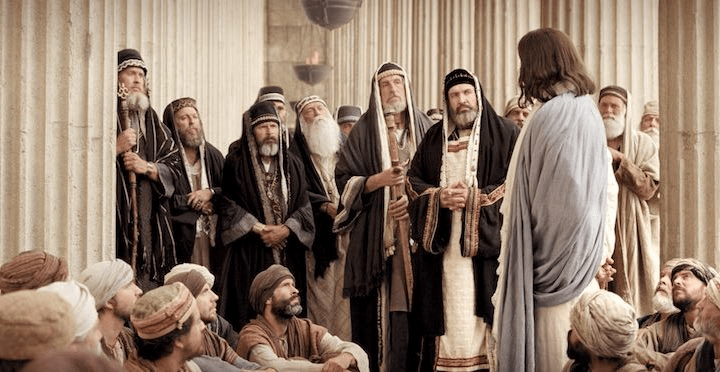
41 Now while the Pharisees were gathered together, Jesus asked them a question, 42 saying, “What do you think about the Christ? Whose son, is he?” They said to him, “The son of David.” 43 He said to them, “How is it then that David, in the Spirit, calls him Lord, saying, 44 “The Lord said to my Lord, “Sit at my right hand, until I put your enemies under your feet”? 45 If then David calls him Lord, how is he his son?” 46 And no one was able to answer him a word, nor from that day did anyone dare to ask him any more questions.” (Matthew 22:41–46 (ESV)

The idiom “the tables are turned” or “turnabout is fair play” respectively refers to a role reversal in a situation or a shift in power. It also means to treat someone in the same way they have treated you. This is often a pejorative, or negative, expression of behavior where we seek to hurt someone who has hurt us. Or, “turnabout is fair play” may refer to the satisfaction we feel when someone receives the same negative treatment they have given to others.

However, Jesus embodied this behavior in righteous perfection. The Pharisees, Sadducees and other Jewish religious leaders repeatedly asked Him questions; for the purpose of accusing and condemning Him. Jesus, for the purpose of confronting the Pharisees, asked, “What do you think about the Christ? Whose son, is he?” Jesus often used this phase, “What do you think” as a way of testing people (Matt. 17:25; 18:12; 21:28; 26:66).  

“Having confounded His questioners three times (Matt. 22:15–40), Jesus assumes the role of examiner, asking the Pharisees to name the Messiah’s father (vv. 41–42). This question is a no-brainer for the Pharisees, as well as every other Jewish sect of the day. The Sadducees, Herodians, Zealots, Pharisees, and so on do not agree on much, but all of them believe the Messiah will be David’s son. When the Pharisees admit as much to Christ, they are merely repeating truths revealed in 2 Samuel 7:1–17, as well as other parts of the old covenant revelation,” explains Dr. R. C. Sproul.

The Pharisees answered, “The Son of David.” Jesus then asked follow-up questions. He said to them, 43How is it then that David, in the Spirit, calls him Lord, saying, 44 “The Lord said to my Lord, “Sit at my right hand, until I put your enemies under your feet”? 45 If then David calls him Lord, how is he his son?”

“What do you think of the Christ?” In guiding the Jerusalem leaders to contemplate this question of eternal weight, Jesus turned to the authority of what is written “in the book of Psalms,” specifically Psalm 110 (Matt 22:41–46Mark 12:35–37Luke 20:40– 44), and asked a question childlike in both simplicity and profundity, the answer to which plunges one into the unfathomable wonder of the incarnation of God,” states commentator Michael Morales.

“How could David refer to his son as Lord? This probing question was but the application of what Jesus would later declare, that He Himself is the object of all the Scriptures of the Old Testament, summarizing their threefold division in Luke 24:44 as “the Law of Moses and the Prophets and the Psalms,” with the Psalms standing as the summary representative of the Writings.”

To prove the Messiah is David’s Lord as well as his Son, Jesus quoted Psalm 110, which the New Testament quotes more often than any other Old Testament text. Since Psalm 110 is Messianic, as most first-century Jews correctly believed, David’s son, the Messiah (“my Lord”), is greater than his father. Yahweh is the One greater than David, who was the most exalted king of ancient Israel.

“Christ is forcing the Pharisees to rethink their Christology and in effect asks of them the same thing He asked of Peter: “Who do you say that I am?” (Matt. 16:15–16). It is a question that He asks of us all,” concludes Dr. Sproul.

Matthew records the following conclusion. “And no one was able to answer him a word, nor from that day did anyone dare to ask him any more questions.”

What is your answer? Of all the questions you may have asked about Jesus Christ, this is the question He asks of you. After all, turnabout is fair play. Have a blessed day in the Lord.

Soli deo Gloria!

The Gospel of Matthew: The Greatest Commandment.

34 But when the Pharisees heard that he had silenced the Sadducees, they gathered together. 35 And one of them, a lawyer, asked him a question to test him. 36 “Teacher, which is the great commandment in the Law?” 37 And he said to him, “You shall love the Lord your God with all your heart and with all your soul and with all your mind. 38 This is the great and first commandment. 39 And a second is like it: You shall love your neighbor as yourself. On these two commandments depend all the Law and the Prophets.” (Matthew 22:34–40 (ESV)

“And the hits just keep on coming.” This phrase, used in many different art forms, can mean one good thing follows another. However, it can also sarcastically refer to one negative thing after another is happening. For example, “I had a flat tire yesterday, then I had an accident with the car, and then my car insurance company cancelled my coverage. And the hits just keep on coming.”

Jesus faced one opponent after another during His Passion Week. First it was the Pharisees (Matt. 21:45-22:22). Then the Sadducees came to trick Jesus (Matt. 22:23-33). Then, the Pharisees again tried to entrap the Lord according to today’s text. And the hits just kept on coming.

After hearing that Jesus silenced the Sadducees, the Pharisees gathered together. While not initially and explicitly stated, the sense is the Pharisees gathered together in order to again try to entangle Jesus in His words (Matt. 22:15).

One of these religious leaders, an Old Testament lawyer by occupation, asked Him a question. He did so, the text explicitly says, in order to test Jesus. To test, (πειράζων; peirazon) means to try to trap or to catch someone in a mistake. It means to obtain information to use against an individual. Often times, this is what lawyers do.

The lawyer asked, “Teacher, which is the great commandment in the Law?” One biblical scholar tabulated there are 613 commandments in the Old Testament Law. The obvious question, seemingly unanswerable, would be which commandment was the most important?  

“The question asked by this law-expert was one that could be expected from him and from the men he represented. The rabbis, devoted to hair-splitting legalism, carried on lengthy debates about the commandments, arguing whether any particular one was great or small, heavy or light. See Matt. 5:19 and 15:1ff. It was natural, therefore, that they often debated the question, “Which—of the 613 commandments, 248 of them positive, 365 negative—was “the great,” here in the sense of a superlative, “the greatest,”one,” explains Dr. William Hendriksen.

Jesus correctly answered, ““You shall love the Lord your God with all your heart and with all your soul and with all your mind. 38 This is the great and first commandment.” This statement was taken from the daily Jewish Shema, or confession, found in Deuteronomy 6:4-8.

“Hear, O Israel: The Lord our God, the Lord is one. You shall love the Lord your God with all your heart and with all your soul and with all your might. And these words that I command you today shall be on your heart. You shall teach them diligently to your children, and shall talk of them when you sit in your house, and when you walk by the way, and when you lie down, and when you rise. You shall bind them as a sign on your hand, and they shall be as frontlets between your eyes.” (Deuteronomy 6:4–8 (ESV)

 Jesus then quoted from Leviticus 19:18 concerning the second greatest commandment. “You shall love your neighbor as yourself.” Jesus then stated, “On these two commandments depend all the Law and the Prophets.” The entire Old Testament hangs on these two commandments.

The word for love (Ἀγαπήσεις; Agapeseis) is a self-sacrificial love of the will. It is a kindness based on a decision of the will for the long-term, and not an emotion of the moment. It is the love husbands are to have for their wives (Eph. 5:25). It is the love believers in Christ are to have for one another (I John 4:7-11).

“Despite attempts to interpret passages like Matthew 5:17 otherwise, today’s passage indicates that Jesus does not abrogate the Law when He fulfills it. He would not single out passages from the Law as God’s greatest commandments if He wanted to eliminate all principles found in the Mosaic code. Also, Jesus’ answer reveals that love is primarily an action, not a feeling. The commandment to love is an order to do something; thus, we are to love others, serving them even if we do not feel like it,” states Dr. R. C. Sproul.

However, we must not ignore the obvious and glaring irony found in today’s text. Jesus correctly answered the Pharisees’ question. There is not even a hint the religious leaders objected or disagreed with Jesus’ answer. Yet the irony is the Pharisees stood before the very God they claimed to love with their entire being. They were so close to God, and yet so far.

Have a blessed day as we seek to love the LORD and our neighbors. This we must do as believers in Christ even when the hits just keep on coming.

Soli deo Gloria!

The Gospel of Matthew: The Answer from Jesus to the Sadducees.

29 But Jesus answered them, “You are wrong, because you know neither the Scriptures nor the power of God. 30 For in the resurrection they neither marry nor are given in marriage, but are like angels in heaven. 31 And as for the resurrection of the dead, have you not read what was said to you by God: 32 ‘I am the God of Abraham, and the God of Isaac, and the God of Jacob’? He is not God of the dead, but of the living.” 33 And when the crowd heard it, they were astonished at his teaching.” (Matthew 22:29–33 (ESV)

Confronting error is not an unloving thing to do. It may be the most loving behavior a believer in Christ can display towards those engulfed in heresy. When doing so, remember Proverbs 15:1 (ESV): “A soft answer turns away wrath, but a harsh word stirs up anger.”  

I recently had to confront biblical error held by a professing brother in Christ. I say “professing” because the doctrinal error he believes contradicts the Gospel. Therefore, my concern is not to win an argument but rather to lovingly lead him to biblical truth.

Jesus did not hesitate to tell the Sadducees they were wrong. To be wrong (Πλανᾶσθε; panasthe) means to lead astray, to be deceived or to wander from the truth. The divine truth standard required to protect oneself from deception, and to confront error, is Scripture.

Jesus told the Sadducees they neither understood the Scriptures nor the power of God. Had they, they would not have devised such a ridiculous scenario or denied the resurrection (Matt. 22:23-28).

Frist, Jesus said there was no marriage in the resurrection. Second, Jesus then quoted from the Pentateuch to prove the Scriptures taught the resurrection. The Sadducees were in awe.

“The Sadducees denied the reality of angels, and Jesus probably intended to address this point as well in His answer to their question (Matt. 22:23–30). He affirmed the existence of angels, who do not marry, when He said we will be like them — functionally — when resurrected (Matt. 22:23–30). The idea here is that marriage itself, as a God-ordained institution to be fruitful and multiply, will be rendered irrelevant in a renewed world without death. Remember that the Sadducees’ question was not about affection and companionship in the resurrection but about fulfilling the mandate to keep the family line going (Deut. 25:6),” explains Dr. R. C. Sproul.  

“Jesus then gives the theology of resurrection that underlies His comments thus far. He bases this doctrine in the Pentateuch, specifically Exodus 3:6, to refute the Sadducees who believe the five books of Moses teach nothing about the resurrection. Our Lord’s argument in Matthew 22:31–32 seems to be based partly on the use of the present tense; God said, “I am the God of Abraham, Isaac, and Jacob,” not “I was the God of Abraham Isaac, and Jacob.” When Yahweh appeared to Moses hundreds of years after the patriarchs died, He remained their God, implying that after death they lived on to worship Him and, most importantly, will be bodily raised in the future. As an aside, this appeal to the tense of one word is important for our doctrine of biblical inspiration, for we see in it that the entire Bible is God-breathed. Not even one word is expendable.”

Death does not have the last word. God is the God of the living by sovereign grace alone, through faith alone in the person and work of Jesus Christ alone.

Soli deo Gloria!

The Gospel of Matthew: The Question to Jesus from the Sadducees.

23 The same day Sadducees came to him, who say that there is no resurrection, and they asked him a question, 24 saying, “Teacher, Moses said, ‘If a man dies having no children, his brother must marry the widow and raise up offspring for his brother.’ 25 Now there were seven brothers among us. The first married and died, and having no offspring left his wife to his brother. 26 So too the second and third, down to the seventh. 27 After them all, the woman died. 28 In the resurrection, therefore, of the seven, whose wife will she be? For they all had her.” (Matthew 22:23–28 (ESV)

The controversial conversations Jesus encountered with His enemies were relentless during His Passion Week. Following the dialogue with the Pharisees concerning taxes (Matt. 22:15-22), Jesus then faced the Sadducees.

John Calvin writes, “Satan brings together all the ungodly, who in other respects differ widely from each other, to attack the truth of God.”

This is not the first occasion Matthew recorded Jesus encountering the Sadducees. A brief review of this first century people group is appropriate.

“In the Gospel narrative the Sadducees first appeared, together with Pharisees, at John’s baptism. He addressed them as “sons of snakes” and challenged them to show repentance in their lives (Matt.3:7–10). Later, the Sadducees came along with some Pharisees to “test” Jesus, asking him to show them a sign from heaven (16:1). Jesus told his disciples to beware of the Sadducees (vv 6, 11–12),” states the Tyndale Bible Dictionary.

“A great difference begins to emerge between Pharisees and Sadducees in Matthew 22:23–33 (cf. Mk 12:18–27; Lk 20:27–38). The Sadducees, who, like others, wanted to embarrass Jesus with their questions, came with a trick question that showed their doubts concerning the resurrection of the dead.”

“Josephus, the Jewish historian who wrote in the closing years of the first century ad, adds to the information in the NT about this party. He said that the Sadducees, in contrast to the Pharisees and Essenes, gave no place to the overruling providence of God but emphasized that all that happens to us is the result of the good or evil that we do (Antiquities 13.5.9; War 2.8.14). Josephus, in a way comparable to the NT, spoke of the Sadducees’ rejection of “the immortal duration of the soul, and the punishments and rewards in Hades” (War 2.8.14). “Souls die with the bodies” was what they said (Antiquities 18.1.4).”

The Sadducees proposed scenario and question is contained in today’s text. In light of a woman married to seven brothers, following each preceding brother’s death, they wanted to know, according to the Mosaic Law, who would she be married to in the resurrection? Remember, the Sadducees did not believe in a resurrection of the body.

“Most Jews disliked the priestly Sadducees, because they embraced Roman customs, accommodating themselves to Rome to maintain their priestly authority. Quarreling with the popular Pharisees did not win friends for the Sadducees, whose contempt for the Pharisaic belief in resurrection is seen in their use of levirate marriage (Deut. 25:5–10) to ask Jesus about the life to come (Matt. 22:24–28),” explains Dr. R. C. Sproul.

“The need to determine the husband to whom the childless woman belongs in eternity remains even if only two brothers are involved. But the Sadducees spoke of seven men to emphasize the countless hurdles they found to belief in the resurrection. They were inferring that resurrection would force incest (being married simultaneously to many living brothers, Lev. 18:16) and break God’s law. How, then, could they affirm the doctrine?”

We will examine Jesus’ response to the Sadducees next time. Until then, have a blessed day in the Lord.

Soli deo Gloria!

The Gospel of Matthew: Render to Caesar.  

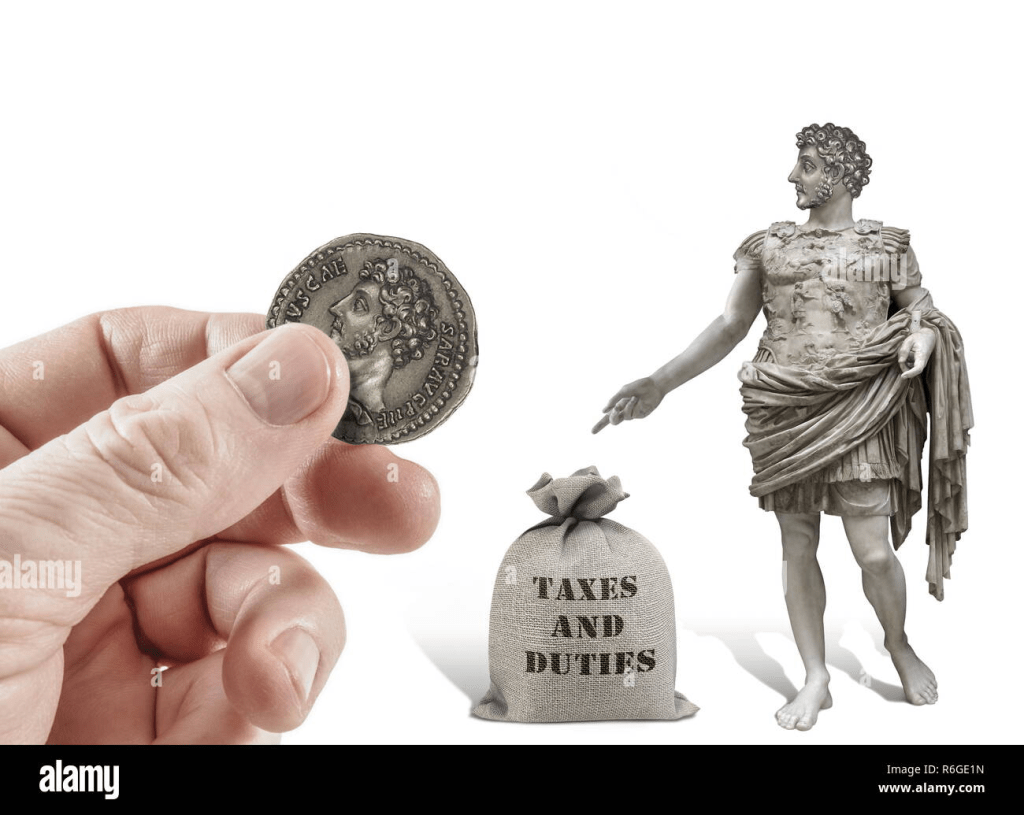
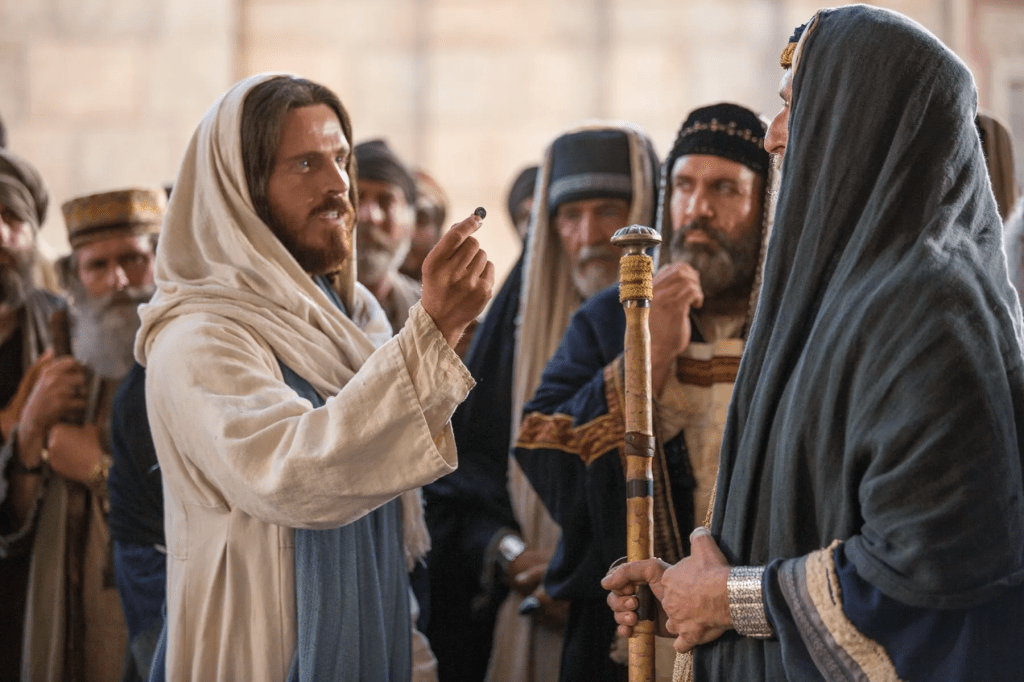
18 But Jesus, aware of their malice, said, “Why put me to the test, you hypocrites? 19 Show me the coin for the tax.” And they brought him a denarius. 20 And Jesus said to them, “Whose likeness and inscription is this?” 21 They said, “Caesar’s.” Then he said to them, “Therefore render to Caesar the things that are Caesar’s, and to God the things that are God’s.” 22 When they heard it, they marveled. And they left him and went away.” (Matthew 22:18–22 ESV)

A common idiom, or turn of phrase, is there are two things certain in life: death and taxes. It was made famous by one of America’s Founding Fathers; Benjamin Franklin.

“Our new Constitution is now established, and has an appearance that promises permanency; but in this world nothing can be said to be certain, except death and taxes.” — Franklin, in a letter to Jean-Baptiste Le Roy, 1789

As long as there has been government, there have been taxes (Deut. 18:14-17; Acts 23:1-5; Rom. 13:1-7; I Peter 2:17). “Because the task of government is divinely ordained and requires financial support, the Christian must pay taxes with a distinctive motive and understanding, as an element of obedience and devotions to God (Matt. 17:24-27; 22:15-21),” explains Dr. R. C. Sproul.

As God Incarnate, Jesus acknowledged and affirmed this biblical truth as today’s text reveals. At the same time, He also recognized the motives of the Pharisees. They were people of malice and hypocrisy. “But Jesus, aware of their malice, said, ‘Why put me to the test, you hypocrites’?”

Malice (πονηρίαν; ponerian) means wickedness. It refers to not only wicked behavior but also a wicked and evil nature. A hypocrite (ὑποκριταί; hypocritai) is pretending to something, or someone, you are not. In the Greek culture, a hypocrite was an actor in the theater pretending to be someone else. Jesus used both terms to describe and judge the ungodly Pharisees.

“As in past episodes (21:23–27), Jesus is in a no-win situation. The Jewish populace will hate Him if He affirms the propriety of the poll tax. Yet if He declares it unlawful, He can be charged with treason. Jesus, of course, sees through the ruse. He asks for the coin used to pay the tax, which for pious Jews should be a special copper coin minted with Rome’s approval, not the silver denarius, which is seen as idolatrous because it depicts the Caesar’s image and his title divus et pontifex maximus, Latin for “divine and high priest.” Jesus’ enemies are revealed as hypocrites when they produce the denarius (22:18–21). Those who hate idolatrous coinage are carrying unclean money themselves,” explains Dr. R. C. Sproul.

Matthew then recorded the following object lesson by the Lord. 19 “Show me the coin for the tax.” And they brought him a denarius. 20 And Jesus said to them, “Whose likeness and inscription is this?” 21 They said, “Caesar’s.” Then he said to them, “Therefore render to Caesar the things that are Caesar’s, and to God the things that are God’s.” 22 When they heard it, they marveled. And they left him and went away.”

The Pharisees marveled at Jesus’ teaching and wisdom. The word marveled (ἐθαύμασαν; ethaumasan) means to wonder and be amazed. They did not expect such an answer. They were filled with awe, but they remained unconverted as they left Him and went away.

“He (Jesus) was not evading the issue, but was clearly saying, “Yes, pay the tax.” Honoring God does not mean dishonoring the emperor by refusing to pay for the privileges—a relatively orderly society, police protection, good roads, courts, etc., etc.—one enjoys. Cf. 1 Tim. 2:2; 1 Peter 2:17. Thus, no truthful charge of sedition could be made against Jesus,” states Dr. William Hendriksen.

“Our Lord’s teaching is a useful principle for understanding when it is lawful to obey the state. As long as it does not claim for itself the rights that appropriately belong to God, Christians must obey the ruling authorities. This means we obey even when we do not agree with their tax rates, speed limits, or regulation of other parts of our lives. Do you obey the government when no biblical principle is violated even if you do not like the laws of the land,” concludes Dr. Sproul.

Soli deo Gloria!

The Gospel of Matthew: Paying Taxes to Caesar.

15 Then the Pharisees went and plotted how to entangle him in his words. 16 And they sent their disciples to him, along with the Herodians, saying, “Teacher, we know that you are true and teach the way of God truthfully, and you do not care about anyone’s opinion, for you are not swayed by appearances. 17 Tell us, then, what you think. Is it lawful to pay taxes to Caesar, or not?” (Matthew 22:15–17 ESV)

Jesus did not just have opposition from the Jewish priests and scribes (Matt. 21:23), but also from the Pharisees and the Herodians. It is wise to review exactly who these people groups were.

The Pharisees were a conservative religious sect originating during the intertestamental period between the prophet Malachi and the beginning of the New Testament. The Pharisees were extremely influential among the common people of Israel. We have previously seen, in Matthew 15:1-9, the Pharisees equated human and oral traditions equal in authority to the Word of God.

In contrast, the Herodians were a political group rather than religious. They had affiliations with the Herod’s but also associated with the Sadducees. The Herodians were the aristocrats of Israel.

Both groups sought to entangle Jesus in what He said. To entangle (παγιδεύσωσιν; pagideusosin) means to entrap or to catch off guard. Therefore, the Pharisees sent their disciples, along with the Herodians, to use Jesus’ words against Him. They do so by asking Jesus a question.

“Teacher, we know that you are true and teach the way of God truthfully, and you do not care about anyone’s opinion, for you are not swayed by appearances.Tell us, then, what you think. Is it lawful to pay taxes to Caesar, or not?”

“What a strange combination: a. Pharisees, who were—or made believe that they were—very concerned about keeping God’s law, and b. partisans of the Herod family, who cared very little about the divine commandments. These two groups unite against Jesus,” states Dr. William Hendriksen.

You have to wonder if they really believed their opening statement to the Lord or were simply flattering Him. If they understood Jesus was true and taught the way of God truthfully, then why would they want to entrap and kill Him? Ironically, they sought to destroy the Lord because He was true and spoke truth, while they were liars and followers of the devil (John 8). Nevertheless, they asked Jesus whether it was appropriate to pay taxes to Caesar; the Roman government.

“Pompey, a famous general during the last years of the Roman republic, brought the territory of Palestine under Rome’s control in 63 BC when his support allowed one side in a Jewish civil war to gain victory. From that point on, Israel ceased to be an independent kingdom and was ruled by client kings — like Herod the Great — who were loyal to the Caesar. In 6 AD, Rome began to rule directly that part of Palestine known as Judea through governors, or procurators. With this rule came also a yearly poll tax of one denarius, the normal daily wage, which was levied on every adult from puberty to age sixty-five. Most Jews loathed the poll tax because it symbolized Rome’s control of Judea,” explains Dr. R. C. Sproul.

No one likes to pay taxes. What is true now was true within the historical context of today’s text. What is equally true, then and now, is people will ask all sorts of questions to deflect from the one core question that needs to asked and answered. The core question is “What must I do to be saved” (Acts 16:30)? The answer, then and now, is “Believe in the Lord Jesus and you will be saved” (Acts 16:31).

More to come.

Soli deo Gloria!

The Gospel of Matthew: The Wedding Crasher.  

11 “But when the king came in to look at the guests, he saw there a man who had no wedding garment. 12 And he said to him, ‘Friend, how did you get in here without a wedding garment?’ And he was speechless. 13 Then the king said to the attendants, ‘Bind him hand and foot and cast him into the outer darkness. In that place there will be weeping and gnashing of teeth.’ 14 For many are called, but few are chosen.” (Matthew 22:11–14 (ESV)

As today’s text reveals, Jesus was not quite done with The Parable of the Wedding Feast. There remained an epilogue. An epilogue is a conclusion or a postscript. In other words, Jesus had more to say in His object lesson to the Jewish religious leaders (Matt. 21:23).

After the wedding hall was filled with invited guests (Matt. 22:10), the king came to look at the guests. Remember, these people were not the ones originally invited and who refused to attend (22:1-8). Rather, they were strangers who the king’s servants found on the roads and invited at the monarch’s request. Some were bad and some were good.

When the king arrived, he saw a man who had no wedding garment. He asked the individual, “‘Friend, how did you get in here without a wedding garment?’ The man in question remained speechless. What was the significance of wedding guests wearing wedding garments?

“When the first invitees turn down their summons to the king’s feast, others, bad and good, come to the table (Matt. 22:10). Does this mean that God’s banquet will include the profoundly wicked who finally trusted Christ as well as those who, though upright by human standards, saw their lack of perfection and served Jesus? Or, are the “bad” guests those who profess faith falsely, the poor fish who in Matthew 13:47–50 dwell among the good until the end,” asks Dr. R. C. Sproul?

“The first interpretation is certainly biblical, but the concluding verses of the parable of the tenants (22:11–14) favor the latter option. Ancient kings often provided the proper attire to the guests at their feasts,” as Dr. John MacArthur notes. “This second group of invitees has need of appropriate clothing, for they are found on the street unprepared to attend a wedding banquet. Therefore, the ejected man’s “lack of a proper garment indicates that he has purposely rejected the king’s own gracious provision.”

Jesus then stated what the king decided to do. ‘Bind him hand and foot and cast him into the outer darkness. In that place there will be weeping and gnashing of teeth.’ 14 For many are called, but few are chosen.”

“The call spoken of here is sometimes referred to as the “general call” (or the “external” call)—a summons to repentance and faith that is inherent in the gospel message. This call extends to all who hear the gospel. “Many” hear it; “few” respond (see the many-few comparison in 7:13–14).,” explains Dr. MacArthur.

“Those who respond are the “chosen,” the elect. In the Pauline writings, the word “call” usually refers to God’s irresistible calling extended to the elect alone (Rom. 8:30)—known as the “effectual call” (or the “internal” call). The effectual call is the supernatural drawing of God that Jesus speaks of in John 6:44. Here a general call is in view, and this call extends to all who hear the gospel—this call is the great “whoever will” of the gospel (cf. Rev. 22:17). Here, then, is the proper balance between human responsibility and divine sovereignty: the “called” who reject the invitation do so willingly, and therefore their exclusion from the kingdom is perfectly just. The “chosen” enter the kingdom only because of the grace of God in choosing and drawing them.”

“This parable teaches us about justification — God’s crediting of His Son’s perfect righteousness to our record through faith alone (Rom. 3:21–26). Yet justifying faith is active, demonstrating itself in good deeds (James 2:14–26; WCF, 11.2). We must distinguish justification, the only way we can stand before the Creator, from sanctification — our working out of salvation by serving others and becoming more like Jesus (Phil. 2:12–13). Still, justification and sanctification are inseparable, and we cannot have one without the other,” states Dr. Sproul. See Zachariah 3:1-5; 2 Cor. 5:21.

Have you received the imputed righteousness of Christ (Romans 3:21-26; 4:1-25)? Are you dressed in His righteousness alone, faultless to stand before the throne? Are you evidencing this righteousness by a holy life?

My hope is built on nothing less
Than Jesus’ blood and righteousness
I dare not trust the sweetest frame
But wholly lean on Jesus’ Name.

On Christ the solid Rock I stand
All other ground is sinking sand
All other ground is sinking sand.

When darkness seems to hide His face
I rest on His unchanging grace
In every high and stormy gale
My anchor holds within the veil.

On Christ the solid Rock I stand
All other ground is sinking sand
All other ground is sinking sand.

His oath, His covenant, His blood
Support me in the whelming flood
When all around my soul gives way
He then is all my Hope and Stay.

On Christ the solid Rock I stand
All other ground is sinking sand
All other ground is sinking sand.

When He shall come with trumpet sound
Oh may I then in Him be found
Dressed in His righteousness alone
Faultless to stand before the throne.

On Christ the solid Rock I stand
All other ground is sinking sand
All other ground is sinking sand.

Soli deo Gloria!

The Gospel of Matthew: The Parable of the Wedding Feast. Part 2.

But they paid no attention and went off, one to his farm, another to his business, while the rest seized his servants, treated them shamefully, and killed them. The king was angry, and he sent his troops and destroyed those murderers and burned their city. Then he said to his servants, ‘The wedding feast is ready, but those invited were not worthy. Go therefore to the main roads and invite to the wedding feast as many as you find.’ 10 And those servants went out into the roads and gathered all whom they found, both bad and good. So the wedding hall was filled with guests.” Matthew 22:5–10 (ESV)

No one wants to be ignored. No one likes being rejected. “I shut down after being ignored, rejected, dismissed, or insulted. I don’t even speak. I just immediately shut down and go mute. It’s so weird,” writes one individual.

Imagine you sent invitations to your daughter’s upcoming wedding. You provide them ample time to plan to attend. It is understandable some people may have scheduling conflicts and are unable to come. They send you their regrets. This happens all the time.

However, how would you feel if everyone on your guest list of family and friends ignored the invitation and did not even respond but went about their busy lives? Not only would this affect your plans and preparation for the wedding and reception, but you would be deeply hurt. I wonder how your daughter would feel.

Jesus said a king gave a wedding feast for his son, the prince. He sent his servants to call the invited guests to attend. However, they would not come. He sent even more servants to announce to the invitees the feast was ready. All the king wanted was for his invited guests to come and enjoy the celebration (Matt. 22:1-4).

Yet they would not come. Today’s text says they paid no attention. They did not respond. They neglected, disregarded and ignored not only the invitation but the good and gracious king. Some went about their lives and businesses. Others reacted by seizing the king’s servants, mistreating them and killing them. Such behavior is totally reprehensible.

The king became angry and took appropriate action. He sent his troops, destroyed the murderers and burned their city. By this time, it should be clear the king is none other than the LORD God. His servants are His prophets, priests, and godly rulers like David. The invited guests who not only reject the servants, but ultimately the King, is Israel.

“The fact that persecution of God’s messengers had already occurred, was actually taking place, and was going to be the order of the day also during the years immediately following is clear from several passages. What had been the reaction of many, especially of the leaders, to John the Baptist? See Matt. 3:7–9; 11:18, 19; 21:25. What was—and was going to be—their attitude to Jesus?” states Dr. William Hendriksen. See Matt. 12:24; 16:21; 20:18; 21:38, 39; 27:20, 22; John 1:5–11; 5:18; 6:66. And to the disciples?” See Matt. 10:16, 22, 25; John 16:33; Acts 4:3; 7:58–60; 8:1; 12:1–3.

“It appears that the invited guests had a city of their own. It is clear that the reference is to Jerusalem. Its destruction (a.d. 70) is here clearly predicted. See also 21:40–43; 23:37, 38; 24:1, 2, 15 ff; Luke 19:41–44. As to the fulfilment, Jerusalem was taken by Titus, son of the emperor Vespasian (a.d. 69–79). The temple was destroyed. It is believed that more than a million Jews, who had crowded into the city, perished. As a political unit Israel ceased to exist. As a nation specially favored by the Lord it had reached the end of the road even long before the beginning of the Jewish War.”

However, Jesus was not finished with His parable. He concluded by saying the king then did the unexpected. He said to his servants, “The wedding feast is ready, but those invited were not worthy. Go therefore to the main roads and invite to the wedding feast as many as you find.”

The servants did what their king commanded. They went out into the roads and gathered all they found, both bad and good. So the wedding hall was filled with guests.

“God, the king in today’s passage, sends His servants the prophets to call His people to come to a feast for His Son (vv. 2–3). Actually, the servants go first to those who once told the king they would be at the party. Two invitations customarily went forth for parties in the ancient Near East. The first one did not list the time and place of the event, it only demanded a response of “Yes, I am coming” or “I cannot make it.” A second invitation then finalized the day and hour. At Sinai, the Almighty invited the Israelites to His banquet (the first invite), and they accepted without knowing when it would be (Ex. 24:1–11). Yet when God sent prophets to announce the day of the Lord and the messianic feast (the second invitation), many Israelites turned down the party (Luke 19:41–44),” explains Dr. R. C. Sproul.

“So the Lord calls on those who have received no invitation — those outside God’s covenant with Israel (vv. 9–10). These foreigners accept the invitation gladly and join those Israelites who are true to Yahweh at the Lamb’s marriage feast (Rev. 19:6–10).”

Have you received your invitation to the wedding feast? What is your response to the King of kings and Lord of lords and His gracious invitation to receive eternal life from Him alone by grace alone, through faith alone, in the person and work of Jesus Christ alone? The invitation is sent. How will you respond?

Soli deo Gloria!