
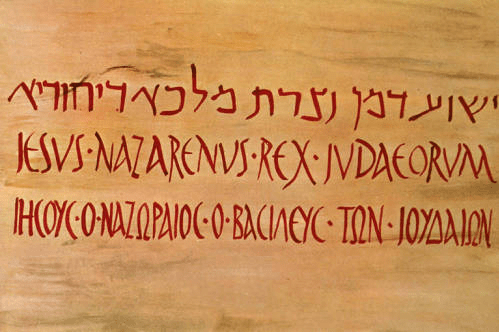
36 Then they sat down and kept watch over him there. 37 And over his head they put the charge against him, which read, “This is Jesus, the King of the Jews.” (Matthew 27:36–37 (ESV)
26 And the inscription of the charge against him read, “The King of the Jews.” 27 And with him they crucified two robbers, one on his right and one on his left.” (Mark 15:26–27 (ESV)
38 There was also an inscription over him, “This is the King of the Jews.” (Luke 23:38 (ESV)
18 There they crucified him, and with him two others, one on either side, and Jesus between them. 19 Pilate also wrote an inscription and put it on the cross. It read, “Jesus of Nazareth, the King of the Jews.” 20 Many of the Jews read this inscription, for the place where Jesus was crucified was near the city, and it was written in Aramaic, in Latin, and in Greek. 21 So the chief priests of the Jews said to Pilate, “Do not write, ‘The King of the Jews,’ but rather, ‘This man said, I am King of the Jews.’ ” 22 Pilate answered, “What I have written I have written.” (John 19:18–22 (ESV)
In our study of the Gospel of Matthew’s record of the Passion Week of the Lord Jesus Christ, it is necessary, and insightful, to examine all four Gospel accounts. This discipline provides us understanding of all the events and encounters which took place during those hours.
For the next several days we will examine what occurred during the first three hours of Jesus’ crucifixion. Today’s focus again concerns the inscription Pontius Pilate wrote and had placed on Jesus’ cross; Jesus of Nazareth, King of the Jews. It is probable Pilate had no awareness the biblical truth of his inscription. He had no knowledge of Psalm 110. It is a Psalm of David. It is a royal psalm ultimately referring to Jesus Christ as the sovereign ruler, or divine/human king, of Israel.
“This psalm contains one of the most exalted prophetic portions of Scripture presenting Jesus Christ as both a holy king and a royal high priest—something that no human monarch of Israel ever experienced. It, along with Ps. 118, is by far the most quoted psalm in the NT (Matt. 22:44; 26:64; Mark 12:36; 14:62; Luke 20:42–43; 22:69; Acts 2:34–35; Heb. 1:13; 5:6; 7:17, 21; 10:13),” explains Dr. John MacArthur.
“While portraying the perfect king, the perfect high priest, and the perfect government, Ps. 110 declares Christ’s current role in heaven as the resurrected Savior (v. 1) and his future role on earth as the reigning Monarch (vv. 2–7). This psalm is decidedly messianic and millennial in content. Jesus Christ (Matt. 22:43–44) verifies the Davidic authorship. The exact occasion of this psalm is unknown, but it could easily have been associated with God’s declaration of the Davidic Covenant in 2 Sam. 7:4–17.”
The outline of Psalm 110 is simple but significant. David’s focus is Christ the King (vs. 1-3) and Christ the High Priest (vs. 4-7). Pontius Pilate did not realize it, but he affirmed the divine kingship and priesthood of Jesus Christ with this inscription.
Soli deo Gloria!





 His Word Today