The Providence of God: Considerations.

“The heart of man plans his way, but the Lord establishes his steps.” (Proverbs 16:9 ESV)

“Here then is a sure resting place for the heart. Our lives are neither the product of blind fate nor the result of capricious chance, but every detail of them was ordained from all eternity; and is now ordered by the living and reigning God. Not a hair of our heads can be touched without His permission. “A man’s heart deviseth his way; but the LORD directeth his steps” (Prov. 16:9). What assurance, what strength, what comfort this should give the real Christian! “My times are in Thy hand” (Ps. 31:15). Then let me “Rest in the LORD, and wait patiently for Him” (Ps. 37:7).” A.W. Pink, The Attributes of God

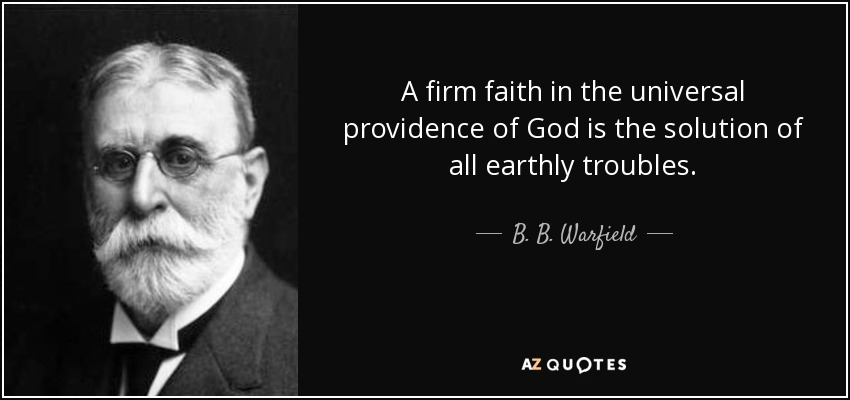
Louis Berkhoff (1873-1957) was a Dutch-American Reformed theologian. He graduated from Princeton Theological Seminary (1904), studying under professors B. B. Warfield and Geerhardus Vos. In addition to pastoring churches in West Michigan, he also taught biblical studies and systematic theology at Calvin Theological Seminary for four decades. He became president of the seminary in 1931 until he retired in 1944.  

One biographer explains, “Professor Berkhoff was not known for being original or speculative but for being very good at organizing and explaining basic theological ideas following in the tradition of John CalvinAbraham Kuyper and Herman Bavinck.”

One of Professor Berknoff’s students was Cornelius Van Til (1895-1987) who served as professor of apologetics and epistemology at Westminster Theological Seminary, Philadelphia, PA.

Theologian Dr. Wayne Grudem has called Berkhof’s Systematic Theology “a great treasure-house of information and analysis […] probably the most useful one-volume systematic theology available from any theological perspective.”  

The following excerpt on God’s providence is taken from Professor Berkhof’s book A Summary of Christian Doctrine. It is available at monergism.com. These meditations are contained in the section entitled The Doctrine of God and Creation.  

“Since God not only created the world but also upholds it, we naturally pass from the doctrine of creation to that of divine providence. This may be defined as that work of God in which He preserves all His creatures, is active in all that happens in the world, and directs all things to their appointed end. It includes three elements, of which the first pertains primarily to the being, the second to the activity, and the third to the purpose of all things.”

1. The Elements of Divine Providence. We distinguish three elements:

a. Divine preservation. This is that continuous work of God by which He upholds all things. While the world has a distinct existence and is not a part of God, it nevertheless has the ground of its continued existence in God and not in itself. It endures through a continued exercise of divine power by which all things are maintained in being and action. This doctrine is taught in the following passages: Ps. 136:25; 145:15; Neh. 9:6; Acts 17:28; Col. 1:17; Heb. 1:3.

b. Divine concurrence. This may be defined as that work of God by which He co-operates with all His creatures and causes them to act precisely as they do. It implies that there are real secondary causes in the world, such as the powers of nature and the will of man, and asserts that these do not work independently of God. God works in every act of His creatures, not only in their good but also in their evil acts. He stimulates them to action, accompanies their action at every moment, and makes this action effective. However, we should never think of God and man as equal causes; the former is the primary, and the latter only a secondary cause. Neither should we conceive of them as each doing a part of the work like a team of horses. The same deed is in its entirety both a deed of God and a deed of man. Moreover, we should guard against the idea that this co-operation makes God responsible for man’s sinful deeds. This doctrine is based on Scripture, Deut. 8:18; Ps. 104:20, 21, 30; Amos 3:6; Matt. 6:45; 10:29; Acts 14:17; Phil. 2:13.

c. Divine government. This is the continued activity of God whereby He rules all things so that they answer to the purpose of their existence. God is represented as King of the universe both in the Old and in the New Testament. He adapts His rule to the nature of the creatures which He governs; His government of the physical world differs from that of the spiritual world. It is universal, Ps. 103:19; Dan, 4:34, 35, includes the most insignificant things, Matt. 10:29-31, and that which is seemingly accidental, Prov. 16:33, and bears on both the good and the evil deeds of man, Phil. 2:18; Gen. 50:20; Acts 14:16.

2. Misconceptions of Divine Providence. In the doctrine of providence, we should guard against two misconceptions:

a. The Deistic conception. This is to the effect that God’s concern with the world is of the most general nature. He created the world, established its laws, set it in motion, and then withdrew from it. He wound it up like a clock, and now lets it run off. It is only when something goes wrong that He interferes with its regular operation. God, is only a God afar off.

b. The Pantheistic conception. Pantheism does not recognize the distinction between God and the world. It identifies the two, and therefore leaves no room for providence in the proper sense of the word. There are, strictly speaking, no such things as secondary causes. God is the direct author of all that transpires in the world. Even the acts which we ascribe to man as really acts of God. God is only a God that is near, and not a God afar off.

3. Extraordinary Providences or Miracles.

We distinguish between general and special providences, and among the latter the miracles occupy an important place. A miracle is a supernatural work of God, that is a work which is accomplished without the mediation of secondary causes. If God sometimes apparently uses secondary causes in the production of miracles, He employs them in an unusual way, so that the work Is after all supernatural.

Some regard miracles as impossible, because they involve a violation of the laws of nature. But this is a mistake. The so-called laws of nature merely represent God’s usual method of working. And the fact that God generally works according to a definite order does not mean that He cannot depart from this order, and cannot without violating or disturbing it bring about unusual results. Even man can lift up his hand and throw a ball into the air in spite of the law of gravitation and without in any way disturbing its operation. Surely, this is not impossible for the omnipotent God. The miracles of the Bible are means of revelation. Num. 16:28; Jer. 32:20; John 2:11; 5:36.

For Further Study:

a. Name some examples of special providences. Cf. Deut. 2:7; I Kings 17:6, 16; II Kings 4:6; Matt. 14:20.

b. How should belief in divine providence affect our cares? Isa. 41:10; Matt. 6:32; Luke 12:7; Phil. 4:6, 7; I Pet. 5:7.

c. Name some of the blessings of providence. Cf. Isa. 25:4; Ps. 121:4; Luke 12:7; Deut. 33:28; Ps. 37:28; II Tim. 4:18.

Soli deo Gloria!

The Providence of God: Salvation.

In him we have obtained an inheritance, having been predestined according to the purpose of him who works all things according to the counsel of his will,” (Ephesians 1:11 (ESV)

Providence is God’s preserving and governing all things by means of primary and second causes (Ps. 18:35; 63:8; Acts 17:28; Col. 1:17; Heb. 1:3). God’s providence extends to the physical and natural world (Ps. 104:14; 135:5-7; Acts 14:17), the overall creation (Ps. 104:21-29; Matt. 6:26; 10:29), the acts of humankind (1 Chr. 16: 31; Ps. 47:7; Prov. 21:1; Job 12:23; Dan.2:21; 4:25), and particular individuals (1 Sam. 2:6; Ps. 18:30; Luke 1:53; James 4: 13-15).

God is in control of the voluntary actions of humans (Ex. 12:36; 1 Sam. 24:9-15; Ps. 33:14, 15; Prov. 16:1; 19:21; 20:24; 21:1). This includes the sinful (2 Sam. 16:10; 24:1; Rom. 11:32; Acts 4:27, 28). and the good (Phil. 2:13; 4:13; 2 Cor. 12:9, 10; Eph. 2:10; Gal. 5: 22-25). In other words, the sinful actions of people occur by God’s permission (Gen. 45:5; 50:20; 1 Sam. 6:6; Ex. 7:13; 14:17; Acts 2:3; 3:18; 4:27, 28), and are within His control (Ps. 76:10), which He uses for good (Gen. 50:20; Acts 3:13; Romans 8:28).

“I have spoken with many Christians over the years who have told me that when they finally came to grasp the sovereignty of God in salvation, they felt as if they were converted to Christ a second time. The reality is that for many people who feel that way, it is actually their first conversion to Christ. For it is only when we come to understand who God truly is that we come to understand ourselves—that we were dead in sin and that God by His sovereign will made us alive in Christ by the Holy Spirit. When we realize that our salvation is all because of God’s amazing grace, our eyes are opened. We see not only that God saved us but also how He saved us as the Spirit helps us reflect on everything that God has been orchestrating throughout our lives to bring about our salvation,” states Pastor Burk Parsons.

I was a first year Bible college student when the realization of God’s providence, of which Pastor Parsons writes, occurred in me. I had been a believer in Christ for three years. It was during a discussion with a professor of mine after a theology class that God’s providence in my salvation became clear. I was stunned. I was overwhelmed. I was filled with awe, joy and a tremendous sense of gratitude to God for saving my soul, when He was under no obligation to do so.

I recalled the believers God brought into my life who shared the Gospel. I thought of an invitation to an Easter Sunday evening concert. I remembered the moment the Holy Spirit regenerated me several months later enabling repentance of my sin and faith in Jesus Christ to occur. These providential events, and many more I suspect, all contributed to my conversion to Christ.

Today’s featured biblical text is one of many addressing the subject of God’s providence in salvation. In explaining the work of the Trinity in saving sinners from the penalty, power and eventual presence of sin (Eph.1:3-14; 2:1-10), the Apostle Paul directly speaks of God’s divine power and purpose; underlying not only the sinner’s salvation but everything else in life and living.

In him we have obtained an inheritance.” God the Father (Eph. 1:3-6), through the person and work of God the Son: Jesus Christ (Eph. 1:7), chose to justify, redeem and reconcile sinners (Rom. 3:21-26), according to His own purpose and will (Eph.1:5, 9). It is because of His purposeful sovereignty; sinners have obtained an inheritance (ἐκληρώθημεν; eklerothemen) referring to God’s sovereign and providential choice. Chosen sinners are passive recipients of God’s active work.

“Having been predestined.” Predestined (προορισθέντες; prooristhentes) means to choose ahead of time or beforehand. It means to foreordain. This also is an active work by God in which sinners are passive recipients.

“According to the purpose of him.” Purpose (πρόθεσιν; prothesis) means to plan or to set forth. In the immediate context, it is to plan in advance the salvation of sinners in Christ alone, by grace alone through God given faith alone (Eph.2:1-9). God’s ultimate purpose in saving sinners is solely sourced and solely originates from God alone.

“Who works all things according to the counsel of his will.” All of the necessary components of salvation, and everything else in God’s created order, is by God’s work according to the counsel of His will. Work (ἐνεργοῦντος; energountos) refers to causing something to function. What God causes to function are all things (πάντα; panta) or everything. This is according to (κατὰ; kata) or in relationship with the counsel (βουλὴν; boulen) or intentional plan of God’s will. Will (θελήματος; thelematos) means God’s intent and desire.

“Neither fate nor human merit determines our destiny. The benevolent purpose—that we should be holy and faultless (Eph. 1:4), Sons of God (verse 5), destined to glorify him forever (verse 6, cf. verses 12 and 14)—is fixed, being part of a larger, universe-embracing plan,” explains Dr. William Hendriksen.

“Not only did God make this plan that includes absolutely all things that ever take place in heaven, on earth, and in hell; past, present, and even the future, pertaining to both believers and unbelievers, to angels and devils, to physical as well as spiritual energies and units of existence both large and small; He also wholly carries it out. His providence in time is as comprehensive as is his decree from eternity. Literally Paul states that God works (operates with his divine energy in) all things. The same word occurs also in verses 19 and 20, which refer to the working (energetic operation) of the infinite might of the Father of glory, which He wrought (energetically exerted) in Christ when He raised Him from the dead. Hence, nothing can upset the elect’s future glory.”

Soli deo Gloria!

The Providence of God: Thoughts by Theologians.

“The lot is cast into the lap, but its every decision is from the LORD” (Pro. 16:33).

The following are select quotes from various evangelical theologians concerning the subject of God’s providence.

“Christian theism is opposed to both a deistic separation of God from the world and a pantheistic confusion of God with the world. Hence the doctrine of creation is immediately followed by that of providence, in which the Scriptural view of God’s relation to the world is clearly defined. While the term “providence” is not found in Scripture, the doctrine of providence is nevertheless eminently Scriptural. The word is derived from the Latin providentia, which corresponds to the Greek pronoia. These words mean primarily prescience or foresight, but gradually acquired other meanings. Foresight is associated, on the one hand, with plans for the future, and on the other hand, with the actual realization of these plans. Thus, the word “providence” has come to signify the provision which God makes for the ends of His government, and the preservation and government of all His creatures. This is the sense in which it is now generally used in theology, but it is not the only sense in which theologians have employed it. Turretin defines the term in its widest sense as denoting (1) foreknowledge, (2) foreordination, and (3) the efficacious administration of the things decreed. In general usage, however, it is now generally restricted to the last sense.”

The Bible clearly teaches God’s providential control (1) over the universe at large, Ps. 103:19; Dan. 4:35; Eph. 1:11; (2) over the physical world, Job 37; PS. 104:14; 135:6; Matt. 5:45; (3) over the brute creation, PS. 104:21, 28; Matt. 6:26; 10:29; (4) over the affairs of nations, Job 12:23; PS. 22:28; 66:7; Acts 17:26; (5) over man’s birth and lot in life, 1 Sam. 16:1; Ps. 139:16; Isa. 45:5; Gal. 1:15-16; (6) over the outward successes and failures of men’s lives, Ps. 75:6, 7; Luke 1:52; (7) over things seemingly accidental or insignificant, Prov. 16:33; Matt. 10:30; (8) in the protection of the righteous, PS. 4:8; 5:12; 63:8; 121:3; Rom. 8:28; (9) in supplying the wants of God’s people, Gen. 22:8, 14; Deut. 8:3; Phil. 4:19; (10) in giving answers to prayer, 1 Sam. 1:19; Isa. 20:5, 6; 2 Chron. 33:13; PS. 65:2; Matt. 7:7; Luke 18:7, 8; and (11) in the exposure and punishment of the wicked, PS. 7:12-13; 11:6. — Louis Berkhof, Systematic Theology, 4th ed.

“God’s works of providence are his most holy, wise, and powerful preserving and governing all his creatures, and all their actions” (Westminster Shorter Catechism Q.11). If Creation was a unique exercise of divine energy causing the world to be, providence is a continued exercise of that same energy whereby the Creator, according to his own will, (a) keeps all creatures in being, (b) involves himself in all events, and (c) directs all things to their appointed end. The model is of purposive personal management with total “hands-on” control: God is completely in charge of his world. His hand may be hidden, but his rule is absolute”.

“Some have restricted God’s providence to foreknowledge without control, or upholding without intervention, or general oversight without concern for details, but the testimony to providence as formulated above is overwhelming.”

“Clear thinking about God’s involvement in the world-process and in the acts of rational creatures requires complementary sets of statements, thus: a person takes action, or an event is triggered by natural causes, or Satan shows his hand – yet God overrules. This is the message of the book of Esther, where God’s name nowhere appears. Again: things that are done contravene God’s will of command – yet they fulfill his will of events (Eph. 1:11). Again: humans mean what they do for evil – yet God who overrules uses their actions for good (Gen. 50:20; Acts 2:23). Again: humans, under God’s overruling, sin – yet God is not the author of sin (James 1:13-17); rather, he is its judge.”

“The nature of God’s “concurrent” or “confluent” involvement in all that occurs in his world, as – without violating the nature of things, the ongoing causal processes, or human free agency – he makes his will of events come to pass, is mystery to us, but the consistent biblical teaching about God’s involvement is as stated above.”

“Of the evils that infect God’s world (moral and spiritual perversity, waste of good, and the physical disorders and disruptions of a spoiled cosmos), it can summarily be said: God permits evil (Acts 14:16); he punishes evil with evil (Ps. 81:11-12; Rom. 1:26-32); he brings good out of evil (Gen. 50:20; Acts 2:23; 4:27-28; 13:27; 1 Cor. 2:7-8); he uses evil to test and discipline those he loves (Matt. 4:1-11; Heb. 12:4-14); and one day he will redeem his people from the power and presence of evil altogether (Rev. 21:27; 22:14-15).”

The doctrine of providence teaches Christians that they are never in the grip of blind forces (fortune, chance, luck, fate); all that happens to them is divinely planned, and each event comes as a new summons to trust, obey, and rejoice, knowing that all is for one’s spiritual and eternal good (Rom. 8:28). – J. I. Packer, Concise Theology.

“GOD’S works of providence are his most holy, wise, and powerful preserving and governing all his creatures and all their actions. Providence, therefore, includes preservation and government. By preservation is meant that all things out of God owe the continuance of their existence, with all their properties and powers, to the will of God. This is clearly the doctrine of the Scriptures. The passages relating to this subject are very numerous. They are of different kinds.”

“First, some assert in general terms that God does sustain all things by the word of his power, as Heb. 1: 3; Col. 1:17, where it is said, “By Him all things consist,” or continue to be. In Neh. 9:6, “Thou, even thou art Lord alone; thou hast made heaven, the heaven of heavens, with all their hosts, the earth, and all things that are therein, the seas, and all that is there in, and thou preserves them all.”

“Secondly, those which refer to the regular operations or powers of nature, which are declared to be preserved in their efficiency by the power of God. See Psalms 104 and 148 throughout, and many similar passages.”

“Thirdly, those which relate to irrational animals.

“Fourthly, those which relate to rational creatures, who are said to live, move, and to have their being in God. These passages clearly teach, (1.) That the universe as a whole does not continue in being of itself. It would cease to exist if unsupported by his power. (2.) That all creatures, whether plants or animals, in their several genera, species, and individuals, are continued in existence not by any inherent principle of life, but by the will of God. (3.) That this preservation extends not only to the substance but also to the form; not only to the essence, but also to the qualities, properties, and powers of all created things.” – Charles Hodge, Princeton Theological Seminary

Soli deo Gloria!  

The Providence of God; What is Providence?   

Do you believe in magic? I sure hope my luck holds out. It was a simple twist of fate. The team doesn’t stand a chance. May the force be with you. All these exclamations seek to explain why things happen the way they do.

What do the words magic, luck, fate, chance and force have in common? What binds them together into a cohesive whole? Ironically, the correct answer is nothing because all these concepts are nothing. They do not exist. They are not real. They are not truth. They are impersonal ideas with no power or ability having no reason or rhyme. In other words, magic, luck, fate, chance, are attempts to explain away the doctrine of God’s person, power and providence.  

I often remark to friends and acquaintances that I do not believe in coincidences. A coincidence is a series of circumstances with no apparent causal power. It’s finding a parking space exactly when you need one. It’s the grocery store employee putting a highly in demand sale item on the store shelf just as you enter the aisle. It’s resigning from one job you had and then receiving an offer “out of the blue” for a job you want and are qualified. It’s trying to select a surgeon from a submitted list and then discovering a fellow believer in Christ worked for one of the doctors on the particular list and gives you a high recommendation for that surgeon. These are all personal examples. Perhaps you can relate.

Providence is from the word “provide.” The prefix “pro” is from the Latin meaning “forward” or “on behalf of,” and “vide” meaning “to see.” However, providence does not simply mean to see forward or to see what happens before it happens. Rather, God’s providence is “the act or purposefully providing for, or sustaining and governing, the world,” states pastor and teacher Dr. John Piper.

In other words, providence acknowledges God is in active control of everything happening in this world. He not only created the world (Gen. 1:1; John 1:1-2), but He also sustains the world He created (Heb. 1:1-3). In God alone we live and move and have our being (Acts 17:28). This truth applies to all of creation. It applies to the converted and the unconverted.

“As Christians, we know there is really no such thing as luck, chance, or fate. We understand that providence is not the Christian synonym for coincidence. We know that everything happens for a reason, and unlike unbelievers who often say the same thing, we actually know the God who is in control of all things. We know the ultimate reason that everything happens: God’s glory and our ultimate, eternal good,” explains Pastor Burk Parsons. 

“As Christians, we cannot help but believe that God is sovereign, for if we don’t believe in His sovereignty, we don’t actually believe that God is God. And if we believe in the sovereignty of God, we must also believe in the providence of God. Though sovereignty and providence are inseparably related, they are not the same. Simply put, God’s providence is the active outworking of God’s sovereignty in everything. Thus, there are no good providences or bad providences, happy or hard providences, but simply providence.”

Isaiah 46:8–10 (ESV) says, “Remember this and stand firm, recall it to mind, you transgressors, remember the former things of old; for I am God, and there is no other; I am God, and there is none like me, 10 declaring the end from the beginning and from ancient times things not yet done, saying, ‘My counsel shall stand, and I will accomplish all my purpose.”

Pastor John Piper defines providence as God’s purposeful action. “God is never merely an observer. He is not a passive observer of the world—and not a passive predictor of the future. Wherever God is looking, God is acting. What we find in the Bible is real and raw. The prizing and proclamation of God’s pervasive providence was forged in flames of hatred and love, deceit and truth, murder and mercy, carnage and kindness, cursing and blessing, majesty and revelation, and finally, crucifixion and resurrection.”

Believers in Christ have the ability to see God’s providence in everything which happens in our lives. The question is whether we joyfully acknowledge this biblical truth or just begrudgingly and reluctantly accept it. Our response to God’s purposeful sovereignty determines whether we will have joy or sorrow, trust or distrust, peace or anxiety in living for Christ in this life.

Consider the words of the Apostle Paul. 33 “Oh, the depth of the riches and wisdom and knowledge of God! How unsearchable are his judgments and how inscrutable his ways! 34 “For who has known the mind of the Lord, or who has been his counselor?” 3“Or who has given a gift to him that he might be repaid?” 36 For from him and through him and to him are all things. To him be glory forever. Amen.” (Romans 11:33–36 (ESV)

This series of articles is not coincidental, a simple twist of fate, or a matter of luck or chance. Neither is your reading of the same. It is providential. I’m glad you’re with me on this journey into the heights and depths of biblical truth of the providence of God.  

Soli deo Gloria!

The Gospel of Matthew: Final Thoughts from the First Gospel.

“It is not how you start the race of where you are during the race–it is how you cross the finish line that will matter.” — Robert D. Hales

The phrase ‘It is not how you start but how you finish’ means that what matters is how you end something, not how you begin itIf you start out strong and finish weak, you will be remembered for your lack of ability to produce. Conversely, if you start weak but finish strong, you will be remembered as a heroThis phrase is often used to encourage people to persevere and finish what they started, even if they encounter difficulties along the way.”

Our study of The Gospel of Matthew began in November, 2022. It startles me realizing this exegetical examination of Matthew’s Gospel has taken over two years. I have enjoyed this journey. I trust you have also.

I thought it would be interesting to look over my introduction. Here is what I wrote and the thoughts I quoted.

“The New Testament begins with the life, death, and resurrection of our Lord Jesus Christ. No part of the Bible is so important as this, and no part is so full and complete. Four distinct Gospels tell us the story of Christ’s doing and dying. Four times over we read the precious account of His works and words. How thankful we ought to be for this! To know Christ is life eternal. To believe in Christ is to have peace with God. To follow Christ is to be a true Christian. To be with Christ will be heaven itself. We can never hear too much about Jesus Christ.” –J.C. Ryle


“Because of the tight relationships among the Synoptic Gospels, the contribution made by any one of them must be evaluated in light of the contribution made by all three. If Matthew suddenly disappeared, much of its material would still be found, more or less intact, in Mark and Luke.”

“But the Synoptic Gospels as a whole make an irreplaceable contribution. Alongside John, they constitute the foundational witness to the person, ministry, teaching, passion, and resurrection of Jesus the Messiah. Nor are the three Synoptic Gospels to be seen as merely redundant testimony. Each provides its own slant, together providing a kind of stereoscopic depth that would otherwise be almost entirely missing. And at a secondary level, each provides a window onto the life of the church at the time each was written. But this window, it must be insisted, is never transparent: it is at best translucent, and the shadows one sees through it have to be interpreted with some care.” – D.A. Carson & Douglas J. Moo

The Gospel of Matthew is the first Gospel, and book, in the New Testament, or the New Covenant Canon. The Gospel of Matthew contains the greatest amount of Jesus’ ethical teaching than anywhere else in the New Testament. From the earliest days of the church, Matthew’s Gospel has been one of the most widely read and perhaps the most influential of the four Gospels. Therefore, a study of this Gospel is imperative.  

Matthew means “gift of the Lord.” It was the alternative name of Levi, the tax collector (Matt. 9:9-13), who left everything to follow Christ (Luke 5:27–32). Matthew was one of the 12 apostles (Matt. 10:3Mark 3:18Luke 6:15Acts 1:13). In his own list of the Twelve, he explicitly called himself a “tax collector” (Matt. 10:1-3). Nowhere else in Scripture is the name Matthew associated with “tax-collector.” The other Gospels always use his former name, Levi, when speaking of his life prior to his conversion.

The canonicity and Matthew’s authorship of this Gospel were unchallenged in the early church. Eusebius (c. A.D. 265–339) said that the early church father Papias spoke of Matthew arranging the oracles of Jesus.

“Among the four Gospels, which are the only indisputable ones in the Church of God under heaven, I have learned by tradition that the first was written by Matthew, who was once a publican, but afterwards an apostle of Jesus Christ, and it was prepared for the converts from Judaism” explains Origen (c. A.D. 185–254) in his Ecclesiastical History, 6:25.

Most biblical scholars claim this Gospel was written at a relatively early date—prior to the destruction of the temple in A.D. 70. Some scholars propose a date as early as A.D. 50, but no later than A.D. 100.

I encouraged us then to begin reading the Gospel of Matthew. I encourage us   now to remember what we have read, the meaning of what we have read, and its application in our lives.

Have a blessed day in the Lord.

Soli deo Gloria!  

The Gospel of Matthew: I Am with You Always. Revisited.

16 Now the eleven disciples went to Galilee, to the mountain to which Jesus had directed them. 17 And when they saw him they worshiped him, but some doubted. 18 And Jesus came and said to them, “All authority in heaven and on earth has been given to me. 19 Go therefore and make disciples of all nations, baptizing them in the name of the Father and of the Son and of the Holy Spirit, 20 teaching them to observe all that I have commanded you. And behold, I am with you always, to the end of the age.” (Matthew 28:16–20 (ESV)

The following excerpt is by Dr. Gerrit Scott Dawson is pastor of First Presbyterian Church, Baton Rouge, La., and author of Jesus Ascended: The Meaning of Christ’s Continuing Incarnation. The article was published in the April 2014 issue of Tabletalk magazine.

Jesus would soon return to heaven while His disciples went out into the world in gospel mission. But they were not going their separate ways. Jesus and His brothers could not be parted by the distance between the world and the heavenly realms. How can this be?

Jesus’ missional instructions can well be translated, “baptizing them into the name of the Father and of the Son and of the Holy Spirit” (28:19). That gives an important insight into conversion and the sealing sign of baptism. Our lives get relocated when we are joined to Jesus by the Spirit through faith. We are launched into Jesus. So now our lives are “hidden with Christ in God” (Col. 3:3). Paul writes dynamically of this reality when he says the Father “has delivered us from the domain of darkness and transferred us to the kingdom of his beloved Son” (1:13).

It’s as if God sent a moving truck to take us out of a dank, evil, broken neighborhood of sin into the spacious streets of freedom in Christ. Peter describes it as God’s “calling us out of darkness into his marvelous light” (1 Peter 2:9). Jesus Himself stated this change of life-address even more mystically: “In that day you will know that I am in my Father, and you in me, and I in you” (John 14:20). These verses give some texture to the phrase Paul uses so often: we are now in Christ.

Jesus is with us always because Jesus is where I live. Believers are forever joined to Him. Jesus returned to heaven and spiritually took us along. What a mystery: “Even when we were dead in our trespasses, [God] made us alive together with Christ . . . and raised us with him and seated us with him in the heavenly places in Christ Jesus” (Eph 2:5–6). Yes, this is a spiritual reality now, as my body quite obviously is still here on the ground. One day, of course, the union will be completed as we receive our resurrection bodies that we might always be in immediate communion with Jesus and one another.

Meanwhile, while we are on earth, Jesus stays with us through His Spirit whom He sends to us. Paul writes, “God’s love has been poured into our hearts through the Holy Spirit who has been given to us” (Rom. 5:5). The Spirit is the personal presence of Jesus “housed” in us. By the Spirit, the Father and Son make a home in us (John 14:23). Christians, both individually and corporately as the church, are a dwelling in which the eternal exchange of love between the Triune persons gets lived out. The Holy Spirit in us keeps us joined to Jesus, who has taken His resurrection body into heaven. He ever lifts us up to see that our true life is located there, in Christ.

The biblical understanding of Jesus’ being with us is very different from any idea that Jesus’ presence just gives a helpful boost to the life I’m trying to make for myself. “I am with you always” does not mean I have a miniature Jesus tucked inside me for inspiration amid my ambitions or for comfort when things don’t go my way. Rather, my little life is taken up into the greatness of Jesus. He is with us most profoundly because by the Spirit we are in Christ. My purpose in life, then, is directed by His mission for His people.

So, I am propelled out of my cozy home where I’d like to stay while Jesus comforts me. He sends me to the cranky neighbor to witness to him with the awareness that Jesus loves him as much as He loves me. “I am with you as you love him in Me.”

Jesus goes with me from my relatively safe street to the sharp neighborhood filled with angry discards. “Pitch a tent there,” He whispers, “as I took up a tent of flesh in a broken world.” That might mean beginning a school, a sports camp, or a clinic in His name.

Right where I don’t want to go, Jesus already is there. He even sends me to engage the people who will scoff at mention of His name. I’d like to avoid them, to keep away from controversy. But the Lord who continues to mix it up in the world He is reclaiming reminds me: “You are in Me, and I am sending My gospel into the world. So you can trust that I am with you as you go into those tricky conversations.”

Jesus is with us always, first and most profoundly because His Spirit has taken us up into His life and, therefore, His mission.

Soli deo Gloria!

The Gospel of Matthew: I Am with You Always.  

16 Now the eleven disciples went to Galilee, to the mountain to which Jesus had directed them. 17 And when they saw him they worshiped him, but some doubted. 18 And Jesus came and said to them, “All authority in heaven and on earth has been given to me. 19 Go therefore and make disciples of all nations, baptizing them in the name of the Father and of the Son and of the Holy Spirit, 20 teaching them to observe all that I have commanded you. And behold, I am with you always, to the end of the age.” (Matthew 28:16–20 (ESV)

Moses was dead (Joshua 1:1-2). For over forty years, he had been God’s chosen instrument to not only lead the nation of Israel out of Egypt, but also to lead their return to the Promised Land after 430 years of captivity (Gen. 15:13; Ex. 12:40).

Moses was dead. The question now was who would succeed him? The LORD knew the answer and the individual He would call to assume the mantel of servant leadership; Joshua.

“After the death of Moses, the servant of the Lord, the Lord said to Joshua the son of Nun, Moses’ assistant, “Moses my servant is dead. Now therefore arise, go over this Jordan, you and all this people, into the land that I am giving to them, to the people of Israel. Every place that the sole of your foot will tread upon I have given to you, just as I promised to Moses,” (Joshua 1:1-3).

What do we know about Joshua? “And Joshua the son of Nun was full of the spirit of wisdom, for Moses had laid his hands on him. So, the people of Israel obeyed him and did as the Lord had commanded Moses.”  (Deuteronomy 34:9 (ESV)

The LORD was ready for Joshua to lead Israel. Israel was ready for Joshua to lead them. However, Joshua was not so sure. Three times the LORD commanded Joshua to be strong and courageous (Joshua 1:6, 7, 9). The reason God gave this command was because Joshua was feeling pretty weak and scared. Who wouldn’t be? Wouldn’t you be?

How often are we feeling weak and afraid to do what the LORD has called us to do? We know even His eleven apostles, and many other disciples, were feeling this sense of weakness and fear (John 14:1). Perhaps they were wondering if they were up to the task of making disciples, baptizing them, and teaching them. Have you wondered the same things when God calls you to serve Him and others?

The LORD gave Joshua a promise. It was the same promise Jesus gave to the disciples. It is the same promise He gave, and gives, to the church. It is this; “I will not leave you nor forsake you” (Joshua 1:5, 9; Matt. 28:20; Heb. 13:5). God is with us wherever we go.

“What a wonderful way to conclude a gospel. The story of the God who came from heaven to earth wraps up with the assurance, “And behold, I am with you always, to the end of the age” (Matt. 28:20). Though Jesus was about to ascend, Matthew wants us to hear that the nearness of Christ’s incarnation continues. He who is Immanuel, God with us, promises to live up to His name,” explains Pastor Gerrit Scott Dawson.

“There’s a touching echo of the beginning of Matthew’s Gospel here. Immanuel, which is translated, “God with us” (1:23), remains “with” us “to the end of the age”—i.e., until he returns bodily to judge the world and establish his earthly kingdom,” concludes Dr. John MacArthur.

“As Christ gave to the apostles a commission which they were unable to discharge by reliance on merely human power, He encourages them by the assurance of his heavenly protection. For before promising that He would be with them, He began by declaring that He is the, King of heaven and earth, who governs all things by His power and authority,” states John Calvin.

What was Joshua’s response to the LORD’s promise? We do not have to wonder. It was heartfelt strong and courageous obedience.

10 And Joshua commanded the officers of the people, 11 “Pass through the midst of the camp and command the people, ‘Prepare your provisions, for within three days you are to pass over this Jordan to go in to take possession of the land that the Lord your God is giving you to possess.’” (Joshua 1:10–11 (ESV)

What was the disciples’ response? The Acts of the Apostles, along with the rest of the New Testament, provides us with the answer. They were faithful, even in the face of death.

For I am already being poured out as a drink offering, and the time of my departure has come. I have fought the good fight, I have finished the race, I have kept the faith. Henceforth there is laid up for me the crown of righteousness, which the Lord, the righteous judge, will award to me on that day, and not only to me but also to all who have loved his appearing.” (2 Timothy 4:6–8 (ESV)

What is, and will be, our response? May it be the same as our spiritual forefathers.

Soli deo Gloria!

The Gospel of Matthew: God’s Commands.

16 Now the eleven disciples went to Galilee, to the mountain to which Jesus had directed them. 17 And when they saw him they worshiped him, but some doubted. 18 And Jesus came and said to them, “All authority in heaven and on earth has been given to me. 19 Go therefore and make disciples of all nations, baptizing them in the name of the Father and of the Son and of the Holy Spirit, 20 teaching them to observe all that I have commanded you. And behold, I am with you always, to the end of the age.” (Matthew 28:16–20 (ESV)

One of the most overlooked components of the Great Commission is the word commanded. The word makes some believers in Christ uncomfortable. For many, the licentious concept of freedom evokes strong emotions against any restrictions of one’s personal choices; regardless of what Scripture says.

The word “commanded” (ἐντέλλω; entello) refers to an order, instruction and a charge. It involves an order or direction to be obeyed. Jesus gave commandments. They were/are personal and propositional truths. They are as binding and harmonious to the commands contained in the Old Testament Scriptures. Remember, Jesus did not come to do away with God’s commandments, but rather to fulfill them.

17 “Do not think that I have come to abolish the Law or the Prophets; I have not come to abolish them but to fulfill them. 18 For truly, I say to you, until heaven and earth pass away, not an iota, not a dot, will pass from the Law until all is accomplished.” (Matthew 5:17–18 (ESV)

34 But when the Pharisees heard that he had silenced the Sadducees, they gathered together. 35 And one of them, a lawyer, asked him a question to test him. 36 “Teacher, which is the great commandment in the Law?” 37 And he said to him, “You shall love the Lord your God with all your heart and with all your soul and with all your mind. 38 This is the great and first commandment. 39 And a second is like it: You shall love your neighbor as yourself. 40 On these two commandments depend all the Law and the Prophets.” (Matthew 22:34–40 (ESV)

“The goal of theology, the study of God, is to grow in our knowledge of God, and as we know God better, we should love Him and His people more. Otherwise, something has gone wrong. This is part of what Jesus meant when He identified the two great commandments: love God and love neighbor (Matt. 22:34–40),” explains one commentator.

“The goal of theology is ultimately worship and the building up of the church, so to be good theologians we must be people who seek the face of the Lord and adore Him in prayer and worship both individually and corporately. We must be those who love the church of Jesus Christ and who want to see it grow in faithfulness.”

Jesus stated His current disciples were to teach future and younger disciples to observe all that He commanded. There is the explicit relationship of connection with the “them” and the “you.” The “them” are new believers in Christ. The ‘you” refers to mature disciples of the Lord. What Jesus stated in principle is clarified by other biblical texts. Here are some examples.

Galatians 5:13–14 (ESV) – 13 For you were called to freedom, brothers. Only do not use your freedom as an opportunity for the flesh, but through love serve one another. 14 For the whole law is fulfilled in one word: “You shall love your neighbor as yourself.”

1 Timothy 4:8–16 (ESV) – 8 …for while bodily training is of some value, godliness is of value in every way, as it holds promise for the present life and also for the life to come. The saying is trustworthy and deserving of full acceptance. 10 For to this end we toil and strive, because we have our hope set on the living God, who is the Savior of all people, especially of those who believe. 11 Command and teach these things. 12 Let no one despise you for your youth, but set the believers an example in speech, in conduct, in love, in faith, in purity. 13 Until I come, devote yourself to the public reading of Scripture, to exhortation, to teaching. 14 Do not neglect the gift you have, which was given you by prophecy when the council of elders laid their hands on you. 15 Practice these things, immerse yourself in them, so that all may see your progress. 16 Keep a close watch on yourself and on the teaching. Persist in this, for by so doing you will save both yourself and your hearers.”  

Titus 2:1–8 (ESV) – “But as for you, teach what accords with sound doctrine. Older men are to be sober-minded, dignified, self-controlled, sound in faith, in love, and in steadfastness. Older women likewise are to be reverent in behavior, not slanderers or slaves to much wine. They are to teach what is good, and so train the young women to love their husbands and children, to be self-controlled, pure, working at home, kind, and submissive to their own husbands, that the word of God may not be reviled. Likewise, urge the younger men to be self-controlled. Show yourself in all respects to be a model of good works, and in your teaching show integrity, dignity, and sound speech that cannot be condemned, so that an opponent may be put to shame, having nothing evil to say about us.”

God’s commands are not restricted to a Top Ten List. They are many and extensive for all of life and living in Christ. Obedience to the Lord’s orders involve the believer’s mind, emotions and will. Believers in Christ are not to be blindly obedient but intelligently, emotionally and volitionally committed to obey God’s revelation and truth.

Consider the many areas of life the LORD Jesus Christ calls believers in Christ to obedience. Discover areas of obedience to Christ you may never knew existed within the Scriptures. Primarily consider the moral commandments God has given, which remain in force within the New Covenant. What commands of God are easy to obey, and which ones are difficult?

“In short, let us hold that by these words teachers are appointed over the Church, not to put forward whatever they may think proper, but that they, as well as others, may depend on the mouth of the Master alone; so as to gain disciples for Him and not for themselves,” explains John Calvin.

Soli deo Gloria!

The Gospel of Matthew: Teaching Them to Observe.

16 Now the eleven disciples went to Galilee, to the mountain to which Jesus had directed them. 17 And when they saw him they worshiped him, but some doubted. 18 And Jesus came and said to them, “All authority in heaven and on earth has been given to me. 19 Go therefore and make disciples of all nations, baptizing them in the name of the Father and of the Son and of the Holy Spirit, 20 teaching them to observe all that I have commanded you. And behold, I am with you always, to the end of the age.” (Matthew 28:16–20 (ESV)

The following article is by Victor-Hugo Cruz, a church-planting pastor in Mexico City. It was originally published in 2014 in Tabletalk Magazine.

Being an evangelist is more than just telling people about Jesus; it requires that we become teachers of the gospel. The gospel is proclaimed by the preaching of the good news. This is the beginning. But we also need to explain to new believers the implications and consequences of believing in the gospel. This is necessary to make real disciples.

The Authority to Teach

R.T. France notes that when Jesus said to His disciples that they would have to teach, He was transferring to them the authority to be teachers. In 28:20, Matthew uses for the first time the verb “teach”—didaskō—which implies that the disciples then had authority from Christ to teach others.

Believing in the gospel requires the newborn believer to submit to teaching and to receive instruction in order to live according to Jesus’ will. Making disciples starts with the confession of faith in Christ (Rom. 10:9); then, baptism in the name of the Father, Son, and Holy Spirit so that we can join the church in order to learn to observe all that Jesus has commanded us in the context of a community of believers.

The Need to Teach

The fact that the church has been established by Jesus to be a teaching community is clear. And if this is the nature of the church, then Christian ministry is mainly a teaching ministry.

In Acts 2:42, we learn that the primitive church gathered together to devote themselves to the Apostles’ teaching and to fellowship, to the breaking of bread and to prayer. The first Christians prioritized their time together in order to comprehend the gospel and its implications in their lives. The Apostles formulated the gospel. Then the preachers proclaimed the gospel and the teachers taught the ethical implications of the message.

God has given the church gifts in order to keep the gospel at the center of the new community. Paul, in his second letter to Timothy, says, “For this gospel I was appointed a preacher and apostle and teacher” (1:11). All the gifts and status given to Paul were used to serve the gospel. The church, then, should be the guardian of the gospel, and everything the church does and every ministry in the church should be an instrument for the promotion of the gospel and the advance of Christ’s kingdom. This is the only way to fulfill the Great Commission.

What to Teach

As we evaluate which teachings are essential for new disciples, we may want to consider what Derek Tidball suggests were Paul’s teaching goals:

He (the apostle) wants his disciples to grow up, to become mature adults, no longer infants and children (1 Cor. 3:1–4; 14:20Eph. 4:14–15). He wants the bride to be a virgin, betrothed to one husband, with eyes for no one else (2 Cor. 11:2). Using imagery from the gymnasium and the athletics track, he wants them to develop strength, build stamina and not be feeble in faith (1 Cor. 9:24–27Eph 4:161 Thess. 3:22 Thess. 2:17, 3:3). Using agricultural imagery, he wants the roots to go down deep and see fruit development (1 Cor. 3:5-92 Cor. 9:10Gal. 5:22 Phil. 1:11Col. 1:10; 2:7). Using educational imagery, he wants them to “learn Christ” (Eph. 4:20).

Tidball demonstrates here the rich diversity of teachings that disciples are to receive but which are nonetheless focused on one goal: the creation of strong, mature believers.

When Paul knew that he was close to death, he reminded Timothy of his duty to the gospel. The heart of his ministry was to preach and teach the gospel, to defend it against attack and falsification, and to ensure its accurate transmission to the generations to come. Timothy was charged to guard the gospel (2 Tim. 1:14), to suffer for the gospel (2:3, 8–9), to continue in the gospel (3:13–14), and to proclaim the gospel (4:1–2). This is the greatest privilege and duty that can be entrusted to a teacher: to be the guard of the gospel and to teach it faithfully to faithful disciples.

Soli deo Gloria!