
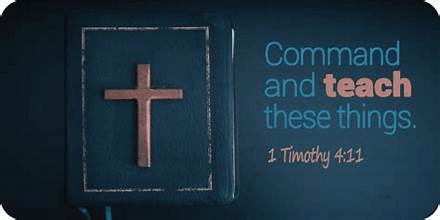
11 Command and teach these things. 12 Let no one despise you for your youth, but set the believers an example in speech, in conduct, in love, in faith, in purity.” (1 Timothy 4:11–12 (ESV)
“Now, in the passage before us today Paul has some words, very personal words, for a man that he knew and loved very well: Timothy. And it would be very tempting for us…and you’re going to hear the “personal-ness” of this message in the pronouns that he uses. He’s speaking “you, you, you, you, Timothy,” and even some of the instructions that he gives are couched in the distinctive personality of Timothy,” explains Pastor Dr. J. Ligon Duncan.
“Timothy was a man who was constitutionally weak, he had stomach problems. He was temperamentally meek, he was given to deference. He had been Paul’s right-hand man, and frankly, he was having a hard time transitioning into the role of leadership where “he was the man.” He was young, and all of those combined to bring about certain characteristics and dynamics in the way that Paul speaks to him in this passage.”
“So, it would be very tempting for us to say, “Well, good. We’re getting ready to listen in on what Paul has to say to one minister, and what this says doesn’t say anything to me today.” You, if you took that posture, would be in the wrong position! Because every word of Scripture is given by inspiration and every word is profitable for you, for reproof and correction and training in righteousness, (2 Tim. 3:16-17).”
“First of all, in this passage what Paul says to Timothy is not only
applicable to Timothy; it is applicable to everyone who is a minister of the
gospel. Secondly, however, even in the things that Paul tells Timothy to do here, there is much that is said about what the ministry pattern of the local church is to be, if Timothy does the things that Paul tells him to do in I Timothy 4:11-16. But finally, you as a believer can learn much about what you are to be and do from this passage to a Christian minister. Why? Because in this passage Paul says, Timothy, you are to do this in order to be an example to the flock. Even though these words in the first instance are spoken to a minister, they’re applicable to every Christian,” concludes Dr. Duncan.
It is imperative for believers in Christ to know what this particular text says, what it means and how it may be applied in our lives. As is the case with this portion of Scripture, so it should be with all portions of Scripture.
The Apostle Paul wrote, “Command and teach these things.” Command (Παράγγελλε; Parangelle) is a present, active, imperative verb. Paul gave an order to Timothy, who in turn was to give an order to the believers in the church he pastored. A command is God’s announcement as to what He wants us to do. God commanded Timothy to give a command from God Himself. This was a solemn responsibility.
Paul not only gave a command from God for Timothy to announce what believers in Christ must do, but he also commanded Timothy to teach believers what they must do. The word teach (δίδασκε; didaske) is also a present, active, imperative verb. It means to instruct in either a formal or informal setting.
The phrase these things (ταῦτα; tauta) refers us back to the immediate context of I Timothy 4:1-10. The apostle commanded the pastor to teach what he taught him, which in turn was what the Lord taught the apostle. These things refer us back to the subjects of apostasy, deceitful spirits, doctrines of demons, seared consciences, and man-made requirements. It also includes genuine thanksgiving to God, good servanthood, words of faith and good doctrine, training for godliness, a willingness to toil and strive for biblical truth, and to set one’s hope solely in the living God who alone is the Savior of sinners.
“Timothy is told to command (or: to keep on commanding) and teach (or: to keep on teaching; both verbs are present imperatives) these things. He must command such things as, “Profane and old-womanish myths shun,” “Train yourself (and yourselves) for godly living” (verse 7). Orders such as these apply not only to Timothy himself but to all the presbyters, yes, and even to all Christians. It is probable that the expression “these things” in connection with “command” refers also to implied commands, such as, “Never reject what God has intended for use, but partake of it with thanksgiving” (verses 3, 4), “Nurture yourself (yourselves) on the words of faith and sound doctrine” (verse 6), “Rely on the living God and on his promise to all who live the godly life and who accept him by genuine faith” (verses 8, 9),” explains Dr. William Hendriksen..[1]
“Timothy must teach such things as, “Apostasy is coming, in the form of asceticism” (verses 1–3), “That error is an insult to God and to his work of creation” (verses 4, 5), “An excellent minister is one who is nourished on sound doctrine which he transmits to others” (verse 6), “The benefit which accrues from godly living transcends that which results from physical training (verses 8–10).”[2]
The application is clear. What Paul commanded Timothy to teach is what God commands all believers in Christ to teach. The Lord’s marching orders have not changed. They are still in force. God calls us to obey them without wavering. As we do, we may face toil and strife in this fallen world, who reject the message and the Messiah.
When this happens let each of us be encouraged by the words of our Savior and Lord who said, “11 “Blessed are you when others revile you and persecute you and utter all kinds of evil against you falsely on my account. 12 Rejoice and be glad, for your reward is great in heaven, for so they persecuted the prophets who were before you.” (Matthew 5:11–12 (ESV).
May the Lord’s truth and grace be found here. Have a blessed day in the Lord.
Soli deo Gloria!
[1] William Hendriksen and Simon J. Kistemaker, Exposition of the Pastoral Epistles, vol. 4, New Testament Commentary (Grand Rapids: Baker Book House, 1953–2001), 156–157.
[2] Ibid., 157.





 His Word Today