2 Thessalonians: Chosen by the Father, Loved by the Son and Sanctified by the Holy Spirit.

13 But we ought always to give thanks to God for you, brothers beloved by the Lord, because God chose you as the firstfruits to be saved, through sanctification by the Spirit and belief in the truth. 14 To this he called you through our gospel, so that you may obtain the glory of our Lord Jesus Christ.” (2 Thessalonians 2:13–14 (ESV)

The content of today’s text encompasses many themes and doctrines the Apostle Paul previously mentioned to the Thessalonian believers. Take note of the following outline and cross references.

For “we are obliged to give thanks to God always for you” see on 2 Thess. 1:3.                 For “brothers beloved by the Lord” cf. see on 1 Thess. 1:4.                                         For “because God chose you” see on 1 Thess. 1:4.                                                     For “salvation” see on 1 Thess. 5:8, 9.                                                                      For “sanctification” see on 1 Thess. 4:3, 7.                                                                   For “belief” see on 2 Thess. 1:3, 4, 11; 1 Thess. 1:3.                                                     For “truth” see on 2 Thess. 2:10, 12.                                                                       For “calling” see on 1 Thess. 1:5; 2:12; 4:7; 5:24.                                                         For “with a view to obtaining” see on 1 Thess. 5:9.                                               For “glory” see on 1 Thess. 2:12.                                                                                    For “our Lord Jesus Christ” see on 1 Thess. 1:1.[1]

Why was Paul was grateful for the Thessalonians? To begin with, the Lord Jesus Christ loved them.

Second, the apostle was grateful for God the Father’s choosing them to be saved. The sovereignty of God in salvation is an often misunderstood and debated biblical doctrine. Some believers in Christ love it, while others reluctantly accept it. Still other believers hate and reject it. It has been a contested topic throughout church history and remains an intramural debate among Christians today.

The Apostle Paul stated to the Thessalonian believers God chose you. The word chose (εἵλατο; heilato) means to select for the purpose of special favor from, and by, the one who selects. Firstfruits (ἀπαρχὴν; aparchen) refers to the first portion of a harvest. It also means a foretaste of what is to come. It can also refer to a beginning. The beginning the apostle spoke of is salvation. To be saved (σωτηρίαν; soterian) means deliverance. In the context, the deliverance God provides for sinners is from the penalty, power and eventual presence of their sin.

Some theologians speculate God chose individuals for salvation because of some foreseen faith. This is known as Prescient View of election. The argument is God looked down the corridors of time and saw who would positively respond to the offer of the Gospel of Jesus Christ.

Based upon this foreseen faith, God then chose to elect sinners unto salvation. This is a misunderstood interpretation of Romans 8:29. For God to foreknow means to foreordain and to love beforehand. The prescient view is also a denial of John 1:12-13 and Romans 9:14-16. It also fails to consider saving faith is a sovereign gift from God (Acts 1 3:48; Eph. 2:1-9; Phil 1>29; 2 Peter 1:1-2).

Third, the Lord’s love and the Father’s choosing would coincide with the sanctification by the Spirit. Sanctification (ἁγιασμῷ; hagismo) means to be set apart, consecrated, and dedicated to God. It also refers to personal holiness. The Holy Spirit sanctifies each believer in Christ as the believer grows in knowledge of God’s Word, prayer, and holy living (Phil. 2:12-13).

Finally, God’s choice of sinners unto salvation is for belief in the truth. The elected believer is to have an increasing trust in, commitment to, dependence upon and honor towards the Word of God.

“The Apostle gives us this information in the context of telling the Thessalonians that he ought always to thank God for them. In so doing, he gives us a remarkably full-orbed presentation of the Lord’s work in salvation that packs a lot of material in a concise form,” states Dr. R. C. Sproul.

“First, we get a picture of the work of the three persons of the Trinity in redemption. Believers are chosen by “God,” Paul’s common way of referring to God the Father. We are loved by “the Lord,” Paul’s preferred name for God the Son. Finally, we are sanctified by the Holy Spirit (v. 13). Each of the persons of the Godhead is active in our salvation, yet we should not think of each of Them as performing a unique work in which the others do not participate. Note that we are loved by the Son (v. 13), and that Paul says elsewhere that the Father, in love, predestined believers in Christ for salvation (Eph. 1:3–10). Election to salvation is not the work of the Father alone, but the Son also loves us and thus chose us for redemption. By extension, given all that the Bible says about the Holy Trinity, the Spirit is also involved in predestinating God’s people to salvation.”

May we thank the Father, Son and holy Spirit for our salvation. Have a blessed day in the Lord.

Soli deo Gloria!


[1] William Hendriksen and Simon J. Kistemaker, Exposition of I-II Thessalonians, vol. 3, New Testament Commentary (Grand Rapids: Baker Book House, 1953–2001), 187


2 Thessalonians: Deluded and Condemned.   

11 Therefore God sends them a strong delusion, so that they may believe what is false, 12 in order that all may be condemned who did not believe the truth but had pleasure in unrighteousness.” (2 Thessalonians 2:11–12 (ESV)

The Apostle Paul described the Antichrist in specific terms. He is (1) a man of lawlessness; (2) the son of destruction; (3) self-exalting; (4) proclaims to be God; (5) is already working lawlessness; (6) is restrained; (7) will be killed by Jesus; (8) is empowered by Satan; (9) will do false signs and wonders; and (10) will use wicked deception for those who are perishing (2 Thess. 2:3-10).

Paul then shifted his attention from the Antichrist to those deceived by the Antichrist. These are they who do not believe the truth of God and also take pleasure in unrighteousness. What truth do these individuals reject? Romans 1:18-23 provides the answer.

18 For the wrath of God is revealed from heaven against all ungodliness and unrighteousness of men, who by their unrighteousness suppress the truth. 19 For what can be known about God is plain to them, because God has shown it to them. 20 For his invisible attributes, namely, his eternal power and divine nature, have been clearly perceived, ever since the creation of the world, in the things that have been made. So, they are without excuse. 21 For although they knew God, they did not honor him as God or give thanks to him, but they became futile in their thinking, and their foolish hearts were darkened. 22 Claiming to be wise, they became fools, 23 and exchanged the glory of the immortal God for images resembling mortal man and birds and animals and creeping things.” (Romans 1:18–23 (ESV)

The truths the unrighteous reject are (1) the truth of God’s existence; (2) the truth of God honoring worship; (3) the truth of God centered thanksgiving; and (4) the truth of not worshipping idols. The consequence of such continued rejection of the Lord’s truth is increasing deception and wickedness. (See Romans 1:24-32).

The Lord does not sit idle. He brings increasing judgment upon increasing wickedness. Today’s text says God sends the unrighteous strong delusion.  The verb sends (πέμπει; pempei) is a present, active, singular verb. God alone actively causes the unrighteous to experience strong delusion (ἐνέργειαν πλάνης; energeian planes). This refers to functioning error and deceit. It means to wander off the path of truth or reality.

The Lord does this so the deceived become increasingly deceived. Sinful rebellion against God does not remain stagnant but like a cancer, it grows in its expanding, destructive spread.

This is an example of an ever-widening gyre. This phrase refers to circumstances spiraling out of control. In the aftermath of the Easter Uprising of 1916, the Russian Revolution of 1917 and World War I (1914-1918), Irish poet William Butler Yeats wrote The Second Coming. In part, Yeats observed:

Turning and turning in the widening gyre                                                                       The falcon cannot hear the falconer;                                                                                          Things fall apart; the center cannot hold;                                                                         Mere anarchy is loosed upon the world,                                                                         The blood-dimmed tide is loosed, and everywhere                                                         The ceremony of innocence is drowned;                                                                          The best lack all conviction,                                                                                            while the worst                                                                                                                  Are full of passionate intensity.

Why does God send this strong delusion. It is “in order that all may be condemned who did not believe the truth but had pleasure in unrighteousness.” This refers to the final judgment (Rev.20:11-15) What sinners sow, they will reap (Gal. 6:7).

“The men of the end-time, who will harden themselves against the earnest exhortation to repent and to receive the love for the truth, will suffer the penalty of being hardened. God sends (i.e., will certainly send) them an “energy of (i.e., unto) delusion.” It will be a power working mightily within them, leading them even farther astray, so that they will believe antichrist’s lie,” explains Dr. William Hendriksen.[1]

“When Pharaoh hardens his heart (Ex. 7:14; 8:15, 32; 9:7), God hardens Pharaoh’s heart (Ex. 9:12). When the king of Israel hates God’s true prophets, then the Lord permits him to be deceived by placing a lying spirit in the mouth of other prophets (2 Chron. 18:22). When men practice impurity, God gives them up in the lusts of their hearts to impurity (Rom. 1:24, 26). And when they stubbornly refuse to acknowledge God, he finally gives them up to a base mind and to unclean behavior (Rom. 1:28).”[2]

God command sinners to repent and receive Jesus Christ as Savior and Lord. May the Lord’s truth and grace be found here. Have a blessed day in the Lord.

Soli deo Gloria!


[1] William Hendriksen and Simon J. Kistemaker, Exposition of I-II Thessalonians, vol. 3, New Testament Commentary (Grand Rapids: Baker Book House, 1953–2001), 185.

[2] Ibid.

2 Thessalonians: The Coming of the Lawless One.  

The coming of the lawless one is by the activity of Satan with all power and false signs and wonders, 10 and with all wicked deception for those who are perishing, because they refused to love the truth and so be saved.” (2 Thessalonians 2:9–10 (ESV)

While discussion among believers in Christ continues regarding the identity of the Antichrist, and when he will appear on the world stage, the power behind him is biblically unquestionable. His power and authority are from Satan, which is a delegated power and authority from God Almighty (Job 1-2).

The Apostle Paul acknowledged to the Thessalonian believers the coming (παρουσία; parousia) or advent of the lawless one would be presently and actively by the activity (ἐνέργειαν; energeian) working and functioning of Satan (Σατανᾶ; Satana) the believers adversary. The is an indisputable truth or fact. Satan is a real being and so is the Antichrist.

Satan’s working through the lawless one will be with all power (δυνάμει; dynamei) ability and might. This power will be displayed by false (ψεύδους pseudos) or lying signs (σημείοις; semeiois) or miracles. His power will also feature false wonders (τέρασιν; terasin) or miracles (Mark 13:22; Acts 2:19, 22; Rom. 15:19; 2 Cor. 12:12; 2 Thess. 2:9; Heb. 2:4).[1]

Accompanying these false signs and wonders will be all kinds of wicked deception (ἀδικίας ἀπάτῃ; adikias apate) meaning unrighteous deceit from the truth of God. Those who will follow this are those who are spiritually perishing (ἀπολλυμένοις; apollymenois). These are they who are lost and dead in their trespasses and sin and following the world, their sinful desires and the devil (Eph. 2:1-3). They are objects of God’s wrath and judgment.

Paul said these individuals refuse to love the truth. To refuse (ἐδέξαντο; edexanto) means to decisively, personally and collectively reject and repudiate “an object or benefit for which the initiative rests with the giver.[2] They have no love for the truth of God. Therefore, they are not saved from the penalty, power and eventual presence of sin. What a tragedy. Professing to be wise, they reveal themselves to be fools (Rom. 1:18-23).

“Second Thessalonians 2:9–10 reveals that the man of lawlessness, the “lawless one,” will be a counterfeit Messiah. He will perform false signs and wonders that will confirm the reprobate in their hatred of the truth,” states Dr. R. C. Sproul.

John Calvin writes, “Christ puts forth the power of his Spirit for salvation, and seals his gospel by miracles; the adversary, by the efficacy of Satan, alienates us from the Holy Spirit, and by his enchantments confirms miserable men in error.”

“Now this coming of the final antagonist, with his lying power, signs, and wonders, though observed by both believers and unbelievers, has the effect of deceiving those who are perishing (i.e., those who then will be perishing); cf. 1 Cor. 1:18; 2 Cor. 2:15; 4:3. The cause of their perishing lies not in God but in themselves. They are perishing because they did not accept (past tense from the aspect of the days just before the final judgment) the love for the truth,” explains Dr. William Hendriksen.

“But what is meant by the expression “the love for the truth”? We answer as follows: When the Gospel is proclaimed, the hearers are urged to accept Christ and all his benefits. These benefits are not only objective, such as heaven, the resurrection-body, etc., but also subjective, such as love and hope. Those hearers who perish do so because they have rejected what they have been urged to accept, in this case: “the love for the truth” (objective genitive) as it is in Christ (the Gospel-truth). The purpose of their accepting it would have been “that they might be saved.” It is true that in his own power no man can accept “the love for the truth.” That, however, is not the emphasis here. Here what is stressed is man’s guilt. When man is lost, it is ever his own fault, never God’s.[3]

Satan loves to disguise himself as an angel of light (2 Cor. 11:14). Therefore, believers in Christ should expect he will present himself as a counterfeit savior and even as one who can perform signs and wonders. Dr. Sproul concludes, “The true messenger of God is not one who claims to be able to do miracles but is one who loves God’s gospel, teaches God’s Word faithfully, and does not practice deception.”

God’s commands sinners to repent and receive Jesus Christ as Savior and Lord. May the Lord’s truth and grace be found here. Have a blessed day in the Lord.

Soli deo Gloria!


[1] James Swanson, Dictionary of Biblical Languages with Semantic Domains: Greek (New Testament) (Oak Harbor: Logos Research Systems, Inc., 1997).

[2] Johannes P. Louw and Eugene Albert Nida, Greek-English Lexicon of the New Testament: Based on Semantic Domains (New York: United Bible Societies, 1996), 571.

[3] William Hendriksen and Simon J. Kistemaker, Exposition of I-II Thessalonians, vol. 3, New Testament Commentary (Grand Rapids: Baker Book House, 1953–2001), 185.

2 Thessalonians: The Revealing of the Lawless One.  

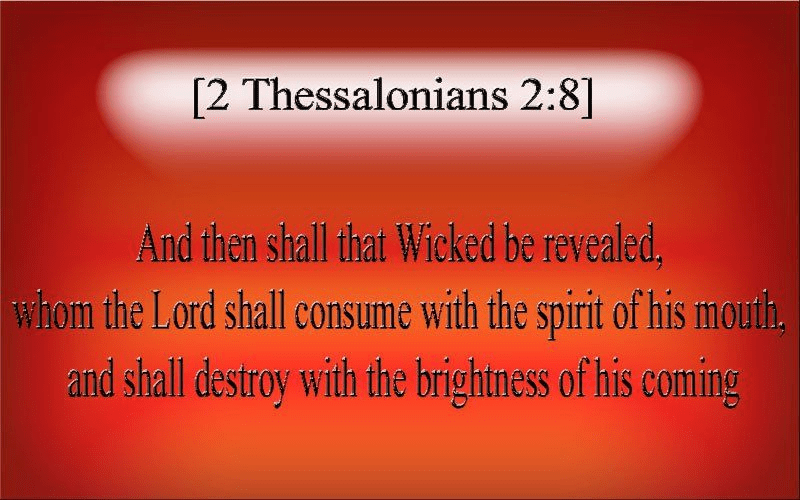
For the mystery of lawlessness is already at work. Only he who now restrains it will do so until he is out of the way. And then the lawless one will be revealed, whom the Lord Jesus will kill with the breath of his mouth and bring to nothing by the appearance of his coming.” (2 Thessalonians 2:7–8 (ESV)

Not only have people asked me who the Antichrist is, they also inquire as to when he will appear or reveal himself. Today’s text, specifically vs. 8, answers the question. This involves the biblical doctrine of eschatology or the doctrine of the end times. However, biblical eschatology involves the now and the not yet. The New Testament church, since the Day of Pentecost (Acts 2), has lived in the last days or the period of time immediately prior to the Lord’s return (I Tim. 4:1; 2 Tim. 3:1).

“Biblical eschatology—the teaching of Scripture regarding the end times—is frequently thought to concern things that have not yet happened. When God’s Word addresses eschatological topics, many people suppose, it is speaking only of things that, from our perspective, are still to come. However, while biblical eschatology certainly involves things that lie ahead, we must not forget that according to the New Testament, the last days began during the ministry of Jesus and His death and resurrection,” explains Dr. R. C. Sproul.

“Peter’s sermon in Acts 2 makes this point, but we also see it in 2 Thessalonians 2:7. Paul notes that at the time of his writing, “the mystery of lawlessness” was “already at work.” Before Christ’s return, this mystery must reach its apex in the revelation of the man of lawlessness, one who embodies the spirit of antichrist most fully. But the presence of this mystery in the first century—and its continuing presence today—demonstrates that we are living in the final era of redemptive history. As 1 John 4:3 confirms, “the spirit of the antichrist . . . now is in the world already.”

At the divine decreed moment, the Lord will remove the restraint. This will allow the full fury of the satanic influenced individual to be revealed. Revealed (ἀποκαλυφθήσεται; apokalyphthesetai) means to disclose and to make fully known. It also means to uncover and to take out of hiding.

However, the divine reveal will coincide with the Lord Jesus Christ’s judgment upon the Antichrist. The text says the Lord Jesus will kill this individual. To kill (ἀνελεῖ; anelei) means to execute or destroy. The Lord will also bring to nothing all of this adversary’s plans.  

“There will not be a long-drawn-out conflict, with victory now apparently with the lawless one, then with the Christ, this “round” going to Satan, that to the Christ. The issue will be settled in a moment. The Lord Jesus (see on 1 Thess. 1:1) will very summarily and decisively put an end to antichrist and his program. The entire description is symbolical. The two clauses are parallel, though this does not necessarily mean that they are completely identical in meaning. The first clause stresses what will happen to the lawless one himself: he will be slain (which in this connection has been interpreted to mean that he will be punished with everlasting death, but the idea that he will first be put to death physically must not be excluded). The Lord will merely blow upon him, so swift will be his destruction,” explains Dr. William Hendriksen.[1]

“The second clause also indicates what will happen to him, perhaps with the added idea: in relation to his program of activities. Also, in this respect he will be “abolished,” “utterly defeated,” “put out of commission,” “rendered useless,” “made inoperative or inactive” (καταργέω; a verb very frequently used by Paul and almost confined to him in the New Testament; for the particular shade of meaning in the present connection see especially such passages as Rom. 3:31; 4:14; 1 Cor. 1:28; Gal. 3:17; Eph. 2:15; 2 Tim. 1:10)” [2]

The phase breath of His mouth (πνεύματι στόματος; pneumati stomatos) refers to the spirit of the Lord’s speech. How fitting. The Lord spoke the universe into being (Gen. 1-2; Psalm 33:6-7) and He speaks forth the utter and total destruction of this evil opponent.

“Paul tells us in 2 Thessalonians 2:8 that at the Parousia of Christ—His final advent or second coming—this man of lawlessness will be killed with the breath of Jesus’ mouth and be brought to nothing. Paul here leans on Isaiah 11:4, a text that prophesies the righteous rule of the Messiah, particularly His just judgment. The Apostle is telling us that when Jesus returns in judgment, His decree of guilt for the man of lawlessness and all who support him will bring an end to his wickedness. Christ’s final judgment is sure and true, and when He speaks His judgment over His creatures, they will be consigned infallibly to everlasting punishment if they have not sought refuge in Him by faith alone,” concludes Dr. Sproul.

Let all the earth fear the LORD; let all the inhabitants of the world stand in awe of him! For he spoke, and it came to be; he commanded, and it stood firm. 10 The Lord brings the counsel of the nations to nothing; he frustrates the plans of the peoples. 11 The counsel of the Lord stands forever, the plans of his heart to all generations. 12 Blessed is the nation whose God is the Lord, the people whom he has chosen as his heritage! (Psalm 33:8–12 (ESV)

May the Lord’s truth and grace be found here. Have a blessed day in the Lord.

Soli deo Gloria!  


[1] William Hendriksen and Simon J. Kistemaker, Exposition of I-II Thessalonians, vol. 3, New Testament Commentary (Grand Rapids: Baker Book House, 1953–2001), 183.

[2] Ibid.

A Word Fitly Spoken: What is Holiness?

Each Lord’s Day, there will be a series of topical devotionals entitled A Word Fitly Spoken. The title is taken from Proverbs 25:11 which says, “A word fitly spoken is like apples of gold in a setting of silver.” 

The current study from Scripture concerns the subject of holiness. Today’s essay asks the question, what is holiness?

“ Strive for peace with everyone, and for the holiness without which no one will see the Lord.” (Hebrews 12:14 (ESV)

3 “And they sing the song of Moses, the servant of God, and the song of the Lamb, saying, “Great and amazing are your deeds, O Lord God the Almighty! Just and true are your ways, O King of the nations!    Who will not fear, O Lord, and glorify your name? For you alone are holy. All nations will come and worship you, for your righteous acts have been revealed.” (Revelation 15:3–4 (ESV)

Holy, Holy, Holy! Lord God Almighty!
Early In The Morning Our Song Shall Rise To Thee;
Holy, Holy, Holy, Merciful And Mighty!
God In Three Persons, Blessed Trinity! – Reginald Heber

“Any sin is more or less heinous depending upon the honor and majesty of the one whom we had offended. Since God is of infinite honor, infinite majesty, and infinite holiness, the slightest sin is of infinite consequence. The slightest sin is nothing less than cosmic treason when we realize against whom we have sinned.”Jonathan Edwards.

“Man is never sufficiently touched and affected by the awareness of his lowly state until he has compared himself with God’s majesty.” John Calvin

What is holiness? Psalms, hymns and spiritual songs contain compositions about it. Pastors and evangelists preach sermons on it. Authors write articles and books exploring the depths of it. What exactly does the Bible mean when it speaks of  holiness?

Holiness, or to be holy, is a doctrine found throughout the Scriptures; in both the Old and New Testaments. Therefore, an understanding of this truth is important for the converted, and unconverted, to know what holiness is, and what it is not.

In the Old Testament (OT), the Hebrew word for holy, or holiness, is kahdosh (קָד֧וֹשׁ׀). It means to be ceremonially and morally sacred, set apart, or uniquely consecrated. When referring to God, the term calls attention to the LORD’s unique and awesome splendor (Isaiah 1:4).

Holiness is the primary attribute of God and a quality for His people. “Holiness” and the adjective “holy” occur more than 900 times in the Bible. The primary OT word for holiness means “to cut” or “to separate.” Holiness, or to be holy, is a cutting off or separation from what is unclean and a consecration to what is pure.

The holiness of God refers to His transcendence over creation and the moral perfection of His character. God is holy because He is utterly different from His creation and has sovereign majesty and power over it. God’s holiness is especially prominent in the Psalms (47:8) and the Prophets, where “holiness” is a synonym for Israel’s God. Thus, Scripture ascribes to God the title “Holy” (Isaiah 57:15), “Holy One” (Job 6:10; Is 43:15), and “Holy One of Israel” (Ps. 89:18; Isaiah 1:4; 60:14; Jer. 50:29).

God’s holiness means the Lord is separate from all evil and defilement (cf. Job 34:10). His holy character is the standard of absolute moral perfection (Isaiah 5:16). God’s holiness is examined in Psalm 99. Verses 1 through 3 portray God’s distance from the finite and earthbound, whereas verses 4 and 5 emphasize his separation from sin and evil.

“In the OT God demanded holiness in the lives of his people. Through Moses, God said to the congregation of Israel, “You shall be holy; for I the Lord your God am holy” (Lev. 19:2, RSV). The holiness enjoined by the OT was twofold: (1) external, or ceremonial; and (2) internal, or moral and spiritual. OT ceremonial holiness, prescribed in the Pentateuch (the first five books of the OT) included ritual consecration to God’s service. Thus, priests and Levites were sanctified by a complex process of ritual consecration (Ex. 29), as were the Hebrew Nazirites, which means “separated ones” (Num. 6:1–21). Prophets like Elisha (2 Kgs. 4:9) and Jeremiah (Jer. 1:5) were also sanctified for a special prophetic ministry in Israel,” explains Old Testament scholar Walter Elwell.

But the OT also draws attention to the inner, moral, and spiritual aspects of holiness. Men and women, created in the image of God, are called to cultivate the holiness of God’s own character in their lives (Lev. 19:2; Num. 15:40).

Next Lord’s Day, we will examine the New Testament’s treatment of holiness. Today’s article concludes with thoughts from biblical scholar and theologian Herman Bavinck (1854–1921).

To correctly assess the benefit of justification, people must lift up their minds to the judgment seat of God and put themselves in his presence. When they compare themselves with others or measure themselves by the standard they apply to themselves or among each other, they have some reason perhaps to pride themselves in something and to put their trust in it. But when they put themselves before the face of God and examine themselves in the mirror of his holy law, all their conceit collapses, all self-confidence melts, and there is room left only for the prayer: “Enter not into judgment with your servant, for no one living is righteous before you” (Job 4:17-19; 9:2; 15:14-16; Ps. 143:2; cf.130:3), and there only comfort is that “there is forgiveness before you, so that you may be revered” (Ps. 130:4). If for insignificant, guilty, and impure persons there is to be a possibility of true religion, that is, of genuine fellowship with God, of salvation and eternal life, then God on his part must reestablish the broken bond, again take them into fellowship with him and share his grace with them, regardless of their guilt and corruption. He, then, must descend from the height of his majesty, seek us out and come to us, take away our guilt and again open the way to his fatherly heart. If God were to wait until we – by our faith, our virtues, and good works…- had made ourselves worthy, in part or in whole, to receive his favor, the restoration of communion between him and ourselves would never happen, and salvation would forever be out of reach for us.

May the Lord’s truth and grace be found here. Have a blessed day in the Lord.

Soli deo Gloria!  

2 Thessalonians: The Mystery of Lawlessness.

For the mystery of lawlessness is already at work. Only he who now restrains it will do so until he is out of the way,” (2 Thessalonians 2:7 (ESV)

I am often asked who I believe is, or could be, the Antichrist. In over fifty years as a believer in Christ, I have heard many theories regarding the identity of this individual. Will he be a politician, a religious leader, or both. The Scriptures, as in today’s text, reveals this individual is a man. Beyond that, this identity of this individual is a mystery.

A mystery (μυστήριον; mysterion) refers to a secret. Unlike the English meaning wherein a mystery may or may not be revealed or understood, the Greek word mysterion refers to what was not known before but what God will reveal in the future.

Whoever the Antichrist is, or may be, he is associated with lawlessness (ἀνομίας; anomias). Lawlessness is behaving with a complete disregard for the laws or regulations of a society (Matt. 1 3:41; I John 3:4). “In some languages one may translate ἀνομία in Mt 13:41 as ‘to live as though there were no laws,’ ‘to refuse completely to obey the laws,’ or ‘to live as one who despises all laws.”[1]

The Antichrist is an individual possessed by lawlessness. Lawlessness originates deep within his soul. He loves it. He expresses it with a corresponding hatred for God and His holy law.

“Though the man of lawlessness has not yet appeared, Paul will not allow his readers to let down their guard. The same satanic power that will ultimately spawn this unholy deceiver was already at work in Paul’s day (I John 2:18) and is at work in ours,” explains Dr. R. C. Sproul.

Although the mystery of lawlessness is working, there is a ministry of restraint also occurring. As noted in our previous blog, to restrain (κατέχων; katechon) means to presently and actively hinder and hold back. What Paul referred to as an impersonal restrainer in vs.6, he now refers to as a person. Who is this individual?

“Whoever the man of lawlessness is, Paul tells us in 2 Thessalonians 2:5–7 that he will not be revealed until “he who now restrains” the mystery of lawlessness is out of the way. Here again we run into the difficulty of identifying this restrainer. Some commentators have suggested that the restrainer is some powerful military or political force who will decline and fall just before the man of lawlessness rises to his position. Others believe Paul means that the restrainer is the Holy Spirit, who will at some point stop holding back the fullness of wickedness and allow a specific archenemy of Christ to come to power. Either way, the existence of a restrainer confirms God’s sovereignty over the events of the end. He will not allow the man of lawlessness to rise until the time He has decreed from all eternity (see also Matt. 24:36–51),” states Dr. Sproul.

Dr. William Hendriksen explains, “Accordingly, the sense of the entire passage (verses 6 and 7) seems to be this: Satan, while perfectly aware of the fact that he cannot himself become incarnate, nevertheless would like to imitate the second person of the Trinity also in this respect as far as possible. He yearns for a man over whom he will have complete control, and who will perform his will as thoroughly as Jesus performed the will of the Father. It will have to be a man of outstanding talents. But as yet the devil is being frustrated in his attempt to put this plan into operation. Someone and something is always “holding back” the deceiver’s man of lawlessness. This, of course, happens under God’s direction. Hence, for the time being, the worst Satan can do is to promote the spirit of lawlessness. But this does not satisfy him. It is as if he and his man of sin bide their time. At the divinely decreed moment (“the appropriate season”) when, as a punishment for man’s willingness to cooperate with this spirit, the “someone” and “something” that now holds back is removed, Satan will begin to carry out his plans:[2]

Throughout church history, individuals have sought to identify the Antichrist and have developed theories as to who he is and when he will come. It is valuable to examine who Paul was thinking of when he wrote of the “man of lawlessness. However, believers in Christ should not spend too much time and effort in this quest. We should be content God knows who this man is and that the Antichrist cannot operate outside the Lord’s sovereignty and providence.

May the Lord’s truth and grace be found here. Have a blessed day in the Lord.

Soli deo Gloria!


[1] Johannes P. Louw and Eugene Albert Nida, Greek-English Lexicon of the New Testament: Based on Semantic Domains (New York: United Bible Societies, 1996), 757.

[2] William Hendriksen and Simon J. Kistemaker, Exposition of I-II Thessalonians, vol. 3, New Testament Commentary (Grand Rapids: Baker Book House, 1953–2001), 182–183.

2 Thessalonians: Restraining Orders.

Do you not remember that when I was still with you, I told you these things? And you know what is restraining him now so that he may be revealed in his time.” (2 Thessalonians 2:5–6 (ESV)

The Apostle Paul continued to instruct the Thessalonians concerning the Day of the Lord (2 Thess. 2:1-4). He reminded them of what he previously taught (I Thess. 4:13-5:11). He did not want them to forget this important information. Neither does the Lord want us to forget this important revelation. Let’s conduct a brief summary of what we have learned in 2 Thess. 2:1-4.

The Apostle Paul taught Jesus had not yet returned when he wrote this second epistle. In fact, he said the Lord would not return until two things have happened. First, there would be a great rebellion or apostasy. Second, the “man of lawlessness” must take his seat “in the temple of God” and set himself against every “so-called god or object of worship.” This man, the Antichrist (I John 4:1-6). will set up himself as the only being to be worshiped in all of creation.

“Figuring out the identities of the rebellion and the man of lawlessness is not easy. Some have suggested that Paul refers to the great rebellion of the Jews against their Messiah, Jesus, culminating in the revolt against Rome that ended with the defilement and destruction of the temple. This interpretation fits well with what we know of the first-century setting, for the Roman emperors claimed to be deities worthy of worship, allowing for virtually any of them to be identified as the man of lawlessness,” explains Dr. R. C. Sproul.

“Others have suggested that Paul speaks of a great apostasy of professing Christians who reject Christ when the final Antichrist reveals himself and demands worship. Perhaps it is best to say that these two views are not necessarily opposed to one another. It very well could be that a Roman emperor is in view in 2 Thessalonians 2 but that he is a type or foreshadowing of the Antichrist who is yet to come but who must come before Jesus consummates His kingdom.”

In today’s text, Paul said something, or someone, was restraining the man of lawlessness. The verb restraining (κατέχον; katechon) is a present, active participle. It means to hold back and hinder. It refers to preventing someone from doing something. In the immediate context, this restraining prevents the Antichrist from taking his seat in the temple of God and setting himself to be God. This restraining will continue until the Lord purposes to reveal (ἀποκαλυφθῆναι; apokalyphthenai) or make fully known this rebellious individual.

“Who or what is restraining the satanically empowered movement against God’s law and is postponing the revelation of the man of sin? Some say it is the Roman Empire. But the empire has long vanished and “the holder back” is not yet revealed. Another suggestion is that this is Satan, but it is difficult to see why he would hold back sin. Others suggest that human governments are holding back sin and the revealing of the Antichrist. But human governments will not end prior to the Antichrist’s unveiling. Nor do all governments restrain sin; many encourage it!” The Holy Spirit of God is the only Person with sufficient (supernatural) power to do this restraining. How does He do it? Through Christians, whom He indwells and through whom He works in society to hold back the swelling tide of lawless living.” [1]

May we seek to be the salt and light God has called each believer in Christ to restrain moral corruption and to be a light of God’s holiness (Matt. 5:13-16). May the Lord’s truth and grace be found here.

Soli deo Gloria!


[1] Thomas L. Constable, “2 Thessalonians,” in The Bible Knowledge Commentary: An Exposition of the Scriptures, ed. J. F. Walvoord and R. B. Zuck, vol. 2 (Wheaton, IL: Victor Books, 1985), 719.

2 Thessalonians: The Man of Lawlessness.  

Let no one deceive you in any way. For that day will not come, unless the rebellion comes first, and the man of lawlessness is revealed, the son of destruction, who opposes and exalts himself against every so-called god or object of worship, so that he takes his seat in the temple of God, proclaiming himself to be God.” (2 Thessalonians 2:3–4 (ESV)

William Hendriksen (18 November 1900 – 12 January 1982) was a New Testament scholar and writer of Bible commentaries. Hendriksen was an ordained minister in the Christian Reformed Church and served as Professor of New Testament at Calvin Theological Seminary from 1942 to 1952. He was pastor of First Christian Reformed Church of Byron Center, MI from 1952 to 1961.

The following article is taken from Dr. Hendriksen’s commentary from 2 Thessalonians. The topic concerns the man of lawlessness, the son of destruction. While there are many misconceptions concerning the man of lawlessness, Dr. Hendriksen draws his conclusions from the biblical canon.  

It can now be positively stated that the apostle’s use of the concept is capable of being traced to a canonical book. It is, indeed, true, as conservatives have always maintained, that many of the features in Paul’s description of the great and final prince of wickedness are derived from the book of Daniel:

(1) “The man of lawlessness,” cf. Dan. 7:25; 8:25.

(2) “the son of perdition,” cf. Dan. 8:26.

(3) “the one who opposes,” cf. Dan. 7:25

(4) “and exalts himself against everything (that is) called God or worshiped,” cf. Dan. 7:8, 20, 25; 8:4, 10, 11.

(5) “so that he seats himself in the temple of God, proclaiming himself to be God,” cf. Dan. 8:9–14.

This is not surprising, for “the little horn” of Dan. 7, the one which came up after the ten horns, is the antichrist, and “the little horn” of Dan. 8, the one which came up out of one of the four notable horns, is Antiochus Epiphanes, antichrist’s most notorious forerunner, the one who desecrated Jerusalem’s temple by erecting a pagan altar over the altar of burnt-offering, and by sacrificing upon it (which was an “appalling horror” in the estimation of every true believer).

Moreover, in Matt. 24:15 (cf. Mark 13:14) “the desolating abomination” (“appalling horror”) of which Jesus speaks is derived from Dan. 11:31; 12:11 (probably not directly from 9:27). History, in a sense, repeats itself. Better: prophecy attains multiple fulfilment. The underlying thought is ever the same. God’s city and sanctuary are desecrated, whether by Antiochus Epiphanes and his sacrilegious offerings (Dan. 8:9–14; cf. “Gog” in Ezek. 38, 39), by Roman armies with their idolatrous standards (Luke 21:20; Mark 13:14); or finally by the antichrist himself.

Now with respect to the final antichrist as pictured by Paul, our present passage (2 Thess. 2:3b, 4) states the following:

He is “the man of lawlessness” (a Semitism), that is, the man in whom opposition to God’s law will as it were be embodied, the very personification of rebellion against God’s ordinances.

He is also “the son of perdition” (another Semitism), the final Judas, see N.T.C. on John 17:12. Cf. David’s remark to Nathan, “The man who has done this is a son of death” (i.e., must certainly die); and cf. also Matt. 23:15: “a son of hell.” The man of lawlessness is pictured here as the utterly lost one, designated unto perdition. Contrast “sons of light” in 1 Thess. 5:5.

Furthermore, he is described as “the one who opposes.” This word (ἀντίκειμαι, here ὁ ἀντικείμενος) is found eight times in the New Testament (Luke 13:17; 21:15; 1 Cor. 16:9; Gal. 5:17; Phil. 1:28; 2 Thess. 2:4; 1 Tim. 1:10; 1 Tim. 5:14). It is used both as a verb (finite) and as a participial substantive (so here). The man of sin is the adversary of God, of God’s law, of God’s people, etc. As such he immediately reminds one of his master, Satan, who is “the great adversary.”

In very close connection with this opposing activity stands the fact that this adversary who will appear in the end-time “exalts himself against everything (that is) called God or worshiped.” In his reckless audacity and ferocious insolence, he uplifts himself (ὑπεραιρόμενος) not only against the only true God who has revealed himself in Jesus Christ and against all so-called gods, but also against all sacred objects, against whatever stands in connection with religious cults. The reference is probably to such objects as temples, places set aside for divine worship, altars, religious statues. He rages against them all.

He recognizes only one god (he would spell it with a capital: God), namely, himself! Hence, he seats himself in the sanctuary (the term ναός in its primary sense, in distinction from ἱερόν, generally refers to the shrine itself rather than to the entire building-complex) of God, that is, in the church (see 1 Cor. 3:16; 6:19; 2 Cor. 6:16; Eph. 2:21; and see N.T.C. on 2:19–22), for the term ναός is here clearly used metaphorically. He arrogates to himself authority over God’s true people. Of course, they will not recognize this violent usurper, and will refuse to render homage to him.

The result will be great tribulation for them (Matt. 24:15, 21, 22, 29). “Standing where he ought not” he proclaims or publicly declares himself to be God. In the Greek of that day and age the verb (ἀποδείκνυμι) is used of proclaiming an appointment to public office. Thus, we are told, “The expectation and hope of the world, Nero, has been declared (ἀποδέδεικται) Emperor” (M.M., p. 60), a quotation which also illustrates emperor-worship. But even Antiochus Epiphanes, that is, “Antiochus (the) Illustrious (God)” or “Antiochus (the) God who reveals himself,” demanding divine homage but not altogether ignoring Zeus, was not as blasphemous as the final man of lawlessness will be, for the latter will recognize only one deity, namely, himself, will seat himself (will not merely deposit his image) in God’s shrine, and will demand divine adoration for himself alone.

It is instructive to note that the explanation which I have given with respect to the “man of sin” passage is in line with that which was favored by the earliest ecclesiastical writers. These understood it as being a prophecy with reference to a definite person who would live on earth at the close of history and would be utterly discomfited by Christ at his return. The church should never have departed from this interpretation.[1]

May the Lord’s truth and grace be found here. Have a blessed day in the Lord.

Soli deo Gloria!


[1] William Hendriksen and Simon J. Kistemaker, Exposition of I-II Thessalonians, vol. 3, New Testament Commentary (Grand Rapids: Baker Book House, 1953–2001), 176–178.

2 Thessalonians: Rebellion and Lawlessness. Part Three.

Let no one deceive you in any way. For that day will not come, unless the rebellion comes first, and the man of lawlessness is revealed, the son of destruction, who opposes and exalts himself against every so-called god or object of worship, so that he takes his seat in the temple of God, proclaiming himself to be God.” (2 Thessalonians 2:3–4 (ESV)

The Apostle Paul, along with Silas and Timothy discovered there was confusion among the Thessalonian believers concerning the return of the Lord Jesus Christ. This was a doctrine Paul previously examined in his first letter to this particular church (I Thiess. 4:13-5:11). There was also speculation another spirit, a spoken word or even another letter supposedly from the three missionaries taught the day of the Lord had already occurred (2 Thess. 2:1-2). This was upsetting, not only to Paul and his companions, but also to the believers.

Therefore, Paul did not want any believer in Christ deceived in any way. Paul stated two events must first occur prior to the day of the Lord. What are these two particular occurrences?  First, an event known as the rebellion. Second, the revealing of the man of lawlessness. Let’s examine both.

What is the rebellion? It was previously notedthe Rebellion (ἀποστασία; apostasia) refers to an abandonment, revolt and/or an insurrection. This literally means a “falling away” or “apostasy.” The apostle probably referred to a falling away by many within the church or even a worldwide defection from God (I Tim. 4:1-2; 2 Tim. 3:1-9; Jude 17-19). Coupled with the definite article “the” this is not just a general apostasy or falling away from the truth. Rather, Paul referred to a particular and specific worldwide event. John Calvin comments that the Apostle “predicts a certain general revolt of the visible Church.”

Following the rebellion there would be the revealing of the man of lawlessness, the son of destruction. To whom was Paul referring?

The man of lawlessness (ἄνθρωπος ἀνομίας; anthropos anomias) is a particular man who lives lawlessly. He behaves with a “complete disregard for the laws or regulations of a society.”[1]  He is a lawbreaker (Matt. 13:41). See also Matt .7:23; 23:28; 24:12; Rom. 4:7; 6:19; 2 Cor. 6:14; 2 Th 2:7; Titus 2:14; Heb. 1:9; 10:17; 1 John 3:4.

The text also refers to him as the son of destruction (υἱὸς ἀπωλείας; huios aploeias). This individual will also be one solely identified and possessing a desire to ruin and destroy; particularly believers in Christ. How does the Apostle Paul describe this individual? He mentioned three distinctive characteristics or behaviors.

First, he is one “who opposes and exalts himself against every so-called god or object of worship.”

Second, he does this “so that he takes his seat in the temple of God.” The phrase takes his seat (καθίσαι; kathisai) refers to a position of authority. Particularly, it may refer in this context to having authority of the Law of Moses. This position is located in the temple of God (ναὸν θεοῦ; naon theou). The temple of God is the Lord’s dwelling place where Yahweh is worshipped. This must refer to the Temple in Jerusalem.

Third, this results in him “proclaiming himself to be God.” Proclaiming (ἀποδεικνύντα; apodeiknynta) is a present, active, masculine, singular participle. This individual will publicly attest or declare himself to be God. The question is when does this man and his blasphemous behavior occur?

It seems clear enough that Paul refers to the one identified elsewhere as “antichrist” (1 John 2:18). Paul, then, may be talking about one final leader of religious rebellion against God and Christ who will appear before the return of Jesus. We cannot be sure of this, however, because much of Paul’s language echoes Daniel 11 and the prophecy of the prince who will defile the Jerusalem temple. So, the Apostle could be talking about a figure who would try to install himself in the Jerusalem temple sometime before Jesus returns. If so, this could be a reference to the Roman general Titus’ defiling of the temple before its destruction in AD 70. But whoever this man of lawlessness is, he clearly is opposed to all that God loves,” explains Dr. R. C. Sproul.

“This probably refers to a literal temple, but some suggest that it is a figurative reference to his occupying the most holy place in human worship, which rightfully belongs only to God. The early church fathers and several good modern-day commentators accept the literal view. This man is also called the “beast coming out of the sea” (Rev. 13:1–10), “a scarlet beast” (17:3), and simply “the beast” (17:8, 16; 19:19–20; 20:10). He is the Antichrist (1 John 2:18), a pseudo-Christ hostile to the Savior. He will be a real human being, not a principle or a system or a succession of individuals. Such a person has not yet been spotlighted on the stage of human history.[2]

 Regardless of whether Paul spoke of a near fulfillment in 70 AD or whether there is one final rebellion coming before Jesus returns, the “spirit of antichrist” has been in the church since the first century (1 John 4:1-3). Therefore, believers in Christ must not think opposition to the Lord will exist only at the last day. At the present time, there are some who try to infiltrate the visible church and lead it astray. These are they who follow the spirit of antichrist and must be confronted and opposed. Truth matters.

May the Lord’s truth and grace be found here. Have a blessed day in the Lord.

Soli deo Gloria!


[1] Johannes P. Louw and Eugene Albert Nida, Greek-English Lexicon of the New Testament: Based on Semantic Domains (New York: United Bible Societies, 1996), 757.

[2] Thomas L. Constable, “2 Thessalonians,” in The Bible Knowledge Commentary: An Exposition of the Scriptures, ed. J. F. Walvoord and R. B. Zuck, vol. 2 (Wheaton, IL: Victor Books, 1985), 718.

2 Thessalonians: Rebellion and Lawlessness. Part Two.

Let no one deceive you in any way. For that day will not come, unless the rebellion comes first, and the man of lawlessness is revealed, the son of destruction, who opposes and exalts himself against every so-called god or object of worship, so that he takes his seat in the temple of God, proclaiming himself to be God.” (2 Thessalonians 2:3–4 (ESV)

The Apostle Paul, along with Silas and Timothy discovered there was confusion among the Thessalonian believers concerning the return of the Lord Jesus Christ. This was a doctrine Paul previously examined in his first letter to this particular church (I Thiess. 4:13-5:11). There was also speculation another spirit, a spoken word or even another letter supposedly from the three missionaries taught the day of the Lord had already occurred (2 Thess. 2:1-2). This was upsetting, not only to Paul and his companions, but also to the believers.

Therefore, Paul did not want any believer in Christ deceived in any way. Paul stated two events must first occur prior to the day of the Lord. What are these two particular occurrences?  First, an event known as the rebellion. Second, the revealing of the man of lawlessness. Let’s examine both.

What is the rebellion? It was previously notedthe Rebellion (ἀποστασία; apostasia) refers to an abandonment, revolt and/or an insurrection. This literally means a “falling away” or “apostasy.” The apostle probably referred to a falling away by many within the church or even a worldwide defection from God (I Tim. 4:1-2; 2 Tim. 3:1-9; Jude 17-19). Coupled with the definite article “the” this is not just a general apostasy or falling away from the truth. Rather, Paul referred to a particular and specific worldwide event. John Calvin comments that the Apostle “predicts a certain general revolt of the visible Church.”

However, there should not be speculation these were, or are, true believers in Jesus Christ who will depart from the Faith. Rather, these are professing believers who the Holy Spirit had not truly regenerated resulting in true repentance and faith in Christ; conversion. The Apostle John referred to these individuals in his first epistle (1 John 2:18–23).

Regardless of whether there is one final rebellion coming before Jesus returns, the “spirit of antichrist” has been in the church since the first century (1 John 4:1-3). Therefore, believers in Christ must not think opposition to the Lord will exist only at the last day. At the present time, there are some who try to infiltrate the visible church and lead it astray. These are they who follow the spirit of antichrist and must be confronted and opposed. Truth matters.

Secondly, following the rebellion there would be the revealing of the man of lawlessness, the son of destruction. To whom was Paul referring?

The man of lawlessness (ἄνθρωπος ἀνομίας; anthropos anomias) is a particular man who lives lawlessly. He behaves with a “complete disregard for the laws or regulations of a society.”[1]  He is a lawbreaker (Matt. 13:41). See also Matt .7:23; 23:28; 24:12; Rom. 4:7; 6:19; 2 Cor. 6:14; 2 Th 2:7; Titus 2:14; Heb. 1:9; 10:17; 1 John 3:4.

The text also refers to him as the son of destruction (υἱὸς ἀπωλείας; huios aploeias). This individual will also be one solely identified and possessing a desire to ruin and destroy.

“The imagery used here derives especially from Jesus, however (cf. Mt 24:15), who took it from Daniel (Dan. 7:25; 8:11; 9:26–27; 11:31, 36; cf. 2 Chron. 33:7; Ezek 8:3). Some scholars who have examined the prophecies carefully have concluded that Daniel 11 describes the abomination caused by Antiochus Epiphanes; yet the “end” seems to come at that time (12:1), about two centuries before Jesus. Like the promise of the land to Abraham’s descendants, deferred repeatedly during the period of the judges, between David and Josiah, and afterward due to Israel’s disobedience, this text might be an example of deferred eschatology. If one counts the period of Daniel 9:24–27, however, the anointed prince (whom some held to be the Messiah) was to be “cut off” around the year that Jesus died; the destruction of the city followed forty years later, again indicating a delay of at least forty years. Evangelical interpreters differ as to whether (1) a specific future tribulation remains (perhaps 2 Thess. 2:8–9), (2) the Jewish war in a.d. 66–70 fulfilled it completely (cf. Matt. 24:15–21), (3) the whole course of history constitutes this period (cf. comments on Revelation, especially chap. 12) or (4) the language is reused in different ways, all of which are true,” explains commentator Craig Keener.[2]  

Dr. William Hendriksen states, “The movement of apostasy will soon have a leader, namely, “the man of lawlessness” (ὁ ἄνθρωπος τῆς ἀνομίας). This is probably the best reading, though there is also rather strong support for the reading “the man of sin” (ἄνθρωπος τῆς ἁμαρτίας). In view of the fact that “sin is lawlessness” (1 John 3:4), this makes no essential difference. It is important to note, in this connection, that just like the apostasy will not be merely passive but active (not merely a falling away from but also a rebellion against God and his Christ), so also the man of lawlessness will be an active and aggressive transgressor. He is not called “lawless” because he never heard God’s law, but because he openly defies it!”[3]

We will examine more about this individual when next we meet. May the Lord’s truth and grace be found here. Have a blessed day in the Lord.

Soli deo Gloria!


[1] Johannes P. Louw and Eugene Albert Nida, Greek-English Lexicon of the New Testament: Based on Semantic Domains (New York: United Bible Societies, 1996), 757.

[2] Craig S. Keener, The IVP Bible Background Commentary: New Testament (Downers Grove, IL: InterVarsity Press, 1993), 2 Th 2:3–4.

[3] William Hendriksen and Simon J. Kistemaker, Exposition of I-II Thessalonians, vol. 3, New Testament Commentary (Grand Rapids: Baker Book House, 1953–2001), 170.