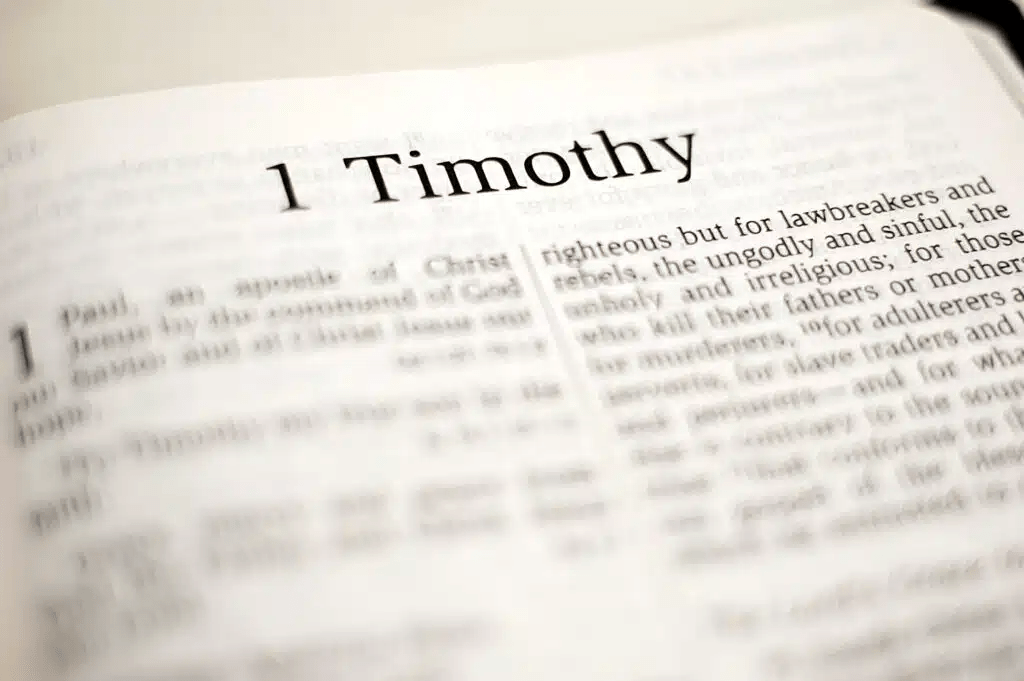
I Timothy: Introduction. Part 2.

Our next study will focus on the New Testament Pastoral Epistles of I Timothy, 2 Timothy and Titus. They are referred to as Paul’s Pastoral Epistles because Timothy and Titus were respectively pastors in the Roman city of Ephesus and on the Island of Crete, which is located in the eastern portion of the Mediterranean Sea. We begin with an introduction of I Timothy.

I Timothy is the first of two inspired (2 Tim. 3:16-17; 2 Peter 1:20-21) epistles Paul wrote to his beloved son in the faith. Timothy means “one who honors God,” or “honoring God.”

“This is a very personal letter. From elsewhere in the New Testament we know that Paul was very fond of Timothy; he speaks of his love for the younger man and of his conviction that he was faithful (1 Cor. 4:17). Paul says further that Timothy could remind the Corinthians of Paul’s way of life, which indicates a certain intimacy and shows that Paul trusted him. It accords with this that he likens Timothy’s relationship to him to that of a son to his father (Phil. 2:22), and with a cheerful disregard for consistency speaks of him as a brother (and fellow worker, 1 Thess. 3:2). He links Timothy with himself in the opening greetings in some of his epistles (2 Cor. 1:1; Phil. 1:1; Col. 1:1; 1 Thess. 1:1; 2 Thess. 1:1), which argues that he was a trusted colleague. Paul asks the Corinthians to ensure that Timothy “has nothing to fear” if he should visit them (1 Cor. 16:10), which seems to indicate a certain diffidence about the young man. He sent him to the Thessalonians, he assures them, “to strengthen and encourage you in your faith” (1 Thess. 3:2), and he plans to send him to the Philippians, explaining, “I have no one else like him, who takes a genuine interest in your welfare” (Phil. 2:20),” explains D. A. Carson & Douglas J. Moo – An Introduction to the New Testament.

“All this gives point to Paul’s greeting, “To Timothy my true son in the faith” (1 Tim.1:2). The letter is written to a younger man for whom the apostle had a deep affection and whom he had for years entrusted with important missions. What Paul now says brings out the truth that Christians are linked in the service of the Lord and that there is significant help they can and should give to one another.”

After Rome released Paul from his first Roman imprisonment (cf. Acts 28:30), he revisited several of the cities in which he had planted and ministered, including Ephesus. Paul left Timothy behind in Ephesus to deal with problems that had arisen in the church, such as false doctrine (1 Tim. 1:3–7; 4:1–3; 6:3–5), disorder in worship (2:1–15), the need for qualified leaders (3:1–14), and materialism (6:6–19), Paul then traveled to Macedonia, from where he wrote Timothy this first letter to help him fulfill his pastoral and leadership duties (cf. 3:14–15).

First Timothy is a practical letter containing pastoral instruction (cf. 3:14–15). Since Timothy knew well Paul’s theology, the apostle did not need to give him extensive doctrinal instruction. However, I Timothy expresses many important theological truths. These include the proper function of the Mosaic Law (1:5–11), salvation (1:14–16; 2:4–6); the attributes of God (1:17); the fall (2:13–14); the person of Christ (3:16; 6:15–16); election (6:12); and the second coming of Christ (6:14–15).

What are some of the interpretative challenges in I Timothy? Here is a top ten list.

First, who are the false teachers (1:3) and the genealogies (1:4) involved in their teaching?

Second, what is meant to be “handed over to Satan” (1:20)?

Third, the letter fosters debate over the extent of the atonement (2:4–6; 4:10).

Fourth, the teaching on the role of women (2:9–15). What, if any leadership role is there for women in the church?

Fifth, what is meant be women being saved by bearing children (2:15)?

Sixth, what does it mean when an elder must be “the husband of one wife?” Does this exclude divorced or unmarried men from eldership (3:1)?

Seventh, does Paul refer to deacons’ wives or deaconesses (3:11)?

Eighth, can Christians lose their salvation (4:1)?  

Ninth, who are the widows in 5:3–16—are they needy women ministered to by the church, or an order of older women ministering to the church?

Tenth, Does “double honor” accorded to elders who rule well (5:17–18) refer to respect or money?

I encourage you to begin reading I Timothy. May the Lord’s truth and grace be found here. Have a blessed day in the Lord.

Soli deo Gloria!

I Timothy: Introduction.

Our next study will focus on the New Testament Pastoral Epistles of I Timothy, 2 Timothy and Titus. They are referred to as Paul’s Pastoral Epistles because Timothy and Titus were respectively pastors in the Roman city of Ephesus and on the Island of Crete, which is located in the eastern portion of the Mediterranean Sea. We begin with an introduction of I Timothy.

I Timothy is the first of two inspired (2 Tim. 3:16-17; 2 Peter 1:20-21) epistles Paul wrote to his beloved son in the faith. Timothy means “one who honors God,” or “honoring God.” His mother Eunice, and grandmother Lois, were devout Jews who became believers in Christ (2 Tim. 1:5). They taught Timothy the Old Testament (OT) Scriptures from his childhood (2 Tim. 3:15). His father was a Greek (Acts 16:1) who may have died before Timothy and Paul met.

Timothy was from Lystra (Acts 16:1–3), a city in the Roman province of Galatia (part of modern Turkey). Paul led Timothy to Christ (1 Tim. 1:2, 181 Cor. 4:172 Tim. 1:2). This occurred during Paul’s ministry in Lystra during his First Missionary Journey (Acts 14:6–23). Revisiting Lystra on his Second Missionary Journey, Paul chose Timothy to accompany him (Acts 16:1–3).

Although Timothy was young, since about 15 years later Paul still called him a young man (1 Tim. 4:12), Timothy had a reputation for godliness (Acts 16:2). Timothy was Paul’s disciple, friend, and co-laborer for the rest of the apostle’s life. He ministered with Paul in Berea (Acts 17:14), Athens (Acts 17:15), Corinth (Acts 18:52 Cor. 1:19), and accompanied him on his trip to Jerusalem (Acts 20:4).

Timothy was with Paul in his first Roman imprisonment and went to Philippi (Phil. 2:19–23) following Paul’s release. Paul frequently mentioned Timothy in his epistles (Rom. 16:212 Cor. 1:1Phil. 1:1Col. 1:11 Thess. 1:12 Thess. 1:1Philem. 1). Paul often sent Timothy to churches as his representative (1 Cor. 4:17; 16:10Phil. 2:191 Thess. 3:2). 1 Timothy finds the young man serving as pastor of the church at Ephesus (1 Tim. 1:3). According to Heb. 13:23, Timothy was imprisoned somewhere and later released.

Dr John MacArthur states, “Many modernist critics delight in attacking the plain statements of Scripture and, for no good reason, deny that Paul wrote the Pastoral Epistles (1, 2 Timothy, Titus). Ignoring the testimony of the letters themselves (1 Tim. 1:12 Tim. 1:1Titus 1:1) and that of the early church (which is as strong for the Pastoral Epistles as for any of Paul’s epistles, except Romans and 1 Corinthians), these critics maintain that a devout follower of Paul wrote the Pastoral Epistles in the second century.”

“As proof, they offer five lines of supposed evidence:( 1) the historical references in the Pastoral Epistles cannot be harmonized with the chronology of Paul’s life given in Acts; (2) the false teaching described in the Pastoral Epistles is the fully developed Gnosticism of the second century;( 3) the church organizational structure in the Pastoral Epistles is that of the second century, and is too well developed for Paul’s day; (4) the Pastoral Epistles do not contain the great themes of Paul’s theology; and (5) the Greek vocabulary of the Pastoral Epistles contains many words not found in Paul’s other letters, nor in the rest of the NT.”

What is the response to these objections to Pauline authorship? Note the following.

(1) Historical incompatibility is valid only if Rome never released Paul from his Roman imprisonment (Acts 28). However, he was released since Acts does not record Paul’s execution, and he also expected to be released (Phil. 1:19, 25–26; 2:24Philem. 22). The historical events in the Pastoral Epistles do not fit into the narrative of Acts because they occurred after the conclusion of the Book of Acts.

(2) While there are similarities between the heresy mentioned in the Pastoral Epistles and second-century Gnosticism, there are also distinct differences. Unlike second-century Gnosticism, the false teachers in the Pastoral Epistles were still in the church (cf. 2 Tim. 1:3–7) and their teachings were from Jewish legalism (1 Tim. 1:7Titus 1:10, 14; 3:9).

(3) The church organizational structure referred to in the Pastoral Epistles is consistent with what Paul established (Acts 14:23Phil. 1:1).

(4) The Pastoral Epistles do mention the essential themes of Paul’s theology: the inspiration of Scripture (2 Tim. 3:15–17); election (2 Tim. 1:9Titus 1:1–2); salvation (Titus 3:5–7); the deity of Christ (Titus 2:13); Christ’s mediatorial work (1 Tim. 2:5), and substitutionary atonement (1 Tim. 2:6).

(5) The subjects in the Pastoral Epistles required a different vocabulary from Paul’s other epistles.

There is more introductory information to come. I encourage you to begin reading I Timothy. May the Lord’s truth and grace be found here. Have a blessed day in the Lord.

Soli deo Gloria!

A Word Fitly Spoken: Be Holy!   

Our study from Scripture concerns the subject of holiness. This Lord’s Day, the focus continues to center on I Peter 1:13-16 and God’s call for His children to be holy as He is holy.

13 Therefore, preparing your minds for action, and being sober-minded, set your hope fully on the grace that will be brought to you at the revelation of Jesus Christ. 14 As obedient children, do not be conformed to the passions of your former ignorance, 15 but as he who called you is holy, you also be holy in all your conduct, 16 since it is written, “You shall be holy, for I am holy.” (1 Peter 1:13–16 (ESV)

As we noted in our previous devotional, one of the most basic disciplines in the Christian life is to not be conformed to the world’s desires which stem from a disobedient spirit towards God. The Apostle John described these desires as the lust of the flesh, the lust of the eyes and the pride of life (I John 2:15-16). The Apostle Paul also encouraged believers to not be conformed to the world but to be transformed by the renewing of their minds (Romans 12:1-2).

The Apostle Peter wrote, “As obedient children, do not be conformed to the passions of your former ignorance.” To be obedient (ὑπακοῆς; phypakoes) means to give evidence or testimony of one’s compliance to the Lord. It is a positive response to God’s commands. This is to be the identity of a child of God.

As such, God encourages believers to not be conformed (συσχηματιζόμενοι; syschematizomenoi) presently, personally, and collectively. This is the word the Apostle Paul used in Romans 12:2. It means to “pattern one’s actions or life after.”

“Peter reminds these Christians that obedience to God and holiness of life are radically different from a life that follows ‘natural’ desires wherever they lead. Doing God’s will is the opposite of doing what remaining sin makes us feel like doing (Rom. 6:12; Gal. 5:16-24),” explains Dr. Wayne Grudem.

The phrase “former ignorance” (πρότερον ἀγνοίᾳ; proteron agnoia) refers to a prior lack of knowledge and willful disobedience. This an ignorance of God and His ways (Acts 3:17; 17:30; Eph.  4:18). The unbelievers’ passions evidenced their previous ignorance of the Lord. Passions (ἐπιθυμίαις; epithymiais) are desires, longings and lusts.

Along with what God calls believers not to do, God also reveals to us what believers are to do. God commands each believer in Christ to be holy. The holiness of God is His most important attribute (Isaiah 6). It stands to reason that the Christian should be holy as God is holy (Leviticus 11:44; 19:2; 20:7).

What does it mean to be holy? Holiness (ἅγιος; hagios) means to be separate from sin. It means to have pure, moral qualities. Consequently, we are commanded to be holy in all our behavior or conduct (ἀναστροφή; anastrophe). This refers to how we daily live and conduct ourselves. A holy inner life from God (Romans 5:1; 2 Corinthians 5:21) leads to a holy outer walk before God (Ephesians 2:10) and other people.

As one commentator has written, “Though absolute holiness can never be achieved in this life, all areas of life should be in the process of becoming completely conformed to God’s perfect and holy will.”

Our standard of holiness is God. It is His moral perfection which we are to pursue (Matthew 5:48; Ephesians 5:1). As people recreated in His image to be like Him in His holy character, let each of us today reflect His holiness. Read Isaiah 6:1-7 and  Revelation 4-5 today.

God is holy (Isaiah 6:1-7; Leviticus 11:44; I Peter 1:16). This means that He is absolutely different or apart from His creation and that He is absolutely pure. As Dr. R.C Sproul comments, “The saints of Scripture were called saints not because they were already pure but because they were people who were set apart and called to purity.”

While it is true that God is our heavenly Father (I John 1:12-13) and that He has adopted us as His children (2 Corinthians 6:18; Psalm 68:5-6; Galatians 4:4-5; Romans 8:14-17), believers will still be judged and rewarded for their good works before God (Romans 14:10-12; I Corinthians 3:12-15). Augustine called this “God crowning His own gifts.”

Therefore, we conduct ourselves while we live on this earth in fear. We must still approach God with humble reverence (Psalm 34:11). We must not approach Him in worship, in prayer, or in service with a flippant or casual attitude of indifference. We serve Him, and not the other way around.

Recalling I Peter 1:1, Peter once again refers to the believer’s time here on earth as one of exile. Our status in this fallen world is that of aliens, strangers and pilgrims. We do not seek to be like the world, but rather to be distinct from it, as befitting our status as belonging to God’s kingdom. To his first century audience, this took on not only a spiritual meaning, but also a physical one. It may also for many today.

Soli deo Gloria!

2 Thessalonians: The Jewel of Peace.

16 Now may the Lord of peace himself give you peace at all times in every way. The Lord be with you all.” (2 Thessalonians 3:16 (ESV)

The following sermon excerpt is by Pastor Charles H. Spurgeon entitled The Jewel of Peace. Spurgeon preached this on Sunday, March 18, 1877.

First, then, let us look at THE MANY-SIDED BLESSING, “The Lord of peace himself give you peace.”

Some have thought to restrict the expression to peace within the church, since disorderly members were evidently increasing among the Thessalonians. But that is a very straitened and niggardly interpretation, and it is never wise to narrow the meaning of God’s Word.

Indeed, such a contracted explanation cannot be borne, for it does not appear that the disorderly persons mentioned in the chapter had as yet created any special disturbance. They had been quietly fattening at the expense of their generous brethren, and would not be very eager to quarrel with the rack from which they fed.

Although no doubt church quiet is included as one variety of peace, yet it would be a sad dwarfing of the meaning of the Spirit to consider one phase of the blessing to the neglect of the rest. No, the peace here meant is “the deep tranquility of a soul resting on God,” the quiet restfulness of spirit which is the peculiar gift of God, and the choice privilege of the believer. “Great peace has all they that love thy law, and nothing shall offend them.”

The peace of the text is a gem with many facets, but in considering its many-sidedness we must remember that its main bearing is toward God. The deepest, best, and most worthy peace of the soul is its rest towards the Lord God Himself. I trust we know this, and are enjoying it at this moment.

We are no longer afraid of God—the sin which divided us from Him is blotted out, and the distance which it created has ceased to be. The atonement has wrought perfect reconciliation and established everlasting peace. The terrors of God’s law are effectually removed from us, and instead thereof we feel the drawings of His love.

Now, secondly, let us note THE SPECIAL DESIRABLENESS OF PEACE.

It is a very great thing for a soul to realize perfect peace, for if it does not do so, it must miss the joy, and comfort, and blessedness of the Christian life. God never meant His children to be like thistle-down, wafted about with every breath, nor as a football, hurled to and fro by every foot. He meant us to be a happy, restful, established people.

The cattle crop the grass, but they are not fattened till they lie down and ruminate in peace—the Lord makes His people to feed and to lie down in quietness. You do not know the Gospel, dear friends, if you have not obtained peace through it. Peace is the juice, the essence, the soul of the Gospel. Doctrines are clusters, but you have never trodden them in the wine vat, you have never quaffed the flowing juice of their grapes, if you have not peacefully considered divine truth in the quiet of your heart.

Without peace you cannot grow. A shepherd may find good pasture for his flock, but if his sheep are hunted about by wild dogs, so that they cannot rest, they will become mere skin and bone. The Lord’s lambs cannot grow if they are worried and harried—they must enjoy the rest wherewith the Lord makes the weary to rest. If your soul is always sighing, and moaning, and questioning its interest in Christ, if you are always in suspense as to what doctrine is true and what is false, if there is nothing established and settled about you, you will never come to the fullness of the stature of a man in Christ Jesus.

Neither without peace can you bear much fruit, if any. If a tree is frequently transplanted, you cannot reasonably look for many golden apples upon its boughs. The man who has no root-hold, who neither believes, nor grasps, nor enjoys the Gospel, can never know what it is to be steadfast, unmovable, neither will he be always abounding in the work of the Lord.

Now, thirdly, we shall get into the very heart of our text while we consider for a minute or two THE ONLY PERSON FROM WHOM THIS PEACE MUST COME,

“Now the Lord of peace himself give you peace.”

Who is this “Lord of peace” but the Lord Jesus, the Prince of peace, born into the world when there was peace all over the world? It was but a little interval in which the gates of the temple of war were closed, and lo, Jesus came to Bethlehem, and angels sang, “Peace on earth.” He came to establish an empire of peace which shall be universal, and under whose influence they shall hang the useless helmet high, and study war no more.

“The Prince of peace!” How blessed is the title! So was it written of old by Isaiah, and Paul, the true successor of Isaiah, changing but a word, now speaks of, “the Lord of peace.” This is He who, being in Himself essential peace, undertook to be the Father’s great Ambassador, and having made peace by the blood of His cross, ended the strife between man and his offended Maker.

This is He who is our peace—who has made Jew and Gentile one, and broken down the middle wall of partition which stood between us. This is the Lord who, when He stood in the midst of His disciples, gave them peace by saying, “Peace be unto you.”

And this is He, who in His departure made His last will and testament, and wrote therein this grand legacy, “Peace I leave with you, my peace I give unto you; not as the world giveth give I unto you.” This is that Lord of peace to whom it is part of His nature and office to give peace.

Now I must conclude with the fourth head, which is a consideration of THE SWEEP OF THE PRAYER,

“The Lord of peace himself give you peace always.” What! always at peace? Yes, that is what the apostle desires for you. May you have peace given you always. “Well, sir, I feel very happy on Sabbath days. I have such peace that I wish I could have a week of Sundays.” May the Lord Himself give you peace always, on all the weekdays as well as on the Lord’s days.

But there are some to whom this peace cannot come, some concerning whom the Lord says, “What hast thou to do with peace?” “There is no peace, saith my God, unto the wicked.” Your works, your prayers, your repentances—none of these can bring you peace. As for the world and the pleasures thereof, they are destructive to all hope of peace.

Come you this day and believe in the great sacrifice which God Himself has prepared in the person of His crucified Son. Come look into Emanuel’s face and read where peace is to be found. Come to the great gash in Jesus’ side, and see the cleft of the rock where God’s elect abides in peace. Trust in Jesus, and you shall begin a peace which shall widen and deepen into the peace of God which passes all understanding, which shall keep your hearts and minds by Christ Jesus. Amen.

May the Lord’s truth and grace be found here. Have a blessed day in the Lord.

Soli deo Gloria!

2 Thessalonians: Benediction.

16 Now may the Lord of peace himself give you peace at all times in every way. The Lord be with you all. 17 I, Paul, write this greeting with my own hand. This is the sign of genuineness in every letter of mine; it is the way I write. 18 The grace of our Lord Jesus Christ be with you all.” (2 Thessalonians 3:16–18 (ESV)

In today’s text, the Apostle Paul’s second epistle to the Thessalonian believers comes to a conclusion. Paul shared his final thoughts to this faithful church. It was a benediction of encouragement, integrity, and comfort.

Paul encouraged the Thessalonian believers when he wrote, “Now may the Lord of peace himself give you peace at all times in every way. The Lord be with you all.” The Thessalonians experienced conflict from opponents to the Gospel (3:1-5). Paul encouraged them by praying for the Lord of peace to give them peace. This would occur because the Lord is the source and originator of peace.

Peace (εἰρήνης; eirenes) refers to tranquility and freedom from worry (Rom 5:1-2; Philippians 4:6-7). This tranquility is because of the Lord’s presence with all believers in union with Christ.

“The Lord of peace is the Lord Jesus Christ. It is he who established peace through his cross. It is he who not only pronounces it but actually imparts it,” explains Dr. William Hendriksen.[1]

“Implied in the peace is the fellowship, which, however, because of its superlative worth, merits special mention. Hence, there follows The Lord (i.e., the Lord Jesus Christ) with you all (with the verb “be” understood). Note: you all, not even the disorderly ones are excluded! Did not the writers proceed from the idea that the censored persons were, after all, brothers? Cf. 1 Cor. 16:24; 2 Cor. 13:13.”[2]

Paul also appealed to his apostolic integrity. He wanted these young believers to know how genuine he loved them. He wrote, “I, Paul, write this greeting with my own hand. This is the sign of genuineness in every letter of mine; it is the way I write.” Although inspired by the Holy Spirit (2 Tim. 3:16-17; 2 Peter 1:20-21), the words Paul wrote were sincerely his own.

“Paul always wrote the closing greeting with his own hand, but he did not always make a point of saying so. He did not need to. The difference in handwriting in the original copy between the closing greeting and the body of the letter would reveal two different writers to those who would see the epistle. In any case, Paul sometimes made a note that he was writing the greeting, probably for the benefit of listeners. His epistles were read aloud to Christian congregations, and not all of them could see the difference in handwriting between the body of the letter and Paul’s self-written closing. But all of them could hear him make a note of it,” explains Dr. R. C. Sproul.

Dr. Hendriksen asks, “Why did the apostle, here in 2 Thess. 3:17, call special attention to this mark of genuineness? The following reasons have been suggested and may well point in the right direction:”

a. “To prevent the disorderly persons from being able to say, “We admit that the letter which was read to us during the service (II Thessalonians) contained some rather uncomplimentary things with respect to us, but we do not believe that it actually represents the thought of Paul. We deny that he either wrote or dictated it.”

b. To discourage the spread of spurious epistles and/or the claim that someone had in his possession (or had seen) a letter from Paul stating that the day of the Lord had already arrived; see on 2:2.”[3]

Finally, Paul wanted to comfort these believers who God led him, Silas and Timothy to evangelize and disciple. “The grace of our Lord Jesus Christ be with you all.” How comforting this was, and is. Regardless of who they were, the well regarded or the rebuked, Paul wanted them all to know God’s grace would be with them all.

“Take some time to skim the book of 2 Thessalonians today and note a teaching or two that are particularly applicable to where you currently find yourself. Ask the Lord to help you follow the teaching and to give you the courage to stand on God’s Word. Thank Him for this Apostolic instruction and for the spiritual life that it gives,” concludes Dr. Sproul.

May the Lord’s truth and grace be found here. Have a blessed day in the Lord.

Soli deo Gloria!


[1] William Hendriksen and Simon J. Kistemaker, Exposition of I-II Thessalonians, vol. 3, New Testament Commentary (Grand Rapids: Baker Book House, 1953–2001), 207.

[2] Ibid.208.

[3] Ibid. 208–209.

2 Thessalonians: Warning Signs.

13 As for you, brothers, do not grow weary in doing good. 14 If anyone does not obey what we say in this letter, take note of that person, and have nothing to do with him, that he may be ashamed. 15 Do not regard him as an enemy, but warn him as a brother.” (2 Thessalonians 3:13–15 (ESV)

The Apostle Paul, Silas and Timothy brought their second letter to the Thessalonian believers in Christ to a conclusion. Their final comments were not a seemingly disjointed collection of random thoughts. Rather, today’s text directly related to the immediately preceding context of chapter 3:6-12.  

Paul and his companions began with the statement, “As for you, brothers, do not grow weary in doing good.” In contrast to those who preferred to be idle and not work, Paul encouraged the faithful brothers in Christ to not grow weary in their work for Christ. To grow weary (ἐγκακήσητε; enkakesete) means to be discouraged, to lose heart, and to give up. Sometimes, much like Asaph in Psalm 73, believers may become disillusioned in their walk of faith in the Lord.

Paul said to not grow weary. He also emphasized believers are not to be discouraged in doing good (καλοποιοῦντες; kalopoiountes). This referred to doing what was right and holy before the Lord and other people. This is the ultimate work and labor God calls believers to perform.

“The hard-working believers were tired of having to support the lazy. They were ready to stop all help to those in need, giving up all charity. Paul reminded them the truly needy still required help and the Thessalonians must not be negligent toward them,” explains Dr. John MacArthur.  

John Calvin states, “Paul admonishes us, that, although there are many that are undeserving, while others abuse our liberality, we must not on this account leave off helping those that need our aid. Here we have a statement worthy of being observed — that however ingratitude, moroseness, pride, arrogance, and other unseemly dispositions on the part of the poor, may have a tendency to annoy us, or to dispirit us, from a feeling of weariness, we must strive, nevertheless, never to leave off aiming at doing good.”

Paul continued by writing, “If anyone does not obey what we say in this letter, take note of that person, and have nothing to do with him, that he may be ashamed.” Paul commanded the church to presently, personally and obediently take note (σημειοῦσθε; semeiousthe) or pay attention to those who were idle and were unwilling to work, even though they were able.

The apostle also stated the church was to no longer associate (συναναμίγνυσθαι; synanamignysthai) and be in the company of such idle individuals. This appears to be overly harsh but absolutely necessary. The reason for this instruction was so the idlers would become ashamed (ἐντραπῇ; entrape) or embarrassed by their behavior.

Often, well-meaning believers seek to assist the idle. They take pity upon them and endeavor to assist them however they can. The idle are more than willing to accept such assistance, and to continue to expect, and be entitled, to it. Consequently, when the idle do not receive what they expect from the church, or para-church ministry, they usually become angry and leave the church, only to find another church of well-meaning believers wherein the process repeats itself.  The Scriptures command believers to break this cycle of perpetuating irresponsibility towards the idle.

Paul cautioned the believing community by writing, “Do not regard him as an enemy, but warn him as a brother.” The believer’ attitude in such situations is critical.

“Paul is telling us that we are to love excommunicated people, not hate them. The goal of church discipline is to “gain” an errant believer (Matt. 18:15), so restoration must be our goal. The hearts of unrepentant people are not softened by our hating them but by our continuing to reach out in love insofar as it is reasonable and we are able. We are not to interact with excommunicated people in a way that makes them think we view them as believers, but that does not mean we cease to love them,” explains Dr. R. C. Sproul.

John Calvin comments, “As to those that the Church marks out by the severity of its censure, Paul admonishes that they should not be utterly cast away, as if they were cut off from all hope of salvation; but endeavors must be used, that they may be brought back to a sound mind.”

May the Lord’s truth and grace be found here. May the Lord also provide wisdom in such circumstances. Have a blessed day in the Lord.

Soli deo Gloria!

2 Thessalonians: Warning Against Idleness. Part 3.

10 For even when we were with you, we would give you this command: If anyone is not willing to work, let him not eat. 11 For we hear that some among you walk in idleness, not busy at work, but busybodies. 12 Now such persons we command and encourage in the Lord Jesus Christ to do their work quietly and to earn their own living.” (2 Thessalonians 3:10–12 (ESV)

The Apostle Paul, along with his companions Silas and Timothy, gave the Thessalonian believers in Christ stern commands regarding the importance and responsibility of working. Having a fervent expectation of the Lord’s return (I Thess. 4:13-18; 5: 1-11; 2 Thess. 2:1-12) was no excuse for members of the church to be idle while waiting for the Lord Jesus Christ’s appearance.

Until Christ comes, or we die and go to be with Him, we are to work and serve the Lord; as we can and when we can. Paul emphasized this moral ethic with a succinct statement: “If anyone is not willing to work, let him not eat.”

“Paul does not reveal anything that we do not already know deep down (2 Thess. 3:10). Aesop’s fables and the testimony of many other non-Christian writings bear witness to humanity’s awareness that those who will not work deserve to go hungry. But note again that we are talking about a willful refusal to work, not an inability to work. Scripture is clear that the church must support those who have lawful reasons why they cannot work—widows, orphans, and the severely disabled (Luke 14:12–14James 1:26–27). To such people, as well as the unemployed who are diligently searching for a job, we must show charity,” states Dr. R. C. Sproul.

I recall a member of the church I pastored who became ill with cancer. She was a single mother of a young child at the time. While in treatment, she was unable to work. Therefore, the church financially supported her and provided for her and her family’s basic needs. When she completed treatments, was cured of cancer, and physically able to return to work, she refused. She wanted to remain unemployed and for the church to continue to meet her financial needs. The church leadership refused her request. Not surprisingly, she and her child left the church.

Shortly thereafter, I received a phone call from a pastor in a neighboring community. The woman and her child began attending the church he pastored and wanted that church to pay her bills. I shared with him our recent experience with this family. He appreciated my candor and thanked me for giving him insight into the situation.

While the reasons for idleness may differ, Scripture is clear. Irresponsible behavior regarding work and employment is no reason for anyone to expect the church to financially support them.

Additionally, Paul faced the situation that those who were busy being idle, were also being busybodies (περιεργαζομένους; periergazomenous). This refers to one who is a present, and actively personal gossip and meddler into other people’s lives (I Tim. 5:11-15).  While not busy working, they are busy meddling.

“It is easy to picture these persons—there were some, not many—laying down their tools, running from one “brother” to another with fantastic stories about Christ’s immediate Return—the “day” had already arrived!—making extravagant claims for the truthfulness of their thrilling tales, returning home without the day’s wages to buy food, then attempting to sponge on others or even on “the benevolence-fund” of the church, and meddling in the affairs of the authorities,” explains Dr. William Hendriksen.[1]

Paul’s, Silas’ and Timothy’s directive regarding this situation was clear. “Now such persons we command and encourage in the Lord Jesus Christ to do their work quietly and to earn their own living.”

The substance of the command and admonition is that by “calmly working for a living” these irregulars shall “eat their own bread.” Instead of gadding about feverishly, running in circles and agitating, spreading excitement and alarm on every side, these people must work calmly (literally “with calmness”). This last expression immediately recalls 1 Thess. 4:11 (“be ambitious to live calmly”); See also 1 Tim. 2:2. If they will obey this commandment and heed this admonition, they will not only be doing themselves a favor, and this both spiritually and materially, but also others. No longer will they be annoying other people. They will be “eating their own bread,” providing their own sustenance,” concludes Dr. Hendriksen..[2]

There are times when it is appropriate for the church to financially assist an individual and family in need. However, this is never to be done when an individual is able to work but refuses to work. The believing community must never perpetuate irresponsibility and sin.

May the Lord’s truth and grace be found here. Have a blessed day in the Lord.

Soli deo Gloria!


[1] William Hendriksen and Simon J. Kistemaker, Exposition of I-II Thessalonians, vol. 3, New Testament Commentary (Grand Rapids: Baker Book House, 1953–2001), 203.

[2] Ibid.

2 Thessalonians: Warning Against Idleness. Part 2.

8 .… nor did we eat anyone’s bread without paying for it, but with toil and labor we worked night and day, that we might not be a burden to any of you. It was not because we do not have that right, but to give you in ourselves an example to imitate.” (2 Thessalonians 3:8–9 (ESV)

The Apostle Paul continued his discourse against Christian idleness, laziness and irresponsibility. In 2 Thessalonians 3:7, Paul cited himself, Silas and Timothy as examples of hard work. In today’s text, he provided a specific illustration.

Paul reminded the Thessalonians how neither he, not his two companions, asked for a meal without paying for it. The three missionaries did not have an entitlement mentality. Unfortunately, some people in ministry expect other believers to not only provide for their needs, but also their wants. No matter how outlandish or extravagant the request, a new private plane for example, the church is expected to not question any such demands. The logical argument is these individuals are doing the Lord’s work and the church should pay for it.

Contrast the entitlement attitude of some in the ministry with Paul’s description of how he, Silas and Timothy worked night and day. This was so they would not be a financial burden to the church. It was not because the church shouldn’t pay them for being in full-time ministry (I Cor. 9:3-7; I Tim. 5:17-18), but rather the three men did not want to impose upon anyone in the church. Rather, they wanted to be examples to imitate.

“Christian theologians often look to the creation account to determine God’s will for humanity. What He commanded before the fall of man remains in force for all people and gives us a basic picture of what human society should look like when it is functioning properly. Among other things, the story of creation in Genesis 1–2 tells us that our Creator made us male and female in His image in order to work. Human beings were created to have dominion over the earth, to work and tend the garden of Eden and extend it around the globe (1:26–28; 2:15). Though difficulties have been introduced into our labor by the fall into sin (3:16–19), lawful work is inherently good, a purpose-granting gift from God whereby we may image Him by working just as He works (see John 5:17),” explains one commentator.

“Christians who are not kept from work by illness or disability and yet refuse to engage in lawful work are saying that the creation ordinance of labor is not the good gift of the Lord. Their actions call into question the benevolence of God in commanding us to work, and they upset the natural order of things. Importantly, one does not even need to know the Scriptures to understand that it is wrong for able-bodied people to live lives of idleness, for creation itself testifies that we should support ourselves through our labor.”

Colossians 3:23–24 (ESV) says, 23 Whatever you do, work heartily, as for the Lord and not for men, 24 knowing that from the Lord you will receive the inheritance as your reward. You are serving the Lord Christ.

“Christians are to be kind and compassionate, helping those who are truly in need. At the same time, the church is no place of charity for the idle. We must seek to wisely assist those who cannot support themselves, especially fellow church members, but we cannot be enablers of those who can work but do not want to do so. As we give of our time and money to help others, let us seek to do so wisely, helping only those who are truly in need,” states Dr. R. C. Sproul.  

May the Lord’s truth and grace be found here. Have a blessed day in the Lord.

Soli deo Gloria!

2 Thessalonians: Warning Against Idleness.

Now we command you, brothers, in the name of our Lord Jesus Christ, that you keep away from any brother who is walking in idleness and not in accord with the tradition that you received from us. For you yourselves know how you ought to imitate us, because we were not idle when we were with you,” (2 Thessalonians 3:6-7 (ESV)

My father was blue collar worker throughout his life. He labored in factories and was a truck driver. He worked a physically demanding job and rarely missed a day of work.

When he was home, he tirelessly toiled around the house making sure the grass was cut, the shrubs were trimmed, the flowers were neatly arranged and the vegetable garden was weeded. I assumed the task of weeding the garden along with mowing and trimming the lawn, and as I got older. He also periodically painted, inside and outside, the house he and my mom purchased when I was a newborn. His car, either a Ford or Mercury, was always washed and clean. In other words, my dad was not a lazy man.

Unconsciously, I embraced these values. When I began working at a restaurant at the age of sixteen, I worked the way my dad worked; hard. I didn’t know any other way. When my co-workers commented about why I worked like I did, I told them its how my dad taught me how to work. It became the ethic I valued throughout my career and pastoral ministry. It was what I shared about my dad when I delivered the eulogy at his funeral.

Puritan Richard Baxter once said, “as never sure to preach again, and as a dying man to dying men.” Living daily in light of eternity gave the Puritans a deep appreciation for living every moment on earth to the fullest for God. “Promise not long life to yourselves,” Baxter advised, “but live as those that are always uncertain of another day.”

For the Puritans, to “redeem the time” (as Baxter put it) meant to order one’s daily life in accordance with godly principles and for maximum effectiveness. One of the Puritans’ favorite epithets was well-ordered,” explains one church historian.

“Their opponents nicknamed them the disciplinarians. The Puritans aspired to be worldly saints—Christians with earth as their sphere of activity and with heaven as their ultimate hope. Baxter exhorted his readers, “Write upon the doors of thy shop and chamber, … This is the time on which my endless life dependeth.” This approach to life resulted in three vintage Puritan traits: the ideal of the God—centered life, the doctrine of calling or vocation, and the conviction that all of life is God’s.”

The Apostle Paul commanded the Thessalonian believers to stay away from an idle brother. “Paul said, “that you keep away from any brother who is walking in idleness.”

Idleness (ἀτάκτως; ataktos) means to be disorderly, irresponsible and lazy. It refers to anyone, especially a so-called believer in Christ, who refuses to work. It becomes a present, active lifestyle. There are times when an individual cannot work, or does not have the opportunity to work. However, the Christian is never to refuse to work when they can work.

Paul used himself, Silas and Timothy as examples of being hard workers. He encouraged the church to imitate their labor.

“The command which follows is given “in the name of”—that is, on the basis of the authority of and in accordance with the teaching (revelation) of—the Lord Jesus Christ (see on 1 Thess. 1:1). He alone is the Anointed Lord and Savior of the Church, and in that capacity has the right to issue commands,” explains Dr. William Hendriksen.

“The command has to do with individual cases of “disorderly conduct.” The expression “every brother” would seem to indicate that the instances were rather isolated: here one and there one. The congregation as a whole was sound in faith and practice. The “disorderly conduct” probably consisted of such things as:

a. loafing, in view of the conviction that Christ would return any day now;

b. spreading all manner of exciting gossip about Christ’s imminent return (cf. 2:2);

c. asking to be supported by the church (see verse 12: “they eat their own bread,” which implies that this was what they did not want to do); and

d. meddlesomeness, perhaps interfering with the business that properly belonged to the officers (see verse 11: “busybodies”).[1]

“Much of Paul’s instruction regarding idleness in 2 Thessalonians overlaps with 1 Thessalonians 4:11–12 and 5:14, but some new points are made. Paul exhorts us to “keep away from any brother who is walking in idleness” (2 Thess. 3:6). Obviously, the Apostle does not mean that we cease fellowship with a professing Christian the first time he evidences laziness; rather, the church must discipline the able-bodied who persistently refuse to work even when they can find employment. Paul also points to his own work as a tentmaker as he did in 1 Thessalonians 2:9 (see Acts 18:1–3), but he adds that his labor is an example that must be imitated (2 Thess. 3:9). If Christ’s Apostles worked diligently in lawful employment, surely we must do the same if we are able”, states Dr. R. C. Sproul.

There are many legitimate reasons why people cannot work. It may be because of illness, disability, or other circumstances beyond their control. Perhaps it is because they cannot find employment even though they are trying. However, for the able-bodied who refuse to support themselves even when they can find work, these are they who are not living according to Christ’s command. Let us resolve to not a part of this people group. See Deuteronomy 24:14-15; Proverbs 18:9; 19:15; 26:13-16; 3 John 1:3-5.

May the Lord’s truth and grace be found here. Have a blessed day in the Lord.

Soli deo Gloria!


[1] William Hendriksen and Simon J. Kistemaker, Exposition of I-II Thessalonians, vol. 3, New Testament Commentary (Grand Rapids: Baker Book House, 1953–2001), 199.

A Word Fitly Spoken: Prepared Minds.  

Our study from Scripture concerns the subject of holiness. This week, the focus begins to center on I Peter 1:13-16 and God’s call for His children to be holy as He is holy.

13 Therefore, preparing your minds for action, and being sober-minded, set your hope fully on the grace that will be brought to you at the revelation of Jesus Christ. 14 As obedient children, do not be conformed to the passions of your former ignorance, 15 but as he who called you is holy, you also be holy in all your conduct, 16 since it is written, “You shall be holy, for I am holy.” (1 Peter 1:13–16 (ESV)

The word “therefore” (διό; dio) means “for this reason.” It is a conclusion. Peter drew a deduction from what he has previously written in 1:1-12.

First, Peter instructed Christians are to acknowledge their identity in Christ. “Peter, an apostle of Jesus Christ, To those who are elect exiles of the Dispersion in Pontus, Galatia, Cappadocia, Asia, and Bithynia, according to the foreknowledge of God the Father, in the sanctification of the Spirit, for obedience to Jesus Christ and for sprinkling with his blood: May grace and peace be multiplied to you.” (1 Peter 1:1–2 (ESV)

Second, believers must remember their conversion in Christ. “Blessed be the God and Father of our Lord Jesus Christ! According to his great mercy, he has caused us to be born again to a living hope through the resurrection of Jesus Christ from the dead, to an inheritance that is imperishable, undefiled, and unfading, kept in heaven for you, who by God’s power are being guarded through faith for a salvation ready to be revealed in the last time.” (1 Peter 1:3–5 (ESV)

Third, Christians must understand their present life in Christ. In this you rejoice, though now for a little while, if necessary, you have been grieved by various trials, so that the tested genuineness of your faith—more precious than gold that perishes though it is tested by fire—may be found to result in praise and glory and honor at the revelation of Jesus Christ.” (1 Peter 1:6–7 (ESV)

Finally, believers are to be confident in their hope in Christ. Though you have not seen him, you love him. Though you do not now see him, you believe in him and rejoice with joy that is inexpressible and filled with glory, obtaining the outcome of your faith, the salvation of your souls.” (1 Peter 1:8–9 (ESV)

In light of these four observations, Peter expressed the practical application for holiness to be the focus in our walk with Christ and our identity in Christ.  He stressed the importance of the believer’s mindset.

“Therefore, preparing your minds for action, and being sober-minded.” Preparing (ἀναζωσάμενοι; anazonnymi) is an aorist, middle, plural participle. It means to literally “gird up.” When first century warriors went into battle, they would hike up their loose robes or tunics above their knees and secure them with a belt. This prevented them from tripping when running or other activities. See Luke 12:35; 15:20. This action prepared the warrior for battle or work. Likewise, the believer is to prepare or “gird up” their minds (ὀσφύας; osphyas). This is metaphorically translated loins or waist.

What is the purpose for this mindset. It is for action (διανοίας; dianoias). It means to have a purposeful thought process to see God work and to be responsive to the Lord with immediate obedience (Ex. 12:11; Job 38:1-3; 40:1-7; Jer. 1:17).  

“Such spiritual alertness is appropriate to life in a New Covenant age characterized by God’s powerful working in people’s hearts,” explains Dr. Wayne Grudem.

Accompanying this thought, is the phrase “being sober-minded” (νήφοντες; nephontes). This is a present, active, plural participle. It refers to self-control, sobriety, and circumspection. It means to not be mentally intoxicated but rather to be mentally alert. We must not let our minds, or thinking, wander.

God calls us to be sober-minded. This means to be self-controlled and restrained in our behavior. We are called to not have irrational thoughts, but rather minds guided by the Spirit of God through the Word of God. This is so God will help us to progress in the grace relationship He has established with us, which ultimately will be fulfilled and completed when Jesus Christ returns to earth in His power and glory.

“Peter uses the same word in I Peter 4:7 and 5:8 to encourage spiritual alertness for prayer and for resisting the devil. He knows how easily Christians can lose their spiritual concentration through ‘mental intoxication’ with the things of the world (Mark 4:19; Col. 2:1-3; I John 2:15-17). We today might well consider the dangers presented by such inherently good things as career, possessions, recreation, reputation, friendships, scholarship or authority,” comments Dr. Grudem.

What is the ultimate purpose in having such a mindset? Peter answered the question in the remaining portion of 1:13. It is so believers will “set your hope fully on the grace that will be brought to you at the revelation of Jesus Christ.”

To set your hope (ἐλπίσατε; elpisate) is an aorist, active, plural and imperative verb. It means to be supremely confident in the Lord and His precious promises. Believers are to set their confidence fully (τελείως; teleios) or completely on the grace (χάριν; charin) or unmerited favor of God. This favor will be climatically brought (φερομένην; pheromenen) to believers at the revelation (ἀποκαλύψει; apokalypsei) or manifestation of the Lord Jesus Christ.

In light of all Peter has stated the believer is and possesses in Christ, while even in the midst of suffering, he called believers to prepare their minds for action. Peter used three words which essentially have the same meaning. Believers are to get their minds ready for action. In other words, we are to understand what Peter said into our thinking. We are to prepare ourselves for learning.

God wants His children to understand and apply what He has revealed to them in His Word. Following Christ is not about fun, games and frivolity. The Christian life is about living for the glory of God and being holy in everything we do. This was a serious concern for the Apostle Peter and should be for all believers in Christ. Each day we have the opportunity to prepare ourselves for action in progressing in the covenant relationship we have with God in Christ. This means to become more holy today than we were yesterday and to be more holy tomorrow than we are today. We are to take this seriously because holiness is serious business with God. Press on, beloved.

Soli deo Gloria!