I Timothy: A Pastor’s Threefold Perspective.

The aim of our charge is love that issues from a pure heart and a good conscience and a sincere faith.” (1 Timothy 1:5 (ESV)

When serving as a pastor, there is a temptation to ignore or dismiss questions and concerns regarding biblical doctrine. How firm must a pastor, or an elder board, be in holding to biblical doctrine? Is it possible, wise, or even biblical to make exceptions for people who want to become church members but who do not completely agree with the church’s statement of faith? In other words, can a so-called asterisk be attached to an individual’s church membership application, who agree with most, but not all, of what the church states it believes?  What are the consequences in such a situation?

First, a church may risk losing potential members who may chose to leave if their request is not granted. They may opt to attend another local congregation. After all, isn’t congregational fellowship and increased attendance more important than doctrine? Is not the rationale, “you are not following successful church growth strategy by not giving people what they want,” applicable in such a scenario?

Second, are not the church leaders allowing for false doctrine to be taught and embraced when allowing people to become new members who do not completely agree with the church’s statement of faith? Should this even be a concern? Again, many might conclude doctrine divides but fellowship unites. Does it really matter what you believer, as long as you are sincere?

Third, doctrine and attendance aside, it is wise fiscal policy to turn potential church members away who may financially give to the church’s ministries and the church staff salaries. Aren’t the congregation customers and are not church leaders to keep the customer satisfied?

These are not new questions or concerns for church leaders. Situations, such as the examples I have outlined, occur all the time. They occur in mega, large and even small churches. Pastors face the consequences of decreasing church membership, financial shortfalls, veiled and outright bullying and threats of termination by not only fellow leaders but also church members. It tempts a pastor to leave the ministry and begin either selling insurance or driving a truck.

The Apostle Paul was firm and forthright with Timothy, who pastored the church in Ephesus. Paul told him to remain the church’s pastor and to command certain individuals to not teach false doctrine (I Tim. 1:3-4). On the surface, this may appear to be overbearing counsel and even harsh. However, Paul understood biblical truth matters. It cannot be compromised no matter the pragmatic consequences.

Understanding Timothy and the church might perceive him as harsh and overbearing, Paul communicated his aim or goal for such a directive. It came from three sources.

First, Paul’s charge originated from a pure heart. Pure (καθαρᾶς; katharas) means to be clean: morally and spiritually. This purity is to be within one’s heart (καρδίας; kardias). This refers to the mind, emotions and will. In other words, the individual’s soul. The heart is pure when it possesses the cleansing work by the Holy Spirit (Ps. 51:10-11).

“The heart is the fulcrum of feeling and faith as well as the mainspring of words and actions (Rom. 10:10; cf. Matt. 12:34; 15:19; 22:37; and see N.T.C. on John 14:1). It is the core and center of man’s being, man’s inmost self. “Out of it are the issues of life” (Prov. 4:23). “Man looks on the outward appearance, but Jehovah looks on the heart” (1 Sam. 16:7),” explains Dr. William Hendriksen.[1]

Second, Paul’s charge came from a good conscience. Good (ἀγαθῆς; agathes) refers to what is morally right in God’s perspective. Conscience (συνειδήσεως; syneideseos) means a moral sensitivity to the Lord.  

Dr. Hendriksen writes, “Conscience is man’s moral intuition, his moral self in the act of passing judgment upon his own state, emotions, and thoughts, also upon his own words and actions whether these be viewed as past, present, or future. It is both positive and negative. It both approves and condemns (Rom. 2:14, 15).[2]

Third, Paul’s charge originated from a sincere faith. Sincere (ἀνυποκρίτου; anypokritou) means to be genuine and without hypocrisy. Faith (πίστεως; pisteos) refers to a trust in, a commitment to, a dependence upon and a worship of the Lord Jesus Christ. Paul wanted Timothy and the Ephesian believers to know his words originated from a genuine trust, commitment, dependence and worship of the Lord.

The overall goal for Paul’s command was love (ἀγάπη; agape). This is a self-sacrificial love of the will. Such a love’s characteristics are found in I Corinthians 13:1-8.  

“Unlike such aimless speculations, the intended result of Paul’s instruction to Timothy was love, and the purest kind of love at that. It is that love which pours naturally from a cleansed heart (cf. 2 Tim. 2:22), untainted conscience, and a sincere (anypokritou, “unhypocritical”; cf. 2 Tim. 1:5) faith. Each member of this beautiful trio speaks of a purity and integrity which produces the most exquisite kind of selfless love, seen in its ultimate form in God’s love itself. Whereas the false teachers were motivated by worthless curiosity, Paul’s instruction was designed to promote the most magnificent of virtues by maintaining the purity of the church’s teaching. God’s truth always purifies the human spirit, while error putrifies it.” [3]

When church elders deny an individual’s request to become a church member, because the individual disagrees with the church’s statement of faith, it is not about these leaders being on a power trip. It is about them having a pure heart, a good conscience and a sincere faith in the Lord and His Word. It is about having a necessary connection to biblical truth in belief and practice. It is about telling the potential church member what they need to hear rather than what they want to hear. Such courage is needed in the church today.

Pray for the pastors and elders of your church. Pray they may be strong and courageous in defending the Word of God and sound doctrine (2 Tim. 3:16-17).

May the Lord’s truth and grace be found here. Have a blessed day in the Lord.

Soli deo Gloria!


[1] William Hendriksen and Simon J. Kistemaker, Exposition of the Pastoral Epistles, vol. 4, New Testament Commentary (Grand Rapids: Baker Book House, 1953–2001), 61–62.

[2] Ibid. 62.

[3] A. Duane Litfin, “1 Timothy,” in The Bible Knowledge Commentary: An Exposition of the Scriptures, ed. J. F. Walvoord and R. B. Zuck, vol. 2 (Wheaton, IL: Victor Books, 1985), 731–732.


I Timothy: Warning Against Myths and Endless Genealogies.

As I urged you when I was going to Macedonia, remain at Ephesus so that you may charge certain persons not to teach any different doctrine, nor to devote themselves to myths and endless genealogies, which promote speculations rather than the stewardship from God that is by faith.” (1 Timothy 1:3–4 (ESV)

“The message of false teachers may be attractive and even seem orthodox. The only way to know for sure is to allow time to see their fruits (I Tim. 1:6-20). Some of the false prophetic fruits are mentioned in the New Testament (NT) controversies (I Tim. 1:3), divisions (I Tim. 6:3-4), greed (6:5-10), destruction of faith (2 Tim. 2:18), and self-destruction by heresy (2 Peter 2:1),” explains Dr. R. C. Sproul.

Paul urged Timothy to remain as pastor in Ephesus. He did not want him to leave this pastoral post. This was because the apostle wanted Timothy to charge (παραγγείλῃς; parangeiles) or command certain individuals within the church to not teach any different doctrine (ἑτεροδιδασκαλεῖν; heterodidaskaein) from what was previously, and accurately, taught. In other words, to teach error in the church was forbidden. This would be anything, by anyone, deviating from the doctrine of justification by grace alone, through faith alone, in the person and work of Jesus Christ alone. In other words, the biblical Gospel.

The danger within the church is not only the existence of false teachers, but also their false teachings. Centuries after the death of heretics, the impact of their heresies remains within the contemporary culture and the contemporary church. An injury may heal, but often a scar remains. The conspicuous scars of once great Christian denominations, and their churches and seminaries, may be seen in many a city’s landscape. The buildings may remain, unless torn down, but the biblical truth taught by godly theologians within those structures has long since disappeared.

The Apostle Paul sought to proactively warn his protégé Timothy to be on guard against false teachers. He also called for his young child in the faith to be equally on guard against false teachings. What false teachings did Paul have in mind?

First, he mentioned the false teacher’s present, active and endless devotion to myths. Myths (μύθοις; mythois) refers to legends, fanciful stories, fables and fairy tales.

Commentator Craig Keener states, “Plato and most other philosophers rejected or reinterpreted the “myths” that they believed misrepresented the gods, although some believed that myths could be used to illustrate truths. Philo, Josephus and other Jews argued that their Scriptures contained no myths; but extrabiblical elaborations of biblical accounts were common, and Paul probably has them in view here (cf. Tit 1:14).[1]

Second coupled with myths is the phrase endless genealogies (γενεαλογίαις ἀπεράντοις; genealogiais aperantois). It means limitless human and family lineages.  

“The expression “myths and genealogies” is one. It must not be divided, as if Paul were thinking, on the one hand, of myths, and on the other, of genealogies. The apostle refers undoubtedly to man-made supplements to the law of God (see verse 7), mere myths or fables (2 Tim. 4:4), old wives’ tales (1 Tim. 4:7) that were definitely Jewish in character (Titus 1:14). Measured by the standard of truth, what these errorists taught deserved the name myths. As to material contents these myths concern genealogical narratives that were largely fictitious,” explains Dr. William Hendriksen.[2]

“We feel at once that here we have been introduced into the realm of typically Jewish lore. It is a known fact that from early times the rabbis would “spin their yarns”—and endless yarns they were! —on the basis of what they considered some “hint” supplied by the Old Testament. They would take a name from a list of pedigrees (for example, From Genesis, I Chronicles, Ezra, Nehemiah), and expand it into a nice story. Such interminable embroideries on the inspired record were part of the regular bill of fare in the synagogue, and were subsequently deposited in written form in that portion of The Talmud which is known as Haggadah.”[3]

“Now there is, indeed, a legitimate place for the exercise of the gift of the imagination. There is room for dramatization, yes even for fables and fairy-tales. Grown-ups as well as children can enjoy Hans Andersen’s “Fir Tree” and can take its lesson to heart. But one who begins to mix sacred history with fiction and this for the purpose of theatrical effect, gross enjoyment, intoxicating thrill, or the satisfaction of vain curiosity, tampers with the very essence and purpose of the inspired record.”[4]

Paul warned such a fixation on fanciful stories leads to that “which promote speculations rather than the stewardship from God that is by faith.” Recent bestselling books, aimed at a Christian market, touts survivors of hell, visitors to heaven and an  individual’s personal encounters with God the Father. The popular book The Shack comes to mind.

Regarding the phrase “the stewardship from God that is by faith” Dr. Sproul writes, “Ministers of the Gospel, like the slave who is steward of his master’s estate, are accountable to the Lord for their conduct in leadership and preservation of the message of Christ (1:11; 6:20; 2 Tim.  1:13-14; 2:1-2). Above all, the steward must be faithful (I Cor. 4:1-2).”

May we each take seriously this counsel from this godly mentor to his godly protégé. We dare not do anything less. May the Lord’s truth and grace be found here. Have a blessed day in the Lord.

Soli deo Gloria!


[1] Craig S. Keener, The IVP Bible Background Commentary: New Testament (Downers Grove, IL: InterVarsity Press, 1993), 1 Ti 1:4.

[2] William Hendriksen and Simon J. Kistemaker, Exposition of the Pastoral Epistles, vol. 4, New Testament Commentary (Grand Rapids: Baker Book House, 1953–2001), 58.

[3] Ibid. 58–59.

[4] Ibid. 59–60.

I Timothy: Warning Against False Teachers.

As I urged you when I was going to Macedonia, remain at Ephesus so that you may charge certain persons not to teach any different doctrine, nor to devote themselves to myths and endless genealogies, which promote speculations rather than the stewardship from God that is by faith.” (1 Timothy 1:3–4 (ESV)

There is a common misconception that a false teacher’s influence and impact only exists outside the church. Therefore, those within the church body need not pay any attention to the heresy proclaimed by such heretics. The Scriptures do not accept or teach such a perspective. On the contrary, the Bible instructs believers in Christ to be on their guard against false teachers and their erroneous teachings.

The Apostle Paul took great care to warn the Ephesian Church elders against such metaphorical wolves in sheep’s clothing. Ironically, the Ephesian Church was the same church Timothy was pastoring when he received this first letter from his mentor.

In Acts 20:17-35, Paul extensively spoke to the church elders in Ephesus. He said in part, 28 Pay careful attention to yourselves and to all the flock, in which the Holy Spirit has made you overseers, to care for the church of God, which he obtained with his own blood. 29 I know that after my departure fierce wolves will come in among you, not sparing the flock; 30 and from among your own selves will arise men speaking twisted things, to draw away the disciples after them. 31 Therefore be alert, remembering that for three years I did not cease night or day to admonish every one with tears.” (Acts 20:28–31 (ESV)

The Lord Jesus said in the Sermon on the Mount, 15 “Beware of false prophets, who come to you in sheep’s clothing but inwardly are ravenous wolves. 16 You will recognize them by their fruits. Are grapes gathered from thornbushes, or figs from thistles? 17 So, every healthy tree bears good fruit, but the diseased tree bears bad fruit. 18 A healthy tree cannot bear bad fruit, nor can a diseased tree bear good fruit. 19 Every tree that does not bear good fruit is cut down and thrown into the fire.” (Matthew 7:15–19 (ESV)

This parallels the words by the Prophet Ezekiel against the false shepherds of Israel. In Ezekiel 34:1-10, the LORD had strong words for false teachers who were leading astray God’s people.

“The message of false teachers may be attractive and even seem orthodox. The only way to know for sure is to allow time to see their fruits (I Tim. 16-20). Some of the false prophetic fruits are mentioned in the New Testament (NT) controversies (I Tim. 1:3), divisions (I Tim. 6:3-4), greed 6:5-10), destruction of faith (2 Tim. 2:18), and self-destruction by heresy (2 Peter 2:1),” explains Dr. R. C. Sproul.

It was with this in mind, Paul urged Timothy to remain as pastor in Ephesus. He did not want him to leave this pastoral post. This was because the apostle wanted Timothy to charge (παραγγείλῃς; parangeiles) or command certain individuals within the church to not teach any different doctrine (ἑτεροδιδασκαλεῖν; heterodidaskaein) from what was previously, and accurately, taught. In other words, to teach error in the church was forbidden. This would be anything, by anyone, deviating from the doctrine of justification by grace alone, through faith alone, in the person and work of Jesus Christ alone. In other words, the biblical Gospel.

“Writing, then, to his trusted friend, Paul gives immediate expression to what he considers the most pressing necessity, namely, that Timothy by all means stay on duty at Ephesus in order to continue the battle for the truth. It is hardly necessary to point out that the apostle was not interested in Timothy’s mere staying in Ephesus, but in his remaining there in order to straighten out what was wrong,” states Dr. William Hendriksen.[1]

Dr. J. Gresham Machen (1881-1937) knew well what Paul warned, and counseled, Timothy. The Princeton Seminary professor, and later founder of Westminster Theological Seminary of Philadelphia, PA, battled false doctrine within the American Presbyterian denomination. Often, he stood alone.

In his classic book Christianity and Liberalism, Dr. Machen wrote in the Introduction these profound words. “Light may seem at times to be an impertinent intruder, but it is always beneficial in the end. The type of religion which rejoices in the pious sound of traditional phrases, regardless of their meanings, or shrinks from “controversial” matters, will never stand amid the shocks of life. In the sphere of religion, as in other spheres, the things about which men are agreed are apt to be the things that are least worth holding; the really important things are the things about which men will fight.”

Paul would later say to Timothy, “Fight the good fight of the faith. Take hold of the eternal life to which you were called and about which you made the good confession in the presence of many witnesses.” (1 Timothy 6:12 (ESV)

May we each take seriously this counsel from this godly mentor to his godly protégé. We dare not do anything less. May the Lord’s truth and grace be found here. Have a blessed day in the Lord.

Soli deo Gloria!


[1] William Hendriksen and Simon J. Kistemaker, Exposition of the Pastoral Epistles, vol. 4, New Testament Commentary (Grand Rapids: Baker Book House, 1953–2001), 56.

I Timothy: Encouraging Disciples. Part 3.

Paul, an apostle of Christ Jesus by command of God our Savior and of Christ Jesus our hope, To Timothy, my true child in the faith: grace, mercy, and peace from God the Father and Christ Jesus our Lord.” (1 Timothy 1:1–2 (ESV)

The following excerpt is by Pastor J. Ligon Duncan. He preached the message entitled Encouraging Disciples June 13, 2004 when he served as Sr. Minister at First Presbyterian Church, Jackson, MS, He currently serves as Chancellor of Reformed Theological Seminary, Jackson, MS where he continues to teach in the department of Systematic Theology. The biblical text is I Timothy 1:1-2.

I want you to see four things that we can learn by example and reminder about how the church ought to be, what the church is supposed to be like. Just from Paul’s dear, kind, blessed words of greetings to Timothy. 

  1. The Ministry of the Christian Church is According to the Commandment of God.
  2. The Ministry of the Christian Church Depends on a Clear Apprehension of Who God Is.
  3. The Ministry of the Christian Church is to be One of Encouragement

But thirdly, if you look at verse two, we seen another thing by way of example in Paul’s words. We see Paul’s example of encouragement. Notice his encouraging words to Timothy. Again, very formally. “Paul, an apostle according to the commandment of God.” Now it’s very tender, and Paul, though not being consciously didactic, he’s not consciously saying, ‘I will not say something to Timothy in order to teach Christians two thousand years from now.’ But it’s God’s word, and therefore it does teach us two thousand years from then. He’s truly, genuinely giving a greeting to Timothy, but the encouragement is palpable: “To Timothy, my true child in the faith.”

You see, the ministry to the Christian Church is to be one of spiritual encouragement. Can you imagine what it would have been like to have heard from Paul, that he considers you to be his true child in the faith? Can you imagine what an encouragement it is to hear from your Savior, in John seventeen, that it is His prayer that His Father would not love you less than He loves Him? 

Now, friends, we have such a material with which to encourage one another in the Christian faith. Do we, do it? Paul can pause in the midst of this very important letter to say, “Timothy, I just want to say, you are a son to me in Christ.” He says it’s as if you have come from my own body, you’re my true son in the faith. Do we encourage one another in the church, and in the ministry, that way? Are we looking to encourage and mentor people in Christian service? Are we supportive of one another in the Christian life, or are we adversarial or indifferent?

Paul’s very example reminds us that we must actively encourage others in the Christian life, in the local church, and in the Christian ministry. Have you encouraged your deacons in what they do for you and for others? Quietly, sometimes, behind the scenes in this church—have you encouraged them in that? Have you encouraged your elders in the spiritual duties that they do in this church? Quietly and behind the scenes, but there, nevertheless. Encourage one another. Paul takes time to do so to Timothy. 

4. We Must Minister from the Resources Granted to us by the Father, in Christ.

Fourthly, notice how he does it. At the end of verse two. “Grace, mercy and peace from God the Father and Christ Jesus our Lord.”  Paul points Timothy to the resources of Christian ministry as his encouragement. Timothy, you’re my true son in the Lord. Now here’s where you need to look for your resources: to the grace, to the mercy, and to the peace of God the Father and our Lord Jesus Christ. How does Paul encourage Timothy? By pointing him to the attributes of God. He is Savior, he is our hope, He is our Father, He is our Lord, but also by pointing to the provisions of God. He gives us grace, and mercy and peace. 

You see, the Christian church is utterly dependent upon the resources granted to us from the Father in Jesus Christ. We do not have the power to do what God has called us to do. Do you know what the task is that God has given to us? God has said, “Now, here’s all I want you to do: I want you to raise the dead, and I want you to heal all the wounded in the church.”

That really boils down to what God is asking us to do in the church: I want you to raise the dead—when we go out to share the good news with those who are apart from Christ, we are being asked to take part in the raising of the dead, the spiritually dead. Ever thrown a life preserver to a person who’s dead? They have a hard time hanging on. Raise the dead. Heal the wounded. That’s all we have to do. I can’t do that! You can’t do that! Only God can do that, and we are pressed back on the resources that only God can give: His grace, His mercy, His peace. We are called to be faithful, but we rest on His resources.

So, there we see it. A God-appointed ministry; a God-conscious ministry; a ministry of encouragement; and, a God-resources ministry. All just in the words of greeting. 

May the Lord’s truth and grace be found here. Have a blessed day in the Lord.

Soli deo Gloria!

I Timothy: Encouraging Disciples. Part 2.

Paul, an apostle of Christ Jesus by command of God our Savior and of Christ Jesus our hope, To Timothy, my true child in the faith: grace, mercy, and peace from God the Father and Christ Jesus our Lord.” (1 Timothy 1:1–2 (ESV)

The following excerpt is by Pastor J. Ligon Duncan. He preached the message entitled Encouraging Disciples June 13, 2004 when he served as Sr. Minister at First Presbyterian Church, Jackson, MS, He currently serves as Chancellor of Reformed Theological Seminary, Jackson, MS where he continues to teach in the department of Systematic Theology. The biblical text is I Timothy 1:1-2.

I want you to see four things that we can learn by example and reminder about how the church ought to be, what the church is supposed to be like. Just from Paul’s dear, kind, blessed words of greetings to Timothy. 

  1. The Ministry of the Christian Church is According to the Commandment of God.

The first thing I want you to see is that Paul draws attention to a God-appointed ministry. It’s vital for Timothy to understand that it is God who has appointed Paul, and it is God who has appointed Timothy to the task of ministry. It is not the church, ultimately, that appoints us to ministry. Although, in this congregation every officer—every elder, every deacon, and even myself—is voted upon by the congregation. You affirm God’s calling to us to serve you, but you do not call us.

God calls. He uses the church to call, but God is the one who appoints to ministry. And Paul is pointing that out. Look at the very first words of verse one: “Paul, an apostle of Christ Jesus, according to the commandment of God our Savior, and of Christ Jesus.” Paul is stressing that the ministry of the Christian church is according to the commandment of God.

2. The Ministry of the Christian Church Depends on a Clear Apprehension of Who God Is.

The second thing you see is this. Look at verses one and two. You see a God-conscious ministry. Paul is exceedingly conscious of the One who has called him into service: who He is, what He’s like. The ministry of the Christian church, in fact, depends upon a clear apprehension of who God is. And Paul stresses four things about God: (1) God is Savior; (2) Jesus the Messiah is our hope; (3) God is Father; and (4) Jesus the Messiah is Lord. He tells you four things about the God who has called him into service.

First of all, God is Savior.  You see, we don’t just need to know stuff, we need to be forgiven. We don’t just need a God who is kindly and goodly, a great grandfather in the sky. We need a God who will forgive us of our sins. And so, from the very first, Paul is conscious that he has been called to serve God’s people by a God who saves, a God who is a Savior. And I want to tell you right now, if you’re in a church where you don’t hear about sin, and you don’t hear about a God who saves at the cost of his own Son, the best thing you can do is get out of that church quick, and find one that will talk about it! Because Paul is talking about the very heartbeat of his ministry here. He’s called by the God who has saved him.

But not only that, he’s called by Christ, who is our hope. That’s a glorious phrase. And two thoughts immediately come to mind. One is, isn’t that an interesting juxtaposition? He’s called according to the commandment of God our Savior, and Jesus Christ who is our hope. Isn’t that interesting, that he groups together God our Savior and Jesus Christ? Somewhere, sometime, young people, there’s going to be a religion professor who tells you something like this: ‘Nowhere in the New Testament does the Bible ever say explicitly that Jesus is God. That is something that Christians only later came to claim about Jesus Christ.’

Well, by the way, there are in fact nine times at least, and perhaps twelve, when Jesus is explicitly called divine. He is God in the New Testament. But, even if those passages were not there, this passage alone indicates the divinity of Jesus Christ. Think of it, my friends. Paul says to Timothy, “Grace, mercy and peace to you from God our Father and the Lord Jesus Christ.” Now isn’t that an interesting way of speaking? 

But notice what he calls Him: He says “Jesus our hope.” That is the second thing I want you to see. You know that the New Testament speaks about ‘blessed hope.’ Blessed hope is the coming of the Lord Jesus Christ, because Paul says in I Corinthians 15, “If our hope is in this life only, we are of all men most miserable.” The great thing that we as Christians look for is the coming of our Lord and Savior Jesus Christ, and the culmination of His kingdom! And so, our hope is firmly placed on Him, on His person, on His divinity, on His incarnation, on His life, on His ministry, on His miracles, on His death, on His burial, and His resurrection, His ascension, and His reign in heaven even now. And we look to His coming again. Our hope is all wrapped up in that. Paul says, I minister in light of the consciousness of the God who is my Savior, but also of Jesus who is my hope. 

And then he goes on to speak of God, who is my Father. You can’t call God “Father” unless you know His Son. It is the Son, the Lord Jesus Christ, who ushers us into the presence of our heavenly Father. He’s no longer the One who ought to be justly judging us for our sins. He’s now our heavenly Father who welcomes us into His family, and Paul knows that it’s vital that we understand that if we are going to minister in the church. God has become in Jesus Christ our Father. The Almighty One, the Maker of heaven and earth. Our Father, if we have embraced Jesus Christ in the Gospel.

You see, you can’t know that God and Father of our Lord Jesus Christ unless you know Jesus Christ savingly. If you have turned from your own attempts to justify yourself, from your own attempts to deny your sin, from your own attempts to make up for your sin, from your own attempts to be good, to be accepted by God on your own merit, and you’ve said, “Lord, I don’t have a chance. The only hope I have is Christ.” And you trust in Him, you believe in Him. You believe what the Bible says about Him. You trust in Him, and you put all your hope in Him. When you have done that, then suddenly you realize that God, the just judge of heaven and earth, is your Father. The ministry of the Christian church depends upon that clear apprehension of who God is: our Savior, our hope, our Father. 

And of course, he concludes by saying that God is our Lord. Jesus is our Lord. Jesus is not merely Savior, He is Lord. Lord of heaven and earth, Lord of the church. And so, it shows in the life of believers.  

More to come. May the Lord’s truth and grace be found here. Have a blessed day in the Lord.

Soli deo Gloria!

A Word Fitly Spoken: An Instrument for a Noble Purpose.    

Our study from Scripture concerns the subject of holiness. This week, the biblical instruction is taken from 2 Timothy 2:20-21.

20 Now in a great house there are not only vessels of gold and silver but also of wood and clay, some for honorable use, some for dishonorable. 21 Therefore, if anyone cleanses himself from what is dishonorable, he will be a vessel for honorable use, set apart as holy, useful to the master of the house, ready for every good work.” (2 Timothy 2:20–21 (ESV)

The Apostle Paul used many metaphors to describe the church of the living God. In today’s featured biblical text, the metaphor he used for the visible church was a great house or a large home.

In every home, there are cooking utensils, pieces of furniture, pots and pans, assorted dishes, towels, blankets, clothing, appliances and many more. Paul referred to these various household items as “vessels of gold and silver but also of wood and clay, some for honorable use, some for dishonorable.”

          Such a large house contains all kinds of utensils; that is, furniture, vases, pots and pans, etc., in short, all those material objects which one expects to find in a mansion, the entire “household contents”; hence, not only gold and silver but also wooden and earthen vessels; not only articles to be kept and displayed, but also those which are taken to the dump or junk-yard when they have served their purpose. In passing, note that Paul must say large house, because a small house might not contain gold and silver utensils [1]

However, the Apostle Paul was referring to the house of God. The inanimate vessels of a physical home were comparable to various individuals, the converted and unconverted who participate in a local church’s ministries and worship services.

Similarly, the visible church, as it manifests itself on earth, contains true believers (some more faithful, comparable to gold; others less faithful, comparable to silver) and hypocrites. Cf. Matt. 13:24–30: wheat and tares. The genuine members are destined for honor (see Matt. 25:34–40); the others, for dishonor (see Matt. 25:41–45). Cf. 1 Sam. 2:30b; Rom. 9:21.[2]

Genuine believers in Christ “cleanses himself from what is dishonorable.” The word cleanses (ἐκκαθάρῃ; ekkathare) is an aorist, active, subjunctive singular verb. Each believer in Christ actively seeks to remove and get rid of whatever is unclean, or unholy, in their life. This refers to a thorough, moral cleansing (Matt. 5:8; I Cor. 5:7). Dishonorable (τούτων; touton) refers what is disrespectful and valueless.

“Paul uses this metaphor of the purging out of everything leavened prior to the Passover to show that all heathen sins and abominations must be set aside if Christ, our Passover Lamb, is to reign (I Cor. 5:1-7). The word is also used at 2 Tim. 2:21 of the setting aside of shameful things (opp. ἡγιασμένος).” [3]

When believers consistently cleanse themselves from moral impurity, they become “a vessel for honorable use, set apart as holy, useful to the master of the house, ready for every good work.” Let’s unpack each of these verb phrases.

To be set apart as holy (ἡγιασμένον; hegiasmenon) is a perfect, passive participle. This is a work by God upon the believer. It means consecration, dedication and sanctification. It involves a service and loyalty to God (I Cor. 1:2).

To be useful to the master of the house (εὔχρηστον δεσπότῃ; euchreston despote) means to be valuable to the Lord.  

To be ready (ἡτοιμασμένον; hetoimasmenon) is also a perfect, passive participle. God enables the believer to be prepared for every good work (πᾶν ἔργον ἀγαθὸν; pan ergon agathon). The tasks God gives the believer to complete will contain a biblical and high, moral content.

Now if anyone will thus effectively cleanse himself, he will be a utensil for honor. The reality rises above the figure: a cheap dish will always remain a cheap dish, but God’s grace enables a sinner to become a saint, “a utensil for honor.” Such a person, having cleansed himself, is sanctified. Through the purifying operation of the Holy Spirit he has now become “a saint in experience as well as position” (K. S. Wuest, Golden Nuggets, p. 72), having been wholly set apart for the Lord and his work, and this abidingly. Accordingly, he is now “very useful” to his Master, the One who exercises full authority over him (cf. 1 Tim. 6:1, 2; Jude 4; Rev. 6:10), namely, Jesus Christ. Once for all he is prepared for every good work (cf. 2 Tim. 3:17; Titus 1:16; 3:8, 14; then 2 Cor. 9:8).[4]

The privilege of serving the Lord comes with great personal and moral responsibilities. We must all strive to be instruments for noble purposes. Otherwise, God will not bless our ministry.

May the Lord’s truth and grace be found here. Have a blessed day in the Lord.

Soli deo Gloria!   


[1] William Hendriksen and Simon J. Kistemaker, Exposition of the Pastoral Epistles, vol. 4, New Testament Commentary (Grand Rapids: Baker Book House, 1953–2001), 270.

[2] Ibid.

[3] Friedrich Hauck and Rudolf Meyer, “Καθαρός, Καθαρίζω, Καθαίρω, Καθαρότης, Ἀκάθαρτος, Ἀκαθαρσία, Καθαρισμός, Ἐκκαθαίρω, Περικάθαρμα,” in Theological Dictionary of the New Testament, ed. Gerhard Kittel, Geoffrey W. Bromiley, and Gerhard Friedrich (Grand Rapids, MI: Eerdmans, 1964–), 430.

[4] William Hendriksen and Simon J. Kistemaker, Exposition of the Pastoral Epistles, vol. 4, New Testament Commentary (Grand Rapids: Baker Book House, 1953–2001), 271.

I Timothy: Encouraging Disciples.

Paul, an apostle of Christ Jesus by command of God our Savior and of Christ Jesus our hope, To Timothy, my true child in the faith: grace, mercy, and peace from God the Father and Christ Jesus our Lord.” (1 Timothy 1:1–2 (ESV)

The following excerpt is by Pastor J. Ligon Duncan. He preached the message entitled Encouraging Disciples June 13, 2004 when he served as Sr. Minister at First Presbyterian Church, Jackson, MS, He currently serves as Chancellor of Reformed Theological Seminary, Jackson, MS where he continues to teach in the department of Systematic Theology. The biblical text is I Timothy 1:1-2.

If you have your Bibles, I’d invite you to turn with me to I Timothy, chapter 1. This is the first of three letters often referred to as Paul’s pastoral epistles, or pastoral letters. They are written to individuals, but they’re meant for congregations. And they’re not simply meant for the original individual and the original congregation to whom they are addressed: they are meant for us. Because as the Apostle Paul tells us, all Scripture is given by inspiration and is profitable for reproof and correction and training in righteousness, and so Paul is not simply sharing his opinions in these letters, he is telling us God’s word for the church today. And so, we’re going to be looking at especially what these letters teach us about the church. 

What is the church supposed to be like? We all have our opinions. You may have some things that you would like First Presbyterian to be different than are. You may be here at First Presbyterian because you didn’t like another church and the way it was, and you found certain things here to your liking.

Oh, we’re not talking about matters of taste or matters of opinion. We’re talking about matters of the principles of God’s Word. And so, we’re going to be asking some questions about what the church should be like. Does the Bible say anything about how the church should be? Does God say anywhere what the church ought to be and do? Yes! All through the Bible God is telling us these things, but especially here in these pastoral epistles. God directs His word through Paul to the pastors of these local congregations that were in existence within thirty years of the resurrection of Jesus Christ, and He gives to us timeless principles which are just as applicable to us today for how the church is to be and do. 

The pastoral epistles give us both a description and a prescription of the pattern and the life of the local church. They give us a description of what it would have been like to have been in a local Christian congregation in the days of the Apostle Paul. Have you ever wondered what it would be like to be part of a congregation pastored by Paul, or pastored by a pastor who had been sent to that congregation through Paul’s missionary work? Well, you get a good description of what it would have been like here, but you get more than a description. Paul is not just tickling your historical interest here. He’s not just giving you some interesting information. He’s actually instructing you how it is supposed to be.

Let me demonstrate that for you by asking you to look back to II Thessalonians, chapter 3, verse 14. You should be able to look back across your page, or maybe just turn one page or so back in your Bibles from I Timothy. In II Thessalonians 3:14, Paul says this to the Christians in Thessalonica: “If anyone does not obey our instruction in this letter, take special note of that man and do not associate with him, so that he may be put to shame.”

Now look, every preacher has wished that he could write a letter like that! But we can’t! But Paul can, because he’s an apostle. Jesus called Paul to his office. Jesus invested Paul with his authority. Jesus told Paul how he wanted his church to be, and so Paul gets to say, ‘Now, take special note of what I’ve written to you. And if anybody doesn’t like it or disagrees, that’s fine. Just kick them out of the church.’ Now, he’s not being mean. He’s making it clear that the church belongs to God, and therefore, the church is going to be done the way that God wants the church to be done, not according to human opinion.

You see this as well, if you turn back a little bit further to I Thessalonians, chapter 2, verse 13, where he congratulates the Christians in Thessalonica for their attitude to the message that he is bringing. In I Thessalonians 2:13, he says “For this reason we also constantly thank God that when you received from us the word of God’s message, you accepted it not as the word of men, but for what it really is: the word of God, which also performs its work in you who believe.”

In other words, Paul is saying, “We thank God that when you heard our message you recognized that this was not our opinion, this was not of our making. This was God’s word, and you received it that way.”

Now Paul in I Timothy, and II Timothy and Titus is not writing his “Best-Seller on Helpful Hints for a Healthy Church.” This is not the wisdom culled from years of pastoring to give you tips on how to be better Christians in the local congregation. No. This is God’s word for how it is supposed to be in the local church. Let’s bear that in mind as we turn to I Timothy 1:1-2. Before we read God’s word, let’s look to Him in prayer and ask for His blessing on the reading and preaching of His word. 

Lord God, since You created the church, You alone can tell us how it is supposed to be. Grant that as we come under the hearing of the word, we would submit all our opinions to Your holy Bible. Grant that we would hear with faith and understanding, and get for Yourself glory, even in our hearing and harkening to the word of God. We ask it through our Lord Jesus, the Messiah. Amen. 

This is the word of God: 

Paul, an apostle of Christ Jesus according to the commandment of God our Savior, and of Christ Jesus, who is our hope, to Timothy: my true child in the faith. Grace, mercy and peace from God the Father and Christ Jesus our Lord.” Amen. And thus ends this reading of God’s holy, inspired and inerrant Word. May He write its eternal truth upon our hearts.

If you enter into a Christian bookstore just about anywhere, chances are there is going to be a large section on “How to Do Church.” Seems like every successful pastor of a large church feels obligated at some point to write the story of how he did it. “How I grew my church from three to 38,312, and how you can do it, too, in five easy steps.” They’re everywhere! Models for how we ought to do church. I don’t want to make fun, there are lots of good common-sense ideas to be found in many of those books. I’ve read a few myself, from time to time. But it seems to me that when you look at the church today, especially in our part of the world, the United States, there are in fact three basic models of approaching how to do and be the church. 

There is what we might call the Liberal Model; there is what we might call the Modern Evangelical Model; and then there’s a third model—and I’ll not title that until we’ve explained the other two. You see these models, all three of them, here in Jackson. If you’ve looked around at the churches, you would find examples of churches that fit into one of these three models if you visited Jackson. 

The Liberal Model says that the Gospel needs to be rethought in contemporary terms if we are going to be able to effectively reach out to our culture. The Liberal Model says, “Look, the Gospel as it was written 2,000 years ago is just not very appealing to modern men and women. It needs to be updated, it needs to be rethought, it needs to be reformulated. We need to take away certain parts that are offensive to the modern mind and intellect, and we need to bring it up to date.”

The idea is that the key to the vitality of the church is an updated message that will really meet the needs of people around us, and will really grab their attention and attract them to the church. And you can find churches in Jackson, around Mississippi and around the United States that essentially bought into that model: that in order for the church to meet this culture, the message needs to be updated.

The leaders of this congregation took a stand against that very model of church life. They said, “No, we believe the Bible message. We don’t believe that it needs to be updated. And we’re not going to affiliate with folks who believe that that message needs to be changed.” It was an act of faith, and it was an act of courage.

But you can find that particular model just about everywhere in the United States.

The second model I call the Modern Evangelical Model. It’s evangelical because, with us, these friends would agree that the Gospel does not need to be updated. The Gospel is just fine. It’s true. It’s historical. It needs to be understood and proclaimed. But these Modern Evangelical brothers and sisters who would agree with us on the Gospel message also believe that our methods need to change. They would say, “the Gospel message is fine, but the old methods aren’t working anymore. The message is great, but we’re going to need to update our methods if we’re going to be able to reach the lost.”

The third model is the Biblical Model.  The biblical view believes that God’s message and method always accomplish what He intends. The biblical view of the church says that the crucial task of the church is not to update the Gospel or to find new methods that work, but to always be striving to be faithful in believing and living out both God’s message and His method.

Those are the three views, basically. Everything that you see out there can be dropped into one or more of these categories in terms of church life today. And I want you to see the Apostle Paul here, in I Timothy and Titus and II Timothy, calling us to both God’s message and God’s method. Let me say that one more way. Liberalism says that the Gospel won’t work unless the message is changed. Modern Evangelicalism says that the Gospel won’t work unless our methods are changed. The Bible says that the Gospel works, and that God has given us both the method and the message to build the church. 

Think of it. In Galatians, Paul defends the message. Remember what he says in Galatians, chapter one? If someone else, even someone who claims to be a messenger from God, comes and tells you a different Gospel than the one that I have preached, let him be eternally accursed. In fact, Paul says, “even if I were to come back to you and tell you, ‘Oh, by the way, I’ve improved the Gospel a little bit, here’s the new improved version’— “he says, ‘reject me!’”

Because God authored the Gospel, it doesn’t change. So, he’s defending the message in the book of Galatians, but here in I Timothy, and then later in Titus and II Timothy, he’s defending the method. Paul is concerned both about what we believe and how we live together as Christians. And in this book, he gives us instructions on how to live in the local congregation in accordance with His method and message.

How would evaluate the church you’re currently attending? Is it a Liberal Church, a Modern Evangelical Church, or a Biblical Church? It is no less a matter of life and death and obedience to the One, True God and His Word.

May the Lord’s truth and grace be found here. Have a blessed day in the Lord.

Soli deo Gloria!

Reformation Day. One Hammer.

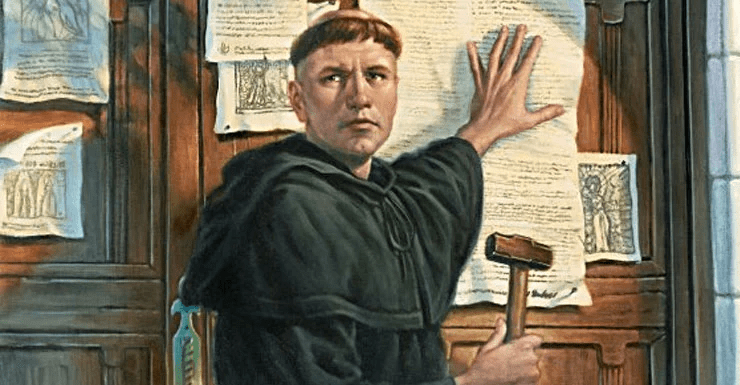
ONE HAMMER in the hand of an obscure Augustinian monk changed the world forever. Martin Luther posted his Ninety-Five Theses on the church door in Wittenberg, Germany calling his fellow professors to examine issues of supreme theological importance. Thus began the Reformation through which the light of God’s Word was brought out of the darkness to shine with clarity once more.

One of the central cries of the Protestant Reformation was this: “The just shall live by faith.” Luther’s development of the doctrine of justification by faith alone recovered the gospel that had been hidden during the Middle Ages.

And at the center of that gospel is the affirmation that the righteousness by which we are declared just before a holy God is not our own. It’s a foreign righteousness, an alien righteousness, a righteousness that Luther said is extra nos—apart from us. Namely, it’s the righteousness of Jesus Christ—that righteousness that’s imputed or counted for all who put their trust in Him.

Because of that affirmation Luther was involved in serious controversies—controversies that culminated in his being brought to trial before the princes of the church and even before the emperor of the Holy Roman Empire, Charles V. And there at the Diet of Worms, summoned in Germany, Luther was called upon to recant his views. He answered his interlocutors by saying, “Revoco? You want me to say revoco? That I recant? I will not recant unless I am convinced by sacred Scripture or by evident reason. I cannot recant for my conscience is held captive by the Word of God. And to act against conscience is neither right nor safe. Here I stand. I can do no other. God help me.”

In every generation the gospel must be published anew with the same boldness, and the same clarity, and the same urgency that came forth in the 16th century Reformation. The church has always done this in both the spoken word and in song—producing hymns that tell us of the great salvation that has been wrought by God alone through Christ alone.”  Dr. R. C. Sproul

Have a blessed Reformation Day.

Soli deo Gloria!

I Timothy: A True Child.

“To Timothy, my true child in the faith: Grace, mercy, and peace from God the Father and Christ Jesus our Lord.” (1 Timothy 1:2 (ESV)

The Apostle Paul had many companions in ministry. All of his epistles, to not only churches but also individuals, mentions many men and women who faithfully served alongside him in the Gospel ministry. However, there were only two individuals who the Apostle Paul referred to as his spiritual children. Titus was one (Titus 1:4) and Timothy was the other (2 Tim. 1:2; 2:1).

In today’s text, Paul referred to Timothy as “my true child in the faith.” The word true (γνησίῳ; gnesio) means genuine and sincere. Child (τέκνῳ; tekno) refers to a young son or daughter (Mark 13:12, Luke 1:7, Acts 7:5; See also Mat.t 7:11, Mark 7:27, Luke 1:17, Eph 6:1, al.; τέκνα).[1] Faith (πίστει; pistei) means one who is trustworthy, committed, dependable and honorable. This is a corresponding result of Timothy’s trust, commitment, dependence and worship of the Lord Jesus Christ (Rom. 3:21-26; Eph. 2:1-9).

“Only Timothy (2 Tim. 1:2; 2:1) and Titus (Titus 1:4) received this special expression of Paul’s favor. “Child” emphasizes Paul’s role as spiritual father to Timothy. “True” speaks of the genuineness of Timothy’s faith (cf. 2 Tim. 1:5). Timothy was Paul’s most cherished pupil, and protégé (1 Cor. 4:17Phil. 2:19–22).,” explains Dr. John MacArthur.

“Apostolic authority and tender love are beautifully blended, for the apostle of Jesus Christ calls the addressee ‘Timothy (my) genuine child in faith.’ Timothy was Paul’s child because it was to the apostle as a means of God’s hand that he owed his spiritual life (I Cor. 4:15; Gal. 4:19),” explains Dr. William Hendrikson.2

Paul’s familiar greeting follows. “Grace, mercy, and peace from God the Father and Christ Jesus our Lord.” These wonderful words appear in all of the apostle’s epistles.

Grace (χάρις; charis) means unmerited favor. It is a predominant term in Paul’s theology (Rom. 5:1-2, 20; 6:14; 11:6; I Cor. 15:10; 2 Cor. 9:8; 12:9; Gal. 2:21; Eph. 2:5,8; 2 Tim. 2:1; Titus 2:11; 3:7). It is God giving sinners what we do not deserve; salvation from the penalty, power and eventual presence of sin. The underlying truth of the believer’s justification, redemption, and reconciliation is by grace alone, through God given faith alone, in the person and work of Jesus Christ alone.

Mercy (ἔλεος; eleos) means to have pity and compassion. Nowhere, except in his two letters to Timothy, does Paul insert the noun mercy. Since grace is God giving sinners what we do not deserve; salvation, then mercy is God “not” giving sinner what we do deserve; judgment.

The logical result of God’s grace and mercy is peace (εἰρήνη; eirene). Peace is harmony and reconciliation between humans and before God.

This triad of grace, mercy and peace is solely originating from and given by God the Father and the Lord Jesus Christ. The phrase God the Father refers to His transcendence and immanence. Christ Jesus our Lord is a statement of deity.   

John Calvin states, “While Paul claims for himself the appellation of father, he does it in such a manner as not to take away or diminish the smallest portion of the honor which is due to God. (Hebrews 12:9.) It is a common proverb “That which is placed below another is not at variance with it.” The name father, applied to Paul, with reference to God, belongs to this class. God alone is the Father of all in faith, because he regenerates us all by his word, and by the power of his Spirit, and because none but he bestows faith. But they whom he is graciously pleased to employ as his ministers for that purpose, are likewise allowed to share with him in his honor, while, at the same time, He parts with nothing that belongs to himself. Thus God, and God alone, strictly speaking, was Timothy’s spiritual Father; but Paul, who was God’s minister in begetting Timothy, lays claim to this title, by what may be called a subordinate right.”

Are you a true child of the faith? Do you have individuals in your life in which you regard them as such?

May the Lord’s truth and grace be found here. Have a blessed day in the Lord.

Soli deo Gloria!


[1] G. Abbott-Smith, A Manual Greek Lexicon of the New Testament (New York: Charles Scribner’s Sons, 1922), 441.

2William Hendriksen and Simon J. Kistemaker, Exposition of the Pastoral Epistles, vol. 4, New Testament Commentary (Grand Rapids: Baker Book House, 1953–2001), 53.

I Timothy: Salutation.  

Paul, an apostle of Christ Jesus by command of God our Savior and of Christ Jesus our hope,” (1 Timothy 1:1 (ESV)

As was the case with all of his epistles, the Apostle Paul immediately identified himself as its author. A salutation is a greeting immediately preceding the contents of a letter. It may contain various introductory words such as “good morning,” or even the word “greetings.” Today’s text is Paul’s salutation to Timothy.

Acknowledging Paul’s authorship should not negate the Holy Spirit’s role in divine inspiration and biblical revelation (2 Tim.3:16-17; 2 Peter 1 :20-21). There is a dual authorship involving the divine and the human.

Paul identified himself as an apostle of Christ Jesus. An apostle (ἀπόστολος; apostolos) was a special messenger. It was “generally restricted to the immediate followers of Jesus Christ, but also extended, as in the case of Paul, to other early Christians active in proclaiming the message of the gospel.” [1]

However, the word apostle also refers to a select number of individuals who held the office of apostle. It was a select and restricted group, of which the exact number varied (Matthew 10:2; Acts 1:2, 26; Acts 14:14; 1 Corinthians 12:28, 29). It also should be noted that the office and responsibility of an apostle was sourced and originated from God alone. The phrase of Christ Jesus meant Paul was solely an apostle sent by and belonging to the Lord Jesus Christ.

Paul’s self-identification as an apostle was not the only title he used. Note the following New Testament (NT) references from the Pauline epistles.   

  • “Paul, a servant of Christ Jesus, called to be an apostle, set apart for the gospel of God.” (Romans 1:1).
  • “Paul, called by the will of God to be an apostle of Christ Jesus,” (I Corinthians 1:1). 
  • “Paul, an apostle of Christ Jesus by the will of God,” (2 Corinthians 1:1).
  • “Paul, an apostle—not from men nor through man, but through Jesus Christ and God the Father, who raised him from the dead— “(Galatians 1:1).
  • “Paul, an apostle of Christ Jesus by the will of God,” (Ephesians 1:1).
  • “Paul and Timothy, servants of Christ Jesus,” (Philippians 1:1).
  • “Paul, an apostle of Christ Jesus by the will of God, and Timothy our brother,” (Colossians 1:1).
  • “Paul, Silvanus, and Timothy,” (1 Thessalonians 1:1).
  • “Paul, Silvanus, and Timothy,” (2 Thessalonians 1:1). 
  • “Paul, an apostle of Christ Jesus by command of God our Savior and of Christ Jesus our hope,” (1 Timothy 1:1).
  • “Paul, an apostle of Christ Jesus by the will of God according to the promise of the life that is in Christ Jesus,” (2 Timothy 1:1).
  • “Paul, a servant of God and an apostle of Jesus Christ, for the sake of the faith of God’s elect and their knowledge of the truth, which accords with godliness,” (Titus 1:1)
  • “Paul, a prisoner for Christ Jesus, and Timothy our brother,” (Philemon 1).

Paul then described by whose authority he was an apostle of Christ Jesus. He wrote, “by command of God our Savior and of Christ Jesus our hope,” Command (ἐπιταγὴν; epitagen) refers to an order, a decree or instruction. The phrase God our Savior refers to God the Father. This title for the first person of the Trinity is found only in the Pastoral Epistles but has its roots in the Old Testament (Ps. 18:46; 25:5; 27:9; Micah 7:7; Hab. 3:18). God the Father by nature is a saving God and the source of the sinner’s salvation from eternity past (Rom. 8:29-30; Eph. 1:3-6; I Tim. 4:10; 2 Thess. 2:13; I Peter 1:1-2).

Additionally, Paul spoke of Christ Jesus our hope. The title Christ Jesus obviously refers to the second person of the Trinity. The word hope (ἐλπίδος; elpidos) refers solely to the confident expectation each believer has in the Lord Jesus Christ. In other words, the salvation God promised to accomplish by the Lord Jesus He will fulfill.

Dr. William Hendriksen explains, “The fact that here in the Pastorals the name Savior is frequently applied to God is, after all, not at all surprising, for even in his earlier epistles Paul frequently ascribes the work of saving man to “God. “For example, “It was God’s good-pleasure through the foolishness of the preaching to save those who believe” (1 Cor. 1:21); “but God … made us alive together with Christ … for by grace have you been saved through faith; and that not of yourselves, it is the gift of God” (Eph. 2:4, 5, 8); “your salvation, and that from God” (Phil. 1:28). To “God” he also ascribes the distinct acts in the program of salvation. It is God who spared not his Son but delivered him up for us all. It is God who sets forth his Son as a propitiation for our sins. It is he who commends his love toward us. It is God who blesses us with every spiritual blessing in the heavenly places in Christ. Foreknowledge, foreordination, calling, justification, glorification are all ascribed to him. It is he who chose us. It is he who causes the gospel to be proclaimed. It is he who bestows his grace upon us. Faith is his gift,” [2]  (See Rom. 1:16; 3:24–26; 4:17; 5:8, 15; 8:3, 4, 11, 28–30, 31–33; 9:10, 11; 15:5, 13; 1 Cor. 1:9, 26–31; 15:57; 2 Cor. 2:14; 4:7; 5:5, 8, 19, 20, 21; 9:15; Gal. 1:15; 3:26; 4:4–7; Eph. 1:3–5; 2:4, 5; Phil. 2:13; 3:9; Col. 3:3).

“In view of all this we can almost say that it would have been strange if somewhere in his epistles the apostle would not have called God “our Savior.” Calling God “our Savior” is entirely proper. And since for Paul God ever saves through Christ, verse 1 is also a fitting prelude to verse 15: “Christ Jesus came into the world sinners to save.”[3]

Dr. Hendriksen concludes by saying, “Amid circumstances which to man might seem hopeless Christ Jesus is pictured as “our Hope,” that is, the very foundation for our earnest yearning, our confident expectation, and our patient waiting for the manifestation of salvation in all its fulness (cf. 1:16; 6:14–16, 19). It is he who made this hope possible and actual. It is he who revitalizes it from day to day. The Source as well as the Object of this hope is he (cf. Acts 28:20; Col. 1:27).[4]

Have you repented of your sin and received Jesus Christ as your Lord and Savior? Hope for deliverance from sin’s penalty, power and eventual presence is found solely in Him.

Mat the Lord’s truth and grace be found here. Have a blessed day in the Lord.

Soli deo Gloria!


[1] Johannes P. Louw and Eugene Albert Nida, Greek-English Lexicon of the New Testament: Based on Semantic Domains (New York: United Bible Societies, 1996), 541.

[2] William Hendriksen and Simon J. Kistemaker, Exposition of the Pastoral Epistles, vol. 4, New Testament Commentary (Grand Rapids: Baker Book House, 1953–2001), 52.

[3] William Hendriksen and Simon J. Kistemaker, Exposition of the Pastoral Epistles, vol. 4, New Testament Commentary (Grand Rapids: Baker Book House, 1953–2001), 52–53.

[4] William Hendriksen and Simon J. Kistemaker, Exposition of the Pastoral Epistles, vol. 4, New Testament Commentary (Grand Rapids: Baker Book House, 1953–2001), 53.