I Timothy: Doxology.

To the King of the ages, immortal, invisible, the only God, be honor and glory forever and ever. Amen.” (1 Timothy 1:17 (ESV)

Today’s text is a doxology by the Apostle Paul. It is one of several in his epistles (Rom. 11:33-36). A doxology is a liturgical formula of praise to God. The term doxology comes from the Latin doxologia. This comes from the Greek word doxa meaning glory and logia meaning an oral or written expression. Therefore, a doxology is an oral or written expression of praise to God. Current examples would be The Gloria in Excelsis and the Gloria Patri.

In producing a written expression of praise to the Lord, Paul included several titles and names for the Lord. They include King of the ages, immortal, invisible, the only God. What do each of these titles mean with respect to the Lord?

King of the Ages. The phrase King of the ages (βασιλεῖ αἰώνων; basilei aionon) refers to an induvial who has absolute authority and who is eternal. This phrase could be accurately translated “to the only eternal king.” In the immediate context (1:16), this title refers explicitly to the Lord Jesus Christ.

“Man proposes; God disposes. Man—for instance Paul before his conversion—may try to destroy the church; God will establish it. And for that purpose he will use the very man who tried to destroy it! Hence, though man is a mere creature of time, God is the King of the ages, over-ruling evil for good; directing to its predetermined goal whatever happens throughout each era of the world’s history. His “dominion endures throughout all generations” (Ps. 145:13),” explains Dr. William Hendriksen..[1]

Immortal. Immortal (ἀφθάρτῳ; aphtharto) means imperishable and not subject to either decay or death. It also refers to incorruptibility, blamelessness, and purity. Since Christ is the King of the ages, He is also immortal.

“This implies that he is the eternal God, and as such “imperishable” (the best reading). His arms never become tired (Deut. 32:27). He never grows weary (Is. 40:28). Decay and death are not applicable to him (Ps. 103:15–17). He never changes (Mal. 3:6). On the contrary, he is the inexhaustible reservoir of strength, ever new, for his people (Is. 40:29–31). For the doctrine of God’s imperishability see also Rom. 1:23; and cf. the synonym immortality (see 1 Tim. 6:16).[2]

Invisible. Invisible (ἀοράτῳ; aorato) refers to what cannot be seen. This is also applicable to the One, True God; Jesus Christ.

“20 For his invisible attributes, namely, his eternal power and divine nature, have been clearly perceived, ever since the creation of the world, in the things that have been made. So they are without excuse.” (Romans 1:20 (ESV)

“When one thinks of God as the imperishable, the mind inevitably turns to those objects that are perishable, for example, grass, the flowers of the field (Ps. 103:15–17), man’s body, birds, quadrupeds, creeping creatures (Rom. 1:23). These are all visible. God, being imperishable, is also invisible, “whom no one has seen or can see” (1 Tim. 6:16). It is only in his Image (Col. 1:15, 16) that man “sees Him who is invisible,” and then only by faith (Heb. 11:27), and in a finite manner. Never shall we be able to “find out the Almighty unto perfection” (Job 11:7, 8). Paul surely was not able to comprehend the grace of God which had been shown to him. Here all reasoning stops. There is room only for doxologies!”[3]

The Only God. The phrase the only God (μόνῳ θεῷ; mono theo) means the One who alone is the One, True God. There is none other.

6 “Thus says the Lord, the King of Israel and his Redeemer, the Lord of hosts: “I am the first  and I am the last; besides me there is no god. Who is like me? Let him proclaim it. Let him declare and set it before me, since I appointed an ancient people. Let them declare what is to come, and what will happen. Fear not, nor be afraid; have I not told you from of old and declared it? And you are my witnesses! Is there a God besides me? There is no Rock; I know not any.” (Isaiah 44:6–8 (ESV)

5 “I am the Lord, and there is no other, besides me there is no God; I equip you, though you do not know me, that people may know, from the rising of the sun and from the west, that there is none besides me; I am the Lord, and there is no other.” (Isaiah 45:5–6 (ESV)

“Such a God, finally, is the “only” God; not merely in the coldly abstract sense that numerically there is but one God, but in the warm, scriptural sense, namely, that this one God is “unique, incomparable, glorious, lovable” (Deut. 6:4, 5; Is. 40:12–31; Rom. 16:27; 1 Cor. 8:4, 5).” [4]

What is the Apostle Paul’s response to such truth? What ought to be our response to such truth? Believers in Christ are to give God honor and glory forever and ever. Honor (τιμὴ; time) means to give respect and value. Glory (δόξα; doxa) means to give praise and honor. This is to the believers’ perspective and discipline for eternity. Paul concludes his doxology with a fervent Amen.

May the passion of our life be to praise, honor, respect and value the Lord Jesus Christ.

“Praise God, from whom all blessings flow; 
Praise him, all creatures here below; 
Praise him above, ye heav’nly host; 
Praise Father, Son, and Holy Ghost.”                                                                         Amen.

Soli deo Gloria!


[1] William Hendriksen and Simon J. Kistemaker, Exposition of the Pastoral Epistles, vol. 4, New Testament Commentary (Grand Rapids: Baker Book House, 1953–2001), 83.

[2] Ibid. 83.

[3] Ibid.83–84.

[4] Ibid. 84.

I Timothy: Christ Displays His Perfect Patience.   

15 “The saying is trustworthy and deserving of full acceptance, that Christ Jesus came into the world to save sinners, of whom I am the foremost. 16 But I received mercy for this reason, that in me, as the foremost, Jesus Christ might display his perfect patience as an example to those who were to believe in him for eternal life.” (1 Timothy 1:15–16 (ESV)

Why did Jesus come to this earth? The Apostle Paul provided the answer when he wrote his first epistle, or letter, to his young protégé Timothy. He prefaced his answer as to why Jesus Christ came as a saying trustworthy deserving of full acceptance.

The trustworthy saying deserving of full acceptance was this; Christ Jesus came into the world to save sinners. This is why Jesus came to earth. This is the core truth of Scripture. The significance of this truth for Paul was he viewed himself as the foremost of sinners. Christ came to save sinners and this former Pharisee’s perspective was he was the worst sinner there ever was.

Prior to his conversion, Paul was the individual he described in his letter to the Ephesians. “And you were dead in the trespasses and sins in which you once walked, following the course of this world, following the prince of the power of the air, the spirit that is now at work in the sons of disobedience— among whom we all once lived in the passions of our flesh, carrying out the desires of the body and the mind, and were by nature children of wrath, like the rest of mankind.” (Ephesians 2:1–3 (ESV)

Notice the personal pronoun the apostle used in vs. 3; It is the pronoun “we.” He included himself in his description of fallen and unconverted sinners. Paul was honest in evaluating his status before God prior to his repentance and faith in Christ. He was an object of God’s wrath and judgment.

In both today’s text from I Timothy, and Ephesians 2, Paul provided the striking contrast of God’s grace and mercy. In Ephesians he continued by saying,

But God, being rich in mercy, because of the great love with which he loved us, even when we were dead in our trespasses, made us alive together with Christ—by grace you have been saved—” (“Ephesians 2:4–5 (ESV). Once again, Paul included himself by using the pronouns “we” and “us.” In today’s text from I Timothy, Paul’s testimony of conversion is more personal as evidenced in vs. 16.

“But I received mercy.” But (ἀλλὰ; alla) is a conjunction of contrast. It means “on the contrary,” “instead,” or “on the other hand.” The phrase I received mercy (ἠλεήθην; eleethen) means Paul received from God kindness because of his serious need of salvation. Mercy is “not” receiving what you deserve, which is judgment or punishment. Instead, the Lord gave compassion.

“Chief of sinners, nevertheless the recipient of infinite mercy! That accounts for the “but.” In fact, the magnitude of the sin made it necessary for mercy, if it was to be shown at all, to superabound,” explains Dr. William Hendriksen.[1]

In acknowledging his former and foremost depravity of sinfulness, Paul also acknowledged Jesus Christ’s demonstration of perfect patience toward him. Perfect (ἅπασαν; hapasan) refers to the whole or completeness. Patience (μακροθυμίαν; makrothymian) is calmness in the face of provocation and irritation. Paul provoked and irritated Christ by his persecution of Christ in attacking Christiana (Acts 9:1-5).

Paul’s salvation in Christ was “an example to those who were to believe in him (Christ) for eternal life.”. Since the Lord Jesus saw fit to save Paul from the penalty, power and eventual presence of sin, He is willing, ready and able to save any kind of sinner. Example (ὑποτύπωσιν; hypotyposin) refers to a prototype or pattern.

“The apostle considers himself not only the chief of sinners but also—and in a certain sense for that very reason—the most glorious illustration of Christ’s longsuffering. Here in verse 16 two ideas blend into one: Paul is “foremost” as an example of what Christ’s longsuffering can accomplish. He is at the same time “foremost” as the head of a procession of persons to whom that longsuffering is shown. Longsuffering indicates the divine patience with respect to persons, by virtue of which wrath is withheld, the sinner is spared, and mercy is shown. In the case of Paul this longsuffering had been exhibited in full measure (note “all his longsuffering,” or as one might say, “the whole of it”), forgiving his frightful crimes, appointing him to the apostleship, and giving him strength for each day,” continues Dr. Hendriksen.[2]

“In his gallery of grace, the Artist-Savior had, as it were, drawn and put on exhibition a sketch (ὑποτύπωσις, acc.—ιν, used only here and in 2 Tim. 1:13), just like a master will first draw a rough pencil-sketch before attempting his final work. This sketch revealed Paul, as an illustration, pattern or model, of the type of work sovereign grace was going to perform in the lives of all those who through its efficacy would come to (cf. Acts 13:48: “had been ordained to”) rest their faith (note durative present infinitive πιστεύειν) on (note ἐπί) Christ, the solid rock or the precious cornerstone (Matt. 7:24, 25; Is. 28:16; cf. Rom. 9:33; 10:11; 1 Peter 2:6), with a view to life everlasting, a life that is opposed to “corruption” (Gal. 6:8) and “death” (Rom. 6:22). Death is wages; life everlasting is a free gift (Rom. 6:22, 23). It manifests itself in fellowship with God in Christ (John 17:3), partaking of the love of God (John 5:42), of his peace (John 16:33), and of his joy (John 17:13). It is also actually what its name indicates ever-lasting, never-ending life.[3]

Consider this biblical truth with the song My Worth Is Not in What I Own by Keith & Kristyn Getty and Graham Kendrick.

1 My worth is not in what I own,
Not in the strength of flesh and bone,
But in the costly wounds of love
At the cross.

My worth is not in skill or name,
In win or lose, in pride or shame,
But in the blood of Christ that flowed
At the cross.

Chorus
I rejoice in my Redeemer
Greatest Treasure,
Wellspring of my soul!
I will trust in Him, no other.
My soul is satisfied in Him alone.

As summer flowers we fade and die,
Fame, youth and beauty hurry by,
But life eternal calls to us
At the cross.

I will not boast in wealth or might,
Or human wisdom’s fleeting light,
But I will boast in knowing Christ
At the cross.

Two wonders here that I confess,
My worth and my unworthiness.
My value fixed – my ransom paid,
At the cross.

May the Lord’s truth and grace be found here. Have a blessed day in the Lord.

Soli deo Gloria!


[1] William Hendriksen and Simon J. Kistemaker, Exposition of the Pastoral Epistles, vol. 4, New Testament Commentary (Grand Rapids: Baker Book House, 1953–2001), 82.

[2] Ibid. 82.

[3] Ibid. 82–83.

I Timothy: Why Jesus Came?

15 “The saying is trustworthy and deserving of full acceptance, that Christ Jesus came into the world to save sinners, of whom I am the foremost. 16 But I received mercy for this reason, that in me, as the foremost, Jesus Christ might display his perfect patience as an example to those who were to believe in him for eternal life.” (1 Timothy 1:15–16 (ESV)

Why did Jesus come to this earth? This is a basic Sunday school question posed to all age groups. It strikes at the very core of the sum and substance of the Gospel. It is the crux of biblical truth. It is a fundamental of the Christian faith.

The Apostle Paul provided the answer when he wrote his first epistle, or letter, to his young protégé Timothy. He prefaced his answer as to why Jesus Christ came as a saying trustworthy deserving of full acceptance.

To be trustworthy (πιστὸς; pistos) means to be dependable, reliable and sure. The word deserving (ἄξιος; axios) refers to worthiness and value. The phrase full acceptance (πάσης ἀποδοχῆς; pases apodoches) means something is true solely because of its source. What Paul wrote to Timothy, and what individuals read in the Scriptures today specifically from today’s text, was a reliable, valuable and true statement.

The trustworthy saying deserving of full acceptance was this; Christ Jesus came into the world to save sinners. This is why Jesus came to earth. This is the core truth of Scripture. Consider also these biblical cross references.

16 “For God so loved the world, that he gave his only Son, that whoever believes in him should not perish but have eternal life.” (John 3:16 (ESV)

When Jesus had spoken these words, he lifted up his eyes to heaven, and said, “Father, the hour has come; glorify your Son that the Son may glorify you, since you have given him authority over all flesh, to give eternal life to all whom you have given him. And this is eternal life, that they know you, the only true God, and Jesus Christ whom you have sent. I glorified you on earth, having accomplished the work that you gave me to do. And now, Father, glorify me in your own presence with the glory that I had with you before the world existed.” (John 17:1–5 (ESV)

But when the fullness of time had come, God sent forth his Son, born of woman, born under the law, to redeem those who were under the law, so that we might receive adoption as sons.” (Galatians 4:4–5 (ESV)

The significance of this truth for Paul was he viewed himself as the foremost of sinners. Christ came to save sinners and this former Pharisee’ perspective was he was the worst sinner there ever was. The word foremost (πρῶτός; protos) means prominent and greatest.

“The psychology of Christian experience, as described by the first generation of Christians, includes a massive dose of what some have disparagingly called “worm” theology (as in “such a worm as I”). Listen to the apostle: “The saying is trustworthy and deserving of full acceptance, that Christ Jesus came into the world to save sinners, of whom I am the foremost” (1 Tim. 1:15),” explains Rev. Terry L. Johnson, senior minister of Independent Presbyterian Church in Savannah, Ga.

“Why does he feel the necessity to rehearse his past as a “blasphemer, persecutor, and insolent opponent”? Why hasn’t the apostle Paul learned to see himself as God sees him — “in Christ” — and not as a sinner, as forgiven, cleansed, adopted, a child of the Father, clothed in the righteousness of Christ? Answer: he does. But he is also careful not to forget the depths out of which he has been saved.”

“The psychology of the Christian experience is wide-ranging, but essentially it is that of humble gratitude. We are humble because we know the truth about ourselves: our corruption, our weakness, our conflicts, our helplessness. We are also exceedingly grateful for what Christ has done and for what we have: peace with God, family membership, and eternal life. Indeed, I understand the magnitude of what I have in Christ because of this accompanying awareness of the depth of my depravity,” continues Rev. Johnson.

“A constant awareness of my past failure and continuing corruption is not only not contrary to a rich apprehension of grace but its necessary companion. The exceeding greatness of God’s grace in Christ is understood in its fullness only against the black backdrop of my unworthiness. This is why the apostle Paul gives thanks (v. 12) and bursts forth in praise even as he recalls his past crimes and present status as the chief of sinners.”

We are not to glory in our past sins; far from it. However, we are never to forget the depths from which the Lord saved us from our previous, Christless existence. WE ought to be overwhelmed with praise and gratitude to God. Consider these lyrics by Jason Ingram, Jonathan Smith, Kristian Stanfill, and Sean Curran entitled Glorious Day.

I was buried beneath my shame Who could carry that kind of weight? It was my tomb ‘Til I met You.

I was breathing, but not alive All my failures I tried to hide It was my tomb ‘Til I met You.

You called my name Then I ran out of that grave Out of the darkness Into Your glorious day.

May the Lord’ s truth and grace be found here. Have a blessed day in the Lord.

Soli deo Gloria!

A Word Fitly Spoken. The Savior in the Psalms: Psalm 2.

“Why do the heathen rage, And the people imagine a vain thing? The kings of the earth set themselves, And the rulers take counsel together, Against the Lord, and against his anointed, saying, Let us break their bands asunder, And cast away their cords from us. He that sitteth in the heavens shall laugh: The Lord shall have them in derision. Then shall he speak unto them in his wrath, And vex them in his sore displeasure. Yet have I set my king Upon my holy hill of Zion. I will declare the decree: The Lord hath said unto me, Thou art my Son; This day have I begotten thee. Ask of me, And I shall give thee the heathen for thine inheritance, And the uttermost parts of the earth for thy possession. Thou shalt break them with a rod of iron; Thou shalt dash them in pieces like a potter’s vessel. 10 Be wise now therefore, O ye kings: Be instructed, ye judges of the earth. 11 Serve the Lord with fear, And rejoice with trembling. 12 Kiss the Son, lest he be angry, And ye perish from the way, When his wrath is kindled but a little. Blessed are all they that put their trust in him.” (Psalm 2)

Psalm 2 describes the nations’ rebellion against the sovereign God of the universe and issues a warning against such foolish thinking. Although it has no title, it seems to bear the imprint of David’s hand. Acts 4:23-28 supports this perspective.

At a time when the Gentile kingdoms seek to reject Israelite rule, this psalm recalls the promises made to the Davidic king at his coronation and notes the Gentiles will find lasting joy only as subjects of this king. With its prospect of a worldwide rule for the house of David, the psalm also looks to the future, when the Davidic Messiah will indeed accomplish this goal. In fact, the scope of such an accomplishment calls for a ruler who is more than a mere man.

To acknowledge God as the Sovereign God of the Universe is to declare that He is the Almighty who possesses all power in heaven and earth so no one can defeat His counsels, thwart His purpose or resist His will (Psalm 115:33). To say God is Sovereign is to declare He is the governor of all nations (Psalm 22:28). It is He who sets up kingdoms, overthrows empires or presidents, and determines the course of dynasties as pleases Him best. To say God is sovereign is to declare with I timothy 6:15-16  “ He who is the blessed and only Sovereign, the King of kings and Lord of lords, who alone has immortality, who dwells in unapproachable light, whom no one has ever seen or can see. To him be honor and eternal dominion. Amen. (1 Timothy 6:15-16 ESV). Such is the God of the Bible.

A four point outline may be crafted for Psalm 2. Take note of the following.

  1. The Arrogant. 2:1-3. The psalmist gives an accurate description of sinful, human rebellion against the One, True God.  
  2. The Almighty 2:4-6. The psalmist presents the LORD’s divine reaction to arrogant, sinful rebellion.
  3. The Anointed 2:7-9. The psalmist depicts the anointed One’s divine rule.
  4. The Advice. 2:10-12. The psalmist cautions all humans in all levels of life to not only serve the LORD with fear but also to rejoice with trembling.

Psalm 2 describes the Messiah’s incarnation, crucifixion and resurrection. The psalm is quoted in four New Testament passages.

Acts 4:23–28 (ESV) says, 23 When they were released, they went to their friends and reported what the chief priests and the elders had said to them. 24 And when they heard it, they lifted their voices together to God and said, “Sovereign Lord, who made the heaven and the earth and the sea and everything in them, 25 who through the mouth of our father David, your servant, said by the Holy Spirit, “ ‘Why did the Gentiles rage, and the peoples plot in vain? 26 The kings of the earth set themselves, and the rulers were gathered together, against the Lord and against his Anointed’— 27 for truly in this city there were gathered together against your holy servant Jesus, whom you anointed, both Herod and Pontius Pilate, along with the Gentiles and the peoples of Israel, 28 to do whatever your hand and your plan had predestined to take place.”  

In writing Acts of the Apostles, Luke attributes Psalm 2 to King David. The setting is when the Jewish leadership released the Apostle Peter and John following their arrest for healing a lame beggar and for preaching the Gospel in the Temple (Acts 3:1-4:22). In writing about the early church, Luke saw obvious parallels in what King David wrote and the persecution the apostles were experiencing.

Secondly, Acts 13:32-33 (ESV) says 32 And we bring you the good news that what God promised to the fathers, 33 this he has fulfilled to us their children by raising Jesus, as also it is written in the second Psalm, “ ‘You are my Son, today I have begotten you.”

Luke records Paul and Barnabas’ preaching the Gospel in Antioch of Pisidia (Acts 13:13-52). Paul cited Psalm 2 to his Jewish audience in the synagogue (Acts 13:14-16) as being fulfilled in the resurrection of Jesus Christ.

Thirdly, Hebrews 1:1–5 (ESV) says , “Long ago, at many times and in many ways, God spoke to our fathers by the prophets, but in these last days he has spoken to us by his Son, whom he appointed the heir of all things, through whom also he created the world. He is the radiance of the glory of God and the exact imprint of his nature, and he upholds the universe by the word of his power. After making purification for sins, he sat down at the right hand of the Majesty on high, having become as much superior to angels as the name he has inherited is more excellent than theirs. For to which of the angels did God ever say, “You are my Son, today I have begotten you”?”

The writer of Hebrews expressed the truth of the eternality, incarnation, crucifixion and exaltation of the Son, Jesus Christ (Acts 1:1-11; Hebrews 2:9).  The text also describes the unique relationship between God the Father and God the Son.  

Finally, Hebrews 5:5 (ESV) says, So also Christ did not exalt himself to be made a high priest, but was appointed by him who said to him, “You are my Son, today I have begotten you.”

By quoting  Psalm 2:7, the writer further explains that Jesus Christ’s incarnation, and His priesthood were both by God the Father’s divine appointment (cf. John 8:54). Jesus’ humanity does not in any way diminish His eternal deity. or alter the essential equality within the Trinity (cf. John 10:30; 14:9–11). Psalm 2 acknowledges the Son of God, Jesus Christ, as both King and Messiah. Jesus Christ is the King-Priest.

“Kiss the Son, lest he be angry, and you perish in the way.” Beloved, I don’t want any of us to ever be in the way of the anger of Christ. And my plea is that we would all rejoice in His coming, willingly bow our knee before Him, embrace Him with affection, and give Him not the kiss of Judas, but the kiss of love and affection in which He delights,” states Dr. R. C. Sproul.

Are you anxious or worried about the current world condition? Take heart! The Lord is the sovereign God of the universe. He is control and is working all things for His purpose and glory. May this week we seek to consciously remember to “Serve,” “rejoice,” “fear,”  “tremble” and “submit” to the LORD.

May Psalm 2, and each of the New Testament references to the same, enrich your Advent season this year. May each of us have a greater understanding that Jesus Christ is the Anointed Son of God who came to earth to fulfill the Father’s sovereign will for our salvation.

May the Lord’s truth and grace be found here. Have a blessed Lord’s Day.

Soli deo Gloria!

I Timothy: Grace Overflowed.

13 though formerly I was a blasphemer, persecutor, and insolent opponent. But I received mercy because I had acted ignorantly in unbelief, 14 and the grace of our Lord overflowed for me with the faith and love that are in Christ Jesus.” (1 Timothy 1:13–14 (ESV)

In spite of all Paul was and did prior to his conversion (Acts 8:1-3; 9:1-10), God’s grace was greater than all his sin. For the believer in Christ, God’s grace is greater than all our sin. For the soul without salvation in Christ, God’s grace is greater than all your sin.

And the grace (χάρις; charis) refers to God’s unmerited favor towards sinners who deserve His wrath and judgment. This grace is solely of our Lord (κυρίου; kyriou) who is the Master and Sovereign God of the universe. Paul elsewhere speaks of God’s grace. Consider these passages.  

Romans 3:21–26 (ESV) – “21 But now the righteousness of God has been manifested apart from the law, although the Law and the Prophets bear witness to it— 22 the righteousness of God through faith in Jesus Christ for all who believe. For there is no distinction: 23 for all have sinned and fall short of the glory of God, 24 and are justified by his grace as a gift, through the redemption that is in Christ Jesus, 25 whom God put forward as a propitiation by his blood, to be received by faith. This was to show God’s righteousness, because in his divine forbearance he had passed over former sins. 26 It was to show his righteousness at the present time, so that he might be just and the justifier of the one who has faith in Jesus.

Ephesians 2:1–5 (ESV) – “And you were dead in the trespasses and sins in which you once walked, following the course of this world, following the prince of the power of the air, the spirit that is now at work in the sons of disobedience— among whom we all once lived in the passions of our flesh, carrying out the desires of the body and the mind, and were by nature children of wrath, like the rest of mankind. But God, being rich in mercy, because of the great love with which he loved us, even when we were dead in our trespasses, made us alive together with Christ—by grace you have been saved—” 

Ephesians 2:8–10 (ESV) – For by grace you have been saved through faith. And this is not your own doing; it is the gift of God, not a result of works, so that no one may boast. 10 For we are his workmanship, created in Christ Jesus for good works, which God prepared beforehand, that we should walk in them.” 

Paul continued to say God’s grace overflowed for me (ὑπερεπλεόνασεν; hyperepleonasen). In the Greek text, this word appears first. It means to abound or to be super abundant. The contrast as to what God’s grace was more abundant would respectively be Paul’s sin of blasphemy, persecution and insolent opposition towards Christ, the church and the Gospel.

Accompanying God’s grace was the God given gifts of faith and love. Faith (πίστεως; pisteos) is solely a trust in. commitment to, a dependence upon and a worship of Jesus Christ  Love (ἀγάπης; agapes) is a self; sacrificial love of the will which solely is from and centered in Jesus Christ.

“The transition from verse 13 to verse 14 is that from abounding sin to super-abounding grace. Here in verse 14 the emphasis is on the great change which by this grace was brought about in the life of the apostle. Note the position of the verb at the head of the sentence, for the sake of emphasis: “And it super-abounded, (namely) the grace of our Lord.” Grace, here as in 1:2, is God’s unmerited favor bestowed on the elect, producing consecrated lives (see 1 Thess. 1:1). The verb super-abounded clearly points to Paul as the author of the Pastorals, for nowhere in the New Testament do we find such constant emphasis on the “super” character of redemption in Christ,” explains Dr. William Hendriksen..[1]

It is Paul who declares:

  • Where sin abounded, grace super-overflowed (overflowed all the more, Rom. 5:20).”
  • “Faith super-increases (is growing beyond measure, 2 Thess. 1:3).” So does love.
  • “I super-overflow (overflow abundantly) with joy (I am overjoyed, 2 Cor. 7:4).”
  • “We are praying super-abundantly (with intense earnestness, 1 Thess. 3:10).”
  • “The peace of God sur (-super)-passes all understanding (Phil. 4:7).”
  • “Esteem them (the leaders) super-abundantly (very highly) in love (1 Thess. 5:13).”
  • “In order that I might not super-exalt myself (uplift myself to an excessive degree), there was given me a thorn in the flesh” (2 Cor. 12:7).[2]

“The phrase “with faith and love” indicates the effect of grace in Paul’s heart and life. Grace kindles faith and love, floods the soul with these divine gifts. The apostle is fond of this combination (see N.T.C. on 1 Thess. 1:3 and 5:8). With him grace is ever the root, faith and love are the trunk, and good works are the fruit of the tree of salvation. That holds for the Pastorals as well as for the other epistles (Rom. 4:16; 11:6; Gal. 5:22–24; Eph. 2:4–10; 2 Thess. 2:13; Titus 2:11–14; 3:4–8). For the concepts “faith” and “love” see N.T.C. on 1 Thess. 5:8. This faith and this love are “in Christ Jesus,” that is, they are centered in him. Paul possesses these graces because of his mystic union with Christ, the Savior,” concludes Dr. Hendriksen..[3]

1 Praise, my soul, the King of heaven;
to his feet your tribute bring.
Ransomed, healed, restored, forgiven,
evermore his praises sing.
Alleluia, alleluia!
Praise the everlasting King!

2 Praise him for his grace and favor
to his people in distress.
Praise him, still the same as ever,
slow to chide, and swift to bless.
Alleluia, alleluia!
Glorious in his faithfulness!

3 Fatherlike he tends and spares us;
well our feeble frame he knows.
In his hand he gently bears us,
rescues us from all our foes.
Alleluia, alleluia!
Widely yet his mercy flows!

4 Angels, help us to adore him;
you behold him face to face.
Sun and moon, bow down before him,
dwellers all in time and space.
Alleluia, alleluia!
Praise with us the God of grace!
– Henry Francis Lyte (1793-1847)

May the Lord’s truth and grace be found here. Have a blessed day in the Lord.

Soli deo Gloria!


[1] William Hendriksen and Simon J. Kistemaker, Exposition of the Pastoral Epistles, vol. 4, New Testament Commentary (Grand Rapids: Baker Book House, 1953–2001), 75.

[2] Ibid. 75.

[3] Ibid. 75.

I Timothy: Not What I Used to Be.

“…though formerly I was a blasphemer, persecutor, and insolent opponent. But I received mercy because I had acted ignorantly in unbelief,” (1 Timothy 1:13 (ESV)

Pastor, musician, author and reformer John Newton (1725-1807) is well known for his classic hymn Amazing Grace.  He is also known for several striking and memorable quotes concerning the Christian life. Here are but a few.

“Although my memory’s fading, I remember two things very clearly: I am a great sinner and Christ is a great Savior.”

“God sometimes does His work with gentle drizzle, not storms.”

Whoever is truly humbled — will not be easily angry, nor harsh or critical of others. He will be compassionate and tender to the infirmities of his fellow-sinners, knowing that if there is a difference — it is grace alone which has made it! He knows that he has the seeds of every evil in his own heart. And under all trials and afflictions — he will look to the hand of the Lord, and lay his mouth in the dust, acknowledging that he suffers much less than his iniquities have deserved.”

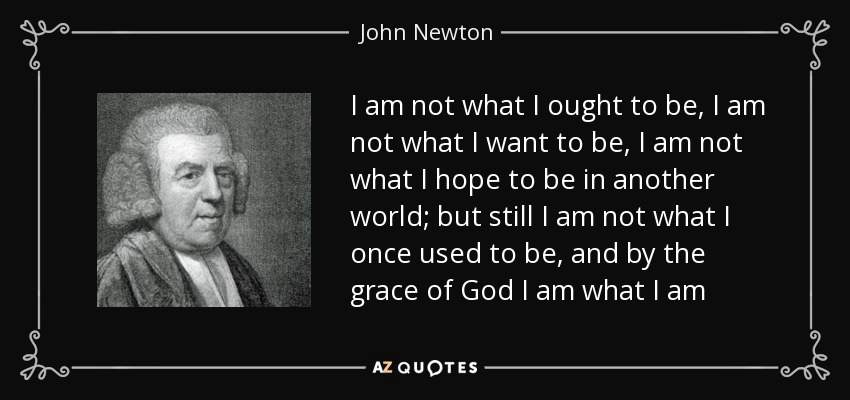
“I am not what I ought to be, I am not what I want to be, I am not what I hope to be in another world; but still I am not what I once used to be, and by the grace of God I am what I am”

In today’s text, the Apostle Paul honestly remembered what he used to be. He called himself a former blasphemer, persecutor, and insolent opponent. The object of his blasphemy, persecution and insolent opposition was none other than Jesus Christ (Acts 9:1-4). This was what Paul was formerly (πρότερον; proteron). This meant his life prior to his conversion.

A blasphemer (βλάσφημον; blasphemon) is one who defames and slanders someone or something. It is reviling, insulting, and despising a person, place or thing. It means to speak evil. Paul not only did this personally, he sought to persuade others to do the same (Acts 26:11).

A persecutor (διώκτην; diokten) means to oppose, harass, and torment. Luke recorded this as historical fact (Acts 8:1-3)

To be an insolent opponent (ὑβριστήν; hybristen) refers to a violent insulter. This implies the malicious treatment of others (Rom. 1:30).

Paul also acknowledged he acted ignortantly in unbelief before his conversion. Paul’s active practice and work was steeped in ignorance (ἀγνοῶν; agnoon) or a failure to understand who Christ was and accomplished. This ignorance was not rooted in any lack of intelligence, but by his unbelief (ἀπιστίᾳ; apistia). Despite being a leader in religious Judaism (Phil. 3:1-6), Paul was a man void of true faith, trust, dependence, commitment and worship of the One, True God of heaven and earth. Ironically, Paul sought to serve the LORD by persecuting the LORD he sought to serve.  

The great news was Paul received mercy (ἠλεήθην; eleethen). The LORD sovereignly chose to “not” give Paul what he deserved; judgment.  Rather, He gave him what he did not deserve; forgiveness, redemption, reconciliation and justification (Eph. 2:1-5).

“Before his conversion, Paul persecuted the church (Acts 8:3; 9:1-5; 22:4-5; 26:9-11; Gal. 1:13). At that time, he saw it as his obligation in his zeal for God’s glory (Phil. 3:6). But now, having received grace through Jesus Christ, he views his history as a persecutor as constituting him ‘the least of the apostles’ (I Cor.15:8-10); ‘the least of all the saints’ (Eph. 3:8), and the ‘foremost of sinners’ (I Tim.  1:15-16),” explains Dr. R. C. Sproul.

John Calvin writes, “We see how candidly he acknowledges that it might be brought against him as a reproach, and how far he is from extenuating his sins, and how, by willingly acknowledging his unworthiness, he magnifies the greatness of the grace of God. Not satisfied with having called himself a “persecutor,” he intended to express more fully his rage and cruelty by an additional term, an oppressor.”

“But he appears to insinuate that there is no room for pardon, unless when ignorance can be pleaded in excuse. What then? Will God never pardon anyone who has sinned knowingly? I reply, we must observe the word unbelief; for this term limits Paul’s statement to the first table of the law. Transgressions of the second table, although they are voluntary, are forgiven; but he who knowingly and willingly breaks the first table sins against the Holy Spirit, because he is in direct opposition to God. He does not err through weakness, but by rushing wickedly against God, gives a sure proof of his reprobation.”

This is why our justification from God must be by grace alone, through faith alone in the person and work of Jesus Christ alone. Read and carefully meditate upon Paul’s inspired words to the church at Rome.

“21 But now the righteousness of God has been manifested apart from the law, although the Law and the Prophets bear witness to it— 22 the righteousness of God through faith in Jesus Christ for all who believe. For there is no distinction: 23 for all have sinned and fall short of the glory of God, 24 and are justified by his grace as a gift, through the redemption that is in Christ Jesus, 25 whom God put forward as a propitiation by his blood, to be received by faith. This was to show God’s righteousness, because in his divine forbearance he had passed over former sins. 26 It was to show his righteousness at the present time, so that he might be just and the justifier of the one who has faith in Jesus.” (Rom. 3:212-6 (ESV)

Therefore, we echo the words of John Newton: “I am not what I ought to be, I am not what I want to be, I am not what I hope to be in another world; but still I am not what I once used to be, and by the grace of God I am what I am”

Thanks be to God for His amazing grace and mercy; not only to the Apostle Paul but also to all believers in Christ. May the Lord’s truth and grace be found here.

Soli deo Gloria!

I Timothy: Called to Serve.

I thank him who has given me strength, Christ Jesus our Lord, because he judged me faithful, appointing me to his service,” (1 Timothy 1:12 (ESV)

I Timothy, along with 2 Timothy and Titus, is a pastoral epistle by the Apostle Paul. It is also one of Paul’s most personal and autobiographical. The epistle not only contains sound doctrine, but also personal reflections. Today’s text is one example of the latter.

Paul recalled to his young protégé Timothy, God’s call for the former Pharisee to be converted and to serve. The apostle could not do anything else but serve the Lord as a missionary, evangelist, pastor/teacher, author of sacred Scripture and an apostle. However, prior to his conversion (Acts 9), Paul was as much a false teacher as those he described in 1:3-11.

“God’s sovereign purpose for Paul and for all believers works through personal faith. Until Paul was turned by the Holy Spirit from self-righteous works (see Phil. 3:4–7) to faith alone in Christ, he could not be used by God. He was in the same condition as the useless false teachers (1 Tim. 1:6–7),” explains Dr. John MacArthur.

God called my wife and I into full-time ministry, following my conversion to become a believer in Christ three years earlier, What a surprise! This sovereign call to serve necessitated my studying at an accredited Bible College. Detroit Bible College (DBC) fit the bill.

I spent three years at DBC of concentrated exposure to the Scriptures, theology, apologetics, pastoral ministry, missions, and philosophy. I describe myself at the time being like a dry sponge placed into a deep well of biblical truth. I soaked it up. It was an amazing time in my life. My wife shared this joy with me.

The phrase appointing me to service (θέμενος διακονίαν; themenos diakonian) means to be sovereignly placed by another into ministry. Paul clearly affirmed the one who appointed him to serve was none other than Christ Jesus our Lord.

Once Jesus called him into ministry, the Lord also gave Paul the strength (ἐνδυναμώσαντί; endynamosanti), or power, to serve. The call to serve is accompanied by the ability to fulfill the call. They are complimentary.

The Lord called the apostle into the ministry because He personally judged (ἡγήσατο; hegesato), or considered, Paul was faithful (πιστόν; piston). This means to be trustworthy, dependable, committed and honorable. What a humble privilege it is to consider the Lord calls individuals into the ministry who He knows will be faithful to the call. I desire to be faithful to the call to serve by the one who is faithful.

These words by Paul were not stiff, formal expressions to a false god. Rather, they were heartfelt words of gratitude to the One, True God who delivered the apostle from darkness into His marvelous light of grace and truth. The tone of the text is one of deep and intense emotion.

“Great is the dignity — of the apostleship, which Paul has claimed for himself; and he could not, looking at his former life, be accounted at all worthy of so high an honor. Accordingly, that he may not be accused of presumption, he comes unavoidably to make mention of his own person, and at once frankly acknowledges his own unworthiness, but nevertheless affirms that he is an Apostle by the grace of God. But he goes further, and turns to his own advantage what appeared to lessen his authority, declaring that the grace of God shines in him so much the more brightly,” explains John Calvin.

“When he gives thanks to Christ, he removes that dislike towards him which might have been entertained, and cuts off all ground for putting this question, “Does he deserve, or does he not deserve, so honorable an office?” For, although in himself he has no excellence, yet it is enough that he was chosen by Christ. There are, indeed many who under the same form of words, make a show of humility, but are widely different from the uprightness of Paul, whose intention was, not only to boast courageously in the Lord, but to give up all the glory that was his own.”

Paul’s perspective ought to be affirmed by each and every one who serves the Lord Jesus Christ. May the Lord’s truth and grace be found here. Have a blessed day in the Lord.

Soli deo Gloria!

I Timothy: The Glorious Gospel of the Blessed God. Part 4.

11 in accordance with the gospel of the glory of the blessed God with which I have been entrusted.” (1 Timothy 1:11 (ESV)

The following message is from Pastor Charles H. Spurgeon entitled THE GLORIOUS GOSPEL OF THE BLESSED GOD. Spurgeon preached this sermon on June 30, 1867 at Camden Road Chapel. The biblical text is I Timothy 1:11.  

“Lastly, it is committed to our trust if we have received it that we may spread it—spread it personally by telling it abroad. If more could preach the Gospel it would be well. We have in all our congregations’ young men who are hard at work—at this very moment I do not doubt but what we have a hundred preaching in the street—perhaps more.”

“But I have sometimes regretted that so few of the wealthier men enter into such labor. We wish to see the men of ten talents preaching—the men of large abilities consecrating themselves to Christ. Many of our young members are more useful at literary institutions than in the church. Other useful occupations are all very well in their way, but I wish we could get the strength of our men spent more in the preaching of the Gospel.”

“The first business of a Christian is his Christianity, all the rest, his patriotism even, must be kept subservient to that, for heaven is more his country than England is, and Jesus Christ is rather his King than any of the kings of earth. “Seek ye first the kingdom of God and his righteousness.” I would ask young men now present who love the Lord, whether they really are doing for the cause of God what they ought to do? Whether they could not do something more by way of making manifest in every place the savor of Jesus Christ’s name?”

“I have to ask you, this morning, to help me to spread the glorious Gospel. Some years ago, having done my utmost to preach the Word with my own mouth, finding that running up and down throughout the country, preaching ten or twelve times a week, I was still able to do but very little. I thought if I found other tongues, and set them talking, found other brains and set them thinking, I might, perhaps, do more for the cause of my blessed Master.”

Before I dismiss you, I would like to press home to each one the question, “Do you believe in the Lord Jesus Christ? Has the Gospel become a glorious Gospel to you?” I do not know you as I know my own people, but when I look along my galleries I mourn over those who have been hearing the word ten years, and are the same as if they never heard it.”

“I suppose there are some of you in the like case, and my esteemed brother, Mr. Tucker, must cast his eye around the gallery, and the area, and see many who have grown Gospel-hardened. It is a horrible thing to think of! The same sun that melts wax hardens clay, and to some hearts the Gospel becomes the savor of death unto death.”

“If nothing comes of this morning’s service but making every one inquire how it is with his own soul, if it shall only constrain you to go to your solitary chamber and shut the door and pray, “O Lord, let me know this glorious Gospel. I have not understood it up till now, for it has not been glorious to me. Do make it so to me this day, that I may be saved!” My heart will be very glad if such shall be the case.”

May the Lord’s truth and grace be found here. Have a blessed day in the Lord.

Soli deo Gloria!

I Timothy: The Glorious Gospel of the Blessed God. Part 3.

11 in accordance with the gospel of the glory of the blessed God with which I have been entrusted.” (1 Timothy 1:11 (ESV)

The following message is from Pastor Charles H. Spurgeon entitled THE GLORIOUS GOSPEL OF THE BLESSED GOD. Spurgeon preached this sermon on June 30, 1867 at Camden Road Chapel. The biblical text is I Timothy 1:11.  

Second, the apostle says, “The glorious gospel of the blessed God, which is committed to my trust.” DO YOU RECOGNIZE YOUR RESPONSIBILITY?

“Paul speaks not here of himself alone. He might have said, “which is committed to the trust of every believer in Christ.” The Gospel is a priceless treasure and the saints are the bankers of it. It is committed to our trust as men commit business to their agents.”

“First, we are bound to believe it all. Take heed of receiving a divided and maimed Gospel. It has been said that “Only half the truth is a lie,” and so it is. Most of the ill reports which distress the world have truth at the foundation of them, but they become false through the exaggeration of one part and the omission of the next.”

“It should be the duty of every enlightened Christian to labor to master the whole compass of truth so far as possible. I suppose none but the Infinite mind can know all the lengths and breadths of truth, but still we should not be warped by education, nor be kept from receiving truth by prejudice. We should strive against all partiality, and it should be, whenever we open this Book, one of our prayers, “Open thou my eyes that I may behold wondrous things out of thy law.”

“To have a mind like molten metal, ready to be run into the mold of the truth, to have a soul like the photographer’s sensitive plate, ready to receive the light-writing of God at once, so that the truth may be there in its entirety, to be willing to give up the most cherished dogma, the most flesh-pleasing form of teaching, when we find it to be contrary to Scripture, this is to be a true disciple. To sit at Jesus’ feet and learn of Him, is the life-business of the Christian in this house of his pilgrimage. The Gospel is in this sense, committed to our trust, for we are to lay it up in our hearts.”

“But someone demands, “How am I to know which is the Gospel?” You may know it by searching the Scriptures. “But one sect says this, and another sect says the opposite.” What have you to do with the sects? Read the Book of God for yourself. “But some men do read it and arrive at one opinion, and some maintain the opposite, and thus they contradict themselves, and yet are equally right. Who told you that? That is impossible. Men cannot be equally right when they contradict each other. There is a truth and there is a falsehood. If yes be true, no is false. It may be true that good men have held different opinions, but are you responsible for what they may have held, or are you to gather that because they were good personally, therefore everything they believed was true?”

“No, but this Book is plain enough. It is no nose of wax that everybody may shape to what form he likes. There is something taught here plainly and positively, and if a man will but give his mind to it, by God’s grace he may find it out. I do not believe that this Book is so dark and mysterious as some suppose or if it were, the Holy Spirit who wrote it still lives, and the Author always knows His own meaning—you have only to go to Him in prayer and He will tell you what it means.”

“Seek to carry out the sacred trust committed to you by believing it, and believing it all. Search the Word to find out what the Gospel is, and endeavor to receive it into your inmost heart that it may be in your heart’s core forever.”

“Next, as good stewards we must maintain the cause of truth against all comers. “Never get into religious controversies,” says one—that is to say, being interpreted, be a Christian soldier, but let your sword rust in its scabbard and sneak into heaven like a coward. Such advice I cannot endorse. If God has called you by the truth, maintain the truth which has been the means of your salvation.”

“Now we can each of us in our station do that. We are not all called to preach in these boxes called pulpits, but we may preach more conveniently and much more powerfully behind the counter or in the drawing room, or in the parlor, or in the field, or wherever else providence may have placed us. Let us endeavor to make men mark what kind of Gospel we believe.”

More to come. May the Lord’s truth and grace be found here. Have a blessed day in the Lord.

Soli deo Gloria!

I Timothy: The Glorious Gospel of the Blessed God. Part 2.

11 in accordance with the gospel of the glory of the blessed God with which I have been entrusted.” (1 Timothy 1:11 (ESV)

The following message is from Pastor Charles H. Spurgeon entitled THE GLORIOUS GOSPEL OF THE BLESSED GOD. Spurgeon preached this sermon on June 30, 1867 at Camden Road Chapel. The biblical text is I Timothy 1:11.  

“It is a most refreshing novelty to hear the voice of Jesus say, “Come unto me and rest.” Though you have heard the invitation outwardly thousands of times, yet Jesus’ own voice, when He speaks to your heart, will be as surprisingly fresh to you as if these dumb walls should suddenly find a tongue, and reveal the mysteries which have been hidden from the foundation of the world. To every believer the Gospel comes as news from the land beyond the river, God’s mind revealed by God’s Spirit to His chosen.”

‘It is good news too. Now, has the Gospel ever been experientially good to you, my hearer? Good in the best sense, good emphatically, good without any admixture of evil, the Gospel is to those who know it—is it so to you? Have you ever been deeply sensible of your overwhelming debt to the justice of God, and then gladly received the gracious information that your debts are all discharged?”

“Have you trembled beneath the thunder-charged cloud of JEHOVAH’s wrath, which was ready to pour forth its tempest upon you, and have you heard the gentle voice of mercy saying, “I have blotted out, as a cloud, thy transgressions, and as a cloud, thy sins”? Have you ever known what it is to be fully absolved, to stand before God without fear, accepted in the Beloved, received as a dear child, covered with the righteousness of Christ? If so, the Gospel has been “good” indeed to you. Grasping it by the hand of faith, and feeling the power of it in your soul, you count it to be the best tidings that ever came from God to man.”

“I shall now ask you earnestly to answer my question as in the sight of God. Let no man escape from this most vital inquiry; Has that which Paul calls the Gospel, proved itself to be Gospel to you? Did it ever make your heart leap, just as some highly gratifying information excites and charms you? Has it ever seemed to you an all-important thing? If not, you know not what the Gospel means. O let my anxious questions tenderly quicken you to be concerned about your soul’s affairs and to seek unto the Lord Jesus for eternal life.”

“Paul, having called the message of mercy “the Gospel,” then adds an adjective— “the glorious Gospel,” and a glorious Gospel it is for a thousand reasons—glorious in its antiquity. For before the beams of the first morning drove away primeval shades, this Gospel of our salvation was ordained in the mind of the Eternal.”

“It is glorious because it is everlasting—when all things shall have passed away as the hoar frost of the morning dissolves before the rising sun, this Gospel shall still exist in all its power and grace. It is glorious because it reveals the glory of God more fully than all the universe beside. Not all the innumerable worlds that God has ever fashioned, though they speak to us in loftiest eloquence from their celestial spheres, can proclaim to us the character of our heavenly Father as the Gospel does.”

“The heavens are telling the glory of God,” but the Gospel which tells of Jesus has a sweeter and a clearer speech. The poet talks of the great and wide sea where the almighty form mirrors itself in tempest. So, indeed, the finger of God may mirror itself, but a thousand oceans could not mirror the Infinite Himself—the Gospel of Jesus Christ is the only molten looking-glass in which JEHOVAH can be seen.”

“In Jesus we see not only God’s train, such as Moses saw when he beheld the skirts of JEHOVAH’S robe in the cleft of the rock, but the whole of God is revealed in the Gospel of Jesus, so that our Lord could say, “He who hath seen me, hath seen the Father.” If the Lord be glorious in holiness, such the Gospel reveals Him. Is His right hand glorious in power? so the Gospel speaks of Him. Is the Lord the God of love? Is not this the genius of the Gospel? The Gospel is glorious because every attribute of Deity is manifested in it with unrivalled splendor.”

“Now, is the Gospel to you, my dear young friend over there, the Gospel of a God whom you bless with all your heart, because He has sent it to you, and made you willing to receive it? If so, you are saved. But if not, if no emotions of sincere gratitude stir the deeps of your soul, then the Gospel has been to you no more than a sounding brass and a tinkling cymbal.”

More to come. May the Lord’s truth and grace be found here. Have a blessed day in the Lord.

Soli deo Gloria!