The Mortification of Sin: The Works of the Flesh, Part 4.

“Now the works of the flesh are evident: sexual immorality, impurity, sensuality, idolatry, sorcery, enmity, strife, jealousy, fits of anger, rivalries, dissensions, divisions, envy, drunkenness, orgies, and things like these. I warn you, as I warned you before, that those who do such things will not inherit the kingdom of God.” (Galatians 5:19-21)

When you are faced with temptation, when lusts rise up within to attack you, consider yourself dead to sin (Romans 6:11). When you grieve over your lack of love for God and growth in grace, remind yourself, I am alive in Christ; I can grow in holiness. Practice the power of spiritual thinking. Second, practice the duty of spiritual enlistment. Paul uses a military concept in Romans 6:12–13. Since sin is no longer our master, we must not let it reign in our bodies to obey its lusts. He uses the term body, since the perversions of sin in the soul often manifests themselves in the bodily appetites and the body becomes an instrument of sin — our eyes, our speech, our hands, and our feet.” — Dr. Joseph A. Pipa, president and professor of systematic and historical theology at Greenville Presbyterian Theological Seminary in Greenville, South Carolina,

The Apostle Paul lists the various, personal sins which the Christian must seek to continually mortify or kill. Paul divides these works into three categories. The first category regards sexual immorality. The second category deals with false worship. The third category concerns human relationships within society and even within the church. This third category of sins include, “enmity, strife, jealousy, fits of anger, rivalries, dissensions, divisions, envy, drunkenness, orgies, and things like these.” Let’s examine the last six listed.

Dissensions (διχοστασίαι; dichostasia) is division and discord. The word literally means to cut in two what was once one. The word for dissension is found in one other Pauline passage. Romans 16:17 says, “I appeal to you, brothers, to watch out for those who cause divisions and create obstacles contrary to the doctrine that you have been taught; avoid them.”

Divisions (αἱρέσεις; haireseis), like dissensions, means to separate or divide people into two opposing groups. Our English word “heresy” comes from this word for division. 2 Peter 2:1 says, “But false prophets also arose among the people, just as there will be false teachers among you, who will secretly bring in destructive heresies, even denying the Master who bought them, bringing upon themselves swift destruction.”

Envy (φθόνοι; phthonoi) means ill will toward someone because of some real or presumed advantage you believe they possess. It literally means to have a heart which is hot or a stomach which burns.

Drunkenness (μέθαι; methai) means inebriation by alcoholic beverages. Ephesians 5:18 says, “And do not get drunk with wine, for that is debauchery, but be filled with the Spirit,”

Orgies (κῶμοι; komoi) means to carouse and to revel in drunkenness. The word refers to drinking parties in which immoral behavior occurs.

The Apostle Paul initially concludes with the phrase “and things like these” to refer to similar types of behavior and works of the flesh. These are the works believers in Christ must mortify.

The apostle then issues a stern and serious warning to his readers: “I warn you, as I warned you before, that those who do such things will not inherit the kingdom of God.” Does this mean that a believer, who may engage in any of these sins, are in danger of losing their salvation? Some Christians believe this is true. However, the issue is not an occasional lapse into sin but rather an ongoing lifestyle.

Dr. John Walvoord explains that, “The apostle then solemnly warned the Galatians, as he had done when he was in their midst, that those who live like this, who habitually indulge in these fleshly sins will not inherit the future kingdom of God. This does not say that a Christian loses his salvation if he lapses into a sin of the flesh, but that a person who lives continually on such a level of moral corruption gives evidence of not being a child of God.”

The true believer may rest assured that God has given them eternal life based upon the person and work of Jesus Christ, He alone is our advocate (I John 2:1-2; I Timothy 2:5). However, we should never have the perspective that we can willfully sin and get away with it. Sin causes real damage to our fellowship with God and with other believers. Put sin to death.

May the LORD’s truth and grace be found here.

Soli deo Gloria!

The Mortification of Sin: The Works of the Flesh, Part 3.

“Now the works of the flesh are evident: sexual immorality, impurity, sensuality, idolatry, sorcery, enmity, strife, jealousy, fits of anger, rivalries, dissensions, divisions, envy, drunkenness, orgies, and things like these. I warn you, as I warned you before, that those who do such things will not inherit the kingdom of God.” (Galatians 5:19-21)

Dr. Joseph A. Pipa, president and professor of systematic and historical theology at Greenville Presbyterian Theological Seminary in Greenville, South Carolina, writes, “Central to the practice of mortification is the believer’s union with Christ Jesus. In Romans 6:1–13, Paul shows the relationship of union with Christ to mortification. In Romans 6, the apostle is answering the objection that justification promotes sin. He teaches that the work of Christ on the cross, which is the basis for justification, is also the basis of sanctification. Paul bases his argument on the believer’s union with Christ in His death and resurrection. He says, “For if we have become united with Him in the likeness of His death, certainly we shall be also in the likeness of His resurrection” (Rom. 6:5 NASB).”

These are various personal sins the Christian seeks to continually mortify or kill. The Apostle Paul divides these trespasses into three categories. The first category regards sexual immorality. The second category deals with false worship. The third category concerns human relationships. These include, “enmity, strife, jealousy, fits of anger, rivalries, dissensions, divisions, envy, drunkenness, orgies, and things like these.” Let’s examine the first five.

Enmity (ἔχθραι; echthra) means to be an enemy of someone. This includes having feelings of hostility and antagonism. This word not only describes sinful relationships with other humans but also our enmity with God prior to our salvation.

Romans 5:10 says, “For if while we were enemies we were reconciled to God by the death of his Son, much more, now that we are reconciled, shall we be saved by his life.”

James 4:4 says, “You adulterous people! Do you not know that friendship with the world is enmity with God? Therefore whoever wishes to be a friend of the world makes himself an enemy of God.”

Mortification of sin is important because God has not only saved us from the penalty of sin but also from the power of sin. If believers in Christ are not mortifying the power of sin in their lives than it stands to reason that God has yet to deliver them from the penalty of sin. In other words, an individual may think and believe they are a Christian, but in reality they are not. This was Jesus’ point in Matthew 7:21-23.

Strife (ἔρις; eris) is discord, contentiousness and quarreling. It is possessing an argumentative spirit. Strife is the natural result of possessing hate or a spirit of enmity.

Jealousy (ζῆλος; zelos) is resentment. In this context, it is self-centeredness which resents what you do not have and also resents those who have what you do not have. See Romans 13:13.

Fits of anger (θυμοί; thymoi) is fury, wrath and rage. It is an outburst of temper as a result of jealousy and resentment.

Rivalries (ἐριθεῖαι; eritheiai) involves resentment and hostility because of selfish ambition. As one author explains, “It (eritheiai) is a self-aggrandizing attitude which shows itself in working to get ahead at other’s expense (cf. Phil. 2:3).”

All of these five works of the flesh are evident in everyday life and living. This is unfortunate but all too characteristic of living in a fallen world.  

Which of these works of the flesh are a part of your own life? Are all of them evident? If so, whether some or all, repent of them today and resolve to mortify them from your mind, emotions and will.

May the LORD’s truth and grace be found here.

Soli deo Gloria!

The Mortification of Sin: The Works of the Flesh.

“Now the works of the flesh are evident: sexual immorality, impurity, sensuality, idolatry, sorcery, enmity, strife, jealousy, fits of anger, rivalries, dissensions, divisions, envy, drunkenness, orgies, and things like these. I warn you, as I warned you before, that those who do such things will not inherit the kingdom of God.” (Galatians 5:19-21)

What exactly are the works of the flesh? While not a complete or comprehensive list, the Apostle Paul does provide a pretty thorough list and reflecting several categories of sin.

What is sin? The question is raised in the Westminster Shorter Catechism. The answer provided to this catechetical question is simply this: “Sin is any want of conformity to or transgression of the law of God.”

Dr. R. C. Sproul explains that, “To gain a complete view of sin, we have to see that it involves more than a negation of the good, or more than a simple lack of virtue. We may be inclined to think that sin, if defined exclusively in negative terms, is merely an illusion. But the ravages of sin point dramatically to the reality of its power, which reality can never be explained away by appeals to illusion. The reformers added to the idea of privatio” the notion of actuality or activity, so that evil is therefore seen in the phrase, privatio actuosa.” This stresses the active character of sin. In the catechism, sin is defined not only as a want of conformity but an act of transgression, an action that involves an overstepping or violation of a standard.”

This is why believers in Christ must set about to mortify their sin. What are some examples of sinful behavior? Galatians 5:19-21 gives us a sampling. They may be divided into three distinct categories.

The first category concerns sexual sin. These are sins which violate God’s standard for sexual intimacy, which He restricts to a man and his wife covenanted in a heterosexual marriage. The violations include sexual immorality, impurity, sensuality (Galatians 5:19).

The term sexual immorality comes from the Greek word πορνεία (pornia) from which we derive our English word pornography and pornographic. It means to engage in illicit sex or fornication. It is a general term referring to any and all sexual immorality, including prostitution and homosexuality.

Impurity (ἀκαθαρσία; akatharsia) means moral impurity. It refers to immorality and sexual filthiness.

Sensuality (ἀσέλγεια; aselgeia) refers to extreme immorality. It is often translated licentiousness. One Greek dictionary says the equivalent of “‘licentious behavior’ would be ‘to live like a dog’ or ‘to act like a goat’ or ‘to be a rooster,’ in each instance pertaining to promiscuous sexual behavior.”

Dr. John Walvoord writes, “Sexual immorality (porneia) is often translated “fornication.” From this word comes the term “pornography.” Porneia refers to any and all forms of illicit sexual relationships. Impurity (akatharsia) is a broad term referring to moral uncleanness in thought, word, and deed (cf. Eph. 5:3–4). Debauchery (aselgeia) connotes an open, shameless, brazen display of these evils (cf. 2 Cor. 12:21 where the same words occur; aselgeia is included in Rom. 13:13).”

These words and phrases reflect the content of many scripted and reality cable television programs. Quite frankly, it is the content of much of the prime-time fare on network television, movies, music and magazines. All of these categories of sexual sin are presented by the culture as normal and liberating. The reality is that these sins are abnormal and enslaving.

Do you struggle with these sins? I know, this is a really personal question but answer it in the inner confines of your soul between you and the LORD. Repent of these desires and continually ask God to give you the strength to guard your heart (Proverbs 4:23-27).

Next time, we will look at the second category of sins found in Galatians 5:20.

May the LORD’s truth and grace be found here.

Soli deo Gloria!

The Mortification of Sin: The Desires and Works of the Flesh.

“But I say, walk by the Spirit, and you will not gratify the desires of the flesh. For the desires of the flesh are against the Spirit, and the desires of the Spirit are against the flesh, for these are opposed to each other, to keep you from doing the things you want to do. But if you are led by the Spirit, you are not under the law. Now the works of the flesh are evident: sexual immorality, impurity, sensuality, idolatry, sorcery, enmity, strife, jealousy, fits of anger, rivalries, dissensions, divisions, envy, drunkenness, orgies, and things like these. I warn you, as I warned you before, that those who do such things will not inherit the kingdom of God.”

What exactly are the desires and works of the flesh? To begin with, what is the distinction between the words desires and works?

The word “desires” (ἐπιθυμίαν; epithymian) means to covet, to lust and to have evil desires. The word “works” (ἔργα; erga) refers to acts or deeds. In other words, behavior. It is a coincidence or an accident by the Holy Spirit, and the Apostle Paul, that the word desires precedes the word works. How we behave, especially in regards to sin, is preceded by how we think and feel.

James says much the same thing in James 1:12-15. “Blessed is the man who remains steadfast under trial, for when he has stood the test he will receive the crown of life, which God has promised to those who love him. Let no one say when he is tempted, “I am being tempted by God,” for God cannot be tempted with evil, and he himself tempts no one. But each person is tempted when he is lured and enticed by his own desire. Then desire when it has conceived gives birth to sin, and sin when it is fully grown brings forth death.”

Notice what James says about desire and sin. Each and every person is tempted when he/she is lured and enticed by their own desire. This is the same word Paul used in Galatians 5:16. It is when an individual gives in to such a desire that it gives birth to sin.

Notice the phrase “has conceived gives birth to sin.” Dr. John MacArthur writes, “Sin is not merely a spontaneous act, but the result of a process. The Greek words for “has conceived” and “gives birth” liken the process to physical conception and birth. Thus James personifies temptation and shows that it can follow a similar sequence and produce sin with all its deadly results.”

What sinful desires are you currently battling within your mind, emotions and will? Remember, God is the only One who determines what is sinful and what is not sinful. The definition of sin does not belong to the culture, a political party or candidate for political office or even a religious denomination or religious leader. Ask God to help you to meditate upon the Word of God in order to battle sinful desires (Psalm 1; Colossians 3).

We all battle with our remaining sinful flesh. The question is whether or not we give in to those desires. If we do, then it becomes sin.

We will look at some specific examples of the works of the flesh from Galatians 5 when next we meet. Ask God to give you the frame of mind to never accommodate sinful desires. Ask Him to give you the resolve to never act upon a sinful desire (I Peter 2:11-12). .

May the Lord’s truth and grace be found here.

Soli deo Gloria!

The Mortification of Sin: The Fruit of the Spirit.

“But the fruit of the Spirit is love, joy, peace, patience, kindness, goodness, faithfulness, gentleness, self-control; against such things there is no law.” Galatians 5:22-23

“While many Christians suppose their spiritual growth is monitored on some sort of heavenly growth-chart, we only grow as we become more and more convinced of God’s holiness and the absence of true holiness in our own lives, mortifying sin and living obediently Coram Deo, before the face of God, for the glory of God on account of God the Son in whom we died and in whom we have been raised to abundant life.” Pastor Burk Parsons

As a young believer in Christ, people taught me about the importance of the gifts of the Holy Spirit. Later, as a Bible college student and then a seminarian, I observed many discussions, in and out of the classroom, regarding the gifts of the Holy Spirit.

However, I rarely encountered discussions regarding the Fruits of the Spirit and their importance in the mortification of sin. While I have seen tests and examinations about the gifts of the Holy Spirit, and which ones you may possess, I don’t believe I have ever encountered a test on the aforementioned fruits. I wonder why this is so? 

The Scriptures tell us that no believer possesses all of the gifts of the Spirit (I Corinthians 12; I Peter 4:10-11)) but each believer is to evidence and demonstrate the fruits. The fruits found in Galatians 5:22-23 have much more to do with spiritual maturity than the gifts. It is only as the Fruits of the Spirit are prevalent in one’s use of the Gifts of the Spirit that the believer glorifies the LORD. For the next several days, we will examine each of the fruits found in Galatians 5:22-23 and how they factor into our pursuit of the mortification of sin.

To begin with, it is important to understand the immediate context that Galatians 5:22-23 is found. Galatians 5:22 begins with conjunction of contrast “but.” It is necessary for us to know what Galatians 5:22-23 stands in contrast. That is found in Galatians 5:16-21.

“But I say, walk by the Spirit, and you will not gratify the desires of the flesh. For the desires of the flesh are against the Spirit, and the desires of the Spirit are against the flesh, for these are opposed to each other, to keep you from doing the things you want to do. But if you are led by the Spirit, you are not under the law. Now the works of the flesh are evident: sexual immorality, impurity, sensuality, idolatry, sorcery, enmity, strife, jealousy, fits of anger, rivalries, dissensions, divisions, envy, drunkenness, orgies, and things like these. I warn you, as I warned you before, that those who do such things will not inherit the kingdom of God.”

To walk by the Spirit is another way of saying to live obediently before God. It is a daily lifestyle and not a weekly adrenaline rush from Sunday to Sunday. It is a continual quest that God commands each believer to pursue. It is not optional.

Also, the desires of the flesh are in conflict with the desires of the Spirit. The Scriptures say that they are opposed to each other. In other words, they are hostile to each other. They are not compatible.

To walk in the Spirit is in contrast to gratifying the desires of the flesh. We will examine what these desires actually are when next we meet.

May the LORD’s truth and grace be found here.

Soli deo Gloria!
The Mortification of Sin: John Owen on The Mortification of Sin.

 John Owen (1616 – 1683) was one of the Westminster Divines, Dean of Christ Church of Oxford, Vice-Chancellor of Oxford University, and chaplain to English Puritan Oliver Cromwell. His treatise on the Mortification of Sin was written in 1656, approximately 150 years after Luther nailed his 95 Theses to the door of the Wittenberg Chapel. It was 100 years after the slaughter of the Hugenots in France, and just 45 years after the King James Bible was published (1611).

Owen maintained that killing sin is a path that believers in Christ must take toward personal holiness. It is how believers maintain intimate fellowship with God by honoring Him with their obedience. This is accomplished in cooperation with, and under the power of, the indwelling Holy Spirit (Romans 8:9, 12-17).

Owen explained that holiness is not simply a list of do’s and don’ts. How many of us learned we shouldn’t go to movies or listen to any type of secular music and by doing so we would become holy? Rather, holiness occurs when we renounce our lifestyle of sin, and devote ourselves to God. It is an attitude toward God more than perfect behavior. We are commanded to “be holy” so that we will be like our Father in heaven (Lev. 11:44, Lev. 19:2, Lev. 20:26, 1Cor. 1:2, Eph. 1:4, Heb. 12:14, 1 Pet. 1:14-16). That means our attitude toward sin needs to be centered on God, not on ourselves.

Author Jerry Bridges explains that, “Mortification of sin (or pursuing holiness) is not what we are against (sin), but what we are for (God) that counts. Joseph understood this idea when tempted by Potiphar’s wife (Gen. 39:9). David said, “Against you only have I sinned” (Ps. 51:4). We sin against God, not other people. Because sin separates us from God, we want to kill it to draw closer to Him. If that is our motive and our purpose, then we can succeed in killing it. Too often we attack sin because we worry about what others think of us, or how we feel about ourselves. That is not what holiness is about. That would be self-centered.

A key principle Owen taught was sin is more a reflection of our heart than our behavior. It is the inward desire, and not just the outward action, that must be killed. As one commentator says, “The sins we commit are just symptoms of an underlying deadly disease. Sin kills, and so we need to kill it before it kills us. It destroys relationships; it shames us; and it ruins our full enjoyment of life. But with faith in Christ, and by the power of His Spirit, we can overcome sin so that it no longer rules us.”

Owen explained that sin never leaves us, and it never stops trying to control us. He calls it “residing sin.” All our lives, we either let sin control us, or we let the Spirit of Christ control us. Owen wrote about what happened to believers in Christ when we let sin control us, or when we let one particular desire rule us. He was not talking about sin’s presence in our lives, but rather its power.

Owen provided the tools and the perspective we need to master sin. He wrote about a mind the Holy Spirit controls. Consequently, our sinful desires become so weak that they cannot produce the deeds of sin. Or as one pastor explains, “Using Owen’s analogy of disease and symptoms, the disease is so controlled that the visible outbreaks of infection disappear.”

There are several categories Owen’s used for sin which will assist the reader. These include:

  • Categorical “sin” or “lust” refers to the overall desire (the sinful nature or lust of the flesh)
  • Singular “sin” or “lust” refers to our specific desire for something
  • The word “deed” refers to acting on the desire (committing the sin).
  • The word “wound” refers to the effect of the deed on our conscience and on those around us.

A downloadable eBook of John Owen’s The Mortification of Sin, updated in modern English, is available at monergism.com. It may be assessed by searching either for The Mortification of Sin or John Owen.

May the Lord’s truth and grace be found here.

Soli deo Gloria!

The Mortification of Sin: Confession.  

If we say we have fellowship with him while we walk in darkness, we lie and do not practice the truth. But if we walk in the light, as he is in the light, we have fellowship with one another, and the blood of Jesus his Son cleanses us from all sin. If we say we have no sin, we deceive ourselves, and the truth is not in us. If we confess our sins, he is faithful and just to forgive us our sins and to cleanse us from all unrighteousness. If we say we have not sinned, we make him a liar, and his word is not in us.” (I John 1:6-10)

The Epistle of I John addresses the theme of authentic faith. For faith to be real, it must be true, and genuine. The reason the Holy Spirit used the Apostle John to write this epistle was two-fold. It was not only because false teachers were denying the bodily incarnation, life, death and resurrection of Jesus Christ, but also because they were claiming to be Christians while living sinfully.

We should not misunderstand. John was not teaching that unless we are sinless and perfect we do not truly belong to Christ. Rather, he wrote of the tension between being justified (counted righteous) before God on the basis of the imputed righteousness of Christ, while at the same time struggling with daily sin in our lives.

Dr. R. C. Sproul explains that, “Perhaps the formula that Martin Luther used that is most famous and most telling is his formula simul justus et peccator. Simul is the word from which we get the English word simultaneously. Or, it means ‘at the same time.’ Justus is the Latin word for just or righteous. Et means and. Peccator means sinner. And so with this formula, Luther was saying, in our justification we are one and the same time righteous or just, and sinners. Now if he would say that we are at the same time and in the same relationship just and sinners that would be a contradiction in terms. But that’s not what he was saying. He was saying from one perspective, in one sense, we are just. In another sense, from a different perspective, we are sinners; and how he defines that is simple. In and of ourselves, under the analysis of God’s scrutiny, we still have sin; we’re still sinners. But, by imputation and by faith in Jesus Christ, whose righteousness is now transferred to our account, then we are considered just or righteous. This is the very heart of the gospel.”

One of the biblical tests of an individual’s authentic faith in Christ is the struggle with one’s daily sin. One of our responses to when we sin, and our efforts to mortify sin, is to confess our sin to God. What does it mean to confess?

Confession is more than just verbally acknowledging that we have done something wrong or failed to do something right in the sight of God. Confession also means to acknowledge our sin to God and to have the same perspective towards it as God does. Confession means to see our sin as cosmic treason against God. We are to confess our sin to God while at the same time seeking to live lives which glorify Him. In other words, confession involves not only acknowledgment of sin but also a turning away, or repentance, of sin.  

As one commentator states, “It appears that the false teachers John has in mind were not only unconcerned with the dark deeds they were performing, they also claimed to be without sin altogether. But such a denial only further evidenced their lack of authentic faith. In this section, John tells us the Christian life is in one sense a life lived in tension. On the one hand, believers will live such good lives that it can be said we walk in the light (vv. 6–7). On the other hand, truly walking in the light will clearly reveal to us the reality of remaining sin, reminding us of our need for repentance and forgiveness (vv. 8, 10).”

Confession and repentance needs to be done daily. It may even occur on a moment by moment basis when the Lord brings your sin to your attention. When that happens, acknowledge your sin to God. Ask for His forgiveness on the basis of the imputed righteousness of Christ that you possess by grace alone, through faith alone in the person and work of Jesus Christ alone.

Confession does not ensure you remain a child of God. Rather, confession ensures that the believer remains in close fellowship with God.

Have a blessed day as you live a life in tension with sin. May the LORD’s truth and grace be found here.

Soli deo Gloria! 

The Mortification of Sin: Biblical Principles.

“Watch and pray that you may not enter into temptation. The spirit indeed is willing, but the flesh is weak.” (Matthew 26:41 ESV)

“If we do not abide in prayer, we shall abide in cursed temptations.” Puritan John Owen

Pastor Sinclair Ferguson recalls a conversation he had with a young pastor who came to him for advice. My friend — a younger minister — sat down with me at the end of a conference in his church and said: “Before we retire tonight, just take me through the steps that are involved in helping someone mortify sin.” We sat talking about this for a little longer and then went to bed, hopefully he was feeling as blessed as I did by our conversation. I still wonder whether he was asking his question as a pastor or simply for himself — or both.”

How would you have responded? How did Dr. Ferguson respond? He said, “The first thing to do is: Turn to the Scriptures. Yes, turn to John Owen (never a bad idea!), or to some other counselor dead or alive. But remember that we have not been left only to good human resources in this area. We need to be taught from “the mouth of God” so that the principles we are learning to apply carry with them both the authority of God and the promise of God to make them work. 

What Scriptures should we specifically read in order to meditate, memorize and apply in our lives so we can put sin to death? Here are some Dr. Ferguson recommend: Romans 8:1-13Romans 13:8–14 (Augustine’s text); 2 Corinthians 6:14–7:1Ephesians 4:17–5:21Colossians 3:1–171 Peter 2:11-12; 4:1–111 John 2:28–3:11. All of these passages, while not all use the word “mortify,” do address the subject and discipline of the mortification of sin.

Colossians 3:1-17 is our biblical source today addressing the subject of mortifying sin. What does the Apostle Paul have to say in this particular text? I respectfully borrow Pastor’s Ferguson’s outline and observations from the text. 

  • Principle One: Know, rest in, think through, and act upon your new identity — you are in Christ.

Paul underlines how important it is for us to be familiar with our new identity in Christ (3:1–4). If then you have been raised with Christ, seek the things that are above, where Christ is, seated at the right hand of God. Set your minds on things that are above, not on things that are on earth. For you have died, and your life is hidden with Christ in God. When Christ who is your life appears, then you also will appear with him in glory.”

  • Principle Two: Mortifying sin is a whole-of-life change.

Paul exposes the workings of sin in every area of our lives (Col. 3:5–11). “Put to death therefore what is earthly in you: sexual immorality, impurity, passion, evil desire, and covetousness, which is idolatry. On account of these the wrath of God is coming. In these you too once walked, when you were living in them. But now you must put them all away: anger, wrath, malice, slander, and obscene talk from your mouth. Do not lie to one another, seeing that you have put off the old self with its practices and have put on the new self, which is being renewed in knowledge after the image of its creator. Here there is not Greek and Jew, circumcised and uncircumcised, barbarian, Scythian, slave, free; but Christ is all, and in all.”

  • Principle Three: Mortifying sin is not only what God calls believers not to do, but also what God calls them to do.

Paul also focuses upon the workings of righteousness in every area of our lives (Col. 3:12-17). “Put on then, as God’s chosen ones, holy and beloved, compassionate hearts, kindness, humility, meekness, and patience, bearing with one another and, if one has a complaint against another, forgiving each other; as the Lord has forgiven you, so you also must forgive. And above all these put on love, which binds everything together in perfect harmony. And let the peace of Christ rule in your hearts, to which indeed you were called in one body. And be thankful. Let the word of Christ dwell in you richly, teaching and admonishing one another in all wisdom, singing psalms and hymns and spiritual songs, with thankfulness in your hearts to God. And whatever you do, in word or deed, do everything in the name of the Lord Jesus, giving thanks to God the Father through him.”

In his preface of his book The Mortification of Sin, John Owen wrote, “I hope…that mortification and holiness may be promoted in my heart and in the hearts and lives of others, to the glory of God; and that in this way the gospel of our Lord and Savior Jesus Christ may be adorned in all things.” 

I trust these practical suggestions will help as you mortify sin. May the LORD’s truth and grace be found here.

Soli deo Gloria!
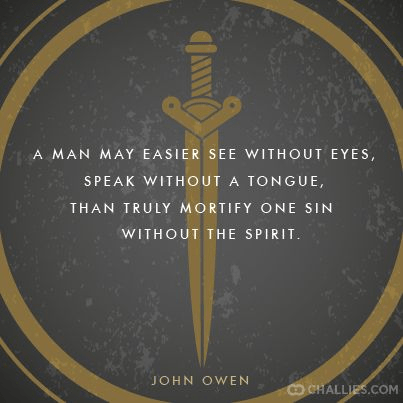
The Mortification of Sin: How to do it!

“If the Spirit of him who raised Jesus from the dead dwells in you, he who raised Christ Jesus from the dead will also give life to your mortal bodies through his Spirit who dwells in you. So then, brothers, we are debtors, not to the flesh, to live according to the flesh. For if you live according to the flesh you will die, but if by the Spirit you put to death the deeds of the body, you will live.” (Romans 8:11-13)

Mortification, or to mortify, means to degrade, humiliate, crush and confound. Within the context of our subject, God calls the believer in Christ to degrade, humiliate, crush and confound sin. This sin in question is not anybody else’s sin, but rather the believer’s own sin.

Putting sin to death, from the Greek word θανατοῦτε (thanatoute), means to completely stop or cease. In other words, to execute. This is an action the believer in Christ is to actively, presently and personally pursue. In other words, God calls the believer in Christ, because of their position in Christ, to commit pre-meditated murder against their personal sin. To do so evidences the believer in Christ is conducting themselves in a manner prescribed by Scripture (Ephesians 4:17-24; Colossians 3:1-11; 2 Timothy 3:12).

This is all well and good. However, how does the believer in Christ go about this process of mortification? Remember, the mortification of sin is not about how to become a Christian but rather embracing one of the fundamental disciplines of life and living which defines and evidences that one is indeed a believer in Christ.

First, see your sin as God sees it. Confess your sin to God and acknowledge it as the cosmic treason against God. Do not make excuses for sin and do not try to justify sin. Obliterate the idea that whatever sin you are committing is to be tolerated, or accepted, by the unbiblical perspective of, “well, that’s just the way I am.”

Secondly, set you heart/soul upon God and His Word. Do it daily! For example, meditate upon the following biblical texts which focus on personal righteousness. It would be good to memorize them.

  • Psalm 1:1-2 – “Blessed is the man who walks not in the counsel of the wicked, nor stands in the way of sinners, nor sits in the seat of scoffers; but his delight is in the law of the LORD, and on his law he meditates day and night.”
  • Psalm 19:7-11 – “The law of the LORD is perfect, reviving the soul; the testimony of the LORD is sure, making wise the simple; the precepts of the LORD are right, rejoicing the heart; the commandment of the LORD is pure, enlightening the eyes; the fear of the LORD is clean, enduring forever; the rules of the LORD are true, and righteous altogether. More to be desired are they than gold, even much fine gold; sweeter also than honey and drippings of the honeycomb. Moreover, by them is your servant warned; in keeping them there is great reward.”
  • Psalm 57:7 – “My heart is steadfast, O God, my heart is steadfast! I will sing and make melody!”
  • Psalm 119:11 – “I have stored up your word in my heart that I might not sin against you.”
  • Haggai 1:5-7 – “Now, therefore, thus says the LORD of hosts: Consider your ways. You have sown much, and harvested little. You eat, but you never have enough; you drink, but you never have your fill. You clothe yourselves, but no one is warm. And he who earns wages does so to put them into a bag with holes. “Thus says the LORD of hosts: Consider your ways.”
  • Colossians 3:1-4 – “If then you have been raised with Christ, seek the things that are above, where Christ is, seated at the right hand of God. Set your minds on things that are above, not on things that are on earth. For you have died, and your life is hidden with Christ in God. When Christ who is your life appears, then you also will appear with him in glory.”
  • I Peter 2:11-12 – “Beloved, I urge you as sojourners and exiles to abstain from the passions of the flesh, which wage war against your soul. Keep your conduct among the Gentiles honorable, so that when they speak against you as evildoers, they may see your good deeds and glorify God on the day of visitation.”
  • I Peter 4:7 – “The end of all things is at hand; therefore be self-controlled and sober-minded for the sake of your prayers.”
  • I John 1:8-10 – “If we say we have no sin, we deceive ourselves, and the truth is not in us. If we confess our sins, he is faithful and just to forgive us our sins and to cleanse us from all unrighteousness. If we say we have not sinned, we make him a liar, and his word is not in us.”

Third, commune regularly in prayer to God. Pour your heart out to God about the sin you are battling and which seems relentless. Remember, God’s grace is sufficient (2 Corinthians 12:1-10; I Thessalonians 5:17).

Fourth, practice obedience to God in every area of your life. No exceptions! No excuses! As one pastor has observed, “Doing God’s will and His will alone in all the small issues of life can be training in habits that will hold up in the severe times of temptation.”

May the LORD’s truth and grace be found here.

Soli deo Gloria!

The Mortification of Sin: The Definition.

“If the Spirit of him who raised Jesus from the dead dwells in you, he who raised Christ Jesus from the dead will also give life to your mortal bodies through his Spirit who dwells in you. So then, brothers, we are debtors, not to the flesh, to live according to the flesh. For if you live according to the flesh you will die, but if by the Spirit you put to death the deeds of the body, you will live.” (Romans 8:11-13)

We are taking a sabbatical from our study of the Gospel of Matthew for a brief period to examine The Mortification of Sin. This may seem to be a strange title for a series and it may even appear to be archaic, old-fashioned and outdated. I mean, who talks about sin anymore? Isn’t the Christian life about being relevant to the world, tolerant of other people’s lifestyles and pursuing your best life now of personal peace and affluence? This is certainly the message we hear from many popular so-called Christian authors.

The Scriptures address God delivering the sinner from the penalty of sin, which is hell. The biblical text also teaches God delivering believers in Christ from the presence of sin, which is heaven. However, the Bible also says that God saves believers from the power of sin, which involves our day to day living. The deliverance from the power of sin involves the mortification of sin.

What exactly do we mean by the phrase the mortification of sin? Mortification, or to mortify, means to degrade, humiliate, crush and confound. Within the context of our subject, what God calls the believer in Christ to do is to degrade, humiliate, crush and confound their sin. This sin in question is not anybody else’s sin but rather the believer’s own sin.

The Apostle Paul refers to this action of mortification in Romans 8:11-13. The Apostle Paul says the Holy Spirit indwells each believer in Christ (Rom. 8:9). This is the same Holy Spirit who raised Jesus Christ from the dead.  Therefore, since the same Holy Spirit will resurrect our dead bodies, we are then no longer debtors to live according to the flesh, or sinful desires. Rather, believers in Christ are to live according to, and by, the Holy Spirit. The way to do this is by putting to death the sinful deeds of the body.

The phrase, put to death, is from the Greek word θανατοῦτε (thanatoute), which means to completely stop or cease. In other words, to execute. This is an action the believer in Christ is to do actively, presently, personally and daily. In other words, God calls the believer in Christ, because of their positon in Christ, to commit pre-meditated murder against their personal sin. This does not mean the believer is to commit murder against their body, or anyone else’s physical life, but rather against their own sinful thoughts, behavior and desires.

The believer in Christ should not misunderstand what Paul is saying. He is not saying that by the behavior and discipline of putting their sin to death that this assures the believer, on the basis of their efforts, that they will inherit eternal life. That would result in the sinner pursuing a works based salvation other than trusting in the person and atoning work of Jesus Christ alone.

What Paul means is that by putting sin to death, the believer in Christ truly demonstrates that they are a child of God. In other words, they evidence their true conversion of not only possessing eternal life in Christ currently on earth, but also the confident expectation (hope) of eternal life in the future with Christ in heaven.

“The body is not evil of itself. Sin originates in the heart, the spiritual center of our being including the will (Mark 7:18-23). But since we live in physical bodies, sin finds expression through the body. Therefore, not only at the inner points of origin, but also in its bodily expressions, sin must be put to death, that is, terminated,” explains Dr. R.C. Sproul.

Parallel passages in Paul’s Letter to the Romans includes Romans 6:12-13 which says, “Let not sin therefore reign in your mortal body, to make you obey its passions. Do not present your members to sin as instruments for unrighteousness, but present yourselves to God as those who have been brought from death to life, and your members to God as instruments for righteousness.”

Another familiar passage is Romans 12:1-2 which says, “I appeal to you therefore, brothers, by the mercies of God, to present your bodies as a living sacrifice, holy and acceptable to God, which is your spiritual worship.  Do not be conformed to this world, but be transformed by the renewal of your mind, that by testing you may discern what is the will of God, what is good and acceptable and perfect.”

What are some particular sins we can personally identify as ones we have committed and perhaps continually commit? Also, how do we go about putting these particular sins to death? These are but a couple of questions we will answer as we continue to explore the subject of the Mortification of Sin.

Finally, Dr. John MacArthur says, “The world doesn’t judge us (Believer’s in Christ) by our theology; it judges us by our behavior. The vitality of Scripture in the word’s view is determined by how it affects us.”

May the LORD’s truth and grace be found here.

Soli deo Gloria!