The Mortification of Sin: Confession. Part 2.

If we confess our sins, he is faithful and just to forgive us our sins and to cleanse us from all unrighteousness.” (I John 1:9)

As previously noted, confession is more than just verbally acknowledging that we have done something wrong or failed to do something right in the sight of God. Confession also means to acknowledge our sin to God and to have the same perspective towards it as God. Confession means to see our sin as cosmic treason against God. We are to confess our sin to God while at the same time seeking to live lives which glorify Him. In other words, confession involves not only acknowledgment of sin but also a turning away, or repentance, of it.  

Dr. Sinclair Ferguson explains that confession involves four basic disciplines.

First, admit sin for what it really is. Call a spade a spade — call it “sexual immorality,” not “I’m being tempted a little”; call it “impurity,” not “I’m struggling with my thought life”; call it “evil desire, which is idolatry,” not “I think I need to order my priorities a bit better. How powerfully this unmasks self-deceit — and helps us to unmask sin lurking in the hidden corners of our hearts!”

Second, see sin for what your sin really is in God’s presence. “My sin leads to — not lasting pleasure — but holy divine displeasure. See the true nature of your sin in the light of its punishment. Too easily do we think that sin is less serious in Christians than it is in non-believers: “It’s forgiven, isn’t it?” Not if we continue in it (1 John 3:9)! Take a heaven’s-eye view of sin and feel the shame of that in which you once walked (Col. 3:7; see also Rom. 6:21).”

Third, recognize the inconsistency of your sin. “You put off the “old man,” and have put on the “new man” (3:9–10). You are no longer the “old man.” The identity you had “in Adam” is gone. The old man was “crucified with him [Christ] in order that the body of sin [probably “life in the body dominated by sin”] might be brought to nothing, so that we would no longer be enslaved to sin” (Rom. 6:6). New men live new lives. Anything less than this is a contradiction of who I am “in Christ.”

Fourth, put sin to death (Col. 3:5). “It is as “simple” as that. Refuse it, starve it, and reject it. You cannot “mortify” sin without the pain of the kill. There is no other way!”

Dr. Ferguson concludes by saying, “The negative task of putting sin to death will not be accomplished in isolation from the positive call of the Gospel to “put on” the Lord Jesus Christ (Rom. 13:14). Paul spells this out in Colossians 3:12–17. Sweeping the house clean simply leaves us open to a further invasion of sin. But when we understand the “glorious exchange” principle of the Gospel of grace, then we will begin to make some real advance in holiness. As sinful desires and habits are not only rejected, but exchanged for Christ-like graces (3:12) and actions (3:13); as we are clothed in Christ’s character and His graces are held together by love (v. 14), not only in our private life but also in the church fellowship (vv. 12–16), Christ’s name and glory are manifested and exalted in and among us (3:17).”

This is the discipline required in mortifying sin. May the LORD’s truth and grace be found here.

Soli deo Gloria!
The Mortification of Sin: Confession.  

If we say we have fellowship with him while we walk in darkness, we lie and do not practice the truth. But if we walk in the light, as he is in the light, we have fellowship with one another, and the blood of Jesus his Son cleanses us from all sin. If we say we have no sin, we deceive ourselves, and the truth is not in us. If we confess our sins, he is faithful and just to forgive us our sins and to cleanse us from all unrighteousness. If we say we have not sinned, we make him a liar, and his word is not in us.” (I John 1:6-10)

The Epistle of I John addresses the theme of authentic faith. For faith to be real, it must be true, and genuine. The reason the Holy Spirit used the Apostle John to write this epistle was two-fold. It was not only because false teachers were denying the bodily incarnation, life, death and resurrection of Jesus Christ, but also because they were claiming to be Christians while living sinfully.

We should not misunderstand. John was not teaching that unless we are sinless and perfect we do not truly belong to Christ. Rather, he wrote of the tension between being justified (counted righteous) before God on the basis of the imputed righteousness of Christ, while at the same time struggling with daily sin in our lives.

Dr. R. C. Sproul explains that, “Perhaps the formula that Martin Luther used that is most famous and most telling is his formula simul justus et peccator. Simul is the word from which we get the English word simultaneously. Or, it means ‘at the same time.’ Justus is the Latin word for just or righteous. Et means and. Peccator means sinner. And so with this formula, Luther was saying, in our justification we are one and the same time righteous or just, and sinners. Now if he would say that we are at the same time and in the same relationship just and sinners that would be a contradiction in terms. But that’s not what he was saying. He was saying from one perspective, in one sense, we are just. In another sense, from a different perspective, we are sinners; and how he defines that is simple. In and of ourselves, under the analysis of God’s scrutiny, we still have sin; we’re still sinners. But, by imputation and by faith in Jesus Christ, whose righteousness is now transferred to our account, then we are considered just or righteous. This is the very heart of the gospel.”

One of the biblical tests of an individual’s authentic faith in Christ is the struggle with one’s daily sin. One of our responses to when we sin, and our efforts to mortify sin, is to confess our sin to God. What does it mean to confess?

Confession is more than just verbally acknowledging that we have done something wrong or failed to do something right in the sight of God. Confession also means to acknowledge our sin to God and to have the same perspective towards it as God does. Confession means to see our sin as cosmic treason against God. We are to confess our sin to God while at the same time seeking to live lives which glorify Him. In other words, confession involves not only acknowledgment of sin but also a turning away, or repentance, of sin.  

As one commentator states, “It appears that the false teachers John has in mind were not only unconcerned with the dark deeds they were performing, they also claimed to be without sin altogether. But such a denial only further evidenced their lack of authentic faith. In this section, John tells us the Christian life is in one sense a life lived in tension. On the one hand, believers will live such good lives that it can be said we walk in the light (vv. 6–7). On the other hand, truly walking in the light will clearly reveal to us the reality of remaining sin, reminding us of our need for repentance and forgiveness (vv. 8, 10).”

Confession and repentance needs to be done daily. It may even occur on a moment by moment basis when the Lord brings your sin to your attention. When that happens, acknowledge your sin to God. Ask for His forgiveness on the basis of the imputed righteousness of Christ that you possess by grace alone, through faith alone in the person and work of Jesus Christ alone.

Confession does not ensure you remain a child of God. Rather, confession ensures that the believer remains in close fellowship with God.

Have a blessed day as you live a life in tension with sin. May the LORD’s truth and grace be found here.

Soli deo Gloria! 

The Mortification of Sin: Biblical Principles.

“Watch and pray that you may not enter into temptation. The spirit indeed is willing, but the flesh is weak.” (Matthew 26:41 ESV)

“If we do not abide in prayer, we shall abide in cursed temptations.” Puritan John Owen

Pastor Sinclair Ferguson recalls a conversation he had with a young pastor who came to him for advice. My friend — a younger minister — sat down with me at the end of a conference in his church and said: “Before we retire tonight, just take me through the steps that are involved in helping someone mortify sin.” We sat talking about this for a little longer and then went to bed, hopefully he was feeling as blessed as I did by our conversation. I still wonder whether he was asking his question as a pastor or simply for himself — or both.”

How would you have responded? How did Dr. Ferguson respond? He said, “The first thing to do is: Turn to the Scriptures. Yes, turn to John Owen (never a bad idea!), or to some other counselor dead or alive. But remember that we have not been left only to good human resources in this area. We need to be taught from “the mouth of God” so that the principles we are learning to apply carry with them both the authority of God and the promise of God to make them work. 

What Scriptures should we specifically read in order to meditate, memorize and apply in our lives so we can put sin to death? Here are some Dr. Ferguson recommend: Romans 8:1-13Romans 13:8–14 (Augustine’s text); 2 Corinthians 6:14–7:1Ephesians 4:17–5:21Colossians 3:1–171 Peter 2:11-12; 4:1–111 John 2:28–3:11. All of these passages, while not all use the word “mortify,” do address the subject and discipline of the mortification of sin.

Colossians 3:1-17 is our biblical source today addressing the subject of mortifying sin. What does the Apostle Paul have to say in this particular text? I respectfully borrow Pastor’s Ferguson’s outline and observations from the text. 

  • Principle One: Know, rest in, think through, and act upon your new identity — you are in Christ.

Paul underlines how important it is for us to be familiar with our new identity in Christ (3:1–4). If then you have been raised with Christ, seek the things that are above, where Christ is, seated at the right hand of God. Set your minds on things that are above, not on things that are on earth. For you have died, and your life is hidden with Christ in God. When Christ who is your life appears, then you also will appear with him in glory.”

  • Principle Two: Mortifying sin is a whole-of-life change.

Paul exposes the workings of sin in every area of our lives (Col. 3:5–11). “Put to death therefore what is earthly in you: sexual immorality, impurity, passion, evil desire, and covetousness, which is idolatry. On account of these the wrath of God is coming. In these you too once walked, when you were living in them. But now you must put them all away: anger, wrath, malice, slander, and obscene talk from your mouth. Do not lie to one another, seeing that you have put off the old self with its practices and have put on the new self, which is being renewed in knowledge after the image of its creator. Here there is not Greek and Jew, circumcised and uncircumcised, barbarian, Scythian, slave, free; but Christ is all, and in all.”

  • Principle Three: Mortifying sin is not only what God calls believers not to do, but also what God calls them to do.

Paul also focuses upon the workings of righteousness in every area of our lives (Col. 3:12-17). “Put on then, as God’s chosen ones, holy and beloved, compassionate hearts, kindness, humility, meekness, and patience, bearing with one another and, if one has a complaint against another, forgiving each other; as the Lord has forgiven you, so you also must forgive. And above all these put on love, which binds everything together in perfect harmony. And let the peace of Christ rule in your hearts, to which indeed you were called in one body. And be thankful. Let the word of Christ dwell in you richly, teaching and admonishing one another in all wisdom, singing psalms and hymns and spiritual songs, with thankfulness in your hearts to God. And whatever you do, in word or deed, do everything in the name of the Lord Jesus, giving thanks to God the Father through him.”

In his preface of his book The Mortification of Sin, John Owen wrote, “I hope…that mortification and holiness may be promoted in my heart and in the hearts and lives of others, to the glory of God; and that in this way the gospel of our Lord and Savior Jesus Christ may be adorned in all things.” 

I trust these practical suggestions will help as you mortify sin. May the LORD’s truth and grace be found here.

Soli deo Gloria!

The Mortification of Sin: How to do it!

“If the Spirit of him who raised Jesus from the dead dwells in you, he who raised Christ Jesus from the dead will also give life to your mortal bodies through his Spirit who dwells in you. So then, brothers, we are debtors, not to the flesh, to live according to the flesh. For if you live according to the flesh you will die, but if by the Spirit you put to death the deeds of the body, you will live.” (Romans 8:11-13)

Mortification, or to mortify, means to degrade, humiliate, crush and confound. Within the context of our subject, God calls the believer in Christ to degrade, humiliate, crush and confound sin. This sin in question is not anybody else’s sin, but rather the believer’s own sin.

Putting sin to death, from the Greek word θανατοῦτε (thanatoute), means to completely stop or cease. In other words, to execute. This is an action the believer in Christ is to actively, presently and personally pursue. In other words, God calls the believer in Christ, because of their position in Christ, to commit pre-meditated murder against their personal sin. To do so evidences the believer in Christ is conducting themselves in a manner prescribed by Scripture (Ephesians 4:17-24; Colossians 3:1-11; 2 Timothy 3:12).

This is all well and good. However, how does the believer in Christ go about this process of mortification? Remember, the mortification of sin is not about how to become a Christian but rather embracing one of the fundamental disciplines of life and living which defines and evidences that one is indeed a believer in Christ.

First, see your sin as God sees it. Confess your sin to God and acknowledge it as the cosmic treason against God. Do not make excuses for sin and do not try to justify sin. Obliterate the idea that whatever sin you are committing is to be tolerated, or accepted, by the unbiblical perspective of, “well, that’s just the way I am.”

Secondly, set you heart/soul upon God and His Word. Do it daily! For example, meditate upon the following biblical texts which focus on personal righteousness. It would be good to memorize them.

  • Psalm 1:1-2 – “Blessed is the man who walks not in the counsel of the wicked, nor stands in the way of sinners, nor sits in the seat of scoffers; but his delight is in the law of the LORD, and on his law he meditates day and night.”
  • Psalm 19:7-11 – “The law of the LORD is perfect, reviving the soul; the testimony of the LORD is sure, making wise the simple; the precepts of the LORD are right, rejoicing the heart; the commandment of the LORD is pure, enlightening the eyes; the fear of the LORD is clean, enduring forever; the rules of the LORD are true, and righteous altogether. More to be desired are they than gold, even much fine gold; sweeter also than honey and drippings of the honeycomb. Moreover, by them is your servant warned; in keeping them there is great reward.”
  • Psalm 57:7 – “My heart is steadfast, O God, my heart is steadfast! I will sing and make melody!”
  • Psalm 119:11 – “I have stored up your word in my heart that I might not sin against you.”
  • Haggai 1:5-7 – “Now, therefore, thus says the LORD of hosts: Consider your ways. You have sown much, and harvested little. You eat, but you never have enough; you drink, but you never have your fill. You clothe yourselves, but no one is warm. And he who earns wages does so to put them into a bag with holes. “Thus says the LORD of hosts: Consider your ways.”
  • Colossians 3:1-4 – “If then you have been raised with Christ, seek the things that are above, where Christ is, seated at the right hand of God. Set your minds on things that are above, not on things that are on earth. For you have died, and your life is hidden with Christ in God. When Christ who is your life appears, then you also will appear with him in glory.”
  • I Peter 2:11-12 – “Beloved, I urge you as sojourners and exiles to abstain from the passions of the flesh, which wage war against your soul. Keep your conduct among the Gentiles honorable, so that when they speak against you as evildoers, they may see your good deeds and glorify God on the day of visitation.”
  • I Peter 4:7 – “The end of all things is at hand; therefore be self-controlled and sober-minded for the sake of your prayers.”
  • I John 1:8-10 – “If we say we have no sin, we deceive ourselves, and the truth is not in us. If we confess our sins, he is faithful and just to forgive us our sins and to cleanse us from all unrighteousness. If we say we have not sinned, we make him a liar, and his word is not in us.”

Third, commune regularly in prayer to God. Pour your heart out to God about the sin you are battling and which seems relentless. Remember, God’s grace is sufficient (2 Corinthians 12:1-10; I Thessalonians 5:17).

Fourth, practice obedience to God in every area of your life. No exceptions! No excuses! As one pastor has observed, “Doing God’s will and His will alone in all the small issues of life can be training in habits that will hold up in the severe times of temptation.”

May the LORD’s truth and grace be found here.

Soli deo Gloria!


The Mortification of Sin: The Definition.

“If the Spirit of him who raised Jesus from the dead dwells in you, he who raised Christ Jesus from the dead will also give life to your mortal bodies through his Spirit who dwells in you. So then, brothers, we are debtors, not to the flesh, to live according to the flesh. For if you live according to the flesh you will die, but if by the Spirit you put to death the deeds of the body, you will live.” (Romans 8:11-13)

We are taking a sabbatical from our study of the Gospel of Matthew for a brief period to examine The Mortification of Sin. This may seem to be a strange title for a series and it may even appear to be archaic, old-fashioned and outdated. I mean, who talks about sin anymore? Isn’t the Christian life about being relevant to the world, tolerant of other people’s lifestyles and pursuing your best life now of personal peace and affluence? This is certainly the message we hear from many popular so-called Christian authors.

The Scriptures address God delivering the sinner from the penalty of sin, which is hell. The biblical text also teaches God delivering believers in Christ from the presence of sin, which is heaven. However, the Bible also says that God saves believers from the power of sin, which involves our day to day living. The deliverance from the power of sin involves the mortification of sin.

What exactly do we mean by the phrase the mortification of sin? Mortification, or to mortify, means to degrade, humiliate, crush and confound. Within the context of our subject, what God calls the believer in Christ to do is to degrade, humiliate, crush and confound their sin. This sin in question is not anybody else’s sin but rather the believer’s own sin.

The Apostle Paul refers to this action of mortification in Romans 8:11-13. The Apostle Paul says the Holy Spirit indwells each believer in Christ (Rom. 8:9). This is the same Holy Spirit who raised Jesus Christ from the dead.  Therefore, since the same Holy Spirit will resurrect our dead bodies, we are then no longer debtors to live according to the flesh, or sinful desires. Rather, believers in Christ are to live according to, and by, the Holy Spirit. The way to do this is by putting to death the sinful deeds of the body.

The phrase, put to death, is from the Greek word θανατοῦτε (thanatoute), which means to completely stop or cease. In other words, to execute. This is an action the believer in Christ is to do actively, presently, personally and daily. In other words, God calls the believer in Christ, because of their positon in Christ, to commit pre-meditated murder against their personal sin. This does not mean the believer is to commit murder against their body, or anyone else’s physical life, but rather against their own sinful thoughts, behavior and desires.

The believer in Christ should not misunderstand what Paul is saying. He is not saying that by the behavior and discipline of putting their sin to death that this assures the believer, on the basis of their efforts, that they will inherit eternal life. That would result in the sinner pursuing a works based salvation other than trusting in the person and atoning work of Jesus Christ alone.

What Paul means is that by putting sin to death, the believer in Christ truly demonstrates that they are a child of God. In other words, they evidence their true conversion of not only possessing eternal life in Christ currently on earth, but also the confident expectation (hope) of eternal life in the future with Christ in heaven.

“The body is not evil of itself. Sin originates in the heart, the spiritual center of our being including the will (Mark 7:18-23). But since we live in physical bodies, sin finds expression through the body. Therefore, not only at the inner points of origin, but also in its bodily expressions, sin must be put to death, that is, terminated,” explains Dr. R.C. Sproul.

Parallel passages in Paul’s Letter to the Romans includes Romans 6:12-13 which says, “Let not sin therefore reign in your mortal body, to make you obey its passions. Do not present your members to sin as instruments for unrighteousness, but present yourselves to God as those who have been brought from death to life, and your members to God as instruments for righteousness.”

Another familiar passage is Romans 12:1-2 which says, “I appeal to you therefore, brothers, by the mercies of God, to present your bodies as a living sacrifice, holy and acceptable to God, which is your spiritual worship.  Do not be conformed to this world, but be transformed by the renewal of your mind, that by testing you may discern what is the will of God, what is good and acceptable and perfect.”

What are some particular sins we can personally identify as ones we have committed and perhaps continually commit? Also, how do we go about putting these particular sins to death? These are but a couple of questions we will answer as we continue to explore the subject of the Mortification of Sin.

Finally, Dr. John MacArthur says, “The world doesn’t judge us (Believer’s in Christ) by our theology; it judges us by our behavior. The vitality of Scripture in the word’s view is determined by how it affects us.”

May the LORD’s truth and grace be found here.

Soli deo Gloria!
The Gospel of Matthew: Mercy Received; Mercy Given.

31 When his fellow servants saw what had taken place, they were greatly distressed, and they went and reported to their master all that had taken place. 32 Then his master summoned him and said to him, ‘You wicked servant! I forgave you all that debt because you pleaded with me. 33 And should not you have had mercy on your fellow servant, as I had mercy on you?’ 34 And in anger his master delivered him to the jailers, until he should pay all his debt. 35 So also my heavenly Father will do to every one of you, if you do not forgive your brother from your heart.” (Matthew 18:31–35 (ESV)

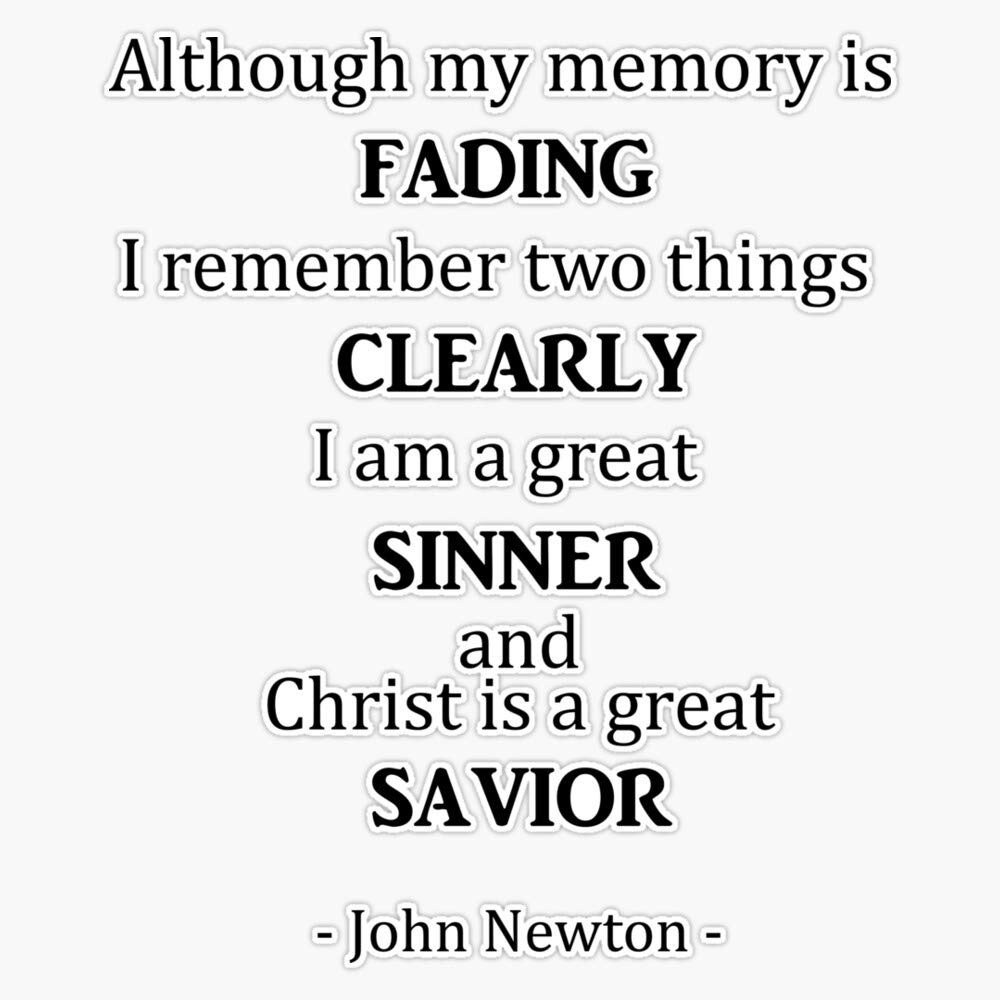
“Although my memory’s fading, I remember two things very clearly: I am a great sinner and Christ is a great Savior.” ― John Newton, Amazing Grace.

For the most part, believers in Christ acknowledge that Jesus Christ is a great Savior. Individuals have written songs and books, and preached great sermons testifying to the great love of God in sending His Son, Jesus Christ, as both Savior and Lord. The familiarity of John 3:16, even in a superficial understanding, underscores this biblical truth.

A disconnection arises when believers in Christ fail to acknowledge that prior to their conversion, and after God’s great salvation, they were/are great sinners. There is a tendency to minimize our own sin, while at the same time maximize the sins of others; especially when they sin against us. We must never forget the greatness of God’s salvation, as compared to the greatness of our sin. John Newton never did.

Unfortunately the first servant, in the context of Matthew 18:23-30, forgot God’s mercy and forgiveness for his unpayable debt. He displayed this callousness by his cruel treatment of a fellow servant, who owed the former a comparatively smaller, payable debt.

When other servants heard about this situation, they were greatly distressed or saddened. They reported what had happened to the master of them all; including the unforgiving servant.

What did the master say? 32 “Then his master summoned him and said to him, ‘You wicked servant! I forgave you all that debt because you pleaded with me. 33 And should not you have had mercy on your fellow servant, as I had mercy on you?’ Mercy received should result in mercy given. How soon we forget the greatness of our sin with respect to the greatness of God’s forgiveness. I’m ashamed to say that I often have.

What did the master do? 34 “And in anger his master delivered him to the jailers, until he should pay all his debt. 35 So also my heavenly Father will do to every one of you, if you do not forgive your brother from your heart.”

“The point of the parable is not that God’s forgiveness, once granted, will be revoked if a follower of Jesus refuses to forgive his brother or sister. Rather, refusal to forgive is symptomatic of a person who fails to grasp the impossible depth of his debt and the infinite magnitude of God’s mercy and therefore has no reason to presume that he has received God’s forgiveness in the first place,” explains Dr. R. C. Sproul.

Do you identify with John Newton’s sentiment? Do you acknowledge that you are a great sinner and that Jesus Christ is a great Savior? Ask God to forgive you of your unforgiving spirit. Ask God to constantly remind you that mercy received should result in mercy given.

Soli deo Gloria!

The Gospel of Matthew: The Unforgiving Servant. 

28 “But when that same servant went out, he found one of his fellow servants who owed him a hundred denarii, and seizing him, he began to choke him, saying, ‘Pay what you owe.’ 29 So his fellow servant fell down and pleaded with him, ‘Have patience with me, and I will pay you.’ 30 He refused and went and put him in prison until he should pay the debt.” (Matthew 18:28–35 (ESV)

“With great power there must also come great responsibility.” – Stan Lee

“With great power there must also come great responsibility” is a proverb popularized by Spider-Man in Marvel comicsfilms, and related media. Introduced by Stan Lee, it originally appeared as a closing narration in the 1962 Amazing Fantasy #15, and was later attributed to Uncle Ben as advice to his young nephew, Peter Parker (aka. Spider-Man).

A similar proverb is, “With great grace received comes great graciousness given.” When an individual receives God’s amazing and gracious forgiveness for sin, the same individual should be willing, ready and able to forgive others of their sin.

Matthew 6:14–15 (ESV) says, 14 For if you forgive others their trespasses, your heavenly Father will also forgive you, 15 but if you do not forgive others their trespasses, neither will your Father forgive your trespasses.”

Ephesians 4:31–32 (ESV) says, 31 Let all bitterness and wrath and anger and clamor and slander be put away from you, along with all malice. 32 Be kind to one another, tenderhearted, forgiving one another, as God in Christ forgave you.

The servant who received forgiveness of his unpayable debt to his master (Matt. 18:23-27), was unwilling to forgive a comparatively smaller debt a fellow servant owed him.  One hundred denarii was not an insubstantial sum. However, the debt owed by the second servant was nothing compared to the debt owed by the first servant.

“One hundred denarii represented one hundred days of a common worker’s wages, which would be a small sum for his fellow tax farmer, after he had finished his accounting with the king (18:23). It was also a ridiculously minuscule sum compared to what the first servant had owed the king. But apparently the forgiven slave, instead of internalizing the principle of grace, had decided to become ruthlessly efficient in his exacting of debts henceforth. Such extreme actions as choking are reported of angry creditors elsewhere in antiquity as well,” explains commentator Craig Keener.

The first servant displayed his calloused heart by his physical and verbal abuse of his fellow servant. When the second servant pleaded for patience to pay the debt, the first servant would not hear of it. The text says, “He refused and went and put him in prison until he should pay the debt.”  

This action was not only hard-hearted, but also ridiculous because how could the imprisoned servant pay off his debt while in jail? “Someone in prison could not pay back what he owed (v. 34), unless friends came to his aid with the requisite funds,” says Keener.

“Because of the smallness of the debt he was not legally permitted to sell his fellow servant into slavery, but was legally permitted to have him sentenced to prison and forced labor, to work off his debt,” explains R. William Hendriksen.

“The foundation for a forgiving spirit is the experience of divine grace. It is by grace that we are saved. It is by grace that we live. It is by grace that we have been forgiven. Therefore, the why of forgiving is to manifest our own gratitude for the grace that we have received,” explains Dr. R. C. Sproul.    

Are you grateful for how much God has forgiven you? Are you willing to forgive others because of God’s forgiveness? Remember, with great grace received comes great graciousness given.

Soli deo Gloria!

The Gospel of Matthew: The Forgiving Master.

23 “Therefore the kingdom of heaven may be compared to a king who wished to settle accounts with his servants. 24 When he began to settle, one was brought to him who owed him ten thousand talents. 25 And since he could not pay, his master ordered him to be sold, with his wife and children and all that he had, and payment to be made. 26 So the servant fell on his knees, imploring him, ‘Have patience with me, and I will pay you everything.’ 27 And out of pity for him, the master of that servant released him and forgave him the debt.” (Matthew 18:23–27 (ESV)

Regarding the subject of forgiveness (Matt. 18:21-22), Jesus taught a parable about the extent of God’s unimaginable forgiveness of sinners and how this should provoke believers in Christ to an eager readiness to forgive others.

The kingdom of heaven, which is God’s rule and reign in the believer’s soul, may be compared to a king seeking to settle accounts with his servants. “Servants probably refers to free provincial satraps, who functioned as the ruler’s tax farmers in various regions; they too were vassals of the king. The ruler would allow them to collect taxes for him at a profit, but he demanded efficiency; this was the time of year when he was going to settle their accounts with him,” explains commentator Craig Keener.

As the king was settling his accounts, there was one servant who owed the master ten thousand talents. Jesus gave no reason as to why the master allowed the servant to accrue so much debt. A talent was the highest monetary unit of currency in first century Judea. It was equal to six thousand denarii. A denarii was a day’s wages. Ten thousand talents was equivalent to sixty million days wages. In other words, the servant owed an unpayable amount.

“Such a debt was practically unpayable, and a debt of this amount would not be repayable over many lifetimes,” explains Dr. R. C. Sproul.

In response, the master ordered the servant to be sold, along with his wife and children and all his possessions. This was so repayment could be made. Selling insolvent debtors into slavery was nothing unusual in the first century, as mentioned in Scripture (Exod. 22:3; Lev. 25:39, 47; 2 Kings 4:1; Neh. 5:5; Isa. 50:1; Amos 2:6; 8:6).

“Outside of the country of the Israelites the practice of selling those who were unable to pay their debts was common, and it is to this that the parable refers. So by royal decree this official, his family, and all his possessions are ordered to be sold. The proceeds must go toward paying the debt. The words used in the original (pay, payment) indicates that the debtor must “give back” what he owes: he must “pay off” his obligation in full. Of course, this was actually impossible. The amount that was to be placed in the king’s treasury, the full proceeds of the sale, would be but a drop in the bucket. So huge was the debt,” explains Dr. William Hendriksen.

What was the servant to do? His sinful irresponsibility resulted not only in his own punishment, but also the punishment of his family. They too bore the consequences of his sin. He faced an unpayable amount of debt and an unfortunate future of regret.

What could the servant do? He begged the master to have patience with him. He promised to repay what he owed. He must have known, as would the master that such a promise was virtually impossible to fulfill.

“The servant is completely crushed by the realization of the severity of his impending punishment. He does not deny that he owes the huge amount, neither does he try to explain how he got into this terrible predicament. He was probably well aware of the fact that excuses would have been useless. It is important to note also that he does not offer to make at least a down-payment on his debt. The implication is clearly this: he makes no such offer for the simple reason that he has nothing! Having prostrated himself, he begged,” states Dr. Hendriksen.

The master was under no obligation to forgive the servant’s debt. There was no one greater than the master who could pressure him to forgive the debt. Yet, that is what master chooses to do. He forgives the debt. Such behavior was not because the servant deserved to be forgiven. It was because the master had pity upon the servant. The master felt love and compassion for an unworthy servant. He forgave him the debt he owed.

“It was out of sheer compassion that the master granted this servant far more than he had asked, completely canceling his huge debt and releasing him from punishment,” concludes Dr. Hendriksen.

Matthew 5:3 (ESV) says, “Blessed are the poor in spirit, for theirs is the kingdom of heaven.”  Like the servant in today’s parable, we faced the Lord God with an unpayable debt. We were beggar poor facing a debt we could not pay. We deserved to be punished The Lord would have been just in doing so. However, the Lord Jesus Christ paid our debt of sin on the cross (Rom. 3:21-26). Our debt is paid in full (John 19:30).

  1. I will sing of my Redeemer,
    And His wondrous love to me;
    On the cruel cross He suffered,
    From the curse to set me free.
  2. Refrain:
    Sing, oh, sing of my Redeemer,
    With His blood He purchased me;
    On the cross He sealed my pardon,
    Paid the debt, and made me free.
  3. I will tell the wondrous story,
    How my lost estate to save,
    In His boundless love and mercy,
    He the ransom freely gave.
  4. I will praise my dear Redeemer,
    His triumphant pow’r I’ll tell,
    How the victory He giveth
    Over sin, and death, and hell.
  5. I will sing of my Redeemer,
    And His heav’nly love to me;
    He from death to life hath brought me,
    Son of God with Him to be.

Soli deo Gloria!


The Gospel of Matthew: Seventy Times Seven.

21 Then Peter came up and said to him, “Lord, how often will my brother sin against me, and I forgive him? As many as seven times?” 22 Jesus said to him, “I do not say to you seven times, but seventy-seven times.” (Matthew 18:21–22 (ESV)

I was never, and am not, strong in mathematics. I am thankful to have married a woman who is. What does math have to do with today’s lesson from the Gospel of Matthew?  Plenty? In today text, Jesus provides believers in Christ with a lesson on multiplication, and forgiveness.

In the immediate aftermath of Jesus instructions regarding church discipline, Peter approached Him and asked, ““Lord, how often will my brother sin against me, and I forgive him? As many as seven times?”

Sin (ἁμαρτάνω; hamartano) refers to a wrongdoing. It means to act or behave contrary to the will and law of God. To forgive (ἀφίημι; aphiemi) means to dismiss, send away or cancel a debit. In this case, the canceled debt that is sent away is a sin committed by someone against you. Peter wanted to know how many times such a cancellation should be done by a believer in Christ. Perhaps he reasoned the doing so up to seven times was really spiritual.

“Peter may have been of the opinion that Jesus would praise him for his bigheartedness. If so, his expectation was not fulfilled. There was something wrong with Peter’s approach. It smacked of rabbinism. It sounded as if the forgiving spirit were a commodity that could be weighed, measured, and counted; as if it could be parceled out little by little up to a certain well defined limit, when further distribution would have to stop,” explains Dr. William Hendriksen.

Jesus dismissed such legalism in His disciples. “Jesus said to him, “I do not say to you seven times, but seventy-seven times.”

“Seventy times seven (some interpreters read seventy-seven) does not really mean exactly 490 here; it is a typically graphic Jewish way of saying “Never hold grudges.” Because true repentance should involve turning from sin, some later rabbis’ limited opportunities for forgiveness for a given sin to three times; Peter might have thought his offer of seven times was generous,” states commentator Craig Keener.

“Forgiveness and the restoration of relationship is the goal of discipline — from the first step to the last step of excommunication. Peter understands this partly; he will forgive a person up to seven times, more than the three times the rabbis prescribe in his day (v. 21). That Peter’s comprehension is incomplete is revealed in the Savior’s command to forgive “seventy times seven” (v. 22). According to some Reformed New Testament scholars Jesus really says, “seventy-seven times,” but the precise number is unimportant. Either way, as seen in the parable that follows, Christ is actually teaching that forgiveness must be unlimited,” explains Dr. R. C. Sproul.

Ephesians 4:31–32 (ESV) says, 31 Let all bitterness and wrath and anger and clamor and slander be put away from you, along with all malice. 32 Be kind to one another, tenderhearted, forgiving one another, as God in Christ forgave you.”

The basis for our unlimited forgiveness of others’ sins against us is God’s unlimited forgiveness of our sins against Him. Have a blessed day in the LORD.

Soli deo Gloria!