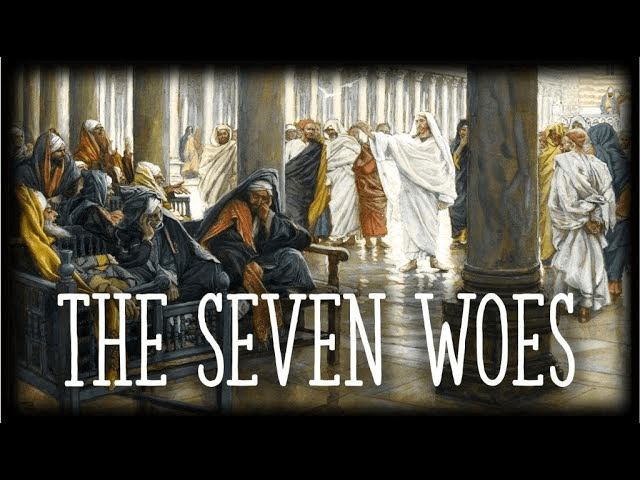
The Gospel of Matthew: The Sixth of Seven Woes.  

27 “Woe to you, scribes and Pharisees, hypocrites! For you are like whitewashed tombs, which outwardly appear beautiful, but within are full of dead people’s bones and all uncleanness. 28 So you also outwardly appear righteous to others, but within you are full of hypocrisy and lawlessness.” (Matthew 23:27–28 (ESV)

In the context of Matthew 23:13-36, Jesus heralded seven woes against the scribes and the Pharisees. Luke 11:37-54 records an earlier lamentation of six woes. Rather than an oracle from a prophet of God, these woes are an oracle from the God of the prophets; Jesus Christ.

In our last blog, I referred to the expression “keeping up appearances.” Keeping up appearances is an idiom or phrase meaning to hide something bad by pretending nothing is wrong. In other words, it means to put on an outward display of behavior in disharmony with one’s true character or personality.

Today’s text, the sixth woe, continues Jesus condemnation of the scribes and the Pharisees for such ritualistic righteousness. The Jewish religious leaders of Jesus’ day were scrupulous when it came to outward behavior. However, inwardly they were wretched.

Jesus used a simile in comparing the scribes and the Pharisees to whitewashed tombs. Tombs (τάφοις; taphois) were essentially different from a grave. A grave is where a dead body is placed six feet into the ground. A tomb was/is “an enclosure for a corpse cut in the earth or in rock or a monument to the memory of a dead person, erected over their burial place,” defines the Oxford English Dictionary.

To whitewash tombs was to paint them white. This was done in order to cover cracks or defects in the tomb’s outward structure and appearance. People use the term today to refer to attempts to cover up or unpleasant facts about a person, place or thing.

“Nothing spread ritual impurity as severely as a corpse (it made anyone who touched it unclean for a week—Num. 19:11); Pharisees believed that one contracted impurity if even one’s shadow touched a corpse or grave. Inconspicuous tombs (or limestone ossuaries) would be whitewashed each spring before Passover to warn passersby to avoid them and so avoid impurity; the Pharisees either lacked this telltale warning (Lk 11:44) or pretended that it was a mark of distinction rather than evidence of impurity. “Whitewash” probably alludes to Ezekiel 13:10–12 and 22:28; it may have covered over a wall’s weakness but would not stop its collapse,” explains biblical commentator Craig Keener.

Jesus used the word “appear” twice in this context. To appear (φαίνονται; phainontai) refers to a superficial likeness to something or some quality. For example, an individual may publically appear to be godly but his private behavior shows his real character. Jesus condemned the religious leaders for their outwardly beautiful appearance which covered up their hypocrisy and lawlessness. They were like outwardly beautiful whitewashed tombs, but inwardly containing dead men’s bones.

“Between the fifth woe and the sixth there is a close relationship, as even the occurrence of the words “outside” and “inside” in both of these woes indicates. Jesus is about to point out that the sin of his opponents is that they externalize religion, as if outward appearance were an adequate cover for shame and crime,” explains Dr. William Hendriksen.

How often are we guilty of externalizing our relationship with Christ? We appear righteous when it is convenient or when people are watching, but we behave differently in private. May we repent of such hypocritical behavior and seek to follow the Lord; publically and privately.

Soli deo Gloria!  
The Gospel of Matthew: The Fifth of Seven Woes.  

25 “Woe to you, scribes and Pharisees, hypocrites! For you clean the outside of the cup and the plate, but inside they are full of greed and self-indulgence. 26 You blind Pharisee! First clean the inside of the cup and the plate, that the outside also may be clean.” (Matthew 23:25–26 (ESV)

In the context of Matthew 23:13-36, Jesus heralded seven woes against the scribes and the Pharisees. Luke 11:37-54 records an earlier lamentation of six woes. Rather than an oracle from a prophet of God, these woes are an oracle from the God of the prophets; Jesus Christ.

How good are you at keeping up appearances? Keeping up appearances is an idiom or phrase meaning to hide something bad by pretending nothing is wrong. In other words, it means to put on an outward display of behavior in disharmony with one’s true character or personality. In today’s text, Jesus condemned the scribes and Pharisees for such actions.

The Jewish religious leaders of Jesus’ day were scrupulous when it came to outward behavior. For example, Jesus said they cleaned the outside of the cup and the plate. What did the Lord mean by this expression?

“Ritual purity was important to the Pharisees, so they washed their vessels as well as themselves in ritual baths. The school of Shammai—the Pharisaic majority in this period—said that the outside of a cup could be clean even if the inside were not; the minority view of Hillel’s followers was that the inside of the cup must be cleansed first. Jesus sides with the school of Hillel on this point, but does this so that he can make a figurative statement about the inside of the heart,” explains commentator Craig Keener.

Jesus’ point was that while the scribes and Pharisees were scrupulous about outside ritual purity, their inner hearts were spiritually filthy. They were full of greed and self-indulgence. Greed (ἁρπαγῆς; harpages) means to rob, plunder and seize another individual’s property. Self-indulgence (ἀκρασίας; akrasias) refers to a lack of self-control.

“These men were harpies, as the Greek original clearly indicates. They were rapacious, greedy and grasping. Jesus undoubtedly has reference to something very definite when he said this, though it is not easy to determine just what it was. Luke 16:14 may be of some help. It shows that the accused were not philanthropists, “lovers of men” but (pardon the word) philargurists, “lovers of money.” They were the kind of people who “devoured widows’ houses” (Mark 12:40; Luke 20:47),” states Dr. William Hendriksen.

“They were guilty of intemperance. They were probably not as conspicuous in this trait as were those coarse materialists, the Sadducees. After all, one can expect scribes and Pharisees to be refined! Yet, even among the scribes and the Pharisees there must have been a generous sprinkling of guzzlers.”

Jesus did not just condemn these hypocrites, but also commanded them to do what was right. The Lord was not teaching a moralistic, therapeutic religion of self-reformation. Rather, He was proclaiming repentance and faith in the One, True God of heaven and earth; Himself. Only through monergistic regeneration by the Holy Spirit can anyone be truly cleansed (John 3:1-8; Titus 3:1-5).

Are you in the habit of keep up religious appearances? For example, do you attend church worship services, read your Bible and serve in some capacity? However, is your heart a heart of stone (Ezekiel 36)?

Have you been born again? Have you received Jesus Christ’s imputed righteousness and been converted by grace alone, through faith alone, and in the person and work of Jesus Christ alone (John 1:12-13; Romans 3:21-26; Ephesians 2:1-10; Philippians 3:1-9)? Only then will you experience truly cleansing; not just on the outside but also on the inside of your soul.

Soli deo Gloria!

The Gospel of Matthew: The Fourth of Seven Woes.  

23 “Woe to you, scribes and Pharisees, hypocrites! For you tithe mint and dill and cumin, and have neglected the weightier matters of the law: justice and mercy and faithfulness. These you ought to have done, without neglecting the others. 24 You blind guides, straining out a gnat and swallowing a camel!” (Matthew 23:23–24 (ESV)

In the context of Matthew 23:13-36, Jesus heralded seven woes against the scribes and the Pharisees. Luke 11:37-54 records an earlier lamentation of six woes. Rather than an oracle from a prophet of God, these woes are an oracle from the God of the prophets; Jesus Christ.

Jesus returned to the recurring phrase found in the first two woes but absent in the third. He now focused on the biblical instruction of tithing. A tithe (ἀποδεκατοῦτε; apodekatoute) literally is to give a tenth. It primarily means to give a tenth of one’s income. The first ten percent of one’s crops, or corresponding income, was to be the tithe. The believer would trust the Lord in living on the remaining 90%.

“According to Deuteronomy (Deut. 12:2–7, 17–19; 14:22–29), the centralization of worship meant that the tithe was taken annually at the sanctuary and shared by priests and Levites. Corn, wine, oil, and flocks were tithed. Every third year, the Levites, foreigners, orphans, and widows were given the whole tithe in charity (Deut. 26:12). According to Numbers 18:21–32, every tithe in Israel was given to the Levites in return for their priestly service,” states biblical scholar Walter A. Elwell in the Tyndale Bible Dictionary.

“The prophet Malachi (Mal 3:8–10), who scathingly declared the withholding of tithes to be “robbing God,” promised full barns and vats, opened windows of heaven, outpoured blessing and deliverance from locusts, in return for faithful tithing. In the early tithe feasts, thanksgiving for God’s gifts would seem appropriate (cf. Gen. 28:22), though not emphasized. Maintenance of the service of God remained the chief purpose of tithing, along with a wide charity.”

The scribes and the Pharisees focused on the minors while ignoring the major principle and importance of tithing. They placed great value on tithing three small garden herbs: mint, dill and cumin. However, they ignored weightier matters of justice, mercy and faithfulness towards God and their fellow man. They adhered to the letter of the Law while ignoring its spirit.

This applies today in the concern over social justice. There is no doubt the church must be concerned about social issues, but never at the expense of biblical truth. The problem with the scribes and the Pharisees was they were concerned about biblical truth but neglected social justice. This delicate balance must be maintained.

“The Social Gospel movement, which arose in America in the late nineteenth and early twentieth centuries under the inspiration of theological liberalism, downplayed sin and reduced Christianity to feeding the hungry, sheltering the homeless, and other acts of social justice. There was a justifiable backlash against this movement in the churches and an exodus of people who affirmed the essential truths of the Christian faith. Unfortunately, some theological conservatives were so afraid of falling prey to the Social Gospel that works of charity ranked at the bottom of their priority list, if they were done at all,” explains Dr. R. C. Sproul.

“Those who neglected acts of social welfare for fear of looking like liberals were guilty of throwing out the baby with the bath water. Though the parallels between this historical example and today’s passage are inexact, Matthew 23:23–24 warns us that it is possible to become focused on one set of God’s demands at the expense of another. The scribes and Pharisees tried to obey God’s law scrupulously; they tithed their herbs even though the Torah did not specifically require the giving of such (Deut. 14:22–23). However, their obedience did not include the weightier, and more difficult, matters of the Law. It is easy to count out a tenth of one’s cumin seeds, but it is much harder to help needy people in a substantial way. Sacrifice of time and leisure might be required to show mercy to the one who is downtrodden. Faithfulness may mean the loss of one’s job or reputation as the result of bearing witness to Christ.”

It is wise to remember Micah 6:8: “He has told you, O man, what is good; and what does the Lord require of you but to do justice, and to love kindness, and to walk humbly with your God?”  Have a blessed day in the Lord.

Soli deo Gloria!

The Gospel of Matthew: The Third of Seven Woes. Part 2.

16 “Woe to you, blind guides, who say, ‘If anyone swears by the temple, it is nothing, but if anyone swears by the gold of the temple, he is bound by his oath.’ 17 You blind fools! For which is greater, the gold or the temple that has made the gold sacred? 18 And you say, ‘If anyone swears by the altar, it is nothing, but if anyone swears by the gift that is on the altar, he is bound by his oath.’ 19 You blind men! For which is greater, the gift or the altar that makes the gift sacred? 20 So whoever swears by the altar swears by it and by everything on it. 21 And whoever swears by the temple swears by it and by him who dwells in it. 22 And whoever swears by heaven swears by the throne of God and by him who sits upon it.” (Matthew 23:16-22 ESV)

 In the context of Matthew 23:13-36, Jesus heralded seven woes against the scribes and Pharisees. Luke 11:37-54 records an earlier lamentation of six woes. Rather than an oracle from a prophet of God, these woes are an oracle from the God of the prophets; Jesus Christ.

What does it mean to swear an oath? To swear an oath (ὀμόσῃ; amose) in this context does not mean to use verbal profanity. Rather, it means to affirm the truth of a statement; as in a court of law. An oath is a solemn promise, often calling upon God as a divine witness, regarding one’s future actions or behavior. How often as kids did we use the phrase, “I swear to God.”

“Today’s passage gives us the third woe Jesus uttered against the scribes and Pharisees (Matt. 23:16–22), the content of which He previously delivered in the Sermon on the Mount (5:33–37), albeit in a different form. As a background to our study, remember that our Creator instituted oaths and vows to safeguard the sanctity of truth (Num. 30). Lying is second nature to fallen people, and the use of oaths and vows to call God as a witness when we make a promise is designed to make us more likely to keep it. Knowing that the Almighty has confirmed the oath should motivate us to fulfill it lest we incur His displeasure,” states Dr. R. C. Sproul.

Jesus said in His Sermon on the Mount, 33 “Again you have heard that it was said to those of old, ‘You shall not swear falsely, but shall perform to the Lord what you have sworn.’ 34 But I say to you, Do not take an oath at all, either by heaven, for it is the throne of God, 35 or by the earth, for it is his footstool, or by Jerusalem, for it is the city of the great King. 36 And do not take an oath by your head, for you cannot make one hair white or black. 37 Let what you say be simply ‘Yes’ or ‘No’; anything more than this comes from evil.”  (Matthew 5:33–37 (ESV)

“The present paragraph (23:16–22), in distinction from the one in chapter 5, shows how stupid and absurd it is to say that an oath by the sanctuary (the inner temple, consisting of “the holy place” and “the holy of holies”) amounts to nothing, but that an oath by the gold of the sanctuary is binding; that an oath by the altar is not valid; but one by the gift on the altar, valid. Naturally it is the greater, in the present case the sanctuary and the altar, that lends sacredness to the lesser; that is, respectively, to the gold of the sanctuary and to the gift on the altar; just as, for example, the “office” of the president of the United States is greater than the person who happens to be elevated to it at any particular point in history. But whether one swears by the sanctuary, by its gold; by the altar, by its gift; by heaven, or by God’s throne, in the final analysis all such oaths are “by God” who owns all and controls all,” explains Dr. William Hendriksen.

May our commitment to the Lord simply be yes and no. Yes to the thoughts, speech and behavior pleasing to Him and no to that displeasing to Him. Read Colossians 3 for further study.

Soli deo Gloria!  

The Gospel of Matthew: The Third of Seven Woes.  

16 “Woe to you, blind guides, who say, ‘If anyone swears by the temple, it is nothing, but if anyone swears by the gold of the temple, he is bound by his oath.’ 17 You blind fools! For which is greater, the gold or the temple that has made the gold sacred? 18 And you say, ‘If anyone swears by the altar, it is nothing, but if anyone swears by the gift that is on the altar, he is bound by his oath.’ 19 You blind men! For which is greater, the gift or the altar that makes the gift sacred? 20 So whoever swears by the altar swears by it and by everything on it. 21 And whoever swears by the temple swears by it and by him who dwells in it. 22 And whoever swears by heaven swears by the throne of God and by him who sits upon it.” (Matthew 23:16-22 ESV)

 In the context of Matthew 23:13-36, Jesus heralded seven woes against the scribes and Pharisees. Luke 11:37-54 records an earlier lamentation of six woes. Rather than an oracle from a prophet of God, these woes are an oracle from the God of the prophets; Jesus Christ.

“Jesus declares seven woes upon the scribes and Pharisees in Matthew 23:13–36, which is a significant number. Scripture often uses the number seven to denote completeness. For example, God rested on the seventh day when He had finished creating the heavens and the earth (Gen. 2:1–3). Considering the association of wholeness with the number seven, Christ’s use of seven woes to denounce scribal and Pharisaic transgressions likely indicates the thoroughgoing wickedness of many people in these groups,” states Dr. R. C. Sproul.

Twice within today’s text, Jesus Christ identified the scribes and Pharisees as blind guides, blind fools and blind men. To be blind (τυφλοὶ; typhloi) means to not only be unable to physically see but in this context to be unable to spiritually understand God and His Word. These religious leaders not only were lacking the ability to comprehend the Scriptures, they hated, as evidenced by their treatment of Jesus, the One, True God of the Word (I Cor. 2:14; John 1:1-3, 14).

Fools (μωροὶ; moroi) are those who are stupid and nonsensical. They are not unintelligent but rather their thoughts lack understanding (1Co 1:25, 27; 2Ti 2:23; Tit 3:9). We derive our English word “moron” from this Greek word.  

Ironically, the scribes and the Pharisees were supposedly religious guides for the people of Israel. The word guides (ὁδηγοὶ; hodegoi) means to be a leader. Literally, it means to take someone by the hand and lead them where they need to go. This is what shepherds, religious or otherwise, were supposed to do. This is what God does (Psalm 23; John 10:11-16). However, these men needed someone to guide them unto salvation. They were blind men leading other blind men. Therefore, they required someone to heal them of their blindness.  

“There are none so blind as those who refuse to see. Some people are born blind and know they are blind (John 9). Jesus is quite willing to open the eyes of these individuals, not merely physically, but spiritually, so that they may see and believe. The man born blind represents these individuals. Others, however, think that they can see, not only physically but spiritually. The Pharisees, who are actually blind to the things of God, represent this second group,” explains Dr. Sproul.  

“Jesus came into the world for judgment, to give sight to the blind and to show how blind those who trust in themselves spiritually are. This is not at odds with His purpose to bring salvation (3:17) but is its secondary and necessary result. Condemnation attends salvation—those who reject the dazzling light of Jesus as He is offered in the gospel are blinded to the things of God by His glory.”

John Calvin comments, “Since Christ is, by his own nature, the light of the world (John 8:12), it is an accidental result, that some are made blind by his coming.”

God is under no obligation to save anyone. Those who harden their blind hearts have no claim to His grace. Each individual must not reject the true light of the Gospel, lest they are blind to His glory and remain condemned in their sin.

“None who Jesus Christ saves will finally blind themselves to Him, but we prove that He has opened our eyes by continually turning to His light and seeking to be guided by it,” concludes Dr. Sproul.

Soli deo Gloria!

The Gospel of Matthew: The Second of Seven Woes.   

15 Woe to you, scribes and Pharisees, hypocrites! For you travel across sea and land to make a single proselyte, and when he becomes a proselyte, you make him twice as much a child of hell as yourselves.” (Matthew 23:15 (ESV)

 In the context of Matthew 23:13-36, Jesus heralded seven woes against the scribes and Pharisees. Luke 11:37-54 records an earlier lamentation of six woes. Rather than an oracle from a prophet of God, these woes are an oracle from the God of the prophets.

“A woe,” James M. Boice writes, “is a lament or wail concerning the final end for evil people.” 

“Woes are an important part of the Old Testament prophetic books; in many places the prophets declared oracles of woe from God that promised judgment for Israel’s sins (for example, Isa. 5:8–23Amos 6:1–7). With His oracles of woe, Jesus stands as the judge of men, warning the impenitent of the fate that awaits them,” states Dr. R. C. Sproul.

In this second woe, Jesus condemned the scribes and Pharisees’ efforts to convert Gentiles to Judaism. The Lord recognized their zeal in traveling long distances to make a single proselyte. A proselyte (προσήλυτον; proselyton) is a non-Jew who is circumcised and adopts the Jewish religion.

“The second woe faults the Pharisees’ missionary outreach (23:15). Making converts per se is not condemned, the problem is the “truth” to which they convert people. Pharisaic teaching tends to produce zealous advocates of legalism and proponents of humanity’s ability to earn God’s favor, not messengers of grace. Since man cannot earn his own righteousness (Rom. 3:23), most converts to Pharisaism become children of hell, preachers of a false gospel,” explains Dr. Sproul.

Jesus’ condemnation was not in the religious leaders attempts to lead people to the One, True God of the Jews. This was a noble effort to bring pagans to biblical truth. However, the scribes and Pharisees efforts resulted in recent converts becoming twice as much a child of hell as these religious leaders.

“There were two kinds of proselytes in the synagogues. One was called ‘a proselyte of the gate.’ This was a Gentile who only attended the services. He now worshipped the true God, but he had not committed himself to full ritualistic and legalistic Judaism. Such proselytes are referred to in the Book of Acts as a person who was devout (Acts 10:2, 7; 13:20), as God-fearing (10:2, 22, 35; 17:4, 17), or as a worshiper of God (16:14; 18:7),” states Dr. John MacArthur.

“The other kind of proselyte was referred to as ‘a proselyte of righteousness’ so called because he became as religiously Jewish as a Gentile could become. They participated in all the ceremonies, rituals, and feasts. They observed all the cleansing and other rites, both biblical and traditional. Those converts were even given Jewish names in order to separate them as much as possible from their pagan past. Contrary to their popular appellation, however, they became anything but righteous. Like the scribes and Pharisees who instructed them, they became paragons of self-righteousness.”

Are you a spiritual soul-winner who leads people to Christ but also to Pharisaic legalism? Resolve to renounce any legalistic tendency you, and others, may possess.

Soli deo Gloria!

The Gospel of Matthew: The First of Seven Woes.   

13 “But woe to you, scribes and Pharisees, hypocrites! For you shut the kingdom of heaven in people’s faces. For you neither enter yourselves nor allow those who would enter to go in.” (Matthew 23:13–14 (ESV)

In the context of Matthew 23:13-36, Jesus heralded seven woes against the scribes and Pharisees. Luke 11:37-54 records an earlier lamentation of six woes. Rather than an oracle from a prophet of God, these woes are an oracle from the God of the prophets.

In the first woe, Jesus said, “For you shut the kingdom of heaven in people’s faces. For you neither enter yourselves nor allow those who would enter to go in.” Jesus reproved the Jewish religious leaders because while pretending to be door openers they actually shut the door, so to speak, in people’s faces.

The phrase kingdom of heaven refers to God’s rule and reign over the hearts and lives of individuals He saves by grace alone, through faith alone, in the person and work of Jesus Christ alone. Where once people sought to rule their own lives, they now acknowledge God to be their Lord and Master of whom they serve for His honor and glory.

To shut (κλείετε; kleiete) means to close, exclude or to cover so as not to be seen. The scribes and Pharisees metaphorically did this by turning people away from the truth of the Gospel of Jesus Christ and His righteousness. Instead, they paraded before people a legalistic religion exalting tradition above grace. They adhered to the letter of the Law but not its spirit. The tragedy is the religious leaders were as spiritually lost as the people.

The scribes and Pharisees influence over the people of their day did not overcome the providential sovereignty of God. They were not able to thwart God’s purpose or design of saving His people.

“What is probably meant is simply this, that these leaders, in addition to not themselves entering by accepting Jesus as their Lord and Savior, are exerting a sinister influence on other men, resulting in apostasy from Christ, in the sense of John 6:66. They are deceivers of men, genuine followers of Satan (Gen. 3:1, 4, 5). They are false prophets. Cf. Num. 15:1, 2; 2 Chron. 18:15; Rev. 2:14, 15, 20,” states Dr. William Hendriksen.

“Specifically, the scribes and Pharisees fought Jesus by means of their teaching, that is, by proclaiming the doctrine of work-righteousness. Think of their many rules and regulations directly contrary to the doctrine of grace and freedom in Christ. By such teaching they took away from the people “the key of knowledge” (Luke 11:52; cf. Hos. 4:6). They also fought Jesus by means of b. their conduct. The result upon those who associated with them was as indicated in 1 Cor. 15:33.”

How many pastors and others today preach a doctrine of works-righteousness? They inflict legalistic rules and regulations upon church members and attendees in order to condemn and to make them conform to man-made rules of self-righteousness.  Enid Strict, unfortunately, is alive and well in many churches today.

“Though the church is not filled with hypocrites, there is no denying that hypocrisy is a sin that is not limited or restricted to New Testament Pharisees. It is a sin with which Christians must grapple. A high standard of spiritual and righteous behavior has been set for the church. We often are embarrassed by our failures to reach these high goals and are inclined to pretend that we have reached a higher plateau of righteousness than we’ve actually attained. When we do that, we put on the mask of the hypocrite and come under the judgment of God for that particular sin,” explains Dr. R. C. Sproul.

“When we find ourselves enmeshed in this type of pretense, an alarm bell should go off in our brains that we need to rush back to the cross and to Christ and to understand where our true righteousness resides. We have to find in Christ, not a mask that conceals our face, but an entire wardrobe of clothing, which is His righteousness. Indeed, it is only under the guise of the righteousness of Christ, received by faith, that any of us can ever have a hope of standing before a holy God. To wear the garments of Christ in faith is not an act of hypocrisy. It is an act of redemption.”  

Soli deo Gloria!

The Gospel of Matthew: Hypocrites.   

13 “But woe to you, scribes and Pharisees, hypocrites! For you shut the kingdom of heaven in people’s faces. For you neither enter yourselves nor allow those who would enter to go in.” (Matthew 23:13–14 (ESV)

In the context of Matthew 23:13-36, Jesus heralded seven woes against the scribes and Pharisees. Luke 11:37-54 records an earlier lamentation of six woes. Rather than an oracle from a prophet of God, these woes are an oracle from the God of the prophets.

“This series of seven woes is a prophetic pronouncement, for it brings God’s lawsuit against His people and announces the imminent realization of the covenant curses (Isaiah 5:8-23; Hab. 2:6-20), especially against Israel’s unfaithful shepherds (Jeremiah 23:1-6; Ezekiel 34),” states Dr. R.C. Sproul. “Leaders of the covenant community are judged more strictly because their words and example influence so many others, for good or ill (James 3:1).”

Jesus began His oracle against the scribes and Pharisees with a recurring phrase; Woe to you, scribes and Pharisees, hypocrites! The Lord invoked this phrase of lament six out of seven times against these religious leaders in this immediate context. In those six of the seven statements, Jesus called them hypocrites. What did He mean?

Hypocrites (ὑποκριταί; hypokritai) are individuals who pretends to be someone other than what they are. They are pretenders, duplicitous and insincere people. They say one thing but do the exact opposite. They make promises they don’t keep, and vows they don’t fulfill.

“The hypocrite is the man who pretends to be better than he really is. He is a fraud, a deceiver, a phony, a wolf in sheep’s clothing, a snake in the grass,” explains Dr. William Hendriksen.

“The term hypocrite came from the world of Greek drama. It was used to describe the masks that the players used to dramatize certain roles. Even today, the theatre is symbolized by the twin masks of comedy and tragedy. In antiquity, certain players played more than one role, and they indicated their role by holding a mask in front of their face. That’s the origin of the concept of hypocrisy,” states Dr. Sproul.

If we are brutally honest with ourselves, all of us could, and should, confess our hypocrisy before the Lord and others. Even on our best days of walking with the Lord, we can be woefully inconsistent and filled with self-importance. We may pretend to be better than we really are. As I write this blog, the Holy Spirit is convicting me of my instances of hypocrisy. On the one hand, I am ashamed. On the other, I am grateful for God’s grace and forgiveness.  It is bad enough when an individual is guilty of hypocrisy. But what about a church? Dr. Sproul shares the following story regarding hypocrisy in the church.

“About thirty years ago, my close friend and colleague, Archie Parrish, who at that time led the Evangelism Explosion (EE) program in Fort Lauderdale, came to me with a request. He indicated that on the thousands of evangelistic visits the EE teams made, they kept a record of responses people made to discussions of the gospel. They collated the most frequent questions and objections people raised about the Christian faith and grouped these inquiries or objections into the ten most frequently encountered. Dr. Parrish asked if I would write a book answering those objections for evangelists to use in their outreach. That effort resulted in my book Objections Answered, now called Reason to Believe. Among the top ten objections raised was the objection that the church is filled with hypocrites. At that point in time, Dr. D. James Kennedy, pastor of the church, responded to this objection by replying, “Well, there’s always room for one more.” He cautioned people that if they found a perfect church, they ought not to join it, since that would ruin it.”

No believer in Christ is guiltless of hypocrisy. All of us falter and fail from time to time. The encouragement is the Lord continues to use us for His honor and His glory as He also continues to conform us to the image of His Son, Jesus Christ.

Let us confess our hypocrisy to the Lord and resolve to be faithful in thought, speech and behavior. I encourage you to read Philippians 3:12-16. Have a blessed day in the Lord.

Soli deo Gloria!