The Gospel of Matthew: As It Was in Noah’s Day.

37 For as were the days of Noah, so will be the coming of the Son of Man. 38 For as in those days before the flood they were eating and drinking, marrying and giving in marriage, until the day when Noah entered the ark, 39 and they were unaware until the flood came and swept them all away, so will be the coming of the Son of Man.” (Matthew 24:37–39 (ESV)

God the Father alone knows exactly when He has decreed God the Son, Jesus Christ, to return to earth in power, might and glory (Matt. 24:29-31, 36), With this in mind, believers in Christ are to still live in rapt anticipation of the Son’s return. The Lord Jesus could return any day. Therefore, using illustrations and parables, the Lord began explaining how to be prepared for His coming (24:37–25:30).

Even in the first century there were those who scoffed at the Lord’s delay in coming again. They doubted God’s truthfulness and trustworthiness much like those who lived during Noah’s day (2 Peter 3:1-7).  

These were people, who perhaps for close to 120 years during the ark’s construction (Gen. 6:1-3), ate, drank, married, and committed great wickedness until the day when Noah entered the ark (Gen. 6:5-22). They did not concern themselves with the things of God until it was too late.

The question might be asked, “What is wrong with these activities, or with ‘buying and selling, planting and building,’ as in the similar days of Lot (Luke 17:28–30)?” The answer is, “Nothing at all.” In fact, by means of them men are able to glorify God (1 Cor. 10:31). But when the soul becomes entirely wrapped up in them, so that matters such as these become ends in themselves, and spiritual tasks are neglected, they are no longer a blessing but have become a curse. They have become evidences of gross materialism, false security, and often cold selfishness,” states Dr. William Henriksen.

What is to be the perspective of the church today regarding the Lord’s return? Are we to live in skepticism because it has been close to 2,000 years since these promised were given? The Apostle Peter, directed by the Holy Spirit (2 Peter 1:20-21), states otherwise.   

But do not overlook this one fact, beloved, that with the Lord one day is as a thousand years, and a thousand years as one day. The Lord is not slow to fulfill his promise as some count slowness, but is patient toward you, not wishing that any should perish, but that all should reach repentance. 10 But the day of the Lord will come like a thief, and then the heavens will pass away with a roar, and the heavenly bodies will be burned up and dissolved, and the earth and the works that are done on it will be exposed.” (2 Peter 3:1–10 ESV)

Peter continued to encourage believers to live holy and godly lives while waiting for the new heavens and a new earth (2 Peter 3:11-12), to be diligent for Christ and to be without spot or blemish (2 Peter 3:14), and to not believe heresy and error (2 Peter 3:17). Rather, believers in Christ are to grow in the grace and knowledge of the Lord and to glorify Him in everything (2 Peter 3:18; I Cor. 10:31).

Soli deo Gloria!

The Gospel of Matthew: No One Knows the Day and Hour.

36 “But concerning that day and hour no one knows, not even the angels of heaven, nor the Son, but the Father only.” (Matthew 24:36 (ESV)

A significant shift occurs in today’s text. Matthew 24:1-35 primarily focuses on the destruction of Jerusalem in 70 A.D. Now the emphasis is upon the “day” of the Lord’s return. Day (ἡμέρα; hemera) normally refers to the daylight in a 24 hour period of time (Genesis 1:1-31). However, it may also refer to a specific moment, or event, in time. This is its meaning in this context.

Although Jesus gave several signs by which they would know when Jerusalem’s destruction would occur, the specific day and hour of His second coming would remain a mystery. Jesus’s return could not, and cannot, be determined with any accuracy by human prophets and prophecies. It is futile to try, and yet many individuals attempt to do so. They are false teachers.                                                                                                                                                                          

The Lord’s return will be like a thief in the night (I Thess. 5:1-3; Rev. 3:1-3). Only God the Father knows the day and the hour of Jesus’ return. The angels of heaven do not know. Even Jesus, in His humanity, does not know.

Jesus Christ is fully God. How then could He not know the day and hour of His return? Jesus Christ is also fully human. In His humanity, Jesus was finite and changeable (Luke 2:52). It is within the context of Jesus’ humanity that He was ignorant of the exact moment of His return.

“The Savior’s ignorance regarding the timing of the end in 24:36 perplexes many believers. How could He who is fully God (John 1:1) not have known when the final day will be? Yet Jesus is also fully man (v. 14). Without surrendering His divine attributes, the second person of the Trinity took on a human nature and became the God-man,” explains Dr. R. C. Sproul.

“Jesus Christ, at times allowing His “divine nature [to be] in a state of repose” and not to “exert itself” (John Calvin). Apparently, the incarnate Son of God chose not to lean on His omniscience when He referred to the timing of His final advent in the Olivet Discourse. Instead, Jesus leaned on His humanity and kept this knowledge from the Twelve.”

“The series of events that shall precede Christ’s return has been described. The precise moment of that great event has however not been indicated. Neither could it have been, for that moment is known to the Father alone, and it has not pleased him to reveal it. The angels, though standing in a very close relationship to God (Isa. 6:1–3; Matt. 18:10), and though intimately associated with the events pertaining to the second coming (13:41; 24:31; Rev. 14:19), do not know the day nor the hour. Nor, in fact, does the Son himself, viewed from the aspect of his human nature. See also on 21:19,” states Dr. William Hendriksen.

“The Father, he alone, knows. This proves the futility and sinfulness of every attempt on man’s part to predict the date when Jesus will return, whether that imagined date be 1843, 1844, more precisely Oct. 22, 1844, the autumn of 1914, or any later one. See Deut. 29:29. Curiosity is wonderful. For nosiness, intrusiveness, impertinence there is no excuse.”

Be careful when pastors, preachers, authors and self-appointed prophetical experts seek to predict the exact date of the Lord Jesus Christ’s return. Their attempts to do so reveal their ignorance of Matthew 24:36. Have a blessed, and discerning, day in the Lord.

Soli deo Gloria!

The Gospel of Matthew: The Lesson of the Fig Tree.

32 “From the fig tree learn its lesson: as soon as its branch becomes tender and puts out its leaves, you know that summer is near. 33 So also, when you see all these things, you know that he is near, at the very gates. 34 Truly, I say to you, this generation will not pass away until all these things take place. 35 Heaven and earth will pass away, but my words will not pass away.” (Matthew 24:32–35 ESV)

Today’s text reminds us of Jesus’ cursing of a fig tree (Matt. 21:18-19). The object lesson then regarded Israel’s spiritual fruitlessness and carnality, evidence by the perverse businesses conducted in the temple courts, in contrast to the magnificence of the temple’s appearance. The cursing of the fig tree foreshadowed the temple’s destruction.

In the Olivet Discourse, Jesus again used a fig tree as an object lesson concerning His soon return. The appearance of buds, leaves and the blossoms which follow indicate the summer growing season is imminent. The leaves and the blossoms will develop into nourishing fruit. Therefore, Jesus’ return would follow the fulfillment of His predictions. This is the first of seven future-kingdom parables Jesus taught His disciples.

“Unlike most Palestinian trees, fig trees lose their leaves in winter; they would have been in leaf by this time of year, however, predicting the fruit that should appear on them in the summer. Jesus had earlier used this tree as a parable for the temple’s destruction (see Mark 11:12–25). But the meaning is ultimately decided by the context: when the signs he had listed (including the temple’s destruction) were fulfilled, his coming would be imminent,” explains commentator Craig Keener.

Jesus taught the imminent destruction of Jerusalem and the temple therein would occur during the disciples’ lifetime. However, the phrase “this generation” may refer to a kind of people or race. In the context, this would be the Jews. In other words, Jesus meant that Israel, then and now, would not become extinct prior to both the destruction of Jerusalem in 70 A.D. and the events throughout church history culminating with His glorious return. This is the most accurate interpretation of vs. 34.

“The temple was destroyed roughly forty years after Jesus spoke these words (which refer to the temple’s demise rather than to the Second Coming—see comment on 24:3). The Dead Sea Scrolls anticipated a final, forty-year generation of tribulation before the end; Jesus leaves the period between the final earthly sign (the temple’s demise) and his return indeterminate,” states Keener.

“There can be no question about that. Jesus now states that when “all this” (literally “all these things”) is seen, “it” is near, at the very gates. “All this” must refer to the fulfilment of the various predictions in so far as this fulfilment could be witnessed by the disciples; note “when you see all this.” It was with reference to Christ’s prediction that not one stone of the temple was going to be left upon another that the men had asked, “Tell us, when shall this happen?” (Matt. 24:3), explains Dr. William Hendriksen.  

“With reference to the rise of false Christs, wars and rumors of wars, famines and earthquakes, etc., events which did indeed begin to happen already before and in connection with the fall of Jerusalem, Jesus had said, “But all these things are (only) the beginning of birth pains” (verse 8). It is natural, therefore, to interpret 33 as meaning that when the disciples see “all this,” for some of them including even the fulfilment of the prediction regarding the “desolating sacrilege” (verse 15) as far as that prediction was fulfilled in their own day, then “it,” namely, the fall of Jerusalem and its temple, must be considered as being near; in fact, at the very gates.”

Jesus affirmed all He said as absolute truth. He confirmed to His disciples’ of all generations that His words would come to pass. All of the events of this discourse occurred in some degree before every member of the twelve disciples died. What has not occurred is the second coming of Christ. This remains future.

“We still wait for Jesus to return and usher in the new heaven and the new earth. Still, we should not underestimate the significance of His judgment of Jerusalem through Rome in AD 70. No longer is there one place in only one country where we may gather for worship, and this confirms God’s intent to save people from all over the world. Let us be grateful that we may worship Him wherever we are and strive to make the praise of our Creator a part of our daily lives,” concludes Dr. R. C. Sproul.

Soli deo Gloria!

The Gospel of Matthew: The Return of Jesus Christ.

29 “Immediately after the tribulation of those days the sun will be darkened, and the moon will not give its light, and the stars will fall from heaven, and the powers of the heavens will be shaken. 30 Then will appear in heaven the sign of the Son of Man, and then all the tribes of the earth will mourn, and they will see the Son of Man coming on the clouds of heaven with power and great glory. 31 And he will send out his angels with a loud trumpet call, and they will gather his elect from the four winds, from one end of heaven to the other.” (Matthew 24:29–31 (ESV)

There has been much discussion and speculation regarding the specific context and meaning of today’s text. The passage naturally points to the second coming of Jesus Christ in power, might and glory. The descriptions of what occurs at His return are all connected to Old Testament prophecies concerning events following the abomination of desolation (Matt. 24:15-28). Note the following biblical texts

  • The sun shall be darkened, and the moon shall not give her light (Isa. 13:10; Ezek. 32:7; Joel 2:10b; 2:31; Rev. 6:12).
  • And the stars shall fall from the sky (Isa. 34:4b; Rev. 6:13).
  • And the powers of the heavens shall be shaken (Isa. 34:4b; Joel 2:10a; Hag. 2:6, 21; Luke 21:25, 26; Rev. 6:13).
  • And then the sign of the Son of man shall appear in the sky, and then all the tribes of the earth shall mourn (Zech. 12:10, 12; Rev. 1:7).
  • And they shall see the Son of Man coming on the clouds of the sky with power and great glory (Dan. 7:13, 14; Matt. 16:27; 26:64).
  • And he shall send forth his angels with a loud trumpet blast (Isa. 27:13; Matt. 13:41; 16:27; 1 Cor. 15:52; 1 Thess. 4:16; 2 Thess. 1:7).
  • And they shall gather his elect from the four winds, from the one end of heaven to the other (Deut. 30:4; Zech. 2:6).

“Such phenomena are a common feature of day of the Lord prophecy (see Isa. 13:9–10Ezek. 32:7–8Joel 2:10, 31; 3:15Amos 8:9). The ultimate fulfillment of these prophecies takes place during the time of the beast’s reign (Rev. 6:12–13; 8:12),” states Dr. John MacArthur.

“The events described here precisely parallel the description in Dan. 7:13 and Rev. 19:11–21. All the tribes of the earth will mourn. I.e., over their own rebellion. Israel in particular will mourn over their rejection of the Messiah (cf. Zech. 12:10–12).”

“The picture is very vivid. While the earth is drenched with the blood of the saints in the most terrible tribulation of all time, all at once the sun becomes darkened. Naturally the moon now also ceases to give her light. The stars deviate from their orbits and race to their doom; they “fall from heaven.” The powers of the heaven are shaken. Terrifying sounds are heard. There is “the roaring of the sea and the billows,” causing perplexity among men. People faint with fear and with foreboding of what is beginning to happen to the world (Luke 21:25, 26),” explains Dr. William Hendricksen.

The destruction of Jerusalem in 70 A.D. was terrible. The times immediately prior to the return of Jesus Christ will be even more devastating. However, there is hope in the midst of this universal hopelessness. Jesus Christ, the great Shepherd of the sheep, will gather His people from all over the world.

“All the “elect” from heaven and earth are gathered and assembled before Christ. This is the culmination of world history, ushering in the millennial reign of Christ (cf. Rev. 20:4),” states Dr. MacArthur.

If anyone has no love for the Lord, let him be accursed. Our Lord, come!” (1 Corinthians 16:22 ESV)

Soli deo Gloria!

The Gospel of Matthew: The False Christs. Part 2.  

26 So, if they say to you, ‘Look, he is in the wilderness,’ do not go out. If they say, ‘Look, he is in the inner rooms,’ do not believe it. 27 For as the lightning comes from the east and shines as far as the west, so will be the coming of the Son of Man.” (Matthew 24:26–27 (ESV)

The time period leading up to the great tribulation will feature many individuals predicting the Messiah’s return. These type of predictions have not only occurred within the last fifty years but also the last 2,000 years, only to be proven false. Many more predictions will follow. Throughout the last two millennia, there have been numerous false prophecies concerning Jesus’ physical return to earth from heaven. Estimates have been made that there has been up to 3,000 such predictions since the first century, up to the present day.

Jesus indicated such false messiahs would appear prior to His return. He said,23 Then if anyone says to you, ‘Look, here is the Christ!’ or ‘There he is!’ do not believe it. 24 For false christs and false prophets will arise and perform great signs and wonders, so as to lead astray, if possible, even the elect. 25 See, I have told you beforehand.” (Matthew 24:23–25 (ESV)

Jesus predicted there would always be false teachers and messiahs trying to persuade and influence the church. Jesus said to not trust in, commit to, depend upon or honor and worship these prophecies or prophecies. They are false. The word false (ψευδό; pseudo) means fake and deceptive.

The Apostle Paul warned the Ephesian church elders of the same type of individuals (Acts 20:28-31). Within the New Testament Epistles, both Paul and Peter spoke against teachers and scoffers who either predicted Jesus Christ had already come, or ridiculed the believers because He hadn’t (2 Thessalonians 2:1-2; 2 Peter 3). So too did the Apostle John (I John 4:1-6) and Jude (Jude 3-4) encounter such individuals. So also does the church today.

What is the believer in Christ to do regarding such false prophecies? Jesus continued to warn His disciples, then and now, about the false predictions by false prophets. There will be many individuals saying Jesus will appear here or there. All such predictions are wrong.

Jesus said there would be those stating He would appear in the wilderness. He said do not go. Jesus said there would be those stating He would appear in inner rooms or chambers. He said to not trust such predictions. In contrast, Jesus stated that as sure as the pattern and reality of lightening, so also would be His second coming.

Wherever the corpse is, there the vultures will gather” was most likely a common proverbial saying in the first century. It meant that as vultures publicly circle around a corpse in the wilderness, so also will Jesus’ coming be public and unmistakable. In other words, when the Lord returns people will know it.

“Some, with reflection on John the Baptist (3:1), may point to the wilderness as the place where the Messiah is to be found. Others, to the inner rooms, as if the Christ were only for a few initiates, the Head of a private fraternity, revealing himself to no one else. In fact, the very opposite is the truth. It will not be necessary in that day to go in search of the Christ, as if he were to be found in some arid waste or some dark corner,” explains Dr. William Henriksen.

“A word should be said about the important term “coming,” in Greek Parousia,” continues Dr. Hendriksen. “The term refers to the return or advent of the Lord, his coming in order to bless his people with his presence. This meaning may be viewed as a modification of the sense: “the arrival” or “the visit” of the king or emperor. The sense of the comparison, then, is this, that just as a lightning flash is so brilliant that from one end of heaven to the other it is clearly visible, so Christ’s coming shall be such that “every eye shall see him” (Rev. 1:7).

One of the evidences the Bible is the Word of God is the accuracy by which it describes the past, present and future. May God continue to sanctify us through His Word each and every day (John 17:17). Have a blessed day in the Lord.

Soli deo Gloria!

The Gospel of Matthew: The False Christs.  

23 Then if anyone says to you, ‘Look, here is the Christ!’ or ‘There he is!’ do not believe it. 24 For false christs and false prophets will arise and perform great signs and wonders, so as to lead astray, if possible, even the elect. 25 See, I have told you beforehand.” (Matthew 24:23–25 (ESV)

The time period leading up to the great tribulation will feature many individuals predicting the Messiah’s return. These type of predictions have occurred within the last fifty years, and the last 2,000 years, only to be proven false. Many more predictions will follow. What is the believer in Christ to do regarding such false prophecies?

Jesus taught, in John 10:1–5 (ESV), “Truly, truly, I say to you, he who does not enter the sheepfold by the door but climbs in by another way, that man is a thief and a robber. But he who enters by the door is the shepherd of the sheep. To him the gatekeeper opens. The sheep hear his voice, and he calls his own sheep by name and leads them out. When he has brought out all his own, he goes before them, and the sheep follow him, for they know his voice. A stranger they will not follow, but they will flee from him, for they do not know the voice of strangers.”

Jesus predicted there would always be false teachers and pseudo messiahs trying to persuade and influence the church. The Apostle Paul warned the Ephesian church elders of the same type of individuals (Acts 20:28-31). Within the New Testament Epistles, both Paul and Peter spoke against teachers and scoffers who either predicted Jesus Christ had already come, or ridiculed the believers because He hadn’t (2 Thessalonians 2:1-2; 2 Peter 3). So too did the Apostle John (I John 4:1-6) and Jude (Jude 3-4).

Throughout the last 2,000 years, there have been numerous predictions concerning Jesus’ physical return to earth from heaven. Estimates have been made that there has been up to 3,000 such predictions since the first century and up to the present day.

“In connection with Jerusalem’s fall but certainly also with the end of the age there will be those who claim that the Christ has already arrived, and will even point to the place where he has landed. Jesus warns his disciples not to believe these deceivers. Some of them (the pseudo-Christs) pretend to be Christ; the rest (the pseudo-prophets) say that this or that other person is the Christ,” explains Dr. William Hendriksen.

“See I-have-foretold you”—reminds us of Christ’s similar sayings in John 13:19; 14:29; 16:4. Lovingly the Master provides for his disciples. When the fiery trial arrives they must never be able to say, “How strange and unexpected! Why did not the Lord prepare us for this? Why did he not warn us?” Having been forewarned, the disciples will not be unduly disturbed when the prediction is fulfilled. In fact, their faith in Jesus will even be confirmed.”

One of the evidences the Bible is the Word of God is the accuracy by which it describes the past, present and future. May we continue to be sanctified by it each day (John 17:17).

Soli deo Gloria!

The Gospel of Matthew: The Great Tribulation.

21 For then there will be great tribulation, such as has not been from the beginning of the world until now, no, and never will be. 22 And if those days had not been cut short, no human being would be saved. But for the sake of the elect those days will be cut short.” (Matthew 24:21–22 (ESV)

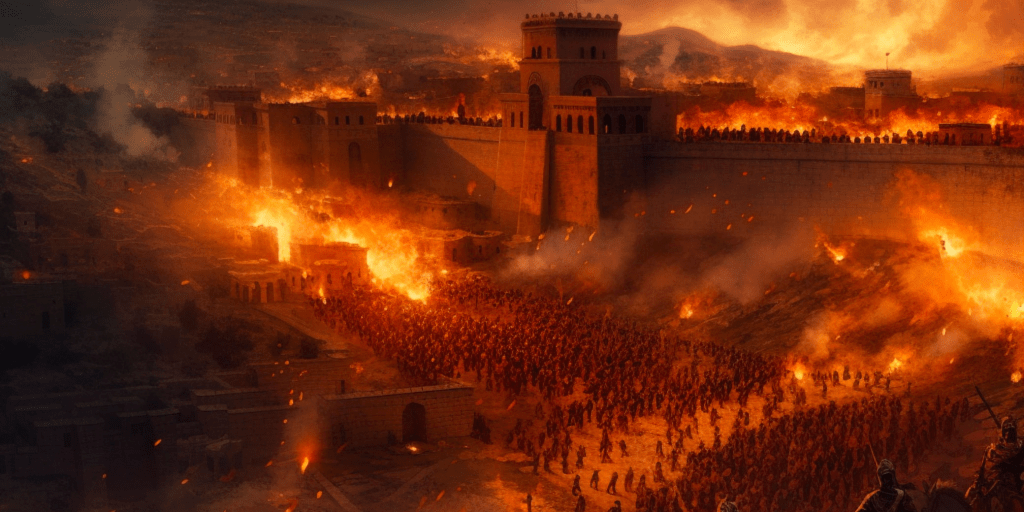
Within the immediate fulfillment of the abomination of desolation (Matt. 24:15), fulfilled with the destruction of Jerusalem and the temple in 70 A.D., Jesus described the actions of those living during this time. While Christ’s words pointed to the immediate future in the first century, they also apply to the greater desolation occurring in the world immediately prior to the return of the Lord (Matt. 24:29-31). It is to this greater, yet future, destruction Jesus transitioned in today’s text.

Following the Fall of Jerusalem and the prophetical description of life and living prior to the return of the Lord, Jesus then taught His disciples what would occur immediately prior to His return to earth in power, might and glory. He referred to this time as great tribulation.  

“From what immediately follows it is evident once again that for Jesus the transition from the second to the third application of Daniel’s prediction was as easy as that from the first (the tribulation experienced by God’s people during the reign of Antiochus Epiphanes) to the second (the distress in connection with the fall of Jerusalem),” states Dr. William Hendriksen.

The phrase great tribulation refers to a future period of time featuring surprising and strange affliction, distress and suffering. Notice Jesus said “there will be great tribulation.” This prophetic time period will occur. Jesus said you could be certain of this truth. It will be unlike anything that has ever happened before in history.

Jesus then said this great tribulation would be sovereignly cut short, or reduced in its number of days. Otherwise, no human being would survive or rescued from its onslaught. This salvation could refer to both physical and spiritual deliverance.

“Jesus is here speaking about a tribulation that will characterize “those days,” a tribulation such as has never been and never again shall be, a very brief period of dire distress that shall occur immediately before his return (see verses 29–31). It is the period mentioned also in Rev. 11:7–9; 20:3b, 7–9a. For the sake of God’s chosen ones—see Eph. 1:4—in order that not all might have to die a violent death, the days of this final tribulation shall be cut short. Herein, too, the love of God is made manifest. It should hardly be necessary to add that justice is not done to the concept of this tribulation, which immediately precedes “the end” of the world’s history and which surpasses any other distress in its intensity, if it is referred solely to the sorrows experienced during the fall of Jerusalem,” explains Dr. Hendriksen.

The time period leading up to the great tribulation will feature many individuals predicting the Messiah’s return. These type of predictions have occurred within the last fifty years, and the last 2,000 years, only to be proven false. Many more predictions will follow. What is the believer in Christ to do regarding such false prophecies? This will be the focus when next we meet.

Soli deo Gloria!

The Gospel of Matthew: The Fall of Jerusalem.

16… “then let those who are in Judea flee to the mountains. 17 Let the one who is on the housetop not go down to take what is in his house, 18 and let the one who is in the field not turn back to take his cloak. 19 And alas for women who are pregnant and for those who are nursing infants in those days! 20 Pray that your flight may not be in winter or on a Sabbath.” (Matthew 24:16–20 (ESV)

Within the immediate fulfillment of the abomination of desolation (Matt. 24:15), fulfilled with the destruction of Jerusalem and the temple in 70 A.D., Jesus proscribed the actions of those living during this time. While Christ’s words point to the immediate future in the first century, they also apply to the greater desolation occurring in the world immediately prior to the return of the Lord (Matt. 24:29-31).

First, Jesus commanded those living during this time in Judea to flee to the mountains. The mountains may refer to areas southeast of Jerusalem. This would be the area near the Dead Sea and would include the hills of Moab and Edom. It was there that David hid from Saul (I Sam. 23:29). It would be here believers in Christ would find refuge from Rome.

Second, fleeing to the hills for refuge would entail an immediate departure. There would be no time to collect personal possessions from home to take on the journey. Jesus commanded His listeners to flee with the clothes on their back and nothing more. Otherwise, they faced certain persecution and death from the Roman army.

Third, the individual in the field must also immediately flee. There would no time to even go back to collect one’s cloak. Even though such a garment would provide warmth and comfort at night, there would be no time to retrieve it. Jesus commanded no one go back for personal effects.

Fourthly, this time of destruction would be particularly difficult for pregnant women and those with nursing infants. Jesus cautioned people the living conditions while fleeing the Romans would prove challenging and difficult. He displayed special concern for women and children, who the male dominated society and culture dismissed and often rejected in the first century.  

Finally, Jesus cautioned people that this devastation and time of flight from Rome could occur either on the Sabbath or during the winter. They needed to prayerfully prepare.

“Even in that climate the winter has its cold days. Moreover, it is the rainy season. Snow, especially in the hills to which Jesus had ordered his followers to flee and even lower down, could not be entirely ruled out,” explains Dr. William Hendriksen.

“Traveling on the Sabbath was difficult. To be sure, even the rabbis permitted flight on the Sabbath when a person was in danger of losing his life. And Christ’s own teaching on the subject of Sabbath observance (Matt. 12:11; Mark 2:27) was sufficiently generous to make allowance for escape on that day. But the many man-made rules and regulations by means of which the scribes and the Pharisees had created the impression that man was indeed made for the Sabbath would have resulted in refusals on the part of many a strict observer to help those in need. So the Lord urges his disciples to pray that they may not have to flee in winter or on the Sabbath.”

“This prophecy, this warning, speaks to the fall of Jerusalem, and only the fall of Jerusalem. Its prime commands cannot possible apply to Jesus’ return,” explains commentator Daniel M. Doriani. “When He (Jesus) comes, it will be utterly pointless to flee to the mountains. Indeed, Revelation says unbelievers will wish to be buried under mountains on that day (Revelation 6:16). Why would a believer want to flee anyway? How could it be worse for mothers at Christ’s return, or worse if He came on a cold winter day? But it is imperative to flee, at once, from a vengeful army, and cold and children do compound the trouble of flight.”

Regardless of whatever happens in life, God remains in control by His purposeful sovereignty. However, this does mean believers in Christ should be prepared for tribulation and suffering. Have a faithful day in the Lord.

Soli deo Gloria!  

The Gospel of Matthew: The Abomination of Desolation. Part 2.

“So when you see the abomination of desolation spoken of by the prophet Daniel, standing in the holy place (let the reader understand).”(Matthew 24:15 ESV)

What did Jesus mean by the phrase abomination of desolation? Linguistically, abomination (βδέλυγμα; bdelygma) refers to what is detestable and abhorrent. It is a repugnant object or situation with no apparent redeemable value. Desolation (ἐρήμωσις; eremasis) is devastation and destruction.

Jesus taught this event and the disciples should have known about it. Daniel the prophet spoke of this detestable destruction during his ministry. The biblical texts to which Jesus referred to were Daniel 9:17, 9:27 and 11:31.

Daniel 9:17 (ESV) – “Now therefore, O our God, listen to the prayer of your servant and to his pleas for mercy, and for your own sake, O Lord, make your face to shine upon your sanctuary, which is desolate.”

Daniel 9:27 (ESV) – “And he shall make a strong covenant with many for one week, and for half of the week he shall put an end to sacrifice and offering. And on the wing of abominations shall come one who makes desolate, until the decreed end is poured out on the desolator.”

Daniel 11:31 (ESV) – “Forces from him shall appear and profane the temple and fortress, and shall take away the regular burnt offering. And they shall set up the abomination that makes desolate.”

While Jesus pointed to near future for His first century audience, He was also looking back to a historical event which was future for the prophet Daniel. What event in biblical and recorded history related to Jesus’ statement in Matthew 24:15?

In Daniel’s prophecies, the abomination of desolation referred to the desecration of the Jewish temple by the Syrian ruler Antiochus IV Epiphanes. In 168 B.C. Antiochus placed a pagan altar in the temple. He also sacrificed a swine or pig. This was foreshadowing of the temple’s desecration and destruction by the Romans in 70 A.D. The Romans entered the temple with military standards, and other ceremonial insignias representing their pagan religion. The Romans removed the temple’s sacred vessels and then burned the temple to the ground.

“In accordance with that prophet’s prediction Antiochus Epiphanes (175–164 b.c.), unaware that he was indeed fulfilling prophecy, and being thoroughly responsible for his own wicked deed, erected a pagan altar over the altar of burnt-offering, thus polluting the house of God. This had happened long ago,” explains Dr. William Hendriksen.  

“Nevertheless, Jesus says, “Now when you see ‘the desolating sacrilege,’ ” showing that he is telling the disciples that a divine oracle may apply to more than one historical situation: the sacrilege that results in the desolation of city and temple takes place more than once in history.”

“Let the man who reads Daniel’s prophecy understand this! Just as in the past the holy places of the Lord had been desecrated, so it will happen again. And it did indeed take place when the Roman armies, with the image of the emperor upon their standards, an image and an emperor worshipped by them laid siege to the city of Jerusalem (Luke 21:20). But just as the pagan altar and the swine offered upon it in the very temple of Jehovah in the second century b.c. pointed forward to the idolatrous legions of Rome, so these in turn foreshadowed the great and final violation by the antichrist of all that is sacred,” states Dr. Hendriksen.

The phrase, “let the reader understand,” is not necessarily just about Matthew’s Gospel, but rather Daniel’s prophecy. Antiochus’ behavior in the past prefigured the temple’s destruction by the Romans in 70 A.D. and the future abomination by the antichrist prior to Christ’s return.

Believes in Christ must always remember the past in order to live in the present and to prepare for the future. Have a blessed day in the Lord.

Soli deo Gloria!