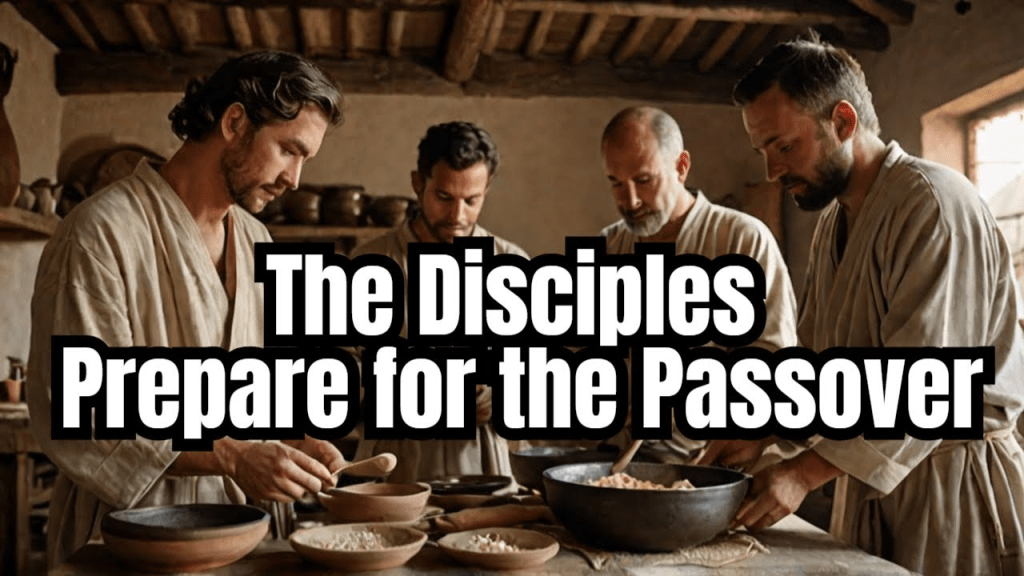
The Gospel of Matthew: The Preparation for the Passover.

17 Now on the first day of Unleavened Bread the disciples came to Jesus, saying, “Where will you have us prepare for you to eat the Passover?” 18 He said, “Go into the city to a certain man and say to him, ‘The Teacher says, My time is at hand. I will keep the Passover at your house with my disciples.’ ” 19 And the disciples did as Jesus had directed them, and they prepared the Passover.” Matthew 26:17–19 (ESV)

12 And on the first day of Unleavened Bread, when they sacrificed the Passover lamb, his disciples said to him, “Where will you have us go and prepare for you to eat the Passover?” 13 And he sent two of his disciples and said to them, “Go into the city, and a man carrying a jar of water will meet you. Follow him, 14 and wherever he enters, say to the master of the house, ‘The Teacher says, Where is my guest room, where I may eat the Passover with my disciples?’ 15 And he will show you a large upper room furnished and ready; there prepare for us.” 16 And the disciples set out and went to the city and found it just as he had told them, and they prepared the Passover.” (Mark 14:12–16 (ESV)

Then came the day of Unleavened Bread, on which the Passover lamb had to be sacrificed. So Jesus sent Peter and John, saying, “Go and prepare the Passover for us, that we may eat it.” They said to him, “Where will you have us prepare it?” 10 He said to them, “Behold, when you have entered the city, a man carrying a jar of water will meet you. Follow him into the house that he enters 11 and tell the master of the house, ‘The Teacher says to you, Where is the guest room, where I may eat the Passover with my disciples?’ 12 And he will show you a large upper room furnished; prepare it there.” 13 And they went and found it just as he had told them, and they prepared the Passover.” (Luke 22:7–13 (ESV)

“Now before the Feast of the Passover, when Jesus knew that his hour had come to depart out of this world to the Father, having loved his own who were in the world, he loved them to the end.” (John 13:1 (ESV)

As the last week of the Lord Jesus Christ is studied, it is important to compare all four Gospels, their particular narratives and themes pertaining to the death, burial and resurrection of the Lord. Today’s focus concerns the preparation for the Passover Feast. This particular feast would picture, and immediately precede, the historical death, burial and resurrection of the Lord Jesus Christ.

All four narratives document the initial preparation for the Passover. The
Synoptic Gospels (Matthew, Mark, Luke) also refer to the day of Unleavened Bread. What is the significance of this distinction? Both titles refer to the same Spring seasonal celebration of the Lord’s deliverance of Israel from Egypt (Ex. 12:1-28). Both titles were used interchangeably. It would be comparable to our expressions of Merry Christmas, Happy Holidays and Seasons Greetings, in which all refer to the observance of the Lord’s incarnation to a greater, or lesser, extent.

“The Passover lambs were killed (Mark 14:12) on 14 Nisan (March/April). That evening, the Passover meal was eaten. The Feast of Unleavened Bread followed immediately after Passover, from 15–21 Nisan. The entire time was often referred to either as “Passover” (Luke 22:1), or as the Feast of Unleavened Bread. Therefore the first day refers to 14 Nisan,” explains Dr. John MacArthur.  

All four accounts reveal the sovereign authority of the Lord Jesus. He knows what is going to occur in the ensuing hours and He diligently seeks the fulfillment of Scripture and His atoning mission. This includes the Passover, for He is the fulfillment of the Passover Lamb (John 1:29-35; I Cor. 5:6-8). Each Gospel provides a unique perspective on the events. However, none are contradictory to each other.

“Nothing is said about the purchase of a lamb. We may probably assume that this had been attended to a few days earlier. See Exod. 12:3. Further preparations had to be made however,” explains Dr. William Hendriksen.

“During the afternoon the lamb must be killed in the forecourt of the temple (cf. Exod. 12:6). A room of sufficient size must be obtained, and everything in connection with this room and its furniture must be arranged. Besides, purchases must be made: of unleavened bread, bitter herbs, wine, etc. The lamb must be made ready for use, the sauce must be prepared. Since it was now Thursday morning, there can be no delay.”

“With the Passover at hand, the disciples come to Jesus to inquire of the place where the meal is to be eaten (Matt. 26:17). This festival, one of the most important feast days on the Jewish calendar, has to be celebrated within Jerusalem proper, and so our Lord and His followers must find a place to eat the Passover meal within the city, for they have been staying in Bethany (v. 6). Christ is able to direct His disciples on how they may find a room in which to eat the Passover, and they then go forth to follow His instructions (vv. 18–19),” states Dr. R. C. Sproul.

Matthew, Mark and Luke all conclude their narratives with these words referring to the disciples; “They prepared the Passover.”

“Some preachers and scholars have long portrayed Jesus as a helpless victim of events, one who is caught off-guard by His arrest and crucifixion. Today’s passage, among many others, indicates that this view is mistaken. Our Savior’s death is no accident of history, it occurred according to the definite plan and foreknowledge of God and of His Christ. He is the sovereign Lord of history who controls all things even until this very day,” concludes Dr. Sproul.

Soli deo Gloria!
The Gospel of Matthew: Judas Schemes to Betray Jesus.

14 Then one of the twelve, whose name was Judas Iscariot, went to the chief priests 15 and said, “What will you give me if I deliver him over to you?” And they paid him thirty pieces of silver. 16 And from that moment he sought an opportunity to betray him.” (Matthew 26:14–16 ESV)

10 Then Judas Iscariot, who was one of the twelve, went to the chief priests in order to betray him to them. 11 And when they heard it, they were glad and promised to give him money. And he sought an opportunity to betray him.” (Mark 14:10–11 (ESV)

Then Satan entered into Judas called Iscariot, who was of the number of the twelve. He went away and conferred with the chief priests and officers how he might betray him to them. And they were glad, and agreed to give him money. So he consented and sought an opportunity to betray him to them in the absence of a crowd.” (Luke 22:3–6 ESV)

As the last week of the Lord Jesus Christ is studied, it is important to compare all four Gospels, their particular narratives and themes pertaining to the death, burial and resurrection of the Lord. Today’s focus concerns Judas Iscariot and his plans to betray Jesus into the hands of His enemies.

As Mary initiated her act of selfless devotion to the Lord in anointing Him, Judas initiated his contact with the chief priests in order to acquire money by betrayal. Luke reveals the actions by Judas were perpetrated by Satan’s internal influence upon the disciple. However, Judas willingly sought to betray the Lord.

What a comparison between Mary and Judas. Mary gave while Judas pursued every opportunity to get. Mary was public in her adoration of Jesus. Judas was private in his effort to betray Jesus. Mary’s object of worship was the Lord. Judas’ object of worship was money. Mary’s legacy is one of loving adoration. Judas’ legacy is heartless betrayal of the Master who loved him. Mary is famous. Judas is infamous.

“Commentators on Matthew 26 point out the contrast between Mary’s act of love in verses 6–13 (see John 12:1–8) and Judas’ evil in today’s passage. Judas is treacherously secretive, betraying the Lord behind His back (Matt. 26:14–15), but Mary publicly pours oil upon His head (vv. 6–13). Mary is selfless; she gives something up to bless her Savior (vv. 7, 10). Judas is selfish; he looks to profit by helping to bring the curse of death upon Jesus (v. 15). Finally, Judas sells out Jesus for a relatively small amount of money, but Mary honors Christ with a large amount of her resources — a year’s worth of wages (v. 9; John 12:5),” explains Dr. R. C. Sproul.

“Standing in sharp contrast to the love and devotion of Mary was the hatred and treachery of Judas. This disciple, who is understandably referred to last in the lists of the Twelve, was the son of Simon, who was also called “Iscariot.” The name “Iscariot” means “man of Kerioth,” which was a small town in Judea about 23 miles south of Jerusalem (cf. 3:19). Thus Judas was not a Galilean like the other disciples,” states Dr. John MacArthur.

“It is clear that Judas never had any spiritual interest in Jesus—he was attracted to him because he expected Jesus to become a powerful religious and political leader. He saw great potential for power, wealth, and prestige through his association with him. But Jesus knew what Judas was like from the start, and that is why he chose him as one of the Twelve. He was the one who would betray him so that the Scripture and God’s plan of salvation would be fulfilled (Ps. 41:9; 55:12–15, 20–21Zech. 11:12–13John 6:64, 70–71; 13:18; 17:12).”

Are you more like Mary or Judas? This is a provocative question but a necessary one. How we answer reveals our true nature and eternal destiny.

“Judas’ betrayal of the Savior is the most wicked deed ever committed. It warns us to be careful lest sin take hold of our hearts and make us turn our backs on Christ. Those who truly know Jesus will not finally betray Him, but it is possible even for Christians to become disenchanted with the way God works out His plan and fall into transgression. Let us take care to remember that we have no right to call the Lord’s way of doing things into question,” concludes Dr. Sproul.

Soli deo Gloria!
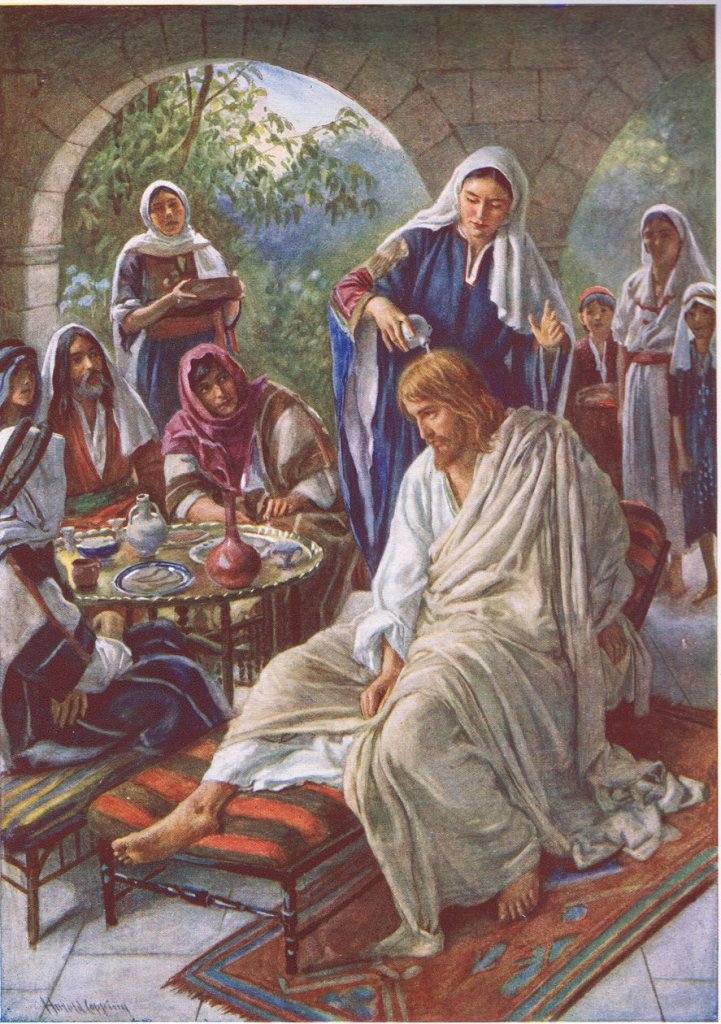
The Gospel of Matthew: Jesus Responds to Mary and the Disciples.  

10 But Jesus, aware of this, said to them, “Why do you trouble the woman? For she has done a beautiful thing to me. 11 For you always have the poor with you, but you will not always have me. 12 In pouring this ointment on my body, she has done it to prepare me for burial. 13 Truly, I say to you, wherever this gospel is proclaimed in the whole world, what she has done will also be told in memory of her.” (Matthew 26:10–13 (ESV)

But Jesus said, “Leave her alone. Why do you trouble her? She has done a beautiful thing to me. For you always have the poor with you, and whenever you want, you can do good for them. But you will not always have me. She has done what she could; she has anointed my body beforehand for burial. And truly, I say to you, wherever the gospel is proclaimed in the whole world, what she has done will be told in memory of her.” (Mark 14:6–9 (ESV)

Jesus said, “Leave her alone, so that she may keep it for the day of my burial. For the poor you always have with you, but you do not always have me.” (John 12:7–8 (ESV)

One of the principles of proper biblical interpretation is Scripture interprets Scripture. This means the Bible is its own interpreter and never contradicts itself. An example of this interpretative principle is found in the story of Jesus’ anointing at Bethany. Jesus’ response to Mary, and the disciples’ response to her, are recorded not only in Matthew’s Gospel but also in Mark 14:6-9 and John 12:7-8.  

Mary’s extravagant act of worship by anointing Jesus with expensive perfume (Matt. 26:6-7; Mark 14:3; John 12:1-3) was contrasted by the disciples’ indignant response against her act of worship and love for Jesus (Matt. 26:8-9; Mark 14:4-5; John 12:4-6). What then was Jesus’ response, not only to Mary but also to the disciples?

In all three text, Jesus firmly reprimands the disciples, and not Mary. In Matthew and Mark’s account, Jesus posed a rhetorical question to the men; ““Why do you trouble the woman” In Mark and John’s Gospel, He also issued a command; “Leave her alone.” He then commended Mary for what she had done calling it “a beautiful thing.”

He understood, even though the disciples did not, the significance of what Mary had done. She prepared Jesus for what would befall Him in the next several days: His substitutionary death, burial and subsequent resurrection.” He selfless acts pointed to the saving Gospel.

“It was not that the Master was unconcerned about the needs, both physical and spiritual, of those to whom help and mercy should be shown. Far from it, as the following passages indicate: Matt. 5:7; 6:2–4; 12:7; 19:21; Luke 6:20, 36–38; 21:1–4; John 13:29. On this subject, as well as on all others, his teaching was in line with the rest of special revelation (Exod. 23:10, 11; Lev. 19:10; Deut. 15:7–11—was he not in a sense quoting Deut. 15:11?—Ps. 41:1; Prov. 14:21b, 31; 19:17; Isa. 58:7; Jer. 22:16; Dan. 4:27; Amos 2:6, 7; and for the New Testament see 2 Cor. 8:1–9; Gal. 6:2, 9, 10; 2 Thess. 3:13; James 5:1–6),” explains Dr. William Hendriksen.

“But there would be many more opportunities to attend to the cause of Christian charity or benevolence. On the contrary, the opportunity to show love and honor to Jesus in the state of humiliation had almost vanished. Gethsemane, Gabbatha, and Golgotha were just around the corner. What Mary had done was therefore right, beautiful even, for it was prompted by thankfulness of heart. It was also unique in the thoughtfulness it revealed. Moreover, it was regal in its lavishness. Last but not least, it was marvelous in its timeliness.”

What may initially appear to be most important, often is the less important. The meeting of physical needs of the moment can never be equal with the eternal significance of the Gospel, and those who proclaim it. Mary’s act pointed the eternal love of God, displayed on the cross. While meeting the social, and material needs of the poor is a good and blessed thing to do, the heralding of the Gospel is far greater and lasts longer (John 4).

What legacy are you living and leaving? Is it the materialism of the moment, or the ministry of a lifetime?

Soli deo Gloria!  

The Gospel of Matthew: The Indignity of the Disciples.

And when the disciples saw it, they were indignant, saying, “Why this waste? For this could have been sold for a large sum and given to the poor.”  (Matthew 26:8–9 (ESV)

There were some who said to themselves indignantly, “Why was the ointment wasted like that? For this ointment could have been sold for more than three hundred denarii and given to the poor.” And they scolded her.” (Mark 14:4–5 (ESV)

But Judas Iscariot, one of his disciples (he who was about to betray him), said, “Why was this ointment not sold for three hundred denarii and given to the poor?” He said this, not because he cared about the poor, but because he was a thief, and having charge of the moneybag he used to help himself to what was put into it.” (John 12:4–6 (ESV)

One of the principles of proper biblical interpretation is Scripture interprets Scripture. This means the Bible is its own interpreter and never contradicts itself. An example of this interpretative principle is found in the story of Jesus’ anointing at Bethany. Mark 14:4-5 and John 12:4-6 are a parallel accounts of Matthew’s text. All three Gospels chronicle the event occurred in the village of Bethany (Matt. 26:6; Mark 14:3; John 12:1).

Mary’s extravagant act of worship by anointing Jesus with expensive perfume (Matt. 26:6-7; Mark 14L3; John 12:1-3) was contrasted by the disciples’ indignant response. To be indignant (ἀγανακτέω; aganakteo) means to be angry and to judge something, or someone, as being wrong. It is to be irritated, provoked and upset towards someone or some situation. The disciples were indignant at Mary.

Some of the disciples expressed this anger only to themselves. Other spoke publically. They objected to such waste. They reasoned the nard, or expensive perfume, could have been sold and the proceeds given to the poor. They estimated the value to be in excess of three hundred denarius. A denarius was a day’s wage for a common laborer, it represented a year’s work.

Mark recorded the disciples scolded Mary (Mark 14:5). To scold (ἐμβριμάομαι; embrimaomai means to harshly denounce, and to exhibit irritation, or even anger, in expressing reproof. Mary was not shy in her worship towards the Lord. The disciples were not shy in their denouncement of Mary.

John adds this indignant response was not completely altruistic, unselfish and humane. He commented about Judas Iscariot’s true perspective towards Mary’s actions and the worth of the perfume. Judas was not concerned about the poor. He was concerned about himself. He was a thief, in charge of the moneybag and stole what was in it. This is a preview of Judas betrayal to come in the ensuing days.

“It is almost beyond belief that the disciples should, by implication, mark as lacking in sufficient sympathy for the poor a most generous hostess; in fact one who together with her sister was in the habit of showing hospitality to them and to their Master whenever these poor people (Matt. 8:20), in need of constant help (27:55, 56), were in the neighborhood. It is even more amazing when one considers that at this very hour these adverse critics, the disciples, were being entertained at the home of one of Mary’s friends,” explains Dr. William Hendriksen.

“He is ungrateful who denies that he has received a kindness which has been bestowed upon him; he is ungrateful who conceals it; he is ungrateful who makes no return for it; most ungrateful of all is he who forgets it.” — Seneca, De Beneficiis III.1.

What will be the response by the Lord to not only Mary, but also to His disciples? More to follow. May we quick to listen and slow to speak.

Soli deo Gloria!

The Gospel of Matthew: Jesus’ Anointing at Bethany.

Now when Jesus was at Bethany in the house of Simon the leper, a woman came up to him with an alabaster flask of very expensive ointment, and she poured it on his head as he reclined at table. Matthew 26:6–7 ESV)

And while he was at Bethany in the house of Simon the leper, as he was reclining at table, a woman came with an alabaster flask of ointment of pure nard, very costly, and she broke the flask and poured it over his head.” (Mark 14:3 ESV)

Six days before the Passover, Jesus therefore came to Bethany, where Lazarus was, whom Jesus had raised from the dead. So they gave a dinner for him there. Martha served, and Lazarus was one of those reclining with him at table. Mary therefore took a pound of expensive ointment made from pure nard, and anointed the feet of Jesus and wiped his feet with her hair. The house was filled with the fragrance of the perfume.” (John 12:1–3 ESV)

One of the principles of proper biblical interpretation is Scripture interprets Scripture. This means the Bible is its own interpreter and never contradicts itself. An example of this interpretative principle is found in the story of Jesus’ anointing at Bethany. Mark 14:3 and John 12:1-8 are a parallel account of Matthew’s text. All three Gospels chronicle the event occurred in the village of Bethany (Matt. 26:6; Mark 14:3; John 12:1).

“There is no conflict between this account (Matt. 26:6) and John 12:1, “Now six days before the Passover Jesus came to Bethany.…” The time indication in Matt. 26:2, “after two days” does not apply to the anointing at Bethany (verses 6–13). At verse 6 Matthew begins to tell a new story. To do so he must go back a few days, to the preceding Saturday evening, when a supper was given at Bethany in honor of Jesus,” explains Dr. William Hendriksen.

“Each night during the last week of His life Jesus is staying in Bethany, a village about an hour’s walk from Jerusalem (Matt. 21:17), probably because the Holy City, filled to the brim with Passover pilgrims, has few vacancies,” explains Dr. R. C. Sproul.

Matthew and Mark record Jesus’ anointing took place at the home of Simon the Leper (Matt. 26:6; Mark 14:3), during a dinner (John 12:1). Mary, Martha and Lazarus were also in attendance (John 12:2-3). Some commentators speculate Simon may have been the father of the three siblings, but we cannot say for certain.

Martha served while Lazarus reclined at table, presumably as an honored guest (John 12:2-3). This was because the dinner was given in Jesus’ honor following the events of John 11 when Jesus raised Lazarus from the dead. John reveals the woman who anointed Jesus was none other than Mary (Matt. 26:7; John 12:3).

“Present at this supper were at least fifteen men: Jesus, The Twelve, Lazarus (John 12:2), and a certain Simon, mentioned only here (Matt. 26:6) and in Mark 14:3. The idea readily suggests itself that the supper (or “dinner” if one prefers) was prompted by love for the Lord, specifically by gratitude for the raising of Lazarus and for the healing of Simon, the man who had been a leper, is still called “Simon the leper,” but had presumably been healed by Jesus. It was at the home of this Simon that the dinner was given,” states Dr. Hendriksen. .

Matthew and Mark indicate Mary had an alabaster flask containing expensive ointment (Matthew 26:7a; Mark 14:3). The flask was perhaps made from pure gypsum. John says the ointment was made from pure nard and measured a pound. Mary was extravagant, not only when she broke the beautiful flask but also when she poured its contents on Jesus’ head (Matt.26:7; Mark 14:3). There was so much ointment remaining that she also anointed the feet of Jesus and wiped His feet with her hair (John 12:3).

Mary’s act was one of unbounded devotion for the Lord. It will be contrasted by the indignity of the disciples. May we choose to live in such a way that our actions, speech and attitudes reflect an utmost devotion for the Lord Jesus Christ.

Soli deo Gloria!  

The Gospel of Matthew: God’s Providence and the Plot to Kill Jesus.

When Jesus had finished all these sayings, he said to his disciples, “You know that after two days the Passover is coming, and the Son of Man will be delivered up to be crucified.” Then the chief priests and the elders of the people gathered in the palace of the high priest, whose name was Caiaphas, and plotted together in order to arrest Jesus by stealth and kill him. But they said, “Not during the feast, lest there be an uproar among the people.” (Matthew 26:1–5 (ESV)

The phrase “When Jesus had finished all these sayings” immediately follows all the five discourses in Matthew’s Gospel (7:28; 11:1; 13:53; 19:1). This fifth and final statement transitions into the final days of the Lord Jesus’ Passion Week.  

“The Savior has already told His disciples three times that He will die and be raised (Matt.16:21; 17:22–23; 20:17–19), but in today’s passage He explains for the first time that this will take place during Passover. This provides a theological framework for understanding the significance of the Messiah’s death. Just as the angel of death passed over all of those who were covered by the blood of the lamb (Ex. 12), so too will the blood of the Lamb “slain from the foundation of the world” (Rev. 13:8, NKJV) shield those whom it covers from eternal destruction,” explains Dr. R. C. Sproul.

Two main perspectives dominate today’s text. They are God’s providence, or purposeful sovereignty, contrasted by the plot by sinful and fallen men. The former will always supersede the latter. The Lord used the latter in order to accomplish the former; His sovereign will (Acts 2:22-24). God’s control is always greater than man’s confident collusion.

Jesus’ statement to His disciples unveiled not only His omniscient knowledge of future circumstances, but also of the Old Testament Scriptures (Isaiah 52:13-53:12). By saying, ““You know that after two days the Passover is coming, and the Son of Man will be delivered up to be crucified,” Jesus acknowledged He, along with God the Father and the Holy Spirit, was in complete control of His circumstances.

Jesus would pray a few days later this prayer to the Father. “Father, the hour has come; glorify your Son that the Son may glorify you, since you have given him authority over all flesh, to give eternal life to all whom you have given him. And this is eternal life that they know you, the only true God, and Jesus Christ whom you have sent. I glorified you on earth, having accomplished the work that you gave me to do. And now, Father, glorify me in your own presence with the glory that I had with you before the world existed.” (John 17:2–5 (ESV)

The fallen world bristles at such sovereign control by God. Even some believers in Christ struggle relinquishing their presumed authority, even when we truly have very little control over our circumstances. The idea humanity does not determine their own destiny is repugnant to the culture. However, we are not the master of our fate and the captain of our souls.

Pastor Michael Reeves explains, “Perhaps this is why Christians have so little joy, are anemic in prayer and enslaved by their sins. This idea (God’s providence and sovereignty) is hard to stomach in a culture sauced in Hollywood goo.”

We witness in the crucifixion God causing all things to work together for good (Romans 8:28). In other words, what the chief priests and elders meant for evil, God meant for good (Genesis 50:20).  

“According to Matthew, Caiaphas is the high priest under whom this will happen (Matt. 26:3), but Luke tells us that Annas is also high priest at this time (Luke 3:1–2Acts 4:5–6). In AD 15, Rome deposed Annas from the high priesthood, later replacing him with his son-in-law, Caiaphas. Yet Annas continued to wield power behind the scenes, almost like a “co-high priest” with Caiaphas,” explains one commentator.

Caiaphas and the others want to kill Jesus because the messianic clamor His presence creates might draw the ire of Rome, but they want to postpone His execution lest it provoke the people to rebel against the priests for murdering God’s Messiah,” But the Almighty has other plans, and in His sovereignty He will bring about Jesus’ predicted death during the Passover,” explains Dr. Sproul.

“The Creator’s providence,” John Calvin says, “will ensure that events turn out exactly as He has planned.”

Soli deo Gloria!

The Gospel of Matthew: The Judgment of the Goats.

41 “Then he will say to those on his left, ‘Depart from me, you cursed, into the eternal fire prepared for the devil and his angels. 42 For I was hungry and you gave me no food, I was thirsty and you gave me no drink, 43 I was a stranger and you did not welcome me, naked and you did not clothe me, sick and in prison and you did not visit me.’ 44 Then they also will answer, saying, ‘Lord, when did we see you hungry or thirsty or a stranger or naked or sick or in prison, and did not minister to you?’ 45 Then he will answer them, saying, ‘Truly, I say to you, as you did not do it to one of the least of these, you did not do it to me.’ 46 And these will go away into eternal punishment, but the righteous into eternal life.” (Matthew 25:41–46 ESV)

Jesus described hell in four distinct ways in today’s text. First, hell is separation; “Depart from me.” Second, hell judgment; “…you cursed.” Third, hell is association; “… into the eternal fire prepared for the devil and his angels.” Fourth, hell is “eternal punishment.”  

The Lord judges the goats, or the unrighteous, by the same judgment in which He judges the sheep, or the righteous (Matt. 31-40). The behavior of each reflect the heart and soul of each. The behavior of both is toward Jesus’ brothers, or His disciples. This does not refer to the Lord’s disciples at that time, but His disciples of all time.

The unrighteous hate the Lord’s disciples (John 15:18-25). They always have and they always will. This reflects their fallen condition. The Apostle expressed this in Colossians 1:24-26. The Apostle Peter stated the same (I Peter 1:3-7; 2:12; 18-25; 3:13-17; 4:1-6; 12-19) as did James (James 1:2-4).

The specific reasons for God’s judgment are stated. “42 For I was hungry and you gave me no food, I was thirsty and you gave me no drink, 43 I was a stranger and you did not welcome me, naked and you did not clothe me, sick and in prison and you did not visit me.’ 44 Then they also will answer, saying, ‘Lord, when did we see you hungry or thirsty or a stranger or naked or sick or in prison, and did not minister to you?’ 45 Then he will answer them, saying, ‘Truly, I say to you, as you did not do it to one of the least of these, you did not do it to me.”  

“It should be noted that all these sins are negative. Not a single sinful deed—such as idolatry, murder, adultery, theft, etc.—is mentioned. Only sins of omission are enumerated, sins of neglect. Cf. Heb. 2:3. This neglect proves that these people have not believed in the Son of man. For this unbelief, thus demonstrated, they are condemned,” states Dr. William Hendriksen.

“We actually serve the Lord when we do simple acts of service for one another. It does not take much effort to make a meal for new parents or a family who has recently lost a loved one. A call or visit to the lonely or shut-in takes mere moments but can reap lasting rewards. The donation of time, money, or supplies to your church’s mercy ministry is an act of love for Jesus. Our profession of faith is invalid if we are not engaged in these or other similar activities,” explains Dr. R. C. Sproul.    

Soli deo Gloria!                    

The Gospel of Matthew: The Least of These.

35 For I was hungry and you gave me food, I was thirsty and you gave me drink, I was a stranger and you welcomed me, 36 I was naked and you clothed me, I was sick and you visited me, I was in prison and you came to me.’ 37 Then the righteous will answer him, saying, ‘Lord, when did we see you hungry and feed you, or thirsty and give you drink? 38 And when did we see you a stranger and welcome you, or naked and clothe you? 39 And when did we see you sick or in prison and visit you?’ 40 And the King will answer them, ‘Truly, I say to you, as you did it to one of the least of these my brothers, you did it to me.’ (Matthew 25:35–40 (ESV)

Today’s text ranks as one of the most familiar, and often quoted, portions of Scripture. It may also be one of the most misunderstood and misinterpreted. For many churches and para-church ministries, Matthew 25:35-40 has become a clarion call for a social gospel or social justice.

The Social Gospel was/is “a religious social reform movement prominent in the United States from about 1870 to 1920. Advocates of the movement interpreted the kingdom of God as requiring social as well as individual salvation and sought the betterment of industrialized society through application of the biblical principles of charity and justice,” explains the Encyclopedia Britannica.

“The Social Gospel was especially promulgated among liberal Protestant ministers, including Washington Gladden and Lyman Abbott, and was shaped by the persuasive works of Charles Monroe Sheldon (In His Steps: What Would Jesus Do? [1896]) and Walter Rauschenbusch (Christianity and the Social Crisis [1907]). Labor reforms—including the abolition of child labor, a shorter workweek, a living wage, and factory regulation—constituted the Social Gospel’s most prominent concerns. During the 1930s many of these ideals were realized through the rise of organized labor and the legislation of the New Deal by U.S. Pres. Franklin D. Roosevelt.”

The Social Justice movement is similar in focus. It seeks to address current social desires. According to the Human Rights Careers website, social justice “is built on the pillars of human rights, equity, participation, and access. When a society is just, everyone is respected, supported, and protected.” No mention is made concerning an individual’s salvation by the One, True God the Scripture.

Some of the issues the social justice movement addresses include the gender pay gap, income inequality, climate change, food insecurity, the refugee crisis, universal healthcare, poverty, gender-based violence, state violence, threats to the trans-community, reproductive rights, and racism. The movement is an explicitly liberal, progressive and woke movement.  

In northeast Indiana, one ministry bases it mission, vision and values on today’s text. Its mission statement says they are “a gospel-inspired healthcare center that provides high-quality medical, dental, vision, and mental health services at no charge to low-income, uninsured adults in Northeast Indiana and Northwest Ohio. We are supported solely by donations, grants, and foundations. Inspired by the Bible verses for which we are named, we offer hope to the most vulnerable in our community—treating them with compassion and dignity, regardless of background or beliefs.”

What the social gospel and the social justice movement has forgotten, set aside or is unaware is the Gospel. The biblical Gospel is primarily concerned with the salvation of the sinner, which then impacts the individual’s various social needs. In other words, humanity’s social requirements, or desires, must not obscure, or violate, the real reason for those social needs; the reality of sin in a fallen world and salvation from the penalty, power and eventual presence of sin by grace alone, through faith alone, and in the person and work of Jesus Christ alone.

It should be noted what the culture calls social needs or justice is in several ways condoning sinful and unrighteous choices. The church must never compromise biblical ethics, which are based upon the biblical Gospel. .

“Christians have heard the account of the sheep and the goats used as an exhortation for the church to meet the needs of all the destitute. Certainly, we must care even for the needy who are not part of the covenant community. After all, the Mosaic Law encourages generosity toward strangers (Lev. 23:22), a principle not limited to the old covenant era (Luke 14:12–14). Not inappropriately, believers have served all mankind based on Matthew 25:31–46,” explains Dr. R. C. Sproul.

“However, Jesus in today’s passage is not dealing first and foremost with poor people in general. Instead, He is referring primarily to our care for other Christians. Since Christ identifies His disciples as His brothers elsewhere in Matthew (12:46–50), the story of the sheep and the goats concerns our treatment of other believers (see 25:40). John Calvin and other commentators recognize this point.”

“This does not mean that doing good to believers’ merits salvation. Jesus is merely teaching that “if anyone says, ‘I love God,’ and hates his brother, he is a liar” (1 John 4:20). True love for the Savior begets love for all those united to Him by faith. Even if only in simple deeds, the sheep are to serve one another, especially the needy. Goats, though they dwell among God’s flock today, disregard the sheep and overlook their needs. Thus, they manifest hatred for the One to whom the sheep are united and deserve only a dreadful fate (Matt. 25:41–46),” concludes Dr. Sproul.

How may we serve the Lord Jesus Christ today as we serve the least of these; believers and non-believers? Have a God-honoring day.

Soli deo Gloria!

The Gospel of Matthew: The Sheep and the Goats.

31 “When the Son of Man comes in his glory, and all the angels with him, then he will sit on his glorious throne. 32 Before him will be gathered all the nations, and he will separate people one from another as a shepherd separates the sheep from the goats. 33 And he will place the sheep on his right, but the goats on the left. 34 Then the King will say to those on his right, ‘Come, you who are blessed by my Father, inherit the kingdom prepared for you from the foundation of the world.” (Matthew 25:31–34 ESV)

Returning to our study of the Gospel of Matthew, today’s text continues the theme of the glorious return of the Lord Jesus Christ. The Lord does not present His return as a possibility (if), or even a probability, but rather a certainty (when). The Son of Man, Jesus’ most frequent reference of Himself, will come in His glory, splendor and majesty. This will be a fulfillment of Daniel 7:1-14.

Jesus will not return to earth alone. His angels will accompany Him. He will then reign in absolute and consummate glory, power and authority.

“What follows is not really a parable, though it does contain parabolic elements. It is a very dramatic, frequently symbolic, description of the last judgment,” explains Dr. William Hendriksen.

“In both cases the glorious coming of the Son of man, accompanied by angels, is described. The Son of man is here represented as seated upon “the throne of his glory.” The symbol indicates a most glorious throne, that is, a throne characterized by external splendor, brightness, brilliance, or radiance, corresponding with the internal and essential splendor of its Occupant’s attributes.”

Jesus does not tell us where His throne is located. Will it be in heaven? Will it be on earth? We do not know.

“One thing is certain. It will be a very glorious throne. God, through the Mediator Jesus Christ, will be Judge. Of course, in the outgoing divine works (such as creation, providence, redemption, and judgment) all three persons of the Holy Trinity co-operate. Nevertheless, from our present passage it is clear that the honor of judging was conferred on Jesus Christ as Mediator, that is, as a reward for his accomplished mediatorial work,” states Dr. Hendrikson. (See also Dan. 7:13; Joel 3:2 (Heb. 4:2); Matt. 13:41; 16:27; 26:64; 28:18; John 5:22, 27; Phil. 2:9, 10.)

The Lord’s judgment from His position of authority will also feature the angelic host. They are mentioned not only because they enhance His glory, but also because they assist the Lord in this great task. They will gather the wicked before the judgment throne and cast them into the furnace of fire (13:41, 42; 24:31; 2 Thess. 1:7, 8; Rev. 14:17–20). The angel’s involvement is stated in Matt. 24:31.

The metaphorical comparison of the Lord separating believers from the unbelievers is of a shepherd separating sheep from the goats. The Lord’s sheep (Ezekiel 34; John 10) will be on His right while the goats will be on His left. The Lord explains the positional distinction. “Then the King will say to those on his right, ‘Come, you who are blessed by my Father, inherit the kingdom prepared for you from the foundation of the world.’” Conversely, those on the left are those who are judged by God the Father who will are consigned for eternal judgment from the foundation of the world.

“According to Matthew’s gospel, only two kinds of people walk this earth: those who love Jesus and those who do not. There is no middle ground — either we are for the Savior or against Him (12:30). On one hand, Herod’s evil plans showed him to be one of the Lord’s enemies (2:16–18), and on the other, Matthew’s leaving all to follow Christ indicated what side he was on (9:9). Then there was the rich young ruler, whose seeming love of money placed him on the wrong side (19:16–22),” comments Dr. R. C. Sproul.

“The picture of final judgment in today’s passage is further evidence that all people will be grouped into two categories at the end of this age.”

The Lord’s judgment is coming. Are you ready?

Soli deo Gloria!