The Gospel of Matthew: Jesus in Anguish.

37 And taking with him Peter and the two sons of Zebedee, he began to be sorrowful and troubled. 38 Then he said to them, “My soul is very sorrowful, even to death; remain here, and watch with me.” (Matthew 26:37–38 (ESV)

33 And he took with him Peter and James and John, and began to be greatly distressed and troubled. 34 And he said to them, “My soul is very sorrowful, even to death. Remain here and watch.” (Mark 14:33–34 (ESV)

At this moment in time, Judas Iscariot had left the Upper Room and was leading Jesus’ enemies to Gethsemane to arrest Him (John 18:1-3). Upon entering the garden, Jesus separated Himself from eight of His disciples and took Peter, James and John with Him alone. These three men formed Jesus’ intimate or inner circle (See Matthew 17).

“Christ separates Himself from most of His disciples, going off to pray with the three men who are closest to him — Peter, James, and John (Matt. 26:37; see 10:2; 17:1). Our Lord is about to enter His most difficult trial and, like all people, desires the support of good friends in His ordeal,” explains Dr. R. C. Sproul.

It was then Jesus began to be sorrowful and troubled. The word sorrowful (λυπέω; lypeo) means to be grieved and distressed. It is a deep and great sadness. To be troubled (ἀδημονέω; ademoneo) refers to personal anguish. Due to the circumstances happening to Him, and would soon occur, Jesus was actively in anguish.

Jesus expressed this sorrow to the three disciples with Him. He said, “My soul is very sorrowful, even to death; remain here, and watch with me.” To be very sorrowful (περίλυπος; perilypos) refers to deep grief.

“All the waves and the billows of distress came pouring over his soul. Cf. Ps. 42:7b. Why this terror and dismay? Was it because he knew that even now Judas was approaching—or preparing to approach—in order to deliver him to his enemies? Was it because he was painfully aware that Peter would deny him that the Sanhedrin would condemn him, Pilate sentence him, his enemies ridicule him, and the soldiers crucify him? No doubt all that was included,” explains Dr. William Hendriksen.

However, as the story develops we notice that it was especially this one thought, namely, that he, a most tender and sensitive soul, is more and more being driven into isolation. Many of the people have already left him (John 6:66). His disciples are going to forsake him (Matt. 26:56). Worst of all, on the cross he will be crying out, “My God, my God, why hast thou forsaken me?” (27:46). Did he, perhaps, here in Gethsemane see this tidal wave of God’s wrath because of our sin coming? (Cf. Isa. 63:3).”

“Jesus, of course, is the incarnate, second person of the Trinity. Still, He is also truly human and His humanness is shown through His prayer in Gethsemane. Knowing what is ahead, our Savior begins to experience an anguish so profound that it feels like it might kill Him (Matt. 26:38). This tells us that to feel sorrow is not necessarily wrong, for Jesus grieves and is yet without sin (1 Peter 2:22). His grief, in fact, helps prove the fact that God became incarnate,” states Dr. Sproul.

John Calvin writes, “Those who imagine that the Son of God was exempt from human passions do not truly and sincerely acknowledge him to be a man.”

Soli deo Gloria!

The Gospel of Matthew: Gethsemane.

Then Jesus went with them to a place called Gethsemane, and he said to his disciples, “Sit here, while I go over there and pray.” (Matthew 26:36 (ESV)

 “And they went to a place called Gethsemane. And he said to his disciples, “Sit here while I pray.” (Mark 14:32 (ESV)

“39And he came out and went, as was his custom, to the Mount of Olives, and the disciples followed him. 40 And when he came to the place, he said to them, “Pray that you may not enter into temptation.” (Luke 22:39–40 (ESV)

When Jesus had spoken these words, he went out with his disciples across the brook Kidron, where there was a garden, which he and his disciples entered.” (John 18:1 ESV)

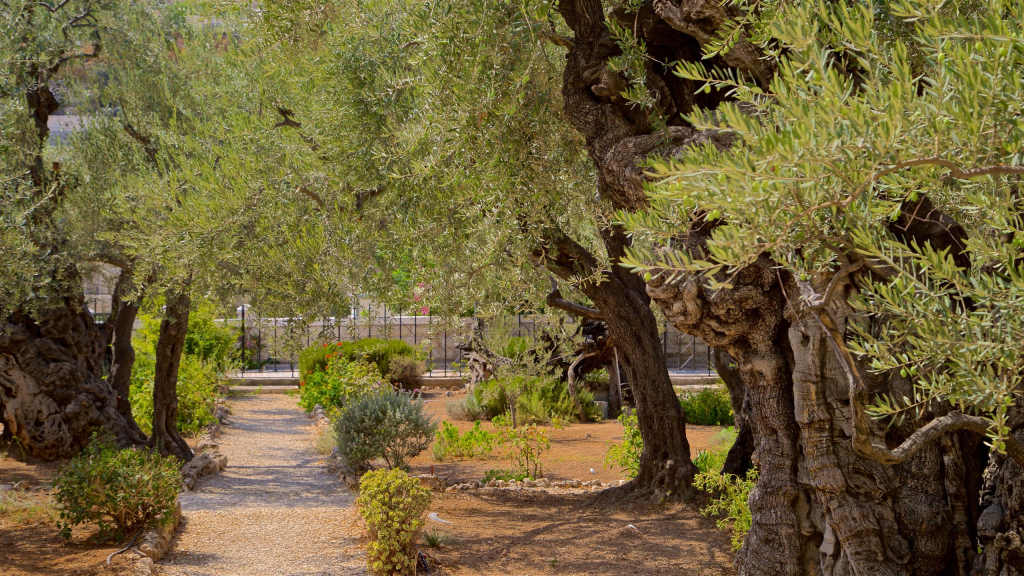
Gethsemane was the place where Jesus and his disciples walked after they gathered in the upper room to observe the Passover. In Gethsemane, Jesus underwent great inner turmoil realizing the hour of his betrayal was at hand (Matt. 26:36–56; Mark 14:32–50; Luke 22:39–53). Gethsemane was/is an olive orchard on the west side base of the Mt. of Olives and near the Kidron Valley.

“The name Gethsemane, used only in the Gospels of Matthew (26:36) and Mark (14:32), means “oil press,” suggesting the presence of an olive grove. The use of the Greek word “place” in the Gospel accounts indicates that Gethsemane was an enclosed piece of ground. It may be that the grove was privately owned and that Jesus and his disciples had special permission to enter,” explains the Tyndale Bible Dictionary.

“Though the Gospels of Luke and John do not mention the word Gethsemane, they both record Jesus’ agony before his betrayal. Luke says the location was on the “Mount of Olives” (Luke 22:39). John describes the area as “across the Kidron Valley” (John 18:1); John’s is the only Gospel to call the spot a garden. From those accounts it is also evident that Jesus and his disciples gathered in Gethsemane often for fellowship and prayer (Luke 22:39; John 18:2). The Gospel narratives indicate that the garden was large enough for the group to separate into different parts of it.”

 It was in Gethsemane Jesus prayed in great agony in submitting to God the Father’s will. It would not be an easy prayer, but it was an obedient prayer. In your life, have you ever had a Gethsemane moment or experience? Every believer in does. The question is whether our prayers to God the Father mirror Jesus’ prayer?

In the garden he went to pray
When it seemed hope was gone
He prayed with a broken heart
He prayed all alone.

Have you had a Gethsemane?
Have you prayed in despair?
In the dark of those weary hours
Did the Lord meet you there?

Have you had a Gethsemane?
Have you prayed the night through?
Have you shed tears in agony
When no hope was in you?

Have you prayed, “If it be Thy will”?
May this cup pass from me?
But if it’s thy will, dear Lord
I will bear it for Thee.

Have you had a Gethsemane?
Have you prayed the night through?
Have you shed tears in agony
When no hope was in you?

Have you prayed, “If it be Thy will”?
May this cup pass from me?
But if it’s thy will, dear Lord
I will bear it for Thee.
– Bill and Gloria Gaither

Soli deo Gloria!  

The Gospel of Matthew: Sing!

30 And when they had sung a hymn, they went out to the Mount of Olives.” (Matthew 26:30 ESV)

26 And when they had sung a hymn, they went out to the Mount of Olives.” (Mark 14:26 ESV)

Somewhat obscured in the dialogue concerning the disciples’ denial and desertion of Jesus was their singing and subsequent journey to the Mount of Olives. Both Matthew and Mark record Jesus and disciples singing a hymn. The Greek word for hymn (ὑμνέω; hymneo) means to sing a song of praise. In other words, to sing praises, certainly in some contexts, from the psalms of the Jewish Scripture (Matt. 26:30; Mark 14:26; Ac 16:25; Heb. 2:12).

“When they had hymned,” says the original. Since, as has been shown, the Lord’s Supper was the natural outgrowth of the Passover, it is probable that the hymns of praise that were lifted up to God were Pss. 115–118,” explains Dr. William Hendriksen.

“Praise the Lord, all nations! Extol him, all peoples! For great is his steadfast love toward us, and the faithfulness of the Lord endures forever. Praise the Lord!” (Psalm 117 (ESV)

“Jesus and His disciples have finished the Passover meal, and today’s passage opens with their singing of a hymn (v. 30), most likely the second part of the Hallel (Pss. 114–118 or Pss. 115–118). Interestingly, one scholar says the disciples probably looked back on their singing with new insight after the resurrection. After all, Christ triumphs in His death and resurrection (Pss. 118:10, 22), establishing a foundation for proclaiming the praise of Yahweh to the nations (117:1),” explains Dr. R. C. Sproul.

“These are songs of praise, thanksgiving, and trust, as anyone can see by reading them. They not only constituted a fitting conclusion to the blessings enjoyed but also a most appropriate preparation for the ordeal that was about to begin,” states Dr. Hendriksen.

Jesus and his disciples, no longer twelve but eleven, then went to the Mount of Olives. They crossed the Kedron Valley and entered the Gethsemane grove, located at the foot of that mountain. See 26:36; cf. John 18:1.

The singing of praise preceded the perils to follow. Perhaps our singing of praise to the Lord throughout the week, and on the Lord’s Day, prepares us for the perils we face, and will face, in the days ahead. Have a blessed, and praise filled, day.

Sing to the King Who is coming to reign
Glory to Jesus, the Lamb that was slain
Life and salvation His Empire shall bring
And joy to the nations when Jesus is King.

Chorus

Come, let us sing a song
A song declaring that we belong to Jesus
He is all we need
Lift up a heart of praise
Sing now with voices raised to Jesus
Sing to the King.

For His returning we watch and we pray
We will be ready the dawn of that day
We’ll join in singing with all the redeemed
‘Cause Satan is vanquished and my Jesus is King.—Billy & Cindy Foote

Chorus

Soli deo Gloria!

The Gospel of Matthew: Denial Predicted, and Denied.

30 And when they had sung a hymn, they went out to the Mount of Olives. 31 Then Jesus said to them, “You will all fall away because of me this night. For it is written, ‘I will strike the shepherd, and the sheep of the flock will be scattered.’ 32 But after I am raised up, I will go before you to Galilee.” 33 Peter answered him, “Though they all fall away because of you, I will never fall away.” 34 Jesus said to him, “Truly, I tell you, this very night, before the rooster crows, you will deny me three times.” 35 Peter said to him, “Even if I must die with you, I will not deny you!” And all the disciples said the same.” (Matthew 26:30–35 ESV)

26 And when they had sung a hymn, they went out to the Mount of Olives. 27 And Jesus said to them, “You will all fall away, for it is written, ‘I will strike the shepherd, and the sheep will be scattered.’ 28 But after I am raised up, I will go before you to Galilee.” 29 Peter said to him, “Even though they all fall away, I will not.” 30 And Jesus said to him, “Truly, I tell you, this very night, before the rooster crows twice, you will deny me three times.” 31 But he said emphatically, “If I must die with you, I will not deny you.” And they all said the same.” (Mark 14:26–31 ESV)

31 “Simon, Simon, behold, Satan demanded to have you that he might sift you like wheat, 32 but I have prayed for you that your faith may not fail. And when you have turned again, strengthen your brothers.” 33 Peter said to him, “Lord, I am ready to go with you both to prison and to death.” 34 Jesus said, “I tell you, Peter, the rooster will not crow this day, until you deny three times that you know me.” (Luke 22:31–34 (ESV)

When Jesus had spoken these words, he went out with his disciples across the brook Kidron, where there was a garden, which he and his disciples entered.” (John 18:1 ESV)

As we consider the various views concerning the events of Jesus’ Passion Week, it is wise to compare the four gospel accounts. Today, we examine Jesus’ prediction of Peter’s denial.

First, Jesus predicted all of His disciples would fall away because of Him. To fall away (σκανδαλίζω; skandalizo) means to sin and disbelieve. By deserting Jesus because of the soon, unfolding events culminating in the crucifixion, the disciples would sin by ceasing to trust in, depend upon, commit to and honor the Lord. Jesus knew this would happen because Scripture prophesied it would happen (Zechariah 13:7). Like sheep who scatter when the shepherd is killed, so also would the disciples scatter because of the Lord’s death on the cross.

“The disciples, our Savior says, will soon abandon Him, just as sheep run when their shepherd is struck down (Matt. 26:31). Once again Jesus reveals that He is fully aware of all that is to happen and, therefore, because He does not try to escape, willingly submits to the evil that men are soon to inflict on Him. Furthermore, striking Christ will fulfill the prophecy of Zechariah 13:7,” explains Dr. R. C. Sproul.

“Since the Lord’s sword is what strikes in Zechariah 13, Jesus must mean that His death, though carried out by wicked men, is due ultimately to the “definite plan and foreknowledge of God” (Acts 2:22–23). In a real sense the Father strikes His Son down on the cross, but that does not excuse the sin of the authorities, nor does it make God an evildoer. As the church father Jerome writes, “The good shepherd is struck…that he may lay down his life for his sheep and that out of many flocks of wandering sheep there may be one flock and one shepherd” (Matthew 4.26.31). God has a good and noble intent in the death of His Son, but the human executioners seek only destruction.”

Second, Jesus also predicted He would rise from the dead. Death would not have the final say. He promised he would meet with the disciples in Galilee. Jesus provided hope, confident assurance even in anticipation of the hell on the cross.

However, Peter and the other disciples insisted they would not abandon Jesus. Peter was most emphatic. He was willing to not only argue with Jesus, but also in pride contrast himself, and condemn, the other disciples. He knew he would not desert and deny Jesus. How little he knew. We will examine Jesus’ extended response to Peter when next we meet.

In his commentary on Matthew, Dr. James M. Boice says that today’s passage is encouraging because it affirms that Christianity is for weak people (p. 563). Zechariah 13 says that though believers may sinfully abandon their master, He will not abandon them and will present them as a holy people to His Father.”  

If you have sinned this day, it is not too late to seek God’s forgiveness. Repent and return to Him and in so doing demonstrate you are one of His sheep.

Soli deo Gloria!

The Gospel of Matthew: The Presence of Christ.

26 Now as they were eating, Jesus took bread, and after blessing it broke it and gave it to the disciples, and said, “Take, eat; this is my body.” 27 And he took a cup, and when he had given thanks he gave it to them, saying, “Drink of it, all of you, 28 for this is my blood of the covenant, which is poured out for many for the forgiveness of sins.” (Matthew 26:26–28 ESV)

14 Therefore, my beloved, flee from idolatry. 15 I speak as to sensible people; judge for yourselves what I say. 16 The cup of blessing that we bless, is it not a participation in the blood of Christ? The bread that we break, is it not a participation in the body of Christ? 17 Because there is one bread, we who are many are one body, for we all partake of the one bread. 18 Consider the people of Israel: are not those who eat the sacrifices participants in the altar? 19 What do I imply then? That food offered to idols is anything, or that an idol is anything? 20 No, I imply that what pagans sacrifice they offer to demons and not to God. I do not want you to be participants with demons. 21 You cannot drink the cup of the Lord and the cup of demons. You cannot partake of the table of the Lord and the table of demons. 22 Shall we provoke the Lord to jealousy? Are we stronger than he?” (1 Corinthians 10:14–22 ESV)

The following article is from Tabletalk, Ligonier Ministries daily Bible study magazine. It originally appeared Nov. 19, 2008; author unknown. May the LORD encourage you by the following insights taken from I Corinthians 10:14-22).  

“Given that transubstantiation and consubstantiation are found wanting, it remains for us to try to define how Jesus is present in the Lord’s Supper. Some believe the Lord’s Supper is only a memorial; thus, Christ is not present in a unique way when we take the sacrament. Yet more is going on in the Lord’s Supper than the remembering of our Savior’s death, as important as that may be. For example, today’s passage speaks of participation or fellowship in the body and blood of Christ when we come to the Lord’s Table (1 Cor. 10:16). Something is happening besides the simple remembrance of the cross.”  

“Moreover, as Dr. Keith A. Mathison observes, the fact that many of those who took the sacrament in Corinth unworthily became ill or died (1 Cor. 11:29–30) proves “that there is much more to the sacrament than mere symbolism and subjective acts of mental recollection” (Given for You, p. 234).”

“The Westminster Confession of Faith summarizes the biblical teaching on Christ’s special presence in the Lord’s Supper, saying that worthy receivers feed on Jesus “not carnally and corporally, but spiritually.” Christ is spiritually “present to the faith of believers,” and we feed upon “Christ crucified, and all benefits of His death” (29.7). The confession affirms that in the Supper we commune with Jesus, both in His humanity and in His divinity, in a way not possible at other times. As we eat the bread and drink the wine, we by faith commit ourselves anew to Jesus and renew the covenant, showing that we need His physical body and blood to save us as much as we need food to nourish us. We meet with Jesus as a whole person, and He strengthens us for the journey from the resources He has both as the Son of God and as a glorified human being.”

“This is possible because of our union with Christ by virtue of the Holy Spirit. In the final analysis, it is a mystery as to how all this happens. But it is to this mystery we have been called to partake of regularly, participating in faith, believing that God has accomplished through His Son all that the Passover in Egypt and the giving of the covenant at Sinai pointed to, namely, the inauguration and consummation of a new covenant.”

“The Lord’s presence in the Lord’s Supper is not easy to conceptualize, but we do affirm that He is truly present every time we take the sacrament with other believers. It behooves us to remind ourselves of this fact and realize that the sacrament is not an afterthought, it is a means of grace that conveys to the faithful the benefits we need to progress in holiness. As you take the Supper, consider the presence of Christ and the way He meets all our needs.”

Soli deo Gloria!

The Gospel of Matthew: This is My Body; this is My Blood.

26 Now as they were eating, Jesus took bread, and after blessing it broke it and gave it to the disciples, and said, “Take, eat; this is my body.” 27 And he took a cup, and when he had given thanks he gave it to them, saying, “Drink of it, all of you, 28 for this is my blood of the covenant, which is poured out for many for the forgiveness of sins. 29 I tell you I will not drink again of this fruit of the vine until that day when I drink it new with you in my Father’s kingdom.” (Matthew 26:26–29 ESV)

22 And as they were eating, he took bread, and after blessing it broke it and gave it to them, and said, “Take; this is my body.” 23 And he took a cup, and when he had given thanks he gave it to them, and they all drank of it. 24 And he said to them, “This is my blood of the covenant, which is poured out for many. 25 Truly, I say to you, I will not drink again of the fruit of the vine until that day when I drink it new in the kingdom of God.” (Mark 14:22–25 ESV)

18 For I tell you that from now on I will not drink of the fruit of the vine until the kingdom of God comes.” 19 And he took bread, and when he had given thanks, he broke it and gave it to them, saying, “This is my body, which is given for you. Do this in remembrance of me.” 20 And likewise the cup after they had eaten, saying, “This cup that is poured out for you is the new covenant in my blood.” (Luke 22:18–20 ESV)

23 For I received from the Lord what I also delivered to you, that the Lord Jesus on the night when he was betrayed took bread, 24 and when he had given thanks, he broke it, and said, “This is my body, which is for you. Do this in remembrance of me.” 25 In the same way also he took the cup, after supper, saying, “This cup is the new covenant in my blood. Do this, as often as you drink it, in remembrance of me.” (1 Corinthians 11:23–25 ESV)

Were the bread and the wine Jesus blessed and gave thanks for His actual body and blood? Some church traditions, and theologians, advocate this view, or a moderate interpretation of the same. What is the biblical understanding of what Jesus meant and how does it apply to the church today when she observes the Lord’s Supper or Communion.

As we consider the various views concerning the Lord’ Supper, one thing is not debated. Jesus commanded His disciples to commemorate and remember, this ordinance. Why is it important to regularly remember Jesus’ death, burial and resurrection? It is because people forget its significance; even believers in Christ.

“Celebrating the Lord’s Supper is one way in which we recall God’s sacrifice of His Son. The bread and wine visibly depict the broken body and shed blood of Christ Jesus and help us remember His death, although the remembering of His death is not all that happens at His table. Nevertheless, the Lord’s Supper is tied inextricably to the past, orienting us to the death of Christ for His people, the single greatest event in world history,” states one commentator.

“To this day, some believers hold that the Lord’s Supper is merely past-oriented, only an opportunity to remember Christ’s death. Those theological traditions with the most adherents, however, all believe that Jesus is uniquely present in time and in space when the Lord’s Supper is celebrated,” comments Dr. R. C. Sproul.

However, there are other denominations which take the presence of the Lord Jesus at Lord’s Supper a step further. This debate centers on four perspectives. While we will define these four views, time and space limit an expanded discussion and examination.

First, the view of transubstantiation articulated by the Roman Catholic communion. The Roman Catholic Church advocates the miracle of the Mass. This means the substance of the bread and wine used in the Lord’s Supper is miraculously changed into the actual body and blood of Christ. Therefore, if you were to ask a Roman Catholic if they have received Christ, they would perhaps respond they have; during the celebration of the Mass.

Second, the doctrine of consubstantiation articulated by the Lutheran community. The term means that Christ is substantively present within the bread and wine. Attending a Lutheran church as a child, this was the view taught in confirmation classes I attended. “We must note, however, that the word consubstantiation, though it is used widely in theological circles to describe the Lutheran view, is not a term that the Lutherans tend to embrace,” explains Dr. Sproul.

Third, the Reformed and Anglican affirmation of the real presence of Christ in the Lord’s Supper. John Calvin used the word “substance” as a synonym for “real” or “true.” He taught the divine nature of Christ is present at the Lord’s Supper as He is everywhere.

Fourth, the memorial-sign view of the sacrament espoused by Ulrich Zwingli and by the majority of those in the Baptist churches and denominations. This view articulates the Lord’s Supper is strictly a memorial, with the bread and wine representative, or symbolic, of Christ’s body and blood.

“The debate goes on, as the church tries to plumb the depths and the riches of this sacrament that was instituted by Jesus and practiced on a regular basis in the primitive Christian church, and this debate has survived even to our day,” concludes Dr. Sproul.

Soli deo Gloria!                                                                                    

.

The Gospel of Matthew: Institution of the Lord’s Supper.

26 Now as they were eating, Jesus took bread, and after blessing it broke it and gave it to the disciples, and said, “Take, eat; this is my body.” 27 And he took a cup, and when he had given thanks he gave it to them, saying, “Drink of it, all of you, 28 for this is my blood of the covenant, which is poured out for many for the forgiveness of sins. 29 I tell you I will not drink again of this fruit of the vine until that day when I drink it new with you in my Father’s kingdom.” (Matthew 26:26–29 ESV)

22 And as they were eating, he took bread, and after blessing it broke it and gave it to them, and said, “Take; this is my body.” 23 And he took a cup, and when he had given thanks he gave it to them, and they all drank of it. 24 And he said to them, “This is my blood of the covenant, which is poured out for many. 25 Truly, I say to you, I will not drink again of the fruit of the vine until that day when I drink it new in the kingdom of God.” (Mark 14:22–25 ESV)

18 For I tell you that from now on I will not drink of the fruit of the vine until the kingdom of God comes.” 19 And he took bread, and when he had given thanks, he broke it and gave it to them, saying, “This is my body, which is given for you. Do this in remembrance of me.” 20 And likewise the cup after they had eaten, saying, “This cup that is poured out for you is the new covenant in my blood.” (Luke 22:18–20 ESV)

23 For I received from the Lord what I also delivered to you, that the Lord Jesus on the night when he was betrayed took bread, 24 and when he had given thanks, he broke it, and said, “This is my body, which is for you. Do this in remembrance of me.” 25 In the same way also he took the cup, after supper, saying, “This cup is the new covenant in my blood. Do this, as often as you drink it, in remembrance of me.” (1 Corinthians 11:23–25 ESV)

As the last week of the Lord Jesus Christ is studied, it is important to compare the New Testament Gospels and Epistles, their particular narratives and themes pertaining to the death, burial and resurrection of the Lord. Today’s focus concerns the celebration of the Passover Meal and the institution of what is referred to as The Lord’s Supper or Communion. This particular observance would symbolize the historical death, burial and resurrection of the Lord Jesus Christ. It is one of two ordinances in the church. The other is Believer’s Baptism.

“After predicting Judas’ betrayal (Matt. 26:20–25), Jesus and His disciples proceed with the Passover meal. It is a special moment indeed, for only close friends eat together in first-century Jewish culture. The forces conspiring against the Lord (vv. 1–5, 14–16) no doubt cast a pall over an otherwise delightful occasion, but the light of the resurrection will reveal even the bitter events to come as integral to the joy of final redemption they will help produce,” explains Dr. R. C. Sproul.

It is most likely Judas departed prior to the institution of the Lord’s Supper (John 13:31). From Matthew’s account, it was during the eating of the Passover Meal when Jesus took bread, blessed it, broke it and gave each disciple a portion of it. Jesus said, ““Take, eat; this is my body.” He then took a common cup filled with wine, gave thanks and said, ““Drink of it, all of you, 28 for this is my blood of the covenant, which is poured out for many for the forgiveness of sins.”

“At this point Passover passes over into the Lord’s Supper; for it was while, toward the close of the Passover meal, the men were all eating freely (see on verse 21) that Jesus instituted the new sacrament that was to replace the old. A few more hours and the old symbol, being bloody—for it required the slaying of the lamb—will have served its purpose forever, having reached its fulfilment in the blood shed on Calvary. It was time, therefore, that a new and unbloody symbol replace the old. Nevertheless, by historically linking Passover and Lord’s Supper so closely together Jesus also made clear that what was essential in the first was not lost in the second. Both point to him, the only and all-sufficient sacrifice for the sins of his people. Passover pointed forward to this; the Lord’s Supper points back to it,” states Dr. William Hendriksen.

Were the bread and the wine Jesus blessed and gave thanks for His actual body and blood? Some church traditions, and theologians, advocate this view, or a moderate interpretation of the same. In the days ahead, we will seek to come to a biblical understanding of what Jesus meant and how it applies to the church today when she observes the Lord’s Supper or Communion.

Soli deo Gloria!

.

The Gospel of Matthew: One of You will Betray Me.

20 When it was evening, he reclined at table with the twelve. 21 And as they were eating, he said, “Truly, I say to you, one of you will betray me.” 22 And they were very sorrowful and began to say to him one after another, “Is it I, Lord?” 23 He answered, “He who has dipped his hand in the dish with me will betray me. 24 The Son of Man goes as it is written of him, but woe to that man by whom the Son of Man is betrayed! It would have been better for that man if he had not been born.” 25 Judas, who would betray him, answered, “Is it I, Rabbi?” He said to him, “You have said so.” (Matthew 26:20–25 (ESV)

17 And when it was evening, he came with the twelve. 18 And as they were reclining at table and eating, Jesus said, “Truly, I say to you, one of you will betray me, one who is eating with me.” 19 They began to be sorrowful and to say to him one after another, “Is it I?” 20 He said to them, “It is one of the twelve, one who is dipping bread into the dish with me. 21 For the Son of Man goes as it is written of him, but woe to that man by whom the Son of Man is betrayed! It would have been better for that man if he had not been born.” (Mark 14:17–21 (ESV)

 “And when the hour came, he reclined at table, and the apostles with him.” (Luke 22:14 (ESV)

21 After saying these things, Jesus was troubled in his spirit, and testified, “Truly, truly, I say to you, one of you will betray me.” 22 The disciples looked at one another, uncertain of whom he spoke. 23 One of his disciples, whom Jesus loved, was reclining at table at Jesus’ side, 24 so Simon Peter motioned to him to ask Jesus of whom he was speaking. 25 So that disciple, leaning back against Jesus, said to him, “Lord, who is it?” 26 Jesus answered, “It is he to whom I will give this morsel of bread when I have dipped it.” So when he had dipped the morsel, he gave it to Judas, the son of Simon Iscariot.” (John 13:21–26 (ESV)

As the last week of the Lord Jesus Christ is studied, it is important to compare all four Gospels, their particular narratives and themes pertaining to the death, burial and resurrection of the Lord. Today’s focus concerns the celebration of the Passover Meal. This particular feast would picture, and immediately precede, the historical death, burial and resurrection of the Lord Jesus Christ.

“Per the custom of their day, Jesus and His disciples recline at the Passover, lying on cushions arranged like a horseshoe around the table (Matt. 26:20). Some commentators believe that the room in which they are commemorating the exodus belongs to John Mark, an associate of Barnabas and Paul (Acts 15:36–41) and probable author of the second book of the New Testament. Whether or not this is the case, we do know that Jesus sees this Passover as the beginning of events absolutely critical to His work,” explains one commentator.

Jesus ate the meal with the Twelve Apostles, including Judas Iscariot. It was during the feast when Jesus announced one of the twelve would betray Him. The response by the eleven was a mixture of sorrow and uncertainty. Judas did not respond. He knew what he was going to do and why he would do it; he would betray Jesus for money.

The eleven began asking Jesus if any one of them was the betrayer. Jesus responded in the follow manner.  ““He who has dipped his hand in the dish with me will betray me.” ““It is one of the twelve, one who is dipping bread into the dish with me.” ““It is he to whom I will give this morsel of bread when I have dipped it.” ” So when he had dipped the morsel, he gave it to Judas, the son of Simon Iscariot.”

Judas played along with the rest of the disciples by asking if he was the betrayer. Matthew records Jesus’ response to Judas’ question. Judas, who would betray him, answered, “Is it I, Rabbi?” He said to him, “You have said so.”

“Such knowledge of the future is also shown when Jesus reveals that He will be handed over to sinners (vv. 20–21). This betrayal fulfills Scripture (v. 24), but how? First, the Messiah must feel the punishment His sinful people have earned and Judas’ betrayal may be one way the Father metes out His wrath. Israel pledged to follow God and then betrayed Him, breaking His Law (Hos. 8); now Jesus — the true Israel — endures in the place of His people the same betrayal they deserve for double-crossing the covenant Lord. In Christ, God repays Israel in kind. Moreover, though the Psalms belong to the entire covenant community, the Psalter is uniquely the king’s song book. David’s greatest son can only sing the Psalms if He feels a friend’s betrayal (see Ps. 55),” states Dr. R. C. Sproul.

Judas did not operate independently of God’s providence. As with Joseph’s brothers, what Judas intended for evil God meant for good (Gen. 50:20). God was in complete and providential control.

“Judas does not operate independently of the Almighty’s sovereign decree (Matt. 26:24–25). But Judas’ evil purpose makes him no less guilty for bringing about what God has ordained,” concludes Dr. Sproul.

John Calvin comments, “Men can do nothing but what God has appointed, still this does not free them from condemnation, when they are led by a wicked desire to sin. For though God directs them, by an unseen bridle, to an end which is unknown to them, nothing is farther from their intention than to obey his decrees.”

Christ’s betrayal results both from divine providence and human sin. However, the LORD mysteriously remains unstained by evil in the process. This demonstrates the doctrine of providence; God’s purposeful sovereignty.

Soli deo Gloria!