The Gospel of Matthew: Why Did Jesus Choose Judas?

The following essay is by Dr. John Piper entitled Why Did Jesus Choose Judas? Dr. Piper is founder and teacher of desiringGod.org and chancellor of Bethlehem College and Seminary. For 33 years, he served as pastor of Bethlehem Baptist Church, Minneapolis, Minnesota. He is author of more than 50 books, including Desiring God: Meditations of a Christian Hedonist and most recently Providence.

There are few more perplexing questions of the Bible than this: If he knew that he would betray him in the end, why did Jesus choose Judas as a disciple to begin with?

The perplexing question comes specifically from a podcast listener named Austin. “Hello, Pastor John. I have been studying through the book of John lately, and I began to wonder why Jesus chose Judas to be one of his disciples in the first place. And what does Jesus have to teach us by choosing someone to be his disciple, knowing full well he would betray him? Are there any takeaways for us in this?”

John 6:64 says, “Jesus knew from the beginning who those were who did not believe, and who it was who would betray him.” Jesus chose his own betrayer to be part of his apostles. Why? I’m going to give five answers that I see in the Scriptures for why God ordained, and Jesus chose, Judas the betrayer to be part of his team.

1. Scripture cannot be broken.

The Old Testament Scriptures prophesied that this would take place. So Jesus chose Judas to fulfill the Scriptures. In John 13:18, Jesus says to his apostles, “I am not speaking of all of you; I know whom I have chosen. But the Scripture will be fulfilled.” And then he quotes Psalm 41:9: “He who ate my bread has lifted his heel against me.” And Peter, on the day of Pentecost, in Acts 1:16, says, “Brothers, the Scripture had to be fulfilled . . . concerning Judas, who became a guide to those who arrested Jesus.”

Step by step, Jesus moved toward the cross, taking pains to fulfill every Scripture concerning his death, right down to the details of how he would be handed over. The point was to show that the Scriptures cannot be broken, and that God is in control.

2. Spectacular sins serve God’s purpose.

By choosing to be betrayed by a close friend, and even by a kiss, Jesus shows us that the most despicable act in the history of the world — the betrayal and consequent murder of the Son of God — was part of God’s saving plan. That’s explicitly said in Acts 4:27–28, that by his hand and his predestination these things took place.

In other words, the lesson of Judas is that the most horrible sins in the world are used by God for his saving purposes. Just when people think they’re getting the upper hand, they find that their hand is serving the very one they are opposing. That’s a great lesson for us to learn.

3. Saving faith is not the same as religious activity.

By choosing from the beginning an apostle who was destined for apostasy and destruction, and by including him in his closest relations, and by giving him power over unclean spirits and over diseases, Jesus shows us that religious associations and religious practices and miracle-working are no sure evidences of being born again. Matthew 10:1–4 describes the choosing of the twelve. It names Judas and says Jesus “gave them authority over unclean spirits, to cast them out, and to heal every disease and every affliction” (Matthew 10:1). Judas walked with Jesus, ministered with Jesus for three years, and he worked those miracles.

Judas becomes a vivid illustration of the people in Matthew 7:22–23: “On that day many will say to me, ‘Lord, Lord, did we not prophesy in your name, and cast out demons in your name, and do many mighty works in your name?’” That’s Judas — and many, many other people in history. And then Jesus will declare to them, “I never knew you; depart from me, you workers of lawlessness.” What a vivid lesson to learn that right doctrine (“Lord, Lord, we know who you are; we’ve got our doctrine right, Lord, Lord”) and religious activity and miracle-working (“We’ve cast out demons; we’ve healed people”) prove nothing about saving faith and being born again. That’s the lesson of Judas.

4. Sovereignty does not undermine human responsibility.

Judas serves as an illustration that predestination and human responsibility go hand in hand. Judas’s destiny was set before his betrayal. Jesus said that he kept all his disciples from apostasy except Judas, “the son of destruction” (John 17:12). In John 6:64, it says, “Jesus knew from the beginning . . . who it was who would betray him.” And then Jesus explained in the next verse, “This is why I told you that no one can come to me unless it is granted him by the Father” (John 6:65). In other words, Judas didn’t repent because it was not granted to him by the Father; his destiny was sealed. And yet he was guilty — really guilty, really accountable, really blameworthy. He was really responsible for what he did. He himself said in Matthew 27:4, “I have sinned by betraying innocent blood.”

So, we learn from Judas not to stumble over the fact that a person may be destined for destruction and yet be totally responsible for what he does.

5. Satisfaction in money corrupts our souls.

Judas serves as a vivid example of the terrible, terrible power of the love of money, and how it blinds us to what is true and beautiful and valuable in this world. In John 12:4–6, when Mary anointed Jesus, Judas said, oozing with hypocrisy, “Why was this ointment not sold for three hundred denarii and given to the poor?” And John comments, “He said this, not because he cared about the poor, but because he was a thief, and having charge of the moneybag he used to help himself to what was put into it.” He did that under the nose of the very Son of God, who would give his life as a ransom for many, whose teachings he had heard for three years, in whose power he did miracles.

Judas loved money more than he loved Jesus. That’s horrific, unbelievable, and unspeakably evil. It should make every one of us tremble at the thought of the power that money has in our lives to blind us to what is true and beautiful and precious. So, when Judas got his chance, thirty pieces of silver is all it took to sell the very Son of God.

I’m sure there are more answers to Austin’s question, but these are at least five answers that I see in the Bible as to why God would ordain, and Jesus would choose, that a betrayer be included among the apostles from the beginning.

  1. To fulfill Scripture: Scriptures cannot be broken, and God is in control.
  2. Even horrific sins serve the saving purposes of God in his sovereign plan.
  3. Time with Jesus and miracle-working are no proof of saving faith.
  4. Predestination and human accountability go hand in hand.
  5. The love of money is behind the worst sin in the world.

Soli deo Gloria!
The Gospel of Matthew: Judas’ Final Fall.

Then when Judas, his betrayer, saw that Jesus was condemned, he changed his mind and brought back the thirty pieces of silver to the chief priests and the elders, saying, “I have sinned by betraying innocent blood.” They said, “What is that to us? See to it yourself.” And throwing down the pieces of silver into the temple, he departed, and he went and hanged himself. But the chief priests, taking the pieces of silver, said, “It is not lawful to put them into the treasury, since it is blood money.” So they took counsel and bought with them the potter’s field as a burial place for strangers. Therefore that field has been called the Field of Blood to this day. Then was fulfilled what had been spoken by the prophet Jeremiah, saying, “And they took the thirty pieces of silver, the price of him on whom a price had been set by some of the sons of Israel, 10 and they gave them for the potter’s field, as the Lord directed me.” (Matthew 27:3–10 (ESV)

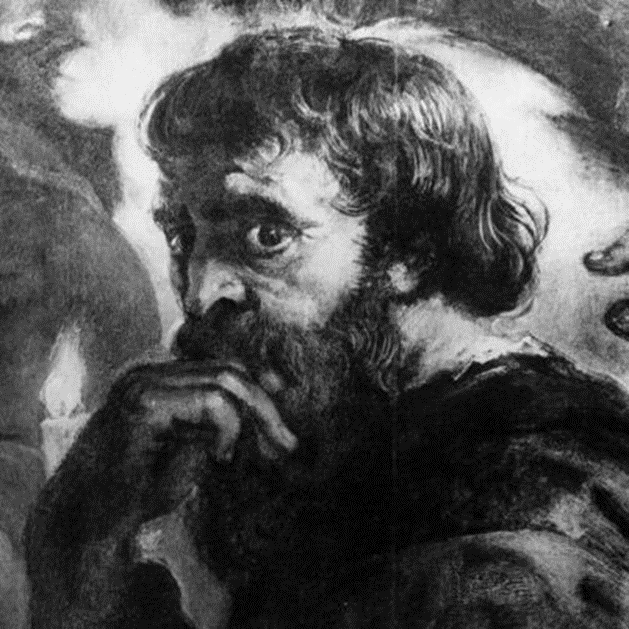
Matthew is the lone Gospel writer to speak of the ignoble end of Judas Iscariot. Judas was a tragic figure in the earthly ministry of Jesus Christ. He embodied the wicked individual the psalmist described in Psalm 1.

“Blessed is the man who walks not in the counsel of the wicked, nor stands in the way of sinners, nor sits in the seat of scoffers; but his delight is in the law of the Lord, and on his law he meditates day and night. He is like a tree planted by streams of water that yields its fruit in its season, and its leaf does not wither. In all that he does, he prospers. The wicked are not so, but are like chaff that the wind drives away. Therefore the wicked will not stand in the judgment, nor sinners in the congregation of the righteous; for the Lord knows the way of the righteous, but the way of the wicked will perish.”  (Psalm 1:1–6 ESV)

Judas was not a God-blessed man. This was because Judas walked, or lived, in the counsel of the ungodly. He stood, or agreed, with the way and lifestyle of sinners. Finally, he fostered the mocking ridicule of the Lord. Unlike the righteous man who is like a tree, Judas was rather like chaff that the wind drives away. He had no solid, spiritual foundation in his life; even though he was in the Lord’s presence for three years. Judas’ end will be him not standing in the judgment as righteous and he will not participate with the congregation of the righteous.

What can we observe from today’s text from Matthew?

  • Judas did not repent of his sin. He just changed his mind.
  • While acknowledging his sin against Jesus Christ, he did not seek forgiveness from Christ.
  • Judas did not speak on behalf of Christ concerning the Lord’s innocence.
  • Because of his lost condition, Judas despaired and committed suicide by hanging himself (Acts 1:12-20).
  • Judas fulfilled Old Testament prophecy.

“Matthew’s juxtaposition of Peter’s denial and Judas’ death invites us to compare the state of their souls. Like Peter, Judas is remorseful after the fact, changing his mind about the wisdom of his deed after seeing Jesus condemned (Matt. 27:3–4). Unlike Peter, Judas does not feel the “godly grief” of repentance (2 Cor. 7:10),” explains Dr. R. C. Sproul.

“The Greek verb for Judas’ change of mind (Matt. 27:3) is not the one normally used for repentance. Moreover, Judas does not really try to stop what he has started and will not testify of Christ’s innocence before Pilate. Were Judas repentant, justice and righteousness would move him to intervene on Jesus’ behalf. Godly sorrow leads people to run to God, but Judas’ despair makes him run into the arms of death (v. 5).”

John Calvin writes, “True repentance is displeasure at sin, arising out of fear and reverence for God, and producing, at the same time, a love and desire of righteousness.”

“Once more, the Jewish leaders care more about the minutiae of ceremonial regulation than the greater sin of killing an innocent man (Amos 5:21–24). They use the blood money paid to Judas to buy a place to bury Gentiles (Matt. 27:6–8), thereby fulfilling prophecy (vv. 9–10). “The text Matthew cites seems to be a paraphrase of Jeremiah 19:1–14 and Zechariah 11,” states Dr. Sproul.

“Both prophets allude to Israel’s rejecting the shepherds God sent to them and the destruction that results. For centuries the Almighty sent His prophets to shepherd His people, but His people rejected them and the destruction of exile occurred. Now with the condemnation of Jesus to death, the leaders have rejected the “Shepherd and Overseer” of their souls (1 Peter 2:25), and they make themselves even more worthy of God’s wrath than their ancestors.”

Neither Judas’ betrayal of Christ nor his suicide is the unpardonable sin. The unforgivable sin was his rejection of the grace of God in the person and work of Jesus Christ. Simon Peter and Judas both committed sins, but Peter repented and received restoration. Let each of us repent of our sins and turn to Jesus Christ for renewal and restored intimate fellowship (I John 1:8-10).

Soli deo Gloria!

The Gospel of Matthew: Jesus’ Trial before the Sanhedrin.

When morning came, all the chief priests and the elders of the people took counsel against Jesus to put him to death. And they bound him and led him away and delivered him over to Pilate the governor.” (Matthew 27:1–2 (ESV)

“And as soon as it was morning, the chief priests held a consultation with the elders and scribes and the whole council. And they bound Jesus and led him away and delivered him over to Pilate.” (Mark 15:1 (ESV)

“Then the whole company of them arose and brought him before Pilate.” (Luke 23:1 (ESV)

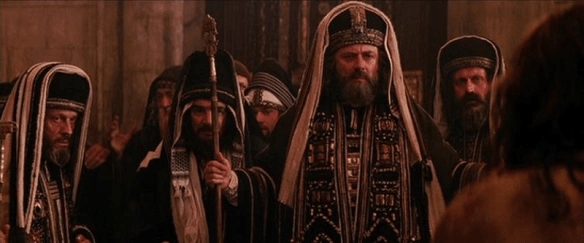
Jesus’ trial before Annas and Caiaphas eventually resulted in His trial before the Sanhedrin. As previously noted, the Sanhedrin was the supreme judicial council, or “high council”, of Judaism. It contained 71 members and was located in Jerusalem.

“The name Sanhedrin (Greek, sunedrion, from sun, “together,” and hedra, “seat”) occurs for the first time in the reign of Herod the Great (Antiquities 14.9.3–5). This is the term used throughout the NT (22 times), along with “the elders” (Luke 22:66; Acts 22:5) and “gerousia” (Acts 5:21),” states the Tyndale Bible Dictionary.

The previous two religious trials occurred in the pre-daylight hours. With the arrival of morning, the entire Sanhedrin council pronounced Jesus guilty of blasphemy and sent Him to Pontius Pilate, the Roman governor, for final sentencing. They wanted Jesus executed.  

“From about three o’clock until daybreak Jesus must have been held in imprisonment somewhere in the palace of Caiaphas. Then “early in the morning”—the Sanhedrin is convened once more. A few minutes may have sufficed, since the verdict, “Guilty of blasphemy and therefore worthy of death” had already been agreed upon. Besides, Jesus must be rushed off to Pilate before the crowds know what is going on. So, very quickly Jesus is sentenced to death,” explains Dr. William Hendriksen.

“The Jewish authorities have to bring Jesus to Pilate, because they were not authorized by the Romans to execute the death penalty themselves. Pilate would be available as early as sunrise; like other Roman officials, he would finish his regular public day before noon,” states commentator Craig Keener.

“Jesus’ first Jewish trials occurred under the cover of darkness. Since Jewish law required trials to be conducted during the day, the chief priests and the elders of the people realized an official trial was necessary. The brief trial recorded in Matthew 27:1 was simply for the court to reaffirm what had taken place earlier. The court decided that Jesus must die, but they did not have the power to put that decision into action (John 18:31). To get a death sentence, they needed to take the case to Pilate, the governor, the procurator of Judea and Samaria, a.d. 26–36 (cf. Luke 3:1). Jesus was therefore bound and brought by the Jews to Pilate. Pilate’s home was in Caesarea, but at this festival time, he was in his Jerusalem palace,” concludes the Bible Knowledge Commentary.

All of this was according to the sovereign and providential plan of God the Father (Acts 2:22-24).

Soli deo Gloria!

Remembering the Reformation. The 5 Solas!

16 For I am not ashamed of the gospel, for it is the power of God for salvation to everyone who believes, to the Jew first and also to the Greek. 17 For in it the righteousness of God is revealed from faith for faith, as it is written, “The righteous shall live by faith.” (Romans 1:16–17 (ESV)

The Protestant Reformation’s enduring legacy, and that of Reformer Martin Luther, centers upon the doctrines of the “solas.” The Reformers believed and taught these five truths and they remain indispensable to the health of the Gospel of Jesus Christ and the authentic growth of the church. 

Why? It is because these five tenants did not originate with the Reformers of the Reformation. On the contrary, the Reformers rediscovered truth God had given in Scripture and which had long been buried by the church. Therefore, the “solas” are to be continually studied, embraced, taught, and defended as God’s eternal truth in a fallen, temporal, and worldly culture. 

A brief description of each “sola” is appropriate.  In April 1996, the Alliance of Confessing Evangelicals held its first major meeting of evangelical scholars. The Cambridge Declaration, first presented at this meeting, is a call to the evangelical church to turn away from the worldly methods it has come to embrace and to recover the Biblical doctrines of the Reformation. The Cambridge Declaration explains the importance of regaining adherence to the five “solas” of the Reformation. The fine “solas” are as follows:

  • Thesis One: Sola Scriptura
    We reaffirm the inerrant Scripture to be the sole source of written divine revelation, which alone can bind the conscience. The Bible alone teaches all that is necessary for our salvation from sin and is the standard by which all Christian behavior must be measured.

    We deny that any creed, council or individual may bind a Christian’s conscience, that the Holy Spirit speaks independently of or contrary to what is set forth in the Bible, or that personal spiritual experience can ever be a vehicle of revelation.
  • Thesis Two: Solus Christus
    We reaffirm that our salvation is accomplished by the mediatorial work of the historical Christ alone. His sinless life and substitutionary atonement alone are sufficient for our justification and reconciliation to the Father.

    We deny that the gospel is preached if Christ’s substitutionary work is not declared and faith in Christ and his work is not solicited.
  • Thesis Three: Sola Gratia
    We reaffirm that in salvation we are rescued from God’s wrath by his grace alone. It is the supernatural work of the Holy Spirit that brings us to Christ by releasing us from our bondage to sin and raising us from spiritual death to spiritual life.

    We deny that salvation is in any sense a human work. Human methods, techniques, or strategies by themselves cannot accomplish this transformation. Faith is not produced by our unregenerate human nature.
  • Thesis Four: Sola Fide
    We reaffirm that justification is by grace alone through faith alone because of Christ alone. In justification Christ’s righteousness is imputed to us as the only possible satisfaction of God’s perfect justice.

    We deny that justification rests on any merit to be found in us, or upon the grounds of an infusion of Christ’s righteousness in us, or that an institution claiming to be a church that denies or condemns sola fide can be recognized as a legitimate church.
  • Thesis Five: Soli Deo Gloria
    We reaffirm that because salvation is of God and has been accomplished by God, it is for God’s glory and that we must glorify him always. We must live our entire lives before the face of God, under the authority of God and for his glory alone.

    We deny that we can properly glorify God if our worship is confused with entertainment, if we neglect either Law or Gospel in our preaching, or if self-improvement, self-esteem or self-fulfillment is allowed to become alternatives to the Gospel.

As any Christian should realize, the 16th century Protestant Reformation was anything but a tempest in a teapot. It was a cataclysmic event which shook the then known world, and continues to do so today. May we continue to hold fast to the truths of Scripture, especially the Five Solas.

Be strong and courageous!

Soli deo Gloria!

Remembering the Reformation. Christ Alone!

16 For I am not ashamed of the gospel, for it is the power of God for salvation to everyone who believes, to the Jew first and also to the Greek. 17 For in it the righteousness of God is revealed from faith for faith, as it is written, “The righteous shall live by faith.” (Romans 1:16–17 (ESV)

“Therefore, since we have been justified by faith, we have peace with God through our Lord Jesus Christ. Through him we have also obtained access by faith into this grace in which we stand, and we rejoice in hope of the glory of God.” (Romans 5:1–2 (ESV)

The church as a whole, and in Wittenberg in particular, anticipated the observance of All Saints Day on November 1, 1517. Therefore, indulgence vendors were in full force. The most notorious of these peddlers was Johann Tetzel.

When entering a town, Tetzel proceeded with a great deal of pomp and circumstance. A cross bearing the pope’s official declaration was held high on a gold-embroidered cushion. The cross, or crucifix, was then planted in the town square, and then Tetzel would begin his sermon. An excerpt follows:

“Consider the salvation of your souls and those of your departed loved ones. Visit the holy cross erected before you. Listen to the voices of your dear dead relatives and friends beseeching you and saying, ‘Pity us, pity us. We are in dire torment from which you can redeem us for a pittance.’ Do you not wish to? Open you ears. Hear the father saying to his son, the mother to her daughter, ‘We bore you, nourished you, brought you up, left you our fortunes, and you are so cruel and hard that now you are not willing for so little to set us free. Will you let us lie here in flames? Will you delay our promised glory’?”

There was a little song composed in light of Tetzel’s motivational speaking. It went like this: “As soon as the coin in the coffer rings, another soul from purgatory springs.”

Talk about a guilt trip! What was a person to do in such an atmosphere but to comply and by so doing alleviate the suffering of their departed dead, as well as the guilt of the living? The tragedy is that this did not, and does not, happen. There is no such thing as purgatory, but only the promise of heaven for the believer, and the promise of hell for the unbeliever.

How many candles have been lit, and prayers said and monies given for the deliverance of the dead? Tetzel even had people believing the cross he brought to a town square was of equal value to the cross Jesus Christ bore to Calvary. As far as Martin Luther was concerned, he had had enough.

As the church as a whole, and in Wittenberg in particular, anticipated the observance of All Saints Day on November 1, 1517, indulgence vendors were in full force.

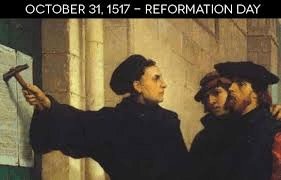
So, on All-Hallows Eve, October 31, 1517, Martin Luther posed his Ninety-Five Thesis to the door of the Castle Church in Wittenberg. Martin had no intention of breaking from the church by his actions. Rather, he was hoping to inspire debate within the church and in the community. Posting such a notice on the church door was a common practice. He did not realize that he would unwittingly tap into a growing resentment among the people that the church cared more about money than it did them.

The preamble to the Ninety-Five Thesis says, “Out of love and zeal for truth and the desire to bring it to light, the following theses will be publicly discussed at Wittenberg under the chairmanship of the reverend Martin Luther.”

Thesis 1 stressed the importance of repentance and that it was God’s will the believer’s life be one of repentance. Thesis 32 declared that those who believed that they were saved because of the payment of an indulgence would be eternally damned to hell along with those who taught such heresy. Thesis 79 declared that it was blasphemous to compare the papal coat of arms or a human cross as equal in worth to the cross of Christ. Thesis 82 questioned why the pope did not open all of purgatory and allow the people to enter heaven? The answer was that the pope wanted people to continue to contribute money to the St. Peter’s Basilica’s building program, and selling indulgences was a way to do it.

Luther originally wrote the Ninety-Five Thesis in Latin. However, university students copied the theses and had them translated into German. Copies were then made, thanks to Gutenberg’s printing press, and distributed throughout Germany. Within months, Luther’s objections were not only the talk of the town, but of many towns.

The church’s leadership were not happy. Pope Leo X said, “Luther is a drunken German. He will feel different when he is sober.” Rather than address Luther’s concerns, the pope dismissed them and this German monk. The fires of the Reformation began to blaze even higher.

Luther found himself in the middle of an ecclesiastical firestorm. It soon blazed beyond anything Martin could have imagined. The controversy Luther created eventually addressed not only the particular subject of indulgences, but ultimately how sinners were justified before God and what by authoritative, objective standard of truth ruled the individual believer along with the church?

While justification by faith may have been the instrumental cause of the Reformation, the foundational issue was the Bible being the sole and ultimate authority binding both Christian and church. The battle continues to this day.

I encourage you to rest in the knowledge that in Christ alone, we have peace with God (Romans 5:1) by grace alone, through faith alone. Reject any notion that forgiveness can be purchased by anything other than the precious blood of Christ (I Peter 1:17-18).

Soli deo Gloria!


Remembering the Reformation. Is the Reformation Over?

16 For I am not ashamed of the gospel, for it is the power of God for salvation to everyone who believes, to the Jew first and also to the Greek. 17 For in it the righteousness of God is revealed from faith for faith, as it is written, “The righteous shall live by faith.” (Romans 1:16–17 (ESV)

Is the Protestant Reformation over? Some would say that it is. Recent overtures resulting in theological agreements between Evangelical Protestants and Roman Catholics would seem to support this idea that little is left of the theological disagreements which occurred in the 16th century.

On October 31, 2016, Pope Francis said that after five hundred years, Protestants and Catholics “have the opportunity to mend a critical moment of our history by moving beyond the controversies and disagreements that have often prevented us from understanding one another.” In light of the pope’s statement, one evangelical professor of theology commented, “From that, it sounds as if the Reformation was an unfortunate and unnecessary squabble over trifles, a childish outburst that we can all put behind us now that we have grown up.”

Tell that to John Wycliffe who the Catholic Church persecuted for translating the Bible into English. Tell that to Jon Huss who was burned at the stake for speaking against the abuses of the Roman Catholic Church. Tell that to Martin Luther, Huldrych Zwingli, John Calvin and others who were hounded, hunted and hurt by the those who refused, and continue to refuse, to acknowledge its errors. People have asked me is the Protestant Reformation over? I say no!

The Latin phrase Semper Reformanda applies here. Rather than mean that churches should always be changing in order to conform to the ever-changing culture, instead it means “always being reformed” or “The church reformed and always being reformed according to the Word of God.” God’s Word should always be reforming God’s people, and for that matter God’s churches. Each and every generation must return to God’s Word each and every day so that the Scriptures would continue reforming our lives, and keeping us from heresy.

The impasse which occurred between the Reformers of the 16th Century and the Roman Catholic Church remain in full force today. These issues are as critical now as they were then. What key takeaways from the Reformation would we be wise to apply to the context of Christianity in the 21st Century?

The first would be that the sole authority for the Christian is to be the Scriptures: Sola Scriptura. Secondly, the commitment to objective truth instead of subjective experience is another lasting benefit from the Reformation. Thirdly, there is the commitment to the doctrine of sola fide or faith alone. This is a short-handed slogan which summarizes the doctrines of grace alone and Christ alone within the specific context of the biblical gospel of salvation.

Luther’s peace with God eventually came not from an emotional experience, but rather through the truth of the God’s Word specifically contained in Romans 1:16-17. On the basis of biblical truth, God credited Martin Luther with Christ’s righteousness, which resulted in Martin’s positional, personal and emotional peace with God.

The Reformation is far from over. It continues on and is as critical today as it was in Martin Luther’s day when biblical truth was at stake regarding how a sinner becomes righteous before God.

Today’s children of the Protestant Reformation hold that salvation is by grace alone, through faith alone, in the person and work of Jesus Christ alone, to the glory of God alone based upon the teachings and truth of the Scriptures alone.

May we continue to hold to these truths as tenaciously as did Martin Luther. It won’t be easy, but “Here we stand; we can do none other. God help us!”

Soli deo Gloria!

Remembering the Reformation. One Hammer!

16 For I am not ashamed of the gospel, for it is the power of God for salvation to everyone who believes, to the Jew first and also to the Greek. 17 For in it the righteousness of God is revealed from faith for faith, as it is written, “The righteous shall live by faith.” (Romans 1:16–17 (ESV)

Each October, I find myself this brief narrative entitled One Hammer captivating and inspiring me. It encapsulates the essence of the 16th Protestant Reformation and Martin Luther’s God ordained role in it. May you be blessed and encouraged.

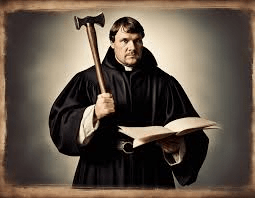
ONE HAMMER in the hand of an obscure Augustinian monk changed the world forever. Martin Luther posted his Ninety-Five Theses on the church door in Wittenberg, Germany calling his fellow professors to examine issues of supreme theological importance. Thus, began the Reformation through which the light of God’s Word was brought out of the darkness to shine with clarity once more.

One of the central cries of the Protestant Reformation was this: “The just shall live by faith.” Luther’s development of the doctrine of justification by faith alone recovered the gospel that had been hidden during the Middle Ages.

And at the center of that gospel is the affirmation that the righteousness by which we are declared just before a holy God is not our own. It’s a foreign righteousness, an alien righteousness, a righteousness that Luther said is extra nos—apart from us. Namely, it’s the righteousness of Jesus Christ—that righteousness that’s imputed or counted for all who put their trust in Him.

Because of that affirmation Luther was involved in serious controversies—controversies that culminated in his being brought to trial before the princes of the church and even before the emperor of the Holy Roman Empire, Charles the V. And there at the Diet of Worms, summoned in Germany, Luther was called upon to recant his views. He answered his interlocutors by saying, “Revoco? You want me to say revoco? That I recant? I will not recant unless I am convinced by sacred Scripture or by evident reason. I cannot recant for my conscience is held captive by the Word of God. And to act against conscience is neither right nor safe. Here I stand. I can do no other. God help me.”

In every generation the gospel must be published anew with the same boldness, and the same clarity, and the same urgency that came forth in the 16th century Reformation. The church has always done this in both the spoken word and in song—producing hymns that tell us of the great salvation that has been wrought by God alone through Christ alone.”  Dr. R. C. Sproul

Have a blessed Day.

Soli deo Gloria!

Remembering the Reformation. Glory to the Holy One.

16 For I am not ashamed of the gospel, for it is the power of God for salvation to everyone who believes, to the Jew first and also to the Greek. 17 For in it the righteousness of God is revealed from faith for faith, as it is written, “The righteous shall live by faith.” (Romans 1:16–17 ESV)

Many Christians observe the anniversary of Martin Luther nailing his 95 Thesis on the church door of Wittenberg, Germany on October 31, 1517. 2024 marks the 507th anniversary of the event which sparked the Protestant Reformation.

We love our heroes. We follow our heroes. We are also devastated when our heroes show themselves to be all too human, just like us. We want them as perfect as the Lord Jesus Christ; but they never can be.

Martin Luther is one of my heroes. I grew up attending a Lutheran Church where I not only learned about Jesus, but also about Luther. Luther began to take on almost super human qualities in my mind. However, he was as flawed a man as me. Therefore, how are we to objectively evaluate the 16th century Protestant Reformation and Luther’s role in it?  

Pastor Burk Parsons writes, “Ultimately, the Word of God was the hero of the Reformation, not Luther. The power was not in Martin Luther or John Calvin or any of the Reformers—the power was the gospel unto salvation for everyone who believes. The fuel and the fire of the Reformation was the Holy Spirit who brought revival and reformation not only in doctrine, but in worship, in the church, in the home, and in the hearts of all those He brought to repentance and faith in Jesus Christ—all for the glory of God to the end that the nations might know, love, and proclaim the name of our triune God Coram Deo, before His face forever.”

In light of this significant event in church history, I would encourage you to meditate upon the lyrics of the following hymn by Dr. R. C. Sproul. It is entitled Glory to the Holy One and is based upon Isaiah 6:1-7.

Seated on the heav’nly throne
Above all mortal view
The King supreme in glory sat
Bathed in resplendent hue.

Refrain
“Holy, Holy, Holy”
Cried the seraph throng
Glory to the Holy One
Join in heaven’s song.

All around the mercy seat
The heav’nly creatures sang
Glory to our God on high
Their poignant anthem rang.

Shielded eyes and covered feet
The angels hovered high
Glory shook the portal walls
And smoke rose to the sky.

“Angel come now, purge my lips
Make pure my soul anew
Now I’ll rise and stand again
In grace to go for you.”

May all of us in grace, go and serve the Lord. Have a blessed day in the Lord.

Soli deo Gloria!

Remembering the Reformation.

It was five hundred and seven years ago this week that Martin Luther nailed his Ninety-Five Thesis on the Castle Church Door in Wittenberg, Germany, thus beginning the Protestant Reformation. The impasse which occurred between the Reformers of the 16th Century and the Roman Catholic Church remain in full force today. These issues are as critical now as they were then. What key takeaways from the Reformation would we be wise to apply to the context of Christianity in the 21st Century?

The first would be that the sole authority for the Christian is to be the Scriptures: Sola Scriptura. The Roman Catholic Church views Scripture as deferring to the church’s authority and traditions. This was not the view of Luther, Calvin, or the other Reformers. This was the foundational issue in the Protestant Reformation.

However, there are those within Evangelical Protestant churches who do not have the viewpoint that the Scriptures alone are our sole and primary authority in matters of faith and practice. Many believers opt for their own opinions and attitudes to shape their decisions, rather than obeying God’s Word. It is when these attitudes and opinions run contrary to the Scriptures, the Word of God is often set aside. This is not becoming the exception, but rather the norm.

For example, when a Christian is unhappy in their marriage, they may feel free to pursue and engage in an extra-marital affair. It doesn’t matter to them what the Bible says about adultery. They want to be happy and woe to the pastor who confronts them about their sin in accordance with Matthew 18:15-20 and Galatians 6:1-2.

Secondly, the commitment to objective truth instead of subjective experience is another lasting benefit from the Reformation. Martin Luther went from one religious experience to another; not only as a child, but also as a young adult. He constantly sought relief from his guilt over his sin by pursuing a religious experience. Whether it was promising to become a monk during a violent thunderstorm, constantly confessing his sins in the monastery, or traveling to Rome and climbing the so-called sacred stairs on his knees while reciting the rosary, his life prior to conversion to Christ was a search for the right experience where he would find peace with God.

However, Luther’s peace with God eventually came not from an emotional experience, but rather through the truth of the God’s Word specifically contained in Romans 1:16-17. On the basis of biblical truth, God credited Martin Luther with Christ’s righteousness, which resulted in Martin’s positional, personal and emotional peace with God (Romans 3:21-26; 5:1-5).

Today, many seek a subjective, religious experience for the sake of a subjective religious experience alone. Their desire for a religious “high” becomes the goal they pursue, rather than the pursuit of objective truth. This is not only true at youth conferences, but also at women’s and men’s conferences. It is also seen in regularly in churches. Few are the worship leaders, pastors and conference speakers who resist this pandering to the crowd for an emotional response. They’re out there, but they’re few and are far between. Style and experience is sought and preferred rather than substantive, objective truth.

Thirdly, there is the commitment to the doctrine of sola fide or faith alone. This is a short-handed slogan which summarizes the doctrines of grace alone and Christ alone within the specific context of the biblical gospel of salvation. For more churches than can be estimated, the gospel has become a self-help movement focused on personal peace and financial affluence. Your best life now, so to speak. It may be summarized by one church which has as its slogan, “Join us! Where it’s okay to not be okay.”

The Reformation is far from over. It continues on and is as critical today as it was in Martin Luther’s day when biblical truth was at stake regarding how a sinner becomes righteous before God.

There are those who teach and believe that Scripture plus the church is the believer’s authority. They teach grace plus human merit saves, and faith plus works is necessary to be made righteous. They also teach Christ’s righteousness, along with one’s own, is indispensable for salvation. Finally, they teach the glory of salvation is to be shared between God and man.

Today’s children of the Protestant Reformation hold that salvation is by grace alone, through faith alone, in the person and work of Jesus Christ alone, to the glory of God alone based upon the teachings and truth of the Scriptures alone. May we continue to hold to these truths as tenaciously as did Martin Luther. It won’t be easy, but “Here we stand; we can do none other. God help us!”

Soli deo Gloria!