The Gospel of Matthew: The First Three Hours on the Cross. A Robber Repents. Part 2.

39 One of the criminals who were hanged railed at him, saying, and “Are you not the Christ? Save yourself and us!” 40 But the other rebuked him, saying, “Do you not fear God, since you are under the same sentence of condemnation? 41 And we indeed justly, for we are receiving the due reward of our deeds; but this man has done nothing wrong.” 42 And he said, “Jesus, remember me when you come into your kingdom.” 43 And he said to him, “Truly, I say to you, today you will be with me in paradise.” (Luke 23:39–43 (ESV)

In our study of the Gospel of Matthew’s record of the Passion Week of the Lord Jesus Christ, it is necessary, and insightful, to examine all four Gospel accounts. This discipline provides us understanding of all the events and encounters which took place during those hours.

We continue to examine what occurred during the first three hours of Jesus’ crucifixion. Today’s focus is the one robber who repented of his sin and Jesus’ promise of paradise. The following is an excerpt from Pastor J.C. Ryle’s article Christ and the Two Thieves.

John Charles Ryle (10 May 1816 – 10 June 1900) was an English evangelical Anglican bishop. He was the first Anglican bishop of Liverpool, England.

You know these verses, I suppose. It would be strange indeed if you did not. Few passages in the New Testament are more familiar to men’s ears.

And it is right and good that these verses should be well known. They have comforted many troubled minds. They have brought peace to many uneasy consciences. They have been a healing balm to many wounded hearts. They have been a medicine to many sin-sick souls. They have smoothed down not a few dying pillows. Wherever the Gospel of Christ is preached, they will always be honored, loved, and had in remembrance.

I. First of all, you are meant to learn from these verses, Christ’s power and willingness to save sinners.

This is the main doctrine to be gathered from the history of the penitent thief. It teaches you that which ought to be music in the ears of all who hear it,—it teaches you that Jesus Christ is mighty to save.

I ask you if any man’s case could look more hopeless and desperate, than that of this penitent thief once did?

He was a wicked man,—a malefactor,—a thief, if not a murderer. We know this, for such only were crucified. He was suffering a just punishment for breaking the laws. And as he had lived wicked, so he seemed determined to die wicked,—for when he first was crucified, he railed on our Lord.

And he was a dying man. He hung there, nailed to a cross, from which he was never to come down alive. He had no longer power to stir hand or foot. His hours were numbered. The grave was ready for him. There was but a step between him and death.

If ever there was a soul hovering on the brink of hell, it was the soul of this thief. If ever there was a case that seemed lost, gone, and past recovery, it was his. If ever there was a child of Adam whom the devil made sure of as his own, it was this man.

But see now what happened. He ceased to rail and blaspheme, as he had done at the first. He began to speak in another manner altogether. He turned to our blessed Lord in prayer. He prayed Jesus to “remember him when He came into His kingdom.” He asked that his soul might be cared for, his sins pardoned, and himself thought of in another world. Truly this was a wonderful change.

And then mark what kind of answer he received. Some would have said he was too wicked a man to be saved. But it was not so. Some would have fancied it was too late: the door was shut, and there was no room for mercy. But it proved not too late at all. The Lord Jesus returned him an immediate answer,—spoke kindly to him,—assured him he should be with Him that day in Paradise: pardoned him completely,—cleansed him thoroughly from his sins,—received him graciously,—justified him freely,—raised him from the gates of hell,—gave him a title to glory. Of all the multitude of saved souls, none ever received so glorious an assurance of his own salvation, as did this penitent thief. Go over the whole list, from Genesis to Revelation, and you will find none who had such words spoken to them as these: “To-day shalt thou be with Me in Paradise.”

Reader, the Lord Jesus never gave so complete a proof of His power and will to save, as He did upon this occasion. In the day when He seemed most weak, He showed that He was a strong deliverer. In the hour when His body was racked with pain, He showed that he could feel tenderly for others. At the time when He Himself was dying, He conferred on a sinner eternal life.

II. The second lesson you are meant to learn from this passage is this,—if some are saved in the very hour of death, others are not.

This is a truth that never ought to he passed over, and I dare not leave it unnoticed. It is a truth that stands out plainly in the sad end of the other malefactor, and is only too often forgotten.

What became of the other thief who was crucified? Why did he not turn from his sin, and call upon the Lord? Why did he remain hardened and impenitent? Why was he not saved? It is useless to try to answer such questions. Let us be content to take the fact as we find it, and see what it is meant to teach us.

We have no right whatever to say this thief was a worse man than his companion. There is nothing to prove it. Both plainly were wicked men. Both were receiving the due reward of their deeds. Both hung by the side of our Lord Jesus Christ. Both heard Him pray for His murderers. Both saw Rim suffer patiently. But while one repented, the other remained hardened. While one began to pray, the other went on railing. While one was converted in his last hours, the other died a bad man as he had lived. While one was taken to paradise, the other went to his own place, the place of the devil and his angels.

Now these things are written for our warning.

There is warning, as well as comfort in these verses, and that very solemn warning too.

They tell me loudly, that though some may repent and be converted on their death-beds, it does not at all follow that all will. A death-bed is not always a saving time.

They tell me loudly that two men may have the same opportunities of getting good for their souls,—may be placed in the same position, see the same things, and hear the same things; and yet only one shall take advantage of them, repent, believe, and be saved.

They tell me, above all, that repentance and faith are the gifts of God, and are not in a man’s own power; and that if any one flatters himself he can repent at his own time, choose his own season, seek the Lord when he pleases, and, like the penitent thief, be saved at the very last,—he may find at length he is greatly deceived.

And it is good and profitable to bear this in mind. There is an immense amount of delusion in the world on this very subject. I see many allowing life to slip away, all unprepared to die. I see many allowing that they ought to repent, but always putting off their own repentance. And I believe one grand reason is, that most men suppose they can turn to God just when they like. They wrest the parable of the laborer in the vineyard, which speaks of the eleventh hour, and use it as it never was meant to be used. They dwell on the pleasant part of the verses I am now considering, and forget the rest. They talk of the thief that went to paradise, and was saved, and forget the one who died as he had lived, and was lost.

More to come. Soli deo Gloria!
The Gospel of Matthew: The First Three Hours on the Cross. A Robber Repents.  

39 One of the criminals who were hanged railed at him, saying, and “Are you not the Christ? Save yourself and us!” 40 But the other rebuked him, saying, “Do you not fear God, since you are under the same sentence of condemnation? 41 And we indeed justly, for we are receiving the due reward of our deeds; but this man has done nothing wrong.” 42 And he said, “Jesus, remember me when you come into your kingdom.” 43 And he said to him, “Truly, I say to you, today you will be with me in paradise.” (Luke 23:39–43 (ESV)

In our study of the Gospel of Matthew’s record of the Passion Week of the Lord Jesus Christ, it is necessary, and insightful, to examine all four Gospel accounts. This discipline provides us understanding of all the events and encounters which took place during those hours.

We continue to examine what occurred during the first three hours of Jesus’ crucifixion. Today’s focus is the one robber who repented of his sin and Jesus’ promise of paradise.  

The two criminals crucified with Jesus were on either side of the Lord. All four Gospels acknowledge this (Matt. 27:38; Mark 15:27; Luke 23:33; John 19:18). However, Luke is the only author who recorded the incident of the repentant robber.

“There was one man for whom the day started as the worst day in his life, but ended not only as the last day, but as the best day. In the morning, he had been dragged along with two others from his prison cell and forced to carry the instrument of his own crucifixion. From around midday, he began to experience the agony of crucifixion, a torturous form of execution that actually led the great Roman orator, Cicero, to say the very word should be absent from the lips of a Roman citizen,” explains Dr. Sinclair Ferguson.

The biblical text identified both men as criminals (κακοῦργος; kakourgos). They were lawbreakers, wrongdoers and evil workers. In other words, they both were career criminals. They lived a life of crime and now they would die in payment for their crimes. They symbolized all sinners who God declares guilty of transgressing His law and who are worthy of death (Gen. 2:15-17; Isaiah 53:5; Rom. 6:23; James 1:15).

Both men mocked Jesus along with the crowd (Matt. 27:44; Mark 15:32). Luke recorded one of the criminals saying, “Are you not the Christ? Save yourself and us!” Luke used the word railed (βλασφημέω; blasphemeo) to describe the one criminal continually reviling and blaspheming the Lord. He was not repentant of his sins. He was not sorry for his transgressions. He only wanted deliverance from the consequences of his sin; which was death.

It was at this point in the narrative Luke introduced a stark contrast. The other criminal, rather than rebuking Jesus as he previously had, actively rebuked (ἐπιτιμάω; epitimao) the other criminal. He expressed strong disproval in what the other criminal said to Jesus. He said, “Do you not fear God, since you are under the same sentence of condemnation? 41 And we indeed justly, for we are receiving the due reward of our deeds; but this man has done nothing wrong.”

The second man acknowledged the sinner he was and the just condemnation he deserved. He also acknowledged someone else; Jesus.  He understood Jesus was different. He did not deserve to be crucified. Then the second criminal said, “Jesus, remember me when you come into your kingdom.” The Holy Spirit began a work of regeneration within the heart and soul of a man who was a heartless and soulless criminal; (John 3:1-8; 6:35-44;Titus 3:1-5).

Jesus replied, ““Truly, I say to you, today you will be with me in paradise.” Paradise (παράδεισος; paradeisos) is the dwelling place of the righteous dead in a condition of blessedness. While the criminal was not righteous, the Lord declared him righteous. The criminal received the imputed righteousness of Jesus Christ (Rom 3:21-26). He was justified and now had peace with God even as he hung on a cross (Rom. 5:1).

“He addresses the One to whom he has now surrendered his heart as Jesus, that is, Savior. See Luke 1:31; 2:21. And, as Gabriel had done (Luke 1:31–33), with that name Jesus the penitent immediately associates royal rule. The angel had said to Mary, “You shall give him the name Jesus.… And the Lord God will give him the throne of his father David. He will reign over the house of Jacob forever, and his kingdom [or royal rule] will never end,” explains Dr. William Hendriksen.

“About that eschatological coming Jesus had spoken again and again. See, for example, the following passages: Matt. 16:27; 19:28; 24:27, 30; 25:31–46; 26:64; Luke 17:22–37; 21:27, 36; 22:29, 30. If the penitent had heard anything about Jesus at all—and his prayer is hard to explain if he had not—he must have heard about his predictions in connection with the glorious Return at the end of the age.”

“The man is asking Jesus, therefore, to be remembered by him at that time. He does not ask for any place of honor. He knows very well that such a place is not for him. But he casts himself entirely upon the Savior’s grace, asking only to be remembered; that is, of course, to be remembered for good,” concludes Dr. Hendriksen.

“That Friday began as the worst day of his life. It was the last day of his life, but it was the best day of his life because the Lord Jesus said to him, “Today, you will be with me in paradise” (Luke 23:43),” states Dr. Sinclair Ferguson.

“It wasn’t an easy road that brought him to Jesus. It was strewn with his own sin and failure. But at last, he was brought near to Jesus to recognize Him as Savior and King, to turn to Him, to cast himself on His mercy, and to find forgiveness and eternal life. And now he’s with Jesus in paradise. That’s what made this Friday “Good Friday” for him, and it’s the only thing that can make it good for us too.”

Have you received this gift of righteousness?  Have you experienced your good conversion day (Psalm 118:24)?

Soli deo Gloria!

The Gospel of Matthew: The First Three Hours on the Cross. The Mockers.

38 Then two robbers were crucified with him, one on the right and one on the left. 39 And those who passed by derided him, wagging their heads 40 and saying, “You who would destroy the temple and rebuild it in three days, save yourself! If you are the Son of God, come down from the cross.” 41 So also the chief priests, with the scribes and elders, mocked him, saying, 42 “He saved others; he cannot save himself. He is the King of Israel; let him come down now from the cross, and we will believe in him. 43 He trusts in God; let God deliver him now, if he desires him. For he said, ‘I am the Son of God.’ ” 44 And the robbers who were crucified with him also reviled him in the same way.” (Matthew 27:38–44 (ESV)

27 And with him they crucified two robbers, one on his right and one on his left. 29 And those who passed by derided him, wagging their heads and saying, “Aha! You who would destroy the temple and rebuild it in three days, 30 save yourself, and come down from the cross!” 31 So also the chief priests with the scribes mocked him to one another, saying, “He saved others; he cannot save himself. 32 Let the Christ, the King of Israel, come down now from the cross that we may see and believe.” Those who were crucified with him also reviled him.” (Mark 15:27–32 (ESV)

35 And the people stood by, watching, but the rulers scoffed at him, saying, “He saved others; let him save himself, if he is the Christ of God, his Chosen One!” 36 The soldiers also mocked him, coming up and offering him sour wine.” (Luke 23:35–36 (ESV)

In our study of the Gospel of Matthew’s record of the Passion Week of the Lord Jesus Christ, it is necessary, and insightful, to examine all four Gospel accounts. This discipline provides us understanding of all the events and encounters which took place during those hours.

We continue to examine what occurred during the first three hours of Jesus’ crucifixion. Today’s focus is the mocking crowd surrounding the scene at Golgotha.

Matthew, Mark and Luke mentioned the mocking of the Lord Jesus by the passersby’s, the chief priests, the scribes, the elders, the Roman soldiers and the two robbers crucified with Him. There were three specific statements of scorn directed to, and about, Jesus by the various people groups.

First, the passersby’s said, ““You who would destroy the temple and rebuild it in three days, save yourself! If you are the Son of God, come down from the cross.” This statement was in reference to when Jesus cleansed the temple of livestock and the moneychangers, early in His ministry (John 2:13-17). In response, the Jews asked Him what sign would He show for doing these things (John 2:18). Jesus replied, “Destroy this temple, and in three days I will raise it up” (John 2:19). The Jews thought Jesus referred to the Jerusalem temple but Jesus spoke of the temple of His resurrected body (John 2:20-22).

Second, the religious leaders said to themselves, “He saved others; he cannot save himself. Let the Christ, the King of Israel, come down now from the cross that we may see and believe.” It is hard to imagine after all the miracles Jesus performed throughout His three year ministry that the Jewish leaders would believe in Christ if He did come off the cross. They would have continued to disbelieve and dismiss the evidence before them of Christ’s deity (Matthew 16:1-4). .

Third, Matthew recorded the religious leaders also saying, “He trusts in God; let God deliver him now, if he desires him. For he said, ‘I am the Son of God.’ ” (See John 5:18).

Fourth, Luke recorded the Roman soldiers joined in the mockery and blasphemy of the Lord.

Finally, the two robbers joined in the clamoring and reviled the Lord. To revile (ὀνειδίζω; oneidizo) means to mock insult and reprimand. The robbers did this actively and continually.

“Scornfully they exclaim that the way for the crucified One to prove his claim to being the Son of God will be for him to descend from the cross. They imply that it is weakness that keeps him there. Actually, however, it was strength, the strength of his love for sinners,” explains Dr. William Hendriksen.

“In the midst of it all Jesus remains silent. He offers not one word of rebuke. Peter puts it beautifully when he says, “who, while being reviled, did not revile in return; while suffering, never threatened, but continued to entrust himself to him who judges righteously; who himself bore our sins in his body on the cross, that we might die to sin and live to righteousness; for by his wounds you were healed” (1 Peter 2:23, 24).”

However, the scene would soon change. Within the providence of God the Father, He would give one of the robbers as a gift to God the Son (Luke 23:39-43; John 6:37). This is what we will examine when next we meet.

Do not be frustrated when people mock, scorn, revile and reject you because of your faith in Christ. As unbelievers treated the Master, they will similarly treat His disciples (John 15:18-25). Rather, count it all joy (James 1:2-4).

Soli deo Gloria!

The Gospel of Matthew: The First Three Hours on the Cross. The Inscription. Part 2.

36 Then they sat down and kept watch over him there. 37 And over his head they put the charge against him, which read, “This is Jesus, the King of the Jews.” (Matthew 27:36–37 (ESV)

26 And the inscription of the charge against him read, “The King of the Jews.” 27 And with him they crucified two robbers, one on his right and one on his left.” (Mark 15:26–27 (ESV)

38 There was also an inscription over him, “This is the King of the Jews.” (Luke 23:38 (ESV)

18 There they crucified him, and with him two others, one on either side, and Jesus between them. 19 Pilate also wrote an inscription and put it on the cross. It read, “Jesus of Nazareth, the King of the Jews.” 20 Many of the Jews read this inscription, for the place where Jesus was crucified was near the city, and it was written in Aramaic, in Latin, and in Greek. 21 So the chief priests of the Jews said to Pilate, “Do not write, ‘The King of the Jews,’ but rather, ‘This man said, I am King of the Jews.’ ” 22 Pilate answered, “What I have written I have written.” (John 19:18–22 (ESV)

In our study of the Gospel of Matthew’s record of the Passion Week of the Lord Jesus Christ, it is necessary, and insightful, to examine all four Gospel accounts. This discipline provides us understanding of all the events and encounters which took place during those hours.

For the next several days we will examine what occurred during the first three hours of Jesus’ crucifixion. Today’s focus again concerns the inscription Pontius Pilate wrote and had placed on Jesus’ cross; Jesus of Nazareth, King of the Jews. It is probable Pilate had no awareness the biblical truth of his inscription. He had no knowledge of Psalm 110. It is a Psalm of David. It is a royal psalm ultimately referring to Jesus Christ as the sovereign ruler, or divine/human king, of Israel.

“This psalm contains one of the most exalted prophetic portions of Scripture presenting Jesus Christ as both a holy king and a royal high priest—something that no human monarch of Israel ever experienced. It, along with Ps. 118, is by far the most quoted psalm in the NT (Matt. 22:44; 26:64Mark 12:36; 14:62Luke 20:42–43; 22:69Acts 2:34–35Heb. 1:13; 5:6; 7:17, 21; 10:13),” explains Dr. John MacArthur.

“While portraying the perfect king, the perfect high priest, and the perfect government, Ps. 110 declares Christ’s current role in heaven as the resurrected Savior (v. 1) and his future role on earth as the reigning Monarch (vv. 2–7). This psalm is decidedly messianic and millennial in content. Jesus Christ (Matt. 22:43–44) verifies the Davidic authorship. The exact occasion of this psalm is unknown, but it could easily have been associated with God’s declaration of the Davidic Covenant in 2 Sam. 7:4–17.”

The outline of Psalm 110 is simple but significant. David’s focus is Christ the King (vs. 1-3) and Christ the High Priest (vs. 4-7). Pontius Pilate did not realize it, but he affirmed the divine kingship and priesthood of Jesus Christ with this inscription.

Soli deo Gloria!

The Gospel of Matthew: The First Three Hours on the Cross. The Inscription.

36 Then they sat down and kept watch over him there. 37 And over his head they put the charge against him, which read, “This is Jesus, the King of the Jews.” (Matthew 27:36–37 (ESV)

26 And the inscription of the charge against him read, “The King of the Jews.” 27 And with him they crucified two robbers, one on his right and one on his left.” (Mark 15:26–27 (ESV)

38 There was also an inscription over him, “This is the King of the Jews.” (Luke 23:38 (ESV)

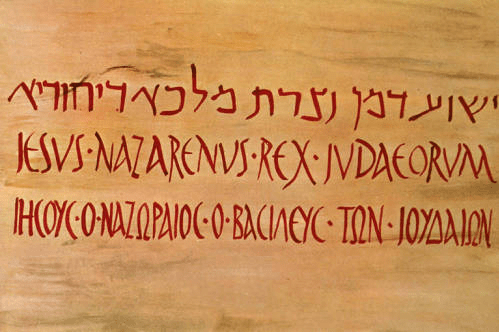
18 There they crucified him, and with him two others, one on either side, and Jesus between them. 19 Pilate also wrote an inscription and put it on the cross. It read, “Jesus of Nazareth, the King of the Jews.” 20 Many of the Jews read this inscription, for the place where Jesus was crucified was near the city, and it was written in Aramaic, in Latin, and in Greek. 21 So the chief priests of the Jews said to Pilate, “Do not write, ‘The King of the Jews,’ but rather, ‘This man said, I am King of the Jews.’ ” 22 Pilate answered, “What I have written I have written.” (John 19:18–22 (ESV)

In our study of the Gospel of Matthew’s record of the Passion Week of the Lord Jesus Christ, it is necessary, and insightful, to examine all four Gospel accounts. This discipline provides us understanding of all the events and encounters which took place during those hours.

For the next several days we will examine what occurred during the first three hours of Jesus’ crucifixion. Today’s focus is the inscription Jesus of Nazareth, King of the Jews.

What is an inscription? An inscription (ἐπιγραφή; epigraphe) are words inscribed on a monument or in a book. Historically, they were written mostly on rocks, stones, walls of buildings, metals etc.

For example, the Lincoln Memorial in Washington D.C. prominently features inscribed texts of two speeches by President Abraham Lincoln: The Gettysburg Address and his Second Inaugural Address. Within the historical context of first century crucifixions by the Romans, “the condemned person often carried the charge (Latin titulus) to the site of execution,” explains commentator Craig Keener.

John’s Gospel explains Pontius Pilate wrote the inscription placed on Jesus’ cross. It was located above the Lord’s head and read, ““Jesus of Nazareth, the King of the Jews.” Matthew’s Gospel states, ““This is Jesus, the King of the Jews.” Mark records, ““The King of the Jews,” while Luke’s Gospel says, ““This is the King of the Jews.” Additionally, John records Pilate wrote the inscription in Aramaic, Latin and Greek.

Matthew and Mark indicate the inscription contained a charge (αἰτία; aitia) against the Lord. A charge contained “the content of legal charges brought against someone—‘accusation, charge, complaint,” explains the Louw and Nida Greek Lexicon.

The Jewish chief priests, Caiaphas and Annas, were not pleased. They said to Pilate, “Do not write, ‘The King of the Jews,’ but rather, ‘This man said, I am King of the Jews.’ “ (John 19:21). Pilate replied, “What I have written I have written,” (John 19:22). Pilate’s actions reflected more his disdain for the Jewish leaders than any personal condemnation of Jesus or any commitment in receiving Jesus Christ as Savior and Lord.

“The Jewish leaders desired to have the ambiguity removed. For reasons of his own Pilate refused. If we bear in mind that by means of this very cross Jesus actually won the victory (John 12:32) we shall understand that he is indeed King over all, including the Jews,” explains Dr. William Hendriksen.

Soli deo Gloria!

The Gospel of Matthew: The First Three Hours on the Cross. Father, Forgive Them.   

And when they had crucified him, they divided his garments among them by casting lots.” (Matthew 27:35 (ESV)

24 And they crucified him and divided his garments among them, casting lots for them, to decide what each should take. 25 And it was the third hour when they crucified him.” (Mark 15:24–25 (ESV)

33 And when they came to the place that is called The Skull, there they crucified him, and the criminals, one on his right and one on his left. 34 And Jesus said, “Father, forgive them, for they know not what they do.” And they cast lots to divide his garments.” (Luke 23:33–34 (ESV)

23 When the soldiers had crucified Jesus, they took his garments and divided them into four parts, one part for each soldier; also his tunic. But the tunic was seamless, woven in one piece from top to bottom, 24 so they said to one another, “Let us not tear it, but cast lots for it to see whose it shall be.” This was to fulfill the Scripture which says, “They divided my garments among them, and for my clothing they cast lots.” So the soldiers did these things,” (John 19:23–24 (ESV)

In our study of the Gospel of Matthew’s record of the Passion Week of the Lord Jesus Christ, it is necessary, and insightful, to examine all four Gospel accounts. This discipline provides us understanding of all the events and encounters which took place during those hours.

For the next several days we will examine what occurred during the first three hours of Jesus’ crucifixion. Today’s focus is Jesus’ first statement from the cross; “Father, forgive them, for they know not what they do.”

The Gospel of Luke is the only one of the four Gospels to contain this statement. I is widely recognized by biblical scholars as the first of seven statements Jesus spoke while on the cross. The Seven Statements of the Cross are as follows.

a. From 9 o’clock until noon:

(1) “Father, forgive them: for they do not know what they are doing” (Luke 23:34).

(2) “I solemnly declare to you, Today you shall be with me in Paradise” (Luke 23:43).

(3) “Woman, look, your son… Look, your mother!” (John 19:27).

b. The three hours of darkness: from noon until 3 o’clock; no words reported.

c. About 3 o’clock:

(4) “My God, my God, why hast thou forsaken me?” (Mark 15:34).

(5) “I am thirsty” (John 19:28).

(6) “It is finished” (John 19:30).

(7) “Father, into thy hands I commend my spirit” (Luke 23:46).[1]

The words are familiar to many. Its meaning may not be.

“Father.” In this context, father (πατήρ; pater) is a title of supernatural authority and care of His children. In Jesus’ case, it was an acknowledgment not only the divinity of God the Father, but also of His own deity as the only-begotten Son of God. This was one reason the Jews hated Jesus and sought to kill Him (John 5:18).

“Forgive them.” To forgive (ἀφίημι; aphiemi) means to pardon someone who has committed sin. It means to no longer hold someone responsible, guilty, for their sin. In this context, it was the sin of those crucifying Jesus. It was a strong statement by the God the Son to God the Father.

To forgive means “to blot out their transgression completely. In thy sovereign grace cause them to repent truly, so that they can be and will be pardoned fully,” states Dr. William Hendriksen.

“That this is the meaning is clear from the fact that the grammatical construction is exactly the same as in Luke 11:4, “And forgive us our sins,” and as in 17:3, “If he repents, forgive him.” Is it even conceivable that He who insists so strongly that His followers must forgive every debtor, and that they must even love their enemies, should not exemplify this virtue Himself?”

“For they know not what they do.” To know (οἶδα; oida) means to understand and to comprehend. Those responsible for the crucifixion of Christ, both Jews and the Romans, did not understand the gravity of their actions.

“Is it not marvelous beyond words that Jesus, in his earnest intercession for his torturers, even presents to the Father a special plea, an argument, as it were, for the granting of his petition, namely, “for they do not know what they are doing”? It was true: the soldiers certainly did not know. But even the members of the Sanhedrin, though they must have known that what they were doing was wicked, did not comprehend the extent of that wickedness,” explains Dr. Hendriksen.

This prayer by Jesus fulfilled the prophecy of Isaiah. 53:12: “Yet he bore the sin of many, and made intercession for the transgressors.”

Author Arthur Pink writes in Jesus’ statement of forgiveness…

       1. Here we see the fulfillment of the prophetic word.
        2. Here we see Christ identified with His people.
        3. Here we see the divine estimate of sin and its consequent guilt.
        4. Here we see the blindness of the human heart.
        5. Here we see a lovely exemplification of His own teaching.
        6. Here we see man’s great and primary need.
        7. Here we see the triumph of redeeming love.

“Some of the fruit of this prayer can be in the salvation of thousands of people in Jerusalem at Pentecost (Acts 2:41),” states Dr. John MacArthur. “Christ’s prayer, while they were in the very act of mocking Him, is an expression of the boundless compassion of divine grace.” See also Acts 4:4; 6:7.

Soli deo Gloria!


The Gospel of Matthew: The First Three Hours on the Cross. Lots are Cast.  

And when they had crucified him, they divided his garments among them by casting lots.” (Matthew 27:35 (ESV)

24 And they crucified him and divided his garments among them, casting lots for them, to decide what each should take. 25 And it was the third hour when they crucified him.” (Mark 15:24–25 (ESV)

33 And when they came to the place that is called The Skull, there they crucified him, and the criminals, one on his right and one on his left. 34 And Jesus said, “Father, forgive them, for they know not what they do.” And they cast lots to divide his garments.” (Luke 23:33–34 (ESV)

23 When the soldiers had crucified Jesus, they took his garments and divided them into four parts, one part for each soldier; also his tunic. But the tunic was seamless, woven in one piece from top to bottom, 24 so they said to one another, “Let us not tear it, but cast lots for it to see whose it shall be.” This was to fulfill the Scripture which says, “They divided my garments among them, and for my clothing they cast lots.” So the soldiers did these things,” (John 19:23–24 (ESV)

In our study of the Gospel of Matthew’s record of the Passion Week of the Lord Jesus Christ, it is necessary, and insightful, to examine all four Gospel accounts. This discipline provides us understanding of all the events and encounters which took place during those hours.

For the next several days we will examine what occurred during the first three hours of Jesus’ crucifixion. Today’s focus is the casting of lots for Jesus’ clothing.

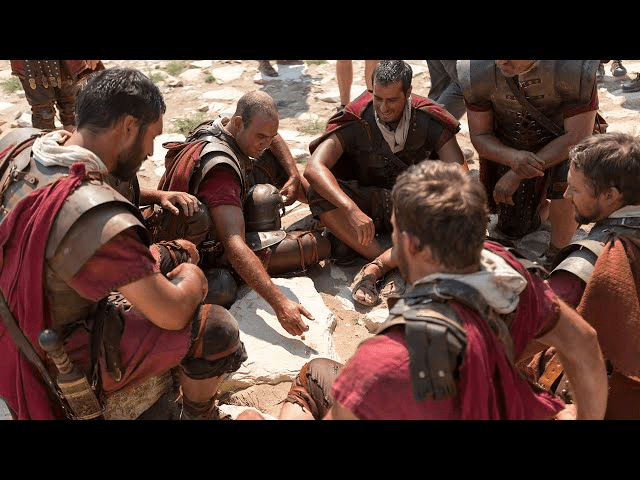
All four Gospels contain this event. However, John explicitly stated the Roman soldiers in charge of the crucifixion were the ones who cast lots for Jesus’ clothes (John 19:23). Casting lots involved throwing a specially marked pebble, piece of pottery, or stick in making decisions based upon chance or luck. In other words, the soldiers rolled the dice to see who would win Jesus’ garments. No mention is made of the two criminals’ clothes. Just the Lord’s.

John mentioned there were four soldiers at the crucifixion. They divided Jesus’ clothes among the four of them. However, when they examined Jesus’ tunic, they did not want to divide it into fourths, but rather see which solider would win it outright (John 19:23b-24a). John stated this behavior fulfilled Old Testament Scripture (John 19:24b; Psalm 22:18).

“Having crucified him, the legionaries divided his garments by casting lots. In all probability by means of the throwing of dice the four pieces—head-gear, sandals, belt, and outer garment—are divided among the four (John 19:23) soldiers. The seamless tunic, all of one piece, woven all the way from top to bottom, is also put into the lottery, all of this in accordance with the prophecy of Ps. 22:18 (LXX Ps. 21:19), though this reference to fulfilment is not found in Matthew but in John 19:23, 24,” explains Dr. William Hendriksen.

“People were usually hung on a cross naked, but Jesus might be allowed a loincloth due to the shame His people associate with nakedness. Either way, His clothing now belongs to the soldiers guarding Him, a custom observed with every crucified victim. Yet this time prophecy is also fulfilled as lots are cast for Christ’s clothing (Matt. 27:35; see Ps. 22:18). John Calvin appropriately comments, “God determined that His own Son should be stripped of his raiment, that we, clothed with his righteousness and with abundance of all good things, may appear with boldness in company with the angels,” states Dr. R. C. Sproul.

Mark recorded it was the third hour when Jesus’ crucifixion began (Mark 15:25). Based upon the Jewish reckoning of time, the crucifixion occurred at 9:00 A.M. Pilate sentenced Jesus to death at 6:00 A.M. (John 19:14), but it wasn’t until three hours later the execution actually began at Golgotha.

“The clear implication of the passage which we are studying must not escape us. It is this: Jesus bore for us the curse of nakedness in order to deliver us from it! (Cf. Gen. 3:9–11, 21; 2 Cor. 5:4; Rev. 7:13, 14). Surely if what Ham did to his father Noah is singled out for special mention because of its reprehensible character, then what the soldiers did when they disrobed Jesus and then divided his garments among themselves, casting lots, should cause us to pause with horror. Such a pause is suggested by the words: These things, indeed, the soldiers did (John 19:24). They did that which was shameful. Yet, by means of that shameful deed God’s eternal plan (hence, also prophecy) was fulfilled. Hence, we pause in abhorrence … and adoration,” concludes Dr. Hendriksen.

Many people continue to deny the severity of Jesus’ substitutionary atonement on the cross. They deny the shame, the curse and the wrath of God the Father poured out upon the sinless Son of God. However, it was in my place condemned He hung on the cross. I encourage you to read and meditate upon Romans 3:21-26.

Soli deo Gloria!

The Gospel of Matthew: Test Your View of the Cross.  

31 And when they had mocked him, they stripped him of the robe and put his own clothes on him and led him away to crucify him.” Matthew 27:31 (ESV)

20 And when they had mocked him, they stripped him of the purple cloak and put his own clothes on him. And they led him out to crucify him.” (Mark 15:20 (ESV)

33 And when they came to the place that is called The Skull, there they crucified him, and the criminals, one on his right and one on his left.” (Luke 23:33 (ESV)

 16 So he delivered him over to them to be crucified. So they took Jesus, 17 and he went out, bearing his own cross, to the place called The Place of a Skull, which in Aramaic is called Golgotha. 18 There they crucified him, and with him two others, one on either side, and Jesus between them.” (John 19:16–18 (ESV)

The following article is by Dr. Martyn Lloyd-Jones. It is entitled Test Your View of the Cross. It is excerpted from Dr. Lloyd-Jones’ commentary on the Book of Romans.

“The Cross does not merely tell us that God forgives, it tells us that it is God’s way of making forgiveness possible. It is the way in which we understand how God forgives. I will go further: how can God forgive and still remain God? — that is the question. The Cross is the vindication of God. The Cross is the vindication of the character of God. The Cross not only shows the love of God more gloriously than anything else, it shows his righteousness, his justice, his holiness, and all the glory of his eternal attributes. They are all to be seen shining together there. If you do not see them all you have not seen the Cross. That is why we must totally reject the so-called ‘moral influence theory’ of the Atonement — the theory which says that all the Cross has to do is to break our hearts and to bring us to see the love of God.”

“Above and beyond all that, Paul says, ‘He is declaring his righteousness for the remission of sins that are past’. Why this, if it is merely a declaration of his love? No, says Paul, it is more than that. If it merely proclaimed his forgiveness we would be entitled to ask whether we can depend on God’s word, and whether he is righteous and just. It would be a fair question because God has repeatedly stated in the Old Testament that he hates sin and that he will punish sin, and that the wages of sin is death. The character of God is involved. God is not as men.”

“We think sometimes that it is wonderful for people to say one thing and then do another. The parent says to the child, ‘If you do this thing you shall not have that sixpence to buy your sweets’. Then the boy does that thing, but the father says, ‘Well, it is all right’, and gives him the sixpence. That, we think, is love, and true forgiveness. But God does not behave in that manner. God, if I may so put it, is eternally consistent with himself. There is never a contradiction. He is ‘the Father of lights, with whom is no variableness, neither shadow of turning’. All these glorious attributes are to be seen shining like diamonds in his eternal character. And all of them must be manifest. In the Cross they are all manifested.”

“How can God be just and justify the ungodly? The answer is that he can, because he has punished the sins of ungodly sinners in his own Son. He has poured his wrath upon him. ‘He bore our chastisement.’ ‘By his stripes we are healed.’ God has done what he said he would do; he has punished sin. He proclaimed this through the Old Testament every­where; and he has done what he said he would do. He has shown that he is righteous. He has made a public declaration of it. He is just and can justify, because having punished another in our stead, he can forgive us freely. And he does so. That is the message of Romans 3:24: ‘Being justified [being regarded, declared, pronounced righteous] freely by his grace through the redemption [the ransoming] that is in Christ Jesus; whom God hath set forth as a propitiation through faith in his blood.’ Thus he declares his righteousness for having passed over those sins in his time of self-restraint. ‘To declare, I say’, his righteousness then, and now, and always, in forgiving sins. Thus he is, at one and the same time, just and the justifier of him that believeth in Jesus.”

“Such is this great and glorious and wonderful statement. Make sure that your view, your understanding of the Cross, includes the whole of it. Test your view of the Cross. Where does this statement about ‘declaring’ his righteousness and so on, come into your thinking? Is it something that you just skip over and say: `Well, I don’t know what that means. All I know is, that God is love and that he forgives.’ But you should know the meaning of this. This is an essential part of the glorious Gospel.”

“On Calvary God was making a way of salvation so that you and I might be forgiven. But he had to do so in a way that will leave his character inviolate, that will leave his eternal consistency still absolute and unbroken. Once you begin to look at it like that, you see that this is the most tremendous, the most glorious, the most staggering thing in the universe and in the whole of history. God is there declaring what he has done for us. He is declaring at the same time his own eternal greatness and glory, declaring that ‘He is light and in him is no darkness at all’. ‘When I survey the wondrous Cross. . .’, says Isaac Watts, but you do not see the wonder of it until you really do survey it in the light of this great statement of the Apostle. God was declaring publicly once and for ever his eternal justice and his eternal love. Never separate them, for they belong together in the character of God.”

Soli deo Gloria!