8 “So they departed quickly from the tomb with fear and great joy, and ran to tell his disciples. 9 And behold, Jesus met them and said, “Greetings!” And they came up and took hold of his feet and worshiped him. 10 Then Jesus said to them, “Do not be afraid; go and tell my brothers to go to Galilee, and there they will see me.11 While they were going, behold, some of the guard went into the city and told the chief priests all that had taken place.” (Matthew 28:8–11 (ESV)
22 “Men of Israel, hear these words: Jesus of Nazareth, a man attested to you by God with mighty works and wonders and signs that God did through him in your midst, as you yourselves know— 23 this Jesus, delivered up according to the definite plan and foreknowledge of God, you crucified and killed by the hands of lawless men. 24 God raised him up, loosing the pangs of death, because it was not possible for him to be held by it.” Acts 2:22–24 (ESV)
The Bible says if Christ has not been raised, then our preaching is in vain and our faith is in vain (1 Cor. 15:14). No event is more critical to Christianity than the Lord Jesus Christ’s resurrection. One commentator writes of the resurrection, “Its historicity is the fact upon which our faith stands or falls.”
“Like the other gospels but unlike the epistles, Matthew offers little theological commentary in his resurrection account. Also, he does not report everything that happened from the time the women came to the tomb to Jesus’ ascension. The other three evangelists likewise recount only some of what transpired during that momentous period, selecting the details important for their audiences. Comparing the four accounts gives us a fuller picture of all that occurred. In any case, the resurrection is historically well-attested. Besides the evidence in the Gospels, Paul records Jesus’ appearances to five hundred people at once, James, and himself (1 Cor. 15:6–8). There are also veiled references to our Lord’s resurrection in rabbinic sources that go back to the first century,” explains Dr. R. C. Sproul.
“Matthew tells us the angel used an earthquake to remove the stone covering Jesus’ tomb (Matt. 28:2). Since Christ left the tomb before the stone was rolled away, this was not to let Him out of the grave but to let the women see the empty tomb. Jesus is not risen as a ghost or spirit; the women grasp His feet, revealing that His physical flesh has been raised (Matt. 28:9). That Christ’s physical body is resurrected indicates matter is not inherently evil and that our eternal state will not be that of a disembodied spirit. Like Jesus, our bodies too will be raised on the last day in our glorification, and the physical world will once again be “very good” and untainted by evil (1 Cor. 15:35–58).”
The Bible says Jesus, having been “delivered up for our trespasses,” was “raised for our justification” (Rom. 4:23–25). By raising His Son from the dead, God the Father signified His acceptance of Jesus’ atonement for the sins of His people, proving that all who trust in Christ alone have their sins covered by the righteousness of Jesus and are reconciled to God (Rom. 3:21-26).
John Calvin comments, “The lively assurance of our reconciliation with God arises from Christ having come from hell as the conqueror of death” with “the power of a new life at his disposal.”
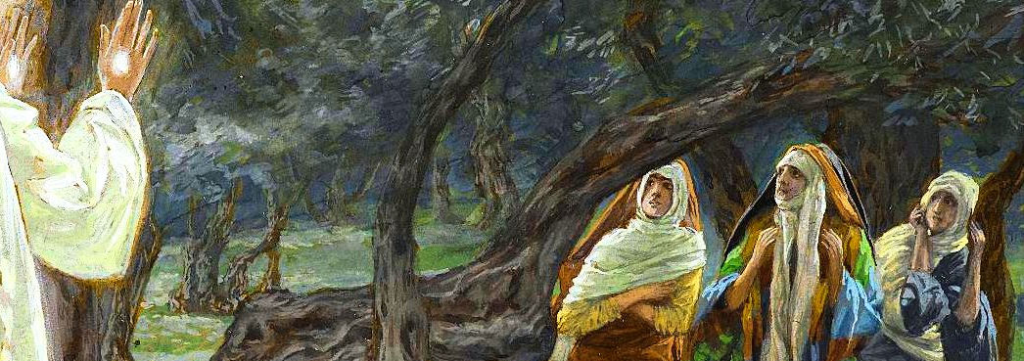
8 “So they departed quickly from the tomb with fear and great joy, and ran to tell his disciples. 9 And behold, Jesus met them and said, “Greetings!” And they came up and took hold of his feet and worshiped him. 10 Then Jesus said to them, “Do not be afraid; go and tell my brothers to go to Galilee, and there they will see me.” (Matthew 28:8–10 (ESV)
All four Gospels parallel each other concerning the events on Resurrection Sunday. The Holy Spirit specifically inspired one of two of the writers to provide particular information not found in the other Gospels. While each writer provides selective, insightful information, they do not contradict each other in telling the wonderful news that Jesus Christ is alive. Such is the case with today’s text from Matthew.
“Given the importance of the resurrection, it is no surprise that critics of the Christian faith often attack the resurrection accounts and defenders of the faith argue for their historical credibility. The four Gospels describe the empty tomb and the post-resurrection appearances of Jesus differently, but the differences are not irreconcilable. Much good work has been done in showing how the accounts fit together, and it is good for believers to equip themselves with a basic knowledge of such things as we face a culture increasingly hostile to the Christian faith. We must be prepared to give an answer for the hope that is within us (1 Peter 3:15–16),” explains Dr. R. C. Sproul.
“That we might be so equipped, we will note one important factor that argues for the historicity of Jesus’ resurrection. In each gospel account, women were the very first witnesses of the empty tomb. This is noteworthy because first-century Jewish culture did not view the testimony of women as reliable. So, if someone invented the resurrection, having women be the first witnesses of it would not be the smart way to go about telling the story. There would be no reason to have the women be the first witnesses of the resurrection unless, in fact, they were the first to see the empty tomb and the risen Lord. The Evangelists include this fact because they had to. It is what actually happened, and they note the women’s presence because they were relaying history.”
The women encountered the angels at Jesus’ empty tomb. These witnesses included Mary Magdalene and Joanna and Mary the mother of James and the other women with them (Matt. 28:7-8; Mark 16:7-8; Luke 24:8-11). Upon hearing the great news of Jesus’ resurrection, and the angel’s command to go and tell the disciples, the women ran with fear and great joy to spread the glorious news to Jesus’ followers. It was at that moment Jesus met them.
He said, “Greetings.” The text continues to say, “And they came up and took hold of his feet and worshiped him.” Being the Incarnate Lord of heaven and earth, Jesus received their worship.
“To put them at ease Jesus used an ordinary greeting when he met them, one that can perhaps be best rendered “Hello,” or “How do you do?” or “Good morning.” See also Matt. 26:49; 27:29. Immediately they recognized him, fell down before him, taking hold of his feet and worshipping him. He was real, even physical (“his feet”). He was Jesus, no one else, the very Jesus whom they had known for a considerable time, and to whom they had rendered valuable service,” states Dr. William Hendriksen.
He then told them, “Do not be afraid; go and tell my brothers to go to Galilee, and there they will see me.” The brothers of whom Jesus referred were the eleven apostles.
“My brothers,” not: “those habitual quarrelers, those men who promised to remain loyal to me no matter what would happen, but who when the crisis arrived left me and fled; those men who, with one exception, were not even present at Calvary when I was laying down my life for them.” None of that. Instead, “my brothers,” those whom I acknowledge as members of my family, those who share the inheritance with me, those whom I love,” explains Dr. Hendriksen.
“Our actions tend to reveal what we really believe, so if we believe Christ has been raised from the dead, we must tell the world. And we tell the world by telling those with whom we have personal contact about Jesus and supporting the work of the church to make disciples of all nations. Are you sharing the good news of Jesus’ resurrection? Are you giving to and praying for the task of world missions,” concludes Dr. Sproul.
7 Then go quickly and tell his disciples that he has risen from the dead, and behold, he is going before you to Galilee; there you will see him. See, I have told you.” 8 So they departed quickly from the tomb with fear and great joy, and ran to tell his disciples.” (Matthew 28:7–8 (ESV)
7 But go, tell his disciples and Peter that he is going before you to Galilee. There you will see him, just as he told you.” 8 And they went out and fled from the tomb, for trembling and astonishment had seized them, and they said nothing to anyone, for they were afraid.” (Mark 16:7–8 (ESV)
8 And they remembered his words, 9 and returning from the tomb they told all these things to the eleven and to all the rest. 10 Now it was Mary Magdalene and Joanna and Mary the mother of James and the other women with them who told these things to the apostles, 11 but these words seemed to them an idle tale, and they did not believe them.” (Luke 24:8–11 (ESV)
All three Synoptic Gospels parallel each other concerning the events on Resurrection Sunday. While each writer provides selective, insightful information, they do not contradict each other in telling the wonderful news that Jesus Christ is alive.
The following devotional is from Pastor John Piper. This excerpt is taken from an Easter Sunday sermon he preached in 2004.
On what basis should we believe that Jesus was raised from the dead and is alive today, reigning as Son of God?
Christianity is built out of these truths: that God created the world; that he guides and sustains the world; that in his divine Son, Jesus Christ, he entered the world; that this Jesus Christ lived a perfect life and that he died for our sins on a particular day about 2,000 years ago, in a particular place just outside Jerusalem; and that God raised him from the dead the third day; and that he sent his followers throughout the world to make disciples of every nation; and that he ascended to heaven where he reigns at God’s right hand, and from which he will come again to establish his kingdom on the earth.
These are all objective, historical events, not just spiritual ideas or experiences. And if these events are false—if they did not happen or will not happen—then Christianity is false and no one should believe it.
So I pose the question at the outset: On what basis should we believe that Jesus Christ was raised from the dead, and is alive today reigning as the Son of God? Before going to our text in Matthew, I just want to point you toward five lines of evidence that you would want to follow in answering that question.
The testimony of the apostle Paul. We have 13 letters from his pen. He was a contemporary of Jesus. He claimed to see the risen Christ. He spoke of others that he knew who saw him alive after his crucifixion, even 500 at once, many of whom were still alive when Paul was writing (1 Corinthians 15:5). This gives to Paul’s writings what is called “historical control,” which means that there is good reason to take seriously what he says because there were so many people around who could easily falsify his claims if they were not true.
The empty tomb in Jerusalem where Jesus had been buried. This is relevant because the claim that Jesus was raised from the dead spread in a city that was hostile to that claim and would have done anything it could to squelch it if they could. The one thing they could have done was to produce the dead body of Jesus, but they could not (Acts 5:30-33).
The courage of the disciples of Jesus and their willingness to lay down their lives to preach that Jesus was raised from the dead just weeks after they abandoned him out of fear and thought that they had been badly mistaken about his Messiahship (Luke 24:21). What had changed them from fearful to courageous so suddenly? And do men really risk their lives for what they know to be a fraud?
The diverse testimony of Matthew, Mark, Luke, John, Peter, James, and the writer to the Hebrews. Here you need to get to know these men as witnesses, and see if they are credible. Give them a hearing and see if they do not win you over, and prove themselves to be more worthy of your confidence than the skeptics of our day.
The ring of truth in the biblical vision of the world. Does not this whole story of God and creation and sin and Christ and salvation help make more sense out of more things in this world from beginning to end than any other vision of reality?
Five lines of evidence. I hope that you will pursue them. Your eternal life hangs on what you conclude from these.
7 Then go quickly and tell his disciples that he has risen from the dead, and behold, he is going before you to Galilee; there you will see him. See, I have told you.” 8 So they departed quickly from the tomb with fear and great joy, and ran to tell his disciples.” (Matthew 28:7–8 (ESV)
7 But go, tell his disciples and Peter that he is going before you to Galilee. There you will see him, just as he told you.” 8 And they went out and fled from the tomb, for trembling and astonishment had seized them, and they said nothing to anyone, for they were afraid.” (Mark 16:7–8 (ESV)
8 And they remembered his words, 9 and returning from the tomb they told all these things to the eleven and to all the rest. 10 Now it was Mary Magdalene and Joanna and Mary the mother of James and the other women with them who told these things to the apostles, 11 but these words seemed to them an idle tale, and they did not believe them.” (Luke 24:8–11 (ESV)
All three Synoptic Gospels parallel each other concerning the events on Resurrection Sunday. While each writer provides selective, insightful information, they do not contradict each other in telling the wonderful news that Jesus Christ is alive. What are some key truths contained in today’s texts?
First, the angel commanded the women to quickly go and tell Jesus’ disciples that He had risen from the dead. Mark indicated the angel specifically mentioned Peter to be a recipient of this good news. Perhaps this was because Peter had denied the Lord three times and this directive was meant to encourage him.
Second, he told the women Jesus was going before them to the region of Galilee. The angel said they would see Jesus in that area. The angel emphasized the truth of his message when he said further, “See, I have told you.” He had done the Lord’s will and work. The time now came for the women to be obediently responsible and do the same.
“The marvelous message must be imparted. It must be proclaimed everywhere by those who at one time were, and soon will again be, The Twelve. Therefore they themselves must hear the glad news. They must get to know that Christ’s repeated prediction, “I am going to rise again on the third day” has now become a fact. Not only that, but for further confirmation of their faith, they must be told that the promise of Matt. 26:32, “But after I have been raised, I will go ahead of you into Galilee” is also going to be fulfilled. It is there, in the very region (4:15, 16) where death and darkness once ruled supreme, but where the Light of the world had performed most of his work, that he again will meet with his disciples. Galilee! That region of rejection, but also of acceptance; of hardship, but also of joy; of unbelief, but also of faith, must rejoice once more,” explains Dr. William Hendriksen.
Third, the women were filled, as you might suspect, with a flurry of conflicting emotions. Matthew and Mark stated they trembled and were astonished. They were also joyful. They did not say anything to anyone but immediately ran and found the eleven apostles. Luke explained the women told the eleven apostles and the rest of the disciples what they saw and heard from the angel. However, the apostles and disciples did not believe the women. They thought what they said were idle tales.
“These women did not walk. They ran to tell the tidings. Luke 24:9 reports that the women fulfilled their mission. How was their report received by the apostles? Answer: it was not believed (Luke 24:10, 11). It began to spread, but by and large was not accepted as true (Mark 16:13; Luke 24:22–25). However, though the disbelief that was going to greet the women everywhere would not be pleasant, their present joy, great as it was, was going to become even greater,” continues Dr. Hendriksen.
“Objection: But Jesus’ first appearance to his disciples did not occur in Galilee but in Jerusalem. These men did not have to wait until they had arrived at last in Galilee, but were going to see the risen Savior this very evening.” Does this mean the Bible contains error and contradiction?”
“Answer: Not at all. This simply shows that God—or the risen Savior—is even better than his promises. But what about Peter, who had bragged in such unrestrained language about his loyalty, but had broken his promises so shamefully, must he also be told? “Yes,” says “the young man,” that is, the angel, “Go, tell his disciples and Peter” (Mark 16:7),” concludes Dr. Hendriksen.
“Now after the Sabbath, toward the dawn of the first day of the week, Mary Magdalene and the other Mary went to see the tomb. 2 And behold, there was a great earthquake, for an angel of the Lord descended from heaven and came and rolled back the stone and sat on it. 3 His appearance was like lightning, and his clothing white as snow. 4 And for fear of him the guards trembled and became like dead men. 5 But the angel said to the women, “Do not be afraid, for I know that you seek Jesus who was crucified. 6 He is not here, for he has risen, as he said. Come, see the place where he lay.” (Matthew 28:1-6 ESV)
“When the Sabbath was past, Mary Magdalene, Mary the mother of James, and Salome bought spices, so that they might go and anoint him. 2 And very early on the first day of the week, when the sun had risen, they went to the tomb. 3 And they were saying to one another, “Who will roll away the stone for us from the entrance of the tomb?” 4 And looking up, they saw that the stone had been rolled back—it was very large. 5 And entering the tomb, they saw a young man sitting on the right side, dressed in a white robe, and they were alarmed. 6 And he said to them, “Do not be alarmed. You seek Jesus of Nazareth, who was crucified. He has risen; he is not here. See the place where they laid him.” (Mark 16:1–6 (ESV)
“But on the first day of the week, at early dawn, they went to the tomb, taking the spices they had prepared. 2 And they found the stone rolled away from the tomb, 3 but when they went in they did not find the body of the Lord Jesus. 4 While they were perplexed about this, behold, two men stood by them in dazzling apparel. 5 And as they were frightened and bowed their faces to the ground, the men said to them, “Why do you seek the living among the dead? 6 He is not here, but has risen. Remember how he told you, while he was still in Galilee, 7 that the Son of Man must be delivered into the hands of sinful men and be crucified and on the third day rise.” (Luke 24:1–7 ESV)
All three Synoptic Gospels parallel each other concerning the events on Resurrection Sunday. While each writer provides selective, insightful information, they do not contradict each other in telling the wonderful news that Jesus Christ is alive. What are some key truths contained in today’s texts?
First, all three Gospel texts state it was the first day of week. It was a Sunday. It was early morning at dawn and the sun had risen; as had the Son.
Second, the women who came to the tomb brought spices so they might anoint Jesus’ body for burial. They did not expect Him to be alive, in spite of His many declarations He would rise from the dead (Matt. 16:21; 27:63; John 2:18-19).
Third, the great stone sealing the tomb was rolled sway from its original placement. The stone was quite large and the women wondered how, or who, would roll away the stone so they could enter the tomb and anoint Jesus’ body. When they arrived at the scene, they saw the stone was already moved.
Fourth, Matthew alone records the stone was moved due to a great earthquake. This was done by an angel from heaven. He appeared like lightening and was dressed in dazzling white as he sat upon the throne. Mark records that upon entering the tomb the women saw another angel. He was sitting on the right side of the empty tomb. These two accounts are in harmony with Luke’s who stated there were two angels.
Fifth, the women were alarmed and afraid. This was a common reaction when humans encountered angels; not only when angels announced the Lord’s conception and birth but also His resurrection (Luke 1:13, 30; 2:8-10). In both instances, the angels commanded people to not be afraid.
Sixth, the angels announced Jesus was alive. He was no longer dead but risen.
“When they arrived, the women found an unexpected sight—the stone was already gone (v. 4). Mark’s brief description invites us to conclude that God rolled the stone away, and Matthew’s gospel makes it clear that our Creator sent an angel to remove the stone and give the women access to Jesus’ grave (Matt. 28:2). Jesus’ prediction that He would rise from the dead after three days had been fulfilled, as the women would soon find out (Mark 10:34; 16:5–8),” explains Dr. R. C. Sproul.
“The women went to the tomb while not expecting anything out of the ordinary. Often, we also go about our days the same way. Yet, as we serve a God who loves to delight us by surprising us with good things, we sometimes find good from His hand that we have not expected. The women experienced this at the tomb, and they feared God. Let us honor and fear the Lord when He intervenes in an unexpected and powerful way.”
“Now after the dawn of the first day of the week, Mary Magdalene and the other Mary went to see the tomb.” (Matthew 28:1 (ESV)
“When the Sabbath was past, Mary Magdalene, Mary the mother of James, and Salome bought spices, so that they might go and anoint him.” (Mark 16:1 (ESV)
55 The women who had come with him from Galilee followed and saw the tomb and how his body was laid. 56 Then they returned and prepared spices and ointments. On the Sabbath they rested according to the commandment. 1But on the first day of the week, at early dawn, they went to the tomb, taking the spices they had prepared.” (Luke 23:55–24:1 (ESV)
In our study of the Gospel of Matthew’s record of the Passion Week of the Lord Jesus Christ, it is necessary, and insightful, to examine all four Gospel accounts. This discipline provides us understanding of all the events and encounters which took place during those hours. There is a lot of information surrounding the resurrection of Jesus Christ following His death on the cross. All four Gospels provide insight into this historical moment.
“The Gospels contain abundant testimony to the resurrection of Christ (See Matt.28:1-20; Mark 16:1-8; Luke 24:1-53; John 20:1-21:25). In addition to these detailed narratives in the four Gospels, the book of Acts is a story of the apostles’ proclamation of the resurrection of Jesus Christ and of continued prayers to Christ and trust in Him as the one who is alive and reigning in heaven,” explains Dr. Wayne Grudem.
“The Epistles depended entirely on the assumption that Jesus is a living, reigning Savior who is now the exalted head of the church, who is to be trusted, worshiped, and adored, and who will one day return in power and great glory to reign as King over the earth. The book of Revelation repeatedly shows the risen Christ reigning in heaven and predicts His return to conquer His enemies and reign in glory. Thus the entire New Testament bears witness to the resurrection of Christ.”
Matthew, Mark, Luke and John all record the events surrounding Jesus’ resurrection occurred on the first day of the week. They are consistent with each other. They do not contradict each other. They all proclaim Jesus’/ resurrection was on a Sunday. The biblical authors all affirm this as undisputed truth.
“Sabbath officially ended with sundown on Saturday. At this time the women could purchase and prepare spices (Luke 24:1). The event described here occurred on the next morning, at dawn on Sunday, the first day of the week,” explains Dr. John MacArthur.
“The women were not expecting to find Jesus risen from the dead; their only plan was to finish anointing His body for burial. Luke mentions that Joanna and other women were also there (Luke 24:10; cf. Mark 15:41). The women bought more spices in addition to those prepared earlier (cf. Luke 23:56; John 19:39–40). Unlike the Egyptians, the Jewish people did not embalm their dead. Anointing was an act of love, to offset the stench of a decaying body. That the women came to anoint Jesus’ body on the third day after his burial showed that they, like the disciples, were not expecting him to rise from the dead (cf. Mark 8:31; 9:31; 10:34).”
“The first witnesses to the resurrection were the same women who were there when Jesus died—Mary, Mary Magdalene, and Salome. They journeyed to the tomb in order to finish the burial customs and anoint Christ’s body, clearly not expecting to find anything there but His body,” states Dr. R. C. Sproul.
Therefore, the two takeaways from today’s texts are (1) The women who came to Jesus’ tomb did so on Sunday and (2) they did not expect Jesus to be alive; otherwise why bring spices to anoint His dead body if they fully expected Him to be resurrected.
“It is true that they should have paid more attention to the Lord’s repeated prediction that he would rise again on the third day. On the other hand, while we may criticize their lack of sufficient faith—a lack which they shared with the male disciples—let us not overlook their exceptional love and loyalty. They were at Calvary when Jesus died, in Joseph’s garden when their Master was buried, and now very early in the morning, here they are once more, in order to look at the tomb; that is, to see to it that everything is in good order, and to anoint the body,” states Dr. William Hendriksen.
62 The next day, that is, after the day of Preparation, the chief priests and the Pharisees gathered before Pilate 63 and said, “Sir, we remember how that impostor said, while he was still alive, ‘After three days I will rise.’ 64 Therefore order the tomb to be made secure until the third day, lest his disciples go and steal him away and tell the people, ‘He has risen from the dead,’ and the last fraud will be worse than the first.” 65 Pilate said to them, “You have a guard of soldiers. Go, make it as secure as you can.” 66 So they went and made the tomb secure by sealing the stone and setting a guard.” (Matthew 27:62–66 (ESV)
Here are some concluding observations of the ignoble burial of Jesus Christ in anticipation of His glorious resurrection. The Jewish religious leaders’ hypocrisy and their hatred of Jesus Christ is on full display.
First, the chief priests and the Pharisees violated their own Sabbath traditions and rules. Instead of observing the Sabbath by doing no work, they went to Pontius Pilate and negotiated with him ways to secure Jesus’ tomb so no one could steal His body. They did this on the day after the Day of Preparation. In other words, they went to Pilate on the Sabbath. These religious leaders evidenced their true selves, fulfilling Jesus’ words He spoke against them.
27 “Woe to you, scribes and Pharisees, hypocrites! For you are like whitewashed tombs, which outwardly appear beautiful, but within are full of dead people’s bones and all uncleanness. 28 So you also outwardly appear righteous to others, but within you are full of hypocrisy and lawlessness.” (Matthew 23:27–28 (ESV)
Second, their full hatred of Jesus is apparent when they called Him an imposter. An imposter (πλάνος; planos) is a deceiver. They also called His claim to rise from the dead a fraud or a deception. Matthew used the same Greek word. These are individuals who cause others to be mistaken. They are liars. They lie purposefully and intently. Ironically, the religious leaders who accused Jesus of being an imposter and His resurrection a fraud were themselves imposters. They lied not only to the people, but also to themselves.
13 “But woe to you, scribes and Pharisees, hypocrites! For you shut the kingdom of heaven in people’s faces. For you neither enter yourselves nor allow those who would enter to go in.” (Matthew 23:13–14 (ESV)
29 “Woe to you, scribes and Pharisees, hypocrites! For you build the tombs of the prophets and decorate the monuments of the righteous, 30 saying, ‘If we had lived in the days of our fathers, we would not have taken part with them in shedding the blood of the prophets.’ 31 Thus you witness against yourselves that you are sons of those who murdered the prophets.” (Matthew 23:29–31 (ESV)
John Calvin was a 16th century Protestant reformer, theologian and pastor. He shares the following insights, in his commentary from the Gospel of Matthew, concerning today’s text.
“Cunning men, practiced at least in fraud and treachery, plot among themselves and contrive a method by which they may extinguish the memory of a dead man. For they see that they have gained nothing if they do not destroy the certainty of the resurrection.”
“But while they are attempting to do this, they appear rather as if they had expressly intended to bring it forth to the light, that it might be known. The resurrection of Christ would undoubtedly have been less manifest, or at least they would have had more plausible grounds for denying it, if they had not taken plans to station witnesses at the sepulcher. We see then how the Lord not only disappointed the crafty (Job 5:12), but employs even their own schemes as snares for holding them fast, that He may draw and compel them to render obedience to Him.”
“The enemies of Christ were indeed unworthy of having his resurrection made known to them; but it was proper that their insolence should be exposed and every occasion of slander taken away from them, and that even their consciences should be convinced so that they might not be held excusable for their ignorance.”
“Yet let us observe that God, as if He had hired them for the purpose, employed their services for rendering the glory of Christ more illustrious, because no plausible ground for lying was left to them when they found the grave empty; not that they desisted from their rage, but with all persons of correct and sober judgment it was a sufficient testimony that Christ was risen, since His body, which had been placed in a grave and protected by guards who surrounded it on all sides, was not to be found.”
What is a doxology? A doxology is an expression of praise to God. The following is an excerpt from a message entitled The Doxology of the Cross by Pastor P.G. Matthew.
“We have been considering the history and theology of the crucifixion of Jesus Christ. Christ was crucified in time and space, and we studied that historical event as recorded in all four gospels. The theology of the crucifixion means the interpretation of Christ’s death as given by Jesus and his apostles. We learned that Christ’s death was for the ransom for the elect of God; that Christ died for our sins; that Christ was made sin that we might become the righteousness of God; that Christ was made a curse that we might receive the blessings of Abraham; and that Christ’s death was a propitiatory sacrifice, one that turned God’s wrath away from us and caused the Father to be propitious and gracious toward us.”
“We learned that the cauldron of God’s wrath against us was poured out in its totality upon his only beloved Son on the cross, leaving nothing to be poured out upon us for whom he died. Christ suffered all our hell and punishment. In Isaiah 53 we are told that “the Lord has laid on him the iniquity of us all,” and “the punishment that brought us peace was upon him” (Is. 53:6, 5). Jesus Christ was punished, but we are given peace. He was wounded, but we are healed and saved. He was judged, but we are justified.
Now we want to consider the doxology of the cross. What does that mean? It is the application of redemption in the lives of God’s elect. It is the praise and honor that redeemed sinners render to God as a result of our understanding of the cross.
God’s people give him glory because he saved them. On the cross Jesus Christ secured salvation for all those who would repent and believe for him. He died for his people, meaning all those whom the Father gave him to save. He loved the church, we are told, and gave himself up for her. And St. Paul says, “For those God foreknew he also predestined to be conformed to the likeness of his Son. . . . and those he predestined, he also called; those he called, he also justified; those he justified, he also glorified” (Rom. 8:29, 30).
God’s people are enabled by the Father to come to Jesus Christ for salvation, and this salvation is sure and complete. Jesus said, “All that the Father gives me will come to me, and whoever comes to me I will never drive away” (John 6:37), and “No one can come to me unless the Father who sent me draws him, and I will raise him up on the last day” (John 6:44). He said, “Whoever hears my word and believes him who sent me has eternal life and will not be condemned; he has crossed over from death to life,” from the realm of death into the realm of life everlasting (John 5:24). The cross, therefore, brings life, peace, justification, and healing to some, and they are the ones who praise God. That is the doxology of the cross.
Not everyone believes in a dying Jesus for salvation and praises God. When Jesus hung on the cross, the vast majority of people mocked and reviled him. What were the taunts of the passers-by? “You who were going to destroy the temple and build it in three days, save yourself! Come down from the cross, if you are the Son of God!” In other words, they were saying, “Jesus, since you are still up there, you must be a false messiah. You are not the Son of God. You are a blasphemer, not a savior!” Was there doxology coming from their mouths? Not at all. Why? They were not the elect of God. They were not included in the Father’s donation to the Son (John 17).
Did the church leaders–Annas, Caiaphas, the Sanhedrin, the Pharisees, the elders, scribes, and theologians–praise God? Not at all. They also mocked Jesus. First they said, “He saved others,” and at least they acknowledged that much. But they continued, “but he cannot save himself! He is the King of Israel! Let him come down now from the cross, and we will believe in him. He trusts in God. Let God rescue him now if he wants him, for he said, ‘I am the Son of God.’” Jesus received no praise from the Jewish establishment.
What about the Gentile soldiers? They also joined the passers-by and the Sanhedrin to mock Jesus the dying Christ. What about the two thieves? We are told in Matthew and Mark that at first both thieves mocked Jesus and heaped insults upon him even in their own hour of death. They did not glorify God. There was no doxology coming from the mouths of any of these people.
But then God sent the miracle of darkness and the miracle of the earthquake–the darkness that lasted three hours long and the earthquake that ripped open stone tombs. As the Roman centurion witnessed these things and the calm and majestic way Jesus was suffering, and as he listened to Jesus’ words: “Father, forgive them, for they do not know what they are doing,” and “Father, into your hands I commit my spirit,” he believed in Jesus. Luke says he praised God, saying, “Surely, this was a righteous man,” and we are told in Mark that he declared, “Surely this was the Son of God.” Here, then, we see doxology coming from the lips of an unlikely candidate–a Gentile centurion. This man praised God, confessing that Jesus is the Son of God, the righteous one. What was this centurion really saying? That Pilate, Rome, and the Sanhedrin were wrong in condemning Jesus. He was filled with a new understanding that Jesus was all he claimed to be–the innocent one, the righteous one, the Son of God, the true King of Israel.
Jesus knew that his death would bring about the salvation of Gentiles. In John 12 we are told about some Gentiles who came to see Jesus, and this is what he said: “But I, when I am lifted up from the earth, will draw all men to myself” (John 12:32). In John 3:14-15 he declared, “Just as Moses lifted up the snake in the desert, so the Son of Man must be lifted up, that everyone who believes in him may have eternal life.” Everyone! And so we see a centurion, a Gentile, enabled and drawn by the Father to come to the Son. He who executed the will of Pilate by crucifying Jesus now made the true confession of faith: “He is innocent. He is the Son of God,” and praised God. This is the doxology of the cross.
We must realize that the history of crucifixion is necessary, but that history alone will not save us. Theology of crucifixion is necessary but that theology alone will not save us. There must be doxology which comes only from a heart that believes in Jesus who died on the cross in behalf of us.
What about you? It is never too late. While you are living, there is hope for you if you repent and trust in Jesus alone. Jesus tells us to look unto him and be saved, all the ends of the earth. You should not delay putting your trust in Jesus. Your children should not go out without trusting in Jesus. Jesus came to save us, and he will save us even now if we do not remain impenitent, hardhearted, stubborn, and loving sin and its pleasure. The real reason people do not want to trust in Jesus Christ is because they want to sin. There is no other reason. The reason is not an intellectual one but a moral one.
May God help us to understand the cross! May we pray to his Son, saying, “Remember me and be gracious to me. Have mercy on me, a sinner. I know that I must stand before God the Judge, but you are the mediator. Have mercy on me and forgive my sin. I believe that you died on the cross for me also–even for me. Clothe me with your righteousness that I may enter into paradise.” May we thus be drawn by the Father, drawn by Christ, and enlightened by the Holy Spirit that we may also enter into paradise when we die!
Praise God, from Whom all blessings flow; Praise Him, all creatures here below; Praise Him above, ye heav’nly host; Praise Father, Son, and Holy Ghost..
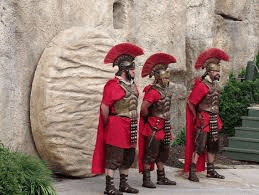
61 Mary Magdalene and the other Mary were there, sitting opposite the tomb. 62 The next day, that is, after the day of Preparation, the chief priests and the Pharisees gathered before Pilate 63 and said, “Sir, we remember how that impostor said, while he was still alive, ‘After three days I will rise.’ 64 Therefore order the tomb to be made secure until the third day, lest his disciples go and steal him away and tell the people, ‘He has risen from the dead,’ and the last fraud will be worse than the first.” 65 Pilate said to them, “You have a guard of soldiers. Go, make it as secure as you can.” 66 So they went and made the tomb secure by sealing the stone and setting a guard.” (Matthew 27:61–66 (ESV)
47 Mary Magdalene and Mary the mother of Joses saw where he was laid.” (Mark 15:47 (ESV)
55 The women who had come with him from Galilee followed and saw the tomb and how his body was laid. 56 Then they returned and prepared spices and ointments. On the Sabbath they rested according to the commandment.” (Luke 23:55–56 (ESV)
In our study of the Gospel of Matthew’s record of the Passion Week of the Lord Jesus Christ, it is necessary, and insightful, to examine all four Gospel accounts. This discipline provides us understanding of all the events and encounters which took place during those hours.
There is a lot of information surrounding the burial of Jesus Christ following His death on the cross. All four Gospels provide insight into this historical moment. The Synoptic Gospels all refer to the Jewish religious leaders’ efforts to secure Jesus’ tomb.
On the day after the Day of Preparation, which was the Sabbath, the Jewish religious leaders met with Pontius Pilate. They wanted Jesus’ tomb sealed and protected from theft or invasion. Their reasons were not altruistic. They remembered the Lord saying He would rise from the dead. While the leaders were sure Jesus would not rise from the dead, they did not want His disciples to steal His body and then say He had come back to life.
Therefore, the chief priests and the Pharisees wanted Pilate to make the tomb secure. Pilate was in no mood for discussion. He said to the Jews, ““You have a guard of soldiers. Go, make it as secure as you can.” They did so by sealing the tomb and setting a guard.
Concurrently, some of the women who were Jesus’ disciples followed these events and knew the exact location of the tomb where Jesus lay. During the Sabbath Day, they prepared spices and ointments in order to complete their annotating of Jesus’ body. This they would do on the first day of week.
“Jesus died late on a Friday afternoon nearly two thousand years ago. Ordinarily in that day, the Jews anointed the bodies of the dead with oil and spices as a sign of respect and to cover up the odor of decaying flesh. But since there was not enough time before the Sabbath to prepare Jesus’ body for burial according to all the proper customs, the body of our Lord could only be wrapped in a cloth and laid in a tomb before the sun set and the day of rest began (Mark 15:46),” explains Dr. R. C. Sproul.
“Ancient Jews reckoned their days from sundown to sundown. Jesus died on a Friday, was laid in the tomb from late afternoon Friday through early Sunday, and then was resurrected sometime Sunday morning near the break of dawn (Mark 16:1–8). That represents a total of three days—Friday, Saturday, and Sunday—because the Jews counted time inclusively. That is, when they said three days from Friday, they included Friday as one of those days.”
One lyricist put it this way: “It’s Friday; but Sunday’s coming.”







 His Word Today