17 “Now from Miletus he sent to Ephesus and called the elders of the church to come to him. 18 And when they came to him, he said to them:“You yourselves know how I lived among you the whole time from the first day that I set foot in Asia, 19 serving the Lord with all humility and with tears and with trials that happened to me through the plots of the Jews; 20 how I did not shrink from declaring to you anything that was profitable, and teaching you in public and from house to house, 21 testifying both to Jews and to Greeks of repentance toward God and of faith in our Lord Jesus Christ.” (Acts 20:17–21)
Jude was not the only one concerned about apostasy within the church. Several years before Jude’s epistle, the Apostle Paul expressed his concerns about false teachers to the Ephesian church elders. We take time to examine this record from the Book of Acts in order to more completely understand the Epistle of Jude.
Acts 20:17 begins a wonderful passage of Scripture depicting the heart of a pastor for the health and wellbeing of a congregation and its elders. The pastor in question is the Apostle Paul. The elders and congregation are the church at Ephesus. The time and culture could be our very own for opposition to the Gospel, and attacks from within and from outside the church remain a clear and present danger.
Paul avoided stopping in Ephesus as he journeyed to Jerusalem. However, while in Miletus he sent for the Ephesian church elders to come and join him. The elders were the ordained representatives of the Ephesian congregation. God called them to overseers and shepherds of the church of God (20:28; I Timothy 3:1-7; Titus 1:5-9).
Paul had some important things to say, which the elders needed to hear. The elders complied with Paul’s request and soon joined him at Miletus.
Paul began his pastoral counsel and encouragement to the Ephesian church elders by reviewing his two-three-year ministry with them at Ephesus (Acts 19:10; 20:31). He shared that he had lived among them, and not detached from them. In other words, Paul knew what kind of church they were and they knew what kind of pastor he was.
He explained that he served the Lord there with humility, tears and trials because of the adversarial plots by the unbelieving Jews in Ephesus. However, even during those difficult days Paul never shirked from his God ordained responsibility of declaring to the elders, and the congregation, the profitable Word of God (2 Timothy 3:16-17). He taught them both in public settings, and also in private visits at people’s homes.
Finally, he related the Gospel of God, which included repentance of sin towards God and also faith in the Lord Jesus Christ. Even today, both Jews and Gentiles must come to God in repentance of sin (Acts 26:20) and trust in, commitment to, dependence upon and worship of Jesus Christ.
If you are a pastor, continue your God ordained responsibilities (2 Timothy 4:1-5). If you are a member of a local congregation, take time today to encourage your pastor(s) for the work God does through them.
“For certain people have crept in unnoticed who long ago were designated for this condemnation, ungodly people, who pervert the grace of our God into sensuality and deny our only Master and Lord, Jesus Christ.” (Jude 4 (ESV)
Jude’s exhortation to the church to contend for the truth (vs. 3) is coupled with becoming aware of individuals within the church who oppose the truth. The struggle for biblical truth was/is not just a philosophical concept but a practical reality. The church not only battles pernicious lies from the outside worldly culture (Eph. 2:1-3; I John 2:15-17), but also battles lies within the confines of the local church. Paul and Peter cautioned church leaders this struggle was coming (Acts 20:17-35; 2 Peter 2:1-3). Jude informed church leaders this struggle had arrived.
Jude stated, “Certain people have crept in unnoticed.” Particular individuals have become part of the church. They “crept in unnoticed” (παρεισέδυσαν; pareisedysan). This occurred at a particular point in time in the past. They did so actively. They did so stealthily and secretly.
“These were infiltrating, false teachers pretending to be true, who on the surface looked like the real thing, but whose intentions were to lead God’s people astray (cf. Matt. 7:15; Acts 20:29; Gal. 2:4–5; 1 Tim. 4:1–2; 2 Pet. 2:1, 20; 1 John 2:18–23). These apostates were Satan’s counterfeits, most likely posing as itinerant teachers (cf. 2 Cor. 11:13–15; 2 Pet. 2:1–2; 2 John 7–11). Their stealth made them dangerous,” explains Dr. John MacArthur.
Every church leader and church member must be on their guard against false teachers. They appear to be genuine believers in Christ, but inwardly they are false shepherds (Matt. 7:15). They can be identified by the lack of godly fruit in their lives (Matt. 7:16). They manifest wickedness because this is what they are inwardly (2 Peter 2:12-22).
However, the Lord is keenly aware of them. He has already condemned these false teachers. “Who long ago were designated for this condemnation.” The phrase “long ago” (πάλαι; palai) refers to the distant past. In the past, the Lord “designated” (προγεγραμμένοι; progegrammenoi) or proclaimed them to be “condemned” (κρίμα; krima) or judged.
“Apostasy and apostates in general were written about and condemned many centuries before, such as illustrated in Jude 5–7 and spoken of as Enoch did in vv. 14–16. Cf. Isa. 8:19–21; 47:9–15; Hos. 9:9; Zeph. 3:1–8. Their doom was “pre-written” in Scripture as a warning to all who would come later. Jesus had warned about them in Matt. 7:15–20 (cf. Acts 20:29). The most recent warning had been 2 Pet. 2:3, 17; 3:7. This condemnation refers to the judgment spoken of by others “long ago.” Jude’s present exposé of apostates placed them in the path of the very judgment of God, written of previously,” continues Dr. MacArthur.
Jude describes them in his familiar triad writing style. These apostates or defectors of the true faith.
First, they were “ungodly people” (ἀσεβεῖς; asebeis). They were impious, wicked, profane and without reverence for the one, true God (cf. Rom. 4:5; 5:6, 1 Tim. 1:9, 1 Peter 4:18, 2 Peter 2:5, 6; 3:7).
Second, they “pervert the grace of our God into sensuality.” To pervert (μετατιθέντες; metatithentes) is a present, active participle. These individuals presently and actively imposed a change or a transferal of God’s grace (χάριτα; charita), or His unmerited favor towards sinners, into sensuality (ἀσέλγειαν; aselgeian). This refers to licentiousness or excessive sin and rebellion. It is unrestrained vice or gross immorality.
Third, they “deny our only Master and Lord, Jesus Christ.” The reject the exclusivity of salvation by grace alone, through faith alone in the person and work of Jesus Christ alone.
“Two Greek words for Jesus are used here. The apostates disowned Christ as sovereign Lord (despotes) and disdained any recognition of Christ as honorable Lord (kurios) by their wicked behavior. The better NT manuscripts omit God in the text, placing the emphasis clearly on one person, the Lord Jesus Christ, and emphasizing that apostates deny him. Cf. Matt. 10:33; 2 Tim. 2:12; Titus 1:16; 1 John 2:22–23. It is always true of apostates, false teachers, and false religions that they pervert what Scripture declares is true about the Lord Jesus Christ,” concludes Dr. MacArthur.
“We make two observations: Jude does not indicate whether these godless men at one time belonged to the Christian community; and these infiltrators are dishonest in their relations with the believers, for they furtively slip into the church,” states Dr. Simon Kistemaker.
“By their secrecy, they reveal their motives. Probably, they are itinerant teachers who were bent on destroying the church of Jesus Christ. The New Testament presents numerous warnings to the believers to avoid strange teachings from false teachers (cf. Phil. 3:2; Col. 2:8; 2 Tim. 3:6; I John 3:7; 4:1; 3 John 7).”
In vs. 4. Jude explains what these apostate and false teachers do. In the remainder of the epistle, he explains what these individuals are.
May we consistently be aware of false teachers. How they live and behave reveals what they believe and teach. May the Lord’s grace and truth be found here.
Continuing our study in Paul’s Epistle to the Colossians, a new paragraph begins in Colossians 3:18-4:1. The truth of what believers “are” in Christ is to be balanced by how believers are to live for Christ. The practical truth of Jesus Christ as the only and all-sufficient Savior, and as sole source of the believers’ life, is now applied to specific groups and situations. What people groups does the Apostle Paul, and the Holy Spirit, have in mind?
Primarily, they were thinking of household groups. What we have in this extended biblical section is a kind of “catalogue of household responsibilities.” Even non-Christian moralists advocate mores of domestic, blissful behavior. Sometimes, Christians opt for secular advice rather than the word of God regarding family life. However, Paul was not adding to unbiblical opinions or philosophies. The apostle was not sugar-coating domestic relationships with a thin veneer of merely adding “in Christ”—which completely misses the point.
Between these pithy directives presented here in Colossians—also in Eph. 5:22–6:9; 1 Tim. 2:8–15; 6:1, 2; Titus 2:1–10; 1 Peter 2:12–3:7—and the maxims of the Stoics and other first century Greek moral philosophers, there is a superficial resemblance. Yet, there are at least three main differences.
First, biblical Christianity supplies the power to carry out the commands. The power being the grace of God (Titus 2:1–10, then verse 11; cf. Phil. 4:13), and the indwelling presence of the Holy Spirit (Romans 8:1-9; I Cor. 6:919-20). All other moral philosophies, even the very best of them, are vehicles lacking these engines.
Second, biblical Christianity also supplies a new purpose. The goal was/is not simply to try to live in harmony with Nature. Rather, believers in Christ are “to do everything to the glory of God” (1 Cor. 10:31). Or, to do all “in the name of the Lord Jesus, giving thanks to God the Father through him,” (Col. 3:17). The only proper way to explain Col. 3:18–4:1 is in light of Col. 3:5-17 and the emphasis on godly behavior, speech and attitudes.
Finally, biblical Christianity supplies the only true pattern for God-glorifying behavior and conduct by the very household groups Paul discussed: wives and their husbands, children and their fathers, servants and their masters. “Christ himself, as the bridegroom, in his matchless love for the church, his bride, furnished the standard for the love of Christian marriage (Eph. 5:22-33),” explains Dr. William Hendriksen.
Let’s begin with the wife. “Wives, submit to your husbands, as is fitting in the Lord.” A wife (γυναῖκες (gynaikes) is to submit to her husband. To submit (ὑποτάσσεσθε (hypotassesthe) means a wife is to presently, personally, and obediently have a voluntary attitude of giving in, cooperating, assuming responsibility, and carrying a burden in their marriage. Submission means being responsible to and responsible for one’s own husband.
Ephesians 5:22–24 (ESV) – “22 Wives, submit to your own husbands,as to the Lord. 23 For the husband is the head of the wife even as Christ is the head of the church, his body, and is himself its Savior. 24 Now as the church submits to Christ, so also wives should submit in everything to their husbands.”
The biblical text continues to say this is fitting (ἀνῆκεν (aneken), The wife’s submission in her marriage is to continually, actively and personally do what is proper, right, and correct in the Lord’s perspective.
What about husbands? “Husbands, love your wives, and do not be harsh with them.” To love (ἀγαπᾶτε (agapate) means to presently, actively and obediently display concern and a self-sacrificial love of the will. This sacrificial spirit goes beyond the emotions of the moment. Rather, it is a resolution of the will for a lifetime.
To not be harsh (Πικραίνεσθε (pikrainesthe) means to presently and obediently not make one’s wife bitter, resentful and hateful towards you. Harshness is the spirit the husband is “not” to create within his wife. The fruit of the Spirit should dominate the husband in this relationship (Gal: 5:22-23).
Then we have the children. “Children, obey your parents in everything, for this pleases the Lord.” Children (tέκνα; tekna) are their parent’s offspring. To obey (ὑπακούετε (hypakouete) means to presently, actively and obediently pay attention to, comply and submit to mom and dad. Parents (γονεῦσιν (goneusin) are biological or legal guardians.
This spirit of obedience is to be in everything (Iάντα; panta). This refers to every kind of situation and circumstance, which coincides with godly behavior. The reason for obedience to this command is because it pleases (εὐάρεστόν; euareston) or is acceptable before the Lord.
What is the parent’s responsibility with their children?“Fathers, do not provoke your children, lest they become discouraged.” Fathers (Πατέρες ;pateres) are the leaders of the family (Eph. 6:1-2). To not provoke (ἐρεθίζετε; erethizete) means to presently, actively and obediently not make children bitter or resentful. In other words, to not provoke them to wrath or resentment. Otherwise, children may become discouraged (ἀθυμῶσιν; athymosin) or actively disheartened. The word literally means to lose energy or passion. Discouraged children lose hope, stop trying, and give up. They don’t care.
“It is tempting to blame children for our family problems. But Scripture does not allow us to do this. Children bear the responsibility to obey their parents. But God commands parents to raise their children with godly nurture, being careful not to frustrate them. Inestimable damage is done by parents who provoke their children, and cause them to become discouraged,” explains Pastor William Boekestein.
“While specifically addressing fathers in Colossians 3:21, God is speaking to both parents. The word translated; “fathers” is elsewhere used to mean “parents” (Heb. 11:23). Additionally, fathers are spoken to as covenant heads of the families. Fathers are to see that neither parent provokes the children. Fathers cannot stand idly by if their children are being provoked by their mothers.”
Pray for your family and the relationships therein. May the Lord bless the obedience of all family members: young and older, wives and husbands, parents and children. May the Lord’s truth and grace be found here.
“Beloved, although I was very eager to write to you about our common salvation, I found it necessary to write appealing to you to contend for the faith that was once for all delivered to the saints.” (Jude 3 (ESV)
“The book is a solemn warning to Christians everywhere, since all are subject to the same doctrinal and practical errors. Though its theme regarding apostasy was specifically directed to first-century Jewish Christians, its message is applicable to all Christians. All believers need to avoid the pitfalls of denying Christ’s lordship, promiscuously following the fleshly desires, rejecting authority, being divisive, and living for self.” – Dr. Edward C. Pentecost
Have your prepared plans ever been interrupted by an unexpected event or set of circumstances? Perhaps a scheduled vacation or activity is delayed by an illness, accident and/or death in the family.
I will always remember Christmas morning of 2002. As always, there was the anticipation of opening presents and enjoying a relaxing day with family and friends; near or far, in person or by text or phone call.
Snow began falling late Christmas Eve and by 4:00 am Christmas Day, Northeast Indiana was a scenic winter wonderland. Six inches of snow lay on the ground and more was expected. I did not have to dream about a White Christmas that year because it was a reality.
I was abruptly awakened by the phone. As a pastor., 4:00 am phone calls are seldom good news. A family in our congregation called to say they were on their way to the Fort Wayne Airport. While in route, their mini-van broke down leaving them stranded at a nearby gas station convenient store parking lot. They needed someone who had a van, who could drive them to the still open airport, and who wouldn’t be angry about being asked to do so. I fit all of the above qualifications.
I drove my friends to the airport that snowy, Christmas morning and cut a trail over unplowed roads and an interstate highway. The only other vehicles I remember seeing were occasional state police and county sheriff cars and SUV’s. Amazingly, they did not stop us.
Once I delivered my previous cargo to the airport, I returned alone to my home listening to Christmas music on the van’s CD player. My wife and two kids were anxiously awaiting my arrival so we could enjoy our Christmas morning. An unexpected phone call, and a particular need of a family, resulted in a Christmas memory I’ll always cherish.
What does my personal recollection have to do with the Epistle of Jude? Jude had intended to write a letter of encouragement to fellow believers in Christ. ““Beloved, although I was very eager to write to you about our common salvation,”
The phrase “I was very eager” (σπουδὴν; spouden) refers to diligence, to work hard and to do one’s best. Jude eagerly wanted to write to these believers. It was not something he dreaded. Jude possessed an intense motivation and enthusiastic desire.
“In a few words Jude reveals the reason for the composition of his letter: He wants to encourage the readers to affirm their faith. Jude addresses his readers with a common greeting of that day: “dear friends” (also see vv. 17, 20). Literally translated the term means “beloved.” He puts this greeting in the context of the address (“to those … who are loved by God,” v. 1) and the blessing (“mercy, peace and love be yours in abundance,” v. 2),” explains Dr. Simon Kistemaker.
Then, rather unexpectedly, he discovered a greater need existed. It was the need for a solemn warning of danger. “I found it necessary to write appealing to you to contend for the faith that was once for all delivered to the saints.”
This is what is upon my heart. To share the wonderful truths of the gospel of Jesus Christ. To dwell upon the blessings of our common salvation is an indescribable joy. It brings such a sense of God’s pleasure to focus on what He has given us in Christ. However, as now there are times when rather than communicate the blessings of God to the flock God has given me to shepherd, I am compelled by Him to preach about the burden of contending for truth in a world and culture living on lies. It is this culture of lies which threatens every local church; past, present, and future.
Jude appealed (παρακαλῶν; parakalon) or implored his readers to contend for the faith. What does it mean to contend for the faith? To contend (ἐπαγωνίζεσθαι; epagonizesthai) is a present, middle infinitive verb referring to an ongoing, personal action of struggling on behalf of someone or something. The faith (πίστει; pistei) is not one’s personal trust in Christ but rather the content or doctrine to trust in, commit to, depend upon and for which we honor and worship the Lord.
It was this doctrine and teachings, through the prophets and apostles, which the Lord delivered to the believers in Christ (2 Timothy 3:16-17; 2 Peter 1:20-21). The Scriptures calls them saints or the called-out ones (ἁγίοις; hagiois). God calls believers saints on the basis of grace alone, through faith alone, in the person and work of Jesus Christ alone.
“Wishing to write of the more pleasant theme of salvation, Jude was forced by his concern to write on an urgent and abhorrent theme. Circumstances had arisen that demanded immediate action, thus presenting an emergency situation. Jude addressed himself to a recognized problem, and exhorted the believers to respond with positive determination,” states Dr. Pentecost.
“As a pastor, Jude clearly distinguishes between the recipients of his letter and the false teachers. He expresses his love to the readers, but also tells them to be aware of the pernicious teachings of these heretics. The term beloved demonstrates his affection for the members of the Christian church, who through Jesus Christ experience the love of God the Father,” concludes Dr. Kistemaker.
Who were these individuals of whom Jude would warn his fellow believers in Christ? This is the subject of the next blog. I encourage you to read Jude 4.
“May mercy, peace, and love be multiplied to you.” (Jude 2 (ESV)
Jude began his epistle by immediately identifying who he was and to whom he was writing (vs.1). He called himself by name, a servant of Jesus Christ and a brother of James. He referred to his readers those who God the Father called, loved and kept.
Jude continued by invoking a common Jewish blessing, or greeting of God’s favor, found in all of the Apostle Paul’s epistles. Employing his characteristic triad, Jude used three nouns in his blessing: mercy, peace and love. What do these three words mean?
Mercy (ἔλεος; eleos) refers to pity and compassion. It also means to show kindness to someone in serious need. Regarding salvation, mercy is God “not” giving what sinners deserve; His wrath and judgment for their sin. Mercy compliments the biblical doctrine of God’s grace, which is God giving what the sinner “does not” deserve; salvation.
Mercy is the need on the part of him who receives it and the resources necessarily adequate to meet the need on the part of God who shows it. Mercy is the sovereign act of God wherein He does not give us what we deserve but rather what we do not deserve; salvation. But here in the context, not just salvation, for they are already saved, but rather mercy displayed towards others as a Christian virtue. Since believers have received mercy from God, they are to exercise mercy in relation to their fellow human beings. It is tolerance when justice demands punishment.
Peace (εἰρήνη; eirene) means tranquility and freedom from worry on the basis of favorable circumstances. Peace also refers to the tranquility and harmony existing between two parties.
There is peace with God (Rom. 5:1). There is also peace with fellow believers in Christ (Rom. 15:13) and in the midst of the circumstances of life (Phil.4:6-7). Peace is also a fruit of the Holy Spirit’s work in our souls (Gal. 5:22-23).
Love (ἀγάπη; agape) refers to self-sacrificial love of the will. Is a love of the will which regards the recipient of such love as valuable and precious. Such love is to be the hallmark of each believer in Christ (I Cor. 13; I John 4:7-11). This is because God so loved us (Jude 1).
Jude in effect prays God will multiply all three Christlike characteristics within the lives of each believer to whom he is writing. Multiply (πληθυνθείη; plethyntheie) means to greatly increase. In addition to God’s mercy, peace and love establishing our position before Him in Christ, we are also to display such mercy, peace and love to fellow believers in Christ.
The Apostle Paul expressed this to the Ephesian Church. Ephesians 4:32 (ESV) says, “Be kind to one another, tenderhearted, forgiving one another, as God in Christ forgave you.”
“Jude says, “May mercy and peace and love” – not be yours but “be” – what? – “multiplied to you.” May mercy and peace and love be multiplied to you because you’re the called and the loved and the kept. The verb here, plēthunō, means to be increased. May you just have a constantly increasing amount of this. It’s like Peter said, 1 Peter 1:2, “May grace and peace be yours in fullest measure.” Or 2 Peter 1:2, “Grace and peace be multiplied to you.” It’s the same thing,” explains Dr. John MacArthur.
“The divine provisions of mercy, peace, and love included in Jude’s greeting are needed by Christians living in the licentious atmosphere of apostate teaching. God’s mercy can sustain them in times of difficulty (Heb. 4:16); His peace can give a subtle calmness when evil abounds (Rom. 15:13; Phil. 4:7); and His love can protect and assure believers in the face of peril (Rom. 5:5; 1 John 4:12, 15–16),” states Dr. Edward C. Pentecost.
“The nature of the salutation reflects the writer’s attitude. Jude’s choice of words introduces his deep-seated compassion and heartfelt concern for his readers. He longed for them to know in the fullest measure God’s “mercy, peace, and love.” Jude overflowed with love for the believers while warning them about those who were making their way into the church to destroy it, those who knew nothing of God’s mercy, peace, or love.”
How may believers in Christ display God’s mercy, peace and love towards fellow believers, and also non-believers? We truly evidence the Lord’s mercy, peace and love He gave us when we give it to others; even when it is not easy and also when we do not feel like doing it. I encourage you to meditate upon I Corinthians 13:1-8 and I John 4:7-12 today.
May the Lord’s mercy, peace and love be found here.
“Jude, a servant of Jesus Christ and brother of James, To those who are called, beloved in God the Father and kept for Jesus Christ:” (Jude 1 ESV)
“God’s truthfulness means that he is the true God, and that all his knowledge and words are both true and the final standard of truth.” – Dr. Wayne Grudem
Conclusions are certain regarding who wrote the Epistle of Jude. Evangelical scholars agree Jude was the brother of James (James 1:1) and both Jude and James were the half-brothers of Jesus (Matt. 13:55; Mark 6:1-3).
What biblical scholars and students of Scripture are less certain is who were the recipients of Jude’s letter? No particular church, and no particular person, is mentioned throughout the epistle.
“There is no indication in the letter of its place of writing or its destination. While some believe Jude’s use of the Old Testament (OT) and Jewish apocryphal literature points to a Jewish Christian audience, this material may reveal more about his own background than that of his readers. Perhaps Jude wrote his epistle as a circular letter to a number of churches whose conditions he knew from having conducted an itinerant ministry among them (I Cor. 9:5),” explains Dr. R. C. Sproul.
“The tone of the letter demonstrates that the original recipients may have been Christian Jews of Palestine who were gathered into local fellowships. The references made to Old Testament incidents and to extrabiblical literature identified the recipients as people who would understand these references with no need for explanation. Egypt, Sodom and Gomorrah, Moses, Cain, Balaam, Korah, Enoch, Adam, and the fallen angels all point to a people familiar with Old Testament history and possibly apocryphal literature,” states Dr. Edward C. Pentecost.
“Who are the original readers of Jude’s epistle? Frankly, we do not know where they resided, because the envelope with the address is lost, so to speak. By examining the content of the letter, we are able to make a few observations about these readers,” states Dr. Simon Kistemaker.
“The recipients of the epistle are well versed in the Old Testament Scriptures, for the author commends them for knowing pertinent facts concerning the exodus (v. 5), angels (v. 6), and Sodom and Gomorrah (v. 7). They know the names of Cain, Balaam, and Korah (v. 11). And they are acquainted with Jewish literature current in the first century (vv. 9, 14). We surmise, therefore, that the recipients were Jewish converts to the Christian faith.”
“Jude’s letter contains no explicit or implicit references to a Gentile audience. The content of this epistle is such that only Jewish people can fully understand the meaning of Jude’s writing. However, we should also consider the letter from the writer’s point of view: Jude wrote as a Jew and thus reflected his own Jewish background. Perhaps we do well to say that Jude addressed Jewish Christians living in dispersion in any of the large Jewish centers of the Middle East. From the content of the two epistles of Peter we are able to conclude that these letters were addressed to Jewish and Gentile Christians living in Asia Minor (1 Peter 1:1). From the content of Jude’s epistle, however, we are unable to determine its place of destination,” concludes Dr. Kistemaker.
What we initially do know about Jude’s audience is contained in the epistle’s second triad. These recipients were called, beloved in God the Father, and kept for Jesus Christ. In other words, these were believers in Christ who God the Father declared righteous by grace alone, through faith alone in the person and work of Jesus Christ alone.
To be called (κλητοῖς; kletos) in this context means to be invited and summoned into a covenant relationship with the Lord. These individuals, for the adjective is in the plural, are believers in Christ. They had experienced the reality of God’s foreordination, predestination, calling, justification, and glorification (Romans 8:29-30). They were converted.
God the Father also beloved them., Beloved (ἠγαπημένοις; egapemenois) is a perfect, passive, plural participle. From this grammatical observation, Jude’s usage of this verb reveals God converted these believers in the past and this past completed act had continuing results in the present and future. Also, these individuals were passive recipients of the Lord’s active work. Like all saved sinners, they had not saved themselves. Thirdly, more than one person experienced this salvation for this is a plural verb.
In this context, to be beloved means to have received God the Father’s self-sacrificial love of the will (John 3:16; Romans 5:8-10; I John 4:7-11). Jude’s usage of the phrase God the Father respectively depicts the Lord as not only transcendent and sovereign but also immanent, near and caring.
“Of the three persons of the Trinity, the Father’s deity is perhaps the most evident in the text of Scripture. For instance, Jesus refers to His God and Mary’s God—the God of the Jews, of the Old Testament—as Father (John 20:17). Elsewhere in the New Testament, we see references to “God the Father” (e.g., Phil. 2:11; 1 Peter 1:2; Jude 1). The Apostle Paul’s conviction of the deity of the Father can be seen in that often he simply says “God” in a context where he is clearly referencing the Father (e.g., 2 Cor. 13:14). Turning to the Old Testament, we see references to Israel’s being the “son” of Yahweh, the one true God, in texts such as Exodus 4:22–23. That, of course, would make God the Father of Israel. To sum it up, plainly God the Father is divine,” explains one commentator.
Finally, they are kept for Jesus Christ. To be kept (τετηρημένοις; teteremenois) means to be guarded, retained and to continue. This verb is also a perfect, passive, plural participle. God the Father continually guarded these believers on behalf of the Lord Jesus Christ for an eternal salvation (John 6:35-44).
“To those who have been called.” Jude fails to mention the epistle’s place of destination. In his letter Jude provides no evidence that he functions as a spiritual father to a specific group of people. Nevertheless, he writes to Christians who need counsel and encouragement to oppose the doctrines of false teachers. Jude first describes the spiritual gifts the believers have received. They have been called by God to be his people. That is, those who have been called are Christians. They have left the world of sin and have entered the light of life,” explains Dr. Kistemaker.
“Who are loved by God the Father.” Jude uses language that is similar to Paul’s letter to the Romans: “You … who are called to belong to Jesus Christ. To all in Rome who are loved by God” (1:6–7). When God calls sinners to himself through Jesus Christ, he as their Father expresses his love to them. He welcomes sinners into the family of believers and the household of God. Through Christ, then, believers experience the continual love of God the Father.”
“And kept by Jesus Christ.” These words echo the prayer of Jesus concerning his disciples: “While I was with them, I protected them and kept them safe by that name you gave me” (John 17:12). Jesus protects his followers from the evil one. Although the previously mentioned clause is a faithful translation, another version has the reading kept for Jesus Christ. This version places the emphasis not on Jesus’ constant watchfulness over the believers, but on the believers being kept by God for the day of Jesus Christ. The Father protects the followers of Jesus from the attacks of Satan (John 17:15) and keeps them whole and complete at the coming of Jesus Christ (1 Thess. 5:23). We conclude that scriptural support for both translations is strong, for these two strands of teaching were current in the early church. Furthermore, the writers of the New Testament epistles often do not carefully differentiate between the work of the Father and the work of the Son,” concludes Dr. Kistemaker.
“Jude, a servant of Jesus Christ and brother of James,” (Jude 1a (ESV)
The Epistle of Jude’s first word “Jude” raises the question as to the identity of this individual. The Hebrew name “Judah” or in the Greek “Judas” is comparable to the English name “Jude.” The author’s identity cannot be ascertained solely based upon his name.
There are at least six individuals in the Scriptures who have this name Jude. Those who bore the name Jude include the following:
Judas the son of James – Luke 6:16; Acts 1:13. One of the twelve disciples. He was also called Thaddeus. However, the author of this book does not call himself an apostle.
Judas Iscariot – Luke 6:16; Acts 1:15-20. For obvious reasons, the writer cannot be Judas Iscariot.
Judas the Galilean – Acts 5:37. He was a revolutionary who was killed because of his subversive activities.
Judas Barsabbas – Acts 15:22-32. He was present at the Jerusalem Council and served as letter carrier to the Gentile Churches.
Judas – Luke 3:33. An ancestor of Jesus.
Judas – Matthew 13:55; Mark 6:3). The brother of James and the half-brother of Jesus.
It is evident that this final individual listed is the author of this epistle. Why? Today’s text provides the best evidence as to Jude’s identity; “brother of James.”
“The best clue as to his identity is the description “brother of James (vs.1). The only James known well enough in the early church to be referred to in this unqualified way is James the prominent church leader (Acts 12:17; 15:13), author of the epistle that bears his name, and half-brother of Jesus (Matt. 13:55; Mark 6:3; Gal. 1 :19). If this identification is correct, the author of the present epistle is Jude, the half-brother of Jesus (Matt. 13 :55; Mark 6:3), who, along with his other brothers, did not believe in Jesus until after the resurrection (Mark 3:21, 31; John 7:5; Acts 1:14),” explains Dr. R. C. Sproul.
Jude does not mention his father but rather his brother; James. Why? James was the pastor of the church in Jerusalem and the author of the Epistle of James. How can we be sure that this is the James to whom Jude is referring? Because no other James mentioned in Scripture also is identified as a brother of our Lord except Jude and James. Others in scripture who had the name James are also as follows:
James the son of Zebedee (Matthew 10:2).
James the son of Alpheus (Matthew 10:3).
James the younger (Mark 15:40).
James the father of Judas (Luke 6:16; Acts 1:13).
James the half-brother of our Lord (Matthew 13:55; Mark 6:3; Acts 15:13; 1Cor. 15:7; Gal. 1:19; 2:9;).
“From the self-identification of Judas as the brother of James we conclude that Jude, the (half) brother of Jesus, is the author who wrote the epistle. Notice that he does not call himself an apostle. Were that the case, we would know that the writer was Judas, the son of James. Instead, in his epistle the author separates himself from the apostles when he writes, “Remember what the apostles of our Lord Jesus Christ foretold” (v. 17),” states Dr. Simon Kistemaker.
“Further corroboration comes from a second-century Jewish-Christian historian named Hegesippus. He relates that grandsons of Jude (“who is said to have been the brother, according to the flesh, of the Saviour”) were summoned before Emperor Domitian. This summons presumably took place in a.d. 96. When the emperor saw their calloused hands and learned of their meager income, he despised them as inferior people and dismissed them.”
Keeping with the epistle’s characteristic of triads, following his name, and prior to him mentioning his relationship to James, Jude identified himself as “a servant of Jesus Christ.”
A great deal is discovered about an individual by observing what they do not say about themselves. Jude does not call himself a brother of Jesus (vs.1). Neither did James (James 1:1). Jude recognized physical kinship to Jesus did not give him any special privileges. As should all believers in Christ, he recognized Jesus as his Lord and Master.
We also learn a great deal about an individual by observing what they do say about themselves. Jude called himself a bondservant (δοῦλος; doulos), or a slave. This was a subjection without the idea of forced bondage. Servant described a relationship of absolute dependence in which the total commitment of the δοῦλος on the one side corresponded to the total claim of the Lord or Master (κύριος; kurios) on the other. Notice, Jude did not claim apostleship.
The phrase “of Jesus Christ” referred to absolute and sole possession. Jesus Christ, the only Savior and Lord, possessed Jude. Jude understood this and willingly submitted to the Lord’s authority. He was the Lord’s slave.
“He knew what slave meant. He lived in a world of slavery. He was a slave in world of slaves, and this was a very familiar way to designate oneself. Paul, Romans 1:1, a bondservant of Christ Jesus. Paul loved that designation. Philippians 1:1, Paul and Timothy, bondservants of Christ Jesus. And even Peter saw himself the same way, 2 Peter 1:1, Simon Peter, a bondservant and apostle of Jesus Christ. And though we as Christians are free from the law and we’re free from its condemnation, we are still slaves to righteousness and slaves to the righteous One,” concludes Dr. John MacArthur.
How do you refer to yourself? Are you enamored with your titles, power and position? What a privilege it is to be a servant of the Lord Jesus Christ. Each of us who claim the Lord to be our Savior, may we live out in practice what we are in position; slaves in humble service for the Master.
” Sanctify them in the truth; your word is truth.” (John 17:17 ESV)
“There is only one truth, one worldview, that is sufficient to explain the world around us and the world within us. Only one fills the philosophical need of existence, of being, and it is the Judeo-Christian God—not just an abstract concept, but rather that this God is really there,” – Francis Schaeffer
The Epistle of Jude is not just a polemic against false teachers and apostates. The majority of the letter (vs. 4-19) addresses the subject of heretics and their serious threat to the church’s wellbeing, Jude encouraged his audience to be witnesses to biblical truth (vs.3), grow in biblical truth (vs. 20) and seek out those wavering from biblical truth (vs. 22-23). The truth of God, and from God, was important to this servant of Jesus Christ.
Jesus prayed for God the Father to sanctify (ἁγίασον; hagiason), dedicate and make Jesus’ disciples holy. The means for holiness is truth (ἀληθείᾳ; aletheia). Truth means what is real . Truth reflects and corresponds to reality. Jesus said the source of truth was the Word of God.
“In Scripture, truth is a very important concept because God is the God of all truth (Ps. 31:5; 108:4; 146:6), who speaks and judges truly (57:3; 96:13). He is the real source and cause of the whole universe. Scripture also focuses on the revealed truth in the gospel of God’s redeeming grace through Christ. This is the truth Christ and the apostles proclaimed (Jn 8:44–46; 18:37; Rom 9:1; 2 Cor 4:2), which was foreshadowed in the OT (1 Pt 1:10–12), and witnessed to by the Holy Spirit (Jn 16:13). The OT teaching was never false, but it was shadowy and incomplete in comparison with the revealed truth of the NT. Christ brought spiritual reality (Jn 1:17), and the Holy Spirit leads believers into the experience of all that is real in Christ (16:13).” –Tyndale Bible Dictionary
“In John 17 Jesus prays to the Father, “Sanctify them in the truth; your word is truth” (John 17:17). This verse is interesting because Jesus does not use the adjectives ἀληθινός (G240) or ἀληθής (G239, “true”), which we might have expected, to say, “Your word is true.” Rather, he uses a noun, ἀλήθεια (G237, “truth”), to say that God’s Word is not simply “true,” but it is truth itself,” states Dr .Wayne Grudem.
The difference is significant, for this statement encourages us to think of the Bible not simply as being “true” in the sense that it conforms to some higher standard of truth, but rather to think of the Bible as being itself the final standard of truth. Some scholars object that it is “too simplistic” to argue as follows: “The Bible is God’s words. God never lies. Therefore, the Bible never lies.” Yet it is precisely that kind of argument that Paul uses in Titus 1:2. He refers to the promises of eternal life made “ages ago” in Scripture and says the promises were made by God “who never lies.” He thus calls on the truthfulness of God’s own speech to prove the truthfulness of the words of Scripture. A “simple” argument this may be, but it is scriptural, and it is true. We should therefore not hesitate to accept it and use it.”
Jude is a derivative of the names Judah and Judas. Ironically, the LORD would use an individual named Jude to combat heresy within the church, when another individual, Judas Iscariot, defected from the truth and committed high apostasy against the Lord, Jesus Christ. Respectively, one man was committed to truth while the other committed betrayal against the Way, the Truth and the Life (John 13:10-11, 21-30; 14:1-6).
Throughout the Scriptures, the truth of God’s Word is paramount. Dr. Sproul, when asked how concerned should believers in Christ be for the lack of truth taught in the church, he answered:
“I don’t know how to put a ceiling on that concern. The church is to be the house of truth. The church is to be founded on truth. The church is committed to the distribution and proclamation of the truth. If you’re not concerned about truth, then what are you doing in the church at all?”
“We’re living in one of the darkest moments in church history with respect to concern for truth. People seem to be more concerned about peace and relationships. They say, “I don’t need to know doctrine, I just want to have good relationships.” They don’t understand that the truth of God’s Word is the only way you can define what a good relationship is.”
“If you don’t care about truth, you don’t care about the Word of God. If you don’t care about the Word of God, you don’t care about the Son of God. Furthermore, if you don’t care about the Son of God, you don’t care about God. We could talk all day about the vital necessity of being immersed in the pursuit of truth, the defense of truth, and contending for the truth. All of these things are a part of the Christian’s calling.”
“There’s so much falsehood in the world, and Satan himself is the father of lies. What nourishes and nurtures our souls more than anything is the truth of God. I don’t want to devote my life to something that isn’t true. Again, that truth is defined by God Himself, who is the Author of truth, the Fountainhead of truth, the Source of all truth”.
“Jesus Himself was the personification of truth: “I am the way, the truth and the life” (John 14:6). When Jesus prayed in the upper room for the sanctification of His disciples, He said, “Father, sanctify them.” How? “By Thy truth, Thy Word is truth” (John 17:17). If you don’t care about truth, there’s no concern about sanctification. It is impossible to be a Christian and not care about the truth.”
In his epistle, Jude did not fixate on false doctrine. You would think he would have, considering the theme of truth. Rather, he focused his attention on false teachers; their character and their conduct. Identifying apostates logically leads to identifying apostasy. The latter logically follows the former. You do not have one without the other.
“The Bible is God’s Word, and God’s Word is the ultimate definition of what is true and what is not true: God’s Word is itself truth. Thus, we are to think of the Bible as the ultimate standard of truth, the reference point by which every other claim to truthfulness is to be measured. Those assertions that conform with Scripture are “true” while those that do not conform with Scripture are not true. What then is truth? Truth is what God says, and we have what God says (accurately but not exhaustively) in the Bible,” concludes Dr. Grudem.
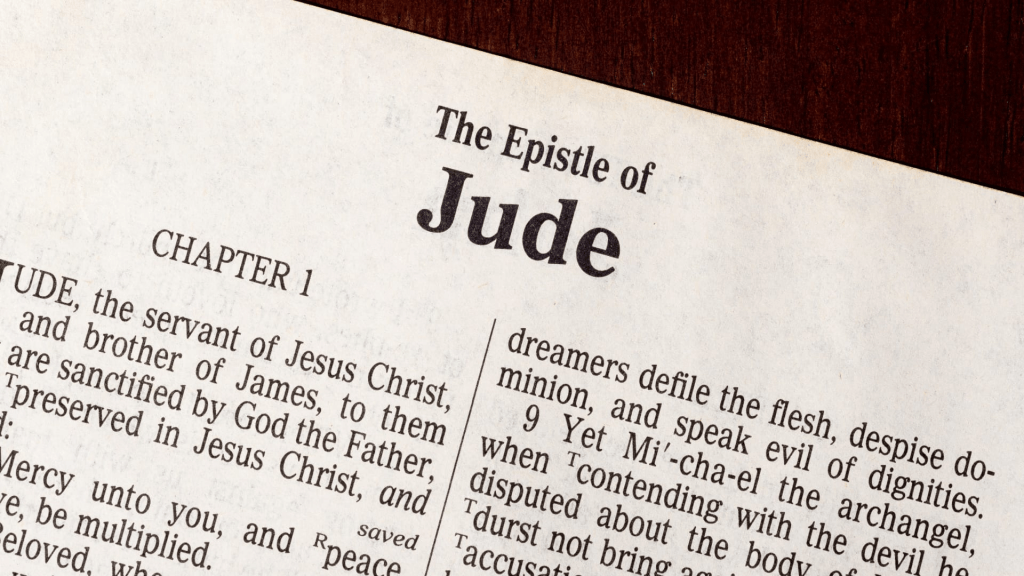
“Jude, which is rendered “Judah” in Hebrew and “Judas” in Greek, was named after its author (v. 1), one of the 4 half-brothers of Christ (Matt. 13:55; Mark 6:3). As the fourth shortest NT book (Philem., 2 John, and 3 John are shorter), Jude is the last of 8 general epistles. Jude does not quote the OT directly, but there are at least 9 obvious allusions to it. Contextually, this “epistolary sermon” could be called “The Acts of the Apostates.” – Dr. John MacArthur
“This short epistle was not lost in the first few centuries of the Christian era but was providentially preserved. It circulated widely in the church and, although some leaders expressed reservation, the letter was accepted as God’s Word. Even if the letter was not written by an apostle, the church gave Jude’s epistle canonical status. Church councils fully acknowledged its status in the last decade of the fourth century (e.g., the Council of Carthage in a.d. 397).” – Dr. William Hendriksen
With only twenty-five verses, the intention is to complete this study of Jude in approximately two months. Each blog will focus on a particular chronological verse. Building on the foundation Jude gave in vs. 1, the goal is to have an overall understanding of this entire, concise epistle. Today’s installment is an introduction of the epistle.
Jude identifies himself “a servant of Jesus Christ and a brother of James (Acts 15; Gal. 1:19). He does not mention he is the brother of the Lord (see Matt. 13:55; Mark 6:3). This may well be because of his humble spirit and an understanding his half-brother is the Lord of heaven and earth. Jude does not call himself an apostle (vs. 1), but distinguishes himself from the apostles (vs. 17).
“The doctrinal and moral apostasy discussed by Jude (vv. 4–18) closely parallels that of 2 Peter (2:1–3:4), and it is believed that Peter’s writing predated Jude for several reasons: 1) 2 Peter anticipates the coming of false teachers (2 Pet. 2:1,2; 3:3), while Jude deals with their arrival (vv. 4,11,12,17,18); and 2) Jude quotes directly from 2 Pet. 3:3 and acknowledges that it is from an apostle (vv. 17,18). Since no mention of Jerusalem’s destruction in A.D. 70 was made by Jude, though Jude most likely came after 2 Peter (ca. A.D. 68–70), it was almost certainly written before the destruction of Jerusalem,” explains Dr. MacArthur.
“Although Jude did travel on missionary trips with other brothers and their wives (1 Cor. 9:5), it is most likely that he wrote from Jerusalem. The exact audience of believers with whom Jude corresponded is unknown, but seems to be Jewish in light of Jude’s illustrations. He undoubtedly wrote to a region recently plagued by false teachers.”
The historical background to the epistle was when Rome was attacking the church politically and culturally from without and false teachers were attacking the church theologically from within. Jude encouraged the believers in Christ to “contend for the faith” (vs.3). This was a time for the church to be fervently active in its commitment to biblical truth.
Jude is the only book in the New Testament singularly devoted to confronting apostasy. Apostasy is a defection from biblical doctrine or truth. Characteristics of apostates are found in 2 Thess. 2:10; Heb. 10:29; 2 Pet. 2:1–22; 1 John 2:18–23.
“Jude also vividly described the apostates in terms of their character and unconscionable activities (vv. 4,8,10,16,18,19). Additionally, he borrowed from nature to illustrate the futility of their teaching (vv. 12,13). While Jude never commented on the specific content of their false teaching, it was enough to demonstrate that their degenerate personal lives and fruitless ministries betrayed their attempts to teach error as though it were truth. This emphasis on character repeats the constant theme regarding false teachers—their personal corruption. While their teaching is clever, subtle, deceptive, enticing, and delivered in myriads of forms, the common way to recognize them is to look behind their false spiritual fronts and see their wicked lives (2 Pet. 2:10,12,18,19),” continues Dr. MacArthur.
In keeping with the epistle’s Jewish tone, Jude contains several historical illustrations from the Old Testament. These include: 1) the Exodus (v. 5); 2) Satan’s rebellion (v. 6); 3) Sodom and Gomorrah (v. 7); 4) Moses’ death (v. 9); 5) Cain (v. 11); 6) Balaam (v. 11); 7) Korah (v. 11); 8) Enoch (vv. 14,15); and 9) Adam (v. 14). Jude’s audience was obviously familiar with the Old Testament Scriptures.
Jude alludes to and quotes from apocryphal literature. He mentions the dispute the archangel Michael had with Satan (v. 9; and see the Assumption of Moses). And he cites from the prophecy of “Enoch, the seventh from Adam” (vv. 14–15; also consult I Enoch.). This may explain why there were initial questions concerning Jude’s canonicity.
“This inclusion of such quotations in the inspired canon, whether for illustrative purposes or an appeal to conventional wisdom, does not imply that the apocryphal and non-biblical documents were themselves inspired or that everything in them is being endorsed by the Bible. It is the use of the particular reference that is inspired, not the source of that reference,” explains Dr. R. C. Sproul.
“The apostolic use of extrabiblical traditions and documents is not contrary to the inspiration of the NT, for the authors of the NT were enabled by the Lord to incorporate only that which is truth into their writings.”
Finally, Jude is particularly structured in triads or groups of three. This stylistic format is found throughout the epistle.
“Throughout the epistle Jude has a peculiar manner of arranging his material in a threefold pattern. Here are a few examples: the addressees have been called, are loved, and are kept (v. 1); in the salutation Jude enumerates mercy, peace, and love (v. 2); the immoral apostates “pollute their own bodies, reject authority and slander celestial beings” (v. 8); the grumblers and faultfinders “follow their own evil desires; they boast about themselves and flatter others for their own advantage” (v. 16); these are men who divide the Christians, follow mere natural instincts, and lack the Holy Spirit (v. 19); and the doxology lists three periods: before all ages, now, and forevermore (v. 25),” concludes Dr. Hendriksen.
Tomorrow, we will examine Jude, vs. 1 “Jude, a servant of Jesus Christ and brother of James, To those who are called, beloved in God the Father and kept for Jesus Christ:” (Jude 1 ESV).









 His Word Today