I Thessalonians: Not My Final Home.

The following devotional is by Pastor and author Paul David Tripp. He entitled it Not My Final Home.

Read a sad message about a church I love, had to say to myself again, “This is not my final home.”

Family brokenness and division tears at the heart, had to reach out for this truth, “This is not my final home.”

Temptation seems to be around every corner, need to pause and consider, “This is not my final home.”

Another trusted leader crashes and burns, had to remind myself, “This is not my final home.”

Watching culture’s descent into insanity, comfort myself with one thing, “This is not my final home.”

See faithfulness give way to compromise, I say with those who’ve gone before me, “This is not my final home.”

The presence and power of remaining sin exposed again, had to reflect on my destiny, “This is not my final home.”

Weariness with the struggle gives way to eternity’s longing, rejoicing another time that, “This is not my final home.”

Creation all around seems to groan under the curse’s pain, no hope without knowing, “This is not my final home.”

When evil seems to prosper and good suffers, I cannot let myself forget, “This is not my final home.”

When the war for the heart seems unrelenting, my strength is found in remembering, “This is not my final home.”

When the world offers nothing that gives life, I look up and remember, “This is not my final home.”

The bright promise at the heart of the gospel of Jesus, in him my future is secured, “This is not my final home.”

Every human being will only ever find one place of rest, one location of final fulfillment. There and there alone will the journey end, the war be over, and our hearts be given the rest they always wanted but never fully had.

We will no longer be haunted by ghosts of “what ifs” and “if onlys.” We will not wish for what others have or lament what we have missed. We will no longer try to satisfy spiritual hunger with physical food.

We will be freed from trying to calm internal restlessness with things that cause us trouble and only deepen our longing. We will know what we have never known before, and we will celebrate that knowledge forever.

When that time comes, we will get it right. We will be completely full, never to hunger again. We will experience what we have longed for at times and in ways that we didn’t even know we were longing.

We will be happy—no, not with the temporary physical, emotional, relational, or situational happiness that fades like morning fog. We will be happy in a deeply contented happiness of heart, a kind of joyful contentment of soul unlike anything we have ever known before.

It is impossible to characterize how deep and expansive our delight in him will be. It is hard to find words that do justice to how completely satisfied we will be. Our hearts will finally have what they have always searched for, and our celebration will never end.

“The Spirit and the Bride say, ‘Come.’ And let the one who hears say, ‘Come.’ And let the one who is thirsty come; let the one who desires take the water of life without price […] He who testifies to these things says, ‘Surely I am coming soon.’ Amen. Come, Lord Jesus!” (Revelation 22:17, 20)

A Prayer for Today: God, when I see the world around me and observe my own sinful heart, I grieve and need to be reminded of the fact that this is not my final home. Thank you for rescuing me and giving me the bright promise that in Jesus, my future is secured for all eternity. As I walk through this life, help me to rest in that promise and believe that it will one day be fulfilled. I long for that day, but until then, may I walk in faithfulness as a Spirit-filled follower of Christ. In his name I pray, amen.

May the Lord’s truth and grace be found here. Have a blessed day in the Lord.

Soli deo Gloria!

I Thessalonians: Caught Up.

17 Then we who are alive, who are left, will be caught up together with them in the clouds to meet the Lord in the air, and so we will always be with the Lord. 18 Therefore encourage one another with these words.” (1 Thessalonians 4:17–18 (ESV)

I Thessalonians 4:13-5:11 addresses the doctrine of eschatology; the doctrine of the last things. The word eschatology comes from a combination of Greek words meaning “the study of last things.” This doctrine includes physical death, the intermediate state, the afterlife, judgment, the millennium, heaven, and hell.

Eschatology also refers to the time of Jesus’ second coming. The Apostle Paul continued to affirm the orderliness of the return of Christ, and the homegoing of believers in Christ, which he began in I Thessalonians 4:15-16.

The bodily resurrection of believers in Christ who are physically dead occurs first at the coming (Parousia) of Jesus Christ. All believers in Christ who are still alive at the Parousia of Christ will be caught up (ἁρπαγησόμεθα; harpagesometha), snatched or taken away by the Lord.

The Apostle Paul emphasized that this event involves all living believers “together” (ἅμα; hama) or at the same time. They will join the resurrected saints in the clouds to meet the Lord in the air.

Paul invoked the personal pronoun “we” to include himself, Silas and Timothy regarding those alive and left following the resurrection of the those who were dead in Christ. This was because at the time he wrote this, he was still physically alive in Christ on the earth. This would change when he physically died (2 Tim. 4:6-8). He would then become part of the first category of believers (I Thess. 4:16), as is the case for all saints who physically die before the Parousia of the Lord Jesus Christ.

Paul added a significant promise at the end of today’s featured text; “…and so we will always be with the Lord.” All believers in Christ will remain with the Lord Jesus Christ for all eternity.

This echoes the Apostle John’s words from his first epistle. “See what kind of love the Father has given to us, that we should be called children of God; and so we are. The reason why the world does not know us is that it did not know him. Beloved, we are God’s children now, and what we will be has not yet appeared; but we know that when he appears we shall be like him, because we shall see him as he is.” (1 John 3:1–2 (ESV)

The apostle then added a significant command; “Therefore encourage one another with these words.” To encourage (παρακαλεῖτε; paralaleite) means to presently actively, collectively and obediently earnestly exhort and comfort fellow believers with the truth of the Lord’s Parousia. This command is for all believers in Christ throughout history. 

“In 1 Thessalonians 4:13–18, Paul makes reference to what has come to be known as the rapture of the church, the catching up of believers to meet Christ in the air. Since the middle of the nineteenth century, the subject of the rapture has received particularly close attention in evangelical circles. Often, the discussion revolves around the timing of the rapture and the rest of the events of the second coming of Jesus, with Christians debating whether the rapture comes before, during, or after the tribulation,” explains Dr. R. C. Sproul.

“The debate over the rapture remains an ‘intramural debate’ between true Christian believers; however, let us note that 1 Thessalonians 4:13–18 does not seem to endorse many popular views in evangelicalism.”

“From a straightforward reading of the passage, it seems that the rapture and the final resurrection will take place at roughly the same time. In fact, if anything happens first, it is the resurrection and not the rapture. Paul says that first the dead will rise, and then those who are alive will join them to meet Christ in the air (vv. 16–17). There is no intervening period between the rapture and the final judgment revealed in this passage,” continues Dr. Sproul.

“Paul’s focus is not on the timing of these final events. Whatever view one takes on the relationship of the rapture to the resurrection, the Apostle tells us that we will not be able to date the end. As he says, “The day of the Lord will come like a thief in the night” (5:1–2). Just as we cannot predict when a thief will break in and steal from us, we cannot know the day or hour of Christ’s return to judge creation. Jesus Himself tells us as much, and we dare not speculate where God is silent (Mark 13:32–37).”

“We do not know precisely when Christ will return, but we know that the “day of the Lord”—the final judgment (Ezek. 30:1–3Zech. 14)—and the destruction of the wicked will come as “labor pains come upon a pregnant woman” (1 Thess. 5:3). The sense here is the suddenness and inevitability of the Parousia or coming of Jesus. Likewise, the Lord’s return must happen, but we do not know when.”

“Yet, 1 Thessalonians 5:3 says that impenitent sinners will be caught off guard when Jesus comes. Their lives will be going on as normal—they will think that they are enjoying peace and security. But that will prove to be an illusion when Christ returns as Judge,” concludes Dr. Sproul.

May the Lord’s truth and grace be found here. Have a blessed day in the Lord.

Soli deo Gloria!

I Thessalonians: Parousia.

16 “For the Lord himself will descend from heaven with a cry of command, with the voice of an archangel, and with the sound of the trumpet of God. And the dead in Christ will rise first.” (1 Thessalonians 4:16 (ESV)

I Thessalonians 4:13-5:11 addresses the doctrine of eschatology; the doctrine of the last things. The word eschatology comes from a combination of Greek words meaning “the study of last things.” This doctrine includes physical death, the intermediate state, the afterlife, judgment, the millennium, heaven, and hell.

Eschatology also refers to the time of Jesus’ second coming. The Apostle Paul continued to affirm the orderliness of the return of Christ, and the homegoing of believers in Christ, which he began in I Thessalonians 4:15.

“The Greek word translated “coming” in “the coming of the Lord” (1 Thess. 4:15) is parousia, a term often used in secular literature to refer to the visit of the emperor or another dignitary to a city,” explains Dr. R. C. Sproul.

During the parousia of an official, great festivities would be held, and the residents of the city would go out to meet him. Sometimes new coins would be minted or it would begin a new era for the people. One wanted to be present at the parousia of an earthly official, so how much more will one want to be at the parousia of Christ? Thus, Paul makes it clear that those who have died in faith before the return of Jesus will be the first to meet Him. They will rise from the dead and precede those who are alive when it comes time for believers to meet their Lord at the last day.”

The apostle wrote, “And the dead in Christ will rise first.” The dead (νεκροὶ; nekroi) in this context referred to believers who had physically died. Paul affirmed their justification by stating these dead were “in Christ.” They were in union with Christ comprising all who participate in the salvation of Christ (I Cor. 15:22-23). This event would include Old Testament believers who lived prior to Jesus Christ’s incarnation and those who trusted Christ after His incarnation.

All believers in Christ who have physically died the Lord will resurrect first. This resurrection at the Lord’s return is a resurrection of all believers God the Father declared justified by grace alone, through faith alone in the person and work of Jesus Christ alone. This is not merely the resurrection of New Testament saints (I Cor. 15:20-23; John 5:28-29).

What immediately precedes this resurrection of the dead in Christ is the return of the Lord to earth from heaven. The text says “For the Lord himself will descend from heaven.” This personal descent (καταβήσεται; katabesetai) by Christ was future then, and remains so today.

“With a cry of command, with the voice of an archangel, and with the sound of the trumpet of God.” The Lord’s descent will be with a cry of command (κελεύσματι; keleusmati). It is an “order” given with specific content. This cry of command is given with the voice of an archangel. Voice (φωνῇ; phone) refers to a loud cry or sound solely belonging to an archangel (ἀρχαγγέλου; archangelou). Along with this will be sound of the trumpet of God.

“The sounds mentioned in this verse—a loud command, with the voice of the archangel and with the trumpet call of God—are difficult to interpret. Who will voice the loud shout? Will it be Jesus Himself (cf. John 11:43), or the archangel Michael (Dan. 10:13; Jude 9), or another angel? Is this a literal trumpet call, or was Paul speaking figuratively in describing the call of God by which He will announce the Advent of His Son? (cf. 1 Cor. 15:52) These three phenomena may all refer to the same thing, but probably they are three separate almost simultaneous announcements heralding Christ’s return. Christ’s return for His saints will be announced from heaven forcefully and dramatically,” states one biblical scholar.

“Christians of every generation are called to be vigilant in their watch for the Parousia in order that His coming will not be a surprise to us, like an unexpected thief in the night. We’re also urged to remind ourselves of this marvelous future manifestation as an encouragement in our present labors,” concludes Dr. Sproul.

Are you looking forward to the coming of the Lord, to the Parousia of Christ? It is easy for believers in Christ to be distracted by everyday activities. We tend to forget Jesus is coming and that He could come at any moment. Therefore, we should not only consider His coming and all the joys it will bring, but also remember the Lord is coming soon (Rev. 22:12, 20).  May this encourage us to be busy with the work of His kingdom.

May the Lord’s truth and grace be found here. Have a blessed day in the Lord.

Soli deo Gloria!
I Thessalonians: The Coming of the Lord.

15 For this we declare to you by a word from the Lord, that we who are alive, who are left until the coming of the Lord, will not precede those who have fallen asleep.” (1 Thessalonians 4:15 (ESV)

Continuing this study, I Thessalonians 4:13-5:11 addresses the doctrine of eschatology; the doctrine of the last things. The word eschatology comes from a combination of Greek words meaning “the study of last things.” This study includes physical death, the intermediate state, the afterlife, judgment, the millennium, heaven, and hell. Eschatology also refers to the time of Jesus’ second coming.

During His earthly ministry, Jesus often spoke about His return, or second coming. Here are some selected Scripture references.

Matthew 24:44 (ESV) – 44 Therefore you also must be ready, for the Son of Man is coming at an hour you do not expect.”

John 14:1–3 (ESV) – “Let not your hearts be troubled. Believe in God; believe also in me. In my Father’s house are many rooms. If it were not so, would I have told you that I go to prepare a place for you? And if I go and prepare a place for you, I will come again and will take you to myself, that where I am you may be also.

Acts 1:10–11 (ESV) – 10 And while they were gazing into heaven as he went, behold, two men stood by them in white robes, 11 and said, “Men of Galilee, why do you stand looking into heaven? This Jesus, who was taken up from you into heaven, will come in the same way as you saw him go into heaven.”

1 Thessalonians 4:16 (ESV) – 16 For the Lord himself will descend from heaven with a cry of command, with the voice of an archangel, and with the sound of the trumpet of God. And the dead in Christ will rise first.”

Hebrews 9:27–28 (ESV) – 27And just as it is appointed for man to die once, and after that comes judgment, 28 so Christ, having been offered once to bear the sins of many, will appear a second time, not to deal with sin but to save those who are eagerly waiting for him.”

James 5:8 (ESV) – “You also, be patient. Establish your hearts, for the coming of the Lord is at hand.”

2 Peter 3:10 (ESV) – 10 But the day of the Lord will come like a thief, and then the heavens will pass away with a roar, and the heavenly bodies will be burned up and dissolved, and the earth and the works that are done on it will be exposed.”

1 John 3:1–3 (ESV) – “See what kind of love the Father has given to us, that we should be called children of God; and so we are. The reason why the world does not know us is that it did not know him. Beloved, we are God’s children now, and what we will be has not yet appeared; but we know that when he appears we shall be like him, because we shall see him as he is. And everyone who thus hopes in him purifies himself as he is pure.”

Revelation 22:12 (ESV) – “Behold, I am coming soon, bringing my recompense with me, to repay each one for what he has done.”

Revelation 22:20 (ESV) – “He who testifies to these things says, “Surely I am coming soon.” Amen. Come, Lord Jesus! “

“This theme is frequently mentioned throughout the New Testament. It is the dominant hope of the New Testament church,” affirms Dr. Wayne Grudem.

The Apostle Paul, Silas and Timothy declared this truth of the Lord’s return when they wrote to the Thessalonians “…by a word from the Lord.” They affirmed the verbal, plenary inspiration and biblical revelation (2 Tim. 3:16-17; 2 Peter 1:20-21).

Paul then said, “we who are alive.” This referred to believers in Christ who are presently alive and living on the Earth. “Who are left until the coming of the Lord,” restated the same truth but added these are they who are alive at the moment of Christ’s return. “Will not precede those who have fallen asleep,” referred to the dead in Christ going to be with the Lord prior to those physically alive in Christ. Paul spoke of a specific orderliness to Christ’s return and the homegoing to heaven for believers in Christ. Dr. William Hendriksen provides some valuable insight into the historical context of this verse.

“This passage comes closer than any other in suggesting the nature of the difficulty in Thessalonica regarding the doctrine of the second coming. But even this states the problem only in a general way. So much is clear, namely, that the readers wondered whether, in some way or other, at the Parousia, the believers who had departed from this life would be at a disadvantage in comparison with those still living on earth.”

“Did they believe that for those that had been previously translated to heaven there would be no rapture in any sense? Did they suppose (at least, were they in danger of supposing) that though the souls of these departed ones would be in glory, yet their bodies would remain buried, and is that why Paul in verse 13 compares their attitude (or their fear) to that of the heathen (who also had no hope with respect to the body)? Did they suppose that while both as to soul and body all believers (departed and survivors) would share in the glory of Christ’s Return, yet in the rapture the already departed saints would receive a lesser degree of glory or would have to follow the others in going forth to meet the Lord in the air? Or were they thinking of some other disadvantage for those who had fallen asleep? Scripture does not reveal the answer.”

It is enough to know that Paul, by a word of the Lord (whether directly to Paul or through oral tradition, but not by means of any passage recorded in the Gospels), assures the readers that they can dismiss their fears. At Christ’s coming the most absolute impartiality will be shown. One group of believers will have no advantage over another.”

More to come next time in studying I Thessalonians 4:16. May the Lord’s truth and grace be found here. Have a blessed day in the Lord.

Soli deo Gloria!  

I Thessalonians: Eschatology.

For since we believe that Jesus died and rose again, even so, through Jesus, God will bring with him those who have fallen asleep.” (1 Thessalonians 4:14 (ESV)

I Thessalonians 4:13-5:11 considers the doctrine of eschatology; the doctrine of the last things. The word eschatology comes from a combination of Greek words meaning “the study of last things. The study of the last things includes physical death, the intermediate state, the afterlife, judgment, the millennium, heaven, and hell. Eschatology also refers to the time of Jesus’ second coming.

The Apostle Paul left the Thessalonian church when he was forced to flee persecution by unbelieving Jews (Acts 17:1–10). Thereafter, confusion arose among the believers regarding the return of Jesus Christ. This bewilderment resulted in many of the Thessalonian Christians mourning deceased loved ones like the unconverted—to mourn as if they had no hope for heaven (1 Thess. 4:13).

Therefore, Paul included in his first letter to the Thessalonians information about death and the afterlife. He did not want them to hopelessly grieve. Paul understood believers rightly mourn when loved ones die.

Augustine of Hippo wrote, “It is unavoidable, after all, that you should be saddened; but when you feel sad, let hope console you.”

Biblical eschatology is rooted and grounded in biblical soteriology; the doctrine of salvation. Central to salvation is the person and work of Jesus Christ and specifically, the bodily resurrection of Christ.

1 Corinthians 15:1–4 (ESV) says, “Now I would remind you, brothers, of the gospel I preached to you, which you received, in which you stand, and by which you are being saved, if you hold fast to the word I preached to you—unless you believed in vain. For I delivered to you as of first importance what I also received: that Christ died for our sins in accordance with the Scriptures, that he was buried, that he was raised on the third day in accordance with the Scriptures.”

Paul told the Thessalonians that “since we believe that Jesus died and rose again, even so, through Jesus, God will bring with him those who have fallen asleep.” The apostle’s promise was believer’s in heaven would accompany the Lord Jesus when He returned to earth in power, might and glory.  

“Paul provides teaching on the basic elements of Christian eschatology—the doctrine of the last things. He begins in today’s passage by stating the core eschatological truth that “Jesus died and rose again” (v. 14). We often think that the doctrine of the last things has to do with things that are yet to occur, and indeed, much eschatological teaching does address those kinds of issues,” explains Dr. R.C. Sproul.  

“However, we must remember that the last days actually began with the death and resurrection of Jesus. In Acts 2:14–36, Peter tells us explicitly that the last days began when Christ died and rose again. Paul calls Jesus “the firstfruits of those who have fallen asleep” in 1 Corinthians 15:20. That is to say, the final resurrection actually began when Jesus defeated death and left the tomb. It has not yet occurred for the rest of His people, but His resurrection guarantees our resurrection if we trust in Him. A day is coming when “many of those who sleep in the dust of the earth shall awake” (Dan. 12:2), but Jesus has already been raised as the proof and surety of the resurrection of His people.”

Paul stressed God would bring “through Jesus” those who had fallen asleep or who died (1 Thess. 4:14). The perspective is when Christ returns, those who have died in union with Him will not miss the eschatological blessings that Jesus brings. Therefore, Christians do not have to worry their Christian loved ones who are dead would not receive the same glorification as the Christians who are still alive when Jesus returns.

“Whether we die before Christ returns or are still living when He comes, we will receive the glory God has promised to His people (2 Tim. 4:8),” states Dr. Sproul.

John Calvin writes, “To sleep in Christ is to retain in death the connection we have with Christ, for those that are by faith ingrafted into Christ have death in common with Him that they may be partakers with Him of life. It is asked, however, whether unbelievers will not also rise again, for Paul does not affirm there will be a resurrection, except in the case of Christ’s members. I answer that Paul does not here touch upon anything but what suited his present design. For he did not design to terrify the wicked, but to correct the immoderate grief of the pious and to cure it, as he does by the medicine of consolation.”  

The return of Christ has always been immanent (2 Peter 3:8-10). The church has been living in the last days since the death and resurrection of Christ. Therefore, Jesus could return at any moment, so believers need to be ready for His return. We prepare ourselves for His return by looking forward to His coming glory, living holy lives, remembering all who are in Jesus will receive ultimate approval through Him, and by sharing the gospel.

May the Lord’s truth and grace be found here. Have a blessed day in the Lord looking forward to His soon return. Perhaps today!

Soli deo Gloria!

I Thessalonians: Good Grief.

But we do not want you to be uninformed, brothers, about those who are asleep, that you may not grieve as others do who have no hope.” (1 Thessalonians 4:13 (ESV)

Today’s text begins an extended section concerning the return of Jesus Christ. The return of Christ dominates interest and discussion among believers in Christ; regardless of denominational affiliation or theological persuasion.  

The extended biblical context has two subdivisions. First, Jesus will come with impartiality toward all believers. Therefore, those who are alive when Christ returns will have no advantage over those who have physically died (4:13–18). Second, Jesus’ arrival will be sudden, taking people by surprise (5:1–11).

I Thessalonians 4:13 begins Paul’s extended narrative about Christ’s future return by acknowledging a present condition among the believers to whom he was writing. They were grieving the death of loved ones. Certainly, we can relate and understand in the 21st century what these believers were feeling in the 1st century.

Paul, Silas and Timothy did not want the Thessalonian believers to be uninformed. To be uninformed (ἀγνοεῖν; agnoein) means to be presently, actively and infinitely ignorant or unaware of the importance of something.

What these believers were ignorant of was the future of their deceased loved ones. Paul referred to these dead Christians as those who were sleeping. The word asleep (κοιμωμένων; koimomenon) is a euphemism for death.  

“The introductory clause, ‘now we do not wish you to be in ignorance,’ has its analogies in many letters that have come down to us from the ancient world. Paul often uses this formula (Rom. 1:13; 11:25; 1 Cor. 10:1; 12:1; 2 Cor. 1:8; cf. Phil. 1:12; Col. 2:1),” explains Dr. William Hendriksen.

“But in Paul’s epistles words are never mere empty forms. They are divinely inspired. There is a special reason for them. So also in the present case. Ignorance concerning spiritual realities is always bad for the believer. It leads to lack of comfort. That was particularly true in this case. The brothers (note affectionate form of address; see on 1:4) are worrying about those who fall (an inferior reading has had fallen) asleep.”

“The death of believers is often compared to sleep (Matt. 27:52; John 11:11–13; Acts 7:60; 1 Cor. 7:39; 15:6, 18; cf. “rest from their labors,” Rev. 14:13). The expression is based on Old Testament terminology with reference to death (Gen. 47:30; 2 Sam. 7:12),” continues Dr. Hendriksen.

“The comparison of death to sleep is particularly appropriate in implying not only rest from labor but also the glorious awakening which believers expect on the other side. This falling asleep does not indicate an intermediate state of unconscious repose (soul-sleep). Though the soul is asleep to the world which it has left (Job 7:9, 10; Is. 63:16; Eccl. 9:6), it is awake with respect to its own world (Luke 16:19–31; 23:43; 2 Cor. 5:8; Phil. 1:21–23; Rev. 7:15–17; 20:4).”

The elimination of ignorance would assist the Thessalonians in their grief. To grieve (λυπῆσθε; lypesthe) is a present, passive condition of sorrow and sadness. It is a deep distress.

People talk as if grief were just a feeling — as if it weren’t the continually renewed shock of setting out again and again on familiar roads and being brought up short by the grim frontier post that now blocks them. The pain now is part of the happiness then. That’s the deal. —  C. S. Lewis

 There is a sacredness in tears. They are not the mark of weakness, but of power. They speak more eloquently than ten thousand tongues. They are the messengers of overwhelming grief, of deep contrition, and of unspeakable love.Washington Irving

The darker the night, the brighter the stars, The deeper the grief, the closer is God!” — Fyodor Dostoevsky

Don’t cry because it’s over. Smile because it happened.Dr. Seuss

Everyone grieves. Everyone experiences the pain in the death of a loved one. The question is whether the individual grieving does so either in despair or hope? As a pastor, I have witnessed families gather in a funeral home in despair when the deceased was not a believer. It is not pleasant. There is an overwhelming sense of the absence of the presence and joy of God.  

Contrast this previous scene with a funeral viewing room filled with believers in Christ who are present to remember a fellow deceased believer in Christ. While there will be tears, the is a sense of hope. Hope (ἐλπίδα; elpida) is the confident expectation of heaven based upon the promises of and from God. For the believer, hope is not a wish but rather a certainty.

“The Greek and Roman world of Paul’s day was, indeed, a hopeless world (Eph. 2:12). According to the Greek (and afterward also the Roman) conception, there was no future for the body, which came to be regarded as the soul’s “prison-house,” states Dr. Henriksen.

“In the second century A.D. a certain Irene, an Egyptian, writes a letter to a family in mourning. She writes that she is sorry and that she weeps over her friend’s departed one just as she had previously wept over the loss of her own dear one. She concludes her letter by saying:”

“But, nevertheless, against such things one can do nothing. Therefore, comfort one another. Farewell.”

“It is clear that such an expression “Comfort one another,” when every ground for comfort was lacking, is, to put it mildly, very insufficient!Indeed, apart from Christianity there was no solid basis for hope in connection with the after-life,” concludes Dr. Hendriksen.

Paul would write to the church at Colossae, “To them God chose to make known how great among the Gentiles are the riches of the glory of this mystery, which is Christ in you, the hope of glory.” (Colossians 1:27 (ESV)

The only confidence anyone has for life after death is in the person and work of Jesus Christ alone, by grace alone through faith alone. Through Christ alone, Christians may grieve but they do so with confidence in the heavenly home God promised (John 14:1-6).

In Christ alone my hope is found;
He is my light, my strength, my song;
this Cornerstone, this solid ground,
firm through the fiercest drought and storm.
What heights of love, what depths of peace
when fears are stilled, when strivings cease;
my Comforter, my All in All;
here in the love of Christ I stand.

No guilt in life, no fear in death;
this is the pow’r of Christ in me.
From life’s first cry to final breath,
Jesus commands my destiny.
No pow’r of hell, no scheme of man
can ever pluck me from His hand;
’til He returns or calls me home,
here in the pow’r of Christ I’ll stand!

May the Lord’s truth and grace be found here. Have a blessed and hope filled day in the Lord.

Soli deo Gloria!

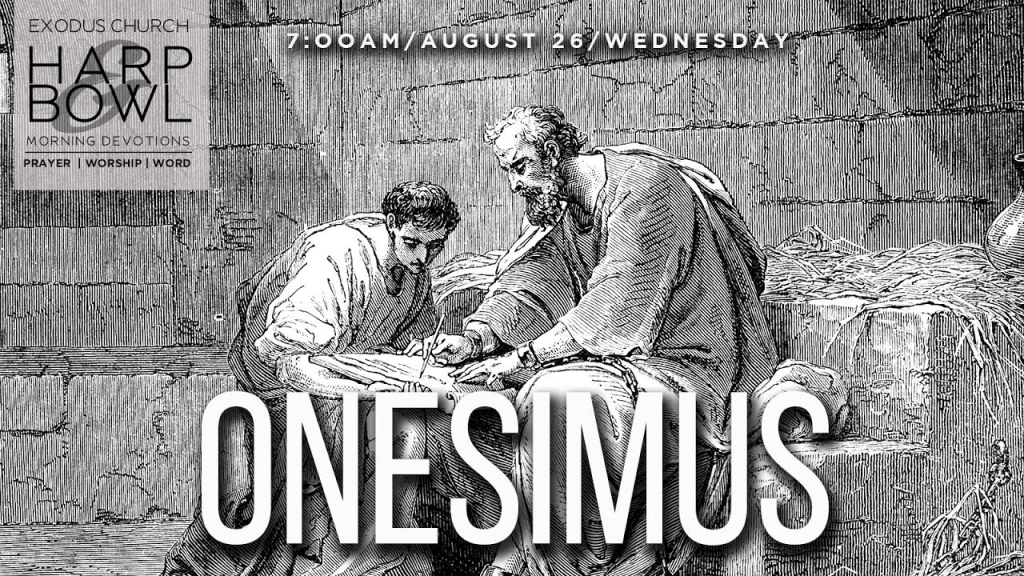
The Book of Colossians: Godly Men: Onesimus.  

“…and with him Onesimus, our faithful and beloved brother, who is one of you. They will tell you of everything that has taken place here.” (Colossians 4:9 (ESV)

“There’s a sickness in our society that has infiltrated and infected the church. I have in mind our modern obsession with superstars. Whether they be Hollywood actors, Wall Street moguls, or overpaid, egotistical athletes, they seem to fill our newspapers and dominate our headlines and have become, tragically in most cases, role models for our children,” states Christian author Sam Storms.

“The Church is by no means immune to this infatuation with celebrity. Mega-church pastors, health-and-wealth advocates, and best-selling authors are promoted and praised as if they are in better standing with the Lord than the faithful but unacknowledged housewife or the quiet pastor who tends a flock of less than a hundred folk in rural Alabama.”

At the end of the Apostle Paul’s New Testament Epistles, he included final greetings. These remarks usually mentioned fellow servants of Christ who ministered to him and alongside him. They may be identified as superstar-less servants. For the next several weeks, we’ll discover some insights from Paul about his many companions. Today, it is Onesimus. Who was this individual?

A significant resource of information regarding Onesimus is contained in the Apostle Paul’s New Testament letter to Philemon. Onesimus was a slave of Philemon. He robbed his master and run away to Rome. Paul became acquainted with him while imprisoned in the city. It was during this time Onesimus became a follower of Christ and also a close friend to Paul (Phlm 1:10).

“Paul wanted to keep Onesimus with him during his imprisonment because he had been helpful to him (in Greek, Onesimus means “useful”). However, Paul returned the slave to his master, confident that the runaway slave would be received by his former owner as a Christian brother and that Philemon would charge any wrong that Onesimus had done to Paul’s account,” explains commentator Dr. Walter Elwell in the Tyndale Bible Dictionary.

Onesimus was with Tychicus and delivered the Letter to the Colossians (Col 4:9), possibly indicating that he came from that region. There are several characteristics about Onesimus found in today’s text.

First, he was faithful (πιστῷ; pisto). Onesimus was trustworthy, committed, dependable and an honorable individual. He not only was a man of faith in Christ positionally, but also relationally with other believers. He was God’s workmanship (Eph. 2:10).

Second, he was beloved (ἀγαπητῷ; agapeto). Paul and the other believers in Rome dearly loved and had deep affection for this young man. The existed a I John 4:7-8 relationship.

Third, the reason Onesimus was faithful and beloved was because he was a brother in Christ. He was just like the Colossians, and they like him. Paul explained Tychicus and Onesimus would explain everything occurring in Rome about the apostle’s imprisonment.

Faithful, beloved and a brother in Christ. This is a fitting testimony for Onesimus and all believers in Christ. Here was a man with no possessions, no rights, and no inheritance under Roman law. He was not wise, powerful or important to the vast majority of people in his day. However, Paul loved and described him as his spiritual son (Philemon 10). Onesimus was a man who diligently served Paul during his imprisonment and for whom Paul would reimburse any debts (Philemon 1117-19).

Many of us are so-called superstar-less believers in Christ. That is fine. We serve the morning star (2 Peter 1:19).

May the Lord’s truth and grace be found here. Have a blessed day in the Lord.

Soli deo Gloria!

I Thessalonians: Why God Wills Work. Part 2.

11 …”and to aspire to live quietly, and to mind your own affairs, and to work with your hands, as we instructed you, 12 so that you may walk properly before outsiders and be dependent on no one.” (1 Thessalonians 4:11–12 (ESV)

The following message is by Pastor John Piper. He is founder and teacher of Desiring God and chancellor of Bethlehem College and Seminary. For 33 years, he served as pastor of Bethlehem Baptist Church, Minneapolis, Minnesota. He is author of more than 50 books, including Desiring God: Meditations of a Christian Hedonist and most recently Foundations for Lifelong Learning: Education in Serious Joy. His article is entitled Why God Wills Work. This is Part 2.

To Provide for Our Needs

The second reason God wills work is that by working we provide for our legitimate needs. When Adam and Eve sinned, God imposed on the human race a condition of hardship that continually reminds us: things are not all right while there is sin. The Lord said to Adam, “Because you have listened to the voice of your wife and have eaten of the tree of which I commanded you, ‘You shall not eat of it,’ cursed is the ground because of you; in toil you shall eat of it all the days of your life; thorns and thistles it shall bring forth to you; and you shall eat the plants of the field. In the sweat of your face, you shall eat bread till you return to the ground” (Genesis 3:17–19). Before the fall, man lived in a garden where God provided his food on trees. All Adam and Eve had to do was pick and eat. That’s why the essence of work is not sustenance of life—God gave himself as the sustainer. Adam and Eve were free to use their time in creative pursuits without the anxiety of providing food and clothing.

But when they chose to be self-reliant and rejected God’s fatherly guidance and provision, God subjected them to the very thing they chose: self-reliance. From now on, he says, if you eat, it will be because you toil and sweat. They are driven from the garden of ease to the ground of sweat. They exchange fruit trees for wheat fields where thorns and pests and drought and plowing and sowing and reaping and threshing consume their days. The curse under which we live today is not that we must work. The curse is that in our work we struggle with weariness and frustration and calamities. And all this is doubly burdensome because now by this very toil we must keep ourselves alive. “In toil you shall eat of the ground . . . In the sweat of your face, you shall eat bread.”

But hasn’t Christ come to lift the curse (Galatians 3:13)? Doesn’t he restore us to our original pre-fallen condition with God? The answer is: Yes, but not all at once. Christ delivered a mortal blow to all evil when he died for sin and rose again. But not every enemy is yet put under his feet. For example, death is part of the curse under which we live. Has Christ’s coming lifted the curse of death? Yes, but only partly now. We still die, but the “sting of death,” the hopelessness of death, is removed because our sins are forgiven in Christ and he is risen!

It is with the necessity that we work to provide for our needs. Christ says, “Don’t be anxious about your life, what you shall eat or what you shall drink, or about your body, what you shall put on . . . Your heavenly Father knows that you need them all. But seek first his kingdom” (Matthew 6:2532f.). He says, “Come to me, all who labor and are heavy-laden, and I will give you rest” (Matthew 11:28). He says, “Know that in the Lord your labor is not in vain” (1 Corinthians 15:58). In other words, God does not want his children to be burdened with the frustration and futility and depressing weariness of work. That much he aims to lift even in this age.

But just as death will be a reality to the end of this age, so will the provision of our needs depend on our gainful employment. The coming of Christ does not mean that we can now return to paradise and pick fruit in someone else’s garden. That’s the mistake made at Thessalonica. So, Paul wrote them and said, “Even when we were with you, we gave you this command: If anyone will not work, let him not eat. For we hear that some of you are living in idleness, mere busybodies, not doing any work. Now such persons we command and exhort in the Lord Jesus Christ to do their work in quietness and to earn their own living” (2 Thessalonians 3:10–12). Able-bodied people who choose to live in idleness and eat the fruit of another’s sweat are in rebellion against God. (See Luke 10:7.)

God has not completely removed the curse in this age. He has softened it with a promise. The curse says: If you want to eat, you must sweat (Genesis 3:19). The promise says: If you sweat, you shall eat (Proverbs 12:11).

So, the second reason God wills work is that by working we provide for our legitimate needs.

To Provide for the Needs of Others

The third reason God wills work is that by working we provide for the needs of those who can’t provide for their own. The promise that if you sweat, you shall eat is not absolute. The drought may strike your village in sub-Sahara Africa; thieves may steal what you’ve earned; disability may cut your earning power. All that is part of the curse which sin brought onto the world. But God in his mercy wills that the work of the able-bodied in prosperous times supply the needs of the helpless, especially in hard times.

Three passages of Scripture make this plain. In 1 Timothy 5:8 Paul speaks to children and grandchildren regarding the aged widows: “If anyone does not provide for his relatives, and especially for his own family, he has disowned the faith and is worse than an unbeliever.” In Acts 20:35 Paul refers to his own manual labor and then says, “In all things I have shown you that by so toiling one must help the weak, remembering the words of the Lord Jesus, how he said, ‘It is more blessed to give than to receive.'” Then in Ephesians 4:28 Paul doesn’t settle for saying: “Don’t steal, work!” He says, “Let the thief no longer steal, but rather let him labor, doing honest work with his hands, so that he may be able to give to those in need.”

So, it’s plain: the third reason God wills work is that by working we provide for the needs of those who can’t provide for their own. Work is a way of love.

To Build Bridges for the Gospel

Finally, God wills work as a way of building bridges for the gospel. In our work we are usually in the world. We rub shoulders with unbelievers. If we do our work in reliance on God’s power, according to his pattern of excellence, and thus for his glory, we will build bridges for the gospel so that people can cross over and be saved. In 1 Thessalonians 4:1112, Paul exhorts the believers “to aspire to live quietly, to mind your own affairs, and to work with your own hands as we charged you; so that you may command the respect of outsiders, and be dependent on nobody.” There is a very close connection between the way we do our work and the attitude that unbelievers will have toward the gospel that makes us tick.

God’s will in this age is that his people be scattered like salt in all legitimate vocations. As long as we are mentally and physically able, we should work, in reliance on his power, according to his pattern of excellence, and for his glory. In this way God wills for us to provide for our own needs, and beyond this, for the needs of others who can’t provide for their own. When we enter our work in this spirit of humble trust in God and love for others, the truth of Christ will be adorned and bridges will be built for the gospel.

May the Lord’s truth and grace be found here. Have a blessed day in whatever you do for the glory of God (I Cor. 10:31).

Soli deo Gloria!

I Thessalonians: Why God Wills Work.

11 …”and to aspire to live quietly, and to mind your own affairs, and to work with your hands, as we instructed you, 12 so that you may walk properly before outsiders and be dependent on no one.” (1 Thessalonians 4:11–12 (ESV)

The following message is by Pastor John Piper. He is founder and teacher of Desiring God and chancellor of Bethlehem College and Seminary. For 33 years, he served as pastor of Bethlehem Baptist Church, Minneapolis, Minnesota. He is author of more than 50 books, including Desiring God: Meditations of a Christian Hedonist and most recently Foundations for Lifelong Learning: Education in Serious Joy. His article is entitled Why God Wills Work.

The most fruitful question that I asked in preparing for this message is: How does a human being differ from a beaver? I was trying to get at the essence of what work is. Because what I want to do this morning is to help us see our work from God’s perspective. If we can discover how God conceives of work and why he wills it, then that huge portion of our lives that may seem so separate from religion and faith can be just as God-focused as our more religious acts.

To be a Christian means to bring all your life, including your work, into sync with God’s revealed will in Scripture. So, to help us do that I want to show from Scripture four reasons why God wills work.

To Glorify God and Increase Our Joy

First, God wills work because when we work in reliance on his power and according to his pattern of excellence, his glory is made known and our joy is increased. In Genesis 1:2728, it says, “So God created man in his own image, in the image of God he created him; male and female he created them. And God blessed them, and God said to them, ‘Be fruitful and multiply, and fill the earth and subdue it; and have dominion over the fish of the sea and over the birds of the air and over every living thing that moves upon the earth.'” Since our being created in God’s image leads directly to our privilege and duty to subdue the earth, I take it that human vocation involves exercising a subordinate lordship over creation by which we shape and control it for good purposes.

God takes man on as his deputy and endows him with God-like rights and capacities to subdue the world—to use it and shape it for good purposes. So, if you go all the way back, before the fall of man into sin, there are no negative connotations about work. According to Genesis 2:2, God himself rested from his work of creation. And the capstone of that work was a creature in his own image to carry on the work of ruling and using creation. At the heart of the meaning of work is creativity. If you are God, your work is to create out of nothing. If you are human, your work is to take what God has made and shape it and use it for good purposes.

But here is where the beaver comes in. A beaver subdues his surroundings and shapes a dam for a good purpose—a house. He no doubt enjoys his work; and even the diligence and skill of the beaver reflect the glory of God’s wisdom.

All things bright and beautiful,
All creatures great and small,
All things wise and wonderful,
The Lord God made them all.

God is glorified in them all. What is the difference between a human being at work and a beaver at work? Or for that matter, a bee, or a hummingbird? They work hard; they subdue their surroundings and shape them into beautiful structures that serve good purposes. The difference is that humans are morally self-conscious and make choices about their work on the basis of motives which may or may not honor God.

No beaver or bee or hummingbird consciously relies on God. No beaver ponders the divine pattern of order and beauty and makes a moral choice to pursue excellence because God is excellent. No beaver reflects on the purpose of his existence and consciously chooses to glorify his Maker by relying on him. But humans have all these potentials because we are created in God’s image.

When God commissions us to subdue the earth—to shape it and use it—he doesn’t mean, do it like a beaver. He means, do it like a human, a morally self-conscious person who is responsible to choose his proper destiny. When he sends us forth to work in his image, to be sure, our ditches are to be dug straight, our pipefittings are not to leak, our cabinet corners should be flush, our surgical incisions should be clean, our typing sharp and accurate, our meals nutritious and attractive, because God is a God of order and beauty and competence.

But cats are clean, and ants are industrious, and spiders produce orderly and beautiful works. Therefore, the essence of our work as humans must be that it is done in conscious reliance on God’s power, as a conscious quest of God’s pattern of excellence, and in deliberate pursuit of God’s glory. When you work like this—no matter what your vocation is—you can have a sweet sense of peace at the end of the day. I don’t think God has created us to be idle. Therefore, those who abandon creative productivity lose the joy of purposeful work. 

Ecclesiastes 5:12 says, “Sweet is the sleep of a laborer, whether he eats little or much, but the surfeit of the rich will not let him sleep.” People who spend their lives mainly in idleness or frivolous leisure are rarely as happy as those who work. Most of the retired people at Bethlehem know this, and so have sought creative, useful, God-honoring ways to stay active and productive in God’s kingdom.

We should help each other in this, and with the whole problem of unemployment. It is not first an economic problem. It is first a theological problem. Human beings are created in the image of God and are endowed with traits of their creator that fit them for creative, useful, joyful work. Therefore, extensive idleness (when you have the ability to work) brings down the oppression of guilt and futility.

So, the first reason God wills work is that when we work in reliance on his power and according to his pattern of excellence, his glory is made known and our joy is increased.

More to come. Have a blessed day at work, wherever and whatever it may be. May the Lord be glorified in all we do (I Cor. 10:31). 

Soli deo Gloria!

I Thessalonians: Aspiration.

11 …”and to aspire to live quietly, and to mind your own affairs, and to work with your hands, as we instructed you, 12 so that you may walk properly before outsiders and be dependent on no one.” (1 Thessalonians 4:11–12 (ESV)

In addition to brotherly love and biblical truth, believers in Christ are to be individuals of aspiration. What does this mean?

Aspiration is the hope or ambition of achieving something. It is a strong desire to attain and accomplish a high or great goal. This may be an education, a career, a family, political office, or a monetary goal and lifestyle. An individual once told me he aspired to become a millionaire. Consequently, he worked hard and ultimately achieved his goal.

The Apostle Paul encouraged the Thessalonians to aspire (φιλοτιμεῖσθαι; philotimeisthai) in a present, personal and infinite manner. He wanted them to be people with ambition who would love and seek honor. The question arises regarding what does the Lord think is honorable for the believer in Christ to aspire or pursue?

Paul said “to live quietly” ( ἡσυχάζειν; hesychaein) which means to presently, actively and infinitely remain silent and peaceful. God’s desire is for His children to not sow discord among the brethren (Prov. 16:19). It also means to maintain the unity of the Holy Spirit within the church body (Eph.  4:1-3).

The apostle then said for believers “and to mind your own affairs.” “To mind” (πράσσειν; prassein) means to presently, actively and infinitely engage or practice a particular behavior. The phrase “own affairs” (ἴδια; idia) refers to one’s own private and personal matters related to home, property, finances and perspectives. In other words, the LORD is encouraging people to mind their own business and to not be nosey.

“The guidance Paul gives in today’s passage also provides a way to love others inside and outside the church. We read that we are to “aspire to live quietly, and to mind [our] own affairs” (v. 11). The words in this verse are used elsewhere in Greek literature to commend not making trouble in society. Essentially, Paul tells us to be good neighbors, to mind our own business, and not to be nuisances in the community. Christians must not cause unnecessary social problems. We dare not look for trouble with others or with the culture’s institutions, though we must seek justice when necessary (Mic. 6:8),” explains Dr. R. C. Sproul.

One way for believers to mind their own business is by working. The phrase “to work with your hands” (ἐργάζεσθαι; ergazesthai) means to presently, personally and infinitely do your own labor and work. If you focus on what God has called you to do, you will be less likely to focus on what someone else is doing, or not doing.

Two thoughts emerge with this admonition and directive. First, perhaps many within the Thessalonian church has ceased working because of the perspective of Jesus’ soon return. Second, there may have been some degradation towards manual labor.

“Paul also writes that Christians should work with their hands (1 Thess. 4:11). Let us note two things about this instruction. First, given that Paul addresses matters related to the return of Christ in 1 and 2 Thessalonians, many commentators believe that his emphasis on labor here and in 2 Thessalonians 3:6–12 means that many in the Thessalonian church had stopped working because they expected the world to end soon. If so, they reasoned that they did not need to waste time working when all was about to end anyway,” states Dr. Sproul.

“Second, the phrase “work with your hands” (1 Thess. 4:11) refers to manual labor, which recognizes the dignity of such work. The ancient Macedonians looked down on those who worked with their hands, but manual labor is a noble Christian calling. Of course, we can extend the Apostle’s instruction to all forms of lawful work.”

 John Calvin comments, “What [Paul] says as to hands is by way of synecdoche [using a part to represent the whole]; but there can be no doubt that he includes every useful employment of human life.” (See Colossians 3:23-24). Paul indicated this was not new teaching. He, along with Silas and Timothy, previously taught this to the Thessalonians.

Finally, in today’s text Paul wrote, “…so that you may walk properly before outsiders and be dependent on no one.” To walk properly (περιπατῆτε; peripatete) means to presently and actively pursue a decent and biblically ordered life and lifestyle before unbelievers. This is so the unconverted may see our good works and glorify God (Matt. 4:14-16). “To be dependent on no one” (χρείαν; chreian) refers to pursuing through one’s own labor and initiative personal needs and not depend upon a welfare state. Paul exemplified this directive (Acts 18:1-4).

“If we are able to work, we must seek to work. And we must seek to live quietly, not putting ourselves in situations where we do not belong. These things commend the Christian life to others, and God uses them to make the gospel more reasonable to those whom He has chosen. If we want to be good witnesses, let us work hard and be good neighbors. And when opportunity comes to share the gospel while doing so, let us share it,” concludes Dr. Sproul.

May the Lord’s truth and grace be found here. May each of aspire to what God has called us to do before a watching world. Have a blessed day in the Lord.

Soli deo Gloria!