
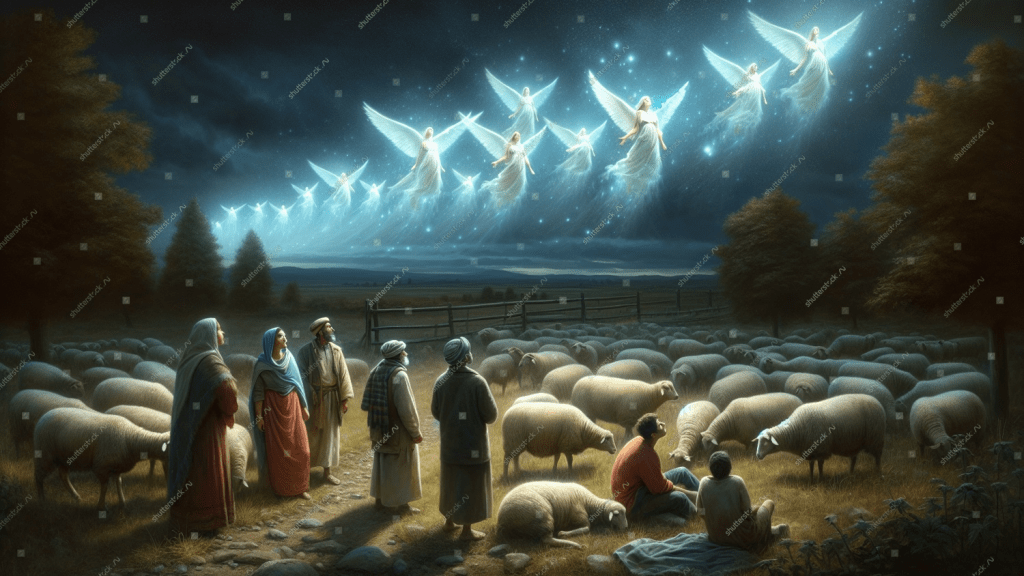
21 In the presence of God and of Christ Jesus and of the elect angels I charge you to keep these rules without prejudging, doing nothing from partiality.” (1 Timothy 5:21 (ESV)
Scripture reveals to us a real but invisible world inhabited by angels and demons. All we can say about this mysterious realm is what is revealed to us in Scripture, which is why speculation beyond the biblical data can be positively dangerous.
Our study of I Timothy is focusing primarily on the subject of angels for the next few days. Since the Apostle Paul referred to elect angels in today’s featured text, it is wise for us to briefly examine what the Bible says about these created, heavenly beings.
Today’s essay is by Dr. Kim Riddlebarger. He is visiting professor of systematic theology at Westminster Seminary California and pastor emeritus of Christ Reformed Church in Anaheim, Calif. His article is entitled What Do We Know about Angels? It appeared in the April 2022 issue of Tabletalk Magazine.
Angels also have names and ranks. Two angels are mentioned by name in Scripture. Michael, who appears in Daniel 10, Jude 9, and Revelation 12, is described as an “archangel” and a warrior. A second angel named Gabriel serves as a messenger/mediator of revelation. Gabriel appears in Daniel 8 and 9 and Luke 1.
Scripture speaks of an order of angels known as the cherubim, who are creatures with four wings and four faces (Ezek. 10) and who are depicted in Genesis 3:24 as guardians of holy places (such as Eden). The seraphim are mysterious creatures who appear only in Isaiah 6:2, 6. They are said to have six wings: two cover their eyes in the Lord’s presence, two cover their feet, and two are used to fly.
Angels are not the only inhabitants of the invisible world, since the Bible speaks of other invisible spiritual beings that possess an evil, malevolent orientation toward us. Scripture identifies them as “demons.” These beings are closely associated with magic and the occult. They seek the destruction of humanity, yet they are aware of their ultimate doom, for they ask Jesus: “What have you to do with us, Jesus of Nazareth? Have you come to destroy us? I know who you are—the Holy One of God” (Luke 4:34). They are commonly identified as “fallen angels,” who, under certain conditions, can possess (control) unbelievers. We do know that Jesus engaged regularly with these “evil spirits,” as in Matthew 8:16: “They brought to him many who were oppressed by demons, and [Jesus] cast out the spirits with a word and healed all who were sick.”
Matthew 9:32 gives us another example: “As they were going away, behold, a demon-oppressed man who was mute was brought to him.” Because deep mystery surrounds them, and since they are malevolent toward humans, they too are the source of much speculation and have given countless authors, musicians, and Hollywood filmmakers much material with which to thrill and terrify.
Like all other created things, angels are included in the declaration made in Genesis 1:31 that all that God had created was created “good.” Since these spiritual beings were created “good,” certain angels must have followed Satan, as recounted in 2 Peter 2:4: “God did not spare angels when they sinned, but cast them into hell and committed them to chains of gloomy darkness to be kept until the judgment”; and in Jude 6, where we read of “the angels who did not stay within their own position of authority, but left their proper dwelling, [whom] he has kept in eternal chains under gloomy darkness until the judgment of the great day.” “Good” angels became “fallen” angels, which we speak of as demons.
The more difficult matter is, how do demons relate to Satan (the adversary)? Thought to be an angelic being of the highest standing, now fallen and expelled from heaven, Satan is the archenemy of Jesus and His saints. Satan (or the devil) appears to be the head of the ranks of fallen angels.
There are some indications in Scripture that he, like Michael and Gabriel, was a majestic prince of the spiritual world (Job 1:6–12). It is he who tempts Eve (Gen. 3:1) and accuses God’s people (Zech. 3:1–2). His very name means “adversary,” and we see him at work in opposing God’s purposes by appearing in Eden, ultimately leading to Adam’s act of rebellion and to the fall of the human race (Gen. 3).
After Adam’s fall, Satan is said to be the accuser of God’s people (Rev. 12:10). He is called “the god of this world” (2 Cor. 4:4) and “the prince of the power of the air” (Eph. 2:2). Although currently bound and confined to the abyss (Rev. 20:1–3), Satan behaves like a roaring lion looking to devour (1 Peter 5:8). He is angered by the limits on his deceptive activity and the knowledge that his eventual destruction is certain. He fears what is foretold in Revelation 20:10: “And the devil who had deceived them was thrown into the lake of fire and sulfur where the beast and the false prophet were, and they will be tormented day and night forever and ever.” As Martin Luther aptly put it in “A Mighty Fortress Is Our God,” “One little word shall fell him.”
Although regular access to the spiritual realm is barred to us until Jesus returns, Scripture reveals to us a real but invisible world inhabited by angels and demons. All we can say about this mysterious realm is what is revealed to us in Scripture, which is why speculation beyond the biblical data not only is foolish but can be dangerous.
May the Lord’s truth and grace be found here. Have a God-honoring day.
Soli deo Gloria!
 His Word Today