
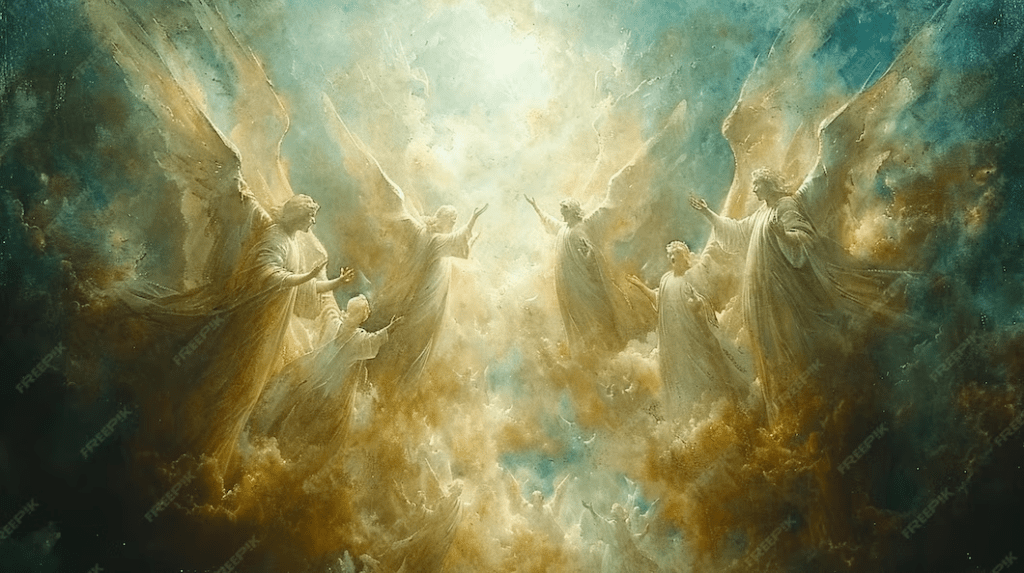
21 In the presence of God and of Christ Jesus and of the elect angels I charge you to keep these rules without prejudging, doing nothing from partiality.” (1 Timothy 5:21 (ESV)
Our study of I Timothy is focusing primarily on the subject of angels for the next few days. Since the Apostle Paul referred to elect angels in today’s featured text, it is wise for us to briefly examine what the Bible says about these created, heavenly beings.
Today’s essay is by Dr. Kim Riddlebarger. He is visiting professor of systematic theology at Westminster Seminary California and pastor emeritus of Christ Reformed Church in Anaheim, Calif. His article is entitled What Do We Know about Angels? It appeared in the April 2022 issue of Tabletalk Magazine.
God created humanity to inhabit a material world of things we can see and things we can touch. We pass through time, which we can remember and record (history). Created in God’s image, we are designed to inhabit the created order in which God has placed us. In our original creation, we were upright and innocent, but after our first father Adam’s sin in Eden, ours is a fallen race. Still, we are capable of great things and great ideas, and we experience powerful emotions. The psalmist tells us that we are fearfully and wonderfully made, knit together in the womb by our Creator (Ps. 139). As divine image bearers, we are like God in every way that a creature can be like God. Yet because we are creatures, we are not and cannot become divine in any sense.
Despite the wonders of human nature, we do not possess the capacity to experience on a daily basis the very real but invisible spiritual world also created by God and inhabited by creatures that we commonly call “angels.” Although this invisible reality is as real as the material world we inhabit, our access to the spiritual world is severely limited because of our creaturely and physical existence. We are not designed to fully comprehend what transpires in the spiritual world, even though we know that such a world exists and that what takes place in it is consequential in ours.
From the earliest days of the Christian church, discussion about angels has produced much controversy. Much of this discussion took place in dialogue with Jewish, gnostic, and pagan thought about the nature of the invisible world, leading to all sorts of unbiblical notions. Our limited knowledge regarding spiritual beings has led to speculative questions such as these: “What form do angels possess?” “What is a ‘spiritual body’ like?” “What role do angels play in our lives, if any?”
There are hints in Scripture that angels are involved in human affairs, even if we cannot witness them directly. Because we cannot see the angels who inhabit this invisible reality, they often become a source of speculation and superstition. But this is also why we need to pump the speculative brakes, for all we can truly know about angels is revealed to us by their Creator and ours in His Word.
Since we do not have full access to the invisible world, we are dependent on Scripture for reliable information about this realm and its immaterial creatures. Thankfully, the Bible gives important information about both—although not in the detail we may wish for.
All we can truly know about angels is revealed to us by their Creator and ours in His Word.
We start with the angels who are best understood as messengers sent by God (Hebrew malach, Greek angelos). In Hebrews 1:14, angels are described as “ministering spirits sent out to serve for the sake of those who are to inherit salvation.”
The psalmist tells us, “Yet you have made [humans] a little lower than the heavenly beings [angels] and crowned [them] with glory and honor” (Ps. 8:5). Angels are of a different created order from humanity, so our deceased loved ones do not “get their wings” in the afterlife—a common but erroneous opinion. We read that angels rejoice when a sinner repents (Luke 15:10), and at times, angels, in their role as messengers, are depicted in Scripture as mediators of divine revelation (e.g., Dan. 9; Luke 1–2; Gal. 3:19).
Psalm 148:2–5 tells us that angels as created beings are included in the ranks of the heavenly court:
Praise him, all his angels;
praise him, all his hosts!
Praise him, sun and moon,
praise him, all you shining stars!
Praise him, you highest heavens,
and you waters above the heavens!
Let them praise the name of the Lord!
For he commanded and they were created.
Scripture ascribes to angels a certain preeminence, since they rejoice in God’s creation of the material world as recounted in Job 38:7: “The morning stars sang together and all the sons of God shouted for joy.” Angels do not have physical bodies as we do, but Scripture reveals that they can appear visibly in various ways to human beings (Luke 2:9) or to animals (Num. 22:21–39).
Scripture informs us that God does not provide redemption for the angels: “For surely it is not angels that he helps, but he helps the offspring of Abraham” (Heb. 2:16). Those described as “good angels” are likely the “elect angels” in 1 Timothy 5:21. Furthermore, angels are said to be immortal in Luke 20:36: “For they cannot die anymore, because [the redeemed] are equal to angels and are sons of God, being sons of the resurrection.”
Some angels participate in the glory and praise of God around His heavenly throne (Ps. 103:20–21; Isa. 6:2, 6; Rev. 4), while others have special care of the “little ones” (Matt. 18:10). This has led to much speculation about the existence of “guardian angels” who protect Christian children, yet Matthew does not go beyond this brief declaration.
More to come. May the Lord’s truth and grace be found here.
Soli deo Gloria!
 His Word Today