
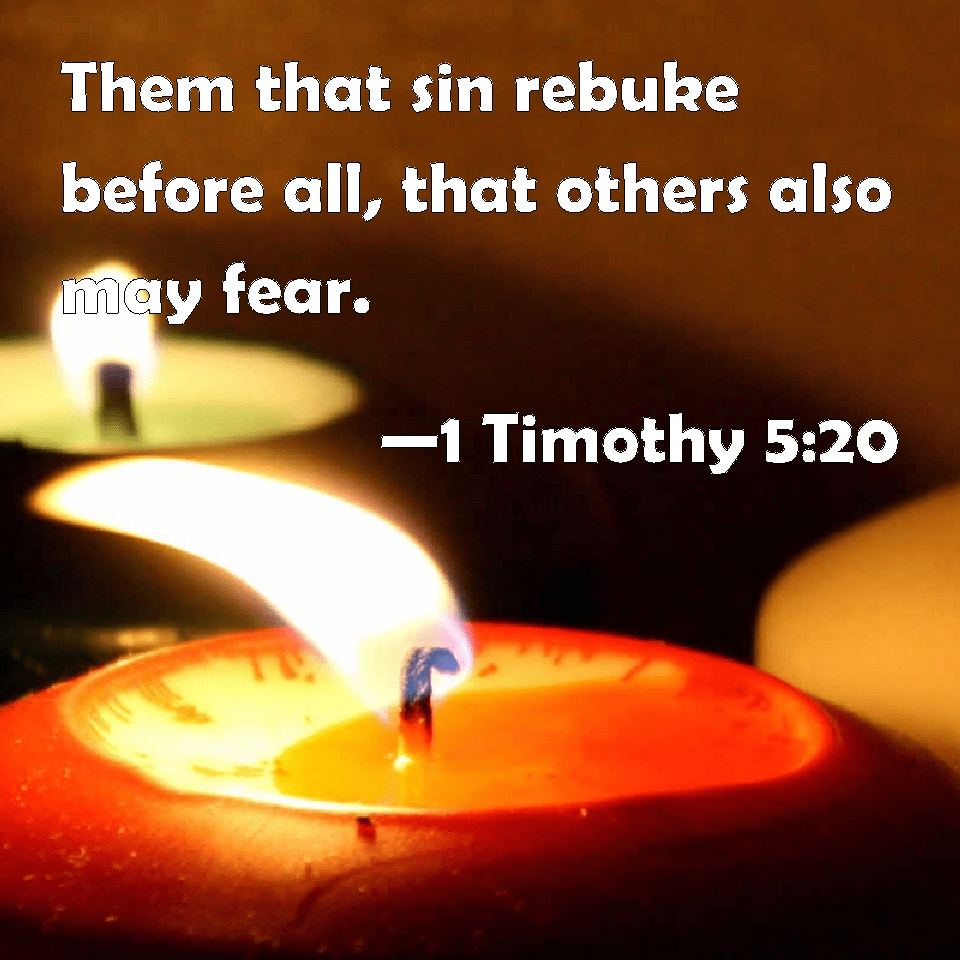
19 Do not admit a charge against an elder except on the evidence of two or three witnesses. 20 As for those who persist in sin, rebuke them in the presence of all, so that the rest may stand in fear.” (1 Timothy 5:19–20 (ESV)
Recently, I was involved in the installation of an elder at my local church. As an elder myself, it was an important moment when the current elder board laid hands on and publicly prayed for our brother in Christ during a Sunday morning worship service.
I briefly explained to the congregation the primary responsibilities of the church’s elder board were to spiritually lead, teach and preach, and protect the congregation. The elders’ source for properly serving, leading, teaching, preaching and protecting the congregation is the Word of God. The elders’ biblical qualifications are all about their godly character (I Tim. 3:1-7).
The Apostle Paul provided his young protégé Timothy, who pastored the church in Ephesus, a series of directives in leading, teaching, preaching and protecting the church, and its elders, from unwarranted criticism. In I Timothy 5:19, Paul commanded Timothy to “not admit a charge against an elder except on the evidence of two or three witnesses.” This was to guard a fellow elder from unsubstantiated accusations.
In I Tim. 5:20, Paul also directed Timothy about what to do whenever accusations against an elder proved to be true regarding their persistent, unrepentant and ungodly behavior. The resulting actions by the elder board taken toward this wayward leader was to protect the church.
Paul prefaced his directives by writing, “As for those who persist in sin.” Within the immediate context, those to whom the apostle referred who were persisting in sin were elders. To persist in sin (ἁμαρτάνοντας; hamartanontas) is to presently, actively and continuously engage in wrongdoing. It is an ongoing disobedience.
When this occurs, the other elders are to rebuke their brother elder. To rebuke (ἔλεγχε; elenche) means to presently, actively and obediently “state that someone has done wrong, with the implication that there is adequate proof of such wrongdoing.”[1] This should be done within the of process of biblical church discipline (Matthew 18:15-20), and with the appropriate biblical attitude (Gal. 6:1-2).
Paul further stated this discipline was to be done “in the presence of all, so that the rest may stand in fear.” The adjectives “all” and “rest” refer to the remaining elders. The influence of a sinful elder’s example sometimes requires a public rebuke among the elders in order to protect and guard the faithful elders.
The purpose of such a public rebuke was so the rest of the elders would stand in fear (ἔχωσιν φόβον; echosin phobon). This means to presently and actively experience in this particular occasion a reverence for God and revulsion towards sin. However, the elders who rebuke their brother must always guard their own heart lest they fall into similar circumstances (Prov. 4:20-27; I Cor. 10:9-13).
Dr. William Hendriksen writes, “Elders who walk in sinful ways must not be spared. In fact, their sin must be punished even more severely than that of others. The law made the same distinction (Lev. 4:22, 27). Timothy must not only bring their sin home to their conscience, but in their case he must do this not privately or in the presence of just a few (Matt. 18:15–17), but publicly, that is, in the presence of the entire consistory (elder board), so that the remaining elders may also become filled with godly fear of wrong-doing (cf. Gen. 39:9; Ps. 19:13).[2]
Such a rebuke must be done with love and wisdom for all concerned. Proverbs 17:10 (ESV) says, “A rebuke goes deeper into a man of understanding than a hundred blows into a fool.”
“Proverbs 17:10 speaks of the rebuke that a wise man will receive. Individuals who are wise can discern whether the rebuke spoken to them is appropriate, and they will hear and heed it. Unlike the stubborn fool who will not learn even after being punished one hundred times, the wise man can be trusted to receive a rightly timed rebuke,” explains Dr. R. C. Sproul.
“Love and wisdom must govern our speech and how we hear the words of others. We are to speak the truth in love, not seeking to crush sensitive souls but to build them up in Christ. This requires discernment. Understanding a rebuke given to us takes discernment as well, for sometimes rebuke comes to us from a fool. Pursuing wisdom involves discerning whether the words spoken to us are appropriate. Seeking counsel from many wise people is one way to gain this discernment.”
May the Lord’s truth and grace be found here. Have a God-honoring day.
Soli deo Gloria!
.
[1] Johannes P. Louw and Eugene Albert Nida, Greek-English Lexicon of the New Testament: Based on Semantic Domains (New York: United Bible Societies, 1996), 435.
[2] William Hendriksen and Simon J. Kistemaker, Exposition of the Pastoral Epistles, vol. 4, New Testament Commentary (Grand Rapids: Baker Book House, 1953–2001), 183.
 His Word Today