
“For to this end we toil and strive, because we have our hope set on the living God, who is the Savior of all people, especially of those who believe.” (1 Timothy 4:10 (ESV)
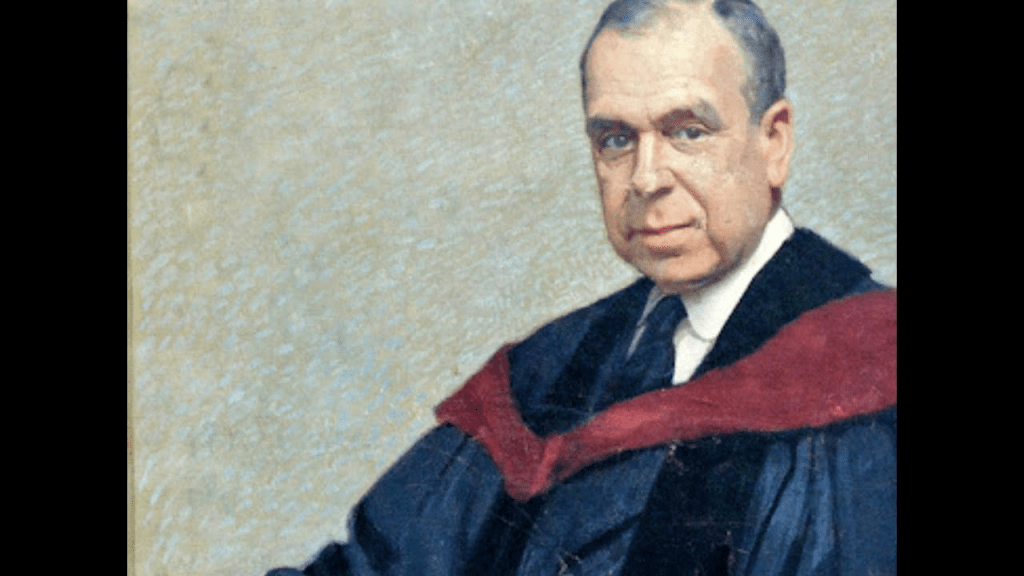
The following essay is by Pastor John Piper. He preached this message January 1, 2020. It is entitled He Took Up Arms Against Liberalism: J. Gresham Machen (1881-1937).
‘Princeton Seminary Is Dead’
A few years earlier, Machen had left Princeton Seminary to found Westminster Seminary. This time he wasn’t forced out, but chose freely to leave when the governing boards of the seminary were reorganized so that the conservative board of directors could be diluted by liberals more in tune with the denomination as a whole.
Princeton Seminary died, in Machen’s eyes, and out of the ashes he meant to preserve the tradition of Charles Hodge and Benjamin Warfield. So when he gave the inaugural address of Westminster Seminary on September 25, 1929, to the first class of fifty students and guests, he said,
No, my friends, though Princeton Seminary is dead, the noble tradition of Princeton Seminary is alive. Westminster Seminary will endeavor by God’s grace to continue that tradition unimpaired. (458)
Machen’s most enduring response to what he called modernism was the founding of these two institutions: Westminster Seminary (which today is a major influence in American evangelicalism) and the Orthodox Presbyterian Church (which now, over eight decades later, bears a witness disproportionate to its small size).
Faith and Doubt
Machen met modernism face to face many years earlier, while spending a year in Germany after seminary. As he studied New Testament with well-known German scholars, Machen was shaken profoundly in his faith. Almost overpowering was the influence of Wilhelm Herrmann, the systematic theologian at Marburg, who represented the best of what Machen would later oppose with all his might. He was not casting stones over a wall when he criticized modernism. Machen had been over the wall and was almost lured into the camp.
In 1905 he wrote home,
I have been thrown all into confusion by what [Herrmann] says — so much deeper is his devotion to Christ than anything I have known in myself during the past few years. . . . Herrmann affirms very little of that which I have been accustomed to regard as essential to Christianity; yet there is no doubt in my mind but that he is a Christian, and a Christian of a peculiarly earnest type. (107)
His struggle with doubt gave him patience and sympathy with others in the same situation. Twenty years later, he wrote,
Some of us have been through such struggle ourselves; some of us have known the blankness of doubt, the deadly discouragement, the perplexity of indecision, the vacillation between “faith diversified by doubt,” and “doubt diversified by faith.” (432)
Nevertheless, Machen came through this time without losing his evangelical faith and was called to Princeton to teach New Testament, which he did from 1906 until he left to form Westminster in 1929. During that time, he became a pillar of conservative, Reformed orthodoxy and a strong apologist for biblical Christianity and an internationally acclaimed New Testament scholar.
Duplicity in the Classroom
Machen’s experience in Germany made a lasting impact on the way he carried on controversy. He said again and again that he had respect and sympathy for the modernist who could honestly no longer believe in the bodily resurrection or the virgin birth or the second coming, but it was the rejection of these things without openly admitting one’s unbelief that angered Machen.
For example, he said once that his problem with certain teachers at Union Seminary was their duplicity:
There is my real quarrel with them. As for their difficulties with the Christian faith, I have profound sympathy for them, but not with their contemptuous treatment of the conscientious men who believe that a creed solemnly subscribed to is more than a scrap of paper. (221–22)
He wanted to deal with people in a straightforward manner and take his opponents’ arguments seriously, if they would only be honest and open with their constituents and readers. As it was, however, many modernist professors and pastors were not honest and open.
More to come.
May the Lord’s truth and grace be found here. Have a blessed day in the Lord.
Soli deo Gloria!
 His Word Today